
Key moments - from our scoring
Substance score
39 / 100
Five dimensions, 20 points each
CEOs increasingly want full-time office presence, yet talent dynamics are forcing a reconsideration of hybrid work as a strategic advantage. Rich, CEO of Mission Leadership, and the host from VOCA discuss the tension between leadership nostalgia for in-office culture and market reality: nonprofit executives and boards now leverage remote options to maintain talent, especially for high performers; posting hybrid or remote roles doubles candidate flow compared to office-only positions; and employees across all life stages now expect flexibility as a non-negotiable negotiation point, sometimes accepting lower salary for hybrid arrangements. Key examples include Jamie Dimon's JP Morgan mandate, boards' embrace of virtual participation with proper technology (Owl cameras, robust cameras), and nonprofits' 57% adoption of remote/hybrid policies by 2023. The conversation shifts from why hybrid persists to how leaders build cohesive remote teams: through intentional practices like care teams (birthday/anniversary ownership), shortened frequent meetings for onboarding, offsites mixing learning with relationship-building, high/low check-in cadences, and critically, performance-based management over presence monitoring. For executives deciding between talent acquisition and physical presence mandates, this episode reframes hybrid as a recruitment and retention tool rather than a compromise.
Remote and hybrid options expand the talent pool beyond geographic constraints - candidates with family obligations, aging parents, or preference to stay in their current cities will wait longer or accept lower pay for flexibility, whereas office-only roles exclude these otherwise qualified candidates entirely.
Adopted from Jed Medoffin at CAFO, a care team consists of 3 designated people with budget responsibility to remember birthdays, work anniversaries, and life events; they send gifts and organize team activities, creating intentional connection points that increase team cohesion and performance metrics.
Board members increasingly embrace hybrid/remote options for meetings because it eliminates travel burden for frequent boards (3-4 meetings yearly), though it requires organizations to invest in proper technology like quality cameras and careful meeting design to ensure robust remote engagement.
Remote workers face higher layoff risk than in-person employees due to 'out of sight, out of mind' dynamics - in-person presence creates greater connectivity and job stickiness, while remote workers lack the visibility that protects job security during reductions.
Leaders must define clear outcomes and deliverables for each role rather than tracking login times or desk presence; without explicit performance expectations, employees - whether remote or in-office - lack clarity on actual job success criteria.
Our reviewer’s read on each dimension, with quotes from the episode.
A few useful nuggets (remote postings doubling candidate flow, focus on performance over presence, remote workers laid off first) are buried in lots of anecdotal back-and-forth and generic advice about offsites and meetings.
if we put out a remote job, we get twice as many candidates
you need to focus over on performance more than presence
Mostly recycled post-COVID hybrid-work observations and well-worn truisms; the niche angle on Christian nonprofits adds slight freshness but the thinking is largely conventional.
after COVID, this is gonna go away and we'll get back to, quote, we'll get back to normal. Not so fast
remote work or remote workers can maintain a relationship, but it can't develop it
The two hosts are practitioners in executive search and leadership development with relevant experience, and they reference real interactions with CEOs and boards, but no external senior guest appears and claims rest on their own anecdotes.
You help find people, you and your team at Mission Leadership
I've talked to half a dozen CEOs just over the last week or two
Some concrete data and named examples (57% nonprofit stat, doubled candidate flow, named orgs and people), but much of it is vague anecdote without verifiable metrics or dollar figures.
by '23, I think 57% of nonprofits, according to one of the largest surveys they've done, had a remote and hybrid policy
Jed Medoffin runs CAFO, which is an amazing organization, the Christian Alliance for Orphans
The hosts do ask each other genuine probing questions (e.g. about control and ego) and build on points, but it's a collegial co-host chat with no real pushback or challenged claims.
how much of it is about the need, the desire, the perception of control?
are you saying it's true that if, if I offer hybrid or, or remote, I'm going to get, it's going to be easier for me to fill my position?
Computed from the transcript - who did the talking, and the words that came up most.
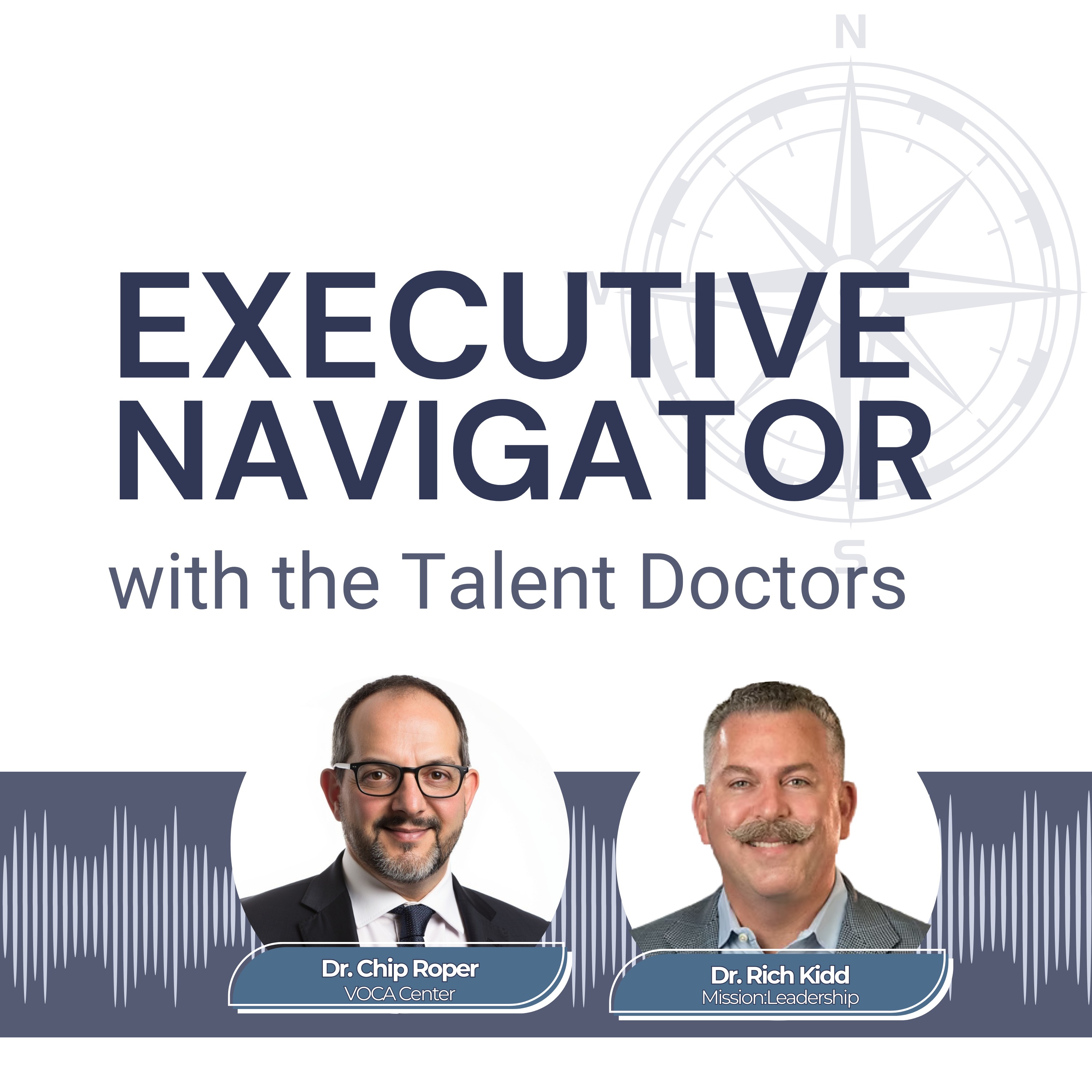
Chip and Rich examine the evolving reality of hybrid work and its talent implications. They explore the risks, tensions, and opportunities across work-location models, offering practical leadership strategies to help you confidently shape the future of your organization.
Transcribed and scored by The B2B Podcast Index.
Here we are, Rich, another episode of The Executive Navigator. And each month we drill down on the dynamics and best practices for navigating the talent side of our executive jobs and callings. You help find people, you and your team at Mission Leadership. We do.
And I'm - my team and I at VOCA, we help develop people. And we also like each other. It is true. I've heard that said.
Yeah, so it's like, that's what we do. So this week I thought we could talk about, or this, on this, on this episode, I thought we could talk about hybrid work because hybrid work doesn't seem to be going away. And I was just, I was talking with somebody, two different, two different conversations this week. One was a COO that's trying to convince her CEO that we really should be not forcing people to come into the office as much as we do.
People actually get more done at home. In fact, she feels she gets more done at home. And my wife was there. She agrees.
My wife is 2 days home, 3 days in the office. And I also heard another story this week about somebody who is being let go because they wouldn't come in 4 to 5 days a week. And even though they were a longtime employee and blah, blah, blah. So, is this topic coming up in your world in the conversations you're having?
Absolutely. I mean, I've talked to half a dozen CEOs just over the last week or two, and it's, you know, I would say 4 out of those 6 were talking about ways that they could get their team in more, that sort of mandated presence, if you will. And 2 of them were going the entirely opposite direction, trying to build out global C-suites where they were, you know, really leveraging that hybrid workforce. So most are trying to pull 'em back in and got a couple that are, that are sort of going with the flow and, and pulling in a, a global hybrid workforce.
Yeah, it's out there. So I think some of us may have thought, well, after COVID, this is gonna go away and we'll get back to, quote, we'll get back to normal. Not so fast. It isn't going away.
And so, in this episode, we'll talk a little bit about kind of some trends and patterns we see, kind of the context. And then, I think there's some things that we all need to think about as executives in terms of how we attract talent, how we develop culture, how we develop people. Those are all sort of swimming out there. And you said your example is just spot on with what I read and see.
CEOs want everybody back, or most of, many of them do. You, you know, you said 4 outta 6, and they think it's just, they're gonna know everybody's getting their work done and they're gonna be able to build culture. And, you know, I was in the, I'm in New York City. I just walked past the new JP Morgan building in New York, which is beautiful.
And Jamie Dimon is famous for saying, you know, everybody's back in the office 5 days a week or go work somewhere else. So, CEOs seem to want this. How are others, other stakeholders kind of lobbying for this too? Do you see that in your world?
Well, it's very interesting. Not only do I work with CEOs, I work with boards. You know, anytime we're doing a CEO selection, obviously we're working with a board hiring a CEO. I've really found that board members love hybrid, right?
Because, you know, on-site board meetings take a couple of days. You have to travel. You know, in my world where most of the boards I'm working with are, you know, they're not for-profit boards, they're nonprofit boards. You, you know, you're paying your own way, you're taking time out of your schedule.
And boy, those board members have really embraced the opportunity to participate. You know, if there's, 3, 4 meetings a year, they're taking 1 or 2 of those remotely. And the CEOs are kind of forced to provide for. And the ones that - I'm involved in a number of boards, and the ones that have the technology and the planning and the camera angles, everything that will support robust engagement by board members remotely has been embraced that I've seen.
So I think that's an entirely different group of stakeholders who want to help organizations, and if they can remotely, they'll take that opportunity. Yeah, I feel a lot of board, my board, the board work I'm involved in is mostly, it's like kind of, it's, it's easy. It's like mostly remote with maybe one in-person meeting a year. Yeah.
Even when we do the in-person meeting, there's always somebody that can't be there that wants to connect in virtually. And so, We have an owl and, you know, one of those funky cameras that's actually pretty cool. And, and that's just the way it works. So yeah, I definitely see it.
I definitely see that. I mean, so I think that's tight. It's dialing into part of the reality. So even though CEOs want this, and maybe it's nostalgia, maybe it's, maybe there is something to be said that certain things do happen in person that don't happen remotely.
But there, there still is the sense that almost every organization is gonna have at least a few people that are remote. Yeah. And I, I see this more in Christian nonprofits than I do in business. Uh, but they're just like, we've got this great person and you know, they're getting their work done and we would rather fly them in for the twice a year meeting than lose them.
Yeah. Well, you talk nonprofits. I mean, nonprofits already have a harder time recruiting talent, right? We've talked about that before.
You know, by '23, I think 57% of nonprofits, according to one of the largest surveys they've done, had a remote and hybrid policy. You know, so they're there. And part of the reason is just preservation. They can't recruit the talent that they're looking for.
So once they find somebody, you know, the person wants to move to a different city because they're caring for their aging parents, or, you know, Junior goes back to school and they want to be home a couple of weeks, whatever. They're, they're making those concessions to your point because there's a particular producer, a particular individual that's giving something to their nonprofit that's unique. And so I, I absolutely do see them making that opportunity. But let me ask you a question.
This, you know, I don't want to rattle anybody's cage, but how much - Oh, let's rattle. Let's rattle cages. Yeah, right. How much do you think CEOs mandating physical presence, which I totally agree with, and I see that more often than not, how much of it is about the need, the desire, the perception of control?
Right? Like, because they, they, they're in that seat. They want to, they want people to jump when they, when they, you know, they want to be able to go into somebody's room, somebody's office and say, hey, I need you for a minute. I mean, what, what is your perception of that?
I don't know. I think there's certainly cases where that's true, right? I mean, we all have an ego and some of us have toxic egos. So I think that's real.
I think too though, like personally, our team's remote and we see each other as we're working on site with clients and we do like once a year, once or twice a year, we get everybody together or try to. I mean, personally, I just like, I like when I used to walk into an office and I used to like to see everybody. I just like that, you know? So I think I miss that.
And, um, so I think there's something, maybe, maybe it's emotional, maybe it's about personality and wiring. Maybe it's nostalgia too. Like there's a lot of layers to it. Yeah.
Um, so all the, I think that's true. I think that's all there. Yeah. Um, do all the extroverts want to go into the office and all the introverts would just want to stay at home and, you know, say, leave me alone, let me get my work done.
Is that how it goes? We should ask Shawna because she's producing this podcast. She usually tests kind of introvert. So, and you're like, probably, you probably broke the test for extrovert.
Oh man, during the pandemic, I'd walk to Kroger just to talk to the bag boys. I mean, I was, it was excruciating. I, you know, I hated it. So it is, is very difficult for me, but we have an entirely remote team.
So let me test this on you. So, my sense is that remote work or remote workers can maintain a relationship, but it can't develop it, right? So, in other words, if your team is already close, if your team knows each other at, let's say, a board or an executive team, and they're checking in regularly on their Zoom calls, they're having a regular Monday meeting, let's say Tuesdays and Thursdays are deep work. Maybe Fridays you check the week and see, you know, how your metrics have gone, celebrating wins, etc.
That works if you've got a relationship, but when you're onboarding new people all the time, when you're trying to get to know people, it, to me, it seems a little more challenging in the hybrid environment. What do you think about that? I think it does, and I want to, I want to get into some solves for this in a minute. Um, before that we do, I just want to throw a couple trends out.
Yeah. And, um, to sort of COVID the landscape. So we've already said CEOs want this. We've already said even though they do, especially in Christian nonprofits, many of them, even if they said they wanted everybody in the office, they've got 2 or 3 key players who aren't and they don't wanna lose them.
So they kind of, I think a third thing in terms of employee expectations, many of us, if we're in the knowledge worker category, and most of your Christian nonprofit executives are,, we expect to be able to work from home some. It's just, it's become an expectation. So if you say absolutely not ever, you are cutting, you are limiting your list of potential candidates to fill roles in your organization. And the fourth thing I was thinking of, which I've also seen, which is more for those of you out there listening who are working for somebody, um, if you have the option to be in person, uh, and you're not taking it, you're, you're putting your job security at risk.
That when organizations let people go, they tend to let go remote workers before they do in-person workers. And that's, I mean, we have more data on that from businesses, but it's just part of the deal. There's something about the connectivity of in-person that makes your job a bit more sticky. So out of sight, out of mind?
Yeah, I think that's a reality out there. You know, we were, we were interviewing, um, somebody else in your industry just about careers and, and one of the, his advice to people that were having trouble finding a job was to voluntarily come to the office, like voluntarily be in person. It sort of sets you apart today instead of demanding it. Even if you don't work there, you just kind of show up at the office.
Yeah. Just show up at somebody's office. You know, you never know where that might go. I love that.
I love that. You might even get paid. You may get a real job and get paid. I love that.
So, Yeah, there is no question that for every proverb there's an equal and opposite proverb. So absence makes the heart grow fonder, but, you know, out of sight, out of mind. Both are true. You know, I have seen on the other side from the talent equation, people, you know, if we put out a remote job, we get twice as many candidates.
So on the candidate side, it's highly, highly desirable. Because people don't want to move. You know, the days of moving for, you know, this big in-person job, you know, corner office, whatever. People, they have family commitments, they have areas they want to stay in.
And they're saying, look, I can get your job done. I don't need to relocate. And they're willing to wait and even in some cases remain underemployed until they find that more powerful hybrid situation. They don't mind travel, they don't mind going to a place, but absolutely double the number of candidate flow when we, when we get a remote or a hybrid option.
So are you saying, this is really interesting, are you saying it's true that if, if I offer hybrid or, or remote, I'm going to get, it's going to be easier for me to fill my position? Absolutely. My open position? Absolutely.
You're, you're, you have access to more of the talent pool and you have more access to the top of the talent pool that, you know, in, and I would say the younger workers, this is, you know, sort of a millennial thing, but that's really not true because I'm seeing workers of all seasons in life desire flexibility of schedule as a negotiating point. They'll go down in salary if they can have, you know, 2 hybrid days, if they can, if they can have more opportunity because they have family obligations, aging parents, children in school, whatever, and they don't want to move.
They're willing to travel, but that negotiation point will close the deal faster than raising their salary in many cases. That's really good. That's really important for our listeners to pay attention to. Yeah.
So, I mean, and that's something I think I just think, and this was be - this is early days. VOCA's been around for 10 years, 11 years, early days. I hoped we would have a, an office in New York City and a team there and all that kind of thing. And it just didn't evolve that way.
Um, and I, and I think we just, you just kind of, we just gotta let it go, I think really. And we serve people everywhere, so it doesn't, you know, we're not really, we serve people in New York City, but we serve people everywhere, so it doesn't, we don't need to all be here anyway. But I just, I think it's a shift. It's a mindset shift.
Shift that some of us need to go through if we're going to get the best talent. I think that's really, it's really great to get your perspective from the front line. I mean, when somebody gives you a mandate to fill a position, you're going out and trying to find the best people to do it. And the more constraints they have on their end as, as a person is seeking to fill a position, then the harder it is for you to do it.
Just so - that's really good. Let's, so let's talk, let's shift, let's talk about how how you deal with this as a leader. How do you, um, how do you make a hybrid team a great team? Yeah.
And you, you were coming down, you were sort of walking down the lane of, well, it's online connecting is really good for maintaining, but it's not really good for establishing or building a relationship. Yeah. Um, I noticed it. And so I stole something from a friend of mine.
Jed Medoffin runs CAFO, which is an amazing organization, the Christian Alliance for Orphans. And he has an entirely remote team, incredible team. But they noticed sort of a lack of team cohesion. So, they developed what he called a care team.
And so, I shamelessly stole it. And it's 3 people on my team whose sole responsibility - I give them budget, and they're supposed to remember people's birthdays, remember people's corporate anniversaries, find things that are going on in their life to celebrate. And then there's a physicality to it. They send gifts.
They have us all do something silly or whatever. And I have noticed an increased sort of cohesion and team performance since I adopted Jed's practice is that when it's somebody's responsibility to make sure we're connecting in life, then it, it just, it just happens more. So it's been really great for our team. That's really good.
I, that's, and it's reminding me that I have to think more about this early, like middle COVID, we thought a lot about it. Right. And, and, and I just, when I, when you asked that question, I was thinking back to, I think, I think I interviewed, I got to interview Pat Gelsinger, who was the CEO of VMware at the time, headed to Intel. And Pat was saying, like when it came to new employees, they tripled and shortened the number of meetings that they had as they got to know them and onboarded them.
And so they started doing a lot of 15-minute meetings, which some of our nonprofit brothers and sisters have never heard of, especially if they're working at church. Like, what's a 15-minute meeting? There is such a thing. That's my meeting, baby.
Well, actually, we'll talk about it next week, or sorry, on our next episode, uh, a little bit. Um, but you know, so they, but they increase the number of connect times, the frequency, because they're trying to build, and they're trying to build some of that like shared understanding and connectivity and that kind of thing. And I think that's, that's really important. Um, I would say is another thing that we've seen companies and ministries doing.
And a lot of companies have multiple offices, so they actually were already dealing with this before we ever heard of COVID-19. How do we build one culture when we've got a group over here and a group over there and a group over here? We only have two people that are in this new office, but so how do we connect them? So this has been a challenge for a while.
So the company offsite is actually really important and you're getting everybody together, having some time for fun and connecting and relationship building and doing some work. And the best models we see, and we were asked to facilitate these quite a bit, the best models we see include some learning and some professional development, but also include just some fun and hanging out and storytelling And we think you can actually really accelerate a foundation of relationship with a well-planned offsite.
Now, you know, if their offsite is just, we're going to come and listen to the president talk wah, wah, wah, wah, wah, wah for 2 days, like that's really not going to accomplish it. But if it's interactive and it's development that everybody wants and needs and there's that mix of fun and learning, it can have a a real - it can be a real accelerant to connectivity and to culture building. No, totally agree. We just got off of ours.
Of course, we went to Florida so that it would be warmer. That helps our team bonding. But we messed up our scheduling and planned it over Super Bowl weekend, right? And didn't realize that at first.
That's true. So, okay, so that's a best practice there, which is the offsite. What other things are you seeing people do? Well, I have a friend - Yeah, yeah.
I mean, most - Because you got to work at it. The bottom line is if you just send everybody off to do their jobs and you don't work on being connected and getting to know each other and working well together as a hybrid/remote team, it's not going to be great. No, agreed. My dear friend Bill Simmons, who is the CEO of Hope Rising, which used to be American Leprosy Mission, wrote a book about this very question.
How do you invite corporate entity into spiritual life together, right? It's a question that lots of nonprofit and business owners that I work with are asking. They are people of faith. Do you just check your faith at the door?
Or can you practice it in a way that bonds you together? And so we've adopted one of Bill's practices, which is Psalm reading. And we've tried different things, reading from a devotional or somebody sharing a little bit from their life, but this Psalm, everybody takes a turn. You read a portion of a Psalm, and everybody just sort of reflects and says what's meaningful to them, and then there's a short prayer at the end.
It's very non-denominational. It's very centering, right? And it's amazing how just going through the Psalms together, just simply reading, can be incredibly powerful and incredibly relevant to what you're going through. That's really good.
So our team, like, one of the things I think, one of the things that's really important is you have a the right cadence to meet. And for our team, most of our team are part-time and they're not full-time with us for a variety of reasons. And so having a meeting with them every week would be a bit, it would be a burden. And especially if it's just like a team meeting for generic chit-chat.
So we only have an all-team meeting once a month, and that works well for our team. And that meeting is primarily dedicated to keeping up with each other personally. And so we do an exercise with a Google Doc where we type into the Google Doc our highs and lows personally and professionally. So we begin the meeting with time for everybody to kind of write their update, and we're all watching each other write on screen live, thanks to the magic of Google.
And then we just talk, each person gets like a moment in the hot seat and they can share one of the highlight things they wanna highlight. And then we just ask them a few questions. And we basically use that whole meeting, it's an hour, just to stay in touch with each other and keep apprised with each other on those updates. And it gives us a sense of connection.
We'll do some other meetings. Sometimes if we have time, we'll do something develop more, a little bit more developmental or strategy, strategic thinking-wise, the question that we'll tease out and work on together as a team. But it's been really good to help us. It just seems to connect us to each other as human beings by giving that high and low update.
And it's not just all good. It's not just one thing. And giving the person who's both reporting and then the rest of the group some agency in steering the conversation. We think they're all like sort of success factors that make that work really well.
I love it. And we do that once a month. I love that. Yeah.
And then we do targeted meetings on a topic as needed. And we do them, sometimes those are just one-on-ones, sometimes those are, you know, different constellations of our team, but they're focused on a specific outcome or problem we need to solve. Yeah. And so that makes those good meetings too.
Because they're focused. No, I love, I love the balance of that. I would say that the strength of ours is, is, you know, regularity. We, we do have a weekly meeting.
I think the weakness of it is, is the specificity of those targeted meetings, right? You know, doing one-offs, pulling a few that I think, I think we would do that more if we were in the same office. We're not, we don't have the, you know, it's actually a strength of our firm that we have people all around the country because, you know, relational networks are in some cases geographic, and that's our job is to know people. But it does feel nice when we go to a conference or when we go to a gathering and we can do those little one-offs.
Hey, let's sit down and talk about what we see in, you know, such and such a sector or what, you know, why is it so hard to, Hire a good CFO. That's been my challenge over the last year, finding great faith-based CFOs. Nobody wants to pay them much because they have these boomers who work for nothing for decades, and now to replace them is just crazy. And so, yeah, it would be nice to be able to pull people aside.
We don't have that luxury, so it does require a little bit more intentionality. It does, but then it could still be good. I'll throw a couple other things at you and just see if any of these resonate before we wrap up. So another shift sometimes that has to happen, and some of our listeners may still need to go through this shift, is that you need to focus over on performance more than presence.
You're not going to see people - I mean, if you really want to check in and see if somebody's logged into their computer, I guess you can do it with Microsoft Teams. But it feels a bit Big Brother-ish. You need to be clear on the outcomes that each person on your team needs to produce. And as we work with organizations on their top-level leadership and strategy, sometimes they are, and sometimes they're like, you know, we hired Sally to be our development person, and basically, we want Sally to raise money, and that's as far as we get.
But we haven't really defined performance for Sally, so she doesn't really know, and we don't really know. She's in Nashville and we're in wherever, we're in Atlanta. And so I think really part of what you said is about intentionality, being intentional about what performance we really expect and having real open dialogue about that. So that's one thing I think that's really important.
A second thing that we help companies do or organizations, ministries do is define your behavioral expectations Sometimes these are called core values, but sometimes core values are just like stuff that you're all, you know, like integrity. Well, you know, if you don't have integrity, then you should be fired. You're like, like there's, that's not really a helpful core value. Right.
Like I, I worked for an organization and we went through this exercise that we do called culture mapping and hospitality was actually a core value of theirs that they want to And everybody's expected to do it. And when I visited them, like everybody was getting me a drink and everybody was offering me a snack. It was amazing. It was palpable.
And that's just this, that's something about them that they want to exude. So you need to know not just what the performance expectations are, but you also need to know what the behavioral expectations are, how we expect our team members to show up. And what level of professionalism do we expect? All these kinds of things.
And if you know, you got to be really clear on this because it's not going to get caught by osmosis in the office because we're not going to be all in the office at the same time, basically ever. And so that's the second thing, I think. So behavioral expectations, performance expectations. And then as a leader, I think you need to think through How do you develop to be a great hybrid, a leader of a great hybrid team?
One of the things I remember, it was back in COVID, but it was just the idea that in a virtual conversation like you and I are having right now, um, like a negative, a negative comment is amplified and a positive comment is like diminished. And so, like, for a positive, for positive feedback to actually get through, you need to say it probably more ways than once and more often. But how do you become a leader of a hybrid team? You know, like, how do you do that?
And, um, yeah, I have a, I have a client who sometimes he's like, he's like, I don't know if I can, I don't know, am I allowed to just call my operations person? You know, or do I have to book a meeting with them? And he's like doing all this math again. I don't, I don't even know what the right answer - there should be a right answer to that, but, um, but it's probably for them to work out.
But I just think there's, there's some things we can do as leaders to get better at this and that can, and that can make it really good. What do you think? I, I agree. Uh, you know, I find myself, you know, I've, I've worked for, for and with lots of really high-powered entrepreneurs, and entrepreneurs tend to be so in the moment that they don't think about the fact it's 3:00 AM or it's 9:00 on a Friday night.
They just text or call. And when you say to them, hey, you realize that when the boss texts somebody, they think you expect them to be online at all times. This is even people who work in offices and, you know, they, they're just always in the moment. So I have to check myself and say, well, okay, if I text this person versus emailing them, you know, email's a little bit more asynchronous.
Okay. What, what message is that gonna send? And of course I want them to respond right now. So I, I text them.
Of course you do. Dopamine. That CEO mandated presence. Yeah.
And, you know, Google is nice because you can work on things together. You know, like you can see when somebody is working and that feels good. I think we are all afraid of spending money. You know, those personnel dollars add up quickly and, you know, what exactly are they doing and how could I cut, you know, that CEO mindset.
Connecting. Something you said, it's easy to be snarky or offhanded or pick at people. And I think that sometimes tone doesn't convey super well through Zoom or certainly through text. And so, I do think you have to check yourself because what you think might be funny, other people may not think is so funny.
Yeah, don't let it go. Don't let it go. Yeah. You know, if on either side, I think it's, I think it's really important.
That's good. Well, hybrid work, it's not going away. And for those of us who hoped it would, we probably need to lean into this topic a little bit and increase the connectivity and the productivity of our teams. And when we're thinking about adding people, um, boy, Rich, what you said, I mean, wherever we land on this is going to dramatically impact, uh, the opportunities, you know, we're going to have, the options we're going to have when it comes to adding team members.
And, uh, as we've said before, we think part of your role as a senior leader is building the best team you can field to accomplish your mission. So, I have the final solution. There is a large corporate employer that my daughter happens to work for, and their solution to it was that they built a corporate cafeteria that's so good and so exquisite that even their remote workers insist on coming into the office at least sometimes because the food is just out of this world and it's ridiculously inexpensive.
So there's the motivation to build an amazing hybrid team that wants to come in. There you go. I love it. All right, Rich, good to see you today.
And we'll connect with all our listeners next month. In the meantime, if you have an opening and you, that you need to fill, talk to Rich. And if you want to take your team to the next level with training and coaching, Talk to me. So we'll, we'll see you next on our next episode of The Executive Navigator.
Fantastic. See you, Chip.
Other episodes covering the same guests and topics, from across The B2B Podcast Index.
 DelCam Capital, LLC - Private Equity Redefined: Transparent Investing in American ManufacturingATLalts · features Rich77 / 100
 The Sales Coaching Disconnect No One Wants to AdmitSurviving Sales Leadership · features Rich75 / 100
 Rookie & The Vet: What NASCAR can teach us about SponsorshipsThe Inches: A Podcast About Sports Sponsorship · features Rich60 / 100
 The Smartest Person in the Room Doesn't Think So: STEM Excellence and the Imposter Syndrome ParadoxMainline Executive Coaching ACT · features Rich43 / 100
 Why AI Usage Reports Don’t Mean MuchPeople Managing People · on Performance management93 / 100
 Spiky Talent, Ruthless Performance, and the Future of Hiring with Nolan ChurchSignal to Noise · on Performance management78 / 100
 Communicating with Business People Requires BLUF58 / 100
 What Keeps You Up at Night?36 / 100The Compensation Conversation You're Avoiding (But Shouldn't)64 / 100
 Calling Your Team a "Family" is Hurting Your Mission53 / 100
 Actively Building the Best Team Possible57 / 100