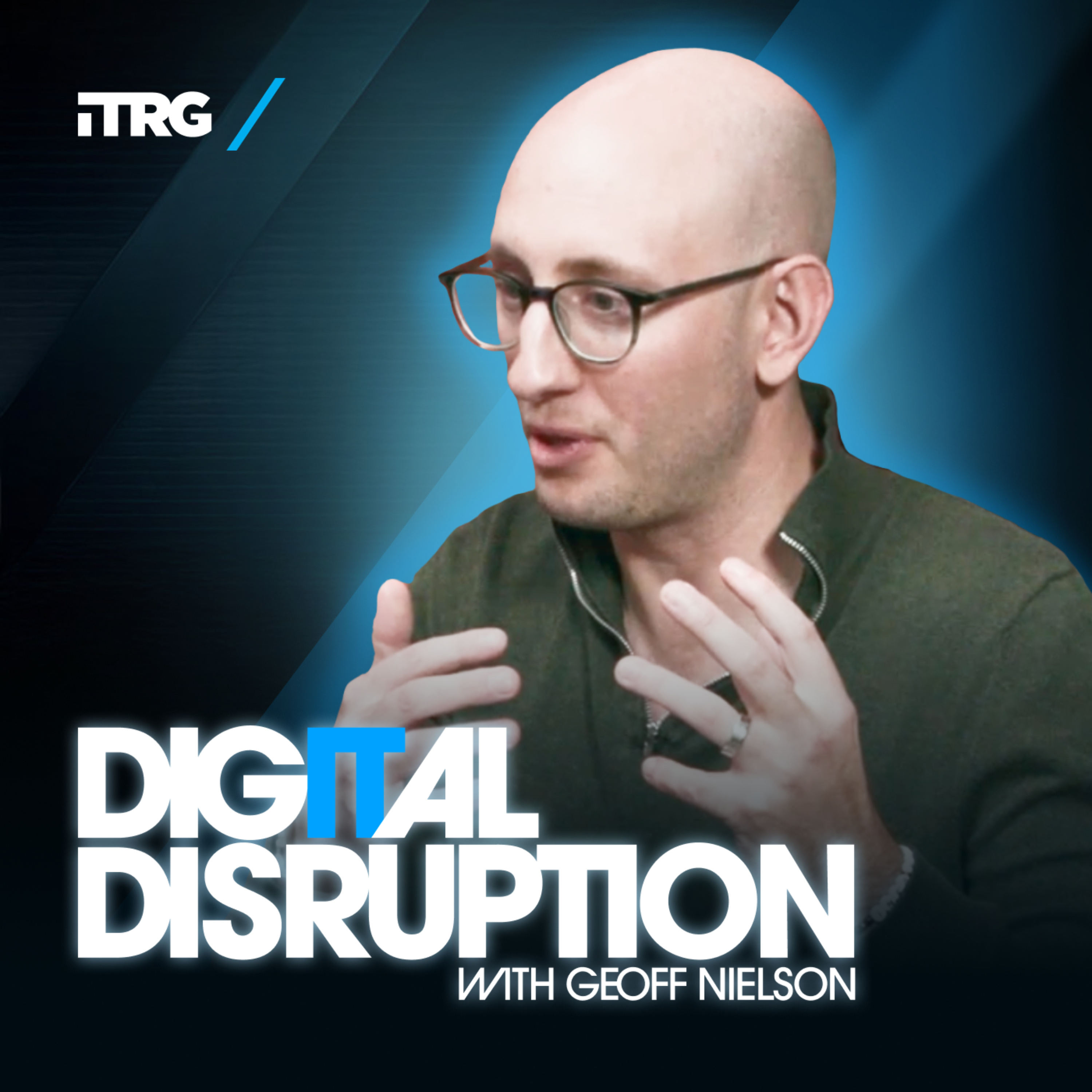
Hosted by Info-Tech Research Group
Listed under Technology
★3.7on Apple Podcasts · 3 recent reviews
The Next Industrial Revolution is Already Here Digital Disruption is where industry leaders and experts share insights on leveraging technology to build the organizations of the future.
76 episodes · publishes weekly · latest 2026-08-10 · ~67 min/episode
Rank
#30
Substance
84.5
/ 100
Breakdown
Scored 2026-08
Updated monthly
Across the index
#30 of 1878
Substance
Top 2%
outscores 98% of the index
Digital Disruption with Geoff Nielson ranks #30 on The B2B Podcast Index with a substance score of 84.5 out of 100, scored across 2 recent episodes. It scores highest on guest caliber and insight density. Hanson is a tenured economist and credentialed futurist with published work (Age of M, academic papers), giving him relevant domain authority. However, he is primarily a theorist-intellectual rather than an operator who has built businesses, scaled organizations, or shipped products at scale. His expertise is conceptual and historical, not empirical in the manner of founders or CROs. For a B2B podcast targeting operators, this limits practical applicability despite intellectual merit.
Averaged across 2 recently scored episodes, with cited evidence.
The episode is densely packed with substantive ideas: Hanson's framework on cultural evolution, the Great Filter paradox, the distinction between Darwinian descendants and alien rivals, multi-level selection dynamics, and the fertility-as-maladaptation thesis. Most claims are non-obvious and theoretically grounded. However, some sections (especially the cultural drift explanation) sprawl conceptually without sharp operational takeaways, and the host occasionally allows philosophical tangents that dilute focus.
“cultural evolution is what allowed those things to appear so rapidly compared to with other animals. Yes, cultural evolution allowed us to invent language, to invent law, to invent trade, to invent capitalism, property”
“the fragmented habitats produce produced more life today, which means evolution of species mattered more than evolution in species”
Hanson's framing of AI as descendants rather than alien rivals is contrarian and theoretically sophisticated. His application of Darwinian selection to cultural evolution, the four-parameter adaptive tracking model, and the specific claim that fertility decline signals maladaptation (not preference) are genuinely original. The integration of the Great Filter with cultural lockdown is not mainstream AI risk discourse. However, some arguments (capitalism's persistence, technological disruption patterns) are more established.
“I do think of AIs as our descendants. And I think this is one of the main ways I disagree with many people in the AI risk world. They've often framed AI as this alien Armana coming from another star”
“we broke the superpower. That's the way to put it. This has been our superpower for a long time, and we basically broke. Have been breaking it in the last century or two”
Hanson is a tenured economist and credentialed futurist with published work (Age of M, academic papers), giving him relevant domain authority. However, he is primarily a theorist-intellectual rather than an operator who has built businesses, scaled organizations, or shipped products at scale. His expertise is conceptual and historical, not empirical in the manner of founders or CROs. For a B2B podcast targeting operators, this limits practical applicability despite intellectual merit.
“I'm intellectually more of a theorist. I'm less of an empiricist, although I try to learn lots of empirics”
“I'm a futurist and I like to think about the long run future. I'm not that interested in the latest press releases”
The episode relies heavily on abstract frameworks (four-parameter model, Darwinian selection theory) without concrete case studies or quantified examples. Hanson references historical transitions (farmers, foragers, industrialists) but in broad strokes. The fertility claim is illustrative but lacks specific demographic data. The software industry prediction (triple size, 20% to AI) is one concrete claim but appears speculative. Missing: named companies facing cultural drift, specific metrics on prestige bias in LLMs, concrete examples of successful cultural adaptation.
“the world doubled roughly every thousand years”
“if it plays out according to that very concentrated, very sudden, without warning transition, then we have to do a lot more preparation”
Nielsen asks informed, open-ended questions (e.g., the Great Filter challenge, cultural drift diagnosis) and occasionally pushes back (property rights in AI transitions, prestige bias in LLMs). However, he often allows Hanson to monologue for 5 - 10 minute stretches without interruption or sharp follow-up. When he does challenge, it's thoughtful but not aggressive. The host enables deep thinking but misses opportunities to stress-test claims or demand specificity. Better pacing and more adversarial questioning would elevate this.
“But to me there is a distinction between, you know, blood of your blood versus creating. And, you know, we could have a conversation about what exactly AI means”
“I also couldn't help but. And I know you have a background in economics as well, but thinking about how capital is moving around”
2 periods tracked.
2 scored on substance · 66 tracked in total.
Add this badge to your site - it links back here and updates automatically as you rank.

<a href="https://index.fame.so/show/digital-disruption-with-geoff-nielson" target="_blank" rel="noopener">
  <img src="https://index.fame.so/badge/digital-disruption-with-geoff-nielson/badge.svg" alt="Ranked #6 on The B2B Podcast Index" width="360" height="136" />
</a>Track Digital Disruption with Geoff Nielson's rank
Get an email whenever this show moves up or down the Index. Monthly at most, no spam.
Companies, products and tools that come up most across this show's episodes.
The themes that come up most across this show's episodes.
Podcasts that dig into the same topics.



