Burnout Proof Leadership · 2026-07-22 · 33 min
Key moments - from our scoring
Substance score
36 / 100
Five dimensions, 20 points each
Russell Harvey brings a refreshingly practical take on resilience for midlife women entrepreneurs. Rather than the overused concept of "bouncing back," he advocates for springing forward with learning - actively pausing after difficult (or even positive) events to extract insights and adjust behavior. His resilience wheel is grounded in research from Robertson Cooper and covers seven interconnected dimensions: attitude (beliefs), purpose (personal and leadership), confidence (self-belief in specific contexts), adaptability (openness to change), support network, meaning (internal storytelling), and energy (strengths-based approach). For female founders specifically, Harvey emphasizes the confidence piece, noting that women often self-deselect from opportunities due to self-doubt, while men apply for roles meeting just one criterion. He references Albert Bandura's five ways to build confidence and encourages women to identify which methods work for them - putting them back in their power rather than labeling them with terms like "imposter syndrome." The conversation touches on VUCA environments, the importance of role modeling resilience, and how clarifying personal purpose simplifies decision-making even when challenges persist.
It means that after facing a challenge, you pause to reflect on what you did well behaviorally, what didn't serve you, and how to do more of what works - rather than just bouncing back to your previous state. The goal is to learn and evolve from every life event, both negative and positive.
The seven components are: attitude (your beliefs), purpose (personal and leadership direction), confidence (self-belief), adaptability (openness to change), support network (nurturing relationships), meaning (your internal storytelling and how you frame situations), and energy (strengths-based approach using tools like StrengthFinder).
Russell recommends identifying which of Albert Bandura's five confidence-building methods work best for you personally - whether that's mastery experiences, social models, verbal persuasion, or others - rather than accepting generic labels like imposter syndrome that don't serve your identity or empowerment.
Ask: (1) What have I been doing behaviorally recently that serves me well? (2) What haven't I been doing that doesn't serve me? (3) How can I do more of what serves me well? These questions guide you to extract learning and adjust your approach.
VUCA stands for volatile, uncertain, complex, and ambiguous - describing today's business environment. The resilience wheel provides a practical framework to assess and strengthen all seven dimensions of your resilience so you can face into that volatility without being consumed by it.
Our reviewer’s read on each dimension, with quotes from the episode.
The episode surfaces a handful of genuinely useful reframes - 'springing forward with learning' vs. bouncing back, the seven-spoke resilience wheel, and the three reflective questions - but the frameworks are described at a shallow level and large stretches of the 33 minutes are consumed by affirmations, pleasantries, and the entirely content-free 'mystery questions' segment. The ratio of new ideas per minute is low.
I define it as springing forward with learning
resilient people have a purpose. I go, so what's yours? The room, 99% of the time gives you a blank look
The 'spring forward with learning' reframe of bounce-back resilience is a mildly interesting distinction, and the pushback on imposter syndrome labelling shows independent thinking, but the bulk of the content leans on established third-party frameworks (Robertson Cooper, Bandura/Maddox, Strength Scope, VUCA) rather than original ideas developed by the guest.
I'm not a fan of the term bounce back
I have a bit of a uh, just want to have a good conversation about the terminology of imposter syndrome. I'm not entirely sure that it is um, out there in the world in the way it was originally intended
Russell Harvey is a legitimate practitioner with 11 years running his own coaching business and 20 years of L&D experience, which gives him real credibility, but he is fundamentally a coach-speaker-facilitator rather than an operator who has built and scaled something - exactly the 'thought leader' archetype that limits the ceiling for B2B operator utility.
the resilience coach will be 11 years old in July
I was working at one of our large retail companies um, over here and I was very nicely asked by the head of HR to have a look at their Women in Business piece
Named research sources (Bandura/Maddox, Robertson Cooper) and tool names (Strength Scope, Strength Finder) provide some anchoring, but almost every example is anonymised ('a lady in a session,' 'one of our large retail companies'), no client outcomes include numbers, and there are zero metrics, revenue figures, or timelines beyond the guest's own business age.
From Albert Bandura and James Maddox, I would encourage uh, each uh, person, each woman to just go work out what are the. Which are the five ways work for them
Robertson Cooper, um, did all the research on of it and I've added to it
The hosts ask broad, open-ended questions ('what does resilience look like for you?', 'what's a simple tool?') and consistently affirm rather than probe; there is no meaningful follow-up or pushback on any claim, and the episode closes with several minutes of entirely substanceless 'mystery questions' about a Graham Norton appearance and TV show names that waste listener time.
You have been invited to be a guest on the Graham Norton Show. Who is on the couch with you?
what is one piece of advice you would give a female founder?
Computed from the transcript - who did the talking, and the words that came up most.
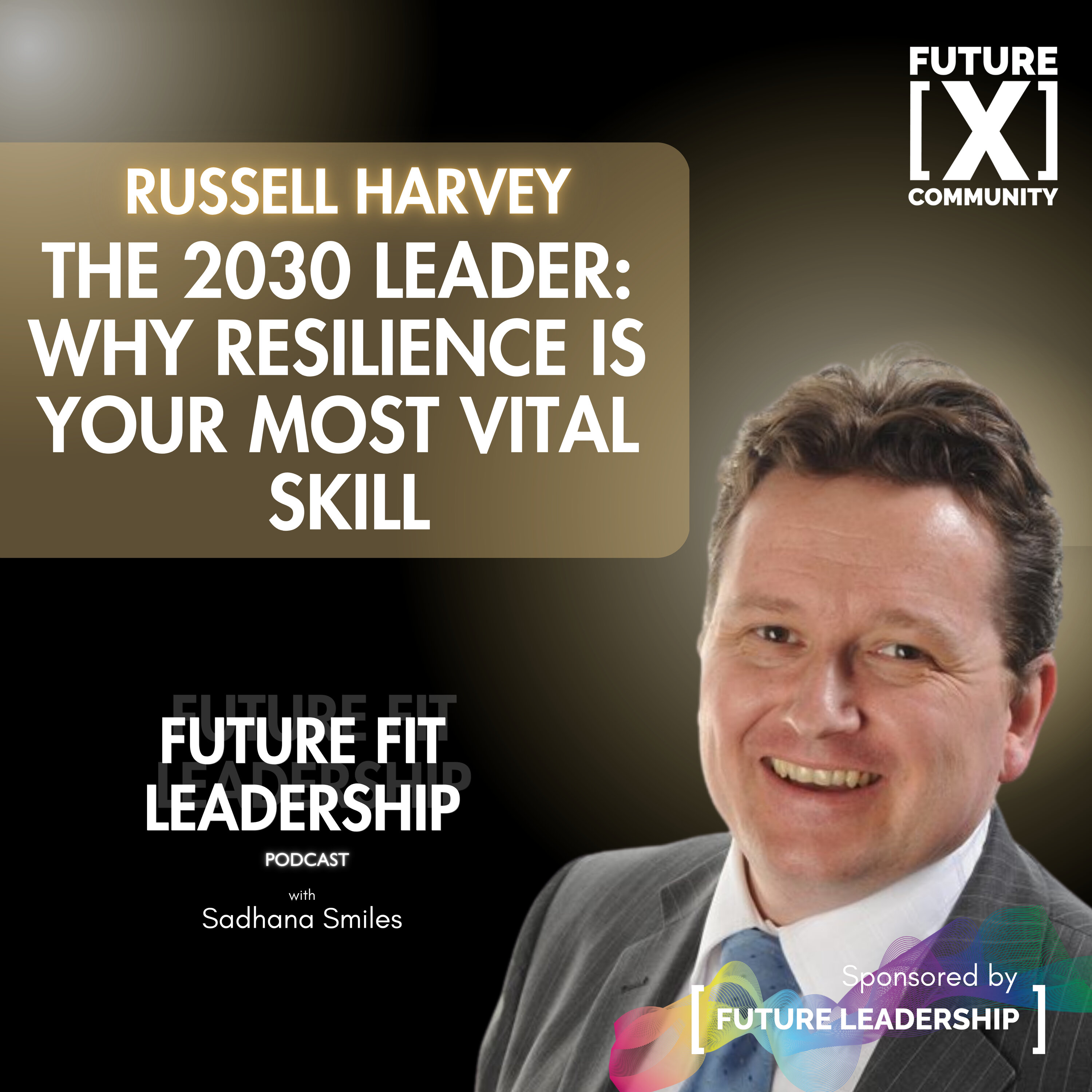
What if resilience isn't about bouncing back, but about becoming a stronger leader through every challenge? In today's fast-paced world, leaders are constantly navigating uncertainty, change, and pressure. It's easy to mistake resilience for simply pushing through, but that mindset can accelerate burnout instead of preventing it. In this conversation, resilience expert Russell Harvey shares a refreshing perspective on how developing your Leadership Identity , strengthening your Leadership Skills , and learning from every experience can help you lead with greater confidence, purpose, and optimism. In this episode, you'll discover: How to build resilience by "springing forward with learning" instead of trying to bounce back. The seven elements of the Resilience Wheel and how they strengthen leadership, confidence, purpose, and wellbeing. Why cultivating optimism, self-awareness, and a strong Leadership Identity helps leaders prevent burnout while leading others more effectively. Press play to discover practical strategies that will help you strengthen your Leadership Skills, build lasting resilience, and lead with confidence without sacrificing your wellbeing.
Transcribed and scored by The B2B Podcast Index.
Speaker A: In this episode, you'll discover the essential leadership skills you must have to keep going when your business gets hard. Welcome to Burnout Proof Leadership, a podcast for midlife women in online business who've hit a revenue ceiling and are ready to stop doing it all. To step into your true leader identity and build a business that can grow without you running everything from the middle.
Speaker B: Hey, this is Tracy. Before we jump into today's episode, we have a quick reminder for you. Uh, starting Wednesday, July 29, we are now going to be From Doer to Leader podcast. Super excited about that. And if you missed that special announcement on Friday, July 17, be sure to go back and give it a listen because we talk all about why we're making this change and what this new, exciting chapter means for you as a listener.
Speaker A: It's still Michelle and Tracy bringing you the same practical leadership insights you know and love, now with an even clearer focus on helping midlife women entrepreneurs make the identity shift from doer to leader so they can scale their business. Now let's jump into today's episode. Welcome to Burnout Proof Leadership. This is Michelle in.
Speaker B: And Tracy. And in this episode, you'll discover what it actually takes to keep going when running a business gets hard. You'll also learn a simple tool you can start using today to be more resilient and avoid burnout. And how to leverage learning to spring forward rather than bounce back.
Speaker A: And what a lovely interview we, ah, had today.
Speaker B: Oh, uh, so much fun.
Speaker A: You're going to have a great time and learn how to look at resilience in a whole new way. And today our guest was Russell Harvey. He's known as the resilience coach, and he is a leadership coach, facilitator, speaker, podcaster, and radio host with over 20 years experience in learning, leadership and organizational development. Without further ado, here's our interview with Russell. Well, hello, Russell. We've been waiting for this moment. Welcome to the show.
Speaker C: Thank you very much. It's very nice to be here. I appreciate it.
Speaker A: Oh, well, we. We appreciate you taking the time to spend with us. So I am going to start our podcast episode with you, and I'm going to just start with the first question that we are so curious about, and it's about resilience, and we hear about resilience all the time. But what does that actually look like for you as a business owner today?
Speaker C: Yeah, so for me, it is really, um, aiming to role model it as much as simply possible, essentially. Uh, that's what it looks like for me. And intentionally sharing Examples of how I put into practice the things that, you know, I, um, share with people. Um, so when I engage with clients a lot, and I know we'll talk about this a little bit later, um, I have the resilience wheel, which is the answer to the question, so, Russell, how do I build my resilience? You know, and there's seven bits to it. So what, uh, it looks like for me is me reflecting on how well I am doing that, how well I am building it, essentially, um, and really trying to make sure that I play to my strengths and I understand the things that I'm not energized by and can sometimes, uh, get into trouble with if I try and do the things that don't energize me in running a business. Yeah, so I think that was one of the. So the, you know, resilience coach will be 11 years old in July. And when I was thinking about sort of, you know, people ask, who are you? Tell us about yourself. And I've always answered with, so I'm a coach and I'm a facilitator. And then it took me a while, a couple of years into running the business before I said, actually, you know what? I'm a coach and I'm a facilitator and I'm a managing director, which made me have to stop and pause and think to myself, oh, good God, what. What does that mean to me? Can I do it? What's the managing director supposed to do? What's involved in that? Essentially, um, that's what it looks like. And then finally, what it really looks like in terms of running the business is, um, really interesting. The inquiries that I get, I still get huge amount of inquiries where the prospective client essentially does a version of, okay, Russell, we've got some time with my team. We're going to do a bit of an away day. We're going to talk about all of our KPIs. We've either got 10 minutes or half an hour or 45 minutes spare. Can you come and make us resilient in 45 minutes? And that, that is what it looks like as the resilience coach a lot of the time as well, essentially. And then I have to either smile or cry or take, um, a deep breath, uh, and decide where to go from there.
Speaker A: Yeah, yeah. The resilient Superman.
Speaker B: Yeah, yeah.
Speaker A: Coming in to save the day in 45 minutes.
Speaker B: Exactly. Exactly.
Speaker A: Well, I love that you said role model, because I think that's so important that we. One of our core values is walking our Talk. And even with the work we do, holding ourselves accountable, holding each other accountable, because it's. People are always watching you.
Speaker C: Right, absolutely. And I, I remember from you, uh, know, when we first spoke just how much of a, um, partnership relationship that the two of you is. So uh, yeah, as I'm, I'm not by myself because one of the um, dimensions of my resilience is your support network. So I work hard at cultivating my own, but at the same time, day to day it, I am in my own office, on my own a lot of the time essentially. Uh, so I suspect with the two of you together that I do miss that immediacy of having somebody by my side because I, I do it immediately. I just want to keep turning to somebody and just, you know, suddenly ask something when they're not there. It's like, oh, yeah, okay, right. I need to call somebody.
Speaker B: Well, you'll have to get a cardboard cut out or get yourself a little, you know, bot to talk.
Speaker C: Yeah, absolutely.
Speaker B: Yeah. Well, before I ask my next question, I just, I think it would be helpful for our listeners to get your definition of resilience because a lot of people look at it in different ways. And so what, when you say resilience, what do you mean?
Speaker C: Yeah, so I define it as springing forward with learning.
Speaker B: Okay.
Speaker C: That's how I define it immediately. I'm not a fan of the term bounce back, which is talked about in relation to uh, resilience. Because what I've noticed is that a lot of people sort of say, right, there's been a challenging event. You know, I've faced into it with whatever levels of resiliency I've got. And then I'll now bounce back to. And then it's a sort of a subconscious instruction to go back to how you were, uh, before the challenging event. And I'm m sort of there, you're nodding away, you know, I'm there waving my hands at that moment in time and go, whoa, whoa, whoa. What did you learn? What did you learn? What are you going to keep doing that worked for you? And what are you going to do differently? So, uh, and I think the other challenge around that, um, is, and even you came up yesterday, that too often too many people think that resilience is only about keeping going regardless. Sometimes it is about keeping going through challenging times. But you need to then have the knowledge that that's what you're doing. You need to have the absolute self awareness that I'm in a moment where I've just got to get through this. Uh, but then you need to make sure you pause and reflect essentially. So to spring forward with learning and the ultimate outcome of that, the measure of like when you're doing that well, is that when. Who ask my clients, when they work with me, how are you? They give the answer of, do you know what? There's a lot going on. It's a crazy world. And um, I'm good.
Speaker B: Yeah.
Speaker C: And they mean it and they believe in it, essentially. And they achieve that by role modeling. Springing forward with learning.
Speaker B: Oh, I love that. I love that. Because it is a crazy world. It's a VUCA world. Right. It's volatile.
Speaker C: It's a VUCA world. Yes.
Speaker B: It is everywhere. And um, and it can be happening around you. It doesn't have to suck you in, but when you are impacted by that, you know, that volatility, it's uncertain. There's a lot of complexity, a lot of ambiguity. Um, and when you kind of, you know, have to be in that and you need to be resilient. What, what are some, what's a simple tool? You mentioned your wheel, right? The resilience wheel. How would somebody use that to, to help them be resilient in this time or in the situation? If it's a VUCA situation, yeah.
Speaker C: And uh, thank you. And so, yeah, I think building your resilience via the resilience wheel is the simple tool enables you to face well into a VUCA world. And so it is seven, uh, aspects that we all built on loads of different research. So I'll do a whistle stop tour and just do a quick example. So heart of resilience is our attitude, essentially. Uh, and I would suggest that you wouldn't necessarily start there. All of aspects of the wheel are interconnected, so when you work on one aspect of it, it has an impact another. But immediately trying to develop your attitude is probably too deep a place to start essentially because it's about your values. And the only thing that I'd say around the attitude piece is the thing it fascinates me is this is about our beliefs. So the dictionary definition of a belief is something we behold to be true without basis in fact.
Speaker B: Mhm.
Speaker C: So challenging your belief is, is something to notice in the attitude place, then it's purpose. So you know, uh, resilient people have a purpose. You only need one. Uh, and I ask people, what's your personal purpose? I also ask clients, what's your leadership purpose? And if you're a leader of a team, they go ask the team, what's the team's purpose. And as a result of that, some singular version of who you are, what you want to do, what you want to be known for, your legacy will emerge. And then sometimes, which has been really interesting, um, I can't remember I came up with this or a delegate on a program, did I sort of say, um, as you think about the family dinner table, um, so you know, fingers crossed some people are still written sitting around dinner tables as a family and eating meals. Um, but it's a really good, great conversation. What's our family's purpose? And there are some people that come back with some absolutely fascinating things that come up with so purpose. Then we've got confidence. Um, and one of the sort of questions they may ask later on, I sort of want to come to that. So there's five ways to build confidence. So it, it's, it's understanding which the five ways work for you. Adaptability is openness, change. So as a simple tool it's revisiting that whole question of, you know, do you like change? And seeing what happens essentially and understanding the difference between adaptable and agile as a nuance in there there's your support network building, nurturing the most useful and worthwhile support network for you. And then there's meaning which is our internal storytelling. So this is once again going back to the question of how are you? It's also thinking about how you answer, uh, how are you? How was the weekend, how was the project going? You know, how's your boss, how's this, how's that? Noticing how you answer it. Because how you answer it is the meaning that you are attaching to those situations and then that meaning can have an impact about how you see yourself. So reframing your meaning. And finally it's the word energy which is all about the strengths based approach. It is absolutely as well around diet and exercise and I'm not a specialist in that area. But energy is very much the uh, strengths based approach. So there's a psychometric in the uk, UK called Strength Scope and I think in USA it is Strength Finder, uh, is an equivalent of it essentially. So it's literally understanding and nurturing all of your strengths and harnessing those. And so you can look at the wheel, not plugging it's on the website, you can just look through those and do a quick self assessment and there is also a diagnostic that's about to go on there as well to just answer some simple questions. So that, that's the tool people can literally just start to go, well where Am I, where am I on this wheel? What's good, what's not so good? And where do you want to start in developing it essentially?
Speaker B: M. Wow.
Speaker A: It's a, it's a free tool.
Speaker C: Yeah, yeah, yeah, absolutely. Yes. So, so originally Robertson Cooper, um, did all the research on of it and I've added to it and they put it into the world for free. So I am, I'm talking about them essentially to go, yes, this, this is where this came from and I've taken it and I've added to it and yes, it's in the world for free. So yes, there we go.
Speaker B: Well, I think that, you know, awareness is the first place to start. Right. You can't improve something if you don't know where you're starting from. And um, so I think it's a great way to, to see how you're showing up now. Do you find that it can be different in different contexts? Like I may like. Or is it like a holistic. You know what I mean?
Speaker C: A bit more of an.
Speaker B: Well, I'm just saying, like you might feel really resilient in some regards in your life, in the context of some aspects of your life, but in another score very differently. Would that be possible or not?
Speaker C: I think that's where it could get confusing.
Speaker B: Okay.
Speaker C: Now so for me that's when, whenever I do hear people just sort of say there's a, there's a work me and a home me. Uh, I'm always really curious about that and sort of positively challenged around that because it's very, very difficult for there to be two versions of ourselves essentially. It can get very confusing. Now there were absolutely as well, you know, um, we will choose in certain environments what we will share about ourselves. So most definitely people in the home life might know a little bit more about you than in certain works of circumstances. Ah. So I think, um, if you, you need to just, you do need to look at it in terms of the whole life because of the resilience wheel is like you as a human essentially. Um, but you might notice actually once again around this word confidence.
Speaker B: Mhm.
Speaker C: That's just at any particular moment in time, what's our belief that we can do something?
Speaker B: Mhm.
Speaker C: So. And outside of work there might be certain things we believe we can do inside of work. There may not be any and vice versa. So the short answer to question is context. Um, absolutely can happen. And the resilience is the same question as actually what does it mean to be human?
Speaker B: Mhm.
Speaker C: So you know, you bring your human Self into all situations.
Speaker B: Yeah, yeah, that's helpful. I just thought somebody might, yeah. Wonder about that. Not me, but I take me everywhere I go.
Speaker C: Excellent. Excellent. Yes.
Speaker A: Okay, Russell, I was really intrigued by your definition of resilience. I want to unpack this learning that you have identified is so critical. So can you share with our listeners how they can actually use learning to spring forward rather than just bouncing back a little bit more detail on that?
Speaker C: Yeah. So, um, so resilience role modeling, uh, is essentially from all of life's events. So, you know, resilience is most definitely about, uh, recovery, uh, as well, and recovery from adverse events. Now, an adverse events doesn't always need to be negative, essentially, because I got a great question from somebody that was running a session. It was a lady, and there's a reason why I'm mentioning gender at this moment in time. And because she asked the question, does an adverse event always have to be negative? And I go, no, how come you're asking? And she said, well, um, it wasn't in my life plan, but recently I became pregnant and had a baby and it was not in my life plan, essentially. Uh, and so it's lovely, it's wonderful. I'm now glad it's happened. However, uh, I view that as an adverse event. You know, I'm very happy that the child is here and when. Yeah, that's. That's a perfect example. Yeah, absolutely. So, um, resilience, role modeling and learn learning is from all of life's events. You need to pause now. A pause is listening to a podcast. A pause is having a really fantastic conversation with a friend or your team or your boss or going for a walk or thousands of other things are a pause. And in those pauses you ask yourself three questions. What have I been doing behaviorally recently that has been serving me well against the resilience wheel? What have I been doing, um, that's not been serving me well behaviorally recently against the resilience wheel? And how can I do more of the answers to the first question, essentially, that is resilience role modeling. What I've been doing well, behaviorally that's been serving me. What have I not been doing well? And, um. Right. How can I do more of the stuff that serves me well against the resilience will? And in those you will have some ideas. And then the learning piece is going from knowing what you're doing to then doing something different, essentially. And it's all interconnected because the resilient individual is more open, is more curious, has more self confidence, and is more okay. Putting themselves into maybe a stretching situation to try something new, essentially.
Speaker A: Yeah.
Speaker B: Mhm. Yeah. It kind of reminds me of some work that we do, um, as well, where it's really like thinking about the life that you want. Right. Whatever the outcome is that you're striving for your purpose, if you want to call it that, or could just be a goal. But it is about aligning who you're being with that outcome and when you shift. And being is a part of beliefs. Right. Your identity, how you see yourself, the stories you tell yourself. Um, and then that when you adjust that then you will take different actions and you'll behave differently. Right. To get the outcome. It's the same kind of, you know, approach. Yeah. Reflection and totally.
Speaker C: I think the one that really intrigues me. So when I run workshops around the resiliency piece, it's got something around the wheel and the one that, the question that. And I understand it when I get to the purpose piece and so just says the room and go, right. So resilient people have a purpose. I go, so what's yours? The room, 99% of the time gives you a blank look.
Speaker B: Mhm.
Speaker C: Essentially. And. But they do also subconsciously have an idea around it. Um, and then I've had some really, you know, sort of powerful pieces of feedback from clients, you know, when they've sort of said, you know, I've really worked out my purpose. And as a consequence of that, I'm much clearer on the decisions that I'm going to make, how I'm going to face into all of my challenges. It's actually to make things feel simpler, things feel lighter, actually things feel clearer about actually this is. The challenges haven't changed, but how I'm going to choose to face into them has completely shifted into a different place. It's um, yeah, it's quite, it's quite magnificent when you see it happen.
Speaker B: Yeah, that's really powerful, that clarity.
Speaker A: Yeah.
Speaker B: Oh yeah, yeah. I love it when people have those like breakthroughs. Right. Those little ahas of they take those steps and it opens up a whole new way of looking at their life and the things that they're doing, choices that they're making.
Speaker C: Right.
Speaker B: So they can make more mindful choices.
Speaker C: Yeah, yeah, absolutely. Absolutely.
Speaker B: Yeah. That's great. Well, you know, since that kind of, you know, springing forward in the learning is so really so very important, what is one piece of advice you would give a female founder? Um, so you know, that she could, what could she learn that would serve her well? In building her business or growing her business.
Speaker C: So yeah, absolutely. So the short answer um, is in this space of confidence and to clarify I am never in the space about pointing or labeling about whether somebody does or doesn't have confidence. But and I'm also curious uh, for a variety of reasons. So many years ago, some time ago I was working at one of our large retail companies um, over here and I was very nicely asked by the head of HR to have a look at their Women in Business piece. And it was an initial instance, talk to the HR Drake said you, yes, absolutely. You do know that I'm um, a man don't you? And she went yes, I really do. I worked that out. Russell. Yes, she was just now just. I'd value your opinion, go and have a look at it. So in that or revisited some of the research that was done in the UK about you know, um, and I'm not sure if it's still valid but I think it is about the reasons that um, that impact women's careers. And one of them is that they self deselect themselves from personal development. If there's personal development that's around they will take a step back um, that the word confidence uh, comes out in the fact that, and I'm sure you've heard this and sort of seen this hundreds of times, the simple analogy was that when a man looks at a job advert, if there's one thing on the job advert they think they can do, they'll just apply for the whole job essentially and a woman will look at an advert and if she can't, if she believes she can't do everything on that advert, won't apply for it essentially. That was what the, the research showed. And I have a bit of a uh, just want to have a good conversation about the terminology of imposter syndrome. I'm not entirely sure that it is um, out there in the world in the way it was originally intended essentially. I think if you look at the original research it's um, it's not about labeling somebody uh, as the imposter syndrome. It's not helpful for people's identity. For me when I've looked at what uh, is denoted as imposter syndrome, it feels to me it's just simply in this word of, in this space of confidence. So my single piece of uh, idea, um, advice for female leaders is there are five ways in which you build your confidence. From Albert Bandura and James Maddox, I would encourage uh, each uh, person, each woman to just go work out what are the. Which are the five ways work for them to actually improve their self belief about the things that they can do. So just continue to really understand what it is that grows your self belief. And I think that is potentially one of the most useful things.
Speaker B: Mhm.
Speaker C: Essentially.
Speaker B: Mhm. Really puts them back in their power.
Speaker C: Yeah, yeah, yeah.
Speaker B: Right. Helps them to. Or to see their power, maybe even.
Speaker C: Yes, yeah, absolutely.
Speaker B: As a person.
Speaker C: Yeah.
Speaker B: There's.
Speaker C: And then, then my intention behind that is there's a lot of. So I don't know what it feels like clearly, but there's a lot of noise around actually, you know, women in business and I think when you have actually nurtured your confidence, you could probably quieten a lot of that noise.
Speaker B: Mhm.
Speaker A: Yeah. Yeah. Because I, you know, I, I always think back about how I really admire women in business or women founders, entrepreneurs. They are the ones that have a. They exude confidence.
Speaker C: Yeah. So yeah.
Speaker A: Do you have a resource?
Speaker B: Well, externally they do, but they may not feel it internally.
Speaker A: Well, uh, maybe not.
Speaker B: I'm just saying, you know, I think we put on that armor at times. Some do put on that armor, like, look, I'm tough, I'm resilient, I can handle this. But inside they're quaking in their boots, you know, like they're not really sure they can do it, but they're not ever gonna let anybody see that they can't. So I'm not always. There are some that, you know, it's just deep in their bones. Uh, but there are some that are exuding confidence that I don't know that they really feel it. You know, we're both right.
Speaker C: So absolutely my intention. Talking about, uh, yeah, sorry, apologies, apologies. My intention of talking about the word confidence is to give more women the opportunity that when they, when others look at them to go, oh, you seem to be sure of yourself. It's real.
Speaker A: Yeah, yeah.
Speaker C: That's my intention behind it, that there is a. There is an internal bedrock behind it because they've continued to work out what is. It enables them to believe in themselves and their capabilities and their abilities. Yeah, yeah, yeah.
Speaker A: Is that resource on your website?
Speaker C: Yeah, it is, yeah. So it's in the confidence element of the wheel. And you know, if anybody looks up, uh, Albert Bandura and James Maddox, five ways to confidence.
Speaker A: Okay.
Speaker C: If this is funny thing called the Internet and search engines, if you go on there and you know, I don't know if you've ever heard of it, but yeah, there we go. Yeah, that's how. Yes, yes. It's also on the website.
Speaker A: Oh, that's great. Because, you know, if someone's listening and they're like really curious about that, we want to make sure they can get their hands on it. So thank you so much.
Speaker B: Yeah, you're welcome. For sure.
Speaker A: All right, well, you know, we're at that time in our show, Russell, where we get to ask you some mystery questions and we're very excited to do this today.
Speaker B: How's your confidence? Just teasing.
Speaker C: It was just, it was just a little tiny moment there. I was like. I remember seeing that as well in the sort of, you know, the, the, you know, preparation notes. Oh, yeah.
Speaker A: Okay, okay, okay.
Speaker C: I'll take a deep breath.
Speaker A: Nothing hard. I'm gonna ask you the first one. Tracy's gonna come at you with the second one. So here we go.
Speaker C: Okay.
Speaker A: Okay. You have been invited to be a guest on the Graham Norton Show. Who is on the couch with you? And you know what? You get to pick who's on the couch with you.
Speaker C: The catching me. Uh, Jurgen Klopp, essentially. Who is, ah, um, the ex Liverpool manager. Ah, essentially.
Speaker B: Okay, awesome.
Speaker C: That's who's on.
Speaker B: Okay.
Speaker C: I'd love an opportunity to just sit down with him essentially.
Speaker B: Why?
Speaker C: Well, um, because, uh, ever as soon as he turned up, uh, at Liverpool, which was about 11 years ago, um, he immediately sort of coined the frames. He's going to turn Liverpool Football Club and its supporters from doubters into believers. And uh, just every time I saw him at a press conference and every time he answered a question, he seemed to be, uh, sort of a lot of the things that I was thinking in my head about strengths based approach. This is how you do things. He was answering in that way. And I'm going, oh, just, I just want to sit and have a chat with you and just see where that, where did that come from?
Speaker B: How come?
Speaker C: Yeah, so Jurgen Klopp.
Speaker B: Oh, awesome. Great. That's a great, that's a great response. Yeah, I think that's awesome. Love it when you kind of have a synchronicity with somebody but you haven't met them.
Speaker A: Right.
Speaker B: And you just want to be in their presence and see, you know, what you have in common and what you can learn from them. So that's awesome. All right, question number two. You did good on that one. Are you ready for the second one?
Speaker C: I hope so.
Speaker B: Okay. You've already been seen on the Graham Norton show. And guess what? A major network wants you to have your own show. What's the name of your show?
Speaker C: What's My show called, um. Well, I did for a while. I had a radio show called Russell's Resilience Radio Show. So, uh, yeah, um, Russell's Resilience TV show.
Speaker B: Okay.
Speaker C: That's what it's called.
Speaker B: All right.
Speaker C: Essentially, yeah. I'm trying to get the, uh, alliteration in there. Is there another way? So Russell's release, if there's another way of saying TV show with an R, and.
Speaker B: Yeah, we'll figure that out. You got a little time, I think.
Speaker C: Yeah, yeah, absolutely. Yeah.
Speaker B: That's good. That's really good. I like that.
Speaker C: And it's not about my ego.
Speaker B: It really isn't.
Speaker C: It's about the. It's about the alliteration of it.
Speaker B: That's right. Absolutely. Uh, that's. That's cool. That's really cool. Wow. Well, it's just been such a pleasure to talk with you, and I, you know, I just love your perspective on resilience. The word is everywhere. And, um, you know, and we need it, and we need to understand what it is, and we need to know how to cultivate it. And I think you've brought a lot of wisdom and a lot of different ways to look at it, and some tools, and so. Thank you so much. It's just really. It's really been a great conversation with you. I've just. I've learned a lot, and I appreciate what you've been bringing.
Speaker A: I love your perspectives on it.
Speaker B: Yeah.
Speaker A: Very helpful.
Speaker B: Yeah. Very refreshing. Is there any.
Speaker C: That's wonderful. Yeah.
Speaker B: Is there anything you'd like to share before we wrap up?
Speaker C: Um, I think, um, in addition to what we talked about, uh, I never want, um, anybody to view this word resilience in a toxic way. Way. So I. Absolutely. My intention is never to think about toxic resilience or toxic positivity. So I love talking about the word optimism, essentially, as a means to feeling hopeful and positive about the world. And it takes a level of resiliency. So to hold an optimistic conversation, well, it requires emotional intelligence, empathy, compassion, and coaching skills, because optimism as well, you know, is grounded in reality. So to be able to talk about the reality of a situation that might be really difficult, really challenging, but doing in a way that doesn't take us into a spiral of despair, you know, and then what also is grounded in reality is what's great about us, what's good about us, what's right about us, our skills, our experiences, our behaviors, our life lessons. And so it's about holding things in two hands. And if you can actually just keep talking more about what's good. Great writing about us then. Humans feel hope.
Speaker B: Mhm. Yeah.
Speaker C: And they feel positive. So whenever I hear people talking about positivity, I just subconsciously straight away my head, I'm going, optimism, right? How do we, how do we turn this into an optimistic conversation? So a question for anybody that's listening now. Uh, I, I'm curious what their answer is to how optimistic are you today? About the future, about the team you're leading, about the organization you're in, about the challenging that you're facing. So nurture optimism alongside the resiliency piece.
Speaker B: Uh, great. Yeah, yeah, we will do that. Do you, uh, where can people find you?
Speaker C: Yeah, so it's the resilience coach.co.uk so all the W's. And yeah, if you can find us on, uh, website, social media, everything. It's the resilience coach, Russell, the resilience coach. That's how you find.
Speaker B: Okay, uh, awesome. We'll make sure we have links in the show notes so everybody can find you and just, you know, for the listeners, thank you for being here with us today and uh, it's been a pleasure to be here and we're grateful every time that you show up and listen to us. So until next time, be safe and stay burnout proof, Sam.
Other episodes covering the same guests and topics, from across The B2B Podcast Index.
 Special Announcement! The ONE Identity Shift Every Woman Entrepreneur MUST Make31 / 100The ONE Identity Shift That Keeps Women Entrepreneurs Out of Survival Mode55 / 100The Leadership Skills Midlife Women Entrepreneurs Need to Stop Being the Bottleneck by Creating a Culture of Team Accountability40 / 100Your Business Won’t Grow Beyond Your Nervous System & Leadership Identity - with Serin Silva51 / 100The Leadership Skill Every Midlife Woman Entrepreneur Needs to Escape the Hiring Catch-22 Dilemma36 / 100