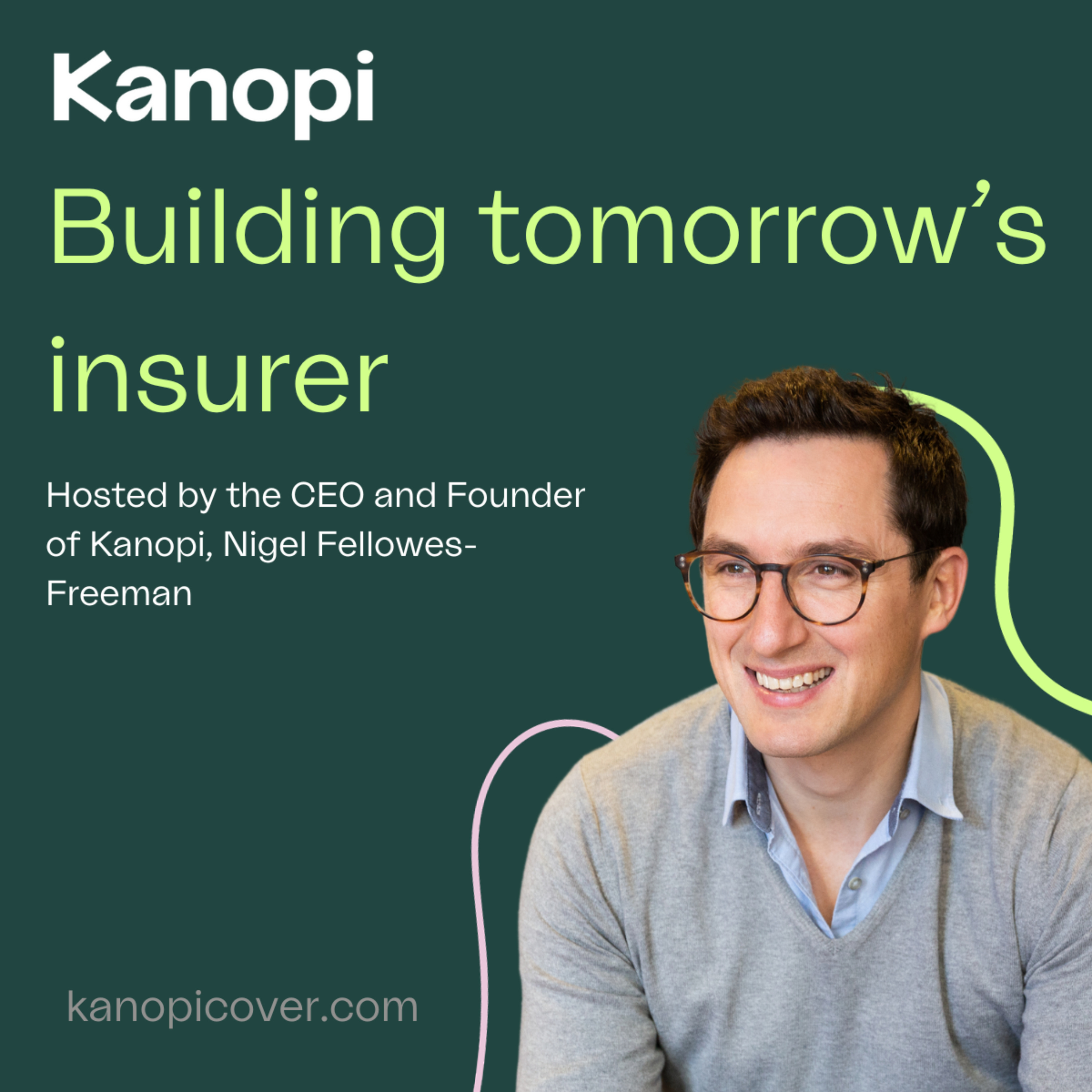
Building Tomorrow's Insurer · 2026-06-10 · 46 min
Key moments - from our scoring
Substance score
58 / 100
Five dimensions, 20 points each
Kyle Nakatsuji spent a decade building ClearCover as a tech-native insurer focused on superior cost structures and digital distribution. But when Anthropic released Opus 4.6 in January - capable of end-to-end reasoning on complex problems - Nakatsuji realized even his decade-old AI-forward company needed to be rebuilt from scratch. That realization sparked Dearborn Labs, a new venture combining consulting and software delivery to help insurers navigate agentic AI adoption. Rather than selling generic platforms, Dearborn takes a consultative approach: understanding each insurer's workflows, identifying where AI actually adds value (avoiding false efficiency gains), and building bespoke systems from platform primitives developed at ClearCover. Nakatsuji identifies four critical AI failure modes: consultants delivering PowerPoint instead of working software; bolting AI onto workflows never designed for it; making wrong build-versus-buy decisions now that engineering costs have dropped; and overspending on horizontal platforms with no vertical ROI. The episode addresses how CIOs should think about data availability, headless policy admin systems, and AI-native operating models - practical concerns for insurers stuck with legacy systems like GuideWire or Duck Creek.
When Anthropic released Opus 4.6 in January, Nakatsuji and his co-founder realized the model was capable of end-to-end reasoning and solving complex problems at a level significantly beyond prior iterations. They assessed what would need to change at ClearCover and concluded that everything would need to change, prompting them to launch Dearborn Labs to help the broader insurance industry tackle the same challenge.
First, hiring consultants who deliver slideware (presentations) instead of working software. Second, bolting AI onto existing workflows that weren't designed for it, adding cost without removing expenses or capturing full AI capability. Third, making wrong build-versus-buy decisions when building bespoke solutions has become more economical. Fourth, overspending on horizontal platforms without enough vertical applications to deliver immediate ROI.
Dearborn combines consultative workflow redesign with actual software deployment by operators (not just engineers) who spent a decade running an insurer. Rather than slideware, they build bespoke, just-enough solutions from platform primitives, and they iterate inside the client's business instead of handing off a strategy deck.
The first challenge is understanding where data actually lives - often still on mainframes or mid-cloud-migration - and how to make it available to AI tools. The second is designing a contextual layer between AI agents and backend policy admin systems, rather than attempting full monolithic system rebuilds.
Deterministic, fast decisions that can be automated without reasoning should not use AI. The most effective implementations deliberately map where human reasoning and probabilistic judgment are needed versus where deterministic rules and control hooks should govern the workflow.
Our reviewer’s read on each dimension, with quotes from the episode.
The episode packs in a meaningful cluster of non-obvious operational ideas - the four AI failure modes, the 'less AI than you think' principle for robust implementations, and the bind-rate-as-pricing-hole detector - but substantial airtime is consumed by the host's lengthy self-insertions, mutual affirmations, and generic workforce commentary that dilutes the overall density.
the not so secret secret about building great AI implementations Is that they often have less AI than you think. Because the the fastest way to make it work badly is to put AI in a process that can be done quickly and in an automated fashion that should be deterministic in the first place.
In like 800 different private DMs within Slack. And if you don't have access to that bit of context, you will not actually understand how undering decisions get made at the business.
There is genuine first-principles thinking in the 'hooks over autonomy' argument for agentic systems and the Slack-DMs-as-ground-truth insight about where operational knowledge actually lives; the four failure modes framework is practitioner-derived rather than recycled. However, the agent-invokes-human inversion, the human-advantage taxonomy (relationships, taste, judgment), and the three workforce scenarios are ideas already circulating widely in the space.
hooks work better than letting the AI just decide what to do. You end up building in quite a bit of determinism into the system to make sure that it functions properly and repeat and and works in a consistent fashion.
failure mode two was there were a lot of people ⁓ to bolt AI on top of existing workflows that were not meant for it. And when you bolt AI on top of an existing workflow that was not meant for it, you were gonna end up with an inadequate outcome
Kyle Nakatsuji is a genuine operator: decade-long founder of a tech-native insurer that built its own policy admin system and was an early LLM adopter, now actively deploying agentic AI inside insurance businesses through Dearborn Labs. He speaks from direct build-and-run experience rather than advisory distance, which is rare in this space.
we built our own policy admin system, we were, you know, very early adopters of generative AI and AI generally in terms of risk models and sort of LLMs that interact with consumers and LLMs that are built into tools our employees use
we for for years felt like we had built up a technology asset, both in terms of the technology we built for clear cover
A handful of concrete details land well - 800 Slack DMs as the real locus of underwriting decisions, the bind-rate walkthrough as a multi-layer leading indicator, and the metrics tree drill-down - but the episode offers no hard financial outcomes from ClearCover or Dearborn Labs deployments, no named clients, and no actual loss or expense ratio figures despite the guest having a decade of relevant data to draw from.
In like 800 different private DMs within Slack. And if you don't have access to that bit of context, you will not actually understand how undering decisions get made at the business.
they rolled out like forty five products in forty to five days or something it was incredible
The host lands a few genuinely useful pushes - the 30-day action plan request and the 'what metrics actually matter' follow-up both surface concrete answers - but he routinely self-inserts multi-sentence commentary before Kyle can respond, answers his own questions, and lets strong claims pass unchallenged; the net effect is a validation session more than a rigorous interview.
Can you give me some something tangible, maybe like a thirty day action plan? Like what for the next thirty days should this person do
Yeah. Yeah. Yeah. Yeah. Yeah. Yeah. Got it. Got it. Interesting. Yeah.
Computed from the transcript - who did the talking, and the words that came up most.
Most insurers are asking how to add AI to existing workflows. Kyle Nakatsuji thinks that's the wrong question. In this episode of Building Tomorrow's Insurer, Nigel Fellowes-Freeman sits down with the founder of Clearcover and Dearborn Labs to explore why the first wave of digital transformation in insurance may already be outdated. After spending a decade building one of the world's best-known tech-native insurers, Kyle believes Agentic AI is forcing the industry to rethink everything from claims and underwriting to operating models and core systems.
Transcribed and scored by The B2B Podcast Index.
Nigel Fellowes-Freeman: Welcome to Building Tomorrow's Insurer. Today we have got the absolute pleasure of ⁓ Kyle Nakatsuji, who's the founder of Clear Cover very newly established in the last six months or so, I think. We'll get into it, ⁓ which is Dearborn Labs. ⁓ Kyle has from a bunch of digging I've been doing, ⁓ has and and to be fair, I've been watching from the sidelines clear cover journey for a while.
and you can't it's interesting, Kyle and we'll get into this, which is You've really come from every angle, right? You've got kind of lawyer, then you're like venture investor with American Family, then you kind of started ⁓ kind of one of the I guess kind of V1 in terms of insure tech clear cover and and now leading the way with Dearborn. And so ⁓ you've gonna have a a mass amount of perspective that I'm really excited to get into because you've I seen, I guess, a bunch of transitions and we're kind of going through another transition now.
So look, really great to have you looking forward to the conversation. So Thanks so for giving us your time. Kyle: Nigel, thrilled to be on the podcast. Thank you for having me.
And ⁓ yes, I think what you're alluding to is I've made many terrible mistakes over the course of my career, which I would be happy to share with you and everyone to help help them avoid the same. Nigel Fellowes-Freeman: I appreciate it. Just always learn more from pain than you do success. So ⁓ it's it's more painful, but it does help more.
You that maybe let's just drive s dive straight into that nugget, right? Which is you've spent you spent a decade basically building ⁓ a tech enabled insurer, really a clear cover. ⁓ really long before many of the incumbents were taking digital transformation very seriously. And now you've made a jump ⁓ to start Dearborn labs.
Kyle: That is very true. Nigel Fellowes-Freeman: ⁓ and I think I kind of read some material that you put out which said kind of even as that ⁓ ten year old native insurer, you essentially need to be rebuilt for the for the AI era. And so maybe let's kick off 'cause I every startup I speak to is having this this conundrum in their minds of what do they do with the business. And so can let me talk to me about it.
Like what made what's changed so dramatically in your mind that you've come to that conclusion? Kyle: Yeah, ⁓ so it's a it's a fascinating question. So going so going back to the story, I'll tell it briefly. I won't monologue ⁓ that so so we did we started ClearCover about a decade ago.
⁓ And thesis when we started the company, as you suggested, was if you built an insurer from scratch ⁓ using was newly available in terms of technology, you could ⁓ use distribution, you could create better customer experiences, ⁓ and you know, in the long term, more importantly than all of that. you could create an advantage cost structure, right? You could create operating leverage by using technology to run the business more efficiently. And so that was the founding thesis for Clear Cover.
And and as you suggested at the time, there weren't a ton of people thinking about how do I use technology simply to create a better cost structure. ⁓ and Nigel Fellowes-Freeman: And is that when you say God, should we jump in then that when you say cost strategy, that's really just like ⁓ like ⁓ like loss ratios. So you could operate the business in terms of from a like an operational perspective much better, get better claims ratios, better loss ratios and therefore better commissions, better like tech costs and therefore, I guess margin wise the profile looks better.
Kyle: So interestingly, yes. I mean, I suppose if you look at our history, I can't hide it, like the loss ratio has gone up and down. It's quite healthy now. So, like, you we've we sort of learned our lesson.
But but when we started the business, ⁓ interestingly, it was less about what we could do with technology to impact the loss ratio and more about what we could do with technology to impact the expense ratio. Because as you as you unpack an insurance business, what we thought is because of ⁓ how advanced most companies were, access to data, regulation. Nigel Fellowes-Freeman: Yeah yeah, yeah, yeah, yeah, yeah, yeah. Got it.
Got it. Interesting. Yeah. Kyle: There was less leverage in the loss ratio than most people expected, particularly please, please keep doing so.
It'll be more fun that way. The so we ⁓ Decided to build this ensure focused on cost structure, made a million mistakes along the way, and we can go into all of them as much as you would like. But but to your question specifically, ⁓ we for for years felt like we had built up a technology asset, both in terms of the technology we built for clear cover. We built our own policy admin system, we were, you know, very early adopters of generative AI and AI generally in terms of risk models and sort of LLMs that interact with consumers and LLMs that are built into tools our employees use.
And so we had invested a lot of time, energy, and money in building this tech asset and did feel like it could help others, but honestly just didn't quite know how to do that and and really hadn't put much thought into it. And so sat on it for a while. And then in January, when Anthropic rolled out Opus 4.6 And then the sort of suite of tools that were built on top of that in the ensuing you know, I it was something like they rolled out like forty five products in forty to five days or something it was incredible.
⁓ my my co founder at Dearborn Labs, who was our COO at ClearCover, and I sat down and had a conversation around what we needed to do at ClearCover to adapt to what that technology was now capable of, because it was capable of so much more than was even even months prior. Nigel Fellowes-Freeman: ⁓ Kyle: Months months before and and capable in terms of ⁓ like end to end reasoning and solutioning of complex problems. And like you look at all the benchmarking tests and the you know, like you can see like market improvement and benchmarking from one model to the next.
But when we just applied it to the work we did day to day in our business, it became very obvious it was much, much more capable than it had been in the prior iteration. And so when we sat down and said, knowing what we know it's capable of, what has to change in our business? And the answer was everything. And we if we're 10 years old and we built this company to be tech native, and ⁓ by the way, we were a very, very early adopter of AI, and we have to start from scratch.
Everybody's gonna have to deal with this problem. And that was really the catalyst for us to say, ⁓ it's time for us to put this technology and these the the engineers and the people who build this technology to use to help the rest of the industry, ⁓ which led to the formation of Dearborn Labs. Nigel Fellowes-Freeman: And so then talk to me about that in terms of so you made that decision. ⁓ and and by the way, I I could not agree more.
We had similar conversation internally. ⁓ we've done ⁓ if I look about the the product cadence and what's happened in the business over the last ⁓ six months, it's been the most insane six months of the journey. ⁓ but so you kind of made that call and said, Okay, sit down. We we need to not just build this for us, but we need to like we've got all the kind of engineers, understanding, understand insurance, understand the domain.
And we know that everyone's gonna have to go through this journey. So we wanna be part of the solution to solve that. Like take me through that piece, which is you make that decision and then you go, Okay, like how do we how do we have the conversations with our customers? How do we have the conversation with new potential customers?
What do we do in terms of platforming? Like take me through that that thinking. Kyle: So ⁓ it's a great question. And we there were a couple things that I think ⁓ came together to to create the founding thesis and strategy for Dearborn Labs.
So one was for a number of reasons, we had the opportunity to spend time with a handful of other insurance businesses and had a chance to see firsthand a couple of times how impactful applying our technology and in particular Like and we'll talk about this, I'm sure, but the impact our technology had on the underlying inputs of our business and how that impacted the financials of someone else's business. So we said, Well well look, if we can actually apply this technology, we can see very clearly in the data that it's gonna create a massive financial windfall for for another business.
And so we had a couple of experiences where we were like, This this really could be economically useful for people who are not us. ⁓ and then we sat down and said, Okay, what do people need? In this in this moment right now, we're we're like where we sat down, where you sat down, everybody's looking around and saying, world just changed, now what? ⁓ what what do people actually need?
And what do we have and how do we find like the overlapping part of that Venn diagram? Where 'cause that's that's where we're most likely to find product market fit with this new business. And and what we thought people needed more than anything, ⁓ was two things. One was of a relationship that started more with a services angle.
Where we really take the time up front to understand what the AI opportunities are at the business and ⁓ and which of them are highest leverage and how they come together to sort of think about new systems and new workflows and new ways of doing work that take advantage of AI. And so this part of the front end that's services oriented, where we really do work in sort of a consultative frame to to to sit with the client, do some boot camps and like really understand. their work and how it might change with AI, we felt like would help people to separate the signal from the noise, which was which was a really hard thing to do.
I think you and I both run companies. No offense to there's there's plenty of of great vendors out there, but like your inbox is probably also full of about a hundred emails every day from different people who do something that sounds kind of similar. And so like we really felt like as operators for a decade helping people to make sense of what was happening. before you make a financial commitment to rolling out AI in your business was a really important part of the value prop.
And again, we had done it for a decade in our own business. And so we felt like we were in a great position to try and help. So that was sort of element one of how, you know, what we really think we had to offer. ⁓ The second is ⁓ and I'm sure you've seen it, we witnessed firsthand in our own business because we made these mistakes ourselves, ⁓ and then saw it happen elsewhere, that AI tends to have AI implementations in an insurance business tend to have four common failure modes.
Nigel Fellowes-Freeman: Yeah. Yeah. Kyle: And we wanted to build a business that solved them. So the first common failure mode was that ⁓ you hire someone to come in in that consultative frame and they give you slideware, not software.
Which, you know, is ⁓ there's some value to it, but a hundred slide presentation that tells you exactly how to lay how to run your strategy for the next three years when you simply don't have the talent engineering or a way to start, is just not that helpful. And it turns out it can be kind of expensive. ⁓ I know. So they they Nigel Fellowes-Freeman: McK ⁓ McKinsey and I said you do a good job there.
Kyle: the great businesses, they make plenty of money. There's clearly great people who work there, but like slideware, not software was not the way to deal with AI moving as quickly as it was. So that was failure mode one. failure mode two was there were a lot of people ⁓ to bolt AI on top of existing workflows that were not meant for it.
And when you bolt AI on top of an existing workflow that was not meant for it, you were gonna end up with an inadequate outcome because in many cases what you're gonna do is not lose any of your expenses. You're gonna add them from spending AI. Nigel Fellowes-Freeman: Yeah. Hundred percent.
Yep. Yep. Got it. Kyle: And you haven't taken full advantage of what the AI is capable of.
And so we just had this fundamental belief that you have to reinvent the workflow first around what the tool is now capable of and likely to be capable of. And a lot of people weren't doing that. It takes it takes somebody with operating experience and it takes people who are gonna step in again and like take that consultative approach to helping you redesign workflows, not just plug-in technology. Failure mode two.
The third failure mode is that There are many places where ⁓ using a platform from someone else makes sense. But in today's world, there are new places where building your own technology makes makes a lot of sense. And so we felt like there were opportunities to build versus buy that many insurers should be taking advantage of, either to protect some proprietary data asset or to maintain some proprietary part of their workflow or to really focus in a product on the things that make that company great.
Again, there are many great reasons to work with a platform per like provider. Sometimes, even if you try customizing it, you end up making a whole bunch of compromises along the way that that you didn't you were happy to make before because it was too expensive to build. In today's world the cost equation changed. And so we wanted to make sure that, you know, there was an option out there for people who were leaning more towards build for some use cases when they used to lean by.
⁓ and they got AI if they were to buy, but they would have gotten a better outcome if if they would have chosen to build. And so that was failure mode three is like you should have built and you bought and and now you can build. And the fourth failure mode was that there are people out there shopping for way too much platform and not enough application. Which is to say they they they were getting pitched by and spending ⁓ a great deal of effort, time and money buying these large horizontal platforms that were supposed to help them implement AI in their business.
Nigel Fellowes-Freeman: Build. Talk through that. Kyle: And it turns out that they get so expensive, by the time you actually roll out enough AI applications that actually have enough ROI in your business to to return what you're spending on the platform, you maybe never get there. And so we had this belief that like there should be a way to go in and sort of build just enough platform.
You you you know, data, you need to think hard about what data is available and how it's available to make an AI implementation work properly, but you don't need to do it everywhere. And so we felt like the fourth failure mode was spending way too much on horizontal platform and not enough on vertical application to get some ROI immediately and then expand the platform. And so ⁓ we we you know saw people make that mistake. And so Dearborn Labs then was created to address those four things.
And the things that we think we do to do it are one, we're a ⁓ team of operators and builders. We've been doing it for a decade. We come in with this consultative frame and spend time helping to it's helping people understand and redefine their workflows around AI. And then when we ⁓ get deployed by someone to build it, we deploy those operators, not just engineers, but we deploy operators into the business to work with the team to build them something bespoke that's suited to their business and maintains their competitive advantage, and just enough to deliver real return on the business.
Because as a startup, we never had the luxury of building something too big for our own good. And so we're pretty good at finding just enough to deliver real ROI for the business and then growing from Nigel Fellowes-Freeman: Super interesting. And and when ⁓ when you go in and you're building something bespoke for the cut for the customer, ⁓ do you have a suite of tools that you use? Do you have a platform you take with you ⁓ that you build on top of?
⁓ is it like pure services, is it services plus some platform? Like how do you think about is there any ⁓ s similarities between each customer and each deployment, or is it very bespoke customer to customer? Kyle: The ⁓ what each customer needs tends to be bespoke. What we tend what we work with is ⁓ what I would refer to as a s a very robust set of platform primitives.
So like the things we built at ClearCover that underlie some of the tools we built at ClearCover. So you may not, if you're a commercial insurer, you may not want the exact AI claims co-pilot that my personal the personal auto adjusters at ClearCover use. But certainly a bunch of the things that form the foundation of that AI claims copilot at ClearGover can form the foundation of a claims copilot in a commercial insurance business or an underwriting workbench in a commercial insurance business, document parsing, figuring out what's real and what's not, surfacing it up into a queue of work for the user.
Like all of these things are platform primitives that end up being either reusable or pattern matchable when you go into a client and are working on a a solution that is more bespoke for them. Nigel Fellowes-Freeman: Yeah, that's fair, that's fair. I think one one thing that we found in the conversations that we we have is that ⁓ I think generally AI adoption is an organizational challenge, just broadly, but I think there seems to be a disconnect between and I think this is because not enough there hasn't been enough usage within organizations.
And so there seems to be a disconnect between the executive perception of AI capability at board level and at at at CEO level, ⁓ and then actually operationally. what folks on the ground and the PMs and and and folks are actually getting done, there there feels to be like a di like a disparity there. Now whether that's ⁓ kind of ⁓ the media doing a really good job of of saying what ⁓ these systems can and can't do, ⁓ versus that like operators like yourself going in and actually executing on workflows.
But like what we've seen is there seems to be a bit of disparity there with between within an organization. Have you have you seen that as well in terms of that challenge? Kyle: Yeah, I I think you're absolutely right. And it is ⁓ it is it's increasingly more difficult to overstate what AI is capable of, but it is still possible.
And so i i yes, you f you find that people have expectations that it doesn't hit or it just makes more mistakes than they thought. And and honestly, I mean you you you live this as well, I'd be interested in your take. But the the ⁓ the not so secret secret about building great AI implementations Is that they often have less AI than you think. Because the the fastest way to make it work badly is to put AI in a process that can be done quickly and in an automated fashion that should be deterministic in the first place.
And so like mapping that workflow and figuring out where AI needs to exist, where decisions are require reasoning or more probabilistic than deterministic, is is a much better way than saying, like, let's just let AI run loose on the whole process and make a bunch of deterministic decisions where That's not like I we can talk about it, but I I built my own chief of staff, my AI chief of staff, and it's been months and months of iteration and effort. And and through those months and months, we've learned many things.
One of them is that ⁓ hooks work better than letting the AI just decide what to do. You end up building in quite a bit of determinism into the system to make sure that it functions properly and repeat and and works in a consistent fashion. And it's the same way when you build systems in a business. Like you you put AI in the places where you have to, and it can be helpful.
Not in the places where you do not. Nigel Fellowes-Freeman: Yeah, I think the extension to that is is just having them ⁓ the ⁓ the context and the task be a little bit smaller. Like as soon as you kind of let them be really long. And that's kind of I think maybe the hack in the hook is actually you're putting these kind of steps in place ⁓ with the hooks and therefore you kind of have a little more control in in the workflow that the agent's running, and so therefore you get a a bit more control, I think.
⁓ that's ⁓ kind of outside in view, but I think maybe that's part of kind of what you see there. Yeah, yeah. Yeah. And and Kyle: I agree.
Nigel Fellowes-Freeman: To to extend that a little bit in terms of really what we're talking about here is a like AI native operating model. Like we're saying that ⁓ in certain parts of an organization, the ⁓ the operating model that you used to run now can be run with a bunch of agents doing specific tasks. and if we're thinking about workflow tooling, cloud migrations, disabil digital distribu digital distribution, like all of these things are coming into ⁓ an organization.
And that causes a real problem for our CIO, right? It causes a real problem when making architectural decisions around how do I architect this organization where I've got these guide-wire, duck creek, got these big legacy systems in place, and now I need to kind of lay some agents in and re-architect somehow. how how are you when see the boardroom, you're chatting to these CIOs, they're having these conversations, how are they starting to think about this like change they have to make in in architecture?
Are they thinking big bang? Are they thinking like How do we do it small and iterative? Kyle: ⁓ it depends. I th I think s I think some are thinking small and iterative, some are thinking big bangs.
Some of that depends on budget and ⁓ and how committed they are to the task. But but I I think two things that we do tend to hear consistently, and it's early admittedly, so like you know the sample size isn't hundreds, but the ⁓ one is answering questions around data availability. Right? Like where where does the data live in the business and how do I make it available to these tools in the way that it needs to be?
Nigel Fellowes-Freeman: Yeah. Yeah. Mm. Kyle: Because people have spent time on it, but like there are still many people that are in the middle of a cloud migration or their data lives on mainframe or it lives in place.
And so the first question tends to be w we need to be candid with ourselves around data availability and what needs to happen for this data to be useful to to be even available for the model to tools to be useful. The the second question, which is related then, is ⁓ is like the sort of contextual layer that sits in between these AI implementations and whatever that data is. So so to your point, like there's ⁓ policy admin vendors who are out there and have done, you know, great things over many years and people love them or they hate them.
And it's the data lives in this system or that system. And and I think everybody's trying to sort of figure out a way in that side of the market to become more AI native themselves and make more tools available. I think our take is for many people, sort of having a vertical system with the IN it will be fine. For a bunch of people, they would prefer those systems just be headless.
And they serve up data to a context layer that sits below the agent layer and the agent layer draws from the context layer. And that agent layer then, you know, when when you have like a a good context, I'll I'll I'll make this more tangible. ⁓ we ran an exercise at clickover. Nigel Fellowes-Freeman: Mm.
Then it's bang on. Yeah. Kyle: To to understand how our underwriting workflows worked. And we sort of have a tool that we can use to run through a whole bunch of different data in the business and start to understand like how do things work today, how should they work, knowing what AI is capable of.
And and one of the things that spit out for us was that we had a ton of process documentation around how underwriting works at our business. And it turns out that ⁓ most decisions were actually getting made. Nigel Fellowes-Freeman: Mm-hmm. Kyle: In like 800 different private DMs within Slack.
And if you don't have access to that bit of context, you will not actually understand how undering decisions get made at the business. And so like this this context layer where you can surface data that is represents the reality of how the business runs is critical to helping an agent do the job of a human. Because if the agent does it according to the workflow documentation and the human does it according to what they're doing in Slack with their peer, the agent's gonna get it wrong.
And so so like that context layer is critical. Now, you you ⁓ when you get to that context layer, now you have all sorts of questions around, okay, off and permissioning and who can see what and how do you sort of mix that data together because you know it it the it can be quite powerful. For example, we all we all have to protect our loss ratio. So What do you look at to make sure in advance you know your loss ratio is not gonna gonna start going the wrong way?
Well, certainly look at frequency, leading indicator. So I'm gonna look at frequency by coverage and understand what trend, but ⁓ but what if I wanted to go earlier in that? Okay, well, I might look at mix of business. What am I binding?
Is it am I binding like the mix I expected to based on what my pricing is? Like, okay, I might look at that. But what if I wanted to go even earlier than that? The the thing I'm gonna look at is ⁓ where my bind rate is higher than I think it should be.
⁓ because if I'm binding stuff at a higher rate suddenly than I expect to, you can be relatively certain it's because somebody found a hole in your pricing. And so that conversation that lives in distribution, right? And so being able to have a context layer where suddenly the agent who's helping you run distribution can alert the agent running claims that bind rate just went up in this channel in this state beyond a level where we're we like it the the the distribution agent probably thinks that's win.
Only when you combine that context with the claims agent's guidance and goals will you say, actually that's that's probably not a win at all. We have to look into that. And so like that cross functional context is really powerful and in an agentic world can be almost instantaneous. It doesn't have to be a cross functional meeting every two weeks where you try and surface this stuff.
So incredibly powerful, but comes with some challenges. So to answer your question, data availability and this context layer are two pretty sort of consistent themes we hear in conversations with people around how you actually roll this stuff out from a CIO, Nigel Fellowes-Freeman: Yeah, super interesting. Yeah, yeah, for sure. Super we ⁓ we obviously work generally in the distribution layer.
⁓ and so kind of look think about ⁓ agent e commerce and how like agents buy and buy products transactionally. And one of the most important things we found when deploying these agentic agents is this control plane that sits underneath that has all of the context of the agent interaction with the MCP around every piece of context associated with what's been passed back. And so then you can pass that context on from the conversation into then back into the core platform into the rules that are based, i.
e., what's the reinsurance rule, what's the loss ratio you're out allowed to bind, all those kind things, but you attach the context to the response. And that's been something really, really important from the that the CIOs have been looking at in terms of allowing those being comfortable to allow the agents to run and to bind on behalf of the customer is knowing that they have the essentially the lineage of Kyle: Mm-hmm. Nigel Fellowes-Freeman: how all of the decisions were made by the agent to agent interaction.
And so yeah, you're absolutely right. That context layer is gonna be a complex one. I think there's gonna be lots of parts to it. It's ⁓ yeah, it's gonna be a big one to solve for sure.
Kyle: And that that lineage is super important for for many reasons, including what you stated, in also including auditability, which is which is critical, right? Like if if you lose some some of that context capture is about having proper auditability for what the agent saw in order to make the decision that it made. And so you know, making the right decisions is important, understanding how the agent like what the agent did and looked at in order to arrive at that decision from an audibility perspective, very important as well.
Nigel Fellowes-Freeman: Yeah. Yeah. Yeah, being able to stand up in front of the regulator because ⁓ Sally's not had a claim to ⁓ rejected because of ⁓ what an agent did. You've been able stand behind how a decision was made if there wasn't a human in it.
Yeah, could not agree more. ⁓ maybe and we've kind of we've edged into it a little bit here, but I suppose there's this we've edged into this this trend of the future of the insurance stack, really, which is like customers, humans, and agents somehow working together. and obviously you're deep in this in bringing agents into organizations. Have you got a ⁓ a view of how these stacks we're having this conversation three, four, five years time, maybe less, of like what these insurance stacks start to look and feel like, maybe on the on the technical level, but also on the organization level, like in terms of 'cause obviously they're they're both very related, I think.
Kyle: Yeah, ⁓ so on a on a technical level, I th you're you're right. I think we started to touch on it, but but I I do think, you know, there is this like ⁓ this this is gonna sound ⁓ pejorative, it is not meant to be. But there's like this utility layer where the core policy admin functions happen and like maybe you build those, maybe you continue to rent them. They're very important, but also I I think like that utility layer in in many ways probably should become more and more headless.
You look at what Salesforce is doing, you know, I think I think you're gonna you should see a similar analog over here. Above that then are going to be all these new data layers that we talked about, which is your context layer, governance and audit like all all these things that sort of make the data rich and safe and permissioned properly for agents to be able to do for the agent to be able to do their job. And then you'll have an application layer, but that application layer will look different than it did in the past.
Because that application layer, I think more and more will be ⁓ software that is ⁓ tends to be homegrown more often than it's bought. Depends on the use case, there'll be both. But I think you'll have this application layer more custom software than there used to be. ⁓ within that custom software, the major theme ⁓ be agentic orchestration, where the human is still a vital part of the process, but the human's work ⁓ is by the workflow and the intelligence Of the agent within said workflow.
So in today's world, like a lot of agentic tools, are ⁓ clear cover included, the human has a workflow. There are parts of the workflow where they invoke the agent. And the agent gives them a result and they go back to doing the work. I think sooner versus later, like might be very soon, that flips.
And the agent owns the workflow and they invoke the human when the human is required to do a task. And that I think is like architecturally it's a little it's a little you know, so I'm obviously I couldn't build it, I'm not technical. But like architecturally I think you're gonna see this inversion of of that relationship where the agent directs the workflow and and and invokes the human versus now where the human is mostly invoking the agent. Nigel Fellowes-Freeman: And how do you think this is a little provocative and you don't have to go there if don't want to?
How does you think that ⁓ affects the workforce in terms of the the human the humans that work in insurers today? ⁓ I ⁓ to give you some context, ⁓ we work with a bunch of like large tier ones and when I speak to their like the ventures parts of those businesses, they are standing in front of the CEOs and saying, like, we have a workforce force problem coming. which is the workforce of tomorrow is going to be very different from the workforce of today. And we have to think be thinking about how that fits and how it works, how we message it to the market.
Like what do we do within the business? How do we retrain or how do we bring the right skills into the business? And so have you got a like a a don't I speak obviously any specifics, but a sense of how organizational human structure will change in the orgs based on what you just said, which is agents driving workflows and invoking a human versus the other way around. Kyle: Mm-hmm.
it it will make the ⁓ it will make the humans a a much more efficient resource. They'll be able to accomplish more. And and it we can get into it in a minute, but you know, one, ⁓ you know, knowing knowing what you're measuring in order to generate some financial output for the business is critically important. And so like that but whatever that is that you're measuring, that will get better.
Now now what you do with that is gonna be a function of of where you are in your business's life cycle and what your strategy is. And so we won't, you know, there's no use in hiding the ball. There will be some insurers for whom cost savings is the imperative. And as a result, because of this improved efficiency, they will reduce the size of their workforce to realize those cost savings.
That's how you do it. Right? Like if a process gets more efficient, we we were talking about this the other day, ⁓ processes don't cost money. People cost money and systems cost money.
So if you want to reduce your cost, you have to reduce one of those. And so like that that is or or at least you have to add revenue relative to one of those. And so like I think some people who are in a position where they need to save money will in fact reduce their workforce because that's just what they have to do in order to achieve their goal. Now, many, many other insurers though, who who aren't in a position where they really need to reduce their expenses immediately are are going to ⁓ are going to upscale and reskill or maybe more importantly, going to use some of the productivity gains the tool provides to grow into that workforce that they have more quickly than they would otherwise.
Right. And so like I think I think there's basically three flavors of what you do with this. One is yes, I did get more efficient. I'm going to reduce the size of my workforce.
Two is I did get more efficient ⁓ and I'm going to retrain my workforce and like sort of deploy them elsewhere in the company. And the third is, you know, yes, I got more efficient, but also I got more abundant. And as a result, I'm just gonna grow into the workforce I have and not do the hiring I would have otherwise done. And that's how I realize my cost savings.
And they all can work. And it's just a function of what you're trying to accomplish as a business. Nigel Fellowes-Freeman: strategy is and flip that on its head and go what's gonna be the human advantage in this like AI native world what ⁓ like my gut says relationship taste ⁓ maybe judgment like what and obviously your part of ⁓ deer labs and the proposition going into organizations is some of that ⁓ like operational excellence have you like been there done that like seeing it all being able to execute effectively and obviously that's part of relationships you have and being able to kind of go deeper on them.
And so you have you got a view on on that? Like what's the what's the human advantage when we start to kind of bring these agents in? Where do where do we bring humans into this in terms of the advantage they can bring? Kyle: I think you're right.
Relationships, yes. ⁓ taste is a great one. I I think I've I've all I've said the same thing before. I agree with you completely.
Like it the the machines are getting better at it, but you know, ⁓ taste as it is a a uniquely human attribute still, I think. ⁓ judgment, ⁓ maybe less and less so. But but ⁓ but maybe maybe judgment we should probably draw like a a distinction between ⁓ quantity and quality. 'Cause like I I think the human probably is ⁓ less efficient than the machine at at applying that judgment repeatedly many, many times and as fast as the machine can do it.
But the human will be better at auditing the machine's judgment to ensure that that freedom is earned. And so like this notion of applying your judgment to the machine's judgment to make sure that it is on the right track and doing the right things is is still gonna be important. And really like ⁓ I again I I still believe because having experienced it with my agent ⁓ evolving the harness. Right.
And like and and making sure that the machine sort of has the appropriate guardrails, is adjusted to the reality of the business, is being fed the right context, like the harnesses are not super automated at this point. And so like I do think for for a while now, ⁓ having humans who are good. at both building and maintaining the harnesses around these automated workforces will be very, very critical. Nigel Fellowes-Freeman: ⁓ can we flip a little bit from spoken a bunch about theory?
I'd love to jump in a little bit into into practical and practically into your experience. So you today, Dearborn Labs, you were the bunch of insurers. And so I was I imagine you're starting to get a a sign, understand the the signs that an organization is is generally ready, ⁓ genuinely ready for these kind of transformations, versus maybe some hand waving and some AI theater. And we spoke earlier a little bit around ⁓ big bang versus small initiative, like risk adjusted.
So could maybe can you talk to me around that around What are those some of those kind of first three signs that you're gonna may see in organizations generally ready to go into this agentic transformation versus kind of ha being happy to to play in POC land and not really ⁓ kind of execute in in the real world? Kyle: ⁓ yeah, this is a this is a fascinating question. I mean it and it's changing every day, right? I I think there's more and more people who are edging ever closer to readiness than they were two months ago than they were six months ago.
I mean I in in my opinion, ⁓ the the single biggest signal that someone is ready is that they sort of are th they have ⁓ may have made a real commitment to actually unpacking how the business works and thinking about how AI is going to sort of create new systems in their company, not just augment the existing work. We talked about this. But like this is this is not meant to be a knock on anyone. But like if ⁓ sort of giving everyone a copilot license and seeing what they can come up with is not readiness.
Now is it is it like is it culturally useful? Absolutely. Right. Like if it you know, get just getting people acclimated to the tool, like I I get it.
There's plenty of ⁓ change management reasons to do something like that. But if you really are are a company that wants to take advantage of what the tools are capable of today, for us like the number one signal is they are leaning into this idea of I gotta rebuild work. I don't need to build AI agents into my work. Nigel Fellowes-Freeman: Yeah, don't ⁓ don't find a job for the tech don't find a use the technology and find a job for it.
Like find the job that's really a problem and then apply the apply the technology to that thing. Have you have you have you come across ⁓ some ⁓ and we we've done a little bit, which is come across folks who've had some POCs, brought some ⁓ consultancies in, like generally pretty expensive consultancies, ⁓ built a bunch of stuff ⁓ in a bunch of workshops and those things have never really got kind of past kind of being anything but a POC. And that's generally because there's no executive sponsorship, there's no agile business deal that they're trying to solve.
There's no PNL holder that's kind of put like putting their not their job on the line, but like really invested in this thing doing well. And it's so we that I think that POC pain has given some like pause ⁓ in for some ⁓ some customers that we speak to. Have you have you sound found anything similar to that? Kyle: Mm-hmm.
Yeah, we've heard stories from people on PLCs that have not been as successful as they would like. sure you you've seen them too. So one one of these is ⁓ it just didn't work like they thought it would. You know, to your point earlier, it to the you know, we had some assumptions around what the AI was capable of and it just it just wasn't.
⁓ Or or more likely, we plugged it into something that didn't all that well to begin with, and the AI wasn't capable enough to overcome the bad substrate that you put it on. And so like sometimes they fail because they just fail. I think the more interesting reason they fail is because people pick ⁓ goals and metrics for the POC that don't deliver financial outcomes for the business. And like I I I'm I'm I'm sure you've lived this as well.
But we I was talking to someone the other day and ⁓ said, you know, a lot of a lot of AI metrics That people like to talk about, and we're guilty of this too, and that people will attach to a POC as proof of success, ⁓ are like measuring miles per gallon in a car. It's like, ⁓ yeah, I want to hit twenty-eight miles per gallon driving this vehicle. And I have no idea whether or not driving twenty-eight miles per gallon is going to help you achieve your goal in that car. Because if you're like driving a big truck.
Nigel Fellowes-Freeman: Or if he's going in the right direction or yeah, yeah. Kyle: If you're right, exactly right. Like you're a big truck on the highway and you you're making a road trip and you're headed in the right direction, like twenty eight miles per gallon might be a great win. But if you're in a racetrack in in like a GT3RS, like twenty eight miles per gallon means you're probably going like twelve miles per hour.
You're gonna get your ass kicked. And so like that, you know, like we pick these metrics that are just not ⁓ they they sort they sound like they make sense, but they're not connected to any real financial outcome in the business. And that's where I think POCs go to die, because then you say, like, well, we did it, and then it goes up the chain and it's like Nigel Fellowes-Freeman: Mm-hmm. It's a great analogy.
Yeah, yeah. Kyle: What is this all it did was add expense. And and I can't f I have I'm I I now have no way to map this to a real financial income for my business. And so we we were forced to do this as a startup because we couldn't afford to invest in things that didn't actually have a financial outcome attached to them.
And that's where I we so that's why we never ran POCs. Because what you don't run them as a startup. You run experiments, but then you launch something and and it and it better work. And so that's that's, you know, one reason it doesn't work.
Second is I just think people tend to pick the wrong goals. Nigel Fellowes-Freeman: Be the wrong thing to to for. And and extend that further, which is what metrics do you think actually do matter? Are they do they does it vary?
It does it vary on the workflow, on the business, on you spoke earlier around like the the the job you want to be done. Is it is it very specific to what you're trying to achieve? Maybe that's gonna sound super obvious, but is that is that the the way you need to think about this, which is every metric needs to match Exactly to what the business is trying to achieve versus having a generic set of metrics that this kind of proves success. Kyle: What what matters is not the ⁓ so much the metric, ⁓ because it does vary, but the map.
So if you and I were gonna run a POC in a business, the the first thing we should do is is go to a white bo you y I need to know your goals. Like the highest level goals for the business. Is it is it to increase earnings by this amount of money? It's a financial goal.
They all are, right? And so like what is it revenue growth, is it earnings growth? It's probably one of those two. And then from there, what we need to do is build essentially a metric tree and say, cool, what are the drive?
It's revenue. Let's say just I I need to grow revenue by 15% this year. All right. What I want to do is say, what are going to be then what's the next layer of inputs to that output?
Okay, now I have those written down. What's the next layer of input? So it's going to be unit sales times average cost per unit. Okay.
Now bring bring next layer down, unit sales. What is that going to be a function of? Is that a function of like how many phone calls we're making to people and what our conversion rate is? Okay, let's do it that way.
All right, conversion rate, what is that a function of? Is it a function of and so you just sort of work your way down this metrics tree until you can put a circle around the thing that like this is what the AI the POC is intended to influence. And so if we move this one by this much, I can work my way back up the tree and see my way to this financial impact on the business. And that's that's what I just think people they'll say, Well, we're gonna we're gonna improve your sort of your reps will handle thirty three percent more tickets than they did prior.
Well like Guess that's okay, but I haven't gone up the tree with that. Like what so so like you you're ⁓ we're implying that sort of tickets handled per rep is important, but we haven't mapped it all the way up to the financial outcome for the business. And that that's what again that the this map, this like tree of metrics that all feed up to the thing that actually is gonna deliver result for the company is really important. That that'll lead you to the metric that actually matters.
Nigel Fellowes-Freeman: Love that. Love that. ⁓ Kyle, I could literally speak to you all day. but I'm gonna have one last question for you.
And we have a l bunch of ⁓ we have a bunch of execs that to this. CIOs, CEOs, ⁓ CTOs, like head of engineering, those kind of folks. ⁓ And lot of them will be debating a lot of things that we've spoken about today, which is should I, am I ready? ⁓ I wanna do agentic CEOs telling CIOs say, Hey, I need to be showing something to the board of what we're doing, some Kyle: ⁓ Nigel Fellowes-Freeman: some metrics to say that we're having kind of having some progress.
Can you give me some something tangible, maybe like a thirty day action plan? Like what for the next thirty days should this person do to be at that that's really practical to go, yep, need to lean in here. We're ready. We're not ready.
Like what what does that what does that that exec need to do over the next thirty days to to try and get themselves in front of the curve and and and lean into this kind of agentic ⁓ kind of push within the organisation? Kyle: This is a really interesting question. And I'm I'm gonna make it a bit of a meta point because ⁓ you you're a kind host and you sent the questions over in advance and and I gave ⁓ we gave ⁓ to our my AI and Jarvis is my AI and and he he got it wrong. This answer is wrong.
So what Jarvis said is like, ⁓ senior leadership should start using the frontier models directly so they can get hands on experience and understand what they're capable of. Nigel Fellowes-Freeman: Got it. Interesting. Kyle: And like, I don't know if that's just Claude trying to bump token usage.
Like, if that's the case, like well done, anthropic, but I don't actually I don't think that's the answer. I think I think we need a little bit of harness curation here for for the AI that drafted that response. I I think the I think the answer is ⁓ it's the same thing that needs to happen anytime you actually want work done in a business. You have to make someone responsible for it.
Nigel Fellowes-Freeman: Mm-hmm. Yeah. Kyle: Right. And then you have to empower that person with the capital and the authority to go and do the work.
It is not going to happen if you stand up in front of the company and say, We're going to be an AI company, everyone, please use Claude Chat. Doomed. But if you find someone in your organization or you hire someone, and you know, like this is a bit self-serving, but it doesn't have to be me. But if you go find somebody and and you make them the responsible individual for running a real AI project that's going to deliver a real financial outcome for the business, and you give them the budget.
Nigel Fellowes-Freeman: Yeah. Kyle: capital and you give them the authority to take that action, you're gonna learn something. You may not succeed, but you will learn something real because you will put something real into production. And so like that that for me, like thirty day plan is oddly enough, it's it's more change in human capital centric than not, which is put someone in charge of it, give them the money, give them the authority, and give them a directive to accomplish something real.
And ⁓ and I think that gets you a lot further. Nigel Fellowes-Freeman: Kyle, that is awesome. ⁓ like as always, it's generally the simplest advice that's the best. So ⁓ I really appreciate that.
Look, thank you so much for your time.
Other episodes covering the same guests and topics, from across The B2B Podcast Index.
 Radiology Can't Keep Up. Here's Where AI Actually Helps | Dr. Nina KottlerRethink Imaging · on Agentic AI96 / 100
 Can responsible AI beat hallucinations?The ITPro Podcast · on Agentic AI95 / 100
 How People Intelligence Is Helping Shape Cisco’s AI Workforce TransformationDigital HR Leaders with David Green · on Agentic AI92 / 100
 Agentic AI in the Commercial Workflow with Johnson Controls CDIO Vijay SankaranEnterprise AI Innovators · on Agentic AI88 / 100
 Why AI-Native Finance Beats Bolted-On AI ToolsCFO Weekly · on AI-native operating models85 / 100
 Turning AI Agents Into Revenue Workflows With OutreachTech Talks Daily · on Agentic AI83 / 100
 Ep. 48 | Agentic AI, Governance & the New Risk Frontier in Financial Services with Davy Ek
 Ep 47 | Stuck in Pilot Purgatory: James Benham on AI That Actually Ships
 Ep 46 | Building Tomorrow's Insurer | How Fintech Platforms Embed Financial Services into Workflows with Michael Nuciforo (Thriday, Tyro)
 Ep. 45 | Building Tomorrow's Insurer | Cyber Resilience Decoded: What Boards Get Wrong About Insurance & Risk
 Ep. 44 | Building Tomorrow's Insurer | The 27-Hour Coding Sprint: How Agentic AI is Transforming Insurance Operations with Alex Taylor (QBE)