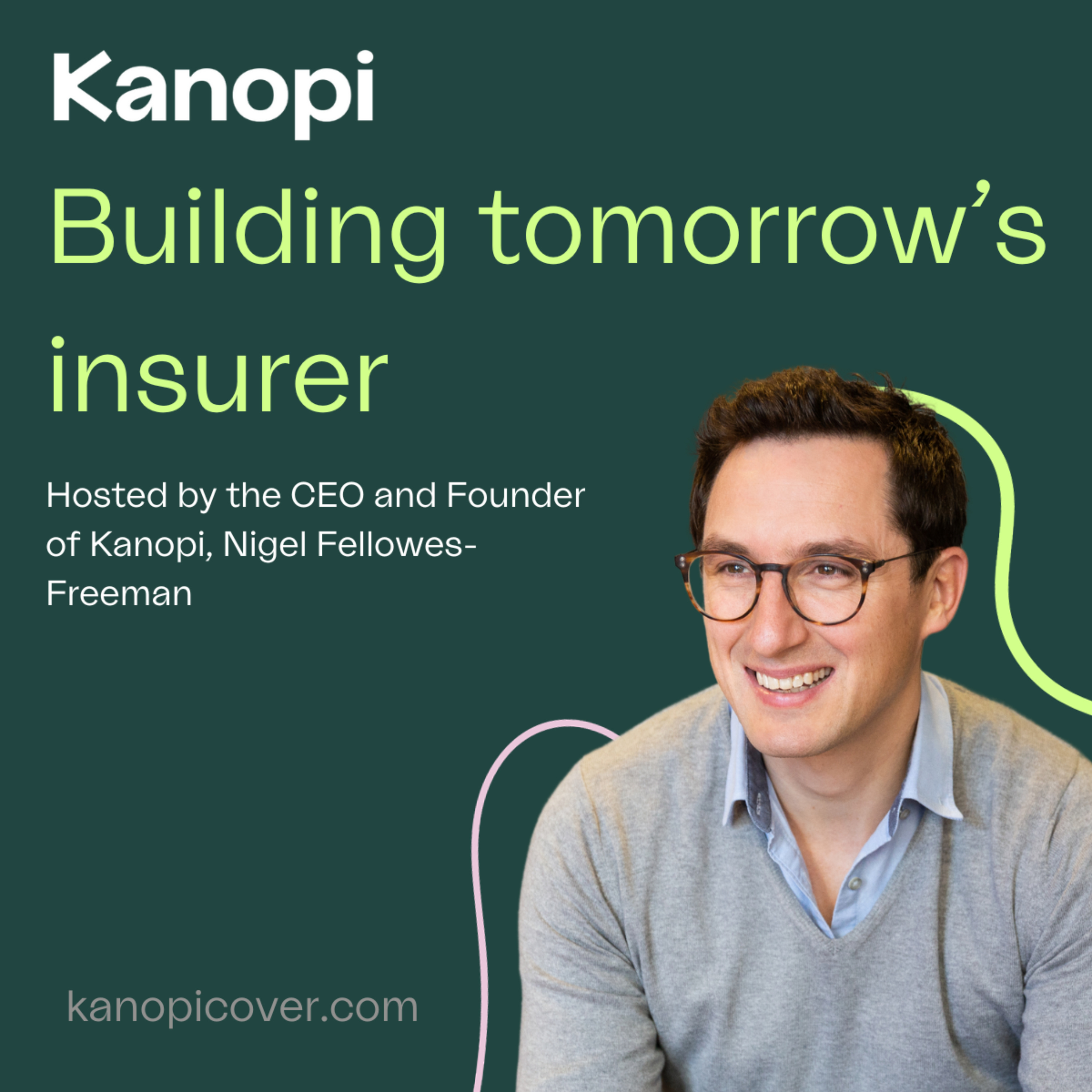
Hosted by Nigel Fellowes-Freeman
Hosted by Kanopi’s Founder and CEO Nigel Fellowes-Freeman, 'Building Tomorrow's Insurer' slices through the complex insurtech landscape. Simple, clear, and forward-thinking - this podcast is your guide to understanding how technology is rewriting the rules of insurance.
80 episodes · publishes fortnightly · latest 2026-06-10 · ~40 min/episode
Rank
#337
Substance
78.0
/ 100
Breakdown
Scored 2026-07
Updated monthly
Across the index
#337 of 6181
Substance
Top 5%
outscores 95% of the index
Building Tomorrow's Insurer ranks #337 on The B2B Podcast Index with a substance score of 78.0 out of 100, scored across 1 recent episode. It scores highest on guest caliber and insight density. Kyle Nakatsuji is a genuine operator: decade-long founder of a tech-native insurer that built its own policy admin system and was an early LLM adopter, now actively deploying agentic AI inside insurance businesses through Dearborn Labs. He speaks from direct build-and-run experience rather than advisory distance, which is rare in this space.
Averaged across 1 recently scored episode, with cited evidence.
The episode packs in a meaningful cluster of non-obvious operational ideas - the four AI failure modes, the 'less AI than you think' principle for robust implementations, and the bind-rate-as-pricing-hole detector - but substantial airtime is consumed by the host's lengthy self-insertions, mutual affirmations, and generic workforce commentary that dilutes the overall density.
“the not so secret secret about building great AI implementations Is that they often have less AI than you think. Because the the fastest way to make it work badly is to put AI in a process that can be done quickly and in an automated fashion that should be deterministic in the first place.”
“In like 800 different private DMs within Slack. And if you don't have access to that bit of context, you will not actually understand how undering decisions get made at the business.”
There is genuine first-principles thinking in the 'hooks over autonomy' argument for agentic systems and the Slack-DMs-as-ground-truth insight about where operational knowledge actually lives; the four failure modes framework is practitioner-derived rather than recycled. However, the agent-invokes-human inversion, the human-advantage taxonomy (relationships, taste, judgment), and the three workforce scenarios are ideas already circulating widely in the space.
“hooks work better than letting the AI just decide what to do. You end up building in quite a bit of determinism into the system to make sure that it functions properly and repeat and and works in a consistent fashion.”
“failure mode two was there were a lot of people ⁓ to bolt AI on top of existing workflows that were not meant for it. And when you bolt AI on top of an existing workflow that was not meant for it, you were gonna end up with an inadequate outcome”
Kyle Nakatsuji is a genuine operator: decade-long founder of a tech-native insurer that built its own policy admin system and was an early LLM adopter, now actively deploying agentic AI inside insurance businesses through Dearborn Labs. He speaks from direct build-and-run experience rather than advisory distance, which is rare in this space.
“we built our own policy admin system, we were, you know, very early adopters of generative AI and AI generally in terms of risk models and sort of LLMs that interact with consumers and LLMs that are built into tools our employees use”
“we for for years felt like we had built up a technology asset, both in terms of the technology we built for clear cover”
A handful of concrete details land well - 800 Slack DMs as the real locus of underwriting decisions, the bind-rate walkthrough as a multi-layer leading indicator, and the metrics tree drill-down - but the episode offers no hard financial outcomes from ClearCover or Dearborn Labs deployments, no named clients, and no actual loss or expense ratio figures despite the guest having a decade of relevant data to draw from.
“In like 800 different private DMs within Slack. And if you don't have access to that bit of context, you will not actually understand how undering decisions get made at the business.”
“they rolled out like forty five products in forty to five days or something it was incredible”
The host lands a few genuinely useful pushes - the 30-day action plan request and the 'what metrics actually matter' follow-up both surface concrete answers - but he routinely self-inserts multi-sentence commentary before Kyle can respond, answers his own questions, and lets strong claims pass unchallenged; the net effect is a validation session more than a rigorous interview.
“Can you give me some something tangible, maybe like a thirty day action plan? Like what for the next thirty days should this person do”
“Yeah. Yeah. Yeah. Yeah. Yeah. Yeah. Got it. Got it. Interesting. Yeah.”
First period on the Index - history builds from here.
1 scored on substance · 60 tracked in total.
Add this badge to your site - it links back here and updates automatically as you rank.

<a href="https://index.fame.so/show/building-tomorrows-insurer" target="_blank" rel="noopener">
  <img src="https://index.fame.so/badge/building-tomorrows-insurer/badge.svg" alt="Ranked #44 on The B2B Podcast Index" width="360" height="136" />
</a>Track Building Tomorrow's Insurer's rank
Get an email whenever this show moves up or down the Index. Monthly at most, no spam.
Companies, products and tools that come up most across this show's episodes.
The themes that come up most across this show's episodes.
Podcasts that dig into the same topics.

Techfluential by Deloitte
Custom Content from WSJ

The Digital Transformation Playbook
Kieran Gilmurray

Rethink Imaging
Imalogix

Enterprise AI Innovators
The AI in Enterprise Software Podcast Series

Engineering Founders
The Engineering Leadership Community (ELC)

Digital HR Leaders with David Green
David Green



