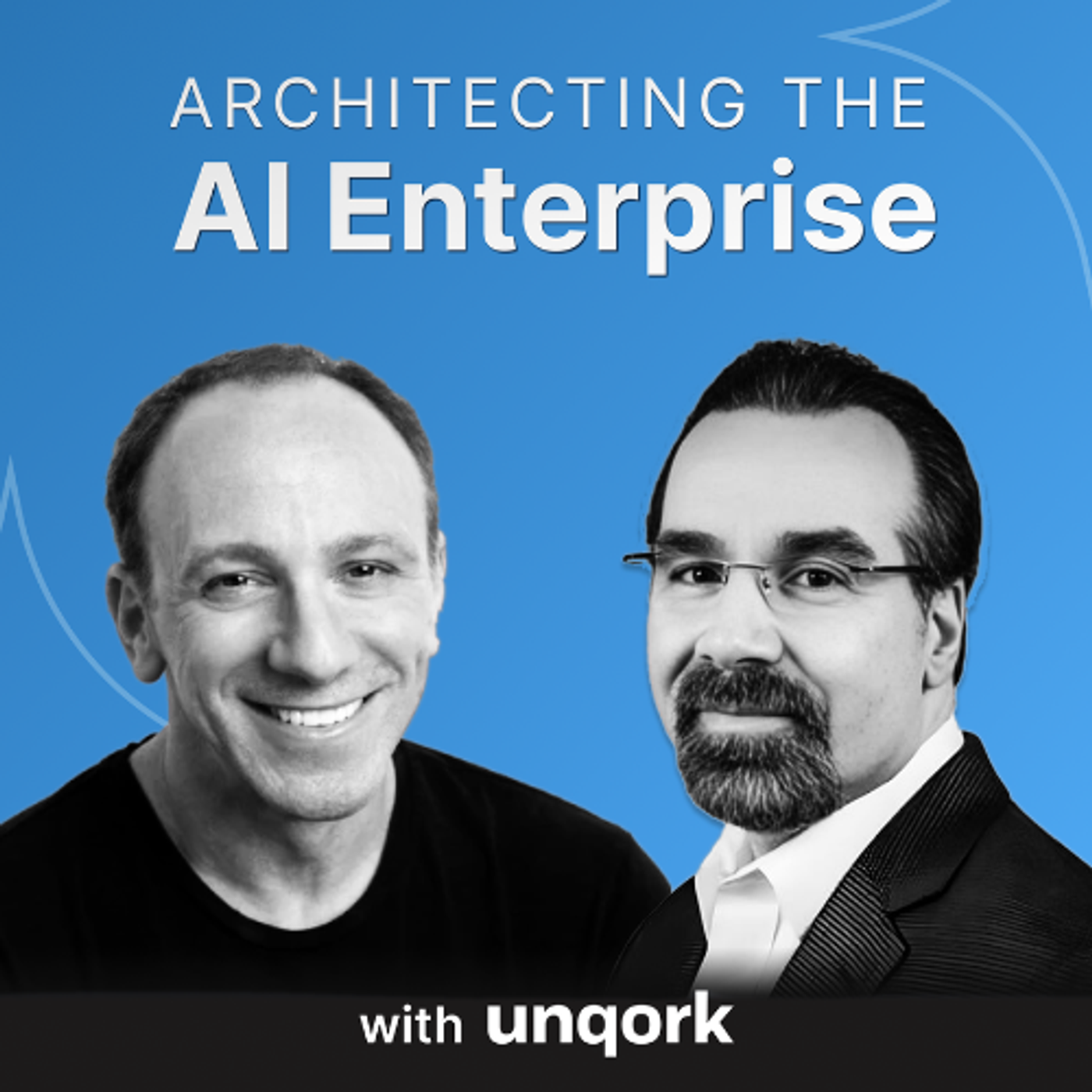
Architecting the AI Enterprise · 2026-07-23 · 35 min
Key moments - from our scoring
Substance score
62 / 100
Five dimensions, 20 points each
Bob Pick brings a unique perspective to enterprise AI architecture, drawing parallels from his background as a credentialed architectural historian. Tokyo Marine's federated operating model across 57 countries and 53,000 employees provides a natural laboratory for thinking about how to architect systems that are simultaneously flexible and governed. Pick advocates for a "thin core" architectural philosophy - lightweight but intentional foundational structures that enable business users to prototype and experiment while maintaining the guardrails that regulated industries demand. He's skeptical of unbridled "vibe coding," arguing that citizens love to develop but rarely maintain or fix bugs, and that four vibe coders can create forty years of technical debt in four days. Dave Ferrucci pushes deeper on the hidden complexity of AI-powered applications: determining what good looks like when systems use LLMs or agents is fundamentally harder than validating deterministic formulas. The trio explores how the CIO function is evolving from a technical role to an orchestrator role - one that assembles solutions from code, people, partners, and tools while ensuring enterprise-class systems remain supportable, auditable, and secure. Pick makes a compelling case for why liberal arts and humanities graduates are increasingly valuable in this world: large language models are fundamentally language machines, and people trained in explanation, context, and linguistic rigor have advantages in prompt engineering and agent design that pure engineers may lack.
A thin core is a lightweight but intentional foundational structure that provides pillar technical capabilities, integrations, and processes, while enabling flexibility and innovation through AI, low-code, and no-code tools - rejecting both monolithic systems and unstructured approaches.
Vibe coding creates technical debt, lacks governance controls, and citizens typically don't maintain or fix bugs; regulated companies must document and sign off on processes like underwriting and claims, and regulators will fine companies $20-50 million if they deviate from documented procedures.
The CIO is evolving from a technical decision-maker to an orchestrator who assembles solutions from code, people, partners, and technology while ensuring systems remain supportable, auditable, and secure - a role that requires understanding how things fit together rather than making detailed technical decisions.
With AI applications using LLMs or agents, it's difficult to know what good looks like - you can't easily verify accuracy, recall blindness hides missing results, and implementation approaches deeply affect quality in ways that require formal evaluation methods to assess.
Large language models are fundamentally language machines, so people trained in explanation, context, and linguistic rigor - skills emphasized in arts and humanities education - are better equipped to be prompt engineers, agent teachers, and context advisors than pure technologists.
Our reviewer’s read on each dimension, with quotes from the episode.
The episode contains solid practitioner insights on AI governance, the tension between democratization and enterprise-grade safety, and concrete architectural philosophy ('thin core' vs. monolithic systems). However, substantial portions drift into general philosophy about AI, liberal arts education, and personal anecdotes that don't directly teach B2B operators concrete operational lessons. The insights cluster heavily in the second half; the first third has notable padding.
four vibe coders can create forty years of technical debt in four days
citizens love to develop. They do not like to test, maintain, or fix bugs
Bob presents a useful reframing of the CIO role as 'orchestrator' and 'glue' rather than technician, and the 'thin core' architectural philosophy is clear. However, most of the core ideas - federated governance, the risks of no-code/low-code in regulated settings, the need for transparency and accountability - are established wisdom in enterprise architecture. The discussion of LLM hallucination and prompt sensitivity, while valid, echoes common concerns already widely circulated in AI circles.
the role of the CIO has been evolving to less of a technical role and more of an orchestrator role
you need to have a lightweight, thin core, we call it, not fat core, and certainly not the more recent trend of morbidly obese core
Bob Pick is EVP and CIO at Tokyo Marine North America (a $6B division) with deputy group CIO responsibilities across 57 countries and 53,000 employees. He is a genuine senior operator managing complex federated IT governance at enterprise scale in a highly regulated industry. His credentials and scope are strong, though he is not a founder or innovator - he is an excellent but traditional enterprise executive.
I'm the CIO for Tokemarine North America, which is about a six billion dollar piece of the PNC puzzle for Tokymarine in the US
I'm deputy group CIO for Tokemarine Worldwide, which means I run around herding cats and trying to get folks to go generally in the same direction
The episode includes some concrete details: Tokyo Marine's $6B revenue, 57 countries, 53K employees, the 250,000 flat files in their policy admin system. Dave Ferrucci provides specific examples (search recall blindness, the LLM hallucination story with 100-page theory on human argument). However, most claims lack supporting numbers, timelines, or named customer examples. The discussion of governance and control remains largely abstract - no specific metrics on how governance is measured, no concrete examples of what 'guardrails' look like in practice, no dollar figures on regulatory penalties cited beyond vague references.
a policy admin systems, for example, it's we've modernized the daylights out of it, but it's on an older architecture. It has 250,000 flat files
four vibe coders can create forty years of technical debt in four days
The hosts ask reasonably sharp follow-up questions ('how does the analogy work for you?', 'do you see any change in the CIO function?', questions on transparency and accountability mechanisms). However, the conversation often drifts into tangential territory - extensive discussion of liberal arts degrees, favorite books, and TV shows that consume substantial time without advancing core insights. When tough questions arise (e.g., the mechanics of maintaining accountability with AI), the answers are acknowledged but not pressed deeply. The hosts miss opportunities to challenge Bob on the vagueness of 'guardrails' or to extract concrete operational details.
I think it works really well. And as we found on our most recent panel with our our friend Sastri, it really the the whole architectural aspect of it
Dave, I I agree absolutely with your your flow there. I think the role of architect, both capital A and small A, becomes actually more important in this environment
Computed from the transcript - who did the talking, and the words that came up most.
In this episode of Architecting AI Enterprise , Unqork CEO Gary Hoberman and Chief AI Officer Dave Ferrucci sit down with Robert Pick, CIO at Tokio Marine North America, to discuss the realities of scaling AI in highly regulated industries. Together, they explore the operational limits of "vibe coding," the evolving role of the CIO as an enterprise orchestrator, and why human context remains indispensable in an AI-driven world.
Transcribed and scored by The B2B Podcast Index.
Unqork: Welcome. I'm Gary Hoberman, founder and CEO of Encork. Hi, Dave Ferrucci. I'm Chief Technology and Chief AI Officer at Uncork.
So in this series, which is Architecting AI Enterprise, we bring top leaders to explore what it means to use AI at enterprise scale. And this is the first one I'm doing outside of our new podcast room. So I am literally on the road, as you could see. You could hear the background noise.
But we didn't want to miss this chance to bring our guest, Bob Pick, EVP CIO at Tokyo Marine North America. ⁓ Bob, you know, I've gotten, I think, is it two panels we've now done together? Maybe three at this point. Three.
That's three. But you know, incredible leader. You know, you're in an organization which is diverse insurance, yet ⁓ also managed very differently. As ⁓ you have to manage all different business units and lines and And keep everything in sync.
If you could tell us, tell us your story. Tell us a little bit about Tokyo Marine, what you do there, and then we'll jump in. Sure. Yeah.
I have two roles at Tokyo Marine. I'm the ⁓ CIO for Tokemarine North America, which is about a six billion dollar ⁓ piece of the PNC puzzle for Tokymarine in the US. And I'm deputy group CIO for Tokemarine Worldwide, which means I run around herding cats and trying to get folks to go generally in the same direction. Tokemarine is one of those.
Relatively quiet companies in the Western markets. We we ⁓ really work through our brands, so it's not necessarily the token ring logo that's ⁓ slapped on everything, but we operate by what we call a federated model, which means outside of Japan we've grown through purchasing performing companies and letting them do their thing. We ⁓ operate very differently than most global companies and certainly than most ⁓ Japanese companies. in that the ⁓ the the local management teams ⁓ they rule the roost and we provide governance support help ⁓ and kind of strategic vision but they do their thing so we're in fifty seven countries about fifty three thousand employees we are predominantly P and C in the Western ⁓ part of the world though we do have group life ⁓ and and benefits over at ⁓ Reliance Matrix ⁓ but we also have ⁓ life and annuity products ⁓ all throughout Asia so it's a it's diversified ⁓ and it's an interesting place.
But one of the one of the things that we're able to do is take that diversification and make it into a really interesting place to work. Yeah, and Bob, you have you have a unique ability that I learned in the last panel we did on stage. And that was when we when we talk about architect, it means something very different to you than it does to Dave and I. Right?
So so if you could just expand on what why why would I say that? Let's hear. Gary is revealing to Dave that I have ⁓ none of the educational background to do anything I've ever done professionally. So I'm a credentialed architectural historian and I love to be the cohort of one.
So when I'm talking to people about AI or or system modernization or whatever esoteric topic of the day, I can do it from the authority of having a master's degree in historic preservation planning. So all very exciting there. But you know, it does have ⁓ actually I was speaking to a group of ⁓ graduates. ⁓ at a liberal arts school ⁓ outside of Baltimore.
And one of the things I mentioned is that that AI, generative AI, is so really centered on a language that the arts and humanities have a great role in in the STEM world that we're such a part of. ⁓ because ⁓ the at least theoretically, arts and humanities ⁓ majors should be able to speak and write and analyze and set the context, write the prompts, do all sorts of things. So I'm actually bullish for arts and humanities in our STEM world. Can I, you know, I never asked you this before, but you know, I've always I remember in the days in the 90s when I would sit with my business and say, Listen, you need to define the requirements.
And they'd go, What do you mean? Why do we have to define the requirements? I'd say, Building great software is like building a house. And we need to first agree on the blueprints and what you're looking for in the windows.
And once we once we put up the two by fours and install that window, it's going to be impossible to move. And Like, is the analogy work for you? Does it not work for you? I'm just curious.
What's your I think it works really well. And as we found on our most recent panel with our our friend Sastri, it really the the whole architectural aspect of it, he made a great elevator analogy, which I've seen go around the planet a couple of times in the last few weeks. I think it works really well. Now that said, being virtual, AI provides us some interesting opportunities and capabilities to move some doors and windows.
But when you think about putting a structure in place, and you and I, ⁓ while we we we debate on a couple of fronts, we have long agreed, ⁓ and and correct me if I'm wrong, that you know, the the days of having giant monolithic systems that sit there where everything is in concrete and you have to literally chisel it out to be able to make any change, long past that. Now that we can argue how lightweight the structure needs to be, ⁓ or even whether there's a structure in a traditional sense at all.
But I do believe that my my architectural philosophy is you need to have a lightweight, thin core, we call it, not fat core, and certainly not the more recent trend of morbidly obese core. ⁓ but you have to have some pillar things in place. Some of them are technical capabilities, some of them are integrations that are in place, others are we'll say, ⁓ kind of pillar process or ⁓ you know, your special sauce. But in and amongst that, whether it's AI, low-code, no code, there's so many techniques available.
To make things more flexible today and to do it safely, responsibly, without, you know, vibe coding on a weekend and trying to throw it in production on Tuesday. I you bring up vibe coding. So I'll ask the first question. Dave, you've got the next one.
You get to pick. On vibe coding itself. Like, so I I was with a there was a reporter yesterday we met with who said, Hey, yeah, I reached out to you because I know on Quark I guess vibe coded this app. And and I'm not technical, but look what I could do, and I want to know how you think of that.
Like that's the You know, what's your view of vibe coding and will the business play a bigger role? Is it gonna bring the business closer? What will the CIO function look like? I'm just curious what your your feeling is.
So I'm gonna walk a tightrope here because I don't want to get in trouble. But I will say a ⁓ a brilliant founder and CEO said I think a year ago that four vibe coders can create forty years of technical debt in four days. ⁓ and I believe that was that was you at ⁓ Uncor Creates in 2025. And I have quoted that repeatedly, and I believe it to be true.
Look, I I'm I'm I've been in the business long enough and I have enough gray hair, what's left of it, that I'm a little cynical when it comes to so-called citizen development. And my experience, my my considered experience and observation, really not trying to be cynical, is citizens love to develop. They do not like to test, maintain, or fix bugs. And Just because we have a new set of tools and new methods with AI, I really think I believe that to still be true.
Now, I I do think the tooling, the modern tooling that we're seeing, AI-centric, but also just the you know, kind of the context around it, is getting easy enough. And where guardrails can be instilled inherently in that tool without being explicit or implicitly without being explicit, I do think it creates more opportunities. For more people who are not deep tech nerds to participate in solution creation. And we do want to unlock that.
A number of our Tokyo Marine groups, actually Tokyo Marine H2CI in in London, is doing some really good work right now to unlock that for more and more of its business users. But the unbridled, I vibe coded this, I'm an underwriter, and I want you to put it in production, please do so. That number one, we're regulated, that can't happen. I mean, our role as an industry is to manage risk.
We can't undertake risky behaviors ourselves. ⁓ that said, I think there's a lot of distance between they build it and throw it in production, or we only the anointed few nerds may may do, you know, technical work. This ⁓ creates more space in that continuum for more people to do more into or have a greater role in solution development for sure. I I like that.
I'm gonna grab some I'm gonna steal some of your quotes on that. And that was good. That vibe coding quote. I've gotten so much mileage out of that.
I'll give you more. We'll we'll come Dave's got a lot of those as well. Look, Dave, when you know we Dave first joined on Cork, he you were Dave, you were in your garage vibe coding. Like you were using every single tool and platform and I I I I I yeah, I mean I still I I still do, right?
I mean, I think that it's so important to understand. the differences, the potential and just understanding where where all these tools are going. ⁓ I tr largely agree with w with ⁓ you know what Bob was saying. I think that I think though there's sort of another interesting aspect to it.
So I think there's absolutely going to be an opportunity for people who do not have as much depth, with regard to the technical skill of programming to be creating applications. I think that's sort of certainly true. I think what's what's hidden in there though, which is really fascinating, is that there are so many things we do with applications today, especially with the the use of AI inside applications, where it's very hard to know what good looks like. In terms of are the answers accurate?
⁓ are they what we expect? Where are the potential flaws or problems in those results? Search is a really good example, right? Search comes up and says, here's a bunch of answers, but you have no idea we call it recall blindness.
You have no idea what's not being showed to you. You don't really have any idea if the most important things are being ranked. and you read the top ten and you're done. And you have no idea what you're missing.
I mean, you have a similar issue with using large language models, you have a similar issue with using agents. you have a similar issue when you program systems that do complex things. They're just not executing a formula or computing an interest rate where you could go in there and check it, right? and a lot of times that has a lot to do with the has a lot to do with how.
The system decided to implement an intent. So if you don't have a depth of understanding about how different implementation approaches impact the quality of those results, you're kind of stuck. You don't know how bad it is or how good it is, or even how to direct the I the AI to improve it, unless you really start to dig in and have it having. A formal understanding of how to evaluate ⁓ those results and how to get the AI to iterate on its implementation to achieve that.
So this is when applications get complex and it's just above and beyond having coding skill. ⁓ and this is an a very interesting challenge. And you and we talk about what is really the skill for building complex systems. And you talked about even other other disciplines playing a role in in all of this.
But the discipline becomes one of being comfortable with formal systems and formal evaluations and the process that is involved in ensuring that a ⁓ a system is meeting those expectations and really understanding that, and then what to do about it. And you might not even know what to do about it. I mean you might have to go get help to figure out what to do about it. So I think it's just more complex than most people realize.
so so while it's like I agree with the premise. I I just say there's just caution as you build more and more complex enterprise class applications that do things that are not as easy as retrieving something for a database or computing a a precise formula. Yeah, it is I liked what you said, Bob, about precision, correctness, regulation. Like people unless you present to regulators and on they're they want to know what you've written down is what's going to be executed.
Right? That's the like you're going to sign off on here's our underwriting process, here's the claims process, here's what we and If they catch you deviating from that even once, you're gonna get fined $20 million, 50 like the costs are immense, right? And I've seen that. So so you're I I like the the concept of that.
That's you know, what does in a world in a world where business is now prototyping faster, do you see any change in the CIO function? Is there gonna be any any future where the CIO function splits between build and operate and run or Do you think it's continuing and just we're bringing the business closer into the process? I'll say heavens, I hope not, because those really need to be inextricably linked. But and and I gotta say, Dave, I I agree absolutely with your your flow there.
I think the role of architect, both capital A and small A, becomes actually more important in this environment because developers themselves are becoming further and further disarticulated from the code that AI is writing. They can't really vouch for it at a certain point because there's so much that's changing underneath. And this goes directly to my response to you, Gary. And that is the, in my opinion, the role of the CIO has been evolving to less of a technical role and more of an orchestrator role.
And I I regularly refer to CIOs as glue. most CIOs that I know are not necessarily making detailed technical decisions on a day-to-day basis, certainly not in shops of any scale, ⁓ for sure. What they are doing is they're thinking about orchestrating not only their people, but systems. They're working in it with an architectural mindset, a relationship mindset, ⁓ and really thinking about how we assemble solutions.
And I include in that code that we write right here. It's not not just, you know, bringing in off-the-shelf stuff. I mean, doing hard engineering internal to our shop, but it's still part of the soup where we're assembling the solutions. And that goes to I I think what Dave was saying, even if you have And we do have AI-powered tools that greatly accelerate that, simplify certain things.
At the end of the process, and hopefully it points along the the way too, it takes women and men who understand how things fit together. And in in my role, it's understanding how people fit together, partners fit together, tech fits together, et cetera. And then everyone has a responsibility in there. So opening up, democratizing whatever kind of cheesy consultant words we want to use, but letting more people into that.
solution proposal, solution prototyping ⁓ process, that's great. But at the bottom of that funnel, out has to pop enterprise class technology that is supportable, sustainable, auditable, and secure. There's no way around it. And that's where ⁓ you know I've commented probably a little bit too much ⁓ recently since we were together at ITI that ⁓ that the challenge of governance and safety of AI being at least a year behind The capabilities of AI is a real problem for every company and every person, but especially for regulated companies.
Cause to exactly to your point, we have regulators who are earnestly expecting us to ⁓ exercise the same care that we do with our, we'll say, incumbent or prior technologies as we do with AI. If we're not able to show them here's the balance, here's how we're doing it, and do it in a way which is pithy and encapsulated and repeatable and that. That's a problem. And that's not a hypothetical hand-wringing line.
These are serious responsibilities we have as an industry, not only to our regulators, but to our policy holders, to our claimants and our business partners. We have to take care of this stuff. So we can't just kind of dabble a little bit and then throw it in and say everything will be fine. And that goes to architecting and orchestrating this assembly deliberately, even while, yeah, we have more people who can do more fun stuff and participate in more aspects of it.
The end of the day, the dirty little secret is as sexy as AI is and as fun as it is to use and as democratized as it is, when it goes into production, it's enterprise tech, full stop. I like that. I like the way you're you know it look for for an architect of, you know, residential and business and appreciating you you you're you're s you know, you speak the truth for sure in that. You would definitely appreciate that.
⁓ you know, it's it's interesting because the idea of an agent taking an action. I I was sharing recently, we were using a model here and during a demo the model started to speak Korean to me. As you do. Of course.
I mean, it knew I it probably knew deep down inside somewhere I wanted to basically learn Korean. You know what I and so it's funny that like imagine that in production and executing ⁓ an underwriting decision. And like it's kind of crazy. It's it's but we'll we will from a governance point of view, I think we'll get there.
I think it's gonna be we all have to recognize we're gonna get there. with the right governance controls and and agreed with that. Yeah. Throw out a question.
Let's do it. You you kind of piqued my interest in the beginning about talking about liberal arts and how you see roles for them opening up as a result of AI in some way. ⁓ I was wondering if you could elaborate on that. Yeah, it's it's interesting because I've I've had to do a lot of thinking of this.
I mean my daughter graduated college last year with a French major and she's doing great, but It's coming in a living in a tech world, ⁓ you know, you you kind of scratch your head a little bit. ⁓ but looking around, ⁓ you know, I'm I'm a big believer in all truly all lenses of diversity, but especially that diversity of thought, that diversity of kind of context and perspective. If the world is full of only engineers and scientists, we would have a problem. If it's full of only arts and humanities, brutal.
And then in the middle we have folks who bootstrap themselves, teach themselves, come out of military backgrounds, whatever it is. It's the soup, it's the the union in that Venn diagram where really cool stuff happens, or really efficient troubleshooting, really efficient problem solving. And when I think of ⁓ you know, the interaction that we have and the the essence of of generative AI as expressed, whether in agentic or chatbot, what have you, recognizing The totality of generative AI is not a prompt and a response.
There's a lot more to it than that. But so much of it in the way it's used in in business is language based. And so I've been been saying as we and it goes back to the the changing roles for for folks in tech, you know, folks who are educated and trained and spent years writing code are now suddenly being asked to not write code or write less code and instead be a teacher to an agent, be a prompt editor, be a context advisor. And you know, I I was we had a town hall here yesterday and asked how many of you assembled self-selected in college to be a teacher.
And ⁓ two of us raised our hands. I wanted to be a high school history teacher at one point, and another ⁓ another person raised her hand. And that tells you everything you need to know. Like, we're not ready to be agent teachers and agent, but the arts and humanities background that has a little bit more of that explanatory, contextualized, linguistic bent, there's a They find that a little bit more comfortable.
I g that's so that's fascin and that's a great perspective because language is ⁓ as you said, these are language machines. Large language models are language machines. Now the reality of the reality is that, you know, there are many kinds of languages, like DNA is a language, right? So a a symbol system that reflects ⁓ A a way to express something about a separate architecture, a separate system, like it's symbols pointing into something else.
Now, natural languages like that, programming languages are like that. I mean, programming languages are formal languages. Natural language is not formal informal, meaning it's polysimous, it's ambiguous, it's highly, highly contextual. And so what's really interesting about what you're saying is I kind of agree with that, but it feels like a double-edged sword to me because.
large language models, what they return back to you is so so tremendously influenced by that prompt. And the reality is if you're crafty with LLMs, you can get them to say whatever it is you want them to say. And so so there's a very different discipline ⁓ that sits somewhere in between what I would consider scientific and logical rigor. And ling and sort of linguistic prowess.
How do you get, and I can and I and you know, I have a ball with this and I could show you so many conversations, you know. How do you get an LLM to actually give you a well reasoned, well ⁓ s cited response? What is the what is that sort of Communication or control over that agent or that LM. What does that look like?
and that's sort of very interesting because that kind of feels like, and this is often what I'm doing with LLMs, being a very critical logician. Yes, I'm communicating through language, but I'm demanding, I'm demanding a certain amount of logical rigor in that in you know, in that process. And When people send me things, well, look, this is what my LLM said. And I said, and I I remember a really great example.
Someone developed this in theory, was extremely excited about it, going back and forth. It was like we're it was like a hundred pages of a theory on some universal model for ⁓ human y ⁓ human argument and communication, whatever it was. And he drew a bunch of inferences. And he said, Dave, what you think?
And so I went through it and I said, I think it's not meaningfully grounded in any way, shape, or form. But the LLM was incredibly supportive of the whole thing. And it said, Well, did you read it? I said, I did.
And and ⁓ and he said, Well, why don't you and I told him all the problems, why don't you argue with the LLM? I said, Are you kidding me? He says, Yeah, don't argue with me. Argue with the LLM.
So I came back about 30 minutes later, where the LOM had completely undid all zone inferences, has backtracked on everything, and called Ethereum a total piece of garbage. I've done this too, Dave. I think it was a point I came to and I go, I go, look, look how great. Like you could ask, you know, Gemini and ChatGPT how great on Quark is and what we're doing and this and is it the right.
And then you're like, yeah, just go open up an incognito window and do the same thing. It's like and it's like, wait, it's it's telling me what I want to hear. I mean, it is it is fascinating and it it believes it though. It makes us it makes us truly believe it, which is which is fascinating.
⁓ But but this is a question. I am not concerned about humans losing their role, ⁓ even in the face of AI, because our role is to provide those, call them guardrails, but provide that context, provide that intelligence, that intuition, everything that we do that differentiates us that it can't do. And I know there's some deep dark AI futurists that is saying, ⁓ it can do everything. Well, I I say no.
It it literally cannot smell a flower and those sorts of things, at least not yet. ⁓ I agree with you. Yeah, I mean it it it it mimics It it actually doesn't formally reason in a mathematical sense. ⁓ you know, it mimics our reasoning patterns.
It mimics the biases and whatever data we gave it or projects the biases. And I don't necessarily mu bias is a bad thing. I mean it, I mean it as whatever it is that the training data ⁓ holds to be more or less true or accurate is reflected by the LLM. So it reflects its bias.
It reflects is the it reflects the reasoning patterns represented by the linguistic structures. Right. If those are good reasoning patterns, great. If they're bad, bad.
But it reflects whatever's in the training data, right? But I often tell people they say, you know, when you talk about, well, is there a human role? Well, you know, well, the LM, you know, when people think of the LM as an oracle in the sky, right? It's it's always right, has the answer.
And I said, first of all, that's not necessarily true because it's really reflecting whatever is in in in in the training data. But then there's this other weird, really weird reality that makes people scratch their heads. I say, you know, we value this notion that someone has this great or perfect answer for us, but we have incredibly smart people in our world without AI that come up with Incredibly fantastic answers and solutions for some of the hardest problems we face, and nobody listens to them.
And this is a whole another reality of our world. It's about incentives and it's about power and it's about self-interest. And what really wins. So you come and say, ⁓ here's the AI.
It said this. Thank you very much. I'm not interested in that answer. Let's move on.
⁓ so you know, there's still this, and to your point, Bob, there's still this. The it's it's our world. It's not the AI's world. We take accountability, we take responsibility, we have our own incentives.
And sometimes getting to the answer is less about the ⁓ logical ⁓ process and more about the human process. Right. Right. We can't escape that.
Yeah. Bob, I'm curious, like from an architecture point of view, like you have an enterpr you have a central enterprise architecture team. Right. You're you're are the who's playing the role of governance in AI?
Who's playing because I'm assuming the businesses are batting down your door and saying, Gimme, give me, give me and you know, you're so how do you view that structure set up, the governance controls? Yeah, for most of our most of our companies, and certainly it the same is true for telegram and North America. We long ago set up working groups that were focused one on governance and kind of ⁓ policy oversight and the other on the on the tech aspects of it. For the most part in our world, those the governance piece of it exists in in enterprise risk management, not in IT.
Now it's an allied discipline. So it's got a whole bunch of folks with various letters before and after their name and that sort of stuff. It's an allied discipline. But then the application of that.
Over on the safety side, if we just simplify it to governance on the one hand, you know, policy, regulatory, ⁓ kind of awareness, et cetera, ⁓ controls compliance, safety is actually the operationalization of that, plus all the usual things we have to do in in enterprise tech. The safety stuff is definitely over on I'll say the the applied and in a lot of our companies it's within IT. Some of them might be the data ⁓ organization, a couple I think it's in Actuary where they have more of an applied wing there.
But We we very much, I mean, we're all about segregation of duties, et cetera, et cetera. And the governance piece of this tends to float over in risk management. Interestingly, a number of our companies have now tagged ⁓ you know, full-time or multiple full-time individuals purely on the governance end to really focus and think this thing through because we're recognizing we don't know what we don't know. And I think most companies, and not just Tokyo Marine, I think most companies in the insurance industry wanna do the right things and they recognize the risks of this stuff as much as they recognize and are very bullish as I am on the benefits that we're going to see.
But we gotta keep ⁓ a little bit of a leash on it. ⁓ that doesn't mean the dog isn't pulling us forward, but it means we we have to we humans and we corporate have to be in control of this as we go forward for all the, you know, the you know, various ⁓ you know, common reasons. Right. And have you thought about, you know, when you talk about control and governance and taking responsibility, all you know, I tell engineers, I mean, you could use AI, but in the end, you're responsible for the outcome, right?
And so how how has the access to that transparency changed with AI, right? Because this, you know, this shift of I I'm not as in touch with every detail because I'm having AI do that. rolls all the way down the whole organization, you know, from executives all the way down to engineers who you ask them a question and say, I'm not really sure I didn't code that part. ⁓ so how how do you maintain like how do you think mechanistically what the tools and systems need to do to give you the transparent transparency to re main ⁓ to provide that accountability response responsibility and governance.
Yeah, it's very challenging because as I referred to before, the disarticulation of coders from code is a real thing. And that's happening right now. And people are uncomfortable saying, you know, sign even signing off and size like I used to know literally every line of that code I wrote it over the last ten years. Now I don't know, they've modified the library.
So quite honestly, I think looking at the tooling that's available and the, you know, alphabet super platforms that everybody's using. There is some kind of ⁓ reconnaissance tooling that allows those quality checks to d to be done and not just quality, but the impact influence, ⁓ adherence to standard security, et cetera. I think some of this, oddly enough, is solved with ⁓ agents and microagents who can go off and do certain very specific tasks and report back on on what they're finding as it relates to adherence to standard.
⁓ and even just in some of our very complex systems, as you guys well know, because Uncork helps to solve this. The degree of complexity for humans is almost impenetrable. So it actually flips the script a little bit. I think one of our policy admin systems, for example, it's we've modernized the daylights out of it, but it's on an older architecture.
It has 250,000 flat files that get lit up for various purposes. There is not and never was a human readable description of what all that does. Now though, we actually have the opportunity to understand it. So There's risk in the new for sure.
There's risk in di in in the disarticulation, but there's also really strong reward in being able to get at areas of mystery code that you were never able to get to. Yeah, a hundred percent. And that's a fascinating kind of two sides of a coin, right? And I've I I I've talked about this many times before because it's a really fascinating point, right?
Is that is that you you have this incredible power to disassociate, right? To disconnect, to obfuscate even. But on the flip side, you have that ability to now parse through and summarize and synthesize enormous amounts of information that was completely impenetrable to you before. Absolutely.
Absolutely. That's that's amazing. So, Bob, this conversation is incredible. I'm like, I know the audience is gonna learn tons from this.
We're gonna do a quick lightning round. This time I'm gonna go first, because I know Dave's question. ⁓ and he knows my question, but I'm I'm afraid to ask. So the question is favorite book, but it's gonna be something architectural related, or would give us give us what it is.
Let's hear your favorite book. My favorite book is almost always the one that I'm reading right now, which I'm actually reading Deb Smallwood's self-powerment. And partly Deb is just awesome and she's been great to this industry. ⁓ but it's also really it it's it's targeted surface wise.
For for females that are in these technical disciplines in the male dominate, but the the the lessons and the thoughts are universal. I'm enjoying that a lot. But my favorite book, pretty much of all time, is actually In the Heart of the Sea by Nathaniel Philbrick. And it's basically ⁓ it's it's ⁓ historical nonfiction.
It's basically the real story behind Moby Dick. ⁓ it was made into a very mediocre movie a number of years ago, but that is a phenomenal book. I enjoy reading it and rereading it. So that's a fascinating book.
I didn't even know it existed. And so what was the the difference between the real story and what we're all familiar familiar with with with ⁓ with Herman Melville's Moby Deck? Well, it was ⁓ it's the real life story that Herman Melville heard that prompted him to write it. Basically, it was a group of ⁓ Nantucket whalers in the middle of the Pacific in the eighteen teens or twenties, chasing a whale who destroyed their boat and they ended up floating for months.
In the middle of the Pacific, occasionally hitting an island, but for months not hitting an island. And a number of them survived. And it tells the entire story. And then it also tells about their life once they returned and what happened.
Absolutely fascinating. Great Americana story. Wow. So I I I always like to I always like to ask because it tells me a bunch, although I have to say it's often biased by what's available and what's promoted so much.
But what was the last thing you binge watched and Unless you you you don't even have a television, you only read history books. I d I don't I don't I don't know. No, we cut the core, but I got T V. Last thing last thing I fully binge watched was Foundation, which is the ⁓ you know, the Isaac Asim also beautifully shot, beautifully shot and made.
⁓ and starts Richard Harris's son and and other stuff. But my binge watching is I can only like do two episodes on a Sunday and then I gotta go to work the next day. So ⁓ that and we're actually watching the the newest incarnation of scrubs. So that's a that's a fun one.
So there's your yin and yang. So foundation, foundation and scrubs. That's awesome. That's so so Bob, this was incredible.
⁓ again, anytime you need a moderator or a fellow panel panelist, I will be there with you. Dave could do it as well now. And we've got because we always enjoy like the conversation's incredible. And thank you for joining us here.
⁓ and really appreciate it. It's it's an amazing conversation. Always fun. I appreciate it.
Great seeing you both. Thank you, Bob. Thank you, Bob. Thanks again for joining us.
Thanks again to everyone. Thank you to our listeners for tuning in. Make sure to like and subscribe. We hope to see you again in our next episode.
Please send ideas for topics or guests that you'd like to hear from. We look forward to seeing you then. Thanks.
Other episodes covering the same guests and topics, from across The B2B Podcast Index.
 Less about Models; More about ArchitecturePractical AI · on Large Language Models (LLMs)85 / 100
 Microsoft Fabric: The Platform That Turns Data into Competitive AdvantageLeading IT - APAC Insights · on Large Language Models (LLMs)85 / 100
 Xero’s CFO: Why Finance Is Taking On More of the BusinessRun the Numbers · on Enterprise architecture82 / 100
 Vibe Coding Your MVP Is a Time Bomb: AI Workflows for Founders Who Want to Ship TwiceAI for Founders with Ryan Estes · on Vibe coding80 / 100
 The Hidden Risk in AI-Generated Tests and Requirements - Olivier DenooSoftware Testing Unleashed · on Prompt engineering79 / 100
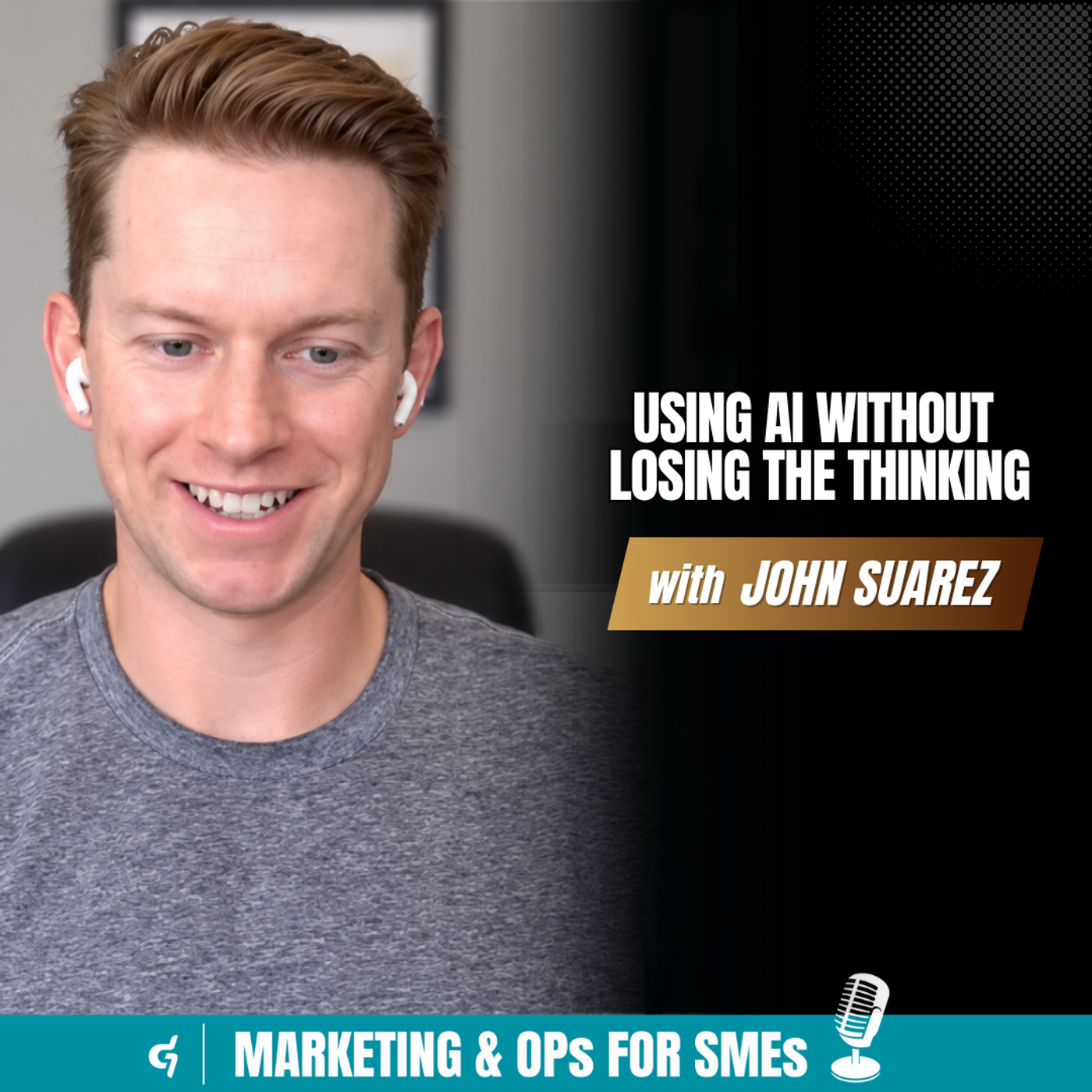 John Suarez on How Businesses Should Actually Use AI Without Losing Human JudgementMarketing for SMEs · on Prompt engineering78 / 100Episode 6: Trust but Verify, Reining In Overtrust in AI OutputsEpisode 5: Is SaaS Dead?Episode 4: The Unseen Role of Judgment and Accountability in AI-Driven DecisionsEpisode 3: Deploying Generative AI to 80,000 EmployeesEpisode 2: From Tech to Business Impact - Rethinking the CIO role in the Age of AI