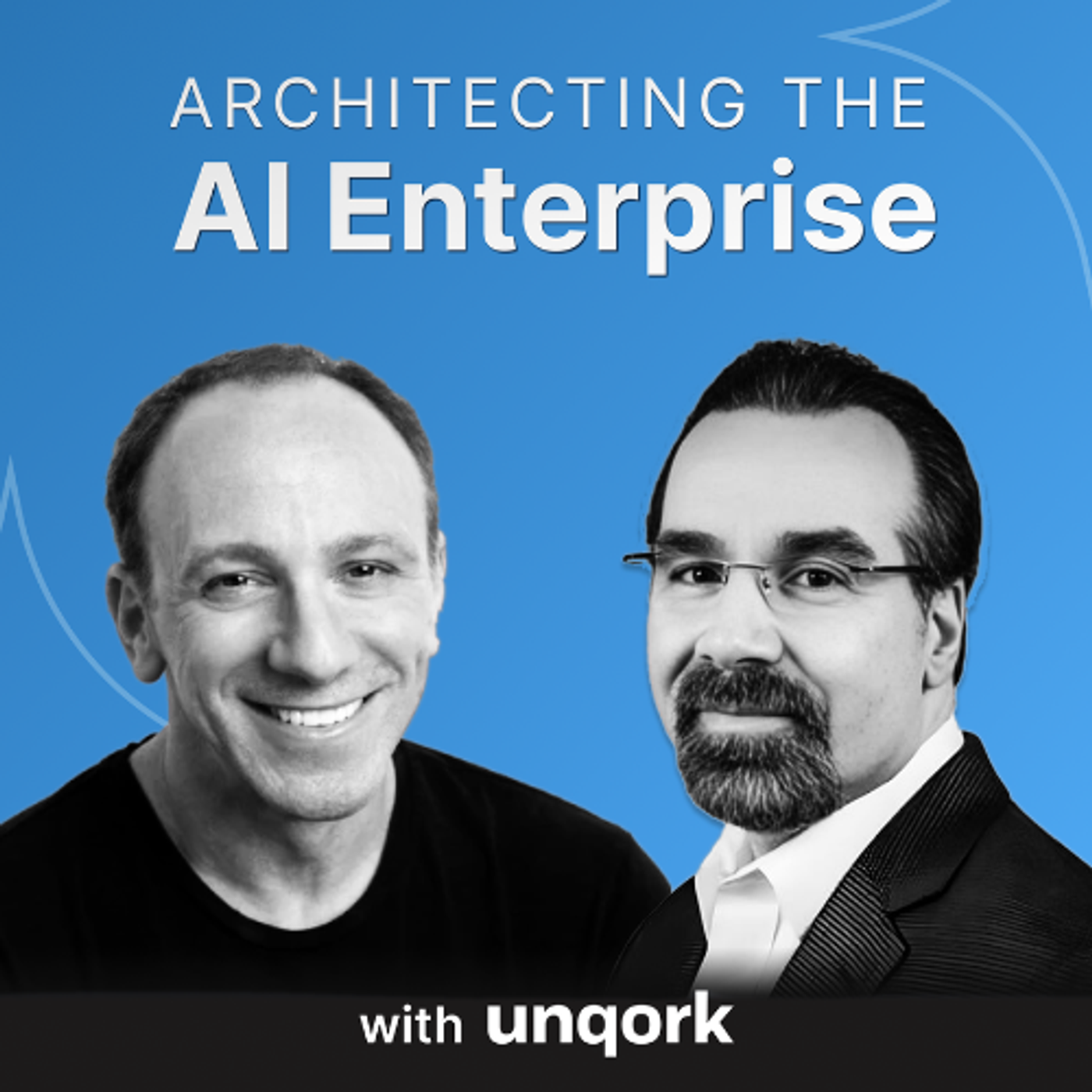
Hosted by Unqork
Listed under Business, Technology
Fresh thinking, actionable insights, and hard-won lessons from tech leaders at the front lines of the AI era.
7 episodes · publishes fortnightly · latest 2026-07-23 · ~39 min/episode
Rank
#174
Substance
82.0
/ 100
Breakdown
Scored 2026-07
Updated monthly
General rank
#22 of 287
Across the index
#174 of 6203
Substance
Top 3%
outscores 97% of the index
Architecting the AI Enterprise ranks #174 on The B2B Podcast Index with a substance score of 82.0 out of 100, scored across 1 recent episode. It scores highest on guest caliber and insight density. Bob Pick is EVP and CIO at Tokyo Marine North America (a $6B division) with deputy group CIO responsibilities across 57 countries and 53,000 employees. He is a genuine senior operator managing complex federated IT governance at enterprise scale in a highly regulated industry. His credentials and scope are strong, though he is not a founder or innovator - he is an excellent but traditional enterprise executive.
Averaged across 1 recently scored episode, with cited evidence.
The episode contains solid practitioner insights on AI governance, the tension between democratization and enterprise-grade safety, and concrete architectural philosophy ('thin core' vs. monolithic systems). However, substantial portions drift into general philosophy about AI, liberal arts education, and personal anecdotes that don't directly teach B2B operators concrete operational lessons. The insights cluster heavily in the second half; the first third has notable padding.
“four vibe coders can create forty years of technical debt in four days”
“citizens love to develop. They do not like to test, maintain, or fix bugs”
Bob presents a useful reframing of the CIO role as 'orchestrator' and 'glue' rather than technician, and the 'thin core' architectural philosophy is clear. However, most of the core ideas - federated governance, the risks of no-code/low-code in regulated settings, the need for transparency and accountability - are established wisdom in enterprise architecture. The discussion of LLM hallucination and prompt sensitivity, while valid, echoes common concerns already widely circulated in AI circles.
“the role of the CIO has been evolving to less of a technical role and more of an orchestrator role”
“you need to have a lightweight, thin core, we call it, not fat core, and certainly not the more recent trend of morbidly obese core”
Bob Pick is EVP and CIO at Tokyo Marine North America (a $6B division) with deputy group CIO responsibilities across 57 countries and 53,000 employees. He is a genuine senior operator managing complex federated IT governance at enterprise scale in a highly regulated industry. His credentials and scope are strong, though he is not a founder or innovator - he is an excellent but traditional enterprise executive.
“I'm the CIO for Tokemarine North America, which is about a six billion dollar piece of the PNC puzzle for Tokymarine in the US”
“I'm deputy group CIO for Tokemarine Worldwide, which means I run around herding cats and trying to get folks to go generally in the same direction”
The episode includes some concrete details: Tokyo Marine's $6B revenue, 57 countries, 53K employees, the 250,000 flat files in their policy admin system. Dave Ferrucci provides specific examples (search recall blindness, the LLM hallucination story with 100-page theory on human argument). However, most claims lack supporting numbers, timelines, or named customer examples. The discussion of governance and control remains largely abstract - no specific metrics on how governance is measured, no concrete examples of what 'guardrails' look like in practice, no dollar figures on regulatory penalties cited beyond vague references.
“a policy admin systems, for example, it's we've modernized the daylights out of it, but it's on an older architecture. It has 250,000 flat files”
“four vibe coders can create forty years of technical debt in four days”
The hosts ask reasonably sharp follow-up questions ('how does the analogy work for you?', 'do you see any change in the CIO function?', questions on transparency and accountability mechanisms). However, the conversation often drifts into tangential territory - extensive discussion of liberal arts degrees, favorite books, and TV shows that consume substantial time without advancing core insights. When tough questions arise (e.g., the mechanics of maintaining accountability with AI), the answers are acknowledged but not pressed deeply. The hosts miss opportunities to challenge Bob on the vagueness of 'guardrails' or to extract concrete operational details.
“I think it works really well. And as we found on our most recent panel with our our friend Sastri, it really the the whole architectural aspect of it”
“Dave, I I agree absolutely with your your flow there. I think the role of architect, both capital A and small A, becomes actually more important in this environment”
First period on the Index - history builds from here.
1 scored on substance · 7 tracked in total.
Add this badge to your site - it links back here and updates automatically as you rank.

<a href="https://index.fame.so/show/architecting-the-ai-enterprise" target="_blank" rel="noopener">
  <img src="https://index.fame.so/badge/architecting-the-ai-enterprise/badge.svg" alt="Ranked #22 on The B2B Podcast Index" width="360" height="136" />
</a>Track Architecting the AI Enterprise's rank
Get an email whenever this show moves up or down the Index. Monthly at most, no spam.
The themes that come up most across this show's episodes.

CareTalk: Healthcare. Unfiltered.
CareTalk: Healthcare. Unfiltered.
Reshaping Workflows with Dell Pro Precision and NVIDIA RTX PRO GPUs
Dell Technologies AI Factory with NVIDIA
Money Code
Stablecon

The RAG Podcast
Sean Anderson

Outthinkers
Outthinker

Business Scholarship Podcast
Andrew Jennings
Podcasts that dig into the same topics.



