UNSTOPPABLE WOMEN · 2021-04-28 · 43 min
Key moments - from our scoring
Substance score
35 / 100
Five dimensions, 20 points each
Vani Gupta Dandia brings two decades of consumer marketing experience from major corporations including Leo Burnett, BBDO, Henkel, Reckitt Benckiser, Unilever, and PepsiCo - where she managed brands like Coca-Cola, Farr, Wheel, and Kurkure. Her career centered on brand marketing, product launches, and regional portfolio management across South and Southeast Asia. After reaching a point of professional saturation despite multiple accolades (PepsiCo Chairman's Award, Innovation Excellence Award, Business Today's hottest young executive under 40), she left corporate to found CherryPeachPlum Growth Partners, a marketing consultancy. The episode explores her philosophy on early-career exploration versus specialization, the decision to quit without a concrete plan, and lessons from high-stakes brand decisions like the Kurkure Family Express train campaign that reversed a 20% business decline. She addresses work-life balance candidly, attributing her sanity to her son's insistence on family time, and emphasizes that entrepreneurship doesn't eliminate option B - there's always something else you can do.
'Valerie' by Amy Winehouse. She was driving to the office, heard the song, and realized in that moment she needed to start her new journey immediately rather than waste more time.
It was a bold digital-first campaign where Kurkure hired a train that traveled from Delhi to Bombay to Chennai to Calcutta, featuring families, media, bloggers, and influencers to generate buzz and digital content. After launching this campaign during a year of 20% business decline, Kurkure recovered to 20% growth the following year.
Vani advises early-career professionals to dabble with more rather than less because young professionals lack exposure to know their true preferences; experimentation across different roles and industries teaches valuable lessons you'll use later, whether you stay in that field or not.
She spoke with financial advisors to determine how long she could sustain her family's standard of living and continue paying for her son's school if her venture generated no income, establishing a financial floor before resigning.
She disagrees strongly - there is always an option B. You have your intellect, knowledge, and learnings which no one can take away, and you can always start again. Her own first venture folded after six months, and she walked out to start CherryPeachPlum.
Our reviewer’s read on each dimension, with quotes from the episode.
The episode is overwhelmingly biographical and motivational, with very few novel, non-obvious claims a B2B operator could act on. The Kurkure turnaround anecdote contains some practitioner logic, but the rest is filled with platitudes about hope, entrepreneurial attitude, and work-life balance that offer nothing beyond what any leadership self-help book contains.
I think it's just the uh, like I said before, I think it's the, the hope for a better tomorrow
a combination of hope plus hard work will definitely see you through
The frameworks recycled here - try many things early in your career, entrepreneurs must do everything, believe in yourself - are completely standard fare. The one genuinely interesting decision (going digital-only and using an experiential train activation during a brand crisis) is described but not examined with any analytical depth or first-principles reasoning.
We didn't do any mass media advertising at all. We only ran digital. And it was a very, very bold digital campaign that we ran with the little monies that we had. We decided to hire a train.
cherry doesn't try to become a peach or a plum. A cherry tries to become the sweetest cherry that it can be
Vani is a legitimate senior practitioner with real CMO-adjacent roles at Unilever, PepsiCo, and Reckitt, and has actually managed large consumer brands at scale - this is not a career thought-leader. However, the interview fails to extract the depth her background should contain, and her experience is in consumer marketing, making her only partially relevant to a B2B operator audience.
I worked with Henkel on a brand called far... Then I went to Reckitt, Ben Keiser launched Wheat, worked with Unilever on the entire hair portfolio
I had just been freshly appointed as uh, the category head on the entire Kurkure portfolio
There are a handful of concrete details - the 20% decline and subsequent 20% recovery on Kurkure, named brands and agencies, the train route geography, and the five signed Bollywood celebrities - but these are scattered and the mechanics behind the results are never explained with data, timelines, or financials. Most of the episode is anecdotal and vague.
the business saw 20% decline in one year. That's a very, very big decline on a brand that size
we were able to bring the brand back up to a 20%, uh, growth
The host asks almost exclusively generic inspirational questions with no follow-up, no challenge, and no probing of the mechanisms behind interesting claims. When Vani describes scrapping a Bollywood shoot on day three of a new role - a genuinely rich moment - the host simply moves on rather than interrogating the decision or its aftermath.
how do you really balance, you know, your health, your career, relationships, doing it all together?
what makes you unstable?
Computed from the transcript - who did the talking, and the words that came up most.
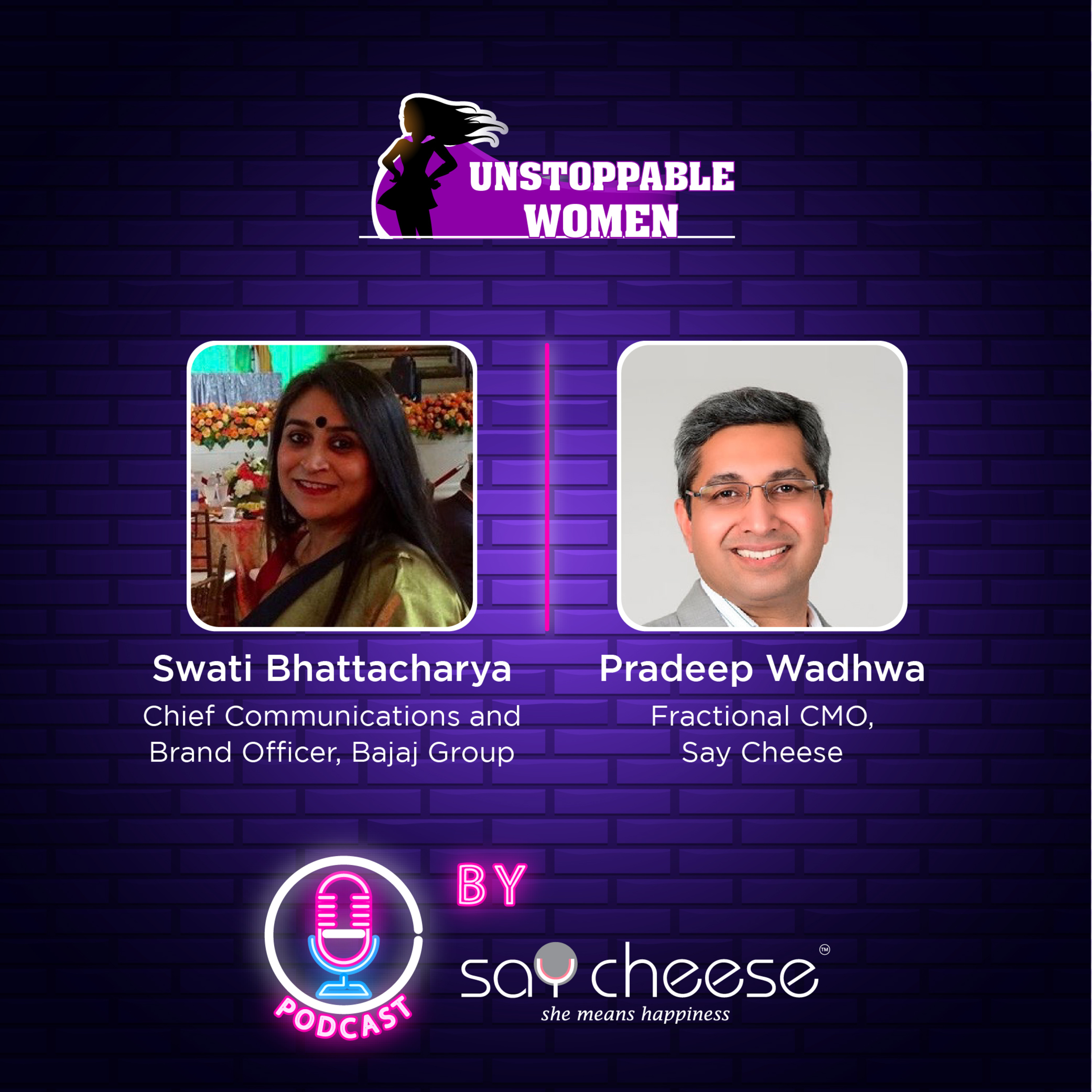
Rajpreet Kaur , Founder & CEO, Say Cheese in conversation with Vani Gupta Dandia - Marketing led business consultant - CherryPeachPlum Growth Partners. Tune in to hear Vani talk about her journey from a corporate professional to finding her calling as an entrepreneur. Listen as she shares insights into what she believes makes her an Unstoppable Woman.
Transcribed and scored by The B2B Podcast Index.
Speaker A: Welcome to the Unstoppable Women podcast by Sechis, India's first exclusive platform focused on increasing women happiness by providing holistic and personalized solutions for real challenges women face. We launched in December 2020 and have more than 3400 users pan India. Um, I'm Rajpreet, your host for today's podcast and we are going live with an eminent women leader in the Unstoppable Women podcast. We will share inspiring stories of women who are leaders and change makers of our society, celebrate their achievements and share their learnings with other women. In today's episode we will be talking to the charismatic Vani Gupta Dandia, marketing led business consultant Cherry Peach Plum Growth Partners. Vaani, I welcome you to our podcast and thank you so much for joining us. We would love to hear a brief introduction about you before we dive into our questions. Welcome Vaani.
Speaker B: Thank you Rajpreet. It's uh, lovely being here. Lovely talking to you. A little about me. I've had a long career in the corporate world. I started with advertising. I worked with Leo Burnett and BBDO on Adidas, Cosmopolitan, um, India Today, um, and then moved on to marketing. I worked with Henkel on a brand called far. It's a personal cosmetics, personal care brand actually. Very big in Europe but not uh, so much in India anymore. Then I went to Reckitt, Ben Keiser launched Wheat, worked with Unilever on the entire hair portfolio, did some bit on tea, then moved to Pepsi, uh, did a long stint with them and now I'm an entrepreneur, um, and I'm founder Cherry Peach Plum Growth Partners. It's a marketing consultancy and I'll talk more about it as we go forward in our conversation.
Speaker A: Wow, that's some bit of an experience I think, um, with all the top brands in India and globally as well. So, so I think amazing, uh, and I think the audience will have a lot to learn. And just to also add that Vaani has also several accolades uh, at PepsiCo including uh, India region above and beyond. 2014 Chairman's Award from PepsiCo CEO Indra Noi for successfully building a new platform of growth for Pepsi Foods, the Innovation Excellence award, uh, and the Emir PWP Sustained performance award for Kurkure brand Vaani. We welcome you. And uh, just to also not miss that, uh, Vaani has also been listed by Business Today as the hottest young executive under 40 in a nationwide survey. So Vani, uh, it's an absolute honor to have you on board with us and I'll straightaway get to the questions. Um, I see you as a very passionate and self driven person. Have you always been like this or has there been a transformation in your journey so far?
Speaker B: Well Rajpreet, I think it's fair to say that I've definitely changed a lot as a person. I can't say that um, I've been more or less passionate as a person as I went along, but I have definitely changed. I think um, there was a time in my career and I'm talking specifically about the time from the time that I started working. So first of all, actually when one just gets out of college, mba, college, I had absolutely no clue at that time. All I knew was I certainly want a career in advertising. I loved consumer behavior as a subject in college and I said that the only job I will do will be in advertising. Unfortunately there was only one ad agency that came to our campus. Um, fortunately I was lucky to land a job with them. But I went to um, this ad agency and uh, I hated the job that I did, you know. So within a couple of months it became quite clear that this is certainly not what I want to do so much for all of that passion for advertising. And then came the question, now what? But even then I landed into another advertising job on the, you know, council of one of my seniors from the same college. And I'm glad I did do that because I had a whale of a time at uh, at Leo Burnett. I worked on Coca Cola, much as I used to get uh, into a lot of scraps with the client. But it was an immensely uh, rewarding, very, very uh, enjoyable stint at Coca Cola. I think I learned a lot of the fundamentals on brand marketing at uh, that stint that I did um, as client servicing for Coca Cola. So we launched Coke 500ml and Coke 200ml. Then, then from there, Rajpreet, I think I went on to a phase in my life where I just was obsessed with doing the best that I could do in the world of marketing. I saw myself, for me the pinnacle in my career would have been to get to being the CMO at a big company. And um, I was fortunate to have landed the right roles. You know, I went to Henkel. It was the only consumer company of any repute at Chennai. My then husband was posted at Chennai. So I was very worried about where I'd work. But I was fortunate to land a job there and a good job at that. Um, we, we sponsored far Femina Miss India in the years that I was there. So that was tremendous learning. Then I went to ah, Vite and subsequently with Unilever. So all of those stints were easy in the sense I knew I had some sense of purpose. I knew what I want, what kind of a job I wanted to do, what kind of experiences I wanted to gain. With Unilever, I was going back and forth between Bombay and Bangkok. My boss, uh, was based in Bangkok. And I was looking at a, um, regional role. So I was looking at a whole host of, um, products for colored hair. It was care for colored hair. And it was a, uh, portfolio that I launched in 10 countries, four South Asian countries and six Southeast Asian countries. And then when, you know, then Pepsi happened. So all of that was good. But then I think somewhere along the line through the last years at Unilever, and then there were phases at Pepsi when I started to think that I've sort of done everything that I could do. And, um, I had these periods of lull when I felt, oh, gosh, am I going to continue doing this for the rest of my life? And I can't do this with yet another corporate. And I remember in the last couple of years that I was at Pepsi, I used to go from one interview to another, uh, trying to figure what kind of a job would I want to do. And every chat I'd come back with these droopy shoulders thinking, oh, gosh, you know, the people will change and the boss will change and the office will change and the category will change, but it will still all remain the same. So, you know, you asked about, um, how passionate and driven were you or have you been like this all along? So the short answer is that there has been a phase and then there was this phase of serious introspection when I was thinking about, oh, what now? But fortunately, I had the courage to jump ship from the corporate world and, uh, become an entrepreneur. So thank God for that. I love the life that I'm currently leading and I'll tell you more about it as we go along.
Speaker A: Sure, of course. And I'm going to come to that soon. And uh, you know, as you started talking about the college and I can relate a lot, also being from the same alma matter as you, uh, from mdi, I think, uh, you know, you were very clear is what I could gather, Vani, that, uh, it is marketing and advertising where you want to build a career. But a lot of women, um, um, the clarity is not there at college, uh, when we are in college. And then, you know, there's always a choice between being a generalist versus being a specialist. So I think in Your case, it was like, uh, you were very clear, and it was a specialist career that you chose. And, uh, then the final moment of taking that, uh, you know, that courageous call, uh, being guided by your inner calling, and that happened. So, you know, what do you really advise to women? Uh, you know, any thoughts on being a generalist versus a specialist?
Speaker B: Rajpreet? You know, my view is that one should actually, in the early stages of one's career, be happy to dabble with more rather than less, because like you rightly said, when one is young and one doesn't have exposure at that time, it's not possible to know what would I really like to do. So, for example, you know, when I was at mdi, the summers that I did, I went and did summers in finance at, uh, gsk. And, um, I did very well on that project. In fact, um, my boss at that time is still a dear friend, um, and I made a lot of friends at gsk, but I hated what I did. You know, I got a damn good appraisal and all of that. But that one and a half months that I spent. Spent over there at gsk, whatever it was, one and a half months, two months, it became clear to me hanging around with the, uh, you know, the. All of the lot over there, the finance lot over there, and seeing what they did, I realized, So. But that would not have. That realization would not have come to me had I not actually elected to do that, uh, stint. And, um, you know, one picks up little things. Uh, I mean, I say this to a number of, uh, you know, young, uh, executives who reach out to me on LinkedIn. I always tell them, don't shy away from taking up anything new because you don't know whether you might like it, not like it, even if you don't like it. Maybe there's something that you pick up from there that would be invaluable for you in the future. So at early stages, one shouldn't get boxed in. I mean, I think in my case, I was just lucky that I sort of went from one job to another. And they all happen to be good companies. They all happen to be great brands. I happen, uh, to land the right kind of assignments, but it doesn't have to be so. It can be a whole host of things that one tries. It's all okay to jump ship, you know, every two years or so, it's okay to try different things. It's the only way one learns. And it's all of tremendous value as one goes, uh, along. Later, when you become A leader of sorts, or when you do something of your own, then it helps to have more knowledge than less of different fields.
Speaker A: So Lao. So I think that's great. So, uh, you know, you've worked with the biggest brands across industries and currently you work for yourself and, uh, you have your own firm. And so was it always like the plan or, uh, you know, it just happened, or, uh, you know, uh, what was that, uh, you know, that moment, uh, of finding that you started on this journey?
Speaker B: Not at all. I had no clue, Rajpreet. In fact, even till a year, forget a year, even till, uh, six months or three months before I quit Pepsi, I had no clue of what I'd do. In fact, even when I went and put in my papers, I remember I was driving up to Pepsi, um, you know, and I was listening to this song. I remember that song so distinctly in my head because, uh, somehow that song was playing in the car and I thought that, uh, I know I'm going to do something different. I'm quite certain about that. Then why am I wasting time? Why am I not embarking on that new journey, whatever it be, even if I don't know what that is, why am I not embarking on that right now? And as I was driving, I remember so clearly, even that stretch of the road, when I took that decision, sitting in the car, at the wheel, um, I told myself so. Aa ji jaaki boss se baakar.
Speaker A: So I wish I could play the song so you can reveal the suspense if you don't mind sharing with our audience.
Speaker B: It's a song, um, called Valerie. Valerie by Amy. Amy Winehouse. Yes, Amy Winehouse. Valerie is the name of that song. I love that song. I love this singer. But I was so certain in my head that if I have to do something new, then I may as well start right away. And that's how it began. And then I quit. And you know, even through my notice period, I had little clue of what I do. All I knew was I knew I have some money in the bank. So that much work I'd done, you know, I'd done that little bit of homework even before I put in my papers, that I'd been talking to my financial advisors. And because I had this brewing in my head that I can't carry on with this job. So I wanted to know, ABHI me pas jitne pese hain manlo agar me pas. You know, how long can I go on with nothing? Worst case, if absolutely nothing were to happen, then would I just collapse? Would I still be able to send my son to school and will we still carry on our normal standard, uh, standard of living? And uh, they said that that should be fine. So there was some comfort of knowing that financially I'm alright. And that's it. With just that comfort, I put in my papers and then I said, look, there are people reaching out to me on LinkedIn, so maybe I can do some, something. And that's how I went along. So I think I'm a bit of a, um, a bit of a dreamer in the way I operate and everybody else doesn't have to be that, but I want to tell people that, you know, by and large, life turns out to be all fine in the moment. We panic, but we don't really need to. If one believes that, you know, there is hope for the future, just that hope that one keeps in one's heart is usually more than enough to see one through. If you have hope, then you would work to deliver on that hope that you're harboring in your heart as well. So a combination of hope plus hard work will definitely see you through.
Speaker A: Wow, that was so beautifully said. Um, you know, being uh, an entrepreneur myself, so I could relate a lot to what you were saying and um, know the hope and which is very much required to make you continue and persevere on this journey. So I've always heard that, you know, for entrepreneurs there is no option B. Uh, so, uh, what are your thoughts on this?
Speaker B: Uh, V, Uh, well, there is always an option B. What is, Uh, I mean, why would we say that there is no option B in the sense, of course, one has to do one's best at making one's own venture work. One, you know, one gets up, uh, thinking about what more can I do, One sleeps thinking about, oh, there's so much more to do. Um, but uh, worst case scenario, if for whatever reason, for example, I myself, in fact, I, um, you know, banded with uh, a couple of guys after I left Pepsi and that venture didn't work out. We folded up in a year. And um, I took the decision to walk out about six, seven months after I had started that venture. But I'm glad I walked out of it. And like I said, you know, it's not that there isn't an option B. There's always something else you can do. You always have your own intellect, your own, uh, all of your own resources. What you are, nobody can take away from you. And so there is always an option B. I mean, one must never feel deadlocked in any way. Worst case, you can always start again because your learnings, one can never take away from you. You know what I've Learned through my 20 years of the corporate world that, uh, nobody can take away from me. So that comfort I have, uh, so,
Speaker A: uh, very inspiring, I think, uh, lots to, um, you know, hear and learn from for the budding entrepreneurs out there. So, um, Savani, uh, again, a personal question. Like, how do you really balance, you know, your health, your career, relationships, doing it all together?
Speaker B: Quite honestly, Rajpreet, I'm actually quite terrible at it. For me, the only saving grace is the fact that I have, uh, you know, an 11 year old at home. And he insists. I mean, it's thanks to him and his insistence that, you know, there will be no call during lunchtime. So he's very, very particular about it. And thank God he is, because that's the only sanity I have in my life that, you know, you will tuck me into bed at such and such time, that during dinner we will watch TV together and we will have this time of ours together. So. But I think in the last one, uh, one and a half years, through this Covid period, my, uh, the only relationship that I've, or I shouldn't say relationship, let's say the physical time that I've spent outside of home has only been with my parents. And uh, as far as relationships are concerned, I think over the last, this is not just Covid period, but over the last few years I've just become more picky about who I choose to spend my, you know, off work hours with. I don't, I'm, uh, not the big party goer anymore, which I was at one time. But now I prefer, uh, smaller get togethers. I prefer more intimate, uh, you know, evenings with, um, friends who I really value. And uh. And of course I'm, uh, I am spending a lot more time with my parents. My parents are getting old and, and I'm very fortunate to have them in the same city. So that's, uh, that's pretty much all I do as far as health is concerned. I really wish I did more. I think I'm terrible. Um, as far as health is concerned. Um, yeah, yeah, I, I don't think I should say more than that. I'm. I'm not the right role model to follow.
Speaker A: You are honest about it, I think. Um, but yeah, so you have those sweet spots, at least, you know, which you really, uh, take out the time for. So. Suvani, um, there would have been many, many success stories and you know, if you can just pick one, uh, you know, like a very significant moment or uh, an epitome moment that you would remember from your career and uh, also a contrary of it. A difficult situation or where you really handled a failure.
Speaker B: So both these. I wouldn't know about success, but I think there are many bets that I took um, through my working years which worked out well. For example, um, on Kurkure, there was a time when you uh, know, we took certain bets as an organization and um, the business saw 20% decline in one year. That's a very, very big decline on a brand that size. And we were all very worried and nervous and the mood in the organization was uh, was very low. A lot of people, everybody's uh, increments bonuses were affected and you know, um, and there is uh, you know, for the feet on street when their bonuses are affected, then you feel terrible about it because they're the ones who actually deliver the real uh, sales. I mean they're the ones who actually bring in the money and one feels responsible for the brand's fortunes. So I remember in that one year we'd taken this huge bet where we actually slashed advertising and marketing spends by a, uh, significant amount, uh, by a significant percentage. And I didn't think that I'd uh, have it in me to actually take um, that call myself. And um, we embarked on something that we'd never done on Kurkure before. We didn't do any mass media advertising at all. We only ran digital. And it was a very, very bold digital campaign that we ran with the little monies that we had. We decided to hire a train. And uh, it was called the Kurkure Family Express, that entire consumer engagement program. This train went from Delhi to uh, Bombay, down to the south to Chennai to Calcutta and then back. And we, you know, had families on that, on that train. And it was a wild extravaganza that we arranged on the train, which was the first of its kind. We had local, uh, reporters, we had uh, food aficionados, we had media and bloggers and uh, um, you know, um, mommy bloggers and whatnot. It was a, um, you know, we had press interviews on the train. So all of that we did only to generate digital content and use some of that, in fact, all of that to create buzz about the brand and to get not just our equity metrics up, but more importantly, um, you know, get our love metrics up for Kurkure to be. I mean Kurkure, it's a. And the only thing that you can do for a Snack is to be top of mind. And that was the attempt, you know, as to how do we do something so wild that we create enough buzz to become top of mind. And that bet paid off. I remember when we, uh, were embarking on this journey, even till a day before the train was to leave the platform, there was this news that, you know, IRCTC has suddenly, uh, uh, you know, put out this notice. They have reservations about this train being used for commercial purposes. And, and we're not so sure if this train will actually leave the platform. And we heard everything. There was a whole program tied up. There were, you know, so many other contracts that were signed and that were. So it was, you know, can you imagine for me, I was sitting there with the phone, uh, in the office and I didn't know where should I be running, you know, should I, you know, who should I be calling, what should I be doing? Um, and we were all sitting on tenterhooks and we didn't know if we could actually pull this off. A lot of people in the company actually told us that you'd be really silly to even attempt this. You don't know how many things could go wrong. But we were very, very fortunate. It all worked out really well. Uh, and in the subsequent year, not just for this reason, but for various other things that we did on the brand and the business, we were able to bring the brand back up to a 20%, uh, growth. So that was a big, big, big win for me. And personally it was very, very satisfying. Um, then as regards a failure, I don't know failure. But um, you know, let's, let's call it a learning. Instead I had just, I had just started working on uh, Kurkuri in the sense I had just been freshly appointed as uh, the category head on the entire Kurkure portfolio. So I was literally like three days old perhaps on that position. And there was a film that we were going to shoot and it was going to be our main thematic film for the year. And I didn't agree that that film was the right thing to do. And I felt I will have to live with this decision for the entire year. It's going to impact the numbers that I have to deliver. This is going to impact my bonus. And yes, it's been only whatever three, four days since I've taken this position, but um, gosh, you know, should I be living with this? Should I be doing something about it? And I decided that the right thing to do would be to scrap it. Uh, and then I went you know, uh, to my seniors saying, look, the shoot is scheduled tomorrow. And this was a shoot with all of these Bollywood celebrities who we'd signed up. There were five celebrities in all who we'd signed up. So scrapping would. Scrapping it would mean, you know, uh, managing all of these five, apart from all of the sunk cost of the shoot and all of that. But I, in all of my wisdom at that time, I felt the right thing would be to, to actually speak up then. And I created a, uh, fair amount of commotion. I remember in the company when I went from cabin to cabin saying, this is the wrong thing to do. And I'd like to table my opinion and know this is why it's the wrong thing to do. And we have to take swift action. We have to scrap this immediately. And of course I was slapped and sent back and told, you don't do such things. And you know, yes, you've been appointed category head, but you don't take such calls like that. So, uh, of course in hindsight, thank God my, you know, my leaders did do what they did. But, um, I think the learning for me from all of that was that not everything is within one's control. It is important to speak up. I did make my opinion known. But, um. But you know, I was also a very impulsive child at that time. I mean some of that, uh, impulsiveness and drive and ambition also got me to where I am today. But, um, But I think, uh, sometimes one doesn't know or one doesn't realize how that impulsive energy could be better redirected. I think I'm a wiser person now. I still have a long way to go. But there was a lot of impulsiveness about me then.
Speaker A: I think I could almost, uh, you know, live the. And connect with what you're speaking, uh, with respect to, you know, the entire Kurkure journey. And this is the positive example of a speak up and which is required. At least you were satisfied that you know, at least you did your bit. So amazing and I think lots to learn from that. Vani, uh, would also like to uh, understand, uh, you know, your current, uh, venture, uh, very unique name and um, you know, I can, um, so if you could tell us more about it, uh, you know, uh, how has been your journey as an entrepreneur? What are some of the challenges that you face and uh, any uh, tips that you would like to give to the audience?
Speaker B: Okay, so, uh, first, about my venture itself. Since you asked about the name. Yes, I love the name. Cherry Peach Plum Growth Partners. And Cherry Peach Plum comes from this philosophy that I follow. It's um, Nichiren Daishnan's Buddhism. And this name comes from there. This, um, philosophy says that each one of us is unique. Each one of us has a, um, very unique personality, unique characteristics. And each one of us must do our best to shine ourselves to our best and we don't need to be like anyone else. So cherry doesn't try to become a peach or a plum. A cherry tries to become the sweetest cherry that it can be. And um, similarly so must it be for all of us. And that's also true for brands and businesses because every brand and business also has its own unique challenges, its own unique set of opportunities. And I felt it was right for what I set out to do because consulting is also a very personalized, uh, um, you know, business in the sense one can't, uh, one can't. One has to work with every founder or with every brand for the context that they operate in and also, you know, calibrated to the dreams and aspirations of that founder, um, himself or herself. So that's about the name, um, what I do with Cherry Peach Plum. It's a variety of stuff that I do. Rajpreet, with uh, founders. Basically it's, I call it marketing my own way. It's all of the principles of marketing that I've learned, uh, through the last 20, 23 years. And I applied to solve for different problems of businesses. I worked on, uh, you know, a business that was looking to expand its, um, portfolio of offerings into a, uh, different service line altogether. It could be to launch a new product or to acquire new consumers or in the case of B2B marketing. I've been doing a lot of B2B marketing lately on how do you build thought leadership. Or it could be solving for brand architecture, um, or just communication, design, identity building, a comprehensive brand playbook. So all of this stuff I absolutely love and I'm so glad I took the decision to go out on my own because I'm doing so much more of what I love now than what I was doing earlier, which is not to in any way discount the tremendously valuable experience I've had thanks to Pepsi Unilever Racket. But, um, I think it's all just happened for the. Fortunately for me, at the right time, um, that I have this width of opportunities available. It's lovely to be working with different entrepreneurs because each has a different challenge. So I'm working on this width of projects, different categories from wealth investment to video conferencing. To shampoos, to you, uh, know, to bread and bakery. Uh, it's wildly different and with wildly different challenges. And the other question you asked was about what, um, tips can I give to entrepreneurs or what is it like to be an entrepreneur? So this entrepreneurial life, Rajpreet, you would also know about it. Um, it's very different from the corporate world in the sense, firstly, there is no such thing as this, uh, is not my job. You know, as an entrepreneur, everything is your job. So, and I've, I've, I feel I've become so much more capable now thanks to just this. You know, you can't say, oh, writing website content is not for me, or uh, uh, you know, or, or sending out parcels and uh, packaging and courier or whatever. Basically you are your own ea, you are your own marketing services, you are your own, uh, mentor, guide your own everything. And uh, and that is partly or in fact a large part of what I love doing right now. You know, there is so much more learning thanks to this. So, um, so one is, is I think as an entrepreneur, fundamentally you have to have a change in attitude. You have to know that as an entrepreneur there is no complaining. There is no, oh, this is not my job, or, or oh, I can't do this. You've got to figure it out. You've got to give it your best shot. You might be able to do it not to 100% of what it might otherwise, uh, look like or what it might, what a professional who is a specialist at that could otherwise, could otherwise deliver. But you tell yourself, if at this stage, with my limited resources, I can do 60% or 70% or even 50% of what I'd like to get to, then it's okay, I do that and I roll with it and move forward. So I love the, the fact that, uh, you know, you have to do more with less. There is no other way of doing, um, of managing entrepreneurship. You have to do more with less. And the other significant bit about being an entrepreneur is that you also have to be your own best friend and your own own confidant. There is no, uh, boss. There is no team. There is nobody to say, oh, good job done. There is, uh, nothing called, oh, these are the targets and then I will get a bonus. Of course that might be true for, that is true for uh, you know, uh, companies raising money and all of that. But I mean, fundamentally you have to figure what you want to do and you have to constantly appraise yourself against your own standards. Standards. And that's also what I love about being an entrepreneur. It makes you a much more self assured individual. You're not looking for assurances from anyone outside and even from clients. In fact, I pride myself for the fact that today I know if I'm doing a great job, I'm happy. You know, um, of course one can always do better. But it doesn't bother me anymore. You know, if clients recognize your great work and say fantastic, then that's great. If they don't, then that's all right as well. So long as you know you've done your best. So those would be the two big things that I think change. Uh, when you become an entrepreneur, you have to do your own thing and you have to be your own best friend.
Speaker A: Sure. I think I couldn't have agreed more being an entrepreneur myself, you know that completely.
Speaker B: You have to go out of your
Speaker A: comfort zone and everything. You have to do it. Uh, and I also think that Vaani, um, you know, you know, something which I really want to mention right now is that um, when you say that uh, you know, for so many years of experience that you're trying to put it all together in your services, I think, you know, that's the best way to give it back to I think society and so many people can learn from your enriching experience. So Vani, what makes you unstable?
Speaker B: That's a tough question. I don't really know. I think it's just the uh, like I said before, I think it's the, the hope for a better tomorrow. It's very important for us all to have hope for a better tomorrow. And it's even more so true now given this Covid context. But it's not just about hope for a better tomorrow externally, but hope for your own self as, as to what you yourself self can be. So I think knowing that tomorrow can be better and that you yourself can be better is uh, is what would make anyone unstoppable. Like I feel sometimes I feel a sense of panic. I feel, oh gosh, I can be doing so much more and I'm not doing it. I can be so much more and I'm not doing it, you know, because the truth is that it's only us, all of us who uh, impose limits on ourselves. If we really want. Wanted to be more, there's nothing stopping us. We can be anybody we want to be in the sense we can do anything we want to, we wish to do if we really wanted to get there. So if we stopped complaining and we stopped sort of externalizing all the problems. And we said, well, I can be whatever I wish to be, then there is nothing stopping us. So, um, just this. The will to do better, the will to do more, the belief, the belief that each one of us is actually far more capable. And that's true for all of us. We are all more capable than we think we actually are. If we genuinely internalize this, um, and understood that I can be more than what I am today, then that would make us all unstoppable. Unstoppable is such a lovely word.
Speaker A: Thanks. I think, um, it's now, you know, we've launched this as a flagship, uh, event also, of which you were a part. And, uh, the idea being that it's unstoppable in spirit and, um, you know, the undying unstoppable spirit in the woman. And, um, which. The hope that you spoke of, which just keeps you going. So. Yeah. And the infinite potential. So very, very motivating. And you, uh, know, I wish I could just go on listening to you. Maybe, you know, we'll just have to take a quick rapid fire now. So, uh, already Vani. Yes.
Speaker B: Shoot.
Speaker A: So, favorite, um, quote that you actually follow in your life.
Speaker B: There's an American journalist called Nora Ephron, and, uh, she said, be a heroine of your own life. Don't be a victim. So she's also a film writer. She's famous for a number of films like When Harry Met Sally and Sleepless in Seattle. And I love this line, be a heroine of your own life. Don't be a victim. Know that in my life, I am the heroine.
Speaker A: Nice, nice. So. So, uh, what's your go to mantra to lead a successful life?
Speaker B: I think it would be just this, that we can all work to becoming better each day. If I can be more, every day I'm more capable than I think I am. If I can work towards becoming a better version of myself every day, then that will add up to a lot. One year down the line and two years down the line and years ahead. So there's always more one can do. And the quest to be more in itself is so joyful.
Speaker A: Lovely. Who will help you, uh, when you are in trouble?
Speaker B: Family, friends, colleagues, everybody. I think I'm, uh, very fortunate since I've been a single mom. And not just that. I think fundamentally everybody is single in some ways. We, we all need a network of supporters. We all need a support structure. And I, uh, mean in my early days of, uh, career, when I had a little child and there was no one else at home, I I remember I used to ring the neighbor's bell at all times and say, look, I really have to step out for an hour. I have nowhere else to leave my child. Just look after him for an hour and I'll be back and I'll make friends with you after I'm back. You know, like I wouldn't even know them sometimes. So I think it's friends, family, one has to, has to, has to invest in relationships because that's all we have finally.
Speaker A: Absolutely. Um, the last one, uh, do you feel guilty to take leaves from work?
Speaker B: It's. I never look at it as a leave, as leave from work in my case, in my view. And it's more true after having become an entrepreneur. You know, I think that there is when, when you are really passionate about what you're doing, when you really enjoy doing what you're doing, when you're driven towards something, then you actually never really stop thinking about it. And so, you know, even in your sleep, my belief is subliminally you're doing something which will help work. So it's not really, it's not really leave from work. So if I were to go on a three day holiday, I may not take work calls but that doesn't mean that I'm on leave as such because I'm still thinking about what can I do better at work or what else could my enterprise, uh, be or I have a dream for the future and I'm investing time in allowing those creative juices to flow. So it's, it's never really leave and one must never feel guilty about it.
Speaker A: Wow. Um, you know, uh, so thank you so much Vani, for joining us and for taking out the time and uh, you know, when you spoke of the support system and investing in relationships, uh, so Seychis, uh, would just like to add that is trying to build a support system system, uh, where people can, women can be there to support each other, where they can share their learnings of so many years together which, with each other so that the other person doesn't have to go and find it
Speaker B: out the harder way.
Speaker A: So thank you so much for supporting this initiative. And we will be back with another inspiring story of an unstoppable woman in our next session.
Speaker B: Thank you so much. Love you. Thank you Vani.
Speaker A: Bye.
Speaker B: Thank you.
Other episodes covering the same guests and topics, from across The B2B Podcast Index.
 Album 8 Track 17: The Mythology Behind a Great Marketer w/Louis MonoyudisBrands, Beats & Bytes · on Leo Burnett81 / 100
 EP 116: "SEO Is Dead. It's an $85 Billion Market and It's Over"Embracing Marketing Mistakes · on PepsiCo80 / 100
 Why DTC Brands Lose Customers They Think Are Already Theirs | Agnes Seville, Little SleepiesThe MarTech Matrix · on Brand marketing79 / 100
 Care For Performance Leadership with Noam BuchalterStrategy Sessions · on Unilever79 / 100
 #106: How Salaries Are Set, And How to Negotiate YoursStepsero · on Unilever77 / 100
 The Invisible Engine Behind Every Brand DecisionOn Brand with Nick Westergaard · on PepsiCo73 / 100