The Values To Profit Podcast · 2024-12-02 · 20 min
Key moments - from our scoring
Substance score
15 / 100
Five dimensions, 20 points each
This episode distills Beverly Mitchell's Values to Profit framework's customer pillar into five actionable steps for family business leaders seeking to differentiate from competitors and drive revenue growth. Mitchell argues that while competitors can copy products and services, they cannot replicate a company's unique culture - making values and culture an underutilized asset for competitive advantage. The framework progresses from internal clarity (Step 1: crystallizing cultural USP) through consistency (Step 2: differentiated customer experience across all departments), deep customer understanding (Step 3: engaging top 10 customers to uncover how they perceive and value your culture), sales capability building (Step 4: training teams to sell value rather than price), and organizational alignment (Step 5: ensuring all customer-facing functions understand the connection between values delivery and customer value). Mitchell illustrates impact through client case studies: one UK family business identified £1M+ growth opportunities after she conducted customer interviews using her "experience to value methodology," and a global family business generated millions in extra revenue over three years by aligning all departments around customer focus. The episode targets family business owners and leaders frustrated by price pressure from procurement and seeking to build deeper, more strategic customer partnerships based on shared values rather than cost competition.
The five steps are: (1) Crystallize your cultural USP to leverage your profit, (2) Scale using your differentiated customer experience, (3) Accelerate growth potential with your top 10 customers, (4) Shift from price to a values-led framework, and (5) Leverage total workforce impact.
Focus on your top 10 customers and those with the greatest potential for future growth by conducting structured interviews to understand how they experience your values and culture and what monetary value that brings to their business - this reveals the biggest opportunities for sales and profit growth.
All departments impact the customer experience, and lack of consistency between them ruins your value promise; even back office functions like accounts, operations, and supply chain significantly influence how customers experience your values and culture.
Train your sales team to quantify the hard cash value your unique culture brings to each customer's business, then connect that directly to what the customer needs; when customers understand and can measure the value, they'll pay for it instead of negotiating on price.
The interviews helped customers connect how they experienced the client's values and culture to tangible business value, resulting in a shift to longer-term strategic partnerships and identifying a major new business opportunity worth over £1 million for 2025.
Our reviewer’s read on each dimension, with quotes from the episode.
The episode spends the majority of its runtime reintroducing and re-summarising the host's own framework, with the actual advice reducible to: know your values, be consistent across departments, talk to key customers, train sales to sell value, and align everyone. These are generic management consulting platitudes with no novel mechanisms, data, or non-obvious reasoning to back them up.
Your values are only words on the page until they're truly reflected in your everyday culture by everyone, everywhere.
Other companies can copy your products and services, but they cannot copy your unique culture.
Every idea presented - values differentiation, customer experience alignment, value-based selling - is recycled B2B consulting orthodoxy. The 'culture can't be copied' framing is a well-worn trope, and there is no contrarian claim, first-principles argument, or counterintuitive perspective anywhere in the episode.
Other companies can copy your products and services, but they cannot copy your unique culture.
Aligning the customer experience and the internal culture are crucial as a consistent customer experience drives loyalty, trust and most importantly, increased sales.
This is a solo monologue by a consultant marketing her own services throughout; there are no guests at all. The host presents herself as an expert but offers no demonstrated practitioner background at scale, and the episode functions primarily as a sales pitch for her consulting programmes.
I'm Beverly Mitchell, the family business values and culture expert
The ability to connect with people and build trust quickly is one of my areas of genius
Two client case studies are referenced but both are fully anonymised (no company names, industries, sizes, or timelines beyond 'three years'), and the only concrete figures offered are a vague '£1 million' opportunity and 'millions of pounds of extra revenue' - numbers too imprecise to be independently meaningful or credible.
an estimated revenue of over £1 million and thus achieving my client's aim of reducing their dependency on their top three customers
The result of leveraging this total workforce impact approach was millions of pounds of extra revenue and profit over the next three years.
There is no conversation - the episode is an uninterrupted solo monologue with zero guests, zero follow-up questions, and zero challenge to any claim. The only 'questions' are rhetorical prompts directed at listeners that immediately pivot back to promoting the host's framework.
So my question to you right now is, do you have total clarity on your values and culture unique selling points?
So let me ask you, are you getting results like this from your customers by leveraging your unique values and culture in this way?
Computed from the transcript - who did the talking, and the words that came up most.
Beverley Mitchell is the Family Business Values and Culture expert. She’s leading the movement in family businesses unlocking the potential to leverage their unique Values & Culture to drive sales, profit, attraction, retention and productivity. In the fourth episode of her Values to Profit podcast she zeros in on the Customer Pillar of her unique Values to Profit Framework™ and shares the highlights of her acclaimed recent live masterclass “Turning Values into Profit: Doubling your Revenue in 2025”. She takes her listeners through the 5 steps to leveraging your values and culture to deliver sales and profit growth and shares some powerful examples of how family businesses have realised hundreds of thousands of £s in extra sales and profit by following her unique methodology. To find out more about Bev’s Values to Profit Framework™ visit her website ,
Transcribed and scored by The B2B Podcast Index.
Hi, I'm Beverly Mitchell, the family business values and culture expert, and I'm leading the movement in family businesses, unlocking the potential to leverage their unique values and culture to drive sales, profit, attraction, retention and productivity. Welcome to the latest episode of my Values to Profit podcast, a podcast for family business leaders. If you are a regular listener, then you will know that in each of my podcasts, I explore how you can turn your unique values and culture into a powerful marketing asset, both internally to attract, retain and motivate your people and externally to differentiate yourself in the eyes of your customers and potential customers and elevate your relationship away from discussions about price.
And if you're sitting there wondering, should I bother investing my time in listening to this podcast? I want to remind you of one very simple but hugely powerful fact. Other companies can copy your products and services, but they cannot copy your unique culture. So why would you not want to be looking for every single opportunity to leverage that unique culture to help you to build a more successful business?
I'm here to help you find those opportunities and turn them into tangible sales and profit. My unique approach is all centred around my values to profit framework methodology, which focuses on each of the six key levers, which will help you to turn your family business values and culture into a driver for long term success. And just a quick reminder of those six key levers, which are firstly, values, the foundation of everything. Secondly, leadership, because for your values and culture to be a true differentiator, your leaders have to walk the talk.
Culture. Because your values are only words on the page until they're truly reflected in your everyday culture by everyone, everywhere. People, because those businesses who know how to make their values and culture truly resonate with and relevant to all of their people, they're the ones that are able to attract, retain and motivate the right people to drive success. customers because your unique values and culture have the potential to differentiate you from your competitors and drive massive sales and profit growth but more of that in a minute and finally storytelling because stories from your past and present which embody your values and culture are your proof that you don't just talk about values and culture, you actually deliver on it.
But let's dive into the focus for today's podcast, customers. And specifically today, I want to hone in on some key points covered in my recent masterclass, Turning Values into Profit, Doubling Your Revenue in 2025. This 45 minute masterclass, which was delivered live, explored how you can turn your values and culture into a huge profitability lever. How to maximise the impact of your values and culture to differentiate yourself versus your competitors and drive increased sales growth.
How to use your values and culture to develop closer customer partnerships based on mutual value. How a consistent values aligned customer experience opens the door to new sales and profit opportunities. And finally how to use the five steps in the customer pillar of my values to profit framework to help you to double your revenue with targeted customers in 2025 Now who wouldn want some of that If you want to watch the full masterclass then I give you the details of how you can do that at the end of this podcast.
But today, I want to focus on those five steps in the customer pillar of my values to profit framework, which will help you to leverage your values and culture to deliver sales and profit growth. So let's start. Step one, crystallize your cultural USP to leverage your profit. So what do I mean by that?
Your values should be clearly communicated and understood. You might have your values written down on paper, but how much are they contributing to your daily culture. But why is it so important? You can't sell the benefits of your values and culture USP if you don't have clarity yourself.
You have such a valuable asset just sitting there, but I see many companies focusing time and investment on areas such as new product development and long term business plans, which, of course, aren't bad things to do. But they're doing that at the same time as they are ignoring an asset which is just sitting there that can provide them with a key differentiator and positively impact their business right now. And they're not fully using it. And that's their culture.
So my question to you right now is, do you have total clarity on your values and culture unique selling points? And are you fully leveraging them to their maximum potential? Step two, scale using your differentiated customer experience. Everyone who impacts the customer experience needs to demonstrate your values and culture in a consistent way.
And I'm not just talking about the obvious customer facing departments such as sales and customer service, but also the back office functions like the accounts department, operations, health and safety, environment and sustainability. all of which have a significant impact on the overall customer experience. A lack of consistency between all your departments will ruin your value promise and undermines all your other actions. I see many businesses talking about the customer experience, but they invariably view it as an externally focused thing.
When in reality, it needs to be both internally and externally focused. Aligning the customer experience and the internal culture are crucial as a consistent customer experience drives loyalty, trust and most importantly, increased sales. So let me ask you to consider where is your value promise being undermined right now? because of a lack of consistency between all departments who impact the customer experience.
Step three, accelerate growth potential with your top 10 customers. In order to do this, you have to know how your most important customers and those customers who have the greatest potential for future growth experience your values and culture. Now, you might be listening to this podcast and thinking, but we already know this. And I'm going to say, do you?
Do you really? Some of your most important customers might have been with you for many years, but I'm going to be a bit controversial here and say, but that is where the danger lies. As after this period of time, we can start to make assumptions. And there comes a point in a relationship with a customer when it becomes more difficult to ask certain questions because we feel like we should already know the answers.
I can pretty much guarantee you that there will be things about these customers that you don know And crucially one of those things will be how they would describe how they experience your values and culture and vitally what that means for them in terms of the value it brings to their business This is so important, though, because it enables you to identify your biggest opportunities for sales and profit growth. The ability to connect with people and build trust quickly is one of my areas of genius, along with knowing the right questions to ask and when to ask them.
And I use that to help my clients better understand their customers' perceptions of their values and culture, which then leads to identifying new opportunities for business growth. Let me give you an example of how this worked in practice with one of my UK based family business clients. They hired Beverly Mitchell Consulting because they wanted to reduce their dependency on their top three customers and because they were coming under increasing pressure from procurement departments focused on price.
And they believed that there was an opportunity to use their strong values and culture more to help them in this area. They received my signature program, which includes working with me on all of these five steps. And step three was a real game changer for them. As a direct result of the interviews I did with their top 10 customers using my experience to value methodology, their customers began to join the dots between how they experienced my clients values and culture and what that meant for them in terms of the value in terms of hard cash that those values and culture brought to their business.
This has resulted in a powerful shift in those key customer relationships and discussions about longer term, more strategic partnerships. And already as a direct result of my unique methodology, it has resulted in a major new business opportunity to double the revenue in 2025 and catapult one customer into being one of the most exciting growth opportunities for the coming year. with an estimated revenue of over £1 million and thus achieving my client's aim of reducing their dependency on their top three customers.
So let me ask you, are you getting results like this from your customers by leveraging your unique values and culture in this way? Or are you leaving opportunities on the table right now? step four shifting from price to a values-led framework once your customers start to join the dots between your unique values and culture and the monetary value that can bring to them you need to have a sales business development commercial team whatever you wish to call them who have the necessary skills and knowledge to identify the real needs of the customer and connect these to your unique values and culture offer.
Without these skills, you can't convert your values and culture into sales and profit. And the impact that this will have on your business? Well, when you can quantify your value and link that to what your customers really want and need, then your customers will be willing to pay for it. And these are the skills that I teach in my values to value program.
So let me ask you, do your sales teams understand how to sell value and are they doing it right now? And finally, step five, leveraging total workforce impact. Being successful in leveraging your values and culture to drive sales and profit isn't just about investing in your sales team. Remember, in step two, we looked at the importance of everyone who impacts the customer experience, demonstrating your values and culture in a consistent way.
Well step five is all about everyone who impacts the customer experience understanding the connection between your values and culture and the value that brings for your customers And vitally, they need to understand the impact of their actions, both positive and negative, on your ability to deliver that value. A consistently strong delivery of values and culture will enhance your ability to charge for the value you deliver, increase customer retention and ensure your differentiation from the competition.
Let me give you an example of how this was done brilliantly by one of my global family business clients. They hired me because they wanted to introduce a more customer focused culture, which was aligned to their values. But at that stage, they had no consistent understanding of what more customer focused actually meant. And they wanted my help to align their whole organization, not just sales, around customer focus to drive their sales and increase their profit.
Now, they received a totally bespoke programme from me, which, although it included the five steps of the customer pillar, included lots of additional interventions to meet their specific needs, such as involving all the key stakeholders to create a consistent definition of customer focus. Included in that bespoke program was my values to value program, which involved all departments who had any impact in the customer experience from sales and customer service to marketing, operations, health and safety, supply chain, environment and sustainability and finance.
The result of leveraging this total workforce impact approach was millions of pounds of extra revenue and profit over the next three years. It also enabled them to acquire new customers who were much more aligned to their values and culture and who recognised the value that brought and most importantly were willing to pay for that value. Now, three years down the line, they have a much stronger business with everyone pulling in the same direction and have a much more differentiated offering versus their competitors.
So as we conclude this fifth and final step in the customer pillar, I'd like to ask you, does everyone who influences your customer experience understand the value of your values and culture and their role in delivering that value? So there you have it. The five steps in the customer pillar of my values to profit framework, which will help you to leverage your values and culture to deliver sales and profit growth. Just a reminder.
Step one, crystallize your cultural USP to leverage your profit. Step two, scale using your differentiated customer experience. Step three, accelerate growth potential with your top 10 customers. Step four, shifting from price to a values led framework.
And step five, leveraging total workforce impact. If you want to get the full experience of this 45 minute masterclass, which was delivered live on Zoom, You can find details of how to download it on the Beverly Mitchell Consulting LinkedIn page or via my website. If you're ready to make the move and activate your family business's potential to leverage your values and culture to drive sales and profit growth, you can contact me directly or book into my calendar to arrange an exploratory call.
But don't delay as I only work with a small number of clients at any one time so that I can guarantee them my 100% attention. If you've enjoyed today's podcast and want to ensure that you don't miss any future episodes, then subscribe now. And don't forget to recommend it to any other family business leaders who you think might be interested. Thanks so much for listening today.
and I look forward to you joining me again next time on the Values to Profit podcast.
Other episodes covering the same guests and topics, from across The B2B Podcast Index.
 Laura Kornhauser - The gift of a family business, calculated risk-taking, and the importance of finding your people | Episode 24Builder, Banker, Hacker, Chief · on family business culture77 / 100
 The Move That Doubled the Business | Adam & Brenda Weatherby of Weatherby, Inc.Family Business Connection · on family business culture67 / 100
 From Childhood Adversity to "Good Shepherd" Leadership with Peter BissonnetteFearless Family Business · on family business culture65 / 100
 Redesigning Work: What Gen Z Wants (and Needs) from Leadership with Hannah DanneckerHappiness at Work · on family business culture58 / 100
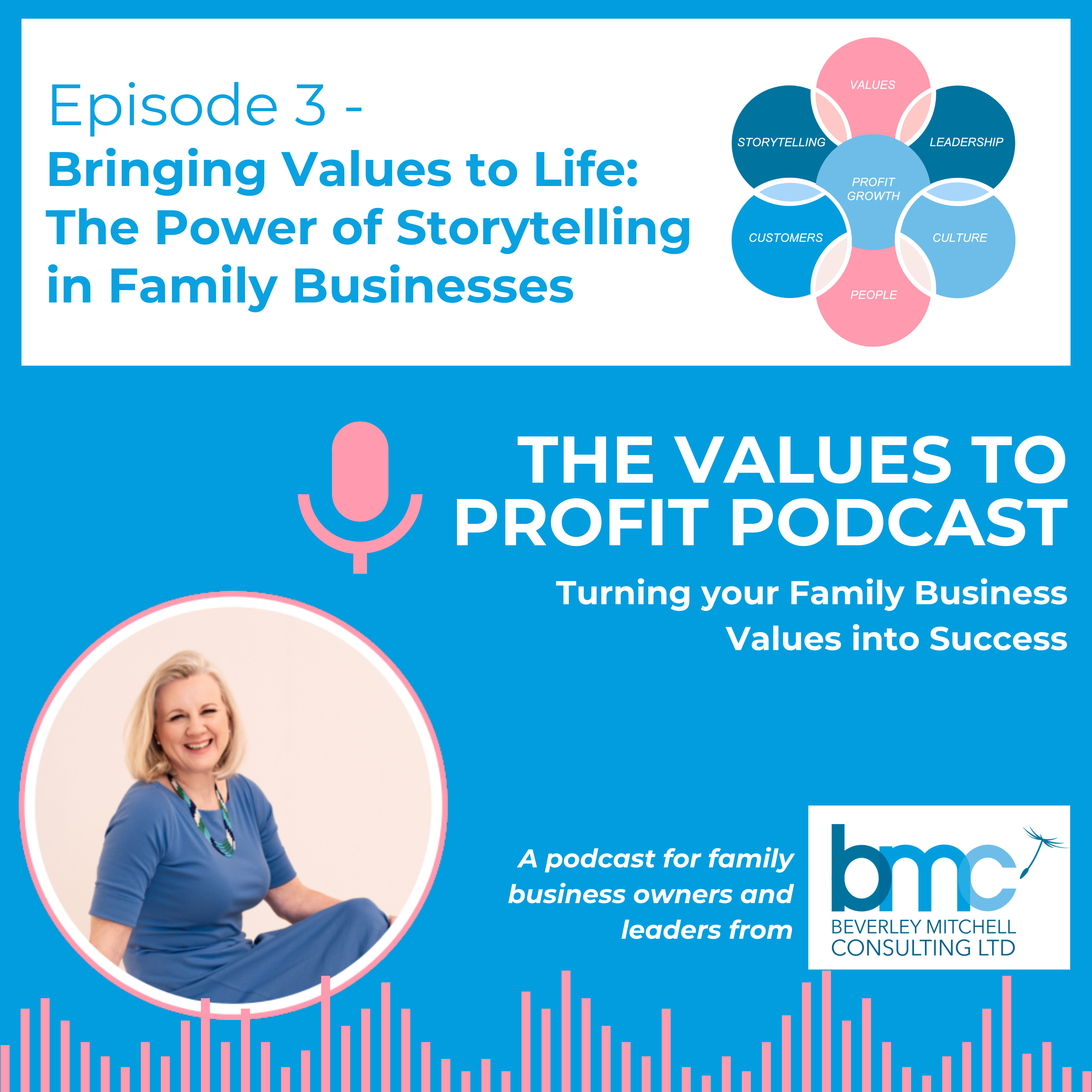 Episode 3 - Bringing Values to Life: The Power of Storytelling in Family Businesses
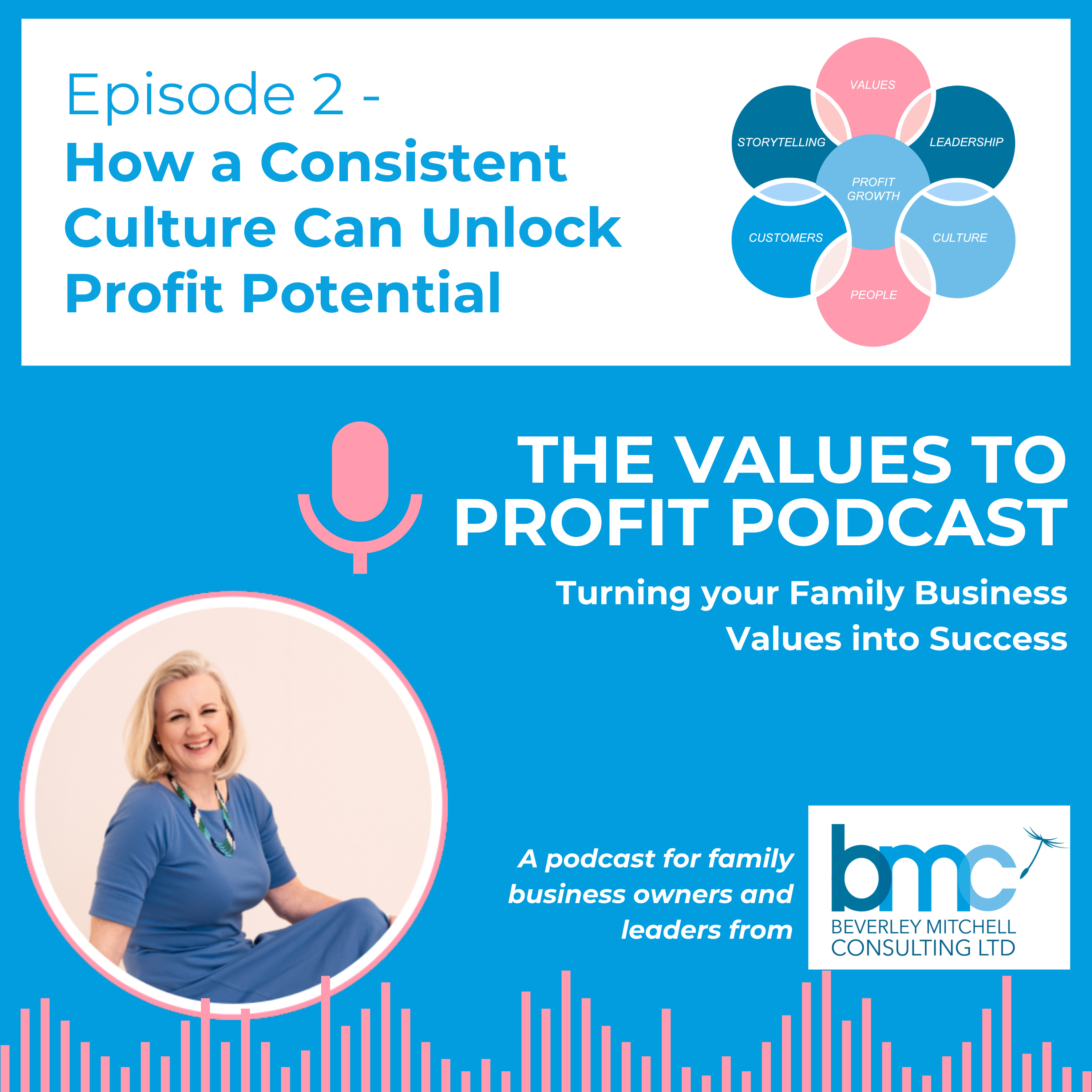 Episode 2 - How a consistent culture can unlock profit potential
 Episode 1 - Leveraging your values and culture to drive customer growth