
The Sales Compensation Show · 2026-06-09 · 35 min
Key moments - from our scoring
Substance score
46 / 100
Five dimensions, 20 points each
Prev Dole, a seasoned sales compensation leader with 11+ years at MongoDB and extensive experience across Silicon Valley tech companies like Mercury Interactive and Sherpa Corporation, argues that well-designed compensation plans often fail not because of flawed mechanics, but due to poor execution and operational readiness. She emphasizes that the real complexity in sales comp lies not in the math - which is straightforward - but in crediting logic: determining which rep gets credit when deals involve multiple sellers, global teams, and complex products. Dole stresses the importance of clarity over simplicity, noting that oversimplified plans can disconnect from business reality, while complex plans with transparent crediting guidelines outperform simple plans with murky logic. She advocates for early cross-functional involvement in comp planning (involving systems, finance, and operations teams by mid-year, not Q4), consistent data and business definitions across geographies and channels, and investing in operational readiness before plan launch. For RevOps leaders and sales compensation practitioners, her insights challenge the conventional wisdom that simpler is always better and highlight why execution failures are often misdiagnosed as design failures.
Most plan failures aren't design issues but operational and rollout problems - systems aren't ready, crediting logic isn't transparent to reps, and there's misalignment between what reps expect to earn and what dashboards show. When reps don't understand their plan in month one or don't trust what they see, the program is already broken regardless of design quality.
Clarity trumps simplicity. A complex plan with transparent crediting guidelines outperforms a simple plan that's misunderstood or mistrusts. The devil is in the details - oversimplifying can disconnect the plan's intention from how the business actually grows, while complexity paired with clear explanation maintains integrity.
Crediting logic - determining when a salesperson gets credit for a deal and which comp bucket it flows into - is the toughest operational challenge. This is complicated by multiple data sources, global teams, different sales channels, and products that get shared across team members, requiring 30+ people to execute correctly.
Planning should start mid-year for the following year, not in Q4. Starting too late creates tight timelines that force quick decisions, compress execution, and leave no room to course-correct. Early involvement of cross-functional teams (systems, finance, operations, partners, professional services) prevents downstream delays and ensures reps understand how to make money on day one.
That simpler plans always perform better. Dole argues this is often wrong - complexity paired with clarity can outperform simplicity that sacrifices meaning. The focus should be on maintaining alignment between plan intention and business reality, not reducing complexity for its own sake.
Our reviewer’s read on each dimension, with quotes from the episode.
There are a handful of genuinely useful operational insights - particularly around execution failure vs. design failure and the clarity-vs-simplicity distinction - but they're buried under extended career biography, rapport-building filler, and a book recommendation segment. The signal-to-noise ratio is low for a 35-minute episode.
most of the time it's not a design issue. It's typically like there's a rollout or an operational problem
the reps don't understand their plan in the first month and they don't agree, they don't experience or they don't like what they're seeing their dashboards, then it's already broken
The clarity-over-simplicity reframe is the episode's most counterintuitive idea and is articulated reasonably well; the execution-not-design 'hot take' has genuine merit. Everything else - stakeholder alignment stories, data definition challenges, spreadsheets persisting - is well-worn territory in the RevOps practitioner world.
you can have a very complex plan that is clearly understood or a simple plan that's misunderstood and mistrusted
the real goal, the real focus should be on just clarity, not simplicity
Prev Dole is a genuine career practitioner with nearly 11 years at MongoDB and earlier experience at Mercury Interactive and Sherpa Corporation - real operational depth in a niche domain. Not a thought-leader or career podcaster, but also not a C-suite architect with rare strategic vantage; her insights reflect solid mid-senior execution experience rather than exceptional scale or novelty.
I was with Mongo for almost 11 years
This was at Mercury Interactive
The episode names specific companies (Mercury Interactive, MongoDB, Sherpa Corporation) and offers one rough numerical benchmark (sales comp as 10 - 20% of revenue), but lacks concrete case outcomes, timelines, dollar figures, or before-and-after metrics. The Mercury Interactive story - the most instructive anecdote - stays entirely anecdotal with no measurable result cited.
sales comp is usually 20%, 10, 10 to 20% of revenue, it's still like the least funded operationally
I rolled out a program without involving a key stakeholder, the person who actually owned the process while the program worked out, the rollout was harder than, you know, it needed to be
The host occasionally adds substantive perspective of his own (e.g., the data-definition vs. business-definition translation problem) and builds on the guest's points rather than just nodding, which elevates the conversation slightly above a pure PR puff piece. However, he talks at length himself, questions are broad and open-ended ('what's a hot take,' 'what's a myth'), and there is no meaningful challenge or probing of any claim made by the guest.
what's a hot take that you have in the world of sales comp
what's a common sales performance myth or misconception that you hear
Computed from the transcript - who did the talking, and the words that came up most.
Sales comp has come a long way from the function nobody wanted to own. Today, it’s where GTM strategy gets pressure-tested in the real world. Territories, quotas, roles, revenue definitions, crediting logic, systems, dashboards, seller trust - eventually, all of it flows into the comp plan. In this episode of The Sales Compensation Show , Forma.ai CEO Nabeil Alazzam sits down with Prev Dole, Global GTM and Sales Compensation Leader and founding member of The Sales Comp Think Tank, for a candid conversation on what years inside the sales compensation profession teach you about the plans that work, the rollouts that don’t, and the gaps leaders learn to spot early. The conversation gets into some of the realities experienced comp leaders know well, from late planning quietly costing teams Q1 momentum, well-designed plans failing when systems aren’t ready, and the fact that many “design issues” are really rollout, dashboard, or operational readiness issues in disguise. Prev and Nabeil also dig into one of the episode’s sharper debates: are simpler comp plans always better? Prev’s answer is more nuanced.
Transcribed and scored by The B2B Podcast Index.
Welcome to the Sales Compensation show where we share the latest sales performance insights through in depth discussion with experts. Season three of our show is your backstage pass to discovering how today's most successful sales and revenue ops teams support go to Market strategy and improve sales performance. Plus, we'll explore what we can learn about incentives from different industries more broadly. Subscribe to hear how leaders are unlocking new growth, implementing the latest compensation trends and their priorities for improving Go to Market performance.
I'm your host CPU CEO of Formai, Nabeel Alzam Prev. It's always great to see you. It's good to have you on the show. Thank you for joining us today.
I'm glad to be here. It's always good to catch up with you, Nabil. It's a fun world of sales comp that we live in. I always start the episode with the big question of how you got into this space.
Yeah, I got into it in a kind of nerdy way. There was a bookkeeping elective in junior high school and I signed up. I did pretty well. I impressed my teacher and I decided to keep going with it.
And I started working for small businesses in high school. So small furniture companies, automotive, Mercedes Benz dealer. That was a fun gig and I learned a lot. I also love dabbling in light computer programming and always had high appreciation for tech gadgets.
I'm more very tech gadgety than my husband, so that got me into revenue accounting and operations where I always ended up owning sales compensation. No, at the time nobody wanted to own it, so I always had it in my ownership bucket. And halfway through my career I pivoted fully to sales comp. When that industry started becoming more and more appreciated.
There were tools, there were systems, it was more process engagement and that's how I ended up in Saskov. It is funny how it's like it does get relegated to whoever's willing to do it because nobody wanted it at the time because they didn't want to deal with conflict and friction when it comes to people's paychecks. Systems weren't as robust as they are now. There weren't a lot of options.
It was like OIC and spreadsheets. And to this day we still use spreadsheets. That's not gonna wait for a lot of. Yeah, that is.
That is the one constant in life. Along with that, taxes. Yeah, yeah. The spreadsheet is still the language unfortunately of sales comp.
But I think, you know what makes it difficult is to your point, it is the conflict and it is a very you know, stressful, like ease be a hundred percent accurate. There's a lot of like time difficulty of like you're constantly jumping from like payroll cycle to you know, quarter end, et cetera. I don't know how you find this but like the data logic and the definition at the data level is a totally different world than the business definition. And so like that difference between metric and data definition is one of the most difficult things to cross.
It's like technical speak to business speak and you have to be that translation layer a hundred percent. It's the very first thing I look at whenever I join any company is their governance in terms of conditions. And it is always the case where everybody sees whether it's TCV, ACB, AR, whatever your booking revenue metric is, it's always going to have a different definition depending on the organization and the people that you ask. So almost always I'm sure to have to clean up the terms and conditions and the definitions and the crediting guidelines.
That's the number one thing I look at in any company. And not only is it different by company but at scale, you know, what we see is it's different depending on the geo or like the, you know, the channel that you're selling through. And so that just compounds in complexity because even within the same company you ask someone what's the definition of this and it really depends on where they're selling and how they're selling. So it's, it's a very, it's a very, very difficult challenge.
So okay, so at one point you realize this is my calling, I'm going to stick to it and I'm going to go through and, and so how did the experience earlier in your career kind of carry forward to how you run sales comp teams? Today I got my big break in, in the tech world. Silicon Valley. I used to live in Santa Cruz and so in order to make serious money and be engaged and, and participate in the tech rise, at the time I, it was important that I, you know, go over the hill is what we referred to it go to.
It's a beautiful drive over that hill. 17 drive. I could, you know, at the time I could drive it with my eyes closed. Don't recommend that people do that.
So I landed my first gig as a revenue accountant which at the time was just what we see today as quote to cash and a little bit of revenue accounting and a little bit of revenue operations. Very small company, Sherpa Corporation. Got my first big break from them. The manager, I was still going through College and the manager gave me a chance and saw my potential.
We had a good rapport. I answered his questions really well. I created enough of an impression and so he gave me a chance. I got that and that was my entry into the tech world and I haven't really left since.
And from that first big break, I like to give others the same opportunity. So kind of a pay forward kind of thing because everybody deserves a chance. Some people are very restrictive about like education, experience. A lot of people have to start somewhere.
And so a lot of my teams early on were just starting out like I was. And so if we had a good fit between us in how we communicated rapport with each other. I'm more of a gut feel person when it comes to certain things, especially hiring. Sometimes it backfires, admittedly, but more often than not, it's pretty successful in building relationships and seeing talent.
Yeah, I mean hiring and talent building is part of like running any sales computer team or any team really. But it's hard, right? Like, you know, it's funny, over the years I've grown more confident in trusting my gut on talent and people, but I've grown less confident in my overall ability to. Even when my gut says yes.
Like, my overall confidence on how successful that person will be is actually declined. So I used to be like very bullish if I thought that this person was good. But really it's, you know, it's so hard in an interview process, you know, unless you actively work together and kind of set up a more of like a trial period to actually truly assess how good someone is. So you can try your best and kind of get a bunch of signals.
But my hit rate on gut feel if I don't have a good gut feel is almost 100%. And that's why I always thought when it's like your gut is. It's this kind of like signal aggregator of signals that you may not even be aware of. And you do have to trust it as a part of the, you know, the process.
But your goal to, you know, should be to try to build as much data collection so that you can, you can find the talent. Because I don't know about you, but like building it, the team, the team makes or breaks, how you're running your sales comp operation. Oh, absolutely. And I've had, I mean I was, I was with Mongo for almost 11 years and I've had a really long successful run.
But there were bits and pieces in time where, okay, this isn't the right person. And so you have the responsibility. And you have to hold yourself accountable for that hire or that misfire and be proactive about doing something about it. Otherwise, you know, the rest of the team suffers, the processes suffer, the company suffers, the people you're paying suffers.
And you know, you make a mistake, you made a mistake, right? Mistakes happen. And what we do to course correct is the most important part. And that to me always shows that whole process of identifying, accepting, owning up to it and then doing something about it immediately.
That to me that how a person proceeds in that process, how quickly they do that and how humble they stay within that process. It's hard to admit mistakes, right. But they happen. And so be able to move forward, build forward from that, learn from it and keep going and be ready to have those hard conversations.
Because you know if your team is, if you hire the rest of your team, right, they will call you out and you want that. So yeah, I mean everyone needs to hold the bar up, you know. And it's a tough, it's a very tough role. Like to your point, you need to be technical like we talked about earlier.
It's be technical. You need to understand that kind of like the asymmetrical business speak versus like data definition and kind of the, the technical language. But then you do have a customer base that you need to serve, right. And you need to get the payouts on time and it's mission critical.
So it's a, it's a very tough, tough role. I actually it, you know, it's interesting, you're the hiring like younger people in their career journey, necessarily young, age wise, but just people earlier in their career journey. It's actually a very lucrative opportunity because you get a very broad lens to how the business operates. Right.
You get to see that, you know the way that the data flows through the meaning of the different products and you know what it means to run the revenue organization. So it's. Yeah, I think you also have to be willing as a leader to invest your time. You're not just believing in this person, but you're will.
You're saying to yourself, I'm willing to invest time in you so that you could be better than me in the future. Like achieve your potential and more if you want. So the other person has to want it too. And I've had interviewees who came off of the interview horribly, but they were talented.
Their skill set was second to none in the entire candidate pool. So if you take a chance on the seemingly still very talented individual but has a low personality and help them evolve and coach them, you know, to work. Of course they have to be comfortable, but you have to be willing to invest. That's been a lot of my.
In the latter half of my career, that's been a lot of what I've done and engaged in is investing myself in developing others. That's where I find the most fun and more fulfilling with my job. And so, you know, you've again been at different organizations, you've scaled over the many years. Yeah.
You've seen a lot of different cycles and flows, I guess. Like, what have you seen evolve and what has that journey been like to see sales compensation from when you first started out to where it is today? If I can see like my whole career cycle in front of me evolving, um, there's a couple of observations I make. First is that comp planning is finally being taken seriously.
It's no longer like an afterthought or, you know, we'll, you know, we'll focus on product, we'll focus on development, we'll focus on marketing and put funds there. But. And we'll fund sales as well. But the funding.
Sales means a lot of things. It means, you know, hiring, headcount training, you know, sales kickoffs, all of that. Right. But then there's also the sales comp side of it.
And sales comp has definitely grown more sophisticated, a lot more challenging and complex. Very creative world. Very creative. Yeah.
There's no shortage of unique incentives that I've seen. And so that forces you to question what you are comfortable with. Like the framework that you, you know, you defined like in your career, what you're comfortable with. So it forces you to really take a look and say, is this the right.
Is this the right way we're doing things? Because we can't put a system, an infrastructure process together and say, okay, we're going to make this comp program fit this framework. Right. It's all.
It's flipped around the other way around, which is very challenging because even though sales comp is usually 20%, 10, 10 to 20% of revenue, it's still like the least funded operationally. Yeah. For the, for the throughput of the money that goes through. Yeah, it's.
It's very, you know, that's the case now and maybe it'll change in the future, but that's. Yeah, it's. But I will say that it hasn't been as difficult to get invited or to even place yourself at the table when design and conversations are happening. You just have to sometimes make it happen yourself.
But I think that the last five years sales comp has been more than welcome to join the table. I do believe that. And even most organizations today still see it as a cost center. Right.
It's an operational cost center. Yeah. Even though it's, it truly when done right is a strategic asset and driver of the, of, of the go to market organization. And you know, the biggest problem that I see is that the different parts of the go to market operations process is so siloed that you know, decisions with territories and decisions with segmentation and coverage and roles are made outside of everything else.
Right. So territories are decided in one way and then you, you know, you go over to comp and those two things are not normally connected or people owned by different parts of the organization. I think the problem there is it is all one cohesive thing. Everything is executed and you feel it the most in sales comp because as a previous guest said on the show, I think like all rivers flow into sales comp.
Right. It's like all ends up. You need all that information, all that detail to execute on a great comp strategy. Yeah.
So yeah. And talking about like planning, one of the things that I encountered and this is typical is you know, you're planning, you're in your comp planning session which typically should start like mid year plan year. Some companies don't do this until for lack of resources or whatever. Right.
They don't do it until like the last quarter. By then like you're putting yourself in a very tight situation because you're going to be dealing with quarter end, year end and if you have to make a big shift, it's very difficult to do so the short window. And so you know, one, during one of the plannings I noticed that yet I saw the strategy timeline and the draft of it was missing partners essays and professional services and because the thinking was to focus on field at the time and then handle everybody else later.
But that very quickly backfired because the field was delayed and so everybody else was delayed and these are people's paychecks and if they don't know how to sell on day one of the new plan year then you know, and it's going to take them a few cycles to, to understand what they're selling and how they're going to sell it and how they're going to make money and you know, you've already, you've already lost like a whole quarter. The lack of clarity at the beginning of the year has such a bigger impact.
I mean there is a lot of other distractions and, and there's, you know, sales kickoff, etc, but the tighter you can get that, the more alignment you can get around that kind of that launch, the better you're gonna end up doing. You just buy yourself time to course correct too. Yeah, I couldn't agree more. I so, so jumping, you know, right into some of my favorite, you know, questions that I ask on the show is given again your experience, I guess like what are you, what's a hot take that you have in the world of sales comp?
Let's see. So I am, and this is going to be a bit controversial but I love it. We're in for something in the world of operations. I love planning, I love details and I'm all operations.
Right. But you know, a lot of some people will, when I'm talking to them, they'll say oh SEO, we've got comp issue and it just wasn't designed right. Well, most of the time it's not a design issue. It's typically like there's a rollout or an operational problem.
And what I mean by that is where well designed plans, and I've seen a lot of well designed plans fail is because simply the systems weren't ready. And we're talking about holistic strategy planning earlier. Right. And so when, when people are thinking about phasing in programs and people and roles like that's you're breaking the chain in my opinion.
And you know, it took me a long time to get comfortable with saying sometimes it's not a comp design problem, it's a rollout and operations problem. Right. So we over focus planning on like the mechanics. But you know, reps aren't, they're not involved in the design.
Right. They're not experiencing the design. I mean they're during the planning stage. The other leadership is in discussion whether or not they can, you know, certain programs are feasible and they can really sell it and reps will be on board and they understand the crediting guidelines.
But when things get over complicated and the reps like start looking at their dashboards and expecting a payment to be one thing, but then they see something completely different, then it doesn't match. So the reps don't understand their plan in the first month and they don't agree, they don't experience or they don't like what they're seeing their dashboards, then it's already broken. Right? Yeah.
And from an operations perspective, you can design the most beautiful plan ever, but if the system's not there fully, completely to support it and the system is still trying to catch up, then it's really not ready. That can cripple a sales organization if the reps aren't getting the information that they need or there's a lack of trust and an entire comp program can go to, go fully to waste. And so I 100% agree with you in the sense of where I see some of the biggest challenges with sales comp operations is the crediting logic.
When do you get credit for sale and what bucket does it go into in your comp plan? One of the toughest problems, like the math of incentives is actually really easy. And if you talk to anyone outside of this world and you say oh, sales comp is super complex, they kind of look at you and they're like, like I don't get it. It's, it's math, 5%, whatever times this, you know, and, and, and I've heard that firsthand.
I've had that like kind of like glaring look back and I'm like, yes, okay, the math is easy. But it's, you know, especially global organizations, you're, you have multiple channels that you sell through. The data is coming from like 50 plus different data sources across the globe. Yeah.
What sales get attributed to what person and the logic behind that is very difficult. And for most organizations, the operation side to your point that like there's not enough investment to make that very transparent, easy to understand for the seller. And that's where you get the problem. Because they book an order and in their mind it looks like one thing.
And then when they look at their dashboard, your point earlier, if they disconnect, that is the biggest challenge that can cripple the execution. Yeah. It's kind of funny that you mentioned being kind of asked like why is it so complicated? During my career break, as I was looking for my next opportunity, my father was asking my husband, what exactly does she do?
Because I was in sales and I earned commission, I sold and I then had to was pay commission. What does she do? And yeah, I had to explain my husband and my father in law like, yeah, okay, you sell something and you should get a commission. But you know, in a global company with all these complex products and ways of slicing and dicing and sharing their booking with other team members around the world, like there's a lot of complexities and layers between point a to point zone.
And so the piece in the middle is what I'm involved in. And sometimes it takes, you know, 30 people to do that. Yeah, no, 100%, it's, it's a complicated problem. And most organizations don't make it easy, easy on themselves because there's not even consistency at the data layer.
There's not consistency at the, the business definition layer. And, and so, yeah, that's. It's certainly a hard, hard challenge. And so, I mean, I agree you want to have a planning discussion and design discussion that's centered around the behaviors that you want to.
But you need to translate that back to, okay, operationally, how are we going to do this to make sure that that communication. Yeah, and it's good. It's good to have that partnership with the rest of the stakeholders in the downstream process be part of, at least be in the room. And the timing of when you start all these discussions and how early they get involved in the process, that can be determined and so scheduled appropriately.
But they have to be there early on, as early as possible, going a slightly different direction, I guess. Like, what's a common sales performance myth or misconception that you hear, you catch and see come up all the time. It's funny if you're talking about like complex designs and layers, but. And again, this is going to be probably controversial, but my.
The thought process that simpler plans always perform better. That is not always, you know, that is sometimes the opposite of what you want. Simplicity is very important. Gaining efficiencies where you can.
But oversimplifying can, you know, disconnect the plan, the intention of the plan with how the business actually is growing. The real goal, the real focus should be on just clarity, not simplicity. So sometimes those two get completed. So, so you can have a very complex plan that is clearly understood or a simple plan that's misunderstood and mistrusted.
I know it's a bit controversial for some people, but, you know, if I'm seasoned and I've seen it fall, you know, backfire when you. Yeah, it's, it's, it's controversial when you say simple plans are not always better. And then, you know, like, it's because truly simplicity is better, but it's only better if you capture the, the same meaning. Right?
Like if you lose meaning of it. If you, if you lose that integrity, clarity, then what's the point of simplifying? You, yes, you've simplified for the sake of simplifying. You haven't simplified while still maintaining the objective.
And then the other part is sometimes you'll see comp plans that are designed by sales leader and the incentives look simple and you're like, okay, so great, you've designed a simple plan, but the creating Logic is so complex. Yes. That you still end with lack of clarity that you end up with in a worse spot than had you had a more complex plan, but that was actually better tied to the crediting logic. And you just took the one time to explain that level of complexity.
And I think there's this element of like, people think the math needs to be simple. The math is a fraction of the difficulty of sales comp plans. And again, rarely do we spend enough time on kind of explaining truly the crediting logic of when do you get credit for something? What happens if you're not the account owner at the point when the transaction goes from a booking to kind of recognize revenue, et cetera, et cetera, all these little things that without that clarity to the seller, it's very difficult to actually incentivize.
And I've been saying this my whole entire life, ever since I did that, even before I took that bookkeeping elective in junior high. The devil's in the details. No, that is, yeah, it can be more true for salespeople. Has to be aligned.
Everybody has to be aligned. So I think over your, your, your, your career and experience in sales comp, is there a specific experience, you know, situation that you've encountered that has truly shaped your, you know, perspective on everything from incentives to planning or leadership on how you approach it? Yeah. So, and I'm comfortable in sharing this.
This is one of those learning moments for me that I share with everybody that wants to know that asks me this question so early in my career. Very young manager. This was after, this was the next career path after the big break I had. This was at Mercury Interactive.
I have an amazing manager there. She was a wonderful director and she was amazing coaching mentor. Still to this day, I hold her up high. She gave me my first break in management.
So, so early in my career, I was very young, I led very aggressively. I delivered excellent results, I must say. But while I was great at execution, I didn't always have the right alignment and buy in. So I rolled out a program without involving a key stakeholder, the person who actually owned the process while the program worked out, the rollout was harder than, you know, it needed to be because I didn't have again, that true buy in.
So that changed how I led. And now I prioritize early alignment because execution without, without it creates friction. And I, it's something that I, if it's something that's impacted me when I project, manage, when I coach, when I talk to salespeople, I always, you know, trying to Understand the point of view of the other side. There's two sides to the story.
You know, you put yourself in somebody else's shoes. Like you don't always know the situation. And so that's. That's made me, you know, come to the table more open, more willing to listen early on in my career.
So previously, you know, my reputation preceded itself not in the most positive way. Now it precedes itself in a more positive light. There's so much stakeholder management and team management in sales comp. Like it is a very.
Again, it's a complex process. A lot of project management. You have to get a lot of people together and alignment certainly streamlines it a lot. So these tough experiences, like the earlier you learn them and go through that pain, the better because then you just bring it down to the rest of your career.
So, yeah, no, I think for the audience, I certainly think that clarity is not just on the compline side. I think that clarity of to the team and the owners and kind of getting alignment throughout, it really does help and facilitate. I also learned from. Because my manager, the director, she was the one who.
Because I didn't see any issues with it at first. Right. And so she was mature enough and she was unafraid to have that difficult conversation with me. And she approached me and told me prev.
What do you think could have made this whole situation better? Is there anything you think prev. That you should have done differently? And do you think there was.
Not that there was a mistake here, but do you have a stake in this? What was your responsibility in this whole process? Not just as the person managing this program and rolling it out. Beyond that, what else was your role?
And if I hadn't had that early on, overachiever, type A personality, you know, where that, you know, directionally, I, you know, would have continued on to be very aggressive leader. And that's not. That just wasn't something that is going to be successful, especially in, you know, the environment that we're in today. Yeah.
So I'm happy that she talked to me. She set me aside and. And was very upfront and honest with me about her observations. Again, it was rooted in facts.
I was supported enough to have the conversation later on with that individual, that stakeholder that was excluded. And to this day we're still in contact. Yeah. And these lessons go a long way in terms of how they cascade out to how you now manage your team, et cetera.
And I think that's certainly helps. Before we wrap up, we always ask our guests Two questions. So first, in the industry, who would you most like to take out to lunch and why? So when I think about this question, it's, it's a no brainer for me.
I would actually just, you know, reached out to this person, my first manager, Vishal. Right. And so I would really like to catch up with the person and kind of see where we're at today. The people that help curate and kind of set you on a path from a career perspective, I think they're, you know, have a tremendous influence.
And yeah, I know that his, you know, his. And he didn't just like give me my first break, was actually my first mentor. And so that one opportunity, you know, he, the fact that he took a chance on me, that one opportunity really stuck with me and changed the trajectory of my career. Okay, second question.
What's a book podcast resource that has helped shape your career that you'd like to share with the audience? I just started reading this book, bounce forward by Amy 30. She's a three time Paralympian gold medalist and a silver and bronze medalist. But so she was on the, on a, on a zoom call on Monday, this past Monday and was introduced to her book and as she was speaking and sharing her story, her mindset really stuck with me.
So early in her youth, at 19, she caught a virus and they don't know how it happened. She lost both her legs and she's no longer a competitive snowboarder. But, you know, snowboarding was her life. She was a strong athlete at that time.
And the way, of course, you know, she went through like, you know, the emotional physical challenges, but the way she tackled the situation that life has dealt her was very inspirational. She ended up changing because there were no, there were no equipment for snowboarding, for para, you know, for. Okay, yeah, yeah. And you know, she's one of the early founders of, I can't recall the company, but her company works with other companies and they developed this, what you now see in the Paralympic sports, in snowboarding.
And she's engaged in motivational speaking and she was at this call on Monday and her mindset of bouncing forward, so you built forward. So a lot of times when we go through adversity and challenges, we say we'll bounce back. Right. But you think about it and her perspective really changed my way of thinking on this.
Like, we don't really want to go back in time and be there again. Like we're not bouncing back. Like we're bouncing forward. So we're building forward and hence the name.
Yeah, That's a great, that's a great mentality. Yeah. Yeah. And so that's, you know, it's like I can think of comp in that way because we go through over our cycles, we go through challenges.
Sometimes plans don't work out, sometimes we roll something out and it just completely like business direction changes drastically. Yeah. And so you. Things will break again.
What matters is, you know, how fast we adapt and rebuild. I always love kind of the resources and you know, whether it's books or you know, content that is totally outside the field, but you bring back to your kind of day to day operation and love that. Yeah. It resonates both like in the personal and professional space.
I thought. I highly recommend the book. Yeah. I think she would be a great speaker.
You should look into it. Yeah. I was gonna say. Yeah, yeah, for sure.
I think move for the sales comp. Think tech. Yeah. I'll yeah.
Talk to you later. But I just want to echo Prev. Thank you for, for jumping on the show and I think all of this, everything we're doing in terms of kind of putting back more into the community and kind of establishing and elevating dysfunction even well, well beyond what. What.
What it already is today. But it's not possible without having experienced professionals like yourself come on and share, share your. Your less scars that we all carry in the world of sales compensation. But thank you again for being on the show.
There's absolutely wonderful discussion, so thank you. Thank you Nabil. I appreciate it as always. Great conversation.
The sales competition show is brought to you by Forma AI, the sales performance management platform that fully integrates sales planning with rapid scalable incentive compensation management. Our data platform brings together how you can plan and manage the entire lifecycle of territories, quotas and incentives. With global customers like Autodesk, Stryker and Hootsuite, we enable go to market teams to plan and deploy even the most complex SPM strategies at speed, taking you from idea to execution instantly.
To learn more about Forma AI, visit our website at Forma AI hit the subscribe button and find more episodes of this show on Apple podcasts, Spotify and YouTube. Thanks for tuning in.
Other episodes covering the same guests and topics, from across The B2B Podcast Index.
 Beyond Efficiency: Why AI Is Forcing Marketing to Rethink Everything, Not Just Cut CostsDisambiguation · on Revenue operations87 / 100
 How B2B Brands Use AI for Dynamic PricingThe Growth Operator with Fexingo · on Revenue operations85 / 100
 From SaaS to Systems of Work: The Vertical AI Opportunity with Nick TippmannInvesting in Startups · on Revenue operations81 / 100
 Turning Finance Teams Into Growth Drivers with AI with Julio Martínez #247SaaS District · on Revenue operations68 / 100
 E156: When AI Runs GTM, What Do Humans Still Own?B2B Marketing Futures · on Revenue operations61 / 100
 Olivier Roth on Why Revenue Lives in the Network, Not the CRM RecordSales POP! Podcasts · on Revenue operations57 / 100
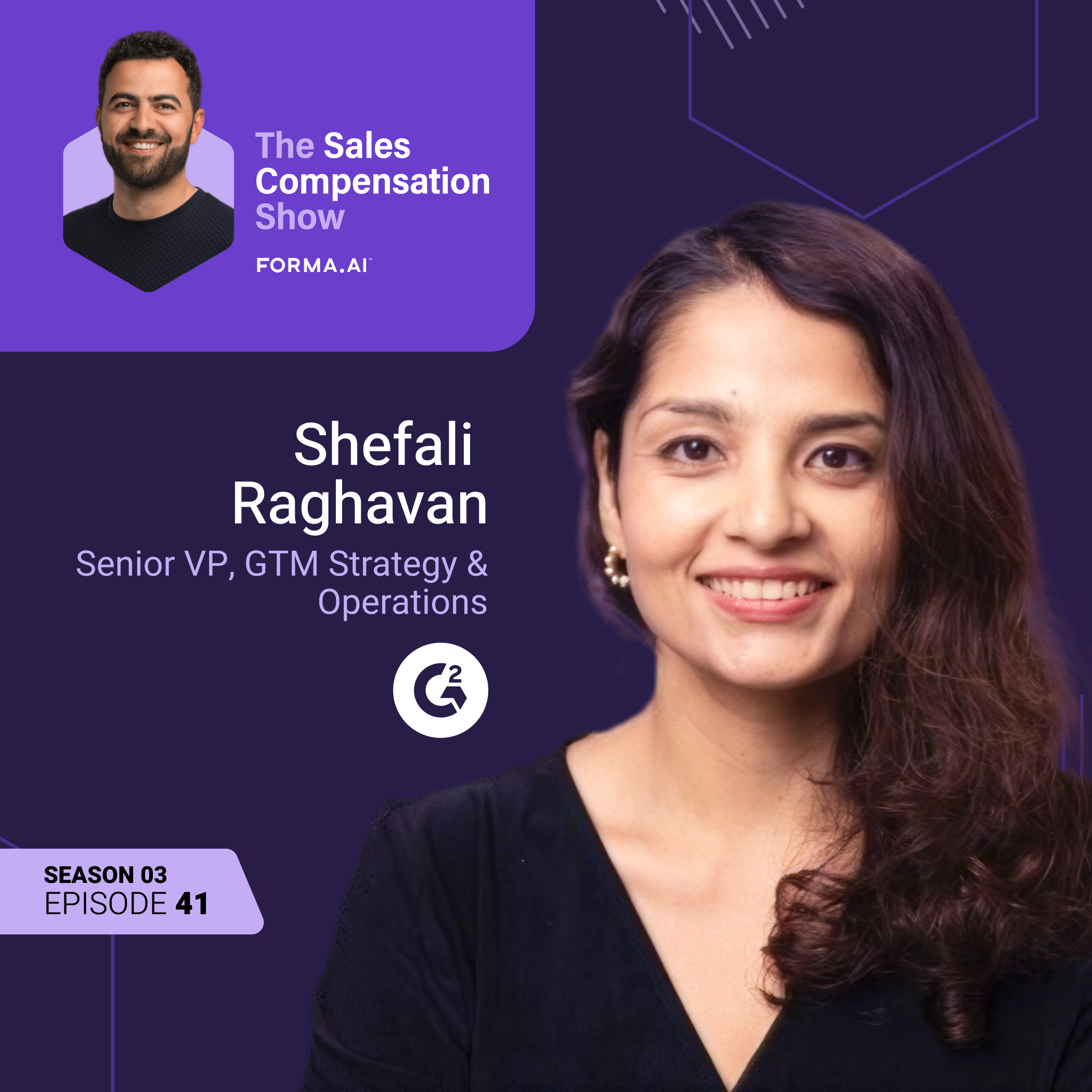 How G2's SVP of GTM Strategy evaluates sales comp plans, scales teams & runs M&A86 / 100
 Inside Microsoft-scale sales operations with Chinesh Gandhi86 / 100
 Sales comp can’t fix an undefined GTM strategy: Lessons from Marnie Sprenger76 / 100
 From enablement to sales performance engineering, with Okta's Lauren Silvers69 / 100
 ClickUp’s Jason Wooten on top sellers, procurement pressure, and leadership risk76 / 100