The Retail Podcast · 2026-06-30 · 15 min
Key moments - from our scoring
Substance score
60 / 100
Five dimensions, 20 points each
Sumit Mehra provides a masterclass in navigating India's luxury retail market, a sector that demands patience, cultural relevance, and a willingness to abandon Western retail playbooks. As CEO of Reliance Brands - which represents portfolio brands including Hamleys (fully owned since 2019), Armani, Bottega Veneta, Valentino, Jimmy Choo, Tory Burch, Michael Kors, and 50+ others - Mehra shares hard-won insights from building luxury distribution across a market of 1.4 billion people where the addressable luxury consumer remains dispersed and occasion-driven. The episode challenges the common mistake of treating India like China: same population, same store density. Instead, Mehra advocates for 'cultural relevance' over localization, long-term investment horizons, and unconventional distribution methods. His trunk show program - where wealthy consumers host fashion events at their homes - and Argyolux (India's largest luxury e-commerce platform delivering to 40,000 zip codes) show how Reliance reaches luxury customers hidden across 50+ cities with over one million residents. Critical for any B2B executive considering India expansion, whether in retail, luxury goods, or multi-brand distribution.
Through trunk shows - curated home events where wealthy consumers host friends for product showcases - and Argyolux, India's largest luxury e-commerce platform that delivers to 40,000 zip codes. This generates 55% of their revenue from regions without physical locations.
Localization means creating India-specific products, which risks dumping down the brand; cultural relevance means keeping the global product unchanged but making the brand present in consumers' life moments - weddings, Diwali, religious functions - where Indians buy luxury.
They treat India like China - assuming similar population means similar store density - without understanding that infrastructure gaps, dispersed wealth, and occasion-driven purchasing require long-term investment, local partnerships, and non-traditional distribution channels.
Indian consumers are occasion-driven (purchasing for weddings, festivals) rather than impulse shoppers, and they trade up on asset classes like cars and jewelry while negotiating on fashion - a behavior requiring distinct value positioning by brands.
Portfolio includes 55+ brands in physical retail (Hamleys fully owned, Armani, Bottega Veneta, Valentino, Jimmy Choo, Tory Burch, Michael Kors, Kate Spade, Coach, Muji, Superdry, Mothercare, Charles Tyrwhitt) plus 20+ brands via joint ventures and digital-only offerings.
Our reviewer’s read on each dimension, with quotes from the episode.
The episode contains a handful of genuinely useful, non-obvious ideas - the culturalise-vs-localise distinction, the trunk-show distribution model for reaching dispersed luxury consumers, and the asset-vs-fashion trade-off - but they are padded with repetition and generic long-term-view platitudes that dilute the density meaningfully.
if you have to be relevant in India you have to culturalize you have to be relevant to my culture yeah not make product specific for India because then you're dumping down your product
the Indian consumer trades down on fashion. Yeah. And trades up on assets.
The culturalise/localise framework is a crisp and defensible reframe rarely articulated this precisely, and the home trunk-show model as a luxury distribution strategy is a legitimately fresh operational insight; the rest retreads familiar 'stay long-term, partner wisely' advice.
look at India as not a market size, but look at India as a movement
if you have to be relevant in India you have to culturalize you have to be relevant to my culture
Sumit is a legitimate category-defining practitioner - employee number four of what became a 55-brand luxury retail operation inside Reliance, personally involved in launching Tommy Hilfiger and Nautica in India, and the architect of the Hamleys global acquisition; this is an actual operator at scale, not a keynote-circuit thought leader.
when this company started, I was employee number four
my early days in retail was when I launched Tommy Hilfiger in India, Nautica in India
The episode is well-anchored in concrete data - specific price points, brand names, road-show counts, zip-code reach, and a dated anecdote - though a few claims (the '30 billion number', Rolls-Royce historical claim) are asserted without sourcing, and the host never probes for deeper figures.
you have 135 euros entry level or a diesel denim. Yeah. The price of gold is 125 euros for 10 grams.
55 road shows last year where actually consumers hosted us at their houses
The host lands one strong structural question (the 55%-revenue-without-stores observation) that unlocks the episode's best passage, but the framing is hagiographic throughout, there is no pushback on any claim, and the closing 'what question should I have asked you' is a soft escape that adds nothing.
it's such a privilege to meet and be able to like have this conversation with you so thank you so much
55% of your revenue comes from where you don't have stores. How are you doing that?
Computed from the transcript - who did the talking, and the words that came up most.
Sumeet Yadav, Head of Reliance Brands Limited, on luxury retail, global partnerships and what international brands need to understand about India. How do global brands enter, adapt and scale in India? In this episode of The Retail Podcast, we sit down with Sumeet Yadav, Head of Reliance Brands Limited, just before his keynote at NRF APAC 2026 in Singapore. Reliance Brands Limited sits at the centre of India’s global luxury and lifestyle retail ecosystem, with partnerships spanning fashion, lifestyle, eyewear, toys, home, and food and beverage. Its portfolio connects high luxury, premium lifestyle, family retail and scaled consumer experiences. This conversation explores the leadership, operating discipline and market understanding required to bring international brands into India and build them for long-term relevance.
Transcribed and scored by The B2B Podcast Index.
Look at India as not a market size, but look at India as a movement. India as something that will surprise you. Hello and welcome back to the Retail Podcast. Now, we are minutes away from Sumit's keynote speech that I have the privilege of moderating.
and we've just been talking and it's I mean this is one of the conversations that is very rare and it's such a privilege to meet and be able to like have this conversation with you so thank you so much you are the CEO of Reliance Brands which just going through this process with you has sort of opened my eyes to not only the challenges of multiple brands coming into India but India itself as this sort of metropolis of different hubs of activity, whether it's billionaires, millionaires, whether it's your middle class.
It's just, there's so many different areas. But why don't we start just quickly before we get into the markets and the country, just to talk about you, if that's okay. How did you end up becoming the CEO of Reliance Brands? Actually, you know, when this company started, I was employee number four.
Okay. This is way back 2007. It's, you know, we're part of the Reliance family, which we all know is one of the largest, you know, private enterprises in the country. Yeah.
I dare say in the world. Yeah. So it sits with the Reliance retail as a vertical. Okay.
I spent seven years initially, did everything that I could. You know, it was a startup. Yeah. So there's no designations.
There's no positions. You are head of ASHA, head of writing, head of international business development, running businesses, head of legal. Yeah. because in negotiating contracts took a step out did a couple of other things ran a family office did a bit of F&B and then came back and you know two and a half years ago is when I took up running Reliance Brands as the head of the business and you know it felt a bit logical because you'd seen the company build from a long term we represent brands in India it's all about relationships and partnerships and the way you build it haven't owned those brands for years so that's the journey in a sense.
You know, my early days in retail was when I launched Tommy Hilfiger in India, Nautica in India. So pretty much ever since inception of premium retail, I've been part of this journey. Actually very privileged to be there at this time in India where you can actually see consumers moving away from buying just, you know, product to buying brands and living that lifestyle. So it's been quite a journey, but really, really enriching journey.
We have, the retail podcast has a global listener base or viewer base. I'm just curious, could you share some of the brands that people may know or heard, sort of some beloved brands that sit underneath your world? You know, let's start at both ends. We have Hamleys.
Yeah. We actually own Hamleys globally. Oh, right. We bought- 100%?
100% owned by Reliance. Okay. We bought that in 2019. We have Bottega Veneta, which we are partners with.
We have Valentino, which we are partners with. We have a joint venture with Senia. We handle all of Armani brands, Emporio Armani, Giorgio Armani, EA7 Sport, Armani Exchange. We have Jimmy Choo.
We have Tory Burch, Michael Kors, Kate Spade, Coach, Muji Joint Rancher, Superdry, the IP of which we own in India. Mothercare, we own the IP in India. Charles Tirrett. I sorry if I forgotten some brands He loves all of them We have 55 brands which we represent in physical retail Yeah So we have online offline and then we have another 20 odd brands where we have a joint venture where we own the IP in India, which we further license.
Wow. And then several brands which we only do digitally and not physically yet. That's incredible. So now let's just shift to India, because I know you're the sort of part of the keynote that you're going to be giving in a bit is asking retailers to think about India in a different way.
Everyone knows that India is set to become the most dominant economy over the next 10 years or so. But just let's zoom into India for a minute. Talk about the shopper and what people are getting wrong about the country. Shall do.
I always say look at India as not a market size, but look at India as a movement. India as something that, you know, will surprise you. And, you know, I'll give you a small example before I come to lessons about India. I think when we chatted before I shared this with you, you know, when we launched diesel in 2009 or 10, I still remember vividly, you know, one of my cousins, I was saying, why are you not wearing a diesel denim and why are you wearing a local product?
Okay. And his answer to me was, Sumit, you have 135 euros entry level or a diesel denim. Yeah. The price of gold is 125 euros for 10 grams.
So what should I buy? Should I buy gold or should I buy a diesel denim? Yes. And that made me think what tough a market we are dealing with and the choices a consumer makes.
Yeah. When they're buying an asset class versus fashion. 25 November at a family wedding, I'm sitting at a table. My nephew, who's same age as my daughter, 27, 28, looks at me and says, Uncle, you know, you have Zenia.
Can I get a discount on a triple stitch shoe? A triple stitch shoe in India is €1200 or dollars, right? Welcome. And I'm looking and saying his father, you know, 15 years ago did not want to buy a diesel denim.
and he's making a trade-off between gold and fashion. His son wants to buy a Zenia triple stitch. I didn't see that coming, honestly. And he clearly said, don't look at my parents.
I'm paying for my own money. So that's the India you're dealing with. It is one of the youngest populations in the world. The Gen Z is exploding.
People are learning much faster, higher. So that 30 billion number will surprise a lot of people. The second thing about India is about staying in India. It is about spending your time in the market because the 30 billion could be bigger or 30 billion could be smaller depending on the pace so you can't give up on India.
You have to stay connected in India, you have to stay invested in India and more often than not which is a put in a plug for Reliance you need a partner which is a long view of India. It's not a short-term view of India. So that's critical as a second point about India. Third point about India in which a lot of consumers or companies or brands mistake is saying to be relevant in India you have to localize.
I say if you have to be relevant in India you have to culturalize you have to be relevant to my culture yeah not make product specific for India because then you're dumping down your product it's about your same product that I would have bought anywhere else yeah the fact that you as a brand is culturally relevant to me yeah you are there with me in my life's moments yeah is what's more important yeah so these are the two or three things that you should remember about India when you want to make India a success story for yourself is it culturally relevant stay deep yeah stay invested for long And third, the youth of India will surprise you because they're more global than you think.
In the audience, we're going to have senior executives from retail brands who are thinking about India as this expansion or growth market. But then they're also going to be thinking about China, South or Southeast Asia. What do you think people get wrong about India when they thinking about coming entering the market to do business What the sort of things that you seen people get wrong The first thing people get wrong about India is size In terms of just the scale? Scale.
They think we are a billion people, China is a billion people, both of us shop similarly. Yeah. It doesn't. So when people come to India, brands come to India, first thing is they have to rationalize what India is.
Yeah. To get a deeper understanding. That's a very, very important part of how you approach India as a market. And which comes to my first point, saying you have to take a long-term view of India.
You can't come in India and say, you know what, China have 100 stores, India, same population, I need 100 stores. The infrastructure doesn't exist. The consumer's still graduating. So it's about staying the spirit in India, putting time in India.
Secondly, when managers make decisions, saying what market, which market, there's never a right answer. Right answer for India is today. But the answer of return is long-term. If you look at luxury in India, we've been consuming luxury products for centuries.
You know, the Indian rajas and so on, the Kathia necklace, the Louis Vuitton bags, and the fact that India was the largest consumer of Rolls-Royce cars is the one time in the world. It's a fact. So we know luxury. We understand luxury.
But it's a different journey that consumers are taking in terms of... So it's all about saying, stay true to who you are. Spend a lot of time in the country. Do not look for a quick return.
More importantly, a lot of people make the mistake of, you know, meeting partners socially and saying, you know, you know, India. We vibe together. Let's go to India. Yeah.
Don't make that mistake. This is not about telling, you know, your friends that I have that brand in India at a dinner conversation. Yeah. This is about making a profitable, scalable, long-term business.
Yeah. So choose your partner wisely and then make sure that you've done it for the right reasons, not because you had a drink with them last night. Yeah, one of the points just to home in on, which I found super fascinating, in terms of the size and scale of the country, from a retail perspective, there's going to be parts of the country that I can't build operations in. And what's super fascinating about your own statistics, something like 55% of your revenue comes from where you don't have stores.
How are you doing that? That's the most amazing and beautiful truth about India is that India is widespread luxury. It's like a needle in a haystack to find a luxury consumer. you know you have to work hard you know you have to know that there are 50 cities in India which have more than a million people and there is that one or two percent in that city who will buy luxury will consume luxury now if you don't have a strategy to reach that person in your head you're thinking I need a retail store there actually you don't you need a retail connect there one of the most beautiful things we've been able to build as a network for ourselves is consumers who love us because of the relationship they've built us and consumers who give access to us in their cities to their friends.
So we run one of the most successful, you know, home shopping or what you call in the West, trunk show program in our country. You know, 55 road shows last year where actually consumers hosted us at their houses and invited their friends for a dinner. So this is something I've not understood. So this is a branded event, as in this is Reliance Brands branded an event?
No, this is actually Alex inviting his friends home and saying, guys, by the way, I have some of the best brands that I've been able to get for you and curated a collection for you. It's your flex in your city. And this is not called a Reliance Brands event. This is called Alex Conigues event.
The luxury, right? We're talking the 1%. We are talking the luxury 1 They get to your house our you know what we call fashion consultants I love that And it a showcase of what the latest product in the market and so on and so forth We do phenomenal amount of business with this The second way, we also have India's largest luxury multi-brand website called Argyolux, which is like Farfetch or anything else. That delivers to 40,000 zip codes in India.
So I exactly know where a luxury customer is hiding. And then we can create a program to get all of them together at one venue through our VIC customers. So, I mean, it was a case study which Fortune actually several years ago featured on the cover page on saying how we are making luxury accessible, not cheaper, accessible to consumers hidden across. Yeah.
Fantastic. Final two questions, because I know we have to go into the keynote. Final two questions. Lots of executives, CEOs, they watch this show and will be out there.
What's your words of wisdom for over the next 10 years, if you like? What's your, you know, if you're going to do business in India or in general within the retail? I have two or three things, like I said earlier. One is stay in the market, long term invested.
I can't stress that enough. Simply because the market will surprise you. This is not about tourists buying in India. This is about Indians buying in India.
And just the sheer size of that market will surprise you. So stay invested. Look at this market long term. And second one is be culturally relevant to the country as a strategy.
Not product relevant. Because product, I am buying because you're selling it globally. I'm seeing you've got a brand. I understand it, yes.
Very important to be culturally relevant. And a lot of brands are doing fabulously well. You know, if you look at Bulgari, what they've done in India, in terms of being culturally relevant, or some of our own brands, that they're now part of when you think of something, Yes They think of that brand first Because one of the things You have to realize When Indians consume luxury Or buy luxury Or accessible luxury You're buying it Always for an occasion It's not because You're walking the mall And say oh I need to buy Valentin Or I need to buy Bottega It's about I have a wedding in the family I have a birthday in the family I have an anniversary In the family Or there is a religious function Like Diwali And that's where You have to become relevant For them to think of you When they're shopping Or you know At a wedding So be culturally relevant Stay invested in the market And focus on the youth they'll surprise you.
Final question. What's the one question I should have asked you that I didn't? If that's like, I'm always conscious, have I missed something? But to be fair, that feels like your natural end would be that point there.
But to be honest, Alex, if it's about retail and about India, you know, we've touched on whatever the relevant topics are. And one thing that we should, again, I always tell people is the Indian Indian consumer is a value conscious consumer depending on the category they operate in. Okay. So I would spend, you know, $150,000 to buy a car.
Okay. Because I see value in a defender as an example. Yeah. But I will negotiate on a shirt, which is a $100 shirt.
Because I don't associate value with that spend. Yeah. That's a critical part, which I actually missed talking about earlier is saying the Indian consumer trades down on fashion. Yeah.
And trades up on assets. You have to create your own value ecosystem to be able to be relevant. Yeah. Sameer, that's been absolutely fantastic.
We're actually, I think in terms of listenership to the podcast, India's number four, I think or three. So in the 100,000 people that listen to the show across the globe, we have a massive contingency of Indian listeners. So thank you. Pleasure has been an absolute pleasure.
Other episodes covering the same guests and topics, from across The B2B Podcast Index.
 AI Search, Shopee, Action & Target: Retail’s Big Week
 Lacoste, Nadine Merabi, Wimbledon Pop-Ups, JD Sports & Disney Collectibles: This week in UK Retail
 Meta Glasses, Walmart Drones & Retail's Biggest Shifts This Week
 How Brands Reach Gen Z Without TikTok + Coach's Retail Masterclass
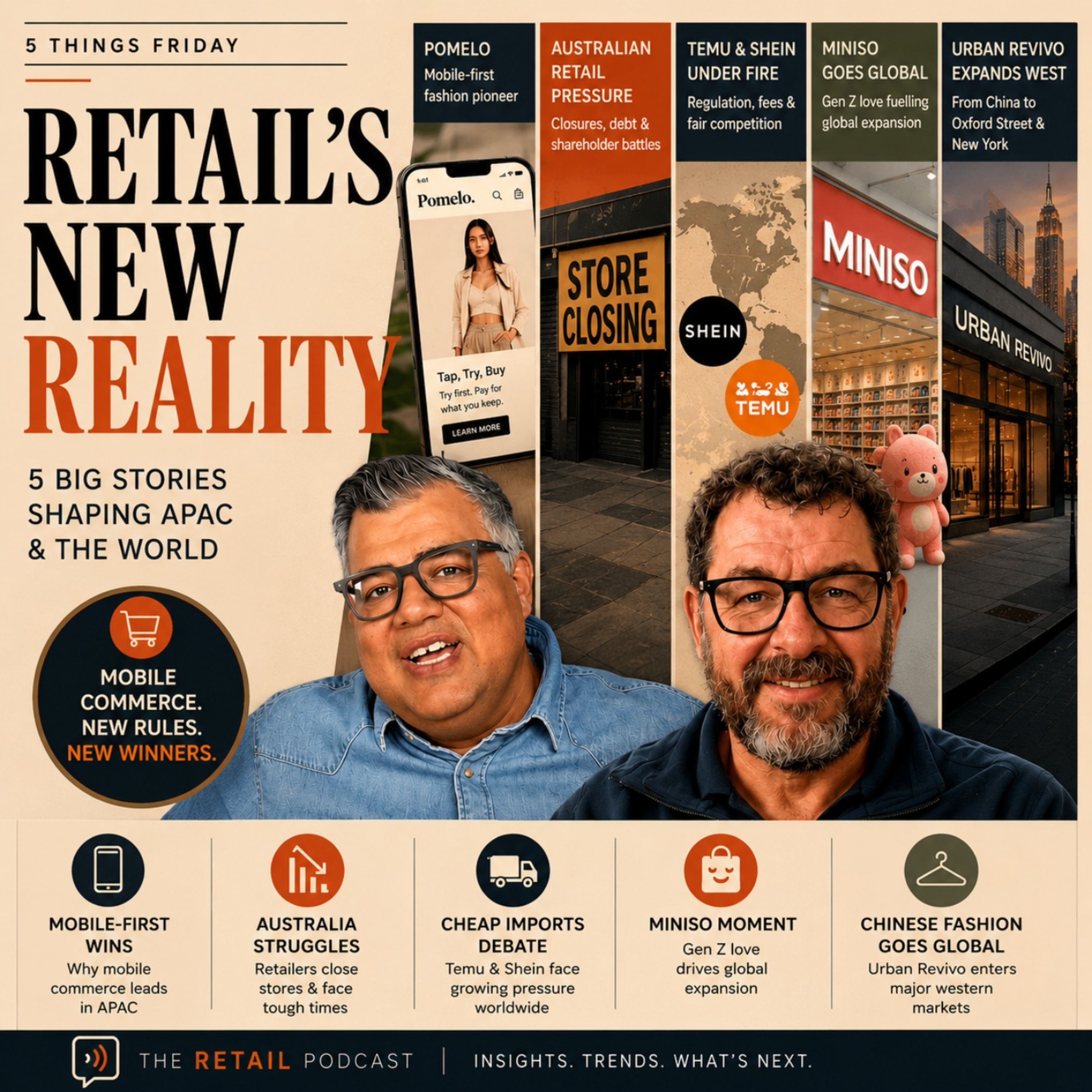 The Retail Trends Reshaping APAC: Pomelo, Temu, Miniso & More