The Modern Hotelier · 2026-07-01 · 13 min
Key moments - from our scoring
Substance score
48 / 100
Five dimensions, 20 points each
Jake Lewis brings 25 years of hospitality technology experience to explain how the best hotel operators think strategically about technology adoption. Rather than pursuing standalone systems in silos, successful hoteliers are moving toward integrated platforms that connect property management, spa, golf, dining, and mobile guest-facing systems into a unified ecosystem. Lewis argues the industry is shifting from disjointed booking and service experiences - where guests must make multiple phone calls and interact with different versions of their profile across departments - toward seamless omnichannel experiences modeled after consumer expectations set by companies like Amazon. Jonas Hospitality's platform Unify exemplifies this approach by synchronizing guest data across all property systems. Lewis emphasizes that technology should remain invisible and augment staff efficiency rather than create additional burdens. He also addresses AI's role realistically: the winners won't be those with the most AI, but those using it most effectively to personalize guest interactions, improve revenue management, and surface actionable data insights. The conversation centers on how hoteliers must first understand their operational needs, then partner with vendors to build solutions aligned with those needs rather than forcing operations to fit pre-built software.
Fragmentation across different solutions creates a disjointed guest experience where the same guest appears as different profiles in the spa, golf, and dining systems, forcing staff to manually reconcile data and guests to make phone calls to change reservations across departments.
Neither all-in-one nor best-of-breed alone is optimal; hotels need the flexibility to select the best systems for their operations, then connect them through an integrated platform that synchronizes data and unifies the guest experience.
AI should augment staff efficiency and decision-making by providing faster access to accurate data and enabling personalization, but success depends on using AI effectively to serve guests better, not simply having the most AI features.
Successful operators first understand how they run their business operationally, then select and align technology systems to support that flow, and partner with vendors to build solutions rather than forcing operations to fit pre-built software.
Our reviewer’s read on each dimension, with quotes from the episode.
The episode delivers moderate insight density with some useful frameworks (systems vs. platforms, best-of-breed vs. all-in-one hybrid approach, AI as augmentation) but relies heavily on familiar hospitality talking points (guest experience, seamless booking, personalization) that operators have heard repeatedly. The guest articulates Jonas's positioning clearly but doesn't dive into surprising data, counterintuitive findings, or novel operational mechanics that would surprise a seasoned hotelieroperator.
really good hotel operators aren't chasing technology. They understand how to operate their business and then are aligning their technology to how they operate
The winners aren't going to be the ones who have the most AI. The winners are going to be the people who use AI the most effectively
The thinking is competent but largely conventional for 2024 hospitality tech discourse. The best-of-breed-plus-platform hybrid positioning is sensible but not novel; the emphasis on clean data for AI, unified guest profiles across touchpoints, and seamless omnichannel booking are industry-standard themes. No contrarian takes, first-principles challenges, or surprising frameworks distinguish this from dozens of similar vendor interviews.
I don't think we're going to be in a world where best-of-breed is the right solution, and I also don't think that an all-in-one is the right solution. I think it's a combination of the two
hoteliers are starting to get smarter about their data and understanding how critical it is to have not only data, but good data, clean data
Jake Lewis brings 25 years of hands-on hospitality tech experience and currently leads Jonas's Property Systems Group, giving him genuine operational and product leadership credibility. He has shipped products and managed teams, not merely consulted. However, he is primarily a vendor speaking about his own platform, which limits his independence and breadth of perspective compared to a multi-property operator or technology buyer.
I've been in hospitality 25 years. I started in tech support for Remco Software 25 years ago while I was in college. After I finished school, I became a developer
I've led pretty much everything, maybe except sales teams directly
The episode is almost entirely devoid of named examples, metrics, and concrete data. References to Jonas Unify are vague; no customer case studies, performance gains (revenue lift, labor savings, booking conversion uplift), adoption timelines, or competitive benchmarks are provided. The guest's personal anecdotes (Amazon delivery speed, golf trip booking friction) are illustrative but not evidential. No dollar figures, adoption rates, or measurable outcomes substantiate the claims.
We recognized in our portfolio that we have several different systems, whether it's PMS, spa, guest-facing mobile, or all of the other connected systems
I recently went on a golf trip, and it was a ton of fun, but the process of booking it wasn't super simple
The hosts ask competent, topic-relevant questions but rarely push back, challenge claims, or dig into specifics. Questions are open-ended setup prompts (e.g., 'How are you seeing hospitality evolve?') rather than sharp follow-ups. When the guest makes sweeping claims (e.g., 'AI should augment processes'), there's no pressure to define terms, share proof points, or defend trade-offs. The conversation reads as a cordial vendor platform rather than a searching dialogue.
That's great. That's great
David Millili: All right, so when you talk to hotel operators, what challenges come up again and again?
Computed from the transcript - who did the talking, and the words that came up most.
In this special HITEC edition of The Modern Hotelier , hosts David Millili and Steve Carran sit down with Jake Lewis, President of Jonas Hospitality Property Systems, to explore how technology is reshaping the hospitality industry. With over 25 years of experience, Jake shares insights on the shift from disconnected software systems to unified hospitality platforms, why seamless guest experiences are becoming the new standard, and how clean, connected data is laying the foundation for AI-driven innovation. The conversation dives into the future of hotel technology, the importance of aligning tech with operational strategy, and why the most successful hoteliers focus on solving real guest problems, not simply adopting the latest tools. Jake also discusses Jonas Hospitality's vision for creating integrated ecosystems that empower both hotel staff and guests through smarter, more personalized experiences.
Transcribed and scored by The B2B Podcast Index.
The Modern Hotelier #302: How the Best Hotel Operators Are Approaching Technology | with Jake Lewis === David Millili: Welcome to a special HITEC edition of The Modern Hotelier, the most engaged podcast in hospitality. Please make sure to follow, like and subscribe, and let us know in the comments what you think about today's episode. Steve, who do we have on the program today? Steve Carran: Yeah, David, we have Jake Lewis, the president of Jonas Hospitality Property Systems.
Thanks for sitting down with us, Jake. Jake Lewis: Absolutely. Steve Carran: How are we doing today? Jake Lewis: Really good.
Excited to kick off HITEC. Steve Carran: Yeah. David Millili: Good. So tell us a little bit about your background and how you got into hospitality.
Jake Lewis: Yeah, so I've been in hospitality 25 years. I started in tech support for Remco Software 25 years ago while I was in college. After I finished school, I became a developer. I started leading development teams.
I've been the director of development teams. I've been a VP of products and services. I've led pretty much everything, maybe except sales teams directly. Steve Carran: That's great.
That's great. So you've been in the industry for a while. How are you seeing hospitality evolve, and what big shifts are you seeing, and how is Jonas helping hoteliers? Jake Lewis: Yeah, there are a couple of things that I would say about shifts that maybe aren't shifts.
These are things that have always existed, but I think what's changed now is we have the ability to capitalize on them. The first is we're starting to move from systems to platforms. What I mean by that is there are all kinds of companies with siloed systems out there. That's actually part of what we tell people.
Siloed systems aren't necessarily a bad thing, but they can be unless you can connect them through an integrated platform and an ecosystem. You're starting to see that become what everybody needs to have. If you don't connect all your systems, you don't have data. It becomes a problem.
The second is just a shift in guest experience. You guys have probably had 100 conversations about the guest experience, but it's really true. When you think about what Amazon did, Amazon took something like a bookstore, and now today I don't know how I'd live my life without Amazon. Steve Carran: Yeah.
Jake Lewis: My wife and I were talking last week, and I said, "It is just incredible that I can order something," and I live in Phoenix, so literally that day it can show up at my door, or maybe the next day. It's changed the game in terms of shopping. I think the same is true for what needs to happen in hospitality. Today it's still very disjointed when you want to book a trip.
I recently went on a golf trip, and it was a ton of fun, but the process of booking it wasn't super simple. I'm at a place where I like to just get online, book my stuff, and know it's going to happen. We're now at a place where we can build systems that allow a seamless experience across a stay where I'm going to golf, stay, book dining reservations, or book a spa. I don't have to call somebody.
I'm also one of those people who, when mobile check-in came out, didn't like it, and now I get mad when I don't have it. I'm getting that way with booking. I don't want to call anybody. I just want to get online and book my trip.
That's becoming the guest's expectation today, and we're now in a place where we can deliver that. That's part of why we launched Jonas Unify. We recognized in our portfolio that we have several different systems, whether it's PMS, spa, guest-facing mobile, or all of the other connected systems. They all operated in their own world.
Now we've built a platform that connects all of those systems. All your guest data and all your information are there, and that's really where we're moving forward. The booking experience is now seamless through our system. That's where we're headed, and we probably couldn't have done that 10 years ago.
David Millili: So as president of Jonas Hospitality's Property Systems Group, you have a unique view across both hotel operations and technology. What do you think the most successful hotel organizations are doing differently when it comes to their technology strategy? Jake Lewis: It's a really good question. What I would say is really good hotel operators aren't chasing technology.
They understand how to operate their business and then are aligning their technology to how they operate. So you can go and buy the system that does check-in or does these things, but how do you do check-ins? What does your flow look like? What do you want your guest experience to be when they show up to the hotel?
So really thinking through, how am I operating, and what systems do I want to have in place to ensure that guest experience is really positive? Beyond just check-in, if you think about the whole guest journey, what are you doing, and how are your systems working prior to them even booking? From the inception of me starting to think about going on a trip, what systems do you have in place all the way through to I've come, I've stayed, I've done my thing, and now I'm gone? How are you aligning those, and how have you connected your platforms?
Here's the other part of that. The really good ones are partnering with their vendors. They're not just buying software from them. The reality is my job as a vendor to hoteliers is to satisfy you and your guests.
The best way I can do that is simply by partnering with you, understanding your business, and having you help me build a solution that's going to do that. Steve Carran: Absolutely. So let's talk vision. Hospitality and technology have changed drastically over the past five to 10 years.
How are you looking at the next five to 10 years, and how do you want Jonas to be involved with the shaping of technology? Jake Lewis: It's kind of crazy, right? Five to 10 years seems like it's changing every month right now. To think about what five years looks like is really difficult.
For me, the classic problem that we've had is all-in-one versus best-of-breed. I don't think we're going to be in a world where best-of-breed is the right solution, and I also don't think that an all-in-one is the right solution. I think it's a combination of the two because, in the end, our customers need to be able to pick the systems that allow them to operate their business best. They need to be able to select a system and connect it to a platform that synchronizes data across all of those systems and then unifies that guest experience.
Steve Carran: Sure. Data's becoming so much more important with AI. Having that transparency between systems is key. Jake Lewis: Over the next five years, I think what you'll see is hoteliers are starting to get smarter about their data and understanding how critical it is to have not only data, but good data, clean data.
If they want the opportunity to take advantage of AI and everything it can do, and to better understand their guests, they've got to have clean data across all of their systems. Steve Carran: Agree 100%. David Millili: Yeah. So what role should technology play in helping hotel operations efficiency without hurting the guest experience?
Jake Lewis: Technology needs to be somewhat invisible. When you think about AI in general, AI should be something that augments processes. Our technology should do the same thing for our customers. It should augment their ability to be hoteliers.
They want to spend time doing things that are valuable, and that's with the guest, not in front of their screens or phones. It's giving them the ability to get access to data faster, to get accurate data faster, and to make decisions about how to satisfy their guests better. Steve Carran: We talk about AI pretty much on every podcast. A lot of hype around it.
But beyond the hype, where do you think are the most meaningful opportunities for AI to really create value for hoteliers? Jake Lewis: This, to me, honestly, is a tough question because I've had a lot of conversations. We're doing a lot of stuff with AI, and there's a lot of really cool stuff out there. The winners aren't going to be the ones who have the most AI.
The winners are going to be the people who use AI the most effectively. AI can do all kinds of stuff, but if it's not augmenting your processes and allowing you to serve your guests better, it doesn't really matter. There are some real practical things we'll be able to do right away, and you're starting to see this with access to data, decision-making, revenue management, and all those things. But how are you really using AI to understand your guest?
When a guest calls and books, I think we're in a really great place where there's potential to truly personalize that conversation with that guest. Or when they show up to the club or the resort, you've already got their itinerary ready for them. You know everything about them, and you can offer things based on their past. That exists today, but I think AI really augments that process and makes it so you don't have to think about it.
It's just there. David Millili: All right, so when you talk to hotel operators, what challenges come up again and again? And how do those everyday frustrations shape the way you think about building technology? Jake Lewis: I've had lots of conversations over the last two years as we launched Unify.
The number one thing that I hear is fragmented systems. It really is the problem of, "I've got seven different solutions, and I need to use all of them for each different outlet." But when Jake shows up at this property and goes into the spa, or goes and plays golf, or whatever I do, whatever I book, it's a different Jake. Or when I go to change my spa appointment, they don't even know that I have a tee time.
They don't understand that. That is probably the thing that I talk about the most. The second is for the guest. Going back to my example about booking my golf trip, I just wanted to get online and book my entire stay, all my reservations, and all my restaurant bookings, and I couldn't do that in one seamless flow.
It was very painful. I actually had to make some phone calls. Then if I wanted to change my tee time, change my restaurant, or do something different, I had to make another phone call. Going back to the very first question you asked me about guest expectations, that's what I'm hearing the most.
When I think about what we're trying to do at Jonas Hospitality, it's to solve those problems. Our customers have a lot of different systems. They have the same challenges, and we've been talking about them for a long time. Now we're in a place where we can actually solve them.
I think Jonas is uniquely positioned compared to others because of our model for acquisitions and building software. AI has changed the game in terms of our ability to build new solutions on our platforms. It's just a different world out there. David Millili: That's great.
Well, that does it for another episode of The Modern Hotelier. Jake, this is where you can let people know how they can get in touch with you and how they can find out more about Jonas. Jake Lewis: Yeah, of course. You can always get ahold of us.
Go to jonashospitality.com. Reach out to us on LinkedIn. That's probably the best way to get ahold of us.
David Millili: That's great. That does it for this special HITEC episode of The Modern Hotelier, the most engaged podcast in hospitality. Whether you're watching or listening, we appreciate you and hope to be with you again soon. Thank you for joining us, Jake.
Jake Lewis: Thanks. Steve Carran: Thank you, Jake. Jake Lewis: Appreciate it, guys.
Other episodes covering the same guests and topics, from across The B2B Podcast Index.
 Turning a Yield-Co into an AI-Native, Next-Gen IPP with David Willemsen of TionThe Pexapark Podcast · on Revenue management95 / 100
 How AI & Digital Check-In Are Transforming Hotels | with Nikolai KronborgGAIN Momentum · on Property Management Systems (PMS)83 / 100
 Nomse Founder on Fixing Hotel Data Before AI AdoptionHotel Tech Insider · on AI in hospitality80 / 100
 Redefining Hospitality Through Tech - Tanya Pratt - Defining HospitalityDefining Hospitality · on Revenue management78 / 100
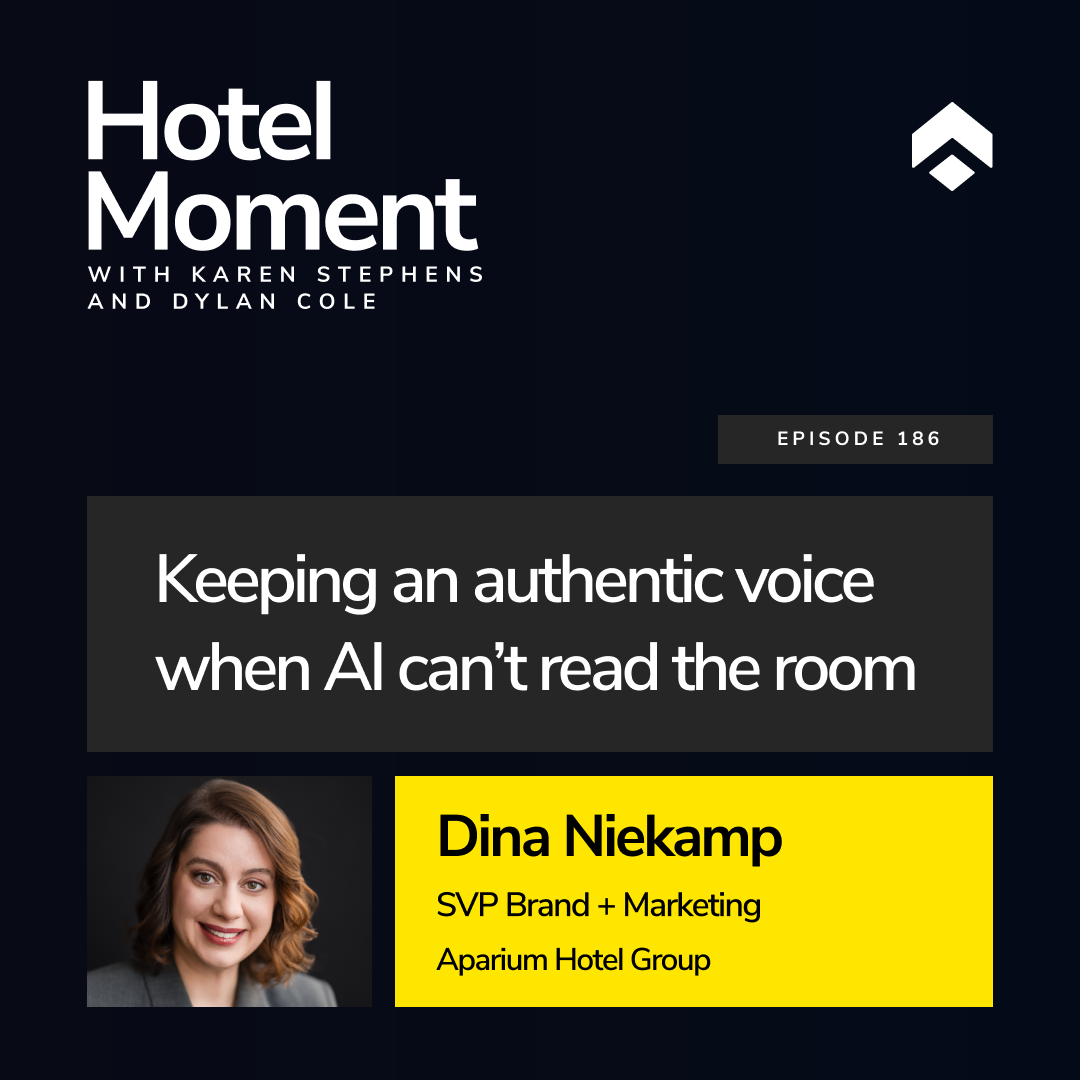 Keeping an authentic voice when AI can't read the roomHotel Moment · on AI in hospitality75 / 100
 Andrew Rubinacci, Chief Commercial Officer, FLYR Hospitality, interviewed by Dorothy DowlingIt's Personal Stories, A Hospitality Podcast · on Revenue management72 / 100#305: Transparency & Confidence is Key in Owner Accounting | with Brian McGeown52 / 100#304: How In-Room Tablets Are Increasing Guest Engagement & Unlocking Revenue | with Kevin Bidner65 / 100#303: How Hotel Maintenance Impacts the Guest & the Bottom Line | with Chris Zach59 / 100#301: Helping Hotels Reduce Revenue Leakage | with Mike Baldinger83 / 100#300: Innovating the Meeting & Events Sales Process | with Mike Waltman67 / 100