The Free to Grow CFO Podcast · 2026-07-02 · 12 min
Key moments - from our scoring
Substance score
36 / 100
Five dimensions, 20 points each
John Blair introduces the FTG Growth Marketing Game Playbook, a framework designed to align DTC brand scaling strategy with underlying unit economics rather than borrowed tactics from unrelated categories. The core principle: scale ad spend only if total contribution margin dollars are increasing. Blair identifies three distinct games DTC brands play - high SKU count/apparel (slow 12+ month LTV), high LTV/subscription (3-6 month payback), and new customer dominant (negligible LTV) - each with different first order profitability rules, scaling constraints, and CFO strategy levers. For apparel brands, the constraint is inventory health and cash conversion cycle; for subscription brands, it's LTV velocity keeping pace with rising CAC; for new customer dominant brands, it's the CAC ceiling where profitability turns negative. The framework requires monthly monitoring and adjustment across P&L, balance sheet, and cash flow metrics. This episode is essential for DTC founders and their fractional CFOs implementing scaling strategies, operators at Free to Grow CFO, and any brand struggling with profitability despite revenue growth.
High SKU count/apparel (slow 12+ month LTV from returning customers), high LTV/subscription (3-6 month payback enabling controlled first order losses), and new customer dominant (negligible LTV with all profit from new orders).
Total contribution margin dollars - if contribution margin is increasing as you spend more on ads, you're winning; if it's decreasing, you're violating the framework and must diagnose immediately.
Rule 1: first order must be profitable with no sustained negative contribution margin; Rule 2: break even acceptable with profit from returning customers; Rule 3: controlled first order loss allowed within a 3-6 month payback window.
LTV velocity keeping pace with rising CAC - the faster you lose money on new customers, the faster returning customer contribution margin must come back to offset it.
Understanding the game doesn't automatically translate to knowing how your P&L responds to ad spend increases, forecasting cash flow crunches, or catching when CAC payback creeps out of range - requiring ongoing monthly CFO-level analysis and adjustment.
Our reviewer’s read on each dimension, with quotes from the episode.
The three-game taxonomy (high-SKU/apparel, high-LTV/subscription, new-customer-dominant) and the north-star CM dollar test are genuinely useful organizing ideas, but they sit on top of well-established DTC unit-economics concepts rather than extending them. The episode is padded with repetition and a lengthy sales pitch that dilutes the useful content.
The marketing tactics that work for your brand are supposed to be governed by the underlying economics of your business and your product category
As we scale ad spend, is total contribution margin going up or going down? That's it. That's the test.
The 'three games' framing is a tidy original packaging device, but the underlying substance - LTV/CAC payback windows, first-order profitability rules, inventory cash conversion cycles - is standard DTC finance thinking available in dozens of articles and podcasts. No contrarian or first-principles arguments are advanced.
Brands out there are borrowing growth marketing tactics from whoever's loudest on social media. They're copying what worked for some other brand in a completely different category
The game you're playing today might shift as your customer base matures. Your first order profitability rule might need to tighten as CAC rises.
This is a solo-host monologue by a practitioner who runs a fractional CFO firm for DTC brands, so there is real operational credibility, but the episode doubles as a lead-generation pitch and no external practitioner or corroborating voice is present to challenge or deepen the thinking.
Over the last four years, Free2Grow CFO has helped hundreds of scaling D2C brands
I've seen it happen. It's not pretty.
The episode references timeframes (12+ months LTV realization, 3 - 6 month CAC payback window) and two named tools (Lifetimely, Expandify), but offers zero named client examples, no real revenue or margin figures, and no case studies - everything is described at a generic, illustrative level.
For high LTV slash subscription brands, it's cohort modeling, skew and offer level CAC payback analysis, making sure you never run out of inventory for your subscriber base, and tools like Lifetimely or Expandify
These businesses have enough returning customer contribution margin coming back quickly, that's within three to six months, to actually finance some level of unprofitable new customer acquisition
This is an uninterrupted solo monologue with no guest, no interview questions, and no genuine dialogue; the only approximation of pushback is a scripted self-objection that is immediately dismissed. There is no opportunity for follow-up, productive disagreement, or probing.
I want to push back on something right now because I know some of you are thinking it. Okay, John, I get it. I know the game now. I've got the framework now. I'm good. No, you're not good
Hey everyone, welcome back to another mini episode of the Free to Grow CFO podcast. I'm your host, John Blair, founder of Free to Grow CFO.
Computed from the transcript - who did the talking, and the words that came up most.
Transcribed and scored by The B2B Podcast Index.
If you're spending more on ads and total contribution margin dollars are increasing, you're winning. Hey everyone, welcome back to another mini episode of the Free to Grow CFO podcast. I'm your host, John Blair, founder of Free to Grow CFO. We are the go-to outsource finance and accounting firm for scaling D to C brands.
Today, I want to introduce something we've been building and refining inside our firm for a while now, something I'm genuinely fired up to share publicly for the first time. We're calling it the FTG Growth Marketing Game Playbook, and I truly believe it's the most important framework we've ever developed for our clients. So buckle up, because this one's going to be good. Over the last four years, Free2Grow CFO has helped hundreds of scaling D2C brands, and there's something that I've noticed again and again that drives me absolutely crazy.
Brands out there are borrowing growth marketing tactics from whoever's loudest on social media. They're copying what worked for some other brand in a completely different category with a completely different customer. They're just doing what I call random acts of marketing. And I get it.
There's no shortage of D2C growth hacks and playbooks floating around the internet. But here's what almost nobody is talking about. The marketing tactics that work for your brand are supposed to be governed by the underlying economics of your business and your product category. Specifically, the economics of how your new customers and returning customers generate contribution margin over time.
If you don't understand that first, you're going to borrow from the wrong playbook, execute it reasonably well, scale your ad spend, and drive your brand straight off a cliff. I've seen it happen. It's not pretty. But don't worry.
That's exactly what the FTG Growth Marketing Game Playbook was built to solve. Before I walk you through the four steps, I want to give you the north star that governs this entire framework. Because if you forget everything else I say today, I want you to remember this one thing. As we scale ad spend, is total contribution margin going up or going down?
That's it. That's the test. If you're spending more on ads and total contribution margin dollars are increasing, you're winning. If they're going down, you're violating something inside our framework and you need to stop and diagnose it immediately.
Everything in this playbook is in service of that outcome. Okay, so let's dive into the framework. Step one, identify the game your brand is playing. Over the years we identified three distinct growth marketing games that DTC brands play and the game you playing is determined by your new and returning customer contribution margin profile The first game is the high skew count slash apparel game These brands they have meaningful LTV, but it's slow.
It often takes 12 plus months to realize. Think seasonal product drops. The profit engine in this game is returning customer contribution margin over time. and inventory management is absolutely critical.
The second game is the high LTV slash subscription game. This is your subscription-oriented consumable product brand. These businesses have enough returning customer contribution margin coming back quickly, that's within three to six months, to actually finance some level of unprofitable new customer acquisition. This is the game where you can intentionally lose money on a first order, but only if the math pencils out on the CAC payback window.
The third game is what we call the new customer dominant game. Negligible, maybe no LTV. Every dollar of profit has to come from new customer orders. These brands have a fundamentally different playbook and the failure mode is very specific.
As you scale ad spend and CAC rises, there's no returning customer base to offset your margin compression. Eventually, you hit a ceiling. Here's the key insight. You cannot steal tactics from another game's playbook.
If you're a new customer-dominant brand trying to run a high LTV slash subscription strategy, taking losses on new customers without the LTV to back it up, you will run out of cash and profitability simultaneously. I've seen it. It's a brutal place to be. All right, so on to step two of our framework.
Step two is what I call the first order profitability rule. This is a decision that we help every single one of our clients make. There are three first order profitability rules. Rule number one, your first order must be profitable.
No sustained negative contribution margin on new customers. Full stop. End of story. Rule two, break even is acceptable.
You're okay with roughly zero contribution margin on the first order, but profit must come from your returning customer base over time. Rule three is a controlled first order loss. You can take a calculated loss on new customer acquisition, but only within a defined payback window, typically three to six months maximum. A brand cannot float between these first order profitability rules.
You pick one, you declare it, and you enforce it. The game you're playing in step one dictates which rules are even available to you. Okay, step three of our framework is defining the scaling constraint inherent in your game. So every game fails somewhere first as you scale.
Our job as your fractional CFO team is to identify exactly where your specific business breaks on the P and or the balance sheet when you pour more scaling fuel on the fire For high SKU count slash apparel brands the constraint is inventory health and your cash conversion cycle Why Because with such a large product catalog and frequent new product launches you can run out of cash while technically being profitable because inventory growth traps capital faster than your profitability returns it.
For high LTV slash subscription brands, the constraint is LTV velocity keeping pace with a rising CAC. It's like a seesaw. The faster you lose money on new customers, the faster your returning customer contribution margin needs to come back to offset it. For new customer dominant brands, your scaling constraint is your CAC ceiling and offer durability.
At some point, no matter how good your creative is, CAC rises to a level where new customer profitability turns negative. And without a returning customer base to fall back on, the contribution margin on your next dollar of ad spend goes negative. Knowing your scaling constraint before you hit it is the difference between scaling confidently and getting blindsided. All right, so what's step four of our framework?
Step four is where it all comes together. You deploy the playbook options that are uniquely available to the game that you're playing. Each game has its own set of CFO strategy levers. For high SKU count apparel stores, it's things like managing inventory purchasing discipline, nailing new product drops to existing customers, and thinking carefully about debt financing for working capital.
For high LTV slash subscription brands, it's cohort modeling, skew and offer level CAC payback analysis, making sure you never run out of inventory for your subscriber base, and tools like Lifetimely or Expandify to get granular on cohort data. For new customer dominant brands, it's increasing gross margin dollars per order, finding any incremental returning customer opportunity, being extremely disciplined on inventory bets, and proactively thinking about sales channel expansion before you hit the D2C ceiling.
Look, this is just a high-level overview of the strategies and tactics that we as expert D2C fractional CFOs deploy with each of our clients. I could spend an entire full-length episode on each of these, and honestly, I probably will at some point. But the point is, the tactics are downstream of the game. Know the game first.
I'll be honest with you. The reason we built this framework is because we kept watching smart, hardworking D2C founders make the same mistake over and over again. Scaling ad spend without understanding the underlying economics of their business. and then wondering why growth felt so hard or why profitability kept moving further away no matter how fast they grew.
The FTG Growth Marketing Game Playbook is our answer to that problem. It how we make sure every client we work with scales fast and profitably through a clear financially grounded defensible strategy for scaling ad spend and growing profit and cash flow at the same time Now here something I want to be really direct about because I think it important This framework is simple to understand, but it is genuinely difficult to implement. And that gap between understanding the playbook and actually executing it successfully is exactly where most brands fall apart.
Why? Because knowing your game doesn't mean you automatically know how your P&L is going to respond when you crank up ad spend next month. It doesn't mean you can see the cash flow crunch coming on your balance sheet before it hits. It doesn't mean you'll catch the moment your CAC payback window starts silently creeping out of range.
Those are CFO problems. And a great D2C fractional CFO is without question the single best strategic ally a D2C brand founder can have in their corner when it comes to implementing this framework. I want to push back on something right now because I know some of you are thinking it. Okay, John, I get it.
I know the game now. I've got the framework now. I'm good. No, you're not good because this is not a one and done exercise.
This framework is a repeating cycle. Plan, execute, measure, adjust, and then do it all over again. The game you're playing today might shift as your customer base matures. Your first order profitability rule might need to tighten as CAC rises.
Your scaling constraint might change as you expand into new channels. The P&L, the balance sheet, your cash flow, they're all telling you a story every single month and you need someone who knows how to read that story and translate it back into your marketing strategy in real time. That is what a great D2C fractional CFO does. Not just closing the books, not just reporting what happened, but sitting alongside you as a strategic partner month after month, helping you implement this framework and more, protect your business and scale with confidence.
That's what we do at Free to Grow CFO. And if you want that kind of partner in your corner, I wanna talk to you. Go to freetogrowcfo.com and book an intro call.
If your brand is a fit for our service, we'll do a free CFO audit. We'll dig into your unit economics, identify your growth marketing game, and show you exactly what it looks like to have an expert D2C fractional CFO guiding the implementation of your growth marketing strategy. If you found this valuable, share it with a D2C founder who needs to hear it because too many brands are running the wrong growth marketing game playbook and they don't even know it. I'm John Blair.
Thanks for listening. And until next time, happy scaling.
Other episodes covering the same guests and topics, from across The B2B Podcast Index.
 Understanding Your True LTV and Company Value | Prof. Daniel McCarthyD2C Diaries · on Customer Acquisition Cost (CAC)96 / 100
 The 3-Pillar Framework to Scale Any E-Commerce Brand (Feat. Abir Syed)Brain Driven Brands · on Customer Acquisition Cost (CAC)90 / 100
 I Was Worth $5 Million at 23. Eight Months Later I Was Negative $1 Million | Ep. 416 with Leo Pareja CEO of eXp RealtyFounder's Story · on Customer Acquisition Cost (CAC)88 / 100
 The Creative Testing Gap: Why Most B2B & B2C Lead Gen Campaigns Fail to ScaleThe Revenue Room · on Customer Acquisition Cost (CAC)80 / 100
 Selling a SaaS Business? The Metrics Buyers Care About Most Business Beyond You · on Customer Acquisition Cost (CAC)80 / 100
 How Medical and Dental Practices Can Grow More Profitably with Ibrahim AshmaweyProvider's Edge · on Unit economics78 / 100
 BONUS EPISODE: Ecom Scaling Show: Why Good Ad Creative Won’t Fix A Bad Offer (Ep. 15)
 Why Most Amazon Sellers Stay Broke (Even When They're Profitable)
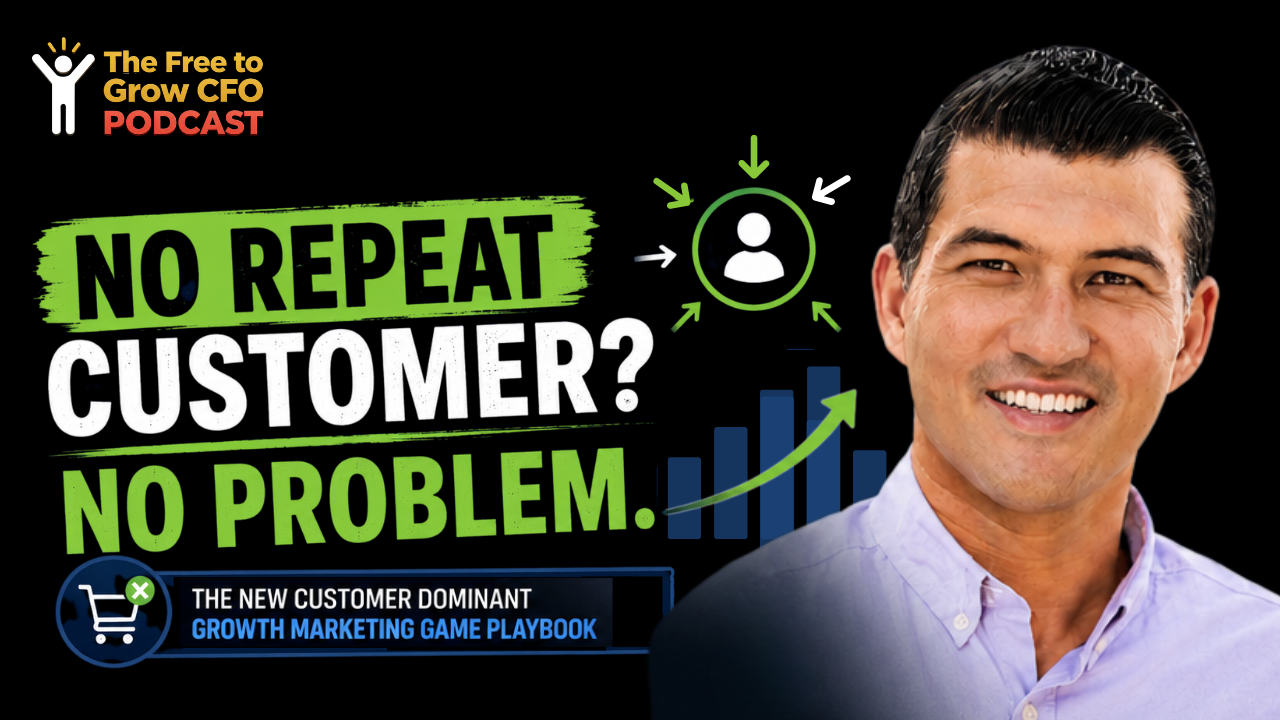 How to Scale a DTC Brand With No Repeat Customers (The New Customer Dominant Growth Marketing Game Playbook)
 Are You The Bottleneck In Your Business?
 BONUS EPISODE: Ecom Scaling Show: Raising Debt vs Equity Financing for $10M+ Brands (Ep. 14)