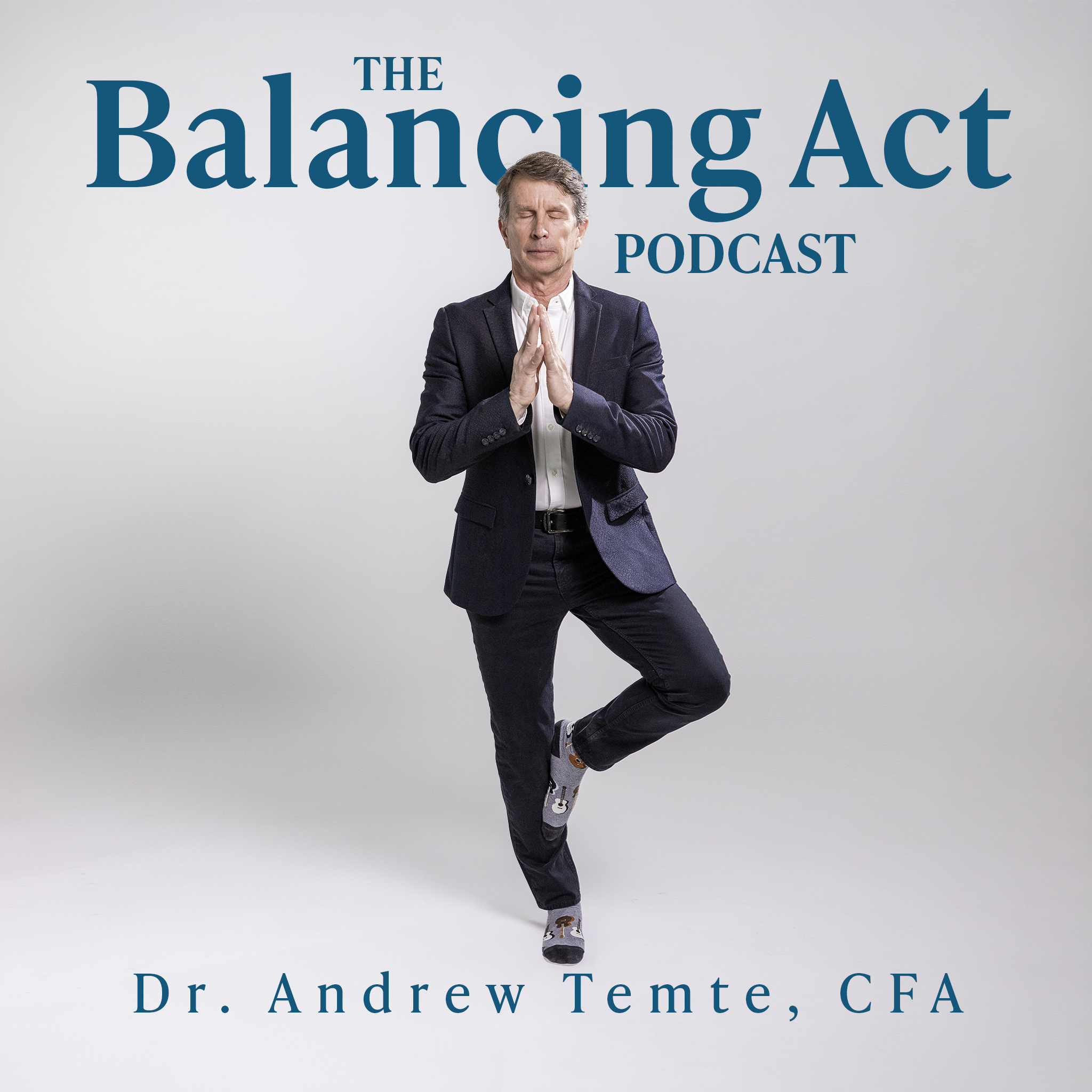
Hosted by Andrew Temte
Listed under Business › Management, Business › Careers, Education › Self-Improvement
★5.0on Apple Podcasts · 6 recent reviews
Elevate Your Leadership Journey Through Authentic Conversations with Business Leaders In business, balancing acts are everywhere. Join Dr.
257 episodes · publishes weekly · latest 2026-08-06 · ~32 min/episode
Rank
#996
Substance
65.5
/ 100
Breakdown
Scored 2026-08
Updated monthly
Across the index
#996 of 1878
Substance
Top 53%
outscores 47% of the index
The Balancing Act with Andrew Temte, PhD, CFA ranks #996 on The B2B Podcast Index with a substance score of 65.5 out of 100, scored across 2 recent episodes. It scores highest on guest caliber and insight density. Don Gregory holds a relevant operating role (COO of a software vendor) with 25+ years of experience spanning startups to Fortune 500 and direct AI certification. He has built a team at scale (30 to 200+ employees, Inc. 5000 five years running). This is a practitioner with skin in the game, not a consultant or thought-leader-for-hire. However, his primary expertise appears to be operations and team-building rather than AI deployment specifics, limiting his authority on the episode's main topic.
Averaged across 2 recently scored episodes, with cited evidence.
The episode contains some substantive ideas about AI adoption (the 80% failure rate framing, the importance of upfront requirements definition) and leadership (coaching as the job, internal work preceding external results), but much of the runtime is devoted to biographical narrative, book promotion, and general leadership platitudes that a B2B operator would already know. The AI section delivers useful pushback on the 'race' mentality but lacks concrete examples or data beyond the 80% statistic.
“I think leaders are treating AI adoption like a race, right? It's like an arms race.”
“if you're off by a little bit upfront, your AI is going to be miles off course later on”
The core framing - that AI should serve people, not vice versa, and that upfront requirements matter more than speed - is sensible but not particularly fresh in 2024. The leadership concepts (empathy as skill, coaching, internal work) are well-worn in management literature. The therapy-adjacent stress/sleep angle is less common in B2B podcasts but underdeveloped here. No contrarian or first-principles arguments emerge; mostly confirming conventional wisdom about human-centered design.
“to me, the human AI relationship is like a leash, and I certainly know what end I want to be on”
“Leadership is a habit”
Don Gregory holds a relevant operating role (COO of a software vendor) with 25+ years of experience spanning startups to Fortune 500 and direct AI certification. He has built a team at scale (30 to 200+ employees, Inc. 5000 five years running). This is a practitioner with skin in the game, not a consultant or thought-leader-for-hire. However, his primary expertise appears to be operations and team-building rather than AI deployment specifics, limiting his authority on the episode's main topic.
“chief Operating officer of First Factory, a multinational software solutions provider”
“we got to a point over 200. We were on the inc. 5000 fastest growing private company companies five consecutive years”
The episode offers some specific data points (80% AI project failure rate, First Factory's 4.5-year avg employee tenure vs. 9-month industry average, 12-year longest client, employee NPS over 70) but largely avoids naming examples, client case studies, or dollar figures. The AI discussion is heavily abstract - 'requirements definition,' 'validation,' 'lean and live' - with no worked examples of a failed vs. successful AI project, no named companies facing the adoption problem, no timeline specifics. Biographical details are concrete but tangential to B2B substance.
“Our average tenure is over four and a half years. And in tech that's unheard of. And for, you know, a vendor like ours, the average is closer to nine months.”
“our average client tenure is over three and a half years. And our longest client's been with us over 12 years”
The host asks thoughtful opening questions (the event that 'put rocket boosters' behind the career, what differentiates First Factory) and does follow up on AI adoption ('where do you see most leaders getting it wrong'). However, most questions are soft-serve - asking Don to expand on his book, his background, or general philosophies. The host rarely pushes back, challenge claims (e.g., the 80% failure rate is cited without scrutiny or evidence), or drill into contradictions. The mentorship moment and lightning round are warm but low-substance. Missing are sharp probes into client outcomes, concrete deployment failures, or trade-offs.
“what struck me is that you frame technology as something that has to serve people and not the other way around. So how should leaders be thinking about adopting AI right now?”
“where do you see most leaders getting it wrong?”
2 periods tracked.
2 scored on substance · 66 tracked in total.
Andrew navigates conversations with expertise, and deep listening. His questions encourage guests to go beyond the surface, revealing practical advice for listeners.
- GusRazzetti
This is by far one of my all-time favorite podcasts! The way that Andy Tempte overdelivers EVERY SINGLE TIME is incredible. If you’re a business leader, this is your “holy grail” lol. Absolutely recommend to anyone looking to become a great leader! Thanks for everything you do Andy. - Doug Noll
- Douglas E. Noll JD MA
Add this badge to your site - it links back here and updates automatically as you rank.

<a href="https://index.fame.so/show/the-balancing-act-with-andrew-temte-phd-cfa" target="_blank" rel="noopener">
  <img src="https://index.fame.so/badge/the-balancing-act-with-andrew-temte-phd-cfa/badge.svg" alt="Ranked #99 on The B2B Podcast Index" width="360" height="136" />
</a>Track The Balancing Act with Andrew Temte, PhD, CFA's rank
Get an email whenever this show moves up or down the Index. Monthly at most, no spam.
Companies, products and tools that come up most across this show's episodes.
The themes that come up most across this show's episodes.

Founder-Led Sales Stories with Pete Kazanjy
Peter Kazanjy

The Secret Life of Great Leaders
TripleGoal

The Dental Economist Show
Planet DDS

The Centre for Army Leadership Podcast
The Centre for Army Leadership

Humanity At Scale: Redefining Leadership
Bruce Temkin

The Shift Code
Project Management Institute
Podcasts that dig into the same topics.