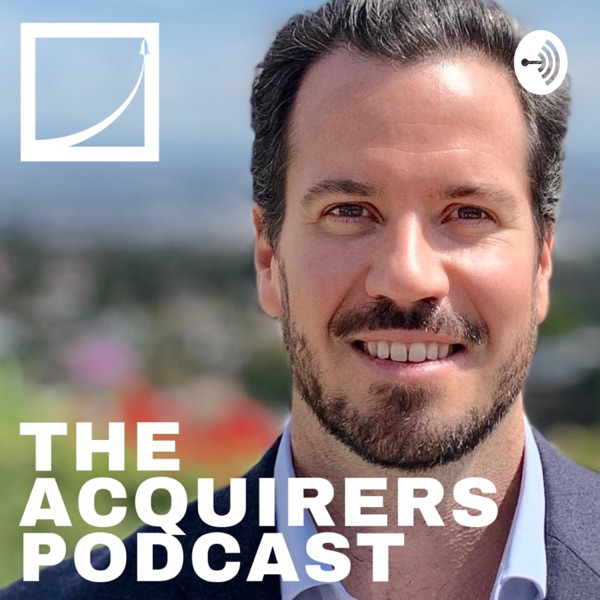
Hosted by Tobias Carlisle
Listed under Business › Investing
★4.4on Apple Podcasts · 50 recent reviews
This is a podcast about finding undervalued stocks, deep value investing, hedge funds, shareholder activism, buyouts, and special situations. We uncover the tactics and strategies for finding good investments, managing risk, dealing with bad luck, and maximizing success.
445 episodes · publishes weekly · latest 2026-09-17 · ~60 min/episode
Rank
#147
Substance
82.8
/ 100
Breakdown
Scored 2026-09
Updated monthly
Across the index
#147 of 6203
Substance
Top 2%
outscores 98% of the index
The Acquirers Podcast ranks #147 on The B2B Podcast Index with a substance score of 82.8 out of 100, scored across 5 recent episodes. It scores highest on guest caliber and specificity & evidence. Sweeney is a credible, practitioner-grade guest - 10 years running Laughing Water Capital, concentrated portfolio with specific investment thesis, real skin in the game managing his own capital. He speaks candidly about failures (Whole Earth Brands), process discipline (red teams, filters), and macro headwinds. Not a household name but a serious operator with track record and humility. However, limited discussion of AUM scale, LP composition, or institutional challenges limits his caliber relative to mega-fund leaders or successful public market operators.
Averaged across 5 recently scored episodes, with cited evidence.
The episode contains solid, actionable frameworks (good business filter, management skin-in-the-game, cycle resilience, valuation thesis) and concrete examples (NextNav spectrum case, Aptus Biosciences structure, Whole Earth Brands failure), but much of the discussion recycles familiar value investing principles. The USS Scorpion analogy and red team process add novelty, but there's considerable throat-clearing about market cycles, small-cap drought, and general philosophy that doesn't produce new insights for an experienced operator.
“Is it a good business? And it's totally possible to make money in the market by owning crappy businesses and hoping they get less crappy. And that's a, a completely valid strategy. Uh, I just know for me in a concentrated portfolio, I sleep better at night knowing that the business is good in quotes.”
“understanding why something is cheap. And you know, why, why am I so lucky to find this opportunity in the market with the general idea that most of the time the market is efficient and you could find these sort of wrinkles or repeatable, repeatable setups that indicate that something might be cheap.”
Sweeney's core ideas - seeking mispricing via gaps between GAAP and normalized earnings, exploiting quant screening blind spots, owning businesses led by aligned managers, testing thesis through red-team criticism - are well-established value approaches. The NextNav deep-dive is specific but not contrarian; the USS Scorpion metaphor borrowed from Jake Taylor's segment is clever but not Sweeney's original thinking. Few genuinely counterintuitive claims; mostly solid execution of known frameworks.
“if you have a business and a team that is going to do well over a reasonable period of time, things like tariffs are not going to change it.”
“the way I Think about it. Mostly we touched on a little bit brief or a little bit earlier with the idea that so much of the market is dominated by quant funds. And what are the things that could kind of trick the quant funds?”
Sweeney is a credible, practitioner-grade guest - 10 years running Laughing Water Capital, concentrated portfolio with specific investment thesis, real skin in the game managing his own capital. He speaks candidly about failures (Whole Earth Brands), process discipline (red teams, filters), and macro headwinds. Not a household name but a serious operator with track record and humility. However, limited discussion of AUM scale, LP composition, or institutional challenges limits his caliber relative to mega-fund leaders or successful public market operators.
“I'm at the point where I, on a very personal level, like the emotional side of it, which is a big part of the game. I really don't feel any sort of pressure to prove myself or to participate or chase.”
“I mean, I can't for marketing reasons, you know, I can't talk about returns, but I'm, I'm pleased with the returns we've had over 10 years. I think my LPs are pleased as well.”
NextNav discussion provides substantial specificity (lower 900 band spectrum, FCC NPRM process, 915 MHz center tune for RFID, engineering study details) and evidences reasoning with physics and regulatory history. Aptus Biosciences example is concrete (royalty stream separation, litigation, trial outcome pending). However, portfolio examples are sparse - Sweeney declines to detail Whole Earth Brands failure or name other holdings, citing discretion. General frameworks lack dollar figures, time horizons, or quantified return targets. Spectrum value appreciation is claimed but not measured.
“Recently I've had a lot of success with, you know, unknown legal outcomes. I hope there's some sort of pending litigation, for example, some sort of regulatory review. But all these things that just don't show up in the numbers but very clearly are going to have an impact on the future earnings power of a business.”
“NexNav has this spectrum which is being underused at the moment. They have applied for permission from the FCC to use their spectrum for 5G mobile communications. If they get permission from the FCC, the value of that spectrum goes up quite a bit. Um, like multiples I should say.”
Hosts ask reasonable follow-ups on NextNav (details on FCC process, timing), the Scorpion analogy (what wreck location implies), and calibration under disagreement. However, questioning is often soft and allows Sweeney to deflect or pontificate - e.g., on Whole Earth Brands he declines to explain ('not one I really want to rehash') and hosts accept without pressing. The Scorpion segment (Jake Taylor) is a monologue, not dialogue. Few moments of productive tension or challenge; Sweeney's pronouncements on small-cap extinction or long cycles go largely unprobed. Hosts seem reverential rather than adversarial.
“Can you tell us what happened, Tell us why? It's, um, some combination of getting the people wrong and the world not changing the way I thought it would, I guess. It's not one I really want to, want to rehash, I guess.”
“Yeah, I mean, it depends. Everyone is unique, right? Especially for me because like I have in the portfolio typically some sort of mix between, you know, what you might label a compounder versus a special situation or something that's more event driven.”
4 periods tracked.
6 scored on substance · 66 tracked in total.
Patience Is the Ultimate Edge in Investing | Matt Sweeney
2026-09-03 · 1h 4m
What 250 Years of Market Data Actually Tells Us | Meb Faber
2026-07-30 · 1h 3m
Oil Isn't Dead - John Love on Why Energy Markets Are Defying the Headlines
2026-06-18 · 60 min
The Stock Market Is Rewarding the Wrong Companies Right Now - Here's the Math
2026-06-11 · 1h 2m
The Fund That's Beaten the Market for 45 Years by Focusing on What Could Go Wrong
2026-06-04 · 1h 1m
Value Investing with Options: Selling Puts to Buy Wonderful Businesses at Better Prices | S08 E18
2026-05-27 · 1h 0m
I love the veggies and value perspective. The podcast is what you will hear sitting in the office overhearing your coworkers.
- EddieKentuckyBlue
Tobias, Jake, and Bill are an excellent standing panel that walk through the value investing topics du jour. The format changes occasionally from panel to 1-on-1 interview. The guests are always fantastic and interesting. Highly recommend!
- D$$$Anders
Add this badge to your site - it links back here and updates automatically as you rank.

<a href="https://index.fame.so/show/the-acquirers-podcast" target="_blank" rel="noopener">
  <img src="https://index.fame.so/badge/the-acquirers-podcast/badge.svg" alt="Ranked #26 on The B2B Podcast Index" width="360" height="136" />
</a>Track The Acquirers Podcast's rank
Get an email whenever this show moves up or down the Index. Monthly at most, no spam.
Companies, products and tools that come up most across this show's episodes.
The themes that come up most across this show's episodes.

Behind the Balance Sheet
Stephen Clapham's Podcast on Value Investing | Stockmarket Analysis | Equities

Acquiring Minds
Will Smith

Fund Shack Private Equity Podcast
Fund Shack

Capital Allocators
Ted Seides - Allocator and Asset Management Expert

Founder Thesis
ThePodium.in

Fintech Business Podcast
Jason Mikula
Podcasts that dig into the same topics.



