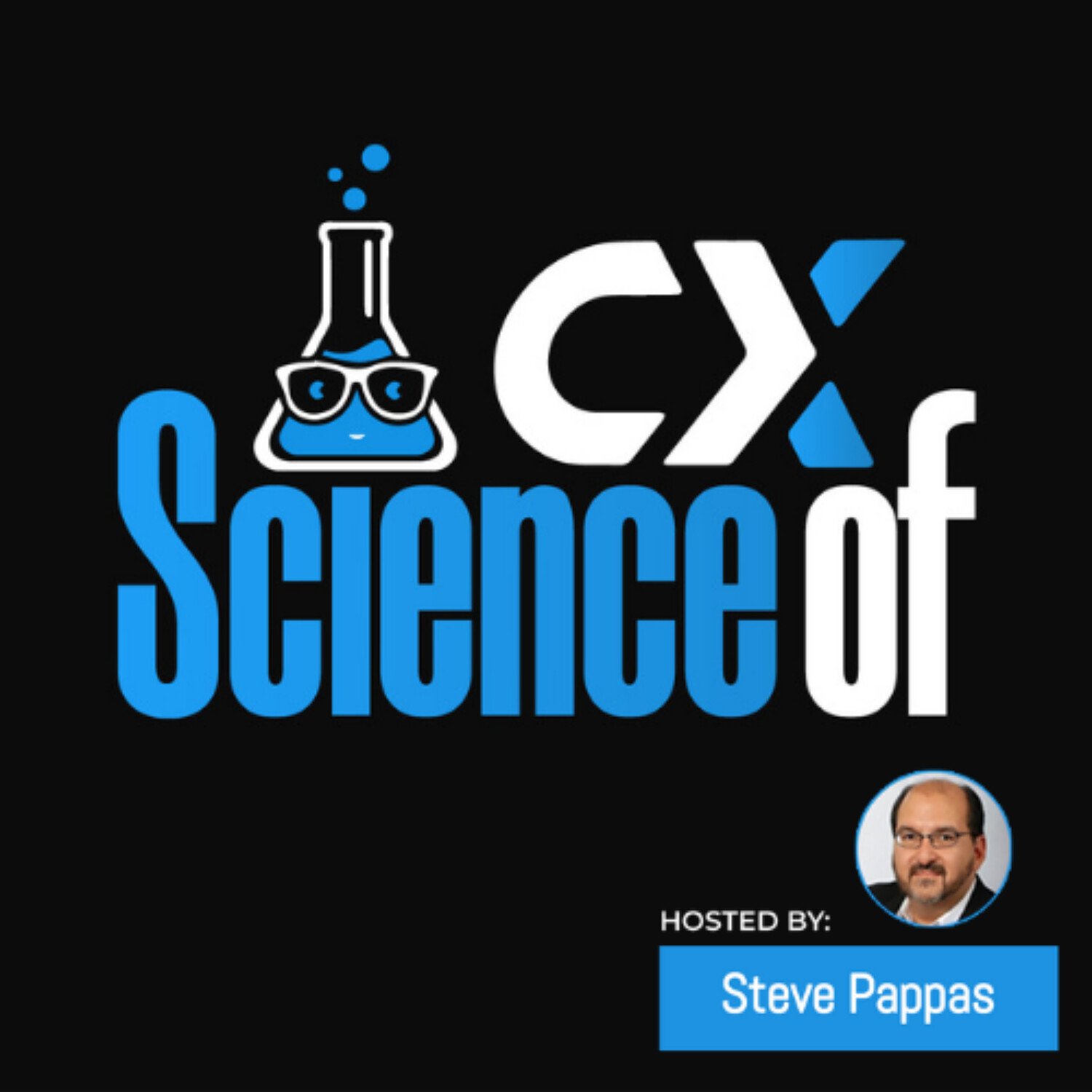
Hosted by Stephen Pappas
★5.0on Apple Podcasts · 9 recent reviews
CX Connoisseur, Steve Pappas, shares his insights on how to turn your customers into loyal brand ambassadors. Known for his relentless pursuit of all things ' customer ', Steve knows how to help your business and create experiences that customers respond to. Listen to Steve's insights.
222 episodes · publishes weekly · latest 2024-07-10 · ~37 min/episode
Rank
#3141
Substance
61.0
/ 100
Breakdown
Scored 2026-07
Updated monthly
Across the index
#3141 of 6181
Substance
Top 51%
outscores 49% of the index
Science of CX ranks #3141 on The B2B Podcast Index with a substance score of 61.0 out of 100, scored across 1 recent episode. It scores highest on originality and guest caliber. The debunking of the 94%-nonverbal-communication myth (traced credibly to Seinfeld's Kramer) is a genuinely entertaining and useful corrective, and the framing of LLMs as scientifically invalid measurement instruments due to non-determinism is a fresh angle. The fixed expert system vs. LLM architecture argument is differentiated, though it stays at a conceptual level.
Averaged across 1 recently scored episode, with cited evidence.
A handful of genuinely non-obvious points emerge - the LLM inconsistency argument for measurement tools, the psychology-vs-neuroscience divide on emotion models, and the debunked 94%-nonverbal myth - but they are heavily diluted by the host's long promotional monologues and vendor-pitch framing. Useful content is buried under repetitive validation and throat-clearing.
“psychology has different models. A standard model of 5 or 7 depending who you ask. It can be 9 or Plutix wheel of 13 emotions which aren't a continuum and diametrically opposed, which unfortunately is really not how the brain works”
“you can go and look at a recent article in the last couple of years in Science where they actually prove that audio signals are only accurate at the lexical level at about 20%, 24%”
The debunking of the 94%-nonverbal-communication myth (traced credibly to Seinfeld's Kramer) is a genuinely entertaining and useful corrective, and the framing of LLMs as scientifically invalid measurement instruments due to non-determinism is a fresh angle. The fixed expert system vs. LLM architecture argument is differentiated, though it stays at a conceptual level.
“one of the myths that we hear all the time is like 94 of communication is non verbal. That actually comes from an episode of Seinfeld that says Cosmo Kramer”
“basically what an LLM is, layman's terms, it's an autofill on steroids. It gives you the next answer based off of the highest probability at the time”
Craig Tucker is a domain-relevant founder with genuine R&D credibility - referencing Edmund Rolls's neuroscience, real partnership work at Boise State's GIM lab, and hands-on comparative testing against major LLMs. He's a practitioner building the technology, not a thought-leader, but the company appears early-stage with limited evidence of large-scale deployment.
“working with Boise State University's GIM lab when we were working on the Army VR app for kids with autism, is that multimodal emotion detection complements one another”
“we asked this of ChatGPT4, of Claude Llama, Coors GPT Hume just had a recent demo where they claim to detect emotions and they all do the same thing”
The episode provides some concrete figures - 80%+ accuracy for lingual analysis, 20-24% for audio alone, 0-100 confidence scale with 51% threshold, sub-two-minute API setup, named partners Cobalt Speech and evermore - but lacks any customer case studies, deployment metrics, or independently validated results. Claims are internally consistent but unverified.
“we get about 80% plus accuracy on all of our emotions. But when you add in the audio signals, that accuracy increases”
“provide a score between like a 0 and 100 on a confidence slash intensity scale. Usually 51% or higher is significant for that emotion”
The host dominates airtime with extended promotional monologues before each question, never challenges a single claim, and frames questions as validation exercises rather than probes. The interview reads more like a vendor showcase than a substantive dialogue - no pushback on accuracy claims, no competitive comparisons tested, no hard questions on limitations.
“I find this thing to be so cool and I'm definitely giving it my cool stamp, which I haven't given many products in the last year”
“Not just great, it's going to be incredible. And let me tell you why”
First period on the Index - history builds from here.
1 scored on substance · 60 tracked in total.
Steve is an excellent interviewer who gets valuable information/key points while still keeping things conversational. Each episode's filled with real insights and actionable advice. Highly recommend that you subscribe and listen to this show!
- Dan Balcauski
Steve is one of the best podcast hosts in the game! The conversations he leads are incredible engaging, as well as informative and inspiring. Go ahead and give Science of CX a follow, it will quickly become a favorite in your feed!
- oliviabaker13
Add this badge to your site - it links back here and updates automatically as you rank.

<a href="https://index.fame.so/show/science-of-cx" target="_blank" rel="noopener">
  <img src="https://index.fame.so/badge/science-of-cx/badge.svg" alt="Ranked #50 on The B2B Podcast Index" width="360" height="136" />
</a>Track Science of CX's rank
Get an email whenever this show moves up or down the Index. Monthly at most, no spam.
The themes that come up most across this show's episodes.
Podcasts that dig into the same topics.