Remarkable Retail Podcast · 2026-06-30 · 55 min
Key moments - from our scoring
Substance score
51 / 100
Five dimensions, 20 points each
Tractor Supply's CMO Kimberly Gardner explains how "Life Out Here" operates not as a tagline but as a strategic guidepost that informs every brand decision and marketing initiative. The philosophy resonates with customers seeking self-reliance, resilience, and outdoor lifestyle pursuits - from container gardening to livestock management - without requiring extensive rural property. Gardner emphasizes the brand's ability to unite practical utility (quality products, value pricing, expert advice) with emotional identity and passion, noting that many Tractor Supply team members are former customers who authentically live the lifestyle. The episode also dissects troubling economic bifurcation data from Moody Analytics showing the top 20% of consumers responsible for 60% of spending with 6.5% spending growth, while the bottom 80% haven't kept pace with inflation. This K-shaped economy manifests acutely in grocery, where traditional middle-market chains like Kroger (1% comps), Albertsons (0.7%), and Publix (flat) struggle while Walmart, Costco, Amazon, Lidl, and specialty formats like Whole Foods and TNT expansion thrive. Canadian grocer Loblaw exemplifies this split, concentrating on opening value-format No Frills and specialty banners like TNT rather than traditional mid-market stores.
'Life Out Here' is not a tagline but a guiding strategic philosophy representing self-reliance, resilience, and outdoor lifestyle - from backyard poultry to container gardening - that informs all brand decisions and marketing initiatives at Tractor Supply.
According to Moody Analytics data, the top 20% of consumers are responsible for approximately 60% of total consumer spending and have increased outlays by 6.5% over the past year, well above inflation, while the bottom 80% haven't kept pace with inflation.
They're caught in the collapse of the unremarkable middle - offering neither the value proposition of discounters like Lidl and Walmart nor the specialty appeal of formats like Whole Foods and TNT, resulting in comp growth of only 0.7-1.0%.
Retailers describe fuel surcharges as difficult to remove once implemented (like bed bugs), with many budgeting them through year-end despite crude oil prices declining, adding ongoing cost pressure to already elevated prices.
Many Tractor Supply team members are former customers who authentically live the rural or outdoor lifestyle, giving them credibility and expertise to relate to customers' practical and emotional needs around property, animals, and outdoor pursuits.
Our reviewer’s read on each dimension, with quotes from the episode.
The episode has scattered useful data points - Moody's K-shaped economy figures, grocery comp sales, Tractor Supply's 5 customer segments and 52x/year Big Barn frequency, and the proprietary in-store LLM tool - but is padded substantially with travel anecdotes, conference small talk, and podcast housekeeping that dilutes the useful-per-minute rate.
the top 20% is responsible for about 60% of consumer spending...their outlays have increased by 6.5% over the past year and on an average of 7.4% per year over the past three years
we've got a tool that we've developed with, we call it. It's a proprietary LLM tool, um, that allows them to say, hey, gura on a headset
The dominant thesis - collapse of the unremarkable middle in grocery - is explicitly Steve Dennis's own multi-year argument recycled for a new vertical, not a fresh insight; the K-shaped economy framing, 'don't lose sight of the human in AI,' and 'life out here as identity marketing' are all well-worn ideas in retail and brand strategy circles.
just quickly to remind people, I think most people that listen to this podcast and, or have read my book will be familiar with, uh, the bifurcation, collapse of the middle concept that I've been talking about for quite a few years now
don't lose sight of the human in, in a world of AI. And I certainly agree with that
Kimberly Gardiner is a legitimate senior practitioner - actual CMO of a 2,400-store, 50,000-employee retailer with 25 years across major automotive brands - and she shares credible operational detail about customer segmentation and AI tooling, though the conference-stage format prevents the depth a one-on-one interview would likely extract.
the last 25 or so years, I've been in various marketing roles with global organizations, including a lot of automotive brands, um, like Toyota, Lexus, Kia, Mitsubishi, and most recently Volkswagen. And then four years ago, I came to Tractor Supply
We have 2,400 stores, uh, across the country. We are the largest rural retailer, real lifestyle retailer, um, in the United States. We have over 50,000 team members
The news segments are the strongest on specificity - named comp figures for Kroger (+1%), Albertsons (+0.7%), and Publix (flat), Moody's spending-share data with percentages and growth rates, and deal sizes for Walmart's Vibe ($1.4B) and Vizio ($2.4B) acquisitions - while the Tractor Supply interview itself relies heavily on qualitative description with few hard numbers beyond store count and the '80% fulfilled from store' stat.
Kroger, the biggest traditional grocer in the United States, their comps were up only 1%...Albertsons, uh...their comps were up 0.7%...Publix...their comp store sales were flat
the top 20% is responsible for about 60% of consumer spending...their outlays have increased by 6.5% over the past year and on an average of 7.4% per year over the past three years
Steve Dennis uses decent conceptual hooks like 'jobs and joy' and mildly challenges the 'frictionless is always good' orthodoxy, but the interview never pushes KG on failures, missed bets, or uncomfortable tradeoffs, and the pre-existing friendship produces a warm but unchallenging dynamic that leaves most of her practitioner depth untapped.
Do you maybe not so much at Traktor, but do you feel in general though that there's this kind of pull towards the automation optimization side when people talk about whether it's headcount reduction
friction actually, you know, there's this idea that friction is actually where meaning and trust can be built if it's useful. Friction, right?
Computed from the transcript - who did the talking, and the words that came up most.
Recorded live on the CommerceNext Growth Show main stage in NYC, Steve Dennis sits down with Kimberley "KG" Gardiner, Chief Marketing Officer of Tractor Supply Company, who traces her path from senior marketing roles at Toyota, Lexus, and Volkswagen to leading one of America's most distinctive lifestyle retailers - 2,400 stores, 50,000-plus team members, and a culture she felt firsthand walking a Virginia store with CEO Hal Lawton during her interview. She explains how the "Life Out Here" platform works as a strategic decision filter, not a tagline, and walks through five core customer segments - from the Country Dabbler to the Big Barn customer, who shops up to 52 times a year. The conversation digs into the jobs-versus-joy duality of the Tractor Supply shopper, the balance of AI and human connection in stores, and why frictionless isn't always the goal. KG breaks down the retailer's proprietary in-store LLM, "Hey Gura," which helps team members field questions on everything from sick livestock to pet nutrition - and explains why 80% of online orders get fulfilled through stores. As she puts it: digital scales convenience, but stores scale trust.
Transcribed and scored by The B2B Podcast Index.
Speaker A: Foreign.
Speaker B: Retail podcast, episode number 306.
Speaker C: I'm Michael LeBlanc.
Speaker D: And I'm Steve Dennis.
Speaker B: On this episode, our guest is Kimberly Gardner, Chief Marketing Officer, Tractor Supply Company. Recorded live on the main stage at the Commerce Next Growth show last week
Speaker C: in the Big Apple.
Speaker B: This interview is the pickup of Steve's opening keynote at the conference. And, and it was a great way to kick off a great conference. Now, you've known Kimberly for a while, right, Steve?
Speaker D: Yeah, actually we met, uh, she reached out to me when she was at Volkswagen and wanted me to do a virtual session with her team on remarkable retail. So that was, I don't know, five years ago or so. And then, uh, maybe a year later, I don't remember the exact timing, uh, she ended up at Tractor Supply. So as people will hear, she's been there about four years now. So, uh, yeah, it was great. Uh, she's a wonderful executive and I think people will enjoy her perspectives.
Speaker B: It was really great to meet her
Speaker C: in person and she, uh, shared she's a fan of the POD as well. So thank you to, uh, Kimberly for listening and everyone else, uh, to tuning in as well. Now, uh, as we said, we're just back from New York and we took
Speaker B: an extra day to do some remarkable store visits.
Speaker C: So lots to see as always, uh, in the Big Apple. I was particularly impressed with our visit to Buck Mason and of all places, the flagship Nespresso Cafe in the Flatiron district. We're going to have lots of, uh, little short videos coming up over the course, uh, of the summer.
Speaker B: Steve, it was a pile of fun.
Speaker C: What was your favorite visit?
Speaker D: Uh, well, you know, I guess just in general, as many people would know, I'm sure, particularly downtown and SoHo area. There's just such a concentration of up and coming as well as established, mostly direct to consumer brands. Uh, so there are a lot of that I really like. Some of them have been in before. So we didn't necessarily go back there. Buck, uh, Mason for sure. I mean, lots of people probably don't know that brand. But, uh, just in terms of really having consistent, powerful branding, great design, everything kind of hanging together. But, uh, you know, we'll create a little suspense. But yeah, we'll have quite a few videos from our trips downtown as well as a visit to Bloomingdale's to see what is behind their great results in Nordstrom and some general commentary. So we'll be rolling those out over the next couple months.
Speaker B: And all of the interviews that we
Speaker C: did at Commerce next, we videotaped them all.
Speaker B: So, uh, keep. Keep your eyes peeled to our YouTube page.
Speaker C: Lots of great content coming up over the course of the summer.
Speaker B: All right, let's get into the news. Uh, you know, I was thinking about,
Speaker C: uh, what's going on in the straight of Hormuz, and it reminded me of some old Bugs Bunny, Daffy Duck episodes. You know, the strait is open, the straight is closed. The straight is open, the straight is closed, holding signs up.
Speaker B: And there's a lot of risks talking
Speaker C: about anything connected to this. And as much as events move pretty quick, last week we had some stuff going on.
Speaker B: Uh, but let's talk about what seems
Speaker C: to be the broader implications from retailers, uh, perspective. And what are you observing?
Speaker D: You know, try to make this quick, because I feel like it is Groundhog's Day. It is an episode, like you say, of the Bugs Bunny thing. Um, well, overall, as I'm sure most people listening would know, I mean, there's good news here in that, for the most part, other than a shooting that went on, uh, last Friday, the hostilities are ended again. Who knows? By the time people listen to this, something could flare up. Oil prices are coming down a lot now. That's the. The crude oil prices, the price at the pump not coming down as quickly, which appears to be something that tends to happen. So we'll see where that goes. But people have called this the art of the MoU instead of, you know, instead of the art of the deal, because there isn't actually a deal. Uh, to the extent that the war is over, it's pretty. I mean, I saw somebody say that this is the only war where everyone has lost. So you go through Israeli didn't get what they want. You know, the US clearly didn't get, uh, you know, really any of the objectives that were laid out. Uh, obviously Iran's had, uh, death, destruction, etc. And the world economy has been hit pretty, pretty significantly. So the strait is very clearly not close to being fully open, but the supply is increasing. So, you know, it's unclear where this will settle out, whether we'll revert back to hostilities and the straight being completely closed, whether we'll see an uptick in supplies, uh, pretty quickly. And obviously, depending on how that goes, that has a lot of implications. One, uh, thing just to keep in mind, even though the fuel costs are coming down, they are still, at least at the moment, quite, quite a bit higher than they were going into the incursion, uh, excursion, whatever Trump is calling it, uh, this week, the real perspective. As an economist, I like Justin Wolfers talks about is really the way to think about it is not that they're coming down, it's really like where would they have been had the war not happened and where are they relative to last year? So one thing to keep in mind, we've talked about a bunch of times. So again, I'll be quick about it, that some of the derivative impacts of high fuel costs, which we see reflected somewhat in the producer price index. So you know what suppliers are uh, experiencing. So fuel is obviously important to input costs. Uh, you know, we haven't necessarily seen most of that yet. We have seen Amazon and UPS add fuel surcharges. Another ripple effect that I don't think we've talked about on the pod is several, and not probably just for the fuel cost reasons, but J. Crew, Barnes and Noble, a number of other retailers have raised their shipping minimums. Uh, so some of this is definitely to offset the fuel costs. Some people speculate it's a little bit to deal with the returns issue. So. And I guess just one broader point I would make because sometimes, you know, we just get so much into the, the economics of this, the retailer impact. But you know, one of the worst things about this, this whole event has been the humanitarian crisis that it is accelerating. Uh, obviously we've got things that have gone on in Lebanon and Syria and Iraq. But one of the other things I saw is just as much as we look at the fuel costs more in the developing, the developed world, fuel, uh, and food costs are a much higher percentage in the developing world. And so there are a lot of people, NGOs and others that are very worried about the degree of starvation this will cause, just general hardship. So I don't think we, you know, we sometimes just put this in terms of uh, what's it going to be in terms of inflation or delivery costs. But you know, millions and millions of people have been affected by this, uh, you know, pretty, pretty senseless war.
Speaker B: I would add one quick thing. In my discussions with retailers, we, uh,
Speaker C: talked about these fuel surcharges and one retailer described them like bed bugs. Once they're, once you got them, it's hard to get rid of them. And many are budgeting these, uh, even domestic, uh, if not global fuel surcharges to last for the rest of the year. So they're budgeting accordingly. So it's not a huge, it's not
Speaker B: a huge knock in, I mean compared
Speaker C: to stuff that went on in Covid. But you know, it's just another cost pressure, uh, on already escalating prices. So, uh, sure, you know, if anybody's got any bedbug solution, uh, formula, we would take that.
Speaker B: Uh, so that's a nice segue into
Speaker C: talking a little bit more about, uh, the economy. And again, in my conversations with retailers, they're, they're kind of startled by this K shaped economy that people are doing super, super well. And other people in Canada we get 2 million people lining up at food banks every month. So something's going on.
Speaker D: Yeah, I mean we've touched um, on this a bunch of times. Part of the reason why I included this is that there's some new data from Mark, uh, Zandi at Moody Analytics. Mark has, uh, been a guest on the POD back in the fall, I guess that was. And um, really what the data says, and I'll show the specifics in a second, is that as we step out, at least particularly in the US the economy looks to be doing well in aggregate, but most people are not doing well. So again, it's this looking at the averages, uh, and not realizing, well, yeah, in aggregate things look good, but if 70, 80% of the people are not doing well, well, is that really the economy doing good? So anyway, some of the statistics that were updated, uh, because Moody's has done quite a bit of analysis on the K shaped economy over the years is that the, uh, you know, we talk about the top 10% driving about 50% of consumer spending. Their analysis shows that the top 20% is responsible for about 60% of consumer spending. So very, very concentrated there, in particular the top 20%. So that top quintile, their outlays have increased by 6.5% over the past year and on an average of 7.4% per year over the past three years. So that is well above the retail average. It's well above the CPI inflation of 2.7%, uh, last year and then 2.9%. So you got about a 4 to 5% gap, uh, or over performance by the top 20%. But if you look at the outlays of the bottom 80%, they didn't even keep pace with inflation. So Holy bifurcation Batman, uh, is one way I've put it. But I mean, I think that really, really brings into relief what's going on here. Uh, you know, not just over the, this past year, but really kind of, uh, since the big post Covid bump that we saw from, from stimulus and inflationary pressures.
Speaker B: So I was in California a couple
Speaker C: of weeks ago for the opening of Canadian grocer Loblaw Asian specialty grocery Store.
Speaker B: Tnt. Fabulous.
Speaker C: Almost a thousand people lined up. It's very definitively picking a spot. It is very clearly what it is. Specialty store. But it does get us thinking. We were talking about it in New York, about the collapse of the unremarkable middle, perhaps in grocery.
Speaker A: Yeah.
Speaker D: So, uh, well, just quickly to remind people, I think most people that listen to this podcast and, or have read my book will be familiar with, uh, the bifurcation, collapse of the middle concept that I've been talking about for quite a few years now. And a lot of times that is mostly centered on the department stores. But it's also been the case, really, if you look at a lot, not all, uh, but a lot of the category killers, Toys R, uh, Us, Bed, Bath and Beyond, you know, folks that just had kind of the peak of the bell curve sort of offering. They weren't the cheapest, they weren't the most special. They didn't have a lot of service. So that's where we've seen significant underperformance for years and years and years.
Speaker A: Really.
Speaker D: The ones that have been protected the most have been the folks like Home Depot and Lowe's, where so much of what they do is very specialized and has a strong store component. Um, but what I've kind of wondered about for a while and hadn't really seen happening too much is what about the middle of the grocery world? You know, the Kroger, the Albertsons, the Publix, and just really over the last year or so, their performance has really started to decline or soften. So just taking a quick look, uh, at some recent earnings. So Kroger, the biggest traditional grocer in the United States, their comps were up only 1%. And you know, you particularly see, uh, quite a lot of food inflation. So that is definitely not keeping pace with inflation. Albertsons, uh, I guess right behind them in terms of size, their comps were up 0.7%. And Publix just kind of rounding out one of the, uh, big ten, uh, in North America, uh, their comp store sales were flat. Uh, now I just should point out Publix has a little bit different reporting period. So it doesn't exactly line up. I think they report their quarter in another week or two. So we'll see what that looks like. But, uh, you know, when you have the three big traditional grocers that really go for that, that center of the bullseye, middle kind of consumer, uh, just barely keeping, you know, barely being positive, obviously something is going on there. Now, to contrast that as we've talked about. So I won't again spend a ton of time on this tremendous growth from big players in grocery like Walmart, like Costco, like Amazon, Amazon now the number two grocer in North America. But also on the value side all the uh, Lidl, you uh, know a lot of the so called hard discounters and then you know like you're talking about with TNT when you go more to the specialty, little higher end side or in many cases very much higher end Whole Foods Market sprouts, you know a lot of those specialty players, they are opening stores and doing quite well. So this is very reminiscent of what I started to see with department stores 10, 15 years ago, what we started to see with the category killers five to 10 years ago. So um, you know we'll see how this plays out. But it's not looking great. Now just to mention as we talked about a couple months ago, I guess now Kroger's got a new CEO, uh, who's got a background at Walmart, so he's just getting started there. So it's you know, the last quarter is certainly not uh, you can't pin that on him per se. One of the first actions he's taken though is to do across the board price decreases, uh, you know, which may turn out to be a race to the bottom. Uh, maybe it'll be a way for them to claw back some market share and start to drive the comp store sales up. So you know we'll have to probably wait a quarter or two to really see if that is working out for them in terms of market share. But ultimately is it working out for them in terms of driving profitability?
Speaker C: Well, connecting back to our prior discussion around the K shaped economy, when I, when I speak to Loblaw, which is the largest grocer in Canada, they, they, they're focused on opening up two formats really. They have multiple, multiple banners but there are no frills which is a discount format. They're just, that's where the push is to open stores. And then the TNTs of the world which is not a high end but it's very specialized. And uh, in Quebec they have a brand called Maxi which is again a discount banner. So that's where the growth is in store. So they see that there's opportunities in different places. But it's exactly picking up on your point. Right in the middle. Yeah, not so much opportunity, we're fine there. But the growth is uh, is on the value side and the specialty side meaning value and all those things that make uh, super interesting retail and super interesting groceries. Very special.
Speaker B: All right, well, let's take a break now and let's get to, uh, your
Speaker C: fabulous interview from the main stage, uh, last week at the Commerce Next show with, uh, Kimberly Gardiner.
Speaker D: All right, well, good morning, everybody. Thanks for coming out early, kg.
Speaker A: We've known each other for a little while. Even before you were at Tractor Supply. Not everybody probably knows exactly who you are or what you do do. Could you give us a little sense of your career journey?
Speaker E: Yeah, absolutely. Well, first of all, though, um, longtime listener to the remarkable retail podcast and a fan of yours. Um, but first time on stage with you and on the podcast, so I'm a little bit nervous.
Speaker A: So edit out the nervous.
Speaker E: Uh, Kimberly Gardner, Chief Marketing Officer, Tractor Supply. I go by kg. It's just a little easier. Um, the last 25 or so years, I've been in various marketing roles with global organizations, including a lot of automotive brands, um, like Toyota, Lexus, Kia, Mitsubishi, and most recently Volkswagen. And then four years ago, I came to Tractor Supply.
Speaker A: So for people that don't know all that much about Tractor Supply, what are some of the key facts they should know?
Speaker E: Yeah, absolutely. Well, um, first off, we have 2,400 stores, uh, across the country. We are the largest rural retailer, real lifestyle retailer, um, in the United States. We have over 50,000 team members across the country. Um, we service a lot of things that we call life out here with our customer base, um, which means everything from clothing and apparel. Think workwear, uh, think birdseed, for example, companion, uh, animals. So we have a lot of customers with, uh, dogs and cats, uh, livestock, Equine poultry is a big one for us, too. Um, and then a lot of other things. Truck, tool, hardware, um, ag and rec department, and a lot of live goods and garden centers.
Speaker A: So you mentioned that you spent a lot of time in automotive. Then you come over to, I guess, more traditional retail and a very unique brand. I was just curious, before we get into kind of the heart of the conversation, was there anything that was a big shift for you or anything you had to kind of unlearn?
Speaker E: Yeah, great question. Well, and truthfully, I knew very, very little about Tractor Supply, um, when I first joined the organization. Um, in fact, when a recruiter reached out about the opportunity, she said, um, now it's a company called Tractor Supply. Have you heard of them? And I said, yes, but I've never been into a store before. Um, when I had an initial conversation with our CEO, Hal Laughton, I've, of course heard of Hal. He's got a great reputation in retail with brands like Home Depot, Macy's, um, and eBay. Um, I had no idea what kind of a leader he was, and I had no idea what kind of, of a culture Tractor Supply really has. Walking a store with him as part of the interview process, we had a breakfast at Cracker Barrel. Then we went over to Tractor Supply store in Manassas, Virginia where, uh, close to where I lived at the time. Um, and just uh, phenomenal to see how our team members were interacting with our customers. Um, Hal walked with me and we helped customers, uh, load up things into their shopping carts. We answered questions that they had about their pet food needs and things like that. It was just so humbling and so phenomenal to watch that in action. Coming from automotive, a very, very different place where I don't know how many of you bought cars or lease cars in the, in the past, you probably don't describe the retail experience as the best of the whole experience, um, unfortunately. Um, but for Tractor Supply, it truly is the best of the retail experience. You know, that, that being in that store, it's just something so phenomenal and special. And when you experience, experience it for the first time, I think it really puts a smile on your face.
Speaker D: Yeah.
Speaker A: Ah. And the growth of the brand has been unbelievable over the last decade or so. So let's talk a little bit about the life out here strategy. When you, how do you apply that as a decision filter or as a guidepost for your marketing initiatives?
Speaker E: Yeah, um, when I first heard the lifestyle, uh, life out here, um, you kind of think about, uh, rural living or rural inspired living, which is absolutely true, but it is not a tagline. It is not something that we use as a, as a means to say, you know, tractor Supply, life out here. Thank you very much. Um, it's truly a guiding light for all the decisions that we make about our brand, um, and truthfully about our customers. You know, living the life out here, lifestyle is something where people feel like it's about self reliance, self sufficiency, resilience, um, those kinds of things which I think really resonate with a lot of folks these days. You don't necessarily have to have a lot of land or property or animals or that kind of thing, I think, to appreciate the lifestyle. Um, and I think a lot of people can see it as. You can set up a container garden maybe on your back porch. And that's just a little bit of life out here. I think in an age where there's a lot of messaging coming at you. Something as simple as life out here, it really resonates with our customer base. It's not fancy, it's not, like I said, a marketing line. It's really a, ah, customer strategy that we use and it really helps us to guide a lot of our decisions.
Speaker A: So, um, it seems to me a little bit, I know about Tractor Supply that there's an aspect of where the customer is really being very pragmatic, utility focused. Uh, but there's also a lot of identity and passion around the brand. I often talk about the fork in the road between kind of errands and experience or jobs and joy. But how does that really play out in the way you go to market?
Speaker E: Yeah, I love the way you said jobs and joy. That's how our customers think about their life out here. So there's not really the separation for our customers between the practical, um, and then the joyful in that case or something that they're passionate about. Their identities are really wrapped up in both things. They're looking for practical solutions. Uh, maybe it's advice that they need about their property. Maybe it's about a mower that they're planning to buy. Maybe it's something around pet food, like I said, for one of their animals. Um, they're looking for that for sure. And they want quality products, value pricing, all those good things as any retailer should provide to their customers. Um, but they're also looking for that emotional connection. They're also looking for in our team members somebody that can relate to the lifestyle. And I think that's what our team members really bring. I, um, should have mentioned earlier when you asked about Tractor Supply, that m many of our team members are actually former customers. So they live the lifestyle, so to speak, in some way and they have some sort of expertise in some of the areas around the things in the store. So I think that makes a big difference. Difference.
Speaker A: So do you find the tension, you know, around having to be able to communicate and deliver on the more practical side of it versus, you know, from a marketing branding standpoint, trying to keep that emotional connection. Because, you know, I think of Tracker Supply, I don't know if you do as really a lifestyle brand. And a lot of lifestyle brands obviously have to create that emotional image, but at the same time they may be serving very practical needs.
Speaker E: Balance that. It's an interesting one. But I think when you think about if you're planting a garden, if you are, uh, caring for your animals outside, maybe you're starting a backyard poultry flock, um, any of those kinds of things I do all the time. Um, those are very active, lifestyle oriented actions that you're doing, right? These are things that you're passionate about. And a lot of our customers, you might hear again the name tractor supply and think that we service customers, commercial farmers, they are some of our customers. But the vast majority of our customers, they wake up every day, they take care of their land, their property, their animals, they go to a job, they come back at night, they do the same thing again. And then on the weekends, they're doing this weekend over weekend and they love it. It's hard work. And I think balancing that practicality is really easy when they feel it's both, right, I'm doing something practical, I'm taking care of something that I really care about and I'm living a lifestyle where I can be outdoors and be outside and not be on my phone all the time. Um, and I think also though too, it's really about how it makes them feel. Right? And when you feel self reliant, when you feel self sufficient, I think that resonates with a lot of folks.
Speaker A: One of the things that I, so I worked uh, with Hal on the tractor supply team a little while, I think right before you got there, and one of the things that was going on was more of the stores were being opened closer to urban areas or I don't know what you call like sort of outlying suburbs as opposed to more rural. And I just. So I would think just in general, you don't have as many customers that have a big piece of property or you know, have livestock as opposed to a dog or a cat. And how do you balance that? Well, I guess my question how much has that actually shifted? Because maybe I'm not right about that. And then how do you balance the different customer types in messaging and serving them in the store?
Speaker E: Yeah, so we have five, uh, core customer, um, segments. Um, the first one is that more casual customer. We call them the country dabbler. So there's somebody that may be coming into the store a few times a year. Maybe not as much property. Maybe they've got a cat or a dog, that kind of thing. Um, they do maybe a little bit of gardening. Then we've got our backyard homesteader. They are the ones that are usually, um, into the backyard flocks, uh, poultry, et cetera. Um, we've got our pet enthusiasts. Um, those are folks, not surprisingly, that are all about their cats and dogs. Um, then we've got our hobby farmer. They tend to start to have more land. Um, and then We've got our Big Barn customers and they come in up to 52 times per year. So you, uh, got a casual customer on one side, and as they kind of migrate through their life out here, then you've got somebody that's coming in pretty often and they're really well and truly into the lifestyle.
Speaker A: And is there a lot of conflict with having to balance the messaging and the tactics?
Speaker E: I think because at the heart of all those customers is this aspiration and inspiration around life out here. Um, the imagery that we show, the things that we have in our TV spots, for example, in our social media content, we have real team members, um, we have real customers, we show real property, um, we film in our stores. Um, so there's that authenticity, I think that's speaks to all kinds of different customer segments, um, regardless if you're a little bit into the lifestyle or if you're all in and you've got, like I said, a lot of property and animals and that kind of thing.
Speaker B: We'll be right back with Kimberly Gardner, CMO Tractor Supply company, live from the Commerce Next stage in New York City, right after these messages. The biggest names in retail. Don't guess. They use Placer AI. Placer's location intelligence platform turns foot traffic into real strategy, giving you near real time insights into market share, cross shopping trends, and trade areas for any location in America. Whether you're entering a new market, tracking a competitor, or optimizing your existing footprint, Placer gives you the data to decide with confidence. Visit Placer AI to see it in action. If the world has changed so very, very much, why have so many organizations changed so little? As the pace of disruption accelerates, leaders need the courage and the insight to aim higher in the value they deliver, move, um, faster than they ever have before, and take the bold action to leap ahead of the competition. With Leaders Leap transforming your company at the speed of disruption, Steve's latest breakthrough bestseller, you'll discover why so many companies fall into the trap of the timid transformation. More than anything, you'll learn about the essential mind leaps leaders need to make
Speaker C: to win the future.
Speaker B: Leaders Leap is available just about everywhere. Books are sold as well as on Audible and as an e book on Kindle for just 999.
Speaker A: All right, so let's get into the heart of the matter here. The balance between AI, well, digital, physical AI and, uh, in person. And how do you think about that balance? Because, you know, we started off talking about the jobs, right, versus joy's kind of transactional versus relationship part. How do you, uh, think about the balance of that and how do you execute it?
Speaker E: Yeah, it's a great question and I'm sure many folks, um, here today probably are grappling with the same thing, I think. On a personal note, I love using AI. I use Claude, I use ChatGPT, attractor supply. Every team member is expected to leverage it in some way. Um, depending on what type of work you do, maybe it's helping to analyze customer data more efficiently like we do. Maybe, um, it's helping to test with certain audiences also how we do that in terms of what messaging is gonna resonate with what types of customers. And um, then we do a lot of modeling, um, to make sure we're really understanding our customer needs and we're building models around reducing churn and trigger journeys and things like that. So on a personal note, a lot of, uh, AI usage, but when you think about our customers, it's an evolving puzzle. Um, some of our customers use, um, AI and they talk about it. So somewhat, um, and then some folks feel like, you know, they'll give us their phone number for their email, for neighbors club loyalty points, but they're not so keen on this whole thing called AI yet. Um, so we have to balance those things out. And I think one of the ways that we do that is we really think about AI as helping to make the shopping experience a little bit more personal, a little bit more relevant, um, maybe more convenient. And how do we give that extra expertise using some tools that we, we built internally to help that customer find what they're looking for, but very much keeping to that human connection because that's so important to Tractor Supply. Our stores are such a, they're really a great community, local hub. And a lot of people talk about, you know, my tractor supply. We wear Tractor Supply gear a lot at Tractor. Um, it's very genuine, it's very authentic. Um, it's who we are. So I think that balance really means how do we keep that personal connection. So when you walk into a tractor supply store or you feel like we know your name, we may know your pet's name, that you feel that welcome sense. Um, I think that's really important, especially in retail today when it's so easy to go the other pathway, which is how do we AI our way into all kinds of personalization and customization efficiency. And yes, that's all really good and we do a lot of that on the back end, but on that customer facing sort of moment. Customer facing, yeah, you want to keep that especially for a Lifestyle brand like ours when, when people are coming in for advice and guidance and maybe just even a chat on a Saturday morning.
Speaker A: Sure, sure. So do you make a big distinction between um, like one of the statistics I thought was very interesting is about, I think it's about 80% of your online orders are actually fulfilled with a store. So there's obviously that connection. But if somebody is mostly digital and is not interacting with a human, do you have a different approach to them or do you really think, think about it as one set of customers? One?
Speaker E: Yeah, we really think about it as one set of customers. We have um, quite a few omnichannel customers that shop both. We have some folks that shop digital only. They are looking more for that convenience. We offer things like subscription, for example. Buy online, pick up in store. Buy online. We'll fulfill from the store. Very, um, important and growing element of our business. Absolutely. Um, but on the other side, you know, we've got a lot of our stuff stores that are really still that hub of all the activity like I was talking about before of the community. So ideally we'd love people to look at both um, and to experience the brand in totality. But when we develop content and messaging around the brand, we think of it as a total life out here, experience across that and it's really about what your needs are as a customer and how do we help serve you, um, and serve your life out here, uh, versus trying to give you maybe more uh, of the AI sort of informed info that may or may not be quite what you're looking for.
Speaker A: Right. Do you maybe not so much at Traktor, but do you feel in general though that there's this kind of pull towards the automation optimization side when people talk about whether it's headcount reduction or just being able to speed up things, that there's kind of a natural pull and then do you at least attract it? Do you feel like you have to fight against that? Uh, a little bit.
Speaker E: I think how we're thinking about AI right now is very much how do we service our customer better? How do we service our 50,000 plus team members better? Um, absolutely. How do we leverage it for efficiency? Um, but a lot of that is how do we do more with what we have now, not so much about how do we do more with less in terms of headcount, at least for now. And I think when we've been growing for a number of years, we're like I said, up to over 2,400 stores right now. But our team, teams are all pretty small. And so a lot of the work that we do, you know, you're executing, you're strategizing, you're visioning for the next couple of years. So AI has allowed us to do a lot more of that at scale, um, in service of our customers and our team members.
Speaker A: Are there any. You know, I guess we cast our minds forward a little bit to how this may play out at Traktor. But just in general, you know, where do you see so far the biggest, uh, roi, I guess, or impact, whether it's for the customers or financially. And where do you expect that's going to go to be able to. I mean, you're going to have to scale a lot of these experiments as well, I imagine. How do you envision that playing out?
Speaker E: Yeah, I think, you know, digital and AI especially is great for, you know, scaling convenience. And I think that's something that we have to balance because even a customer that wants to come in multiple times, maybe a month to tractor supply, they're still looking for that efficiency. They've got other things that they want to do as well with their days. And we need to make sure that we leverage AI for convenience. Absolutely. But for US stores, really scale, trust M. And you have to have a balance of both, I think, to be a great retailer these days. Um, the ROI in one is convenience. And how quickly can we get that order to that customer? How do we make sure the inventory is there when they need it? How do we make sure we're giving them the advice that they need to make sure that they're taking care of their property and their animals and things like that. We often, you know, have somebody that comes in and says, you know, I've got a sick, um, animal. Maybe it's a horse or it's a goat or who knows? And I love hearing those stories because a lot of times you'll have somebody that, um, and our team members, they may not be able to get the answer right away, um, in terms of that need right in front of them. But we've got a tool that we've developed with, we call it. It's a proprietary LLM tool, um, that allows them to say, hey, gura on a headset. Um, I've got a customer here who's got a sick animal. Um, these are the symptoms. What's the right thing to tell them in terms of something that we have in store that might be able to help? Um, and so that's a nice way, I think, to balance the two of those things in Terms of what's the return from an AI perspective, and then what's the return from making sure that you have that really close store connection with our team members.
Speaker A: Do you. Do you think it's too black and white?
Speaker D: You know, one of the things.
Speaker A: Go to a lot of conferences and, you know, one of the things people have been talking about is, you know, it's all about frictionless. Yada, yada, yada, right? And part of me is like, well, it's all about frictionless when somebody is trying to get something done fast. Um, but friction actually, you know, there's this idea that friction is actually where meaning and trust can be built if it's useful. Friction, right? Like, slow down, take time, pay attention to the customer. Is it too black and white to kind of say, well, you know, let's get clear on what's somebody's trying to get it off their to do list versus I'm really trying to figure out what's going on, and I'm trying to get to a solution.
Speaker E: I think that it depends on the customer. And I would bet if we asked folks in this room here about frictionless, and what does it look like for you? The answer probably is a little bit individual. Some of it might be speed. Some of it might be convenience. Some of it might be, I want you to know everything about me so that I don't have to think about what my next order needs to be. And then some folks might be, um, I'm okay with a little bit of that because I like newness and I like discovery. And I think that's also something that we have to balance with retail is, yes, you may come in for a mission. You may need something, whether that be online or in store. But sometimes you might stumble across something and you might be surprised how interesting and how it's like, oh, I didn't know that you had that. That's kind of cool. Is that something maybe that I could, you know, buy and explore and add to my kind of life out here lifestyle? For us, I think we need a little bit of that. Just because the discovery element, whether you're online or in store, I hope is still something that's going to be part of retail going forward.
Speaker A: I hope so.
Speaker D: Thanks for the conversation. Thanks for listening, and I hope everybody has a great conference.
Speaker B: Well, as I said off the top, Steve, uh, you knew and have known
Speaker C: Kimberly for a while, so it was a natural. My observation is very natural. Conversation was clear. You knew each other. I mean, you're a very good interviewer, but uh, you know, you had that extra thing, you've known each other for a while, so you had a great discussion. What were your thoughts about uh, the session?
Speaker D: Well, first of all, I think KG just does a really good job of laying out how the brand architecture works, what's important to them. And so I just, I mean anybody who just listened to it will I think come to the same conclusion that uh, they have a very clear idea, tractor supply of what they're about and how to go about prosecuting, uh, their marketing strategy and their customer experience. Um, you know, just to kind of tie it to some things we've talked about for a while is you know, the more that you. And some of this sounds like marketing one on one in a way, but a lot of companies really struggle with it. But the more you have a focused set of, of uh, customer segments and really understand what they're about and you understand the different purchase occasions, the easier it is to really figure out what you need to do. And this life out here, positioning, uh, clearly is something that they've got their head around, has really been working for them. Uh, you know, it gets a little bit to uh, you know, go tribes or you know, just sort of any kind of identity marketing where you're tied to a group because of shared interest, uh, you know, belonging to being seen a certain way in the world. So I think that's just an example of that one, uh, of the things I think is interesting and you know we'll be talking about, uh, we talked about a bunch already but we'll be talking about more is you know, the degree to which you can serve a customer base that is sometimes really running errands, getting something off their to do list, you know, kind of a need, uh, versus looking for that more connected, experiential, emotional kind of experience. I think Tractor supply, I mean you hear her talk about that, that they, they feel like they can do both and they do both. But I think they're obviously much more focused on connecting with the customer in a more emotional way than being about uh, speed, value, convenience and just leveraging technology to make efficiency happen. You know, efficiency is important, uh, and technology can help that. But they're not chasing technology for technology's sake. And I think that that uh, clearly makes a ton of sense for just about every company other than the really large kind of optimization focused retailers.
Speaker B: So as I said, we had some
Speaker C: great, uh, great interviews, uh, Ulta for example and Bombas.
Speaker B: But also on the stage, there's lots
Speaker C: of voices on the stage. What did you uh, take away from the conference overall and uh, what did you take away from some of the speakers?
Speaker D: Well, at one level there were some similar themes across uh, you know, I didn't go to every talk for sure. So some of the ones I checked out, I, um, mean the overall theme was to you know, kind of don't lose sight of the human in, in a world of AI. And I certainly agree with that. In general, I think that there is more uh, nuance to that. Like I think it's easy to say, it's kind of like a mantra to say, well, you know, don't lose sight of people, don't lose sight of customers.
Speaker A: Important.
Speaker D: What does that really mean from a strategy standpoint? So I'm doing some work in that arena that we'll talk about more in the future. But one of the talks I really liked was the uh, panel, I guess with ALTA Chief Retail Officer Amy Thomas, who people will hear in a few weeks that she came on the pod, and the Chief Retail Officer Kim Height at Tacovas, uh, and also I believe his title is Senior VP of Omnichannel Tapestry. But they all really talked about technology, AI in particular being an enabler, being uh, kind of necessary but not sufficient to winning. And that you know, really understanding the consumer in store in particular using your associates, uh, to be in dialogue, make that connection is really more the point of differentiation. Uh, some of the other talks, you know, there is a, there is for sure a changing world of discovery. You know, when I wrote Remarkable Retail, I probably overly black and white said well you know, online is in, you know, digital in general is great for search. Stores really win at discovery. And you know, that was probably more black and white than it needed to be five years ago. But in an agentic world, clearly there are aspects of discovery that are being driven by agentic technology. So the lines are getting a little blurrier there. Um, but you know, really the, the overall message was uh, there's some unique things you can do as a brand with stores with a great store experience, with well trained associates that have empathy and, and uh, solution selling, you know, all those, all those kinds of things. So I thought there was a lot of great, a lot of great stuff. And you know, the only ones that the sessions that I wouldn't say I didn't, um, and I'll mention one other thing quickly, but I wouldn't say I didn't like them, but I did feel like some of the sessions were really uh, a little bit of technology in search of a problem to solve. You know, it's like you were, you know, so enamored with the technology and there's a lot of cool stuff going on. So I don't want to diminish that. But I don't know, I tend to lose interest when it starts with the tech rather than sticking with the customer. And then here's what the technology does. And I think some companies, you know, particularly the tech providers, are guilty of that, not too surprisingly. Last thing I'll just mention real quickly is our friend I posted this on LinkedIn. So some of our audience may have seen it, but, uh, the last session, you know, Kimberly KG and I opened the uh, uh, up the conference and uh, Simeon Siegel, who was on, uh, a couple weeks ago, was in conversation with Mickey Drexler. I'm sure many people know Mickey famously ran the Gap, uh, J. Crew now, uh, is at Alex Mill, smaller brand. And he's um, had a couple other jobs along the way, I think Ann Taylor, uh, but anyway, uh, Mickey is a legend. Uh, Mickey is not shy. Uh, and uh, you know, he shares,
Speaker B: he shares his insights freely.
Speaker D: He is not shy, but he is very wise. Uh, there are times when he brought a little bit of the, uh, you know, get off my lawn sort of, uh, thing because he's not particularly enamored of technology. But you know what he. Well, there's a lot of things he does well, but you know, he really talks about, you know, taste and curation and craftsmanship and you know, that, that is a differentiator for most brands. You know, he's not talking about Walmart or Costco, but when you talk about the brands that sit on the other side of that bifurcation, you know, the brands that do that well, and we've talked about a bunch of them and have several on the pod, you know, they really bring that extra almost artistic quality to it, which is supported by the technology, not the other way around. And uh, so it was a very entertaining conversation. Uh, but it was also filled with just a ton of wisdom. And you. Some people say he's old school, but I don't know. You know, a lot of times it's those old school principals that really make, really make the difference.
Speaker B: Well, shout out to the entire team of Commerce next for, uh, a great conference. They're moving their conference next year to
Speaker C: the uh, Javits north building of the
Speaker B: Javits and a couple of weeks earlier.
Speaker C: So, uh, stay tuned for more information on that. Book that into your calendar.
Speaker B: Let's get into a couple of other Pieces of news. Speaking of Vibe, Walmart is buying Vibe
Speaker C: code, uh, uh, and I'm trying to
Speaker B: parse out what all this means and
Speaker C: I guess it's connected to retail media. Talk about it.
Speaker D: Yeah it is. So Walmart doesn't do a lot of acquisitions. This is um, the second biggest big one they've done in the last I uh, guess three years. I don't know, I guess they're just buying companies that names uh, start with Vi because we got VI Co, which is a French founded connected TV ad platform. But a couple years ago they bought Vizio. Yeah, both of these deals, uh, you know, not huge for a company the size of Walmart. Um, the Vibe deal is about 1.4 billion. Vizio deal is about 2.4 billion. What vibe does is it's basically um, self serve ad buying platform which is really targeted more towards small brands, uh, to buy connected TV ads without having to use an agency. As we've talked about, Walmart is uh, second biggest player in retail media. It is growing very quickly. I think they've grown more than 20% for three years straight or something like that. Um, they are, despite being a number two, they are quite a bit smaller than Amazon. But I think both the Vizio deal and the Vibe deal really is just more evidence that they are serious about growing the advertising business and taking on Amazon um, a little bit more head on. So Vizio gave Walmart the screenshot. Vive gives them the software to help execute that. You know, if you think about what's going on with some of these super scalers again Amazon and Walmart mostly they drive a lot of incremental profitability from the advertising business. And so I don't think it's surprising that Walmart is looking for ways to increase their capabilities there and uh, keep the growth going well.
Speaker B: And it reminds me and makes me
Speaker C: think back to our interview with uh, the Home Depot retail media team who said, you know there's a level of big, big brands that they deal with one to one but there's lots and lots of smaller brands in all these retailers that really need a self serve application. Right. The brands can't really be serving them and goodness knows they're all used to, all the brands are used to self serve. They do it in Amazon and uh, Meta and all these things. So I think there's a nice mix of demand and supply and getting the small guys to be able to uh, participate in those growth opportunities, you know,
Speaker B: as opposed to having a big kind
Speaker C: of how's the prediction going Mid year
Speaker B: uh, we thought that we pop in
Speaker C: when a news story kind of correlated to one of your uh, predictions and one of your predictions was Starbucks reverses course on digital first cafes. So uh, there's some news about that.
Speaker D: If people haven't seen the predictions or heard the predictions because they were published on substack as well as um, we talked about on the pod, uh we can put a link in the show notes but the basic premise or observation I guess was that uh, I said that I thought that Starbucks uh, would see that they made a bit of a mistake by pulling back on these smaller largely digital only pickup drive thru only cafes uh to be all about the third place. And the reason I said that was I really think and this gets back to kind of the uh, different purchase occasions. You've got the Starbucks kind of experience where you want to sit there, meet a friend, work on your computer, you know, hang out, you know the classic kind of third place thing we talk about. But then there's just also the coffee run, you know picking up that cup of coffee on your morning commute or just dashing in to get your caffeine fix when you're working in the office or whatever it might be. And I thought just being overly tilted towards the third place kind of experience was going to leave a lot of money on the table in general because I think people look to Starbucks for that but also because there is so much more competition now. Not that this is all new but uh, companies like Dutch Bros, Lucan, you know, Dunkin Donuts, you know many of them are very, very focused on the convenience occasion. So the particular news that prompted this was that they said uh, that they are going to open or they have the potential to open 5,000 more locations just in the U.S. they also talked about some of their international uh, plans after kind um, of right. Sizing their portfolio a little bit, closing several hundred in the past year. So they are going to be building much smaller stores. I think there's an aspect of their kind of value engineering the box, you know, trying to get smaller locations. So both the cost would be lower uh, but also more locations would be open to them because a thousand square foot store is a lot easier to locate than a uh, 25003000 square foot store. They would all have drive throughs. You know I think they are acknowledging you know that there is this opportunity to go after the more convenience minded customer. And if you're under a thousand square feet it's pretty hard for me to imagine that they're really bringing the third place promise to life. You know, by the time you have the back office and the drive through and the uh, you know, counter, it's not a lot of space. So these are definitely not what I would describe as digital first cafes or mobile only cafes. They clearly aren't. But I do think it's a big reversion to seeing the need to uh, both for growth reasons but I think frankly for competitive reasons to go after that convenience based opportunity much more aggressively.
Speaker C: It really puts them though in the crosshairs of existing convenience operators like McDonald's. McDonald's sells a ton of coffee through their drive through through Dunkin Donuts. As you mentioned Tim Hortons, uh, Luckin who's really, I think Luckin has really perfected the digital get your coffee super fast. So and they've proven that in China they've outstripped uh, Starbucks by a lot.
Speaker B: Do you think, do you think there's
Speaker C: risk there that well now you're just going to compete on either where your location is or is it a better cup of coffee that's cheaper? Like do you, do you see any risk there to the brand?
Speaker D: Well, no, I really. Well I mean I don't know enough about the numbers to put a fine point on it, but I think it's very clear that you know, just in a weird way like we were talking about with KG about tractor supply, you know, you have some people coming to you to get their pet supplies or just you know, get things that are much more um, errands and other people coming because they want the full tractor supply experience which is a chance to see the full assortment and engage with the store associate and those more experiential things. And I think that's the nature of the coffee business. And when you're Starbucks, um, I'm not sure why you would just decide you can't do both. I think you clearly can do both. And I um, don't think it's diluting what the brand is about. I think customers understand that Starbucks is sometimes a place I want to go and hang out and other times I just want to grab my latte or whatever it happens to be. So they could obviously screw up the execution or over expand or whatever, but the danger is that they lose. And um, this was the reason for my, my uh, prediction in the first place. I think, you know, they're just walking away from a lot of business. Like the person who's just running to get their coffee on the way to work is not suddenly going to say oh, you know What I'm going to go inside and sit down and open my, like they're, they're very discreet purchase occasions. And so I think if you understand that they're very different and you want to maintain your dominance, basically you have to protect your flank. Uh, now some of these stores, one of the things I skipped over a little bit, but some of the stores they're opening are they believe they can get that they're under, penetrated in some kind of secondary cities and wouldn't say rural markets, but you know, smaller markets. So some of that I think is less about boxing out. You know, that's not the place that Dutch Bros and Luckin's necessarily gonna go. Um, so some of it is just, we think with a smaller box we can uh, open up more, you know, more markets work for us economically. So, so I think it's a mix of both. But no, I'm not, I'm not terribly worried about it. I mean 5,000, whether it's 2,000 stores, 5,000 stores, like that's where I just don't have a good idea for where they might be pushing it too far.
Speaker B: Well, let's wrap this episode with what's on our radar screen. What are you seeing in front of
Speaker C: you that you want to chat about?
Speaker D: Well, one of the things I noticed over the last couple of weeks is what appears to be, though it's certainly not comprehensive data at this point. Point is, are we going to see a big escalation in promotional activity? You know, we talk about inflation, we talk about, you know, on the one hand, retail sales overall looking pretty good. On the other hand, the majority of customers needing to pull back getting squeezed by inflation. Um, so there have been just this past week multiple reports of, uh, back to school deals starting earlier this year. Typically you don't see a lot of back to school activity in the middle of June. So uh, it's noteworthy that several of the big retailers have launched back to school specials already. Um, I don't know if this is related or not because presumably this decision was made a while back. But Amazon did move up. I mean they're now done but moved up prime day or prime days. Uh, some people think that that was to get it into a certain, you know, get into this quarter, whatever. I, you know, I, it's hard to say exactly what they, the reasoning was for it. But if they're a little bit worried about which, um, you know, who knows if they really are, if they're a little worried about demand softening in the second half of the year, maybe get out in front of that and foreclose some opportunities before other retailers have a chance to react. So anyway, that's what I'm, you know, it's both to see, once we get, uh, this quarter's reports, whether that was a big thing that, that drove sales and affected margin, but also just looking to see if we see some more aggressive promotional activity in the, in the
Speaker F: weeks ahead on my radar screen. And maybe it's because I'm grumpy after the 90 minute Uber rides we had last week, uh, because of lanes, so many lanes being closed in Manhattan to make sure the millionaires could get to the games. And this is actually building on something, uh, that you, uh, you pointed out. The economic results for the 16 cities involved in the FIFA World cup are starting to take shape. The news is not great. The impact to retailers I've spoken to here has been very, very uneven. Very focused on just around where the event is. Hotel occupancy is down year over year in every city.
Speaker D: So basically between FIFA.
Speaker F: Fascinating, right? So basically between FIFA booking a bunch of hotel rooms, uh, and then reneging on them and people staying away from World cup series, it's a net loss. One analyst I was reading described, uh, there's some projections of Deloitte that goes around to the city, say we want to compete for this. As, you know, the projections of economic values, complete fantasy. And you know, I'm interested to see who's held accountable for this because, you know, I can look at these things and it scares away the turn, the turn of events is it scared away more people than it attracted and in a not insignificant way, uh, you know, from Airbnb have been talking about this as well. And is there any brand benefit to the cities? You know, it's a global stage, 16 matches. Who's paying attention to Pittsburgh, Dallas or Toronto? It's hard to argue that that's enhanced. Oh, I want to go now to Toronto or Dallas, as wonderful as those cities are. So anyway, like I said, maybe I'm just grumpy because of the time we spent. Though I did get to spend more time with you.
Speaker D: Yeah, well, that's always, you know, that's the gift that keeps on giving. Well, first of all, I would say I think you can pretty much count on FIFA not to do the right thing whenever they have the opportunity. Uh, but I also going to say, and I'm not just playing up to certain of our fans, but in the epic battle between Taylor Swift and FIFA, I think clearly Taylor Swift won the economic contribution to city, uh, battle. So you know, one woman standing up against the uh, patriarchy at FIFA. Congratulations. Taylor might be married by the time, uh, people.
Speaker A: Well.
Speaker B: And what did you mention about Mickey?
Speaker C: Uh, you know, get off my lawn kind of uh, stuff. I mean it is fun. It's good to see people dressing up and it's exciting. And you'll see in many of our videos some great activations in some of the retail stores, Nordstrom's for example. Uh, so it was fun and there is fun and people are generally happy, I thought as we walked the streets of Manhattan.
Speaker B: All right, well that's a wrap on this show.
Speaker C: Reminder to uh, the listeners for the uh, Summer Biscuit. We're going to go every two weeks weeks. We'll have fresh interviews, the ones we did in uh, in commerce next and our insights for the past couple of weeks. So you have to fill a void in those weeks. But maybe we'll run some of those store visits that we did to fill that gap, uh, so that you don't feel so empty on Tuesdays when those, when we don't have a listen, uh, you don't have an episode of remarkable retail podcast to listen to.
Speaker B: So reminder to everybody, be sure and
Speaker C: tell all your friends about the show and share uh, the where we get lots of great feedback at the show. That's a wrap.
Speaker D: Thanks for listening. To learn more about my keynote speaking best selling books and advisory services, go to stephenp. Dennis.com and don't forget to check out my substack. Pardon the disruption.
Speaker B: Be sure and follow us on your favorite podcast platform or on YouTube and give us a five star rating and review. This summer new episodes will be released every two weeks. You can learn more more about me or get in Touch on LinkedIn or online at eminelblanc co.
Other episodes covering the same guests and topics, from across The B2B Podcast Index.
 The Big Story: Oil is back above US$100. What does it mean for Singaporeans?Your Way Home with Hongbin Jeong · on Strait of Hormuz80 / 100
 412. Refinancing, Right-Sizing, & Repositioning: $5.49B in CMBS Hard Maturities, Camden Heads South, & Apollo's Austin BetThe TreppWire Podcast: A Commercial Real Estate Show · on K-shaped economy79 / 100
 How This CPG Founder Went From a Kitchen Experiment to 7,000 Stores Unfinished Business · on Kroger77 / 100
 Retail’s Mid-Year Report Card With Ethan Chernofsky of Placer.ai | Ask An ExpertOmni Talk Retail · on Walmart75 / 100
 Scaling Financial Operations and AI Innovation with Rohini JainSecrets of Rockstar CFOs · on Walmart73 / 100
 The coupon deal that revealed retail media's power with David GlazaThe Curiosity Current: A Market Research Podcast · on Walmart67 / 100
 The Analysts Reunited: Strong Sales, Sour Sentiment, and Tough Turnarounds
 The Fuel Powering Costco's Growth, Department Store Drama, & Off-Price Domination
 People-led, Tech-Powered with Walmart/Sam's Club Chris Nicholas (E), Plus Super Scaler Surge and Where Irony Goes to Die
 Reimagining the Mall with Simon Property Group's Eric Sadi, Plus Why Stores Still Matter and On Keeps Running.
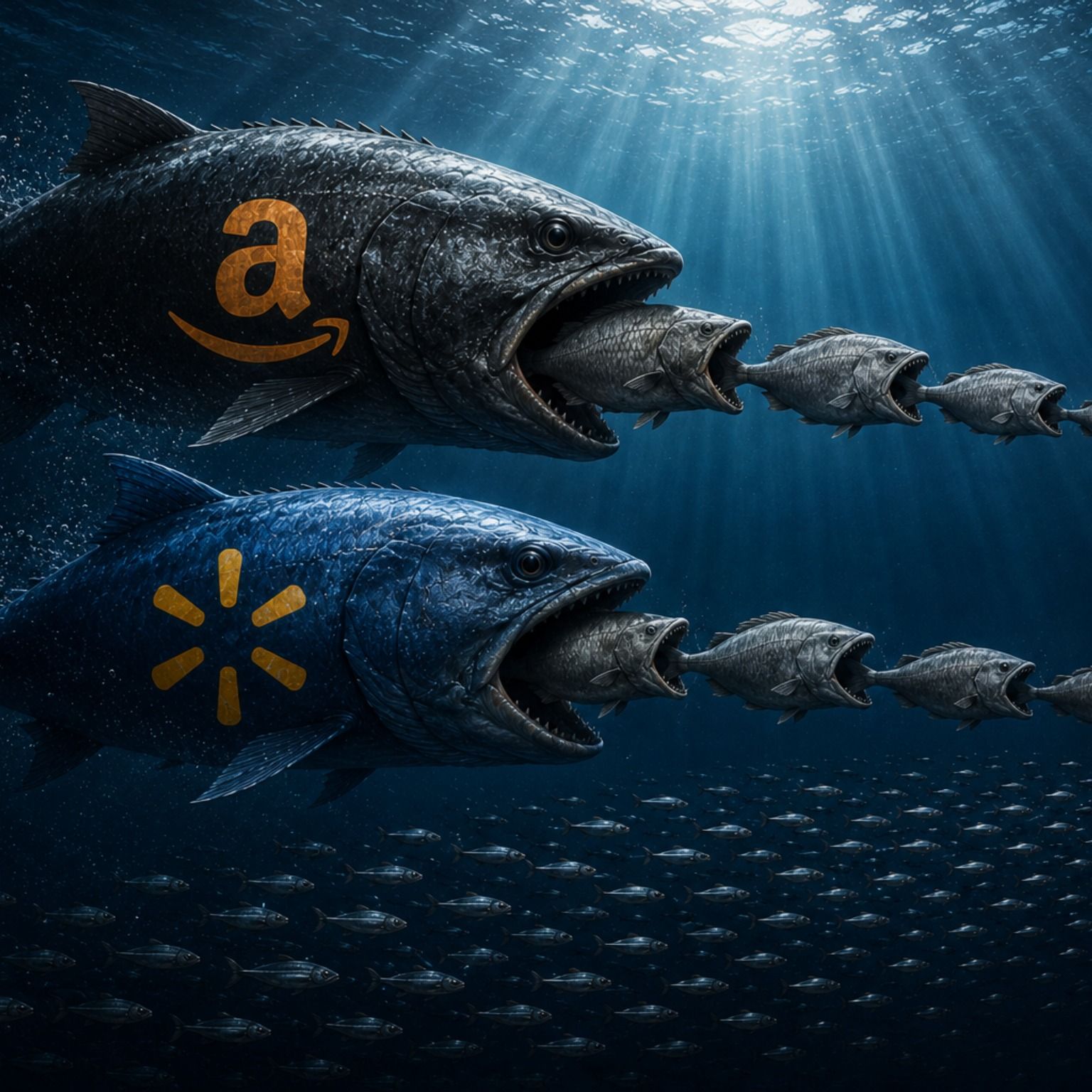 Retail's Great Concentration, Tapestry's Comeback, and the Dumbest Story of the Year