
Product Led Growth Leaders · 2026-07-16 · 25 min
Key moments - from our scoring
Substance score
42 / 100
Five dimensions, 20 points each
Evan J. Schwartz frames the current moment as a liminal state comparable to the 1990s internet transformation - a fundamental shift from UX (widgets and screens) to AX (agentic experience). At AMCS Group, a software provider for waste, recycling, and sustainability companies, he's leading adoption across three dimensions: internal operations, product development, and customer-facing AI frameworks. The core concept is 'AI stewardship' - humans learning to orchestrate agent systems by providing precise context, clear prompts, and output validation rather than executing tasks themselves. Schwartz uses manufacturing analogies (recipes, PLCs, dashboards) to explain how business will become process-oriented with agents handling outputs and humans orchestrating outcomes. He argues that traditional roles - report builders, analysts, programmers - will compress into generalist positions requiring new skills. His 750-page free workbook on evanjschwartz.com covers change management for technology adoption, and he's building a master's program at Jackson University to train AI stewards. The message is urgent: companies have roughly 18 months before competitors proficient in AI stewardship outpace them in decision speed and operational agility. Schwartz emphasizes this is a choice, not destiny - organizations can build human creativity on top of AI-driven efficiency, or face disruption.
An AI steward orchestrates agent systems by providing precise context, clear prompts, and validation of outputs - similar to a manufacturing supervisor monitoring a process. Rather than executing repetitive tasks themselves, stewards learn to communicate clearly with AI agents, ensure agents have complete data and knowledge, and verify outputs stay within target conformance limits and upper limits.
Competitors who master the transition from UX to AX will compress their organizations, accelerate decision-making, and win business faster than slower-moving rivals. Once a competitor has operationalized AI stewardship across their business, slower adopters will never catch up because the agile competitor will have already secured clients and operational advantages.
Instead of analysts gathering data, building Excel models, creating multiple iterations for management, and distilling insights into PowerPoint for the board, AI agents can produce bespoke real-time outputs for each decision-maker. Agents handle conforming decisions automatically within defined swim lanes, escalating only exceptions to humans for strategic judgment.
If AI produces unexpected results or surprises you, the agent is filling gaps by relying on its trained LLM knowledge rather than the specific context you provided - creating hallucination risk. This signals insufficient prompting and incomplete data; stewards must be directive and specific to prevent stochastic errors.
Traditional titles and salary bands lag reality; companies haven't yet articulated what they need. Within a few years, strong AI stewards will command $300k-$400k+ annually because they deliver 5-8x revenue impact, while commodity roles (report builders, basic analysts) compress into lower-paid generalist positions or disappear entirely.
Our reviewer’s read on each dimension, with quotes from the episode.
There are a handful of genuinely useful framings - AI stewardship as a new role, the context-vs-data distinction, and the idea that top producers will be best stewards but resist the shift - but they are heavily diluted by motivational padding, the tractor metaphor, education-system digressions, and repetitive apocalypse/renaissance rhetoric.
AI knows everything about your industry, knows nothing about your business
the best AI stewards are our highest producers. People who produce the best PowerPoints, produce the best Excel worksheets. They are the best at being an AI steward. The problem is they tie their self-worth to that thing.
The 'AI stewardship' label and the manufacturing PLC analogy applied to business delegation are mildly fresh framings, but the internet-as-prior-parallel, tractor metaphor, jobs-won't-disappear-just-change argument, and renaissance-vs-apocalypse framing are among the most recycled takes in the current AI discourse.
The only thing that even comes close was the delivery of the internet.
We're at a liminal state, which is why I do not prescribe to the apocalyptic world of AI. We're at a renaissance if we do it right.
Evan has genuine practitioner credentials as CIO at a real enterprise software company serving a specific industrial vertical, with 35 years of hands-on experience, which is above average; however, the conversation reveals he is operating heavily in evangelist/thought-leader mode rather than sharing hard-won operational specifics from his actual deployments.
we're delivering a product out into the industry. So if you're in pulp and paper, you're scrap metal, your waste and recycling, wherever you are within the space that we serve, we're delivering an enterprise-grade system that comes with an AI framework
I am four to six years from graduating a master's level degree of the first AI steward.
The episode is almost entirely abstract; the numbers offered (18-month competitive window, $300 - 400k steward salaries, '5 - 6 - 8 million in orders of magnitude') are illustrative assertions with no backing data, named customer examples, or measurable outcomes from AMCS's own AI deployments.
I could easily see a strong AI steward commanding three, four hundred grand a year because the output and my impact to the business is somewhere orders of magnitude five, six, eight million
You've got about 18 months. Someone in your industry, a competitor, is gonna do this journey
The host occasionally tries to structure a debate ('I'm going to throw a couple of claims out there') and the Excel analogy question is a reasonable setup, but he frequently hijacks the conversation with long rambling monologues of his own, never challenges any of Evan's unsubstantiated salary or timeline claims, and lets the discussion drift into motivational territory without probing for specifics.
I'm going to throw a couple of claims out there, and I want to see how you do whether you agree or disagree with these.
for years of SaaS products, years of ERPs being built, digital transformations. A lot of times you could attest to this three and a half decades of experience. You're often just replacing Excel
Computed from the transcript - who did the talking, and the words that came up most.
AI is starting to feel less like a tool you click and more like a coworker you direct and that shift changes everything. We sit down with Evan J. Schwartz, CIO and Chief Innovation Officer at AMCS Group, to unpack what happens as companies move from classic UX to what he calls AX, the agentic experience. If you lived through the early internet era, you will recognize the pattern: the first wave adds new tech on top of old work, and the second wave rewires the work itself. We get specific about what leading an AI initiative actually looks like inside an enterprise: adopting AI across internal functions like HR and finance, building with AI inside product and engineering teams, and shipping enterprise-grade AI to customers in resource-intensive industries like waste, recycling, and sustainability. Evan explains why “AI knows your industry but knows nothing about your business,” and why context, governance, and real use cases matter more than flashy demos. The heart of the conversation is the emerging role of the AI steward.
Transcribed and scored by The B2B Podcast Index.
Welcome to Product Led Growth Leaders. We've got a great guest for the show today, Evan J. Schwartz. He has spent three and a half decades building enterprise technology and digital transformation and everywhere ranging from startups to global enterprises.
He's uh become a Forbes Technology Council member, a patent holder, adjunct professor. Today he is CIO, Chief Innovation Officer at AMCS Group, the global leader in software for resource-intensive industries, helping waste recycling and sustainability companies run smarter, leaner, and greener. Um, and also leading an AI initiative, and you've got a book. So uh let's let's unpack all of this.
Uh uh, Evan, welcome to the show. Thank you, Thomas. I'm happy to be here. Yeah, absolutely.
Let's start off by talking about the kind of where you are today mentally regarding just kind of the time period that we're in and how that relates to your work. Yeah, look, we're at a we're at a liminal state of transition from what would be considered the UX user experience way of interacting with software to AX, the agentic experience, where everything is changing and going on its head, right down to what you think your role in business is and your ability to interact with software and what you're expecting software to do is changing.
This the only thing that even comes close was the delivery of the internet. And you'd have to be back in the 90s to have seen that, where businesses threw the internet over their business like a blanket and kind of said, so what? and realized that there's no value. It didn't touch their filing cabinets, it didn't touch the paper on their sheets.
But today, when we look at a business, can you imagine a single business being in business without the internet? We're at that same stage. We're living through it again. At least I am.
I'm old enough to be living through it again. So that's that's really where a lot of the thought process is is what's what's that next human interface looking like into the way all things are going to be touched by AI and business? Yeah, I mean, AI is changing everything, right? That's no secret.
And the whole way that we interact with software is rapidly changing. Um, I tend to think so. When we think about UX in terms of widgets on a screen, that certainly is changing rapidly. There still is always an experience when a human is interacting with the technology, but the nature of that changes.
So, like ChatGPT, you know, we're able to talk to it like we're talking to a person. That's a different experience than coding. And for a long time we couldn't talk to computers unless we had specialized knowledge of how to talk to computers. That was the software developers.
But now that anyone can you can misspell things, you can not put punctuation theory into it. Right? Yeah. And so now you are you are CIO at AMCS Group, but you're also leading their AI initiative.
What does that mean? So the AI initiative across AMCS group, and this would be any company. So, what is our own internal adoption for AI across our HR department, our finance department? How are we applying that tech and technology?
Then how we're a we're a product shop. We build software. So we're adopting AI within our development and core product organization. What does that look like?
How does AI support that? And then the third rung of that is we're delivering a product out into the industry. So if you're in pulp and paper, you're scrap metal, your waste and recycling, wherever you are within the space that we serve, we're delivering an enterprise-grade system that comes with an AI framework, comes with a Gen Tech systems. We're having to be good stewards of this tech.
So it's more than just delivering tools. We have to come to the table with use cases ready to go for an industry. And we have to be able to help our customers understand what the adoption is. So we're walking the walk ourselves.
I do it at my role as an adjunct professor in Jackson University, teaching it because we need different graduate skills. It's different muscles than what we used to have. So there's just a journey there that has to happen. And it's similar to you, you mentioned the book, which is about the rollout and deployment of ERP.
I call that a customer journey. There's a journey to be able to take that change in your organization. AI is doing exactly the same thing, it just is affecting roles differently. You're going to have different roles in your organization than what you're used to.
So, what's an example of how the roles change? I think we can intuitively detect it, but what does it kind of boil down to in this age of AI in terms of what changes about the roles? I'm calling it AI stewardship, just to give it a name. So an AI stewardship is you're interacting with an orchestrator agent.
That is just like me and you were talking right here. And that orchestrator agent has access to subagents, experts, worker agents, data agents. You're driving the context, you're driving the ask, the prompting, your clarity of your speech, you're learning how to communicate with this agent in a way the same way we do. And as we pointed out, there's a lot of intuitive flexibility there.
But context is important. If I give it a task and I don't give it the context data, and it has to go into its own trained LLM to fill in gaps to fulfill my task, there's an opportunity for hallucinations. So you, as the steward, need to get better at going, not only have I asked you to do something, I've given you all of the data and knowledge. That's context.
It's not just data, it's data plus knowledge, in order to complete the tasks. My last job function as a steward is looking at that thing's output and putting it on the dashboard and go, does it fall within targets? Does it fall within conformances? Does it fall within upper limits?
Now that's going to start to sound a lot like manufacturing. If you go into a manufacturing floor, you look at the PLC systems, there's a recipe on how I put something in at the front, it goes through various steps and processes, and maybe I get a pizza box out the back end. Business is becoming process oriented and driven. Agents are doing the output, humans are orchestrating the outcomes.
And that's a it's a different way of thinking about what I'm producing as value than what's okay. So let's dive into a couple of specific examples that you might see across the landscape of a data, uh, a digital transformation project. So let's let's uh pick a few job roles. Um, let's do a job role.
Um let's say that 15, 20 years ago, this a person or a small group of people is responsible for producing reports, right? Right. So the very common, right? So you've got, you know, Excel, you've got Power BI, you know, whatever.
Right. And there's a certain set of data that matters to stakeholders, and a bunch of stuff's being uh collected. And then this group is assigned to put something together, and then you have the quarterly meeting or the monthly meeting where the report system is. That's correct.
So there is a bunch of deliverables in the process, but presumably the need or some big part of the need still survives uh up until now. People need to make decisions. So so so walk us through how that will change kind of in a before and after the AI revolution. So if you even if you go, I'd say take it into three steps.
Before the advent of Excel, you had floors full of analysts cranking calculators on sheets. And now a single Excel worksheet allows you to do the work of floors of analysts, right? Now we roll ahead to AI, and I still am going to need to understand what is the outcome. What, to your point, decisions have to be made.
Before AI, I would have to gather the data, make sense of it into Excel. Maybe there's some transformations, maybe there's formulas, maybe I need to put some kind of a prediction or some sort of a projection, Z forms, all kinds of things you would expect finance guys to do. What is my internal rate of return? What is my future value?
Give me the charts. That goes into your manager, manager, looked at those things. That's good at a tactical level, but I'm not going to present all of this to the board. That's too heavy.
I'm going to distill this down into my metrics. And now I'm going to bubble this back up into a PowerPoint before it gets all the way into what's basically a crown-drawn picture that goes up to the board for them to see it. We don't have to do any of that anymore. That transactional data can present a bespoke output for the person who needs to do that job and make that decision, but it goes a little bit further.
And this is the difference between AI analytics and agentic is as you're looking at this data, what's the whole point of putting that data in front of someone to make a decision? Why would you even do it? Because something needs to be decided, some action needs to be taken. There is now a whole suite of those things that fall within absolute targets, absolute conformance, outer limits.
I'm not dealing with the easy decisions anymore, agent. Here's your swim lanes, here's your dashboards. You stay within these conformities, just do it. This is the this is maximizing that delegation chart, if you've ever seen that.
What's the best delegation is do you even need to tell me about it? You took care of the problem, you made the decision stun. Do I even need to know? Down to you go do all the research, you find everything, you bring it to me, and then I will tell you exactly what the dough is the lowest.
But agents are going to give us that agency of delegation at every stage of the flow. Most of it is going to be self-licking ice cream cones. Only the exceptions am I going to have to work with all the way up to the top. And rather than the data goes through multiple iterations up to the board, it's real time to the board.
So the board is looking at high-level strategic metrics at the same time as the boots on the ground tactical steward is driving the business on the tactical data that's coming in. And that's going to change the decision speed. The acceleration of the iteration is really the value of the agenda. And it's across every role.
Now, here's a question I've got for you, Evan. It's something that I think about a lot. And you touched on it when you said bespoke solutions, right? I'm going to throw a couple of claims out there, and I want to see how you do whether you agree or disagree with these.
Okay. I feel like um, let's say let's take Claude as our example, LLM, because it seems like the future is kind of moving toward Claude kind of as the product specific product that's the LLM that's leading. I feel like the LLMs, ChatGPT Claude, are the new Excel. And so in the sense that wildly different, right?
But in the sense that everyone uses Excel and for decades, Excel is the go-to. You can walk in among school teachers working or guys working at a refinery, or scientists, or social worker, you know, and they're they can all use Excel for their own exact bespoke. And then and it just uh you know, just penetrated the marketplace, never went anywhere for decades and decades and decades because it's such a statistic on this that every single person uses less than 10% of what it can do.
Right. So that's yeah, just the fact that cells exist, statements can be made between cells. Yeah, somehow does a lot of it, but then but then for years of SaaS products, years of ERPs being built, digital transformations. A lot of times you could attest to this three and a half decades of experience.
You're often just replacing Excel and just making a streamlined workflow within some kind of hobbled together. Oh, we've got file folders over here, and then we've got this exposure sheet, and then we've got this. Because all it is is data under the hood in a form, but it's attached to a process that's doing something. So it's doing the transformations and it's portable.
The big thing that SaaS ERP does is it makes it portable and consistent, whether it's I'm doing it or you're doing it, we're all following a consensus problem. The problem is Excel could do that. And in fact, I've there's a whole host of businesses that used to tell me if you could just make Excel do this, like if I could just make this change in Excel spreadsheet, I'd buy this product all day long. I'd rather do all of the everything in Excel and just hit a button, it goes into some magical cloud, and everyone sees everything the same way.
Excel's flexibility is its problem, and you're right, already touching on that with AI, right? Because where people you could ask it a question and it would be so intuitive, so on track. Because I I warn my customers, AI knows everything about your industry, knows nothing about your business. So it you have to be shockingly careful because it you may ask it to do something, go, oh yeah, yeah, I didn't ask you to do that, but you were smart enough to know this thing's amazing.
But when you take it to scale, because in that one instance, when you didn't give it the appropriate context, it went into its LLM that knows everything about your industry, and it just happened to be right that time. And it pulled that knowledge up to complete the task. And you're thinking, what a great tool. This tool is helping me, it's giving me insights, it's asking me to do things.
Yeah. What agentic AI and what the next situation, the reason why these things need to sit on top of SaaS solutions is it's doing the same thing that SaaS ERP systems did to Excel. It's giving you the consistency of delivery. If you look at our education system, and I'm fighting back hard on this because I saw it happen to my youngest son.
You know, he went from first grade up to fifth grade. He, you know what kids are. Anything's possible. Fearless.
They're gonna try to create something that could teleport. There was nothing they wouldn't try. And then all of a sudden, that goes away. They've reached honor roll status, they've got their pretty certificate, and now there's nowhere else to go up.
But why would I try anymore? I'm gonna take the easy path to maintain my honor roll status. So I've achieved the height of what business wanted was a cog that had repeatable excellence that could follow a process and do it over and over again. We're at a liminal state, which is why I do not prescribe to the apocalyptic world of AI.
We're at a renaissance if we do it right. It's a choice. I'm telling everyone it's a choice. We don't have to choose the apocalypse.
The future happens because of us, not to us. So stop being a victim. We can choose a better way and delegate to AI, just like we did that tractor. I'm not out there plowing acres for my food, right?
A tractor does that for me now. I can have AI do this repeatable excellence for me and allow me to do what I need to do as a human is be creative, look for opportunities based on the dynamics of the world. AI is not good at it. They don't have the way to do it.
If there's a car accident and I'm in charge of logistics and shipping, and I've got vehicles that need to get out the door, unless AI is tied into every single thing and can sense the living world the way we can, it needs us to feed it context so that it's making smart output. But we have to be the ones that are making the outcomes happen. We're still choosing it, right? And that's the muscle shift because I'm finding that the best AI stewards are our highest producers.
People who produce the best PowerPoints, produce the best Excel worksheets. They are the best at being an AI steward. The problem is they tie their self-worth to that thing. I'm a chairmaker, right?
And I'm now upset that AI is making my chair. I'm an Excel guy. I'm great at it. I know all the shortcuts, I know all the formulas, and now this thing is crapping out an Excel file and doing my job.
And now my self-worth is tanked. No, sir. You are the best AI steward we can get. It's about 30%.
And it's not because they can't do it, they won't. Because our education system was so good at convincing them to be cogs that it's we're finding it difficult to ask them to be something more. Think of outcomes and not output. So if there's a message I want to leave the audience with today, is start thinking in outcomes.
Train yourself on how to get that agent to do that repeatable zero value item. The fact that that thing can produce that so quickly and easily, its value has reduced to zero. Think about it. Used to be an analyst in Excel producing this thing 80,000, 90,000 a year.
And now I can put that same prompt into Claude and get that Excel worksheet in seconds. Yeah. What do you think of this problem that I'm kind of seeing and struggling with? Is you have, I think there's lots of reason to be optimistic.
If we pick the right path into the future, there's actually no reason why humans shouldn't be pretty happy we have the robots doing all the farming and we go to the beach and drink quina coladas. I don't think it's quite that scenario. I think that we're still making the play calls for business. But yeah.
Well, well, the thing is, so in this interim uh liminal space, as you referred to it, the one of the issues that I see is those of us who use AI a lot for lots of different things, you you discover all of these opportunities to just multiply your productivity. And you're like, wow, I can really test my ideas way faster and better and duration is faster. Everything, every part, if you think creatively, you can just make everything better. One of the issues I see is that do you think that the market has to catch up in terms of its vocabulary in terms of what it asks for?
So, like let's take the chair and make you get what I'm saying. So the chairmaker is like, I'm a craftsman who makes chairs, and then oh no, the AI has taken my job. But the that person can still add value, but no one knows how to talk about the value yet. That maybe two years from now, that's what we need to do.
Yeah, we need to do this. Yeah, let's talk about chairmakers. Let's put it in a context that AI is dominating right now, which is 3D printing. That thing that AI can generate the mesh file, put it in 3D printer, and output that thing it can print.
Right. It just became zero. So that's not where the value is. The value is the guy that is crafting the prompt that gets the 3D model that it's going to print.
Right. But the job descriptions don't aren't there yet. The job description description, there's like a few that still say, I want a chairmaker. And then the people are like, I want a really good person at AI, but they're not special.
So I don't know how what do you do, you have any forecasts on when does it kind of shake out over the next few years? I'm I'm doing this evangelism thing to companies. I'm building this at Jackson University. I'm starting with the the industry that was hit hardest, which are programmers, as everyone knows.
No one codes anymore, but I still need architects, right? I have to have the architect. Now, what you're seeing is role compression. I'm seeing the product owner becoming a little bit of an architect, a little bit of a developer, a little bit of an engineer.
You're seeing you're having to be the generalist again. Now, you don't look as old as me. But in the 80s and 90s, there weren't SaaS software companies. Every company built their stuff in-house until they realized good God almighty, the cost of ownership is so much.
Let's spin this thing off into a company that sells this to a thousand customers. So that took some learning to do. But in that environment, the generalist, oh no, no, no, no one touches that printer. Only Bob can touch that printer.
He hooked all this up. That guy was a king in that realm. Right. And then everyone started becoming these specialists to the point where I also grew up during the development phase.
And to me, it's an athame that I'd go and find a developer who doesn't know how to do any SQL or database work. But now there's back end developers and front-end developers, and there's guys that just know UI. So even that's a weird universe to me. And we've come full circle back to the generalist because that's going to be a compressed role.
So I'm teaching this language and concept to businesses, and I'm warning them. Here's here's the there is no change without pain. So I'm creating a little bit of pain to effectuate this change. I am four to six years from graduating a master's level degree of the first AI steward.
So, business, you have four to six years to do this, build these muscles. Now, here's what happens if you don't. I give it away for free, Thomas. If you go to my website, that customer journey, 750-page manual.
Let's let's let's uh let's shut that out for the listeners. What is the website? It's evanjschwartz.com.
You just go my name.com and you'll go into the customer journey, take the tour. That entire scenario is there. I get that's a philanthropic thing.
I don't want companies wasting money on ERPs, failing to take the change management. AI follows the same process. Pain management for technology is what it says right there on the front, right there. Oh my goodness.
Yeah, everybody check this out. And then it's got your book right there as well. That's all of it's theirs. You should you should be getting to anything.
Now you're gonna have to buy the book. Forbes published that. I can't give the book away for free. But the the the 750-page workbook on how to work through this process, free.
Take it. I just I want businesses to make the right call, right? So yeah, the point is, and this is the pain to make the change. If you do not take this adoption, there's gonna be a journey from UX to AX.
You've got about 18 months. Someone in your industry, a competitor, is gonna do this journey and they're gonna get good at it. And by the time you've assembled a room to talk about a proposal to go bid on new business, that guy has already won the business and has his vehicle on route to service that customer while you're still trying to get people in a room to talk about it. You are never going to catch up because he's gonna be able to compress his organization.
He's gonna have people that are good at making decisions that generate outcomes. Every part of his business is gonna be outcome-based. Just if you think that way, you are already an AI steward. The rest of it is a skill like you would get with Excel.
You just got to get good at the commands, you got to get good at talking, playing with it. You said it. I'm finding new stuff every day. You do that by playing.
You get better at making sure, hey, it anytime you're surprised that AI did something you didn't expect, that's a warning sign. It's looking at its LM. You didn't direct it. So, unless you're being specific and directive to the agent, you are now running the risk of its stochastic nature.
It's how the LMs are built. They are gonna hallucinate. So give it the context, give it the commands, measure the output. You'll be a great steward.
And you were think about what you're gonna be able to command in salary. That's gonna take time to catch up. But right now, that 70, 80 grand a year analyst on an Excel worksheet, you're doing the job of 10 to 15 people now comfortably. I could easily see a strong AI steward commanding three, four hundred grand a year because the output and my impact to the business is somewhere orders of magnitude five, six, eight million in orders of magnitude in revenue, bottom line.
Why wouldn't I pay any businessman in the world? Say if I I gave you 500,000 and you give me five million back, how many times would you do that? All day, every day. Yeah.
Yeah. That's the world we're moving to. Excellent, excellent insights, ladies and gentlemen. We've been speaking with Evan J.
Schwartz. Check out Evanj Schwartz.com for uh his blog, his book, everything that he's got to say. Evan, thank you so much for being with us today.
Thank you, Thomas. I appreciate it. Spread the word, brother.
Other episodes covering the same guests and topics, from across The B2B Podcast Index.
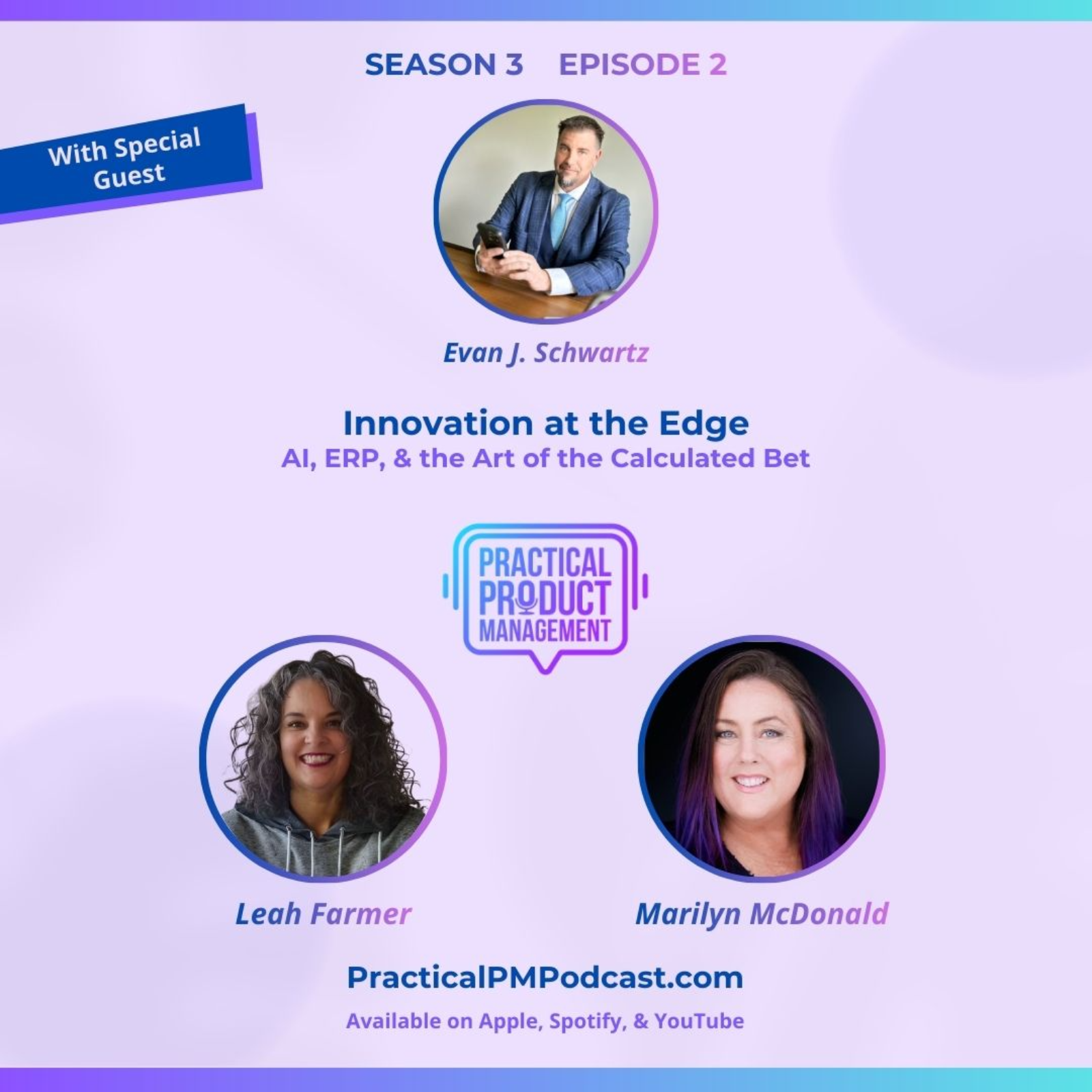 Innovation at the Edge: AI, ERP, and the Art of the Calculated BetPractical Product Management · features Evan J. Schwartz86 / 100
 AI in the room, helping non-technical teams actually use itDefinitely, Maybe Agile · on Agent orchestration80 / 100
 Securing AI Agents in the Enterprise: NanoClaw, Zero Trust Guardrails, and Governance at ScaleThe Enterprise AI Show · on Agent orchestration78 / 100
 #23 Skillstack for the future: 26 Skills for 2026Future of Work, Future Skills & AI · on Agent orchestration44 / 100
 How VCs Are Valuing AI Agents That Work TogetherThe Venture Capital Podcast with Fexingo · on Agent orchestration
 Ep3. The Tech Stack: A New Internet Architecture | The Post Web Audio DocumentaryThe Outlier Ventures Podcast · on Agent orchestration190 - What If Leave Policies Felt Like Product Design - with Romy Malviya80 / 100189 - Behavior Patterns That Predict Conversion - with Keith Zubchevich68 / 100188 - ADHD Is A Label But Capacity Is The Problem - with Frankie Berkoben50 / 100187 - Product-Led Growth Meets Agentic Selling - with Channing Ferrer60 / 100186 - What If Recognition Worked Like A Viral Product - with Ali Linz65 / 100