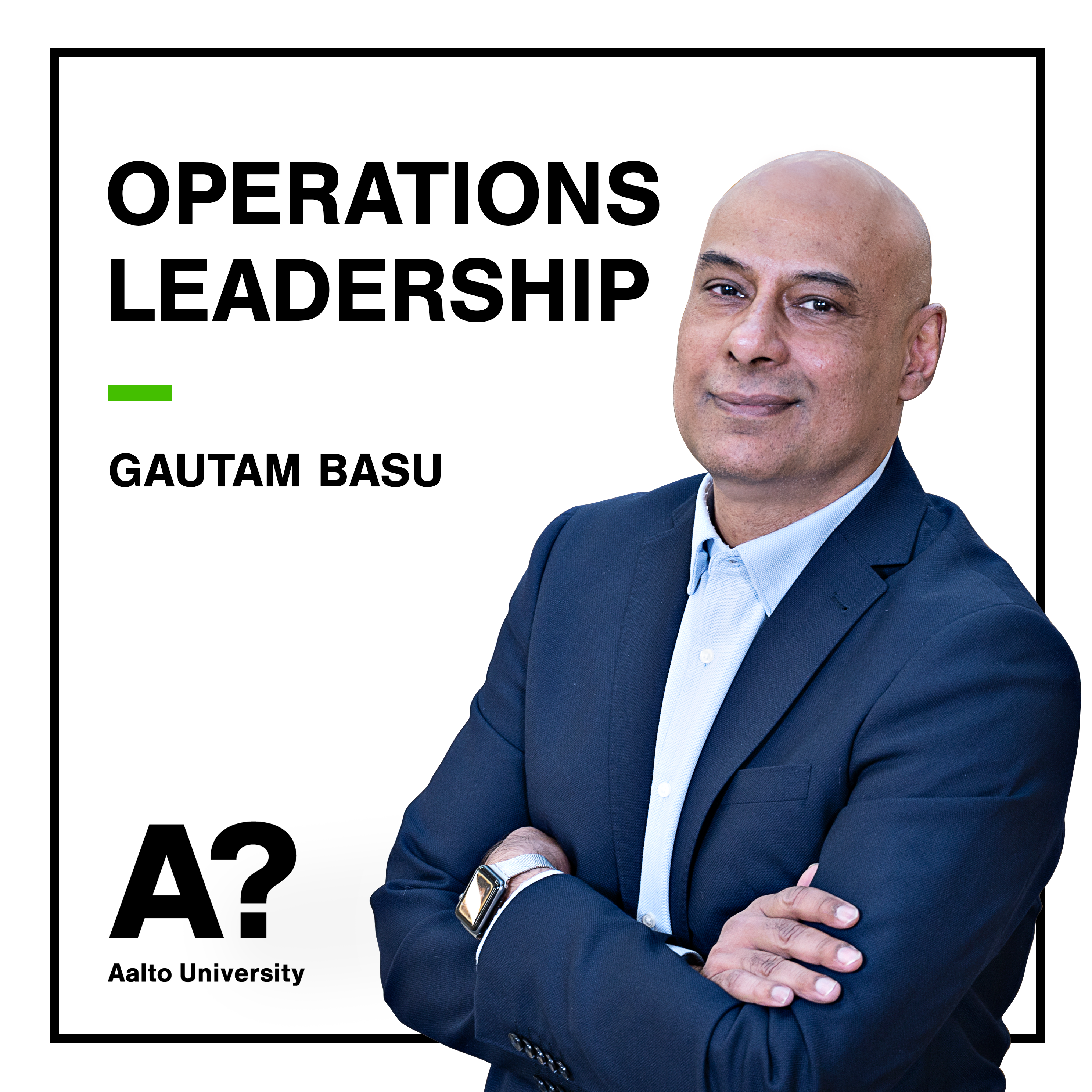
Operations Leadership · 2026-06-05 · 37 min
Key moments - from our scoring
Substance score
46 / 100
Five dimensions, 20 points each
This is a data-driven outlook on operations leadership through 2031 grounded in academic research, field experiments, and large-scale surveys. Speaker A argues that organizations operate at a massive disadvantage because they've failed to redesign core workflows around AI capabilities. Harvard Business School and Wharton research shows that one human plus AI equals two humans in productivity, while cross-functional silos collapse when AI is properly integrated - yet most organizations layer AI tools onto unchanged processes. McKinsey's Agentic Organization report projects that AI task completion without human supervision doubles every four months, reaching four-day autonomous work capability by 2027. However, 87% of operations executives cite poor data quality actively blocking AI value, and only 27% have fully embedded AI strategy. The episode also covers the World Economic Forum's finding that 39% of today's skills become obsolete by 2030, the MIT Media Lab's research on cognitive debt (55% reduced neural connectivity in LLM users), Shanghai University research showing that supply chain resilience requires deep AI integration not surface adoption, and Deloitte's evidence that 70% of leaders now prioritize speed and nimbleness over efficiency. The conversation targets operations leaders, supply chain officers, and executives responsible for organizational architecture decisions.
Harvard Business School and Wharton research found that one human plus AI matches the performance of two humans without AI, and importantly, cross-functional silos collapse when teams use AI together, driving better cross-disciplinary solutions.
85-90% of organizations are still running operations the way they did when fax machines were cutting edge, according to multiple industry reports cited in the episode.
McKinsey's research shows unsupervised AI task completion length has doubled every four months since 2024, projecting to approximately four days of autonomous work by 2027.
MIT Media Lab research found that LLM users showed 55% reduced neural connectivity and 83% could not recall content from essays they just finished, suggesting AI assistance may degrade critical thinking and memory over time.
Fundamental workflow redesign when deploying AI is the single strongest predictor of enterprise-level AI impact, not the model, data budget, or technology investment itself.
Our reviewer’s read on each dimension, with quotes from the episode.
The episode cites multiple peer-reviewed and institutional studies with specific quantitative findings that a B2B operator would find genuinely useful - particularly the 1+AI=2 humans result, the AI task-completion doubling rate, and the cognitive debt research. However, roughly a third of the runtime is motivational rhetoric, metaphor-padding ('Ferrari filled with wet sand'), and hortatory summaries that dilute the research density.
one plus AI equals two. That basically means that individuals working with AI match the performance of two person teams without AI
AI systems will be capable of completing approximately four days of work without a human in the loop
A few genuinely useful framings emerge - 'cognitive debt,' 'work slop,' 'pilot purgatory,' and 'human-agent pairing as the unit of performance' - but the overarching thesis (AI changes everything, redesign workflows, courage over technology) is well-worn territory in 2026 and the episode does not argue from first principles or take a meaningfully contrarian stance.
work slop is the abundance of fast, poor quality work produced by or with AI because employees are being told to use AI for as many use cases as possible
transformation is no longer something organizations do. It is something organizations are
This is a solo monologue with no guest at all; the host's own practitioner credentials are never established in the transcript, making it impossible to credit any operator-level authority or depth of lived experience.
So in this episode, we're going to talk a little bit about what may the next five years of operations will look like
The episode is notably strong on named research sources and sample sizes - 776-person Harvard/Wharton/P&G experiment, 767-executive PwC survey, 54-participant MIT EEG study, WEF data covering 55 economies - lending meaningful credibility. It is notably weak on real company examples, actual operational case studies, and dollar-denominated outcomes, which prevents a higher score.
Researchers from Harvard Business School and Wharton School and Procter and Gramble ran a field experiment. 776 professionals, real product innovation challenges
55% reduced neural connectivity in LLM M users versus those working without AI assistance. And also 83% of LLM M users could not recall quotes from essays they had just finished writing
There is no interview and therefore no host craft to evaluate in the traditional sense; the host does proactively surface and rebut anticipated objections, which partially compensates, but a prepared monologue reading research summaries cannot demonstrate follow-up skill, genuine pushback, or productive disagreement with another human.
I know the objection. This is the robots talking job speech. It is not
I will not use the phrase digital transformation with a straight face. I will not tell you to lean into disruption, and I will not give you a seven step framework with a catchy acronym
Computed from the transcript - who did the talking, and the words that came up most.
In this episode, Gautam looks into the future of operations. He digs deep into the six forces that will reshape operations in the next 5 years and why 89% of organizations are still running industrial age operating models, while 1% are lapping the field; what science tells about the new unit of work, and why … Continue reading "Episode 40: Future of Operations: Outlook 2031"
Transcribed and scored by The B2B Podcast Index.
Speaker A: The ops were revealed Operations leadership notes from the Field. Welcome back to the Notes from the Field. And I have to warn you up front, this one is going to be a little bit uncomfortable in the way that looking at your bank statement in January is uncomfortable, maybe with all the excessive spending during the holiday season, uh, but it is necessary and clarifying. So let's talk about the future, specifically the next five years of operations and what the academic literature, the field experiments and the industry data are screaming at anyone willing to listen. And spoiler alert, most people are not listening. That is, as it turns out, that's the whole point of this episode. I want to start this episode with a range of numbers. 85 to 90%. And that is the percentage of organizations operating right now, today, in 2026, according to multiple industry reports that classifies as still running industrial age operating models. We have put robots on Mars. We've mapped the human genome. A 14 year old with a laptop and a free API key can build a product that reaches millions of people in a weekend. And yet 85 to 90% of organizations are still running their operations the way they did when a fax machine was, was considered cutting edge. And there is a guy, and I guarantee there is a guy in your organization right now whose entire job is to email a spreadsheet to another guy who puts it in a different spreadsheet and email sit to a third guy. And nobody has asked why because that is how it has always been done. And that phrase, that exact phrase, how it's always been done is the single most expensive sentence in the English language. There are a very, very select few organizations that have built what's a decentralized AI native operating network. And these organizations are not just catching up. They are not in the same race. They are lapping everyone else. And they're not even breathing hard. So in this episode, we're going to talk a little bit about what may the next five years of operations will look like. And I'm going to make you exactly one promise. I will not use the phrase digital transformation with a straight face. I will not tell you to lean into disruption, and I will not give you a seven step framework with a catchy acronym that you put on a slide to show your board and never execute. But what I am going to do is walk you through six forces grounded in peer academic research, uh, large scale field experiments and data from organizations surveying tens of thousands of executives across a dozen countries that will define who wins and who becomes a case study in what not to do between now and 2031. This is not a technology story, it's a courage story. And most organizations are frankly not courageous enough to hear the difference. So I want to tell you about a study. This is a peer reviewed pre registered published through the National Bureau of Economic Research Science. And I say that because this finding is so striking that your first instinct will be to dismiss it. Don't M Researchers from Harvard Business School and Wharton School and Procter and Gramble ran a field experiment. 776 professionals, real product innovation challenges, not simulated, not staged, actual work with actual stakes were surveyed and they divided the participants into four conditions. Number one, solo with AI. Number two, solo without AI. Number three, team with AI. And last but not least, a team without AI. And here's what they found. One plus AI equals two. That basically means that individuals working with AI match the performance of two person teams without AI. One human plus AI equal two humans. And this is the part that should rewrite your org chart. They finished faster. Now, if you're a CEO and you just heard that one of two thoughts cross your mind. Either extraordinary, this changes how I think about team design and resource allocation, or great, I can cut headcount in half if it was a second thought. I want you to stop this podcast, go sit quietly in a room and think about why you got into business in the first place. Because that instinct, uh, that reflexive jump to extraction is exactly what separates the organizations that will thrive from those that will spend 2031 wondering what happened. There's a second finding from the same study and that is, if anything, more important. Without AI, R&D professionals clustered around technical solutions. Commercial professionals cluster around commercial ones. Classic silo behavior. Two smart people talking past each other across a functional boundary that exists on an org chart and nowhere else. With AI, the silos collapsed, the cross disciplinary solutions emerged. And the AI did not just do more with work, it changed how people thought about the work. It essentially dissolved invisible walls that have been costing organizations billions in coordination costs for decades. There was a study by McKinsey which adds a timeline, um, in their September 2025 report called the Agentic Organization, it tracks the length of tasks that AI can reliably complete without human intervention or supervision. That is two times every four months. That's the length of unsupervised AI task completion, which, which has doubled every seven months since 2019 and every four months since 2024. Think about that for a second. Every four months. That is not Moore's law. That is faster than Moore's Law and The projection based on that trajectory is that by 2027, AI systems will be capable of completing approximately four days of work without a human in the loop. Four days unsupervised by next year. So right now, if you're hiring an intern, by 2027 you have a mid level analyst who does not need managing. And by 2029, uh, the same report suggests that you may have something closer to a senior colleague who works continuously, never takes a sick day, never asks for a raise, and frankly, never makes the office politics weird. Now I know the objection. This is the robots talking job speech. It is not the Harvard Business School data is explicit. AI does not replace the human, it restructures the team. The humans who know how to work with AI will have a structural compounding advantage over those who do not. And that gap will be visible in output, in speed, and eventually in compensation. So the unit of performance is no longer the individual, it is no longer the team, it is the human agent pairing. And most organizations have not yet updated a single process to reflect that. So the five year implication, by 2020-31, operations leaders who have not redesigned their staffing models, their workflow architecture and their performance metrics around human agent pairings will be structurally behind in a way that is extremely difficult to close, not impossible, but very expensive and very humbling. And here's a part where I get a little less theoretical and a little bit more irritated because the data on where most organizations actually are right now is not inspiring. It is a masterclass in the gap between strategic ambition and operational risk reality. PwC's 2026 Digital Trends and Operations Survey had 767 operations executives and supply chain officers, senior people, the people actually responsible for making things work. And they had three findings. 27% have fully embedded an AI strategy across their business units. 37% feel comfortable assigning AI agents to execute end to end processes. And 87% say poor data quality has actively blocked value from their digital investments. So 87%, let me say that again with full weight, it deserved. 87% of the people responsible for digital operations say their data is so bad it actively prevents them from doing the thing they know they need to do. And here is my favorite metaphor for this situation. You bought a Ferrari, a beautiful, absolutely extraordinary machine, and then you fill the tank with wet sand and published a press release about your commitment to high performance driving. That is the current state of enterprise AI adoption. The car is real. The ambition is real. The fuel is not. There is a finding that I want Tattooed on the inside of every operational leader's eyelids. The single strongest predictor of enterprise level AI impact is whether an organization fundamentally resigned its workflows when deploying AI. Not the model, not the data budget, not the technology investment. The workflow redesign. And, um, this is the finding that most organizations are paying enormous consulting fees to avoid hearing. Because redesigning workflows is painful and it's political. It requires killing processes that somebody built their career on. It requires looking at how work has been done for 15 years and saying out loud to the people who built it, this was not optimal. And that, my friends, is a hard conversation. It's much easier to buy an AI tool that's new and layer it on top of the old processes. And you get to tell your board you're innovating and you get to publish a press release and you get to fail quietly over the next three years while the 1% who actually redesigned their workflows pull further and further ahead. This is what some folks call the failure mode. Many local wins, little systematic reinforcement. And I call it the pilot purgatory. And I've spoken about this on previous episodes, on notes on the field where every function has a brilliant AI initiative. The operations team, the procurement team, the finance team. Each one has a case study they are proud of. None of them connect, none of them compound. And the organization looks at its P and L at the end of the year and genuinely cannot understand why AI has not moved the needle. It is because you built islands and islands do not scale. Bridges scale. So the five year implication, the operations leaders who win between now and 2020, 31 are not the ones with the largest AI budgets. They're the ones with the organizational courage to redesign, not decorate, how the work gets done. And to connect the islands, to build bridges and to have the uncomfortable conversations that make both, um, possible. Now I want to talk about another force which, which is going to underpin the next five years, which I call the skills earthquake. The World Economic Forum's Future of jobs report in 2025 stated that over a thousand leading global employers, 14 million workers, represented 55 economies. This is the most comprehensive view of global workforce transformation available from any source anywhere. And it's not subtle. They state that 22% of all jobs will be disrupted by 2030, 170 million roles, new roles will be created by 2030, and 92 million roles will be displaced by 2030, and 39% of the today's core skills will be obsolete by 2030. So what this means that there will be A net positive on jobs, the optimist will say, but 78 million more roles than we lose. And that is progress. Sure. And if you're one of the 92 million whose role disappears, I'm sure that is enormously comforting. Right? The point here is not the net number, the point is the churn. 39% of the skills that are valued today will not be valued in four years. And that is not a training problem, that is a strategic architecture problem. So the real question is not can we upskill fast enough. The question should be what are we building an organization that learns faster than the environment changes. So now most people hear skills of the future and they think technical AI, coding, data science, and yes, the world economic firms, those do top the list. But here is the part that gets left out of every LinkedIn post about the future of work. Human skills Human skills are growing in criticality at almost the same rate. We're talking about creative thinking, resilience, flexibility, agility, curiosity and leadership. The WEF projects that these will be among the fastest growing skill requirements globally. And the academic literature from peer reviewed journals like the International Journal of Production Research backs this up. They did a Systematic review of AI across 13 operations management domains and concludes that the human skills of interpretation, judgment and cross functional synthesis become more, not less important as AI handles more of the mechanical world. Think about what that means as AI gets better at the transactional, the repeatable, the forecastable, the humans who can think across domains, adapt to ambiguity and exercise genuine judgment become rarer and more valuable, not less relevant, more relevant. And so the AI enabled skills based organizations a state are 79% more likely to drive positive workforce experiences and 63% percent more likely to achieve their organizational outcome. These kind of numbers that show up in the market share and margin over a few five year window. And the five year implication is that organizations that build workforce architecture, and not just training programs but actual architecture around the human plus AI combination will have a talent base in 2021, 2031 that is genuinely difficult to replicate. And the ones that treat this as an HR deliverable and file it away, well, they're going to spend 2031 paying enormous premiums to recruit the talent they should have been building for the last four years. The next force is the cognitive trap. And this is the segment that nobody wants to put in the deck. But I think it might be the most important thing I say in this episode. So I'm going to ask you to say it with me. MIT's Media Lab in June 2025 um had their research researchers run an experiment where participants wrote essays using one of three conditions. Number one, chat GPT, number two, a search engine, and number three, nothing at all. Just their own brain and a blinking cursor. They measured brain activity through by using eeg, electroencephalogy, graphy and actual neuroscience. Not a survey, not self reported feelings. And their findings said that 55% reduced neural connectivity in LLM M users versus those working without AI assistance. And also 83% of LLM M users could not recall quotes from essays they had just finished writing. That's kind of astounding. 55% reduced neural connectivity and 83% could not remember what they had just written in essays they had just written minutes ago. So the research coined the term cognitive debt. And here's an idea where AI assistance spares you mental effort in the short term, which actually feels great, it generally does. And it's pleasurable, it's efficient, but it accumulates a hidden cost over time. And that's in critical thinking, in creativity, and what they call intellectual independence and in memory. Now the important caveat, this was a small study, 54 participants and preliminary. It is not the definitive neuroscientific verdict on AI and cognition, but it is the first neurophysiological evidence that the way we use AI might be quietly restructuring how our brains function. And the operational implications of that, if it holds scale, are really profound. Because here is the scenario nobody is planning for. Your organization spends the next five years maximizing AI adoption across every function. The speed will go up, the output volume will go up, and everything looks great on a dashboard. And then somewhere around 2029, you realize that your workforce capacity for deep reasoning, novel problem solving and independent judgment has been quietly degrading. And you do notice, because all the metrics you're tracking are volume metrics, not quality metrics. And there's already an early version of this problem. And it's this. And I love this work slop. Work slop is the abundance of fast, poor quality work produced by or with AI because employees are being told to use AI for as many use cases as possible, with no guidance on when not to use it, no training in how to evaluate output quality, and no time to think carefully about whether the model produced is actually fit for purpose. And that, my friends, is fast garbage at enterprise scale. There's another peer, uh, reviewed paper in Frontiers in Medicine, which was published in 2026 that makes the case that addressing cognitive descaling is not about rejecting AI. It's about intentional Design, the prescription is built in regular practice of unsupported reasoning. And this makes space for humans to engage with hard problems without AI assistance. Not because AI is bad, but because the human skill of independent judgment is load bearing. And if you do not exercise a muscle, it atrophies. So the real fundamental question is not whether to use AI. The question is whether you are designing for the human capability that sits underneath it. And most organizations are not even asking that question. So the five year implication is that operational leaders who look back on this period with pride will be those who build deliberate systems for when humans fully engage and when AI assist, not those who let convenience make the decision by default. Your workforce in 2031 is being shaped right now by the choices you are making or not making today. The next major force that's going to be impacting the future is what I like to call resilience as revenue. And this is something that is very much near and dear to my heart, and that's supply chains. Because this section is not really about supply chains in the abstract, but it's about whether your company survives the next decade. And as we all know, in the last six years we've had a global pandemic that shut down manufacturing on three continents simultaneously. A land war in Europe that withdrew the energy map of the western world, a US China trade conflict that made friends shorting a real term and the and that's serious people use in serious meetings and what economists call geoeconomic fragmentation, which is a very polished way of saying everything you assumed was stable is not. And through all of that, the academic literature has been trying to answer a genuinely important question. Does AI actually make supply chains more resilient or does it make them faster? Because faster fragile is not better, faster fragile is just faster collapse. And so I think the answer may come from a peer reviewed research that is quite nuanced and important. Research at Shanghai University published, uh, a paper in Nature scientific reports in 2025. Um, and they've spent a decade studying Chinese manufacturing companies with real firms, real data and actual AI adoption measured through textual analysis of annual reports. And what they came up with is, uh, some actual resilience indicators constructed at the firm level. And their conclusion is that AI greatly enhanced supply chain resilience primarily by driving in organizational structure and improvements in internal control systems. But the depth of AI integration matters enormously. Um, they claim that service level adoption does not move the needle, but deep integration changes the architecture. And that last sentence is the one that you should sit with. Um, surface level adoption does not move the needle. Ah, for example, a chatbot answering supplier queries. Is not supply chain resilience. An AI system that continuously in ingest signals from your supply network and it identifies as emerging risks before they become disruptions and recommends adaptive responses in real time. That is supply chain resilience. And that also requires deep integration, not just a proof of concept. There was an also another paper uh, in 2024 which in the Journal of Production Research which provided a Systematic review of AI's role across 13 distinct supply chain and operations management decision areas. Things like demand forecasting, inventory management, network design, risk management. And their headline was that AI, and specifically generative AI opens what they call revolutionary potential in operations. But they also realize that this will require new skills, new data infrastructure and new organizational relationships between human judgment and machine recommendation. And there's also the macro context from the World Economic Forum which is around supply chain and transportation, uh, being one of the industries showing the sharpest spike in AI related training completion globally right now. And that's a leading indicator because smart organizations in this sector are not waiting for the next disruption to decide what they should have built better, uh, sensing capabilities they're building right now. And while it is optional because in 2028 or 2029 when the next big thing happens and there will be the next thing, it will not be optional anymore, it will be existential in my view. So the five year implication by 2031, supply chain resilience will be a competitive growth capability and not just a risk management footnote. The companies that built AI, augmented sensing, scenario planning, adaptive response into their supply chain architecture in the next coming years will have a structural advantage that will take competitors years to close. And I think the ones who have waited, they will be the ones paying $6,000 per container to move things. They should have moved six months earlier. And we've all seen that movie and it's not a good ending. The sixth and final force that I feel that's going to impact the future of operations is something around transformation not being a destination. And uh, the ideas around this came from McKinsey's State of the Organization's report in 2026, where they had more than 10,000 senior executives over 15 countries and 16 industries. And it provided a comprehensive snapshot of organizational thinking as it exists anywhere around the world. And its central conclusion is the one that I think most leaders are not ready to hear. And that is transformation is no longer something organizations do. It is something organizations are. And it is not a project with completion date. It is a permanent operating condition. Permanent, that is a word that is not recurring, not frequent, but permanent. The idea you can run a transformation program, declare victory and return to business as usual. That idea, I think, is over. And the environment is changing faster than any transformation can keep up with. Which means the capability you need is not the ability to transform. It's the ability be in continuous transformation while simultaneously running the business. And that, my friends, is a fundamentally different leadership challenge. And most leadership teams are not built for it. There was another report, uh, by Deloitte in 2026 around the global human capital trends. And it's a survey of 9,000 leaders in 89 countries. And it was conducted in partnership with Oxford Economics. And they asked executives about their primary competitive strategy for the next three years. And seven in 10 said that to be fast and nimble, not efficient, not cost optimized, but fast and nimble, the ability to adapt is now the strategy. And they use a metaphor I want to steal because it is genuinely good and it's around the S curve, the classic model of organizational growth. Gradual lift, rapid acceleration, the inevitable plateau. And companies used to live comfortably on a single S curve for decades. For example, a successful product launch, a dominant market position, 20 years of incremental optimization. That era is over. AI and workforce transformation are inevitably compressing that curve so aggressively that organizations hit the plateau before they have fully monetized a climb. And they have to jump to the next curve under time pressure, with imperfect information, while the current curve is still technically profitable. And that really is the operational reality that I see in 2026 through 2031. You are jumping while you are still climbing. There is no comfortable pause at the top. And if you think about these various frameworks, um, they give specific structural changes in, in the next five years, um, such as flatter organizations, leaner hierarchies, and team organized around outcomes rather than functions. So this will enable new roles. Agent orchestrators who design and supervise AI workflows, Hybrid managers who can blend human agent teams and AI coaches who help employees develop genuine capability with technology. And simultaneously the disappearance of entire layers of middle management whose primary function was to translate information between organizational silos. And when you think about AI and what it can do, that translation instantly, continuously and without political friction. Those roles do not just change. They cease to exist in their current form. And that's pretty uncomfortable for most folks. Um, Gardner also adds one more concept worth naming before we close this particular force and what they call regrettable retention. This is a situation where your best people, the ones you actually need to build a future become so disengaged by the gap between what the organization says it wants to be and what it is actually capable of doing that they just check out. They're physically present, but professionally absent. They're just going through the m motions, collecting a salary and eventually leaving. And so in an era where the scarcest resource is not capital or technology, but human judgment and creative capacity, this regrettable retention is not an HR problem. It's a strategic emergency. And the organizations most likely to experience it are the ones with the most impressive looking transformation roadmaps and the least actual will to ex execute them. So the five year implication is uh, the org chart of 2031 will not look like the org chart of today. And for operations leaders who will succeed, uh, they will be the ones who start redesigning now, not because they have a perfect clarity about what the destination looks like, but because they understand that waiting for clarity itself is not a choice. And it is a choice in favor of the people who are already moving. All right, let's start to bring this home with a timeline. So this is not a prediction. And I think the point is that the window between now and when the decisions get made for you is much shorter than most organizations planning cycles assume. So in 2026 I believe that the scaling gap widens. Uh, AI pilots are multiplying, but the value stays trapped at a functional level. Because as some of these studies state, the vast majority of organizations discover that their data infrastructure was never built for this moment. In 2027, uh, AI systems will complete four plus days of work unsupervised. And this is when the first true human agent teams appear at scale. And the performance gap between organizations that redesigned workflows and those that didn't becomes visible. In 2028 that cognitive debt surfaces as a measurable workforce issue. And I think forward thinking organizations introduce deliberate human reasoning protocols. And this is where supply chain resilience is a board level metric and not just a cto Footnet. In 2029, AI governance moves from policy document to real time embedded oversight. And the organizations that built resilient AI augmented supply chains and operations start to begin to realize structural competitive advantage. And in 2020, 2030, sorry, the World Economics Forum, 170 million new roles begin to materialize. And here there will be a skill mismatch and that will reach peak intensity. And organizations that built workforce architecture for the human plus AI era start to pull significantly ahead. And in the final year 2031, the gap between AI native and AI layered organizations is visible in the P and L, in the talent pool and in the market, and the window to close it is narrow and expensive. And the decisions being made in 2026 are the ones that determined which side of that line you ended up on. So the research, academic, institutional, empirical, converges on three characteristics that define organizations that will lead operations in 2031. First, they redesigned their workflows before they deployed technology, not after, not during, but before. They asked, what should this process be, before they asked, what AI should we use. Second, they invested in the human edge. Judgment, creativity, independent reasoning, accountability. With the same rigor and the same budget, they invested in automation. And they also understood that human capability is not a cost to minimize, but it's a capability to build. And the third is, is they treated governance not as a compliance cost, but as the infrastructure that makes fast movement safe, as they built the guardrails before they press the accelerator. And that is it. That's the whole research synthesis. Three things. None of them complicated, all of them hard. And hard is exactly where the advantage lives, because hard is the filter. Hard is what separates the organizations that say the right things on earnings calls from the ones that build something that actually lasts. So the question is not whether the future of operations will be fundamentally different m from the past, because it will be. The question is whether you are going to design it or have it designed for you. I know which one I would choose. So, in conclusion, I wanted to have this episode because I think conversation about operations, real operations, the actual work of building and running organizations that create value, is too often hijacked by either breathless techno optimism or defensive nostalgia. And the research does not support either. The picture is genuinely complex, genuinely exciting, and genuinely urgent in equal measure. And I. I believe that the organizations that treat the next five years as an opportunity to fundamentally rethink how they operate will be extraordinarily difficult to compete with in 2031. And the ones that spend the next five years optimizing their existing models with a thin layer of AI will have a very efficient legacy business right up until they don't. So that's it for this episode. I want to thank you for listening and go build something that matters. We're out. Real market. The ops were revealed. Operations leadership notes from the field.
Other episodes covering the same guests and topics, from across The B2B Podcast Index.
 Skills Shift - Thriving With AI, Part 2The Future of Work · on World Economic Forum Future of Jobs report80 / 100
 Best practices for Corporate AI transformation with Adam NewtonThe Lean AI Podcast presented by Eric Ries · on World Economic Forum Future of Jobs report61 / 100
 Can an Algorithm Replace a Teacher’s Instinct?This Week with EdSurge · on National Bureau of Economic Research51 / 100Episode 39: Behind the Numbers: Insights from M&A Due DiligenceEpisode: 38: Field Notes - AI ROI Reckoning: Why Most AI Deployments Still Aren’t Hitting the P/LEpisode 37: Manufacturing Operations Leadership in Private EquityEpisode 36: Field Notes - Network Redesign from Resilience to Total ValueEpisode 35: Field Notes - Chokepoint: Hormuz, World’s Most Dangerous 21 Miles