Motivational Mondays: Conversations with Leaders · 2025-09-08 · 11 min
Key moments - from our scoring
Substance score
34 / 100
Five dimensions, 20 points each
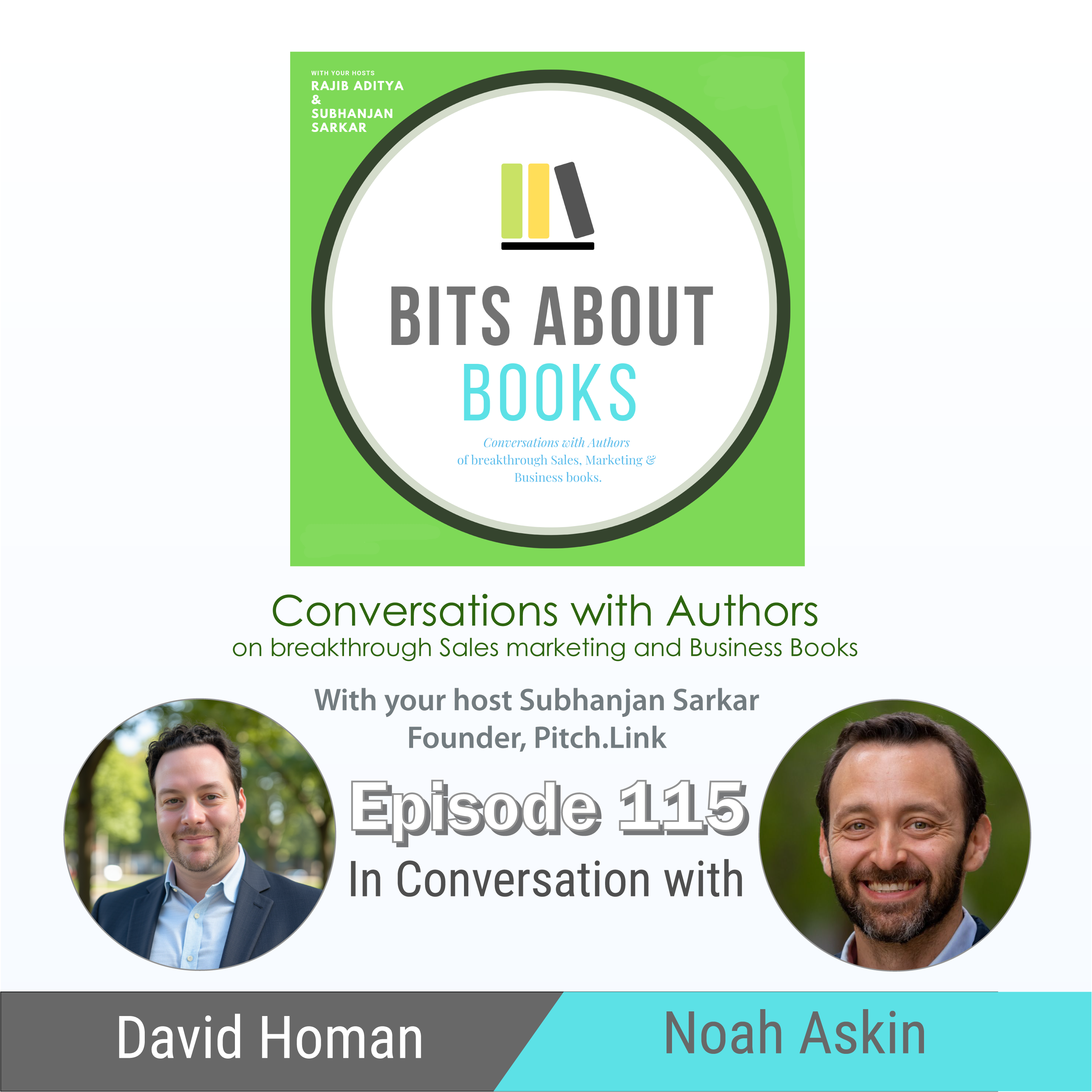
David Homan, founder and CEO of Orchestrated Connecting, and Dr. Noah Askin, organizational sociologist at UC Irvine's Paul Merage School of Business, examine the mechanics of building purposeful communities that foster genuine belonging and align with personal purpose. The book emerged from Askin's pandemic-era practice of hosting open office hours on LinkedIn, which evolved into hundreds of conversations over five years and caught Homan's attention through a mutual connection. Rather than viewing networking as achievement-dependent or transactional, they argue that establishing relationships with authenticity, curiosity, and vulnerability creates depth and lasting value. Askin teaches undergraduates that everyone brings unique stories to the table - whether it's their background, perspective, or potential - and that lowering barriers to entry into networks helps young professionals recognize their inherent worth. Homan emphasizes that success follows connection when built on genuine principles: stating clear intentions, championing others reciprocally, and balancing the polished "brand" side of connection with vulnerable authenticity. Their work appeals to organizational leaders, HR professionals, and emerging professionals seeking frameworks for building cultures of belonging that transcend generational divides and social anxiety around networking.
Build relationships with authentic curiosity and vulnerability, balancing your polished professional brand with genuine struggles and humanity; this depth cannot be manufactured and emerges only when you connect with sincere intent rather than immediate gain.
Everyone brings unique value through their story, background, and perspective, and while they may not have extensive networks at 22, they offer genuine potential and relationships that gain meaning over decades as both parties grow.
Inherent curiosity about other people and authentic vulnerability; together these create depth that cannot be orchestrated, only genuinely expressed in moments of real human interaction.
Dr. Noah Askin started hosting open office hours during the pandemic on LinkedIn, which attracted David Homan's attention through a mutual connection; recognizing aligned values around connection and generosity, they collaborated to ground Homan's community-building practices in social science research.
Our reviewer’s read on each dimension, with quotes from the episode.
The episode is 11 minutes including a lengthy intro and outro, leaving maybe 6-7 minutes of substantive content. There are a couple of genuinely reframeable ideas - connection preceding success, vulnerability as the missing half of brand - but the bulk of the talk is generic networking advice dressed in slightly new language, with no sustained development of any single idea.
if you think that you have to achieve success to find connection with somebody, that's actually not the case. You have to build connection with somebody so that when you achieve success, the relationship stays
A brand presents half the story of what connection is the half the story we believe that is as authentic and more necessary is the vulnerable side to it
The 'connection before success' inversion is a reasonable reframe and the brand-vs-vulnerability duality has some freshness, but the surrounding advice - be curious, be authentic, embrace vulnerability, relationships compound over time - recycles standard networking canon without adding first-principles reasoning or counterintuitive evidence.
you have to build connection with somebody so that when you achieve success, the relationship stays and there's a difference in how you build it
I might be that all star ex or that master convener, but really, my mom's been sick. I don't tell anyone about it, but I'm going to tell you now
Noah Askin is a credentialed organizational sociologist (UC Irvine, Thinkers50 radar) who teaches a dedicated course on networks, giving him genuine academic grounding; David Homan is a practitioner who has built a real community. However, neither is a B2B operator who has done this at scale in a commercial context, and the episode doesn't draw on either guest's deepest expertise.
He's recognized on the Thinkers50 radar list, and he is an award winning teacher and researcher whose work on leadership and culture and creativity has been recognized around the world
I teach a whole course on networks and connecting
The only concrete data point is Noah's pandemic office hours anecdote with approximate frequency and cumulative volume; everything else is anecdote-free abstraction. No named companies, no metrics from the book's research, no cited studies, and no dollar or growth figures appear anywhere in the substantive portion.
I was doing this for like an hour to an hour and a half every Friday and had dozens, and now, five years later, hundreds of conversations
one of the people who noted this was a former MBA student of mine, um, named Jamil Nguyen
The host's visible role in the transcript is entirely limited to a scripted intro and a closing sign-off; there are zero questions, zero follow-ups, and zero moments of pushback or productive tension. The two guests essentially deliver pre-packaged book-tour talking points to each other with no external pressure applied.
That's it for Motivational Mondays. I hope you enjoyed learning from David and Noah
So let's dive straight into this episode where David and Noah get to the heart of what is in their book
Computed from the transcript - who did the talking, and the words that came up most.
In this episode, organizational sociologist Dr. Noah Askin and relationship-building expert David Homan share how generosity and authenticity are the real foundations of meaningful relationships. What started as Noah’s open office hours during the pandemic grew into hundreds of conversations and, ultimately, a powerful partnership with David. Together, they’ve discovered that connection isn’t something you pursue after success - it’s what sustains you on the way there. They reveal why lasting networks are built on trust, not transactions, and how even the smallest acts of generosity can spark relationships that transform careers and communities. You’ll learn why connection comes before achievement, how to build a network rooted in authenticity, and why showing up consistently for others pays off in the long run. LEARN MORE: > > Orchestrating Connection: How to Build Purposeful Community in a Tribal World ( ) WE WANT TO HEAR FROM YOU: > > We’re trying out a shorter format for Motivational Mondays ! Take our quick 2-minute survey to let us know what you think. ( nsls.org/mm-survey )
Transcribed and scored by The B2B Podcast Index.
Speaker A: Hello everybody and welcome back to Motivational Mondays. I am your host, Marissa M. Levin, and I am also the Chief Human Resources Officer and Chief culture officer of UM, the NSLS. I have had a 35 year entrepreneurial, leadership and culture journey and I am beyond honored to be able to bring this podcast to you as its host. If you've missed some of our last episodes, you may not be aware that we're changing the format of Motivational Mondays. Our goal is still to share inspiring leadership stories and connect you with incredible authors and experts that have paved the way for all of us regarding culture, leadership and community building. And we want to continue offering you actionable tips. But we condense the length of the podcast so that you can get what you need and get on with your day. At the end of the show, we would love your thoughts, so stick around for a quick survey. So let's jump right into this episode. Today we have two incredible authors who have teamed up, uh, to produce a groundbreaking book on the building of purposeful communities. We have David Homan and Noah Askin and they are the co authors of Orchestrating how to Build Purposeful Community in a Tribal World. David is the founder and CEO of Orchestrated Connecting, a global community of connectors, as well as Orchestrated Opportunities and Soar Connect. He's known around the world for his groundbreaking ideas in building purposeful community and in corporate culture. Noah is an organizational sociologist at UH UC Irvine's Paul Merage School of Business where he directs the Leadership Development Institute. He's recognized on the Thinkers50 radar list, and he is an award winning teacher and researcher whose work on leadership and culture and creativity has been recognized around the world. Together, they team up to explore how intentional purpose driven community can transform us on both an organizational and a personal level. Their work highlights the shared values, rituals and culture that help people feel a sense of belonging while also dialing into their purpose. So let's dive straight into this episode where David and Noah get to the heart of what is in their book, Orchestrating Connection. How to Build Purposeful Community in a Tribal World.
Speaker B: This is a story we talk about in the book, um, obviously the power of connecting and connection. And it started in the pandemic. I was living in France. I had two very young children, uh, when the pandemic hit and basically realized I was not going to get a whole lot of actual work done, but didn't want to feel like I had nothing to contribute to society. And as a professor we host office hours and I thought, you know, I should host open office hours. To anybody where everybody's on zoom or teams or whatever at this point in 2020. And this can be some small way of connecting with people and helping them out in the midst of the pandemic. And that was just something I posted on LinkedIn, shared with my network. And next thing I knew, I was doing this for like an hour to an hour and a half every Friday and had dozens, and now, five years later, hundreds of conversations. And one of the people who noted this was a former MBA student of mine, um, named Jamil Nguyen. And Jamil knew David and saw kind of what I was doing around connecting, around generosity, around trying to help others, and was like, oh, you should meet this guy, David Homan. Um, I think you're very, you know, your. Your visions and values around connecting are aligned. And so he made the introduction, and David and I connected and started talking about David's community, about the orchestrated connecting community and what he had built and the ethos and practices behind it. And I was like, that's really interesting. Do you have any background in the social science behind what you're doing? And he said, not really. I was like, because there's a lot to support the way you've gone about building your community and the way you look at connecting with others. And, you know, that was four and a half, five years ago, something like that. And that sort of led to the creation of the book. And maybe, David, you want to pick it up there?
Speaker C: Uh, I would say Noah probably has a greater expertise in the definition of this than I do. But, you know, when I think about specifically speaking to all the listeners here, if you think that you have to achieve success to find connection with somebody, that's actually not the case. You have to build connection with somebody so that when you achieve success, the relationship stays and there's a difference in how you build it. And so when looking at what your community is, what your network, everyone around you is an opportunity for where you can choose to spend your time or not. And the more you understand that you are advancing yourself and therefore the opportunities for you, for your family, for what comes in your life, the more you'll be out of that predicament of, I don't know anyone, how do I get started? More than this understanding that everyone around you has that shared experience of making that investment with you. And it is just invariably the case that many of the people that individuals meet while going to school end up becoming their closest friend, their confidence. In some cases, it could be somebody you met, you had an imprint on, and 20 years later, you get a call from them because you were valuable to them, and then that's the opportunity you never knew building a relationship could then turn into. But it does, but only if you're not after something that is transactional or temporary.
Speaker B: Yeah. I think just to add to that. So I teach undergrads. Uh, I teach a whole course on networks and connecting. I teach a class on leadership. And I think, you know, part of what I view my role in those classes is, is lowering the bar for what college students feel like they need to be able to bring to the table in order to be able to enter a network or community and recognize, first of all, they all bring something unique to the table. Their story, their background, uh, you know, whatever. Whatever it is that got them to where they are. Right. Being at a top business school here, like, they clearly have something to bring to the table, and it's starting to unpack that and identify what that is in themselves first to kind of own their own story. Um, and then it's also recognizing that, like, their experience. Right. A lot of people in the workforce these days out in the world are trying to understand what to make of this generation. What do they want? What. What are their drivers? What are their motivations? And because, you know, when you're in it, you don't have any concept of, like, oh, I bring this unique perspective to the table. As somebody who is about to graduate college and has a different set of, of wants and desires and maybe interests and purpose that motivate me, and that's something that I can share right out of the gates. So, you know, there already are things that, that, that college students and beyond can bring to the table from that perspective. But it's also, to David's point, like recognizing that, just establishing those relationships now and understanding that people get that you're not necessarily going to bring every amazing introduction to the table when you're 22 years old, but that you are, you know, there's. You are potential. Right. And in addition to what you. Your story, you are offering the fact that down the line people get that they're investing in relationships that will eventually come to have lots more meaning.
Speaker C: Yeah. So two different points to make with that. Because the people who are unsure how to activate themselves and then the people whose social, uh, dynamics mean they have to learn more of how to be out there, either one is erased when you have purpose and you understand your value, regardless of how people respond to you. And so it's not about the circumstance. Right. Do you contact people cold? Do you go to conferences, do you try to bring people together? It's the fact that you need to work to state your intentions. You need to see if other people can champion you as you champion them. And then the environments in which you do that are utility of being much more content with taking that risk, to go out there, to take that purpose and to not. You might care, right? I care that anytime somebody says my events aren't great, they don't like my network. But I get it less and less because I spend my time embodying the two principles that Noah and I believe are key to that type of interaction, which is to be inherently curious of other people and then talking about the brand. A brand presents half the story of what connection is the half the story we believe that is as authentic and more necessary is the vulnerable side to it. And when you can embrace both without the fear of that rejection, because you'll get it anyway, you have a different recipe of what it means to put yourself out there. Whether you're an introvert, an extrovert, extrovert, socially anxious, or you think you're the life of the party. But you've never offered substance till now. And therefore you haven't had depth until you pause to go. I might be that all star ex or that master convener, but really, my mom's been sick. I don't tell anyone about it, but I'm going to tell you now. And then you say to me, well, actually my parents are getting old too. And suddenly it's not just about the impression or the brand. You suddenly have depth, which you cannot buy, you cannot orchestrate. You just have to connect with intent just for that moment, for that interaction.
Speaker A: That's it for Motivational Mondays. I hope you enjoyed learning from David and Noah, uh, on what it means to create an intentional purpose community. And you're feeling just as inspired as I am. I hope you're ready to take on the week with fresh energy and purpose. As we build out this new chapter of the podcast, it is very important to us that we get your feedback on what works and what doesn't work. Let us know the type of content that you want, the type of guests you want to hear from. Let us know what matters most to you. So we've put together a super short survey that you can complete and the link is in the bottom of the description or you can visit nsls.org mm m m survey and that will take it to you as well. Thanks so much for listening and being a part of the NSLS community. I am Marissa Levin, and I will see you soon.
Other episodes covering the same guests and topics, from across The B2B Podcast Index.
 Rising Above Self Doubt (Feat. Melody Wilding)
 Lead Like People Matter (Feat. Zach Mercurio)
 Reinventing Leadership Through a Negative Split (Feat. Mary Beech)
 Breaking Barriers in Mental Health (Feat. Heather Stephens)
 Discovering Kindness From Within (Feat. Leon Logothetis)