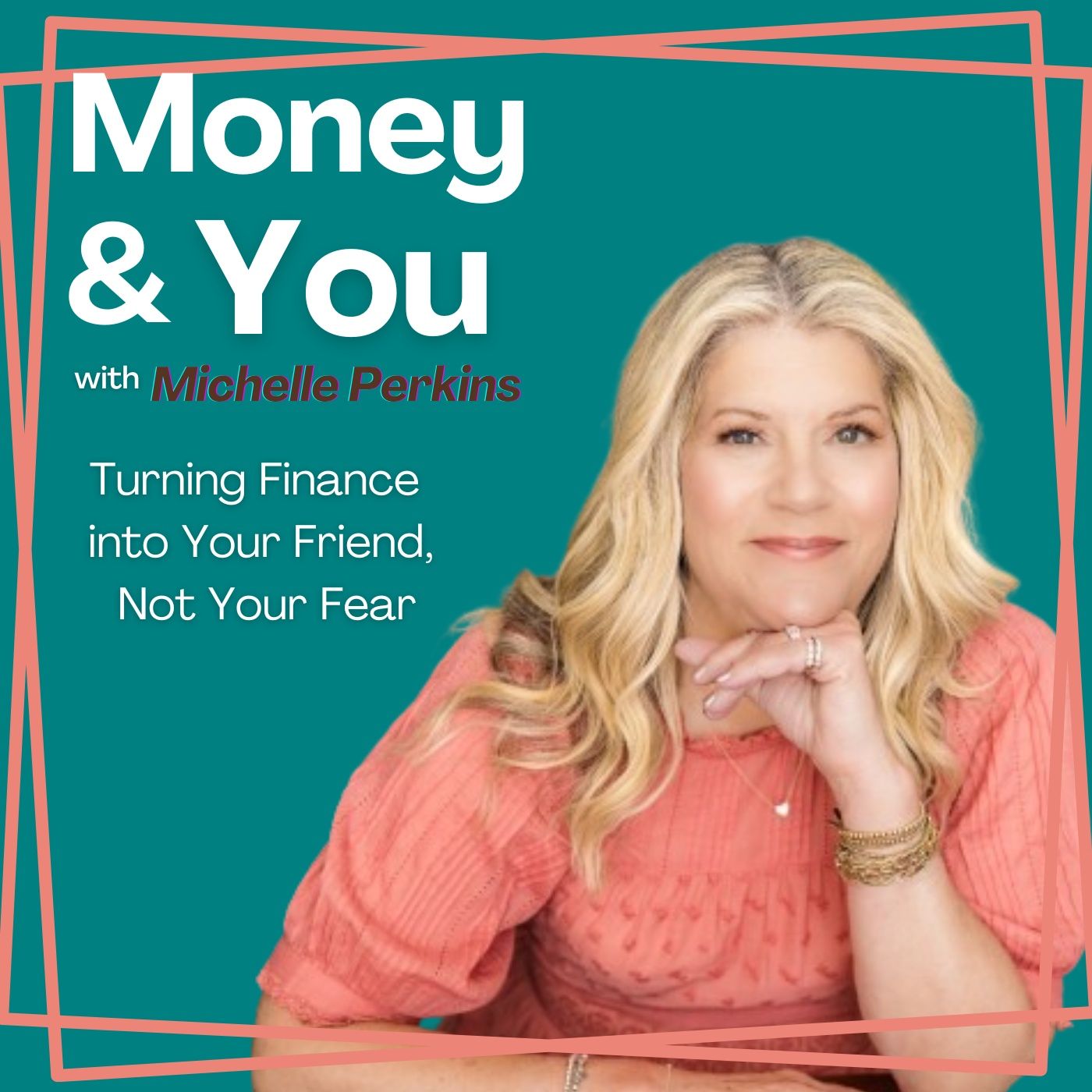
Money & You with Michelle Perkins · 2026-06-29 · 12 min
Key moments - from our scoring
Substance score
27 / 100
Five dimensions, 20 points each
Bonnie Russo brings clinical insight to the intersection of financial stress and relationship health. Drawing from her work with diverse clients navigating high-conflict divorce, financial abuse, and life disruptions, she identifies a critical gap: most people lack education and access to honest financial conversations, particularly within intimate partnerships. The episode explores why money remains taboo despite its profound impact on wellbeing - rooted in family systems, cultural messaging, and the assumption that partners will 'do the right thing' without explicit dialogue. Russo emphasizes that pre-marital money conversations, while valuable, are insufficient; what matters more is understanding whether a partner values your contributions equally and establishing ongoing dialogue as circumstances change. She highlights a specific gendered pattern: women are historically undertrained in finance and often default to trusting a partner with financial oversight without visibility into actual accounts or decisions. Russo advocates for reframing financial awareness not as distrust but as self-protection and education - challenging the belief that asking questions about money somehow signals lack of faith in a relationship.
Bonnie identifies patterns rooted in family systems and cultural upbringing - people assume their partner will manage finances the way their parents did without ever explicitly discussing it, often unaware their partner grew up with completely different money practices and values.
No; while pre-marital conversations are valuable, they're insufficient because income levels, life circumstances, and personal growth change over time, making ongoing dialogue throughout a relationship essential.
Bonnie observes that girls are historically undertrained in finance, function, and future planning at a young age, and are culturally conditioned to defer financial management to husbands while trusting without visibility into actual accounts and decisions.
Reframe financial awareness as self-education and protection, not distrust - it's important to ask questions, seek understanding, and get on the same page regardless of how much you love or believe in your partner.
Our reviewer’s read on each dimension, with quotes from the episode.
Roughly three minutes of the twelve-minute runtime is intro/bio reading, and the remaining conversation yields only a handful of loosely articulated points (money avoidance stems from family culture, pre-marital conversations need to be ongoing, women aren't taught financial self-advocacy). None of these are developed with depth or nuance, and the exchange is padded with affirmations and re-statements.
I am so excited. There's a little pattern that I've noticed with my shows
it is okay to ask questions. It is okay to want to understand. It is okay to get educated and to get on the same page
Every point raised - women are financially under-educated, couples avoid money talks, pre-marital agreements need revisiting - is standard personal-finance and couples-therapy conventional wisdom. There is no contrarian or first-principles argument, and the 'act as if' protective framing is the closest thing to a novel heuristic but is expressed in passing without development.
protect yourself as if right
the ones that you think are never going to do it to you, they might not right, but act as if
Bonnie Russo is a credentialed, working clinical social worker who runs both a private practice and a nonprofit, giving her genuine practitioner legitimacy. However, the transcript reveals very little scale or depth of expertise - her observations are general and anecdotal, and she is not a nationally recognised authority or someone who has operated at institutional scale.
I've seen, you know, a cop people over the years, and the patterns that I see are very consistent
I really want to take that pain and put it into purpose so I can help educate people
There are virtually no concrete data points, statistics, research citations, or named case studies in the entire episode. The sole illustrative example is a colourful but vague anecdote about a hypothetical partner hiding money in a backyard can - no client outcomes, no prevalence figures, no timelines.
maybe your partner's dad stashed all of his money in the backyard in a can and then took off. We don't know, we don't know
I cannot speak for everybody, but I can't speak you know, I've seen some folks
The host asks broadly relevant questions but frequently answers them herself before the guest can respond, and she never challenges or probes a guest claim. The conversation is friendly and mutually validating rather than intellectually productive, and the most substantive guest point ('value you and money that you would make') is met with a simple 'Interesting?' rather than a meaningful follow-up.
Why don't you There are some things specifically in your bio that you talk about with respect to finance. Did you choose to address those or were those things that just sort of started coming to you
Interesting?
Computed from the transcript - who did the talking, and the words that came up most.
Transcribed and scored by The B2B Podcast Index.
1 - >
Speaker 1: Hey there, and welcome to Money and You. I'm Michelle Perkins, 2 - > your host. My search for more fulfilling work led me 3 - > to career in business coaching, where I stumbled upon a 4 - > game changing discovery. Money issues often start with our mindset 5 - > and habits. You see, our relationship with money is the 6 - > key to overcoming those frustrating financial obstacles. As an entrepreneur, coach, 7 - > and problem solver, I'm passionate about helping you create a 8 - > great relationship with money, because turns out that's the foundation 9 - > for a limit free life. Each week on Money in You, 10 - > I speak with amazing guests about all things money, mindset, 11 - > practical tips, and everything in between. We're here to give 12 - > you new insights, education and empowerment. So money can be 13 - > one of your favorite relationships. So join us for some 14 - > lively conversations and let's transform your financial life together. Hello 15 - > and welcome to another episode of the Money and You podcast. 16 - > I am so excited. There's a little pattern that I've 17 - > noticed with my shows, and that is that when if 18 - > i have somebody in the therapy world, a financial therapist, 19 - > a regular therapist on the show, it actually gets liked 20 - > the most, or noticed the most, or whatever. The crazy 21 - > metrics are and I have found that to be really 22 - > interesting because when you think about our money, a lot 23 - > of what we're trying to do is get rid of 24 - > the stress and the worry and the anxiety or the 25 - > conflict around money. And therapists see this all the time, 26 - > and they see it in depth, in detail, and getting 27 - > their perspective on how other people are dealing with their 28 - > money or not dealing with their money, how they're interacting 29 - > with partners around money, how they're managing that stress is 30 - > so fascinating and so helpful because you know, and this 31 - > isn't about how much money you have, of people who 32 - > have very little, people who have a lot, it can 33 - > all be feeling anxiety around money or problems around money. 34 - > And so today we have a fabulous guest, wonderful speaker 35 - > and wonderful, wonderful woman in her profession. I'm going to 36 - > just read you a little about Bonnie Russo. Bonnie Russo 37 - > lssw QS. We're going to find out what that means 38 - > that QS. Bonnie Russo is a licensed Clinical social Worker, 39 - > qualified supervisor. Oh there we go, psychotherapists, speaker, advocate and 40 - > founder of Papion Health and Wellness. She's also the founder 41 - > of Bridges to Wellness, a nonprofit organization focused on supporting adults, seniors, 42 - > and veterans through a teaching based wrap around model, rooted 43 - > and whole person care. Bonnie's work sits at the intersection 44 - > of mental health advocacy, financial stability, trauma, recovery, and real 45 - > life life support. As a psychotherapist, she's worked with vastly 46 - > diverse individuals, families navigating high conflict, divorce, financial abuse, custody, stress, grief, trauma, 47 - > substance use, recovery, career transitions, and other life disruptions that 48 - > deeply impact emotional and financial wellbeing. So her bio is 49 - > much longer than that, but I will save that and 50 - > put it in the show notes. And I want us 51 - > to get started because I know we're going to have 52 - > just the most interesting conversation today. Welcome Bonnie. I'm so 53 - > excited that you're here. 54 - >
Speaker 2: Thank you so much, Michelle for having me. I'm really 55 - > excited to have this conversation that I feel like should 56 - > be had right So, I'm so glad, I'm so welcoming this. 57 - > Thank you for having me. 58 - >
Speaker 1: Oh, I've known you for a little while. I've been 59 - > wanting to have you on for a long time, and 60 - > I'm you know, it is true. When I've had some 61 - > therapists on, people have really glommed on to those shows, 62 - > which is telling to me. I think we're all in 63 - > this crazy world that we're living in right now, having 64 - > you know, I mean, it's hard not to have some 65 - > emotional psychological problems right now. And I mean I hate 66 - > calling them problems, but for lack of a better word, yeah, 67 - > but things are crazy, and so financially things are more 68 - > challenging potentially than they have been. There's just a lot 69 - > going on. I mean, on the flip side, the options 70 - > are also increasing, and there are good options for people. 71 - > There are more ways to get involved in your finances 72 - > than there ever were, more ways to learn about how 73 - > to manage things well than there ever were. So it's 74 - > not that it's all bad. It's just a bit chaotic. 75 - > So you know, it's kaotak on the in the world, 76 - > and it's also chaotic within people's homes and within their 77 - > own you know kind of systems. So that's where I 78 - > think you are brilliant at helping us to see what 79 - > what's going on out there. So I'd love to just 80 - > pick your brain a little and talk to you about 81 - > some of the things you're seeing. And you know your 82 - > financial life is so interconnected with all the other parts 83 - > of your life, your health, your well being, you know, 84 - > your mental state, all of it. So what you know? 85 - > Why don't you There are some things specifically in your 86 - > bio that you talk about with respect to finance. Did 87 - > you choose to address those or were those things that 88 - > just sort of started coming to you within your work 89 - > and so you made that part of your work. 90 - >
Speaker 2: So yes, I chose to address those specifically because there 91 - > was a time in which I saw personally that there 92 - > was a lack of education, access and understanding. And so 93 - > I've taken my knowledge and my understanding now of the 94 - > lack of access and the lack of education, and I 95 - > really want to take that pain and put it into 96 - > purpose so I can help educate people and have a 97 - > bet have folks have a better understanding for themselves, right, Yeah, 98 - > I don't think that people are very confident talking about 99 - > their money, even if it's their own money. Some people can, 100 - > and some people have a really hard time just having 101 - > a conversation. 102 - >
Speaker 1: Yes, And we spoke about this for just a minute, 103 - > and I really wanted to get into it, into the show, 104 - > because for years I've been saying people have to have 105 - > conversations around money. That's a huge. 106 - >
Speaker 2: Part of how we learn. 107 - >
Speaker 1: I mean, we talk about relationships all day long, we 108 - > talk about different things in our lives that are so significant, 109 - > but we avoid talking about money. So first of all, 110 - > why are we so avoidant in that area? Is it 111 - > just old messaging that people shouldn't talk about it? Like? 112 - > What is it? So? 113 - >
Speaker 2: I mean, I cannot speak for everybody, but I can't 114 - > speak you know, I've seen some folks. I've seen, you know, 115 - > a cop people over the years, and the patterns that 116 - > I see are very consistent. Right, either it was the 117 - > family system they came from, the culture that they came from, 118 - > or this idea that my person is going to do 119 - > the right thing right or do whatever we think is 120 - > the right thing without ever having that actual conversation. 121 - >
Speaker 1: Right now, you're talking about couples and they're I'm talking about. 122 - >
Speaker 2: Couples, right. So if one family saw, well, this is 123 - > how my mom and dad did it, and they just 124 - > assume that that's how they'll do it, but they've never 125 - > had that conversation, And maybe your partner didn't grow up 126 - > that way, Maybe your partner's dad stashed all of his 127 - > money in the backyard in a can and then took off. 128 - > We don't know, we don't know. But these folks are 129 - > getting married and they're making financial decisions and they're building 130 - > a future or so they think together, but they haven't 131 - > mapped that out. 132 - >
Speaker 1: What does that look like? Yeah, so I you know, 133 - > And it's more I think, you know, people will say, well, 134 - > you need to have these pre marital conversations about money 135 - > only I think at that stage that's not the right 136 - > stage to be having this conversation. In my opinion, Yes, 137 - > have it, but it needs to continue because what's said 138 - > when people are brand new and or even if they're 139 - > not brand new, but they're you know, they're in that 140 - > space of just about to get married, maybe who knows 141 - > how old they are. I mean they may not even 142 - > be working, you know, at their future jobs yet they might. 143 - > Their income levels are going to change, and the interactions 144 - > with money are certainly going to change, and you can't 145 - > really anticipate at that stage, like how are we going 146 - > to decide on how to invest for retirement or whatever? 147 - > I mean, don't you find that people would be very 148 - > much in agreement at that stage and maybe later the 149 - > problems come up with. 150 - >
Speaker 2: You know, there's always a chance of we agree to 151 - > something in the beginning, but life has changed, We've developed, 152 - > things have changed, people change, Ye, so might it might 153 - > not be the right time. 154 - >
Speaker 1: To do it. 155 - >
Speaker 2: I would figure out before you want to marry somebody, 156 - > does this person value you and money that you would 157 - > make or money or work that you would contribute as equal? 158 - >
Speaker 1: Interesting? 159 - >
Speaker 2: And why do you say value is different? Yeah? 160 - >
Speaker 1: Yeah, so the values people have around money. First of all, 161 - > do you think people are typically clear on what their 162 - > money values are, especially women? No, ma'am. No. 163 - >
Speaker 2: I think that we do not adequately teach and prepare 164 - > girls to speak as women, to speak up for themselves 165 - > in that way. I don't think that we are appropriately 166 - > trained in finance and function and future at a young age. 167 - > I think that historically we have given it to the husband. 168 - > That's my partner. He takes care of that, he takes 169 - > care of the bills. I trust him. I do this 170 - > thing over here. But what I am seeing is that 171 - > we are not laying eyes on what we're trusting. And 172 - > I have seen it over and over. You know, the 173 - > ones that you think are never going to do it 174 - > to you, they might not right, but act as if, 175 - > protect yourself as if right. Yeah, as if. 176 - >
Speaker 1: And you know that's a tough one too, because I 177 - > think women often and sometimes men as well as sort 178 - > of givers. You know, you feel it feels wrong to 179 - > be having all these questions about your partner, Like if 180 - > you love them, you wouldn't be and you believe in them, 181 - > you wouldn't be questioning whether something could happen later in 182 - > the financial old space. I don't know what you do 183 - > about that. That's not you know, that's not the way 184 - > to go. You do need to question everything, unfortunately in life, and. 185 - >
Speaker 2: So I think those could tie back to somebody else's 186 - > old beliefs or old ideas that have been passed down. Okay, 187 - > it is okay to ask questions. It is okay to 188 - > want to understand. It is okay to get educated and 189 - > to get on the same page. 190 - >
Speaker 1: As your partner. 191 - >
Speaker 2: Yeah, we feel bad because it's been ingreened in us 192 - > to do something
Other episodes covering the same guests and topics, from across The B2B Podcast Index.
 Show Me Your Numbers, I'll Tell You Your Story with Simi MandelbaumReal Money, Real Experts · on Financial therapy82 / 100
 223: Give Every Dollar a Job: Creating Meaning & Purpose for Your MoneyMoney Skills For Therapists · on Financial therapy79 / 100
 Financial Therapy, Money Trauma & Abundance Mindset: How to Rewrite Your Money StoryValuationPodcast.com · on Financial therapy44 / 100Ep 230: The Investor's Secret: Live Like You're Already Retired77 / 100Ep 229: Building Wealth & Influence Through Books, Podcasts & Personal Branding67 / 100Ep 228: Franchising: The Perfect Hybrid Between Employee and Entrepreneur73 / 100Ep 227: From Chaos to Clarity: Understanding Your Business Finances77 / 100Ep 226: The Hidden Truth: About Money, Inflation & Power72 / 100