M365.FM · 2026-06-29 · 1h 17m
Key moments - from our scoring
Substance score
47 / 100
Five dimensions, 20 points each
The enterprise governance model is built on binary logic - data is either classified or not, users are either authorized or not - but this framework is already cracking under probabilistic AI reasoning (confidence scores instead of certainties) and will completely fail when quantum computing introduces superposition and simultaneous states. Rather than treating quantum as a 2030 problem, organizations must recognize it as a structural constraint today. The episode maps how Microsoft's roadmap positions quantum-classical hybrid workflows to become business-critical by 2027-2029, how the "harvest now, decrypt later" threat means adversaries are already capturing encrypted M365 traffic for future decryption, and how agent fabric becomes the critical control plane for managing multi-agent workflows across classical, probabilistic, and quantum logical regimes. The speaker argues that cryptographic agility must be built into governance frameworks immediately, and that decisions made now about agent fabric design will determine whether organizations can actually function in the coming quantum era or face complete system redesigns under pressure.
Adversaries are already recording your encrypted M365 traffic today through 'harvest now, decrypt later' attacks; when quantum computers become powerful enough around 2030-2035, all that captured data will become instantly readable retroactively, making data encrypted today with classical algorithms vulnerable within 10 years.
By 2030 it will be too late to retrofit crypto agility and governance controls into systems not designed for quantum; organizations waiting until quantum workloads arrive will face complete system redesigns under pressure, whereas building governance frameworks now with quantum-aware design costs less and enables gradual migration.
Your governance is built on binary logic (authorized or not, compliant or not) but Copilot operates on probabilistic reasoning (87% confidence scores) and quantum introduces superposition (simultaneous states); forcing all three logical regimes into a binary framework makes governance architecturally incompatible.
Agent fabric isn't primarily an AI management tool - it's the control plane blueprint for routing work between classical and quantum agents, managing orchestration decisions about when to use quantum vs. classical, embedding security and compliance controls across the entire hybrid pipeline.
Long-term contracts, intellectual property with 20+ year value, health records with lifetime privacy requirements, merger and acquisition communications, and strategic decisions - any data encrypted today that still holds sensitive value in 2035 or beyond.
Our reviewer’s read on each dimension, with quotes from the episode.
The episode is dense with substantive technical and governance concepts that most B2B operators haven't encountered: probabilistic vs. binary logic frameworks, the harvest-now-decrypt-later threat, crypto agility as a governance primitive, the measurement collapse problem in quantum systems, and the multi-layer hybrid governance model. Most claims are non-obvious and substantively developed rather than platitudinous, though some sections repeat core themes.
Your entire governance framework is built on Boolean logic...Now you're adding co-pilot, you're adding LLMs, you're adding AI agents that operate on confidence scores instead of certainties.
Attackers are recording your encrypted M365 traffic as we speak...In 2030 or 2035, quantum computers will finally be powerful enough to solve the math protecting your data. When that happens every single bit of harvest that traffic becomes readable, it happens instantly.
The core thesis - that quantum is a structural constraint on current governance models rather than a future IT problem - is genuinely counterintuitive and underexplored. The framing of governance as an inflection point rather than security is fresh. However, the specific technical details (post-quantum cryptography roadmaps, harvest-now-decrypt-later) and the recommendation to start crypto agility now are increasingly mainstream in security discourse, limiting originality.
The governance model you're building for your AI systems today will be obsolete in 18 to 24 months if you aren't thinking about quantum from the beginning.
Co-pilot isn't the endpoint. It's the entry point to a much larger orchestration problem that most organizations haven't mapped yet.
This is a solo monologue with no guest interview present. There is no guest to calibrate for seniority, relevance, or practitioner experience. The speaker delivers ideas rather than defending them against skeptical questioning.
This is a solo narrative episode with no guest participation.
The episode cites Microsoft roadmap timelines (2027-2029 for hybrid workloads, 2026-2027 for crypto components, 2033 full migration), NIST August 2024 standards, NSA 2027 deadline, and named frameworks (agent fabric, QIR, Azure Quantum). However, it lacks concrete company examples, actual breach data, named pilots, specific M365 configurations, or quantified business impact. Most scenarios are illustrative rather than evidenced.
Microsoft has already committed to a quantum safe transition. They're looking at early adoption by 2029 with a full migration of their entire product portfolio by 2033.
NIST finalized the standards for post-quantum cryptography in August 2024 and the NSA has set 2027 as the hard deadline for all new systems to be quantum safe.
This is a monologue with zero conversational elements: no guest pushback, no follow-up questions, no debate, no skeptical probing. The speaker makes sweeping claims without defending them against objections. There is no dynamic exchange or intellectual tension. The format is one-directional instruction delivery rather than dialogue.
The governance model you're building for your AI systems today will be obsolete in 18 to 24 months if you aren't thinking about quantum from the beginning.
This isn't a metaphor. We have actual deadlines, government mandates and regulatory requirements all hitting at the same time.
Computed from the transcript - who did the talking, and the words that came up most.
The enterprise AI conversation is focused on copilots, agents, automation, and productivity. But beneath the excitement lies a much bigger challenge that few organizations are discussing. The governance models that have guided enterprise technology for decades were built for a binary world - one based on certainty, permissions, and deterministic outcomes. The next generation of intelligent systems will not operate that way. In this episode of the m365.fm podcast, we explore why AI governance is rapidly evolving from a security discussion into an architectural challenge. As organizations deploy Microsoft Copilot, AI agents, Azure services, and prepare for the arrival of quantum computing, they are unknowingly creating intelligence pipelines that span multiple logical frameworks. Traditional governance models were designed around binary decisions. AI introduces probabilistic reasoning. Quantum computing introduces entirely new concepts such as superposition and measurement collapse. The result is a future where governance must operate across multiple layers simultaneously.
Transcribed and scored by The B2B Podcast Index.
The enterprise has built its entire intelligence layer on one assumption. It's simple. It's wrong. You assume that artificial intelligence reasons probabilistically, that it gives you confidence scores, and that it's bounded by the data you feed it.
You think it's reversible? You believe you can audit it, trace it, and understand exactly how it arrived at an answer. That assumption is about to break. This isn't happening because quantum computers are arriving tomorrow or because, as your quantum is suddenly mission critical to your business, the thing that actually matters is different.
The architecture required to prepare for quantum computing is fundamentally incompatible with how you're building AI systems today. This is not a technical problem. It's a governance problem. It's a structural problem.
And it's arriving faster than you think. In this episode, we're going to explore what happens when you stop treating quantum as a future problem for 2030 and start treating it as a structural constraint on your governance model right now. Because the moment you do, everything changes. Your data classification policies change.
Your key management changes, your audit trails change. Your entire decision making framework around what data can go where and who can access it. That all inverts. The governance model you're building for your AI systems today will be obsolete in 18 to 24 months if you aren't thinking about quantum from the beginning.
So let's start with what you think you're building. The model behind the model. Most organizations frame AI governance as a security problem. Access control, data classification, model validation.
You build policies around who can use co-pilot, you control which data feeds into your AI systems. And then validate that the models behave as expected. That framing makes sense because it's what you know and it's what security teams have been doing for decades. But the real problem is architectural.
You're stacking something fundamentally new, probabilistic reasoning on top of infrastructure that was designed for an entirely different world. Think about your classical M365 environment. It's built on binary logic. A file is either classified as confidential or it isn't.
A user is either authorized to access data or they're not. An encryption key is either valid or it's compromised. True or false. 1 or 0.
Your entire governance framework is built on Boolean logic. That's the model. Now you're adding co-pilot, you're adding LLMs, you're adding AI agents that operate on confidence scores instead of certainties. An AI system doesn't tell you that something is definitely a match.
It tells you there is an 87% match. That's a different logical framework entirely. It's probabilistic, it's fuzzy, it introduces uncertainty into every decision. Your governance model is starting to crack.
You're creating policies that try to force probabilistic reasoning into a binary framework. And it doesn't quite fit. Then, on top of that, you're going to introduce quantum computing. This is where it gets real.
Quantum computing introduces a third logic tier called superposition. A quantum bit doesn't exist as a 0 or a 1. It exists as both simultaneously until the moment you measure it. That measurement collapses the superposition into a classical state.
And that collapse is probabilistic. You don't know which state you'll get until you measure. Your governance framework can't handle that. It's not designed for it.
You can't write a policy that says data can be processed if it's in a superposition because that's meaningless in classical governance terms. But here's the part that matters. You're going to need to handle it. Microsoft's roadmap says quantum classical hybrid workloads will start becoming operationally real between 2027 and 2029.
These won't be research projects. These will be actual business workflows. The moment you introduce quantum workloads into your architecture, you're redesigning your entire governance model. Not adding to it, redesigning it from the ground up.
The stack you've built, M365 data, co-pilot and Azure infrastructure assumes the world stays classical. But the world isn't staying classical. Microsoft, Google and IBM are all betting heavily that quantum computing is going to be a core part of enterprise infrastructure within the next decade. So you have a choice.
You can pretend this is a future problem. You can defer quantum governance until 2027 or 2028 when quantum workloads actually start hitting your infrastructure. Or you can treat quantum as a structural constraint right now. You can start redesigning your governance model today to accommodate a world where classical and quantum computation coexist.
The organizations that choose the second path will be ready. The organizations that wait will be retrofitting governance onto systems that were never designed with quantum in mind. Why probabilistic AI is actually a liability? This is where most people get it wrong.
Everyone sees co-pilot and these LLMs and things great. We have a powerful tool. We can summarize documents faster. We can draft emails.
We can find patterns in data that humans would miss. And in those use cases, probabilistic reasoning is exactly what you want. The AI doesn't need to be certain. It just needs to be useful.
Summarize this email thread for me. Create a meeting agenda. Find similar documents in my archive. Co-pilot does all of that beautifully.
Confidence scores don't matter because you're not making a regulated decision. You're just getting a helpful starting point. But here's where governance breaks. The moment you ask co-pilot to make a decision that affects regulated data or critical systems, you've crossed into dangerous territory.
That's when the governance problem becomes real. Imagine this scenario. You have a financial model in Excel stored in M365. It contains sensitive trading positions, portfolio allocations and regulatory calculations.
Co-pilot analyzes it. The AI identifies what it thinks is in anomaly. A position that seems out of line with your risk policy. It flags it for compliance review.
Your governance framework expects a binary answer. Either this position violates your policy or it doesn't. True or false, approved or denied. That's how your controls are built.
That's how your audit trails work. But co-pilot doesn't give you a binary answer. It gives you a confidence score. It says this position has a 73% likelihood of violating your risk policy based on the patterns I've learned from your historical data.
Now what? Do you escalate it? Do you ignore it? Do you require the AI to reach 90% confidence before it triggers an alert?
You're trying to map probabilistic reasoning onto a binary decision framework and the fit is imperfect. The problem gets worse when you layer in regulation. HIPAA requires you to control who accesses health data. Your governance says authorised or not authorised.
Simple. But your AI system says this access pattern is 82% consistent with authorised usage but there are some unusual features that make me 68% confident it might be suspicious. Your compliance officer asks, is this access compliant or not? The AI can't answer that question in the binary terms your governance framework requires.
You're forcing a three-value problem into a two-value box. Now imagine what happens when you add quantum computing on top of this. Quantum introduces superposition, not just uncertainty about the answer, actual simultaneous states. A quantum computation can be exploring multiple solution paths at once.
When you measure the result, one of those paths collapses into your classical answer. But during the computation, the system exists in a state of genuine ambiguity that's completely foreign to governance frameworks built on Boolean logic. Here's what's actually happening. You're trying to govern systems that operate across three different logical regimes.
You have classical binary logic, the foundation, you have probabilistic logic, the LLMs and AI agents, and you're about to add quantum logic, superposition and measurement collapse. Your governance model needs to handle all three at once. When you process M365 data through a co-pilot analysis, you need to govern the probabilistic stage. When you send that data to a quantum optimization algorithm in Azure Quantum, you need to govern the quantum stage.
When the quantum algorithm returns results, you need to govern the classical interpretation of those results. Each stage operates under different logical rules. Each stage requires different governance controls. This isn't an upgrade to your current governance model.
This isn't version 2.0 of what you already have. This is a redesign. You're not adding a layer.
You're rebuilding the entire framework. Most organizations haven't even recognized this problem yet. They're still thinking about AI governance in terms of data classification and access control. They're still trying to fit probabilistic reasoning into binary frameworks.
That approach worked barely when AI was just a helpful tool. Co-pilot as a summarization engine, LLMs as a drafting assistant. But the moment you start using AI to make decisions that affect regulated data, or the moment you start integrating quantum workloads into your infrastructure, your current governance model becomes a liability, not because it's insecure, but because it's architecturally incompatible with the systems you're building. The co-pilot trap.
Here's where organizations are getting stuck. Most M365 strategies treat co-pilot as the endpoint. That's the mental model. You get co-pilot, you integrate it with M365, you train your workforce to use it, and you govern it like any other cloud application.
Co-pilot solves the problem, the end, but that's wrong. Co-pilot isn't the endpoint. It's the entry point to a much larger orchestration problem that most organizations haven't mapped yet. Think about what actually happens in your environment when you deploy co-pilot at scale.
Co-pilot generates outputs based on M365 data. Someone asks you the question about your company's strategy and it pulls information from your documents, your emails, your teams conversations, and your SharePoint repositories. It synthesizes that data, it generates a response that response is useful, so useful in fact, that someone uses it to inform a decision. That decision affects your business processes.
Maybe it's a strategic recommendation that shapes resource allocation. Maybe it's a customer insight that drives a sales strategy. Maybe it's a compliance interpretation that affects how you structure a contract. That decision generates new data.
Email chains about the decision. Documents recording the decision, follow-up actions, new workflows. All of that flows back into M365. You now have a closed loop.
M365 data leads to co-pilot analysis, which leads to a business decision, which creates new M365 data, which feeds the next co-pilot analysis. That loop is governed. You have access controls. You have audit logs.
You have data classifications. You're tracking which co-pilot sessions accessed which data. Good. Now add a quantum component.
And this is where it gets interesting. Co-pilot is smart enough to recognize when it's encountered an optimization problem. Maybe it's identifying that your company has a global scheduling challenge. Thousands of employees, multiple time zones, resource constraints, meeting room availability, all of this feeding into a calendar system that needs to optimize for both individual preferences and organizational efficiency.
The system recognizes this as a problem that classical computing solves inefficiently. So it sends it to Azure Quantum. A quantum classical hybrid solver. The solver runs the optimization algorithm.
It explores solution space that would take classical computers days or weeks to evaluate. It returns a result. That result, an optimized global schedule. Get stored back in M365.
It's used to actually schedule meetings. It affects your company's productivity. It affects your employee's work-life balance. It becomes part of your operational reality.
Now think about your governance framework. It was designed for co-pilot. It tracks M365 access. It monitors Azure workloads.
But does it track the quantum classical hybrid loop? Do you know which M365 data fed into the quantum optimization? Can you trace it? Can you verify that the data was classified correctly before it left M365?
Do you know what cryptographic protections were applied during quantum processing? Can you audit the quantum computation itself to verify it was performed correctly? Do you have controls on the results when they come back into M365? Most organizations don't.
They have co-pilot governance. They have Azure governance. They have quantum governance as a separate R&D function. But they don't have hybrid governance.
They don't have a framework that tracks data and decisions as they flow across classical, probabilistic and quantum logical regimes. That's the trap. You're building the future architecture without realizing the governance model has already become obsolete. You're creating dependencies on quantum classical workflows without the controls to manage them safely.
The problem isn't co-pilot. Co-pilot is just the catalyst. The problem is that your governance architecture assumes clean boundaries between systems. But in a hybrid world, those boundaries dissolve.
Data flows. Decisions flow. Governance needs to flow with them. The quantum safe cliff.
The clock is already running. And this isn't a metaphor. We have actual deadlines, government mandates and regulatory requirements all hitting at the same time. Microsoft has already committed to a quantum safe transition.
They're looking at early adoption by 2029 with a full migration of their entire product portfolio by 2033. That isn't a guess. It's a published roadmap. NIST finalized the standards for post-quantum cryptography in August 2024 and the NSA has set 2027 as the hard deadline for all new systems to be quantum safe.
But here is the problem. Most organizations completely miss what this timeline actually means. You aren't waiting for quantum computers to show up before your encryption breaks. This isn't a future problem.
It's happening right now, today, inside your own environment. The threat is called "harvest now" decrypt later. It's a simple strategy. An attacker doesn't need a quantum computer today to steal your data.
They just need patience and a lot of storage. What's happening is that attackers are recording your encrypted M365 traffic as we speak. They are capturing your exchange online emails, your sharepoint documents and your team's conversations. All of that data moves across the internet protected by TLS, using RSA or ECC exchange, and it's all being captured and warehouseed.
Right now that traffic is useless to them. The encryption is too strong for current computers to crack and it will probably stay that way for the next five years. But the attackers are thinking in decades. Because in 2030 or 2035, quantum computers will finally be powerful enough to solve the math protecting your data.
When that happens every single bit of harvest that traffic becomes readable, it happens instantly. It happens retroactively. That email you sent in 2024 about a merger in 2026 will be wide open. Your contract negotiations and strategic decisions will be visible to anyone with a powerful enough machine.
Dytre you encrypted today with the best tools available will be exposed in 10 years because the math you relied on is suddenly breakable. This isn't a what if scenario from a research paper. This is the exact threat model that the NSA and every serious security agency is using to make their decisions right now. And this is where governance matters.
Your data governance today has to account for that future decryption risk. Not in five years. Now you have to identify which M365 data needs to stay secret past 2035. Think about long term contracts, intellectual property that stays valuable for 20 years or health records that have to stay private for a lifetime.
All of that data is at risk. The problem isn't that your encryption is weak today. The problem is that it will be weak tomorrow and you are storing data today that still has value in the future. The answer isn't to panic.
The answer is to build crypto agility. You need the ability to swap out cryptographic algorithms without having to redesign your entire application from scratch. You need systems where you can move from RSA to post quantum math without touching every line of code. Your governance model has to be quantum aware even while your hardware is still classical.
Most companies treat this like a 2030 problem, but by then it's too late. You can't retrofit agility into a system that wasn't designed for it. The organizations that survive this are the ones starting now. They are rethinking their governance today and mapping out their dependencies before the pressure mounts.
The cliff is real and you're closer to the edge than you think. Agent fabric as a governance inflection point, this is where the architecture starts to matter. And it's where Microsoft's real strategy becomes clear. Microsoft is building something called agent fabric.
If you haven't looked into it yet, you should. The pitch is simple. It's a governed layer for managing multi agent AI systems. Right now your AI tools are all over the place.
Different teams are using different models with different policies. You have co-pilot in exchange SharePoint and teams plus custom apps in Azure and they all run independently. Agent fabric pulls all of that together. Instead of a mess of disconnected tools, you get a central control plane.
It's a single orchestrator that sees your entire agent ecosystem routes the work and keeps a consistent audit trail. That's useful for AI, but it isn't the real story because in reality agent fabric isn't just for AI. What Microsoft is actually building is the blueprint for how companies will manage hybrid quantum classical workloads. That is the real inflection point.
Look at how a quantum classical workflow actually functions. You have a classical agent that pulls data from M365 and cleans it. That's one step. Then a quantum agent takes that data, runs the actual computation and sends it back.
Finally, another classical agent interprets those results and stores them. That is a multi agent workflow. It is the exact pattern agent fabric was built to handle. The only difference is that the quantum agent is running on quantum hardware instead of a GPU.
To the governance model, it's just another agent that needs routing and policy enforcement. This isn't theory. The Microsoft quantum development kit is already being positioned to plug into these orchestration frameworks. The QDK can be called as a service and governed just like any other cloud tool.
And here is the shift. The governance model you build for AI agents today is the same one you will inherit for quantum tomorrow. If you build agent fabric governance right now without thinking about quantum, you are making a choice. You are optimizing for the present and assuming you'll figure out the rest later.
But here's the problem. In a few years when those quantum workloads start hitting your fabric, you'll realize your model doesn't work. Your policy framework won't support the logic and your audit trails won't capture the right events. You won't be looking at an update.
You'll be looking at a total redesign. That's a four-year project that will hit right when you need the system to be running. The alternative is to build with the future in mind from day one. You don't need quantum workloads running this afternoon to do this.
You just have to design a framework that can handle the logical structures and cryptographic needs that quantum demands. Your building and flexibility you're making the system future proof. This is the moment where decisions made in 2026 will determine if you can actually function in 2029. Agent fabric is more than an AI manager.
It is the control plane for your entire intelligence stack from classical to quantum. The question is whether you're building it for the world that's coming or the one that's already fading away. The three layers of hybrid governance. We need to move from architecture to something more concrete.
What does quantum aware governance actually look like when you build it? The goal is a structure that works across classical, probabilistic and quantum logic at the same time. This framework breaks down into three distinct layers. Think of them as three reinforcing control systems.
Each managing a different part of your hybrid pipeline. The first layer is orchestration. This is your agent fabric or whatever control plane you build to root work between classical and quantum resources. The orchestration layer makes the routing decisions.
It looks at the workload and decides where it belongs. If it's a classical optimization problem, it goes to a classical solver. If the job benefits from quantum acceleration, it roots to Azure Quantum. And if quantum hardware is unavailable today, it falls back to a quantum inspired algorithm running on classical infrastructure.
But orchestration decisions are actually governance decisions. They aren't just technical routing. Imagine a quantum job fails. Maybe the hardware went offline or the algorithm hit an error.
Or the decoherent threshold was exceeded and the quantum state collapsed. Now what happens? You have to decide if you retry on classical hardware. Or if the data needs to be re-encoded from scratch, you have to weigh the time cost against the accuracy cost of using a different algorithm.
These aren't infrastructure questions. They are policy questions. Your orchestration layer must embed these decisions about when to use quantum, when to fall back. And how to handle failure?
The second layer is security. This is where quantum safe cryptography, zero trust identity and key management all meet. A quantum job processing sensitive M365 data needs more than just basic encryption. It needs to be protected by quantum safe algorithms.
You have to manage those keys with crypto agility. Assuming that algorithms will change and your system must adapt without a total redesign. The audit trail can't just show who ran the job. It has to show exactly what cryptographic protections were applied at every single stage of the pipeline.
Think about the data journey. Information leaves M365 encrypted with classical algorithms and enters pre-processing. Does that encryption stay active? Is the data decrypted for processing and then re-encrypted?
If so, what algorithm is used? And who can see the decrypted form? Then the data enters the quantum stage. Quantum algorithms operate on quantum states, not encrypted bit strings.
You have to figure out how the encryption is removed, how the data is encoded into quantum form, and how that encoded data stays protected. When the results emerge, they are classical again. They need to be re-encrypted. Do you use post-quantum algorithms or hybrid schemes or stick to classical for compatibility?
Every transition between these stages is a security event. Your governance layer needs visibility into all of them. This isn't about checking logs after a breach happens. It's about having controls in place that prevent the violation from happening at all.
The third layer is compliance. This is where you track data lineage, retention policies, and regulatory rules through the whole hybrid pipeline. Suppose a quantum job process is financial data from M365 and returns optimized results to SharePoint. If those results are used in a regulated trading decision, you have to prove the entire end-to-end process met your requirements.
GDPR, HIPAA, S-OX, whatever applies to you. That proof isn't a nice to have. It is existential. If you can't demonstrate compliance in your quantum classical workflows, you can't run them in production.
Most organizations have done this for their AI systems. They have agent fabric handling the routing, security controls for encryption, and compliance tracking for lineage. But here is the reality. Almost nobody has done this for hybrid quantum classical systems.
Even fewer have integrated all three into one coherent framework that spans every domain at once. This integration is the work for the next two or three years by 2027. Or 2029, these workloads become operationally real. When that happens, this framework needs to be ready, not as a draft, and not as a pilot.
It needs to be fully operational. The data structure problem, this is where governance meets architecture, and the abstraction gets brutally concrete. Quantum algorithms do not think like classical systems. They don't consume data the way Excel spreadsheets or JSON payloads do.
An optimization algorithm needs its input as a cubo matrix. A very specific mathematical form, a simulation algorithm, needs Hamiltonian representations. Machine learning models need feature vectors in superposition states. Every quantum algorithm family speaks its own native data dialect, but your M365 environment speaks a different language.
It's full of documents, emails, spreadsheets, and chat logs. It's unstructured text and semi-structured hierarchies built over decades. So a translation layer has to exist, somewhere between M365 and the quantum processor. Classical pre-processing takes your data and cleans it.
It aggregates, normalizes, and encodes that data into a form the quantum algorithm can actually use. In most technical docs, this pre-processing is invisible. It's treated as a minor detail, but from a governance perspective, it's a nightmare. Here's a scenario.
You have financial data and SharePoint marked as confidential. It has high sensitivity and strict access controls. You want to run a quantum optimization on it for portfolio rebalancing. That data leaves M365, flows through the pre-processing pipeline, gets encoded into matrices, and goes to Azure Quantum.
At what point does that confidential label stop applying? Does it stay with the data during pre-processing when that data becomes a cubo matrix? Is that matrix still confidential? The original spreadsheet was.
And the matrix is mathematically the same thing, but it looks completely different. You have to decide if it's still subject to the same access controls. Then there are retention policies. Your rules might say financial trading data must be deleted after seven years.
That makes sense for the spreadsheet. But what happens when that data is processed through a quantum simulation? The results end up in Azure Data Lake. Are those results still subject to that seven-year rule?
They are derived from the original data. And mathematically connected to it, but they aren't the original data. The transformation breaks the lineage. These aren't edge cases.
They are central to any governance model that spans classical and quantum domains. The solution is to rethink how you classify and govern data at the exact moment it transitions. You need metadata that travels with the data through the encoding process. You need retention policies that account for both classical and quantum versions.
Your access controls must understand that a matrix derived from confidential data is still confidential. Even if it looks like gibberish. Most organizations haven't even found these transition points in their infrastructure. They don't have visibility into which systems cross from classical to quantum and back.
They don't have the metadata to track the changes. And they don't have the rules for what happens when data changes its form. That visibility is the first requirement. Until you understand your architecture well enough to find these transition points, you can't govern them.
And until you govern them, you can't safely run quantum workloads in production. Cryptographic agility as a governance primitive. Let's talk about the foundational capability you need to build right now. Crypto agility is a term you're going to hear constantly over the next few years.
It means one simple thing. Your systems can swap cryptographic algorithms without redesigning applications. That's it. In the quantum safe world, this becomes non-negotiable.
You cannot afford to redesign your entire M365 integration layer when this releases a new post-quantum standard. You cannot afford to touch every application, every library and every integration point because the cryptographic algorithm protecting keys just became vulnerable. That's not a 2030 problem. That's an extinction level problem if you're not prepared.
But here's the problem. Crypto agility isn't primarily a technical issue. It's a governance problem. Your key management system needs to do more than store keys.
It needs to track the algorithms those keys use. It needs to understand when those algorithms became quantum safe. And it needs to know the exact moment they become unsafe because algorithms don't suddenly go from strong to broken. The transition is political and technical at the same time.
NIST publishes a new standard. Security organizations adopted. Vendors begin supporting it. Over time, older algorithms are deprecated.
Eventually, they're removed from standards entirely. Your governance model needs to track all of that motion. Your data classification policies need to expand to include cryptographic strength as a dimension of sensitivity. This isn't something you've done before.
You classify data by content, financial health customer, you classify by regulation, GDPR, HIPAA, SOX. But you haven't classified by cryptographic durability. You need to start. Data encrypted with RSA tuned to you 48 today might be decryptable in 2035, while data encrypted with post-quantum algorithms will remain secure.
And that represents a material difference in your risk profile. Your sensitivity labels need to reflect it, not as the primary dimension of classification, but as a secondary attribute that affects policy. If you have data labeled must remain confidential for 20 years, that label needs to automatically trigger a requirement for post-quantum encryption. If you have data labeled 20-year retention required, that triggers cryptoagility requirements in your key management system.
The label drives the policy. The policy drives the technical implementation. Your procurement policies need to require cryptocurrency from every vendor and SaaS provider you work with. When you evaluate Microsoft for M365, or when you look at your backup provider and any system that touches sensitive data you're going to ask, do you support cryptoagility?
Can you swap cryptographic algorithms in place without requiring a complete platform migration? What's your roadmap for post-quantum cryptography support? When will hybrid schemes be available? When will you deprecate quantum vulnerable algorithms?
These become non-negotiable requirements, not nice to have, not optional enhancements, mandatory capabilities? Your architecture review board, the committee that approves major technology decisions needs a new question in their standard checklist. For every system design, every integration, and every data flow, they must ask if you can swap algorithms here without breaking the system. If the answer is no, the design gets sent back.
It's not approved until the team has designed in algorithmic agility. For M365 specifically, this means understanding exactly where RSA and ECC are used in your environment. Identity systems, key exchange protocols, data protection mechanisms, you need an inventory, not a general list, but a detailed system by system understanding of cryptographic dependencies. Then you need a roadmap.
When will you migrate identity systems to hybrid or post-quantum schemes? When will you upgrade TLS termination? When will you re-key your customer-managed encryption keys with post-quantum algorithms? Microsoft has published its own roadmap.
They plan to have post-quantum cryptography in foundational components like SIM-crypt, their core cryptographic library by 2026 and 2027. Core infrastructure like identity, key management and signing services should follow by 2027 and 2028. Broad product rollout across Windows, Azure and Microsoft 365 is scheduled for 2027 through 2033. Your governance model needs to align with that timeline.
Not because Microsoft is mandating it, but because data encrypted today with quantum vulnerable algorithms will be at genuine risk between 2030 and 2035. And you need time to make the transition. Crypto agility is the governance primitive that makes that transition survivable. It's not the solution itself.
It's the structural mechanism that allows solutions to be implemented without catastrophic disruption. This is the foundational work. Everything else builds on top of it. The identity problem in hybrid systems.
Let's zoom in on identity because it's where governance gets really complex. In a purely classical M365 environment, identity flows through a relatively simple architecture. A user sits down at their computer and authenticates to Azure AD using their credentials, then Azure AD validates them and issues a token to prove their identity. That token is cryptographically signed with an RSA key.
They use that token to access M365 resources, SharePoint verifies the token signature. Exchange verifies it, Teams verifies it, the signature verification proves the token came from a trusted source. The user gets access. It's straight forward, linear, Boolean, valid or invalid.
In a hybrid quantum classical system, identity becomes distributed across multiple control planes simultaneously. And that distribution breaks the simplicity, picture the actual workflow, a user authenticates to Azure AD. Classical system, they get a token. That token is signed with RSA, standard stuff.
But now they initiate a workflow that involves quantum processing. They're asking for a global optimization analysis of something stored in M365. That request gets routed to Agent Fabric, the orchestration layer we discussed earlier. Agent Fabric is hybrid by definition.
It understands both classical and quantum resources. It needs to verify that the user who initiated this request is actually authorized to run quantum jobs. It needs to verify that they're authorized to access the specific M365 data being processed. It needs to verify they're authorized to use quantum infrastructure.
Each of those verification steps is an identity event. Each one involves cryptographic operations. But now things start breaking. If the Agent Fabric orchestrator is using classical RSA signed tokens to verify identity and those tokens contain authorization to run quantum jobs, you have a vulnerability.
A quantum computer powerful enough to factor the RSA key can forge tokens. It can claim to be any user. It can authorize itself to run any quantum job and access any M365 data. So the token needs to be signed with post-quantum cryptography.
But now you've created a different problem. Agent Fabric is issuing quantum safe tokens. But the downstream systems consuming those tokens might not understand them. Your legacy identity verification systems might not recognize post-quantum signatures.
You break compatibility. That's where hybrid cryptography comes in. You use both RSA and post-quantum algorithms together. The token is signed with both, an RSA signature and an MLDSA signature covering the same data.
If an attacker breaks RSA, the MLDSA signature still holds. Neither algorithm alone is sufficient, both are required, breaking one doesn't compromise the system. But that adds substantial complexity to your governance model. You're not tracking one cryptographic scheme anymore.
You're tracking hybrid schemes. You need to know which keys are pure classical RSA, which are pure post-quantum MLDSA and which are hybrid combinations. You need to understand the cryptographic strengths at each stage of the pipeline. When a token is issued, was it signed with classical only, hybrid or post-quantum?
As it flows through agent Fabric, does it get resigned? With what algorithm? And you need to ensure that a quantum job processing sensitive M365 data is authenticated with quantum safe credentials, not legacy RSA tokens. That means your token issuance policy can't just say issue tokens for all requests.
It needs to say if the request involves quantum processing, require hybrid or post-quantum token signatures. If the request accesses confidential M365 data, require post-quantum protection. All of this needs to happen without breaking the system. All of this needs to happen without breaking existing integrations or forcing users to re-authenticate constantly.
A user shouldn't need to log in multiple times as their request flows through classical, orchestration, and quantum stages. That's operationally impossible. The system needs to handle token translation, resigning and verification transparently. This is the work of two to three years for any organization serious about quantum readiness.
Not because the technology is hard, but because the governance implications are vast. You're fundamentally changing how identity flows through your infrastructure. Governance gates and decision criteria. Now we need to talk about how you actually decide if a workload belongs in a hybrid quantum classical pipeline.
You need decision gates, checkpoints. These are moments where a proposed workload gets measured against specific criteria before it moves an inch further. This isn't theoretical governance theater. This is operational rigor.
You need real checks. And real blockers when something doesn't meet the standard. These gates have to exist at multiple stages of your pipeline. The first gate is when a workload is proposed before you invest any engineering effort.
The second is when data is about to leave M365, which is the point of no return. Then you have a gate when a job is submitted to Azure Quantum right before irreversible execution. Finally, you need a gate when results come back into M365 before they hit your business systems. Each stage asks different questions and each stage needs the authority to say no.
The criteria you evaluate against covers six dimensions. Think of them as six separate gates running in parallel. The first gate is data sensitivity. You have to ask if the data is classified as confidential or higher.
If it has long term secrecy requirements, meaning ten years or more, it needs quantum safe encryption. That is non-negotiable. Data that must stay secret longer than it takes for quantum computers to break classical math gets different treatment. You cannot process it through classical only pipelines because you cannot accept the harvest now decrypt later risk.
These datasets get rooted to quantum safe paths or they get rejected entirely. The second gate is cryptographic requirements. Is your data currently protected by algorithms like RSA or ECC? If the answer is yes, you have to ask if this data can be re-encrypted with post-quantum algorithms before processing, sometimes you can, but sometimes you can't.
Legacy systems might not support it or the data might have dependencies that make migration a nightmare. If you cannot re-encrypt it, the workload does not proceed. The gate blocks it. The third gate is regulatory compliance.
Does this data fall under GDPR, HIPAA or SOX? If it does, you have to prove your pipeline actually meets those specific cryptographic requirements. Not that it could meet them, but that it demonstrably does right now. If it doesn't, the gate blocks the workload.
You don't get to experiment with health data or financial records. The fourth gate is algorithm maturity. You have to know if the quantum algorithm is proven and peer reviewed or if it's still experimental. There is a massive difference between the two.
A proven implementation has been studied for years while an experimental algorithm nobody has run its scale is just research. Experimental code runs on synthetic data or de-identified sets. Never on production data. The gate routes experimental work to research and proven math to production.
The fifth gate is hardware availability. Is the hardware you need actually available and reliable? A pilot using Azure Quantum Simulators is fine because those run predictably. But a pilot requiring a specific process that only exists in one lab is a research effort.
You might tolerate downtime in a research lab, but you won't tolerate it in production. The gate distinguishes between the two. The sixth gate is fallback capability. If the quantum job fails and they do fail, can the workload fall back to a classical solution?
You need to know the performance cost and the time cost of that backup plan. If a quantum job fails and you have no fallback, you have no solution, the gate checks this before execution. If you can't fall back, the gate blocks it. These gates aren't here to stop innovation.
They are here to ensure hybrid workloads meet the same standards as any other enterprise system. You wouldn't run an untested algorithm on production data in a classical system, so you don't do it with quantum. You wouldn't process regulated data through unverified encryption. So you don't do it here either.
The rigour is the same. Most organizations don't have these gates yet, but building them is foundational work for quantum readiness. It isn't optional infrastructure. It is the prerequisite for safe production.
The audit trail problem. This is where governance becomes operationally real. And where the theory gets brutally practical. In your classical M365 environment, audit trails are simple.
Someone accesses a file and the system logs it. It records who, when, and if they had permission. When a policy changes, the log captures the specific admin and the specific time. The logic is linear.
Cause, then effect, action, then consequence. You can reconstruct what happened and prove it to auditors. Quantum classical systems break that linearity. Think about what an audit trail needs to capture for a hybrid workload.
When sensitive data leaves M365, that is an event. You need to log who started the export, why they did it, and what classifications were applied. Then the data hits a pre-processing stage where it gets cleaned and normalized. Each of those transformations is an event.
Then it's encrypted for Azure Quantum, the algorithm, the key, and the parameters, all events. When the job is submitted, you need to know the user, the algorithm, the hardware, and the resource estator. Each of these steps is a separate event. They all need to be logged with enough detail that someone looking at it six years from now can understand exactly what happened.
You have to be able to prove it was done correctly and verify that no compliance rules were broken. But quantum introduces a new problem that has no parallel in the classical world. A quantum algorithm runs in superposition. The processor explores multiple solution paths at the same time.
The system exists in multiple states at once. That isn't a metaphor. It is mathematically real. For the moment you measure the result, the system genuinely occupies multiple states.
Then measurement collapses that superposition. The system snaps into a single classical state. That state is your answer. But before that measurement, there was genuine ambiguity.
That measurement event is a governance event. You have to log it. You don't just log that it happened. You log what state the system was in before it collapsed.
You need to know why that specific outcome occurred instead of the other possibilities. You have to verify if the measurement was accurate and if the error correction worked as expected. This isn't just for scientists. This is for regulated decisions.
If a quantum job drives a trading decision or produces safety data for a new drug, you have to prove to regulators that the computation was right. You need an audit trail that shows the system behaved as expected. You need to show the results are trustworthy. That proof requires an audit trail that goes all the way into the quantum system itself.
It isn't enough to log the classical preprocessing. You need the quantum computation, the measurement events and the error correction. Everything. Most quantum tools today don't generate logs at that level.
As your quantum is starting to build these features. But the frameworks to interpret them don't exist yet. Nobody has done this at scale. There are no best practices or industry standards.
We don't even have a consensus on what a quantum aware audit trail looks like. You need to build these frameworks. Or at the very least, you need to know what they should look like so you can demand them from your providers. You need this before you run production workloads, before your process regulated data.
And before you make decisions that actually matter. The hybrid key management architecture. Let's talk about the infrastructure that makes all of this possible. If audit trails are the record of what happened, key management is the mechanism that lets it happen safely in the first place.
It is the backbone of any cryptographic system. But in a hybrid environment, it becomes something more. It becomes the backbone of governance itself. Your key management system has a specific job.
In a classical M365 environment, it stores RSA and ECC keys while managing their life cycles. It tracks how long they stay active when they rotate and when they finally retire. It also monitors which keys protect which data and enforces access control. This is sophisticated infrastructure, but the scope is limited.
You are managing one family of algorithms and one set of assumptions about what breaks and when. In a quantum safe world, that scope expands. Your system now needs to store classical keys like RSA and ECC because your organization still depends on those legacy algorithms. It also needs to store post-quantum keys, specifically MLKM for key establishment and MLDSA for digital signatures.
You will need to manage hybrid keys that use both classical and post-quantum algorithms at the same time. This ensures that if one algorithm breaks, your security stays intact. The system must track the life cycle of every key type, rotating them on schedule and retiring them the moment an algorithm becomes unsafe. This isn't just a small addition to your current workload.
It is a fundamental shift in complexity. As your key vault is the service that handles this for the Microsoft ecosystem. It is enterprise-grade and battle-tested. But even key vault has to be extended to understand these new quantum specific key types.
The foundational infrastructure is there. But the governance on top of that infrastructure has to be built from scratch. The governance model for key management needs a few specific things. First, it needs clear ownership.
Every key needs an owner, which means a specific person or team is responsible for that key's life cycle. If a key is compromised or a rotation deadline is missed, you need to know exactly who is accountable. Second, it needs a clear purpose. You have to document why a key exists, what data it protects, and which systems depend on it.
Third, you need clear life cycle policies. This defines how long a key stays active and what the specific rotation schedule looks like. This cannot be vague. It shouldn't be sometime next year.
You need specific dates and procedures that outline who does what at each stage. Finally, you need retirement policies. When a key reaches the end of its life, you have to decide if it gets archived or destroyed and how long you keep it for compliance. Most organizations already do this for classical keys.
But when you add quantum to the picture, the complexity explodes. For M365 data processed by quantum algorithms, the governance model needs even more. You need clear cryptographic requirements. You have to decide which algorithms are acceptable for specific data classifications.
For example, you cannot use classical RSA for data that requires long-term confidentiality. Hybrid cryptography is acceptable, but whether you need pure post-quantum depends on your specific timeline and risk tolerance. You also need clear key strength requirements. The choice between MLCAM 768 and MLCAM 2.
24 matters because it affects both security and performance. Your policy has to specify these details then there are audit requirements. You need to log key creation, rotation, access and retirement. Every time someone touches a key, that event needs to flow into your audit trail.
There is one critical piece that needs its own focus. Customer-managed keys. M365 lets you bring your own encryption keys so you don't have to rely on Microsoft's internal keys. If you are processing data with quantum algorithms, those customer-managed keys must be quantum safe.
This means migrating from RSA-based key wrapping to post-quantum key wrapping. It means updating your infrastructure to support new algorithms and rewriting your operational procedures to handle quantum safe rotation. This is multi-year work. It isn't glamorous, but it is foundational.
Without a quantum safe architecture for your keys, you cannot build a quantum safe governance model. And without that model, you cannot safely process sensitive M365 data. This is the prerequisite. Everything else depends on getting this right.
The quantum resource estimator as a governance tool. This is where the technical and governance layers start to merge. The Azure quantum resource estimator does something very specific. It takes a quantum algorithm and predicts how many qubits you need, how long the computation will take, and how much energy it will consume.
It calculates all of this for a future, fault tolerant quantum computer. We don't actually have those systems yet, but we expect them within the next decade. Most people think this is just a tool for developers. They assume it's for quantum programmers who need to understand hardware requirements.
That is true, but it misses the governance side of the story. The real question, the resource estimator answers is much simpler. It's a binary choice. It tells you if a workload is even feasible to run on quantum hardware.
Think about what that means. You have a proposed workload that classical system struggled to handle. You've designed the algorithm and prototyped it. You've even run it on simulators with good results.
Now you want to move it to production and process real M365 data on real quantum hardware. Before you start, you feed that algorithm into the resource estimator. You put in realistic hardware parameters like error rates and gate times, the estimator runs the numbers and gives you a result. It might tell you that your algorithm requires 8.
5 million physical qubits and will run for 47 seconds. Now you compare that to your actual resources. If you have access to a provider with 1,200 qubits and a decoherence limit of 100 microseconds, you have a problem. The gap is enormous.
This isn't a gap you can fix with a little optimization or a few engineering tweaks over the next two years. The problem is structural. The requirements of your algorithm are orders of magnitude higher than your hardware capacity. At that point, the resource estimator output becomes a governance decision.
You don't run that workload. It isn't feasible. You either have to simplify the problem, break it into smaller pieces, or wait for better hardware. You might even decide to solve it classically using better heuristics.
That is a governance gate. It isn't a technical preference or a computational choice. It is a decision rooted in quantitative reality. The resource estimator didn't pretend you had capabilities you lacked.
It answered the question directly and the answer was no. For M365 workloads, this is how you evaluate if hybrid approaches make sense for a business problem. Imagine a customer scheduling challenge with thousands of users and complex constraints across different time zones. This is a problem that classical methods can't easily solve.
You design a quantum algorithm and estimate how many operations it needs. The resource estimator then calculates the physical-cubit requirements for different architectures and error-correction models. The output gives you something concrete to work with. If the tool says that by 2030, this problem will require 15,000 physical qubits and eight seconds of runtime.
You have a business case. That is challenging, but it is feasible. If the numbers don't align, you don't have a case. The resource estimator is the checkpoint.
It is the tool that decides which workloads go to quantum and which stay classical. It isn't based on politics or gut feelings. It is a quantitative feasibility assessment. Most organizations don't have this checkpoint yet.
To build it, you have to understand the tool and your business workloads well enough to make a call. This requires quantum literacy in your governance teams. You need a disciplined way to evaluate quantum pipelines against actual resource limits. This is the divide.
Some organizations will successfully integrate quantum into their infrastructure and others will struggle. The ones who build this capability now will be ready. The ones who wait until they are desperate for a solution will be forced to improvise under pressure. The data residency and sovereignty problem we need to move from the technical setup to something that crosses legal and geopolitical lines.
When you process M365 data with a quantum algorithm, the physical location of that data becomes a massive issue. Quantum isn't inherently tied to a specific spot, but the laws governing your data definitely are. You have to ask where the computation is actually happening and where that quantum hardware sits. You need to know who has access to it and if they can see your data.
These aren't just theoretical questions. They determine if you can legally run your workload at all. The sovereignty issue is very simple. If you're a European company and your data falls under GDPR, can you send it to a quantum service located in the United States?
The answer is messy. It depends on how you classify the data and which quantum provider you're using. It depends on your specific regulatory rules and whether your data processing agreements even mentioned quantum workloads. Your governance model has to handle this mess.
You need policies that clearly state which data can go to quantum services and in which specific regions. You have to define the conditions and the contractual protections required before any data moves. This isn't a nice-to-have part of your strategy. It's a requirement before you ever touch regulated data with a quantum pipeline.
Microsoft already offers regional deployments for M365. You can store and process your data in Europe, the US or Asia-Pacific depending on what your organization needs. You have geographic control over where your standard M365 infrastructure lives. But here's the problem.
As your quantum doesn't have hardware in every single region. Microsoft keeps those resources in very specific spots. If your M365 data is sitting in Germany to meet GDPR residency rules but you want to use a quantum algorithm, you might have to move that data to a different region where the hardware actually exists. That's where the model breaks.
Most organizations haven't planned for this. They built M365 governance for classical data that stays put in one region. They built Azure Governance for cloud-native apps that bounce between regions constantly. But they haven't built a model for data that leaves its home zone to visit a quantum facility in another country and then comes back.
That's a structural failure. You have to track that movement across borders. You have to make sure it doesn't trigger a violation of GDPR, HIPAA or National Security Rules. You need an audit trail that shows exactly where the data went, who touched it, and how it was protected during the trip.
All of this has to happen without breaking your original residency promises. If you add quantum-safe cryptography to the mix, things get even more complex. When you encrypt data with post-quantum algorithms before it crosses a border, it becomes much harder for anyone to steal it during transit. That protection becomes a core part of your residency strategy.
You can move data between regions more confidently because the encryption itself acts as the control. The data leaves home, but it's wrapped in a layer of protection that doesn't rely on old-school key management. Your governance model needs three parts working together. First, you need clear residency rules for different data types.
Second, you need regional encryption standards for data in motion. Third, you need cross-border policies that make moving data for quantum processing safe and auditable. This is non-negotiable for regulated industries. A bank can't just send customer financial records across the ocean on a whim.
Healthcare groups can't move patient files through random jurisdictions. If you run critical infrastructure, you can't expose your operational data to foreign quantum systems. You need a model that solves for residency, sovereignty, and regulation all at once. Global companies face the same pressure.
If you're running M365 data through quantum algorithms across three continents, you need one framework that works everywhere. You can't rewrite your policy every time you hit a new border. That standard doesn't exist yet, so you're going to have to build it yourself before you start processing data. The skills and organizational design challenge.
Building a quantum-aware governance model requires a specific set of skills that most companies simply don't have. That's not an exaggeration. It's a reality of the market. You need people who understand quantum algorithms, hardware, cryptography, and enterprise governance.
Those are four completely different worlds. Most teams have experts in one or two, but almost nobody has someone who can speak all four languages at the same time. Look at the technical side first. You need developers who can write coupons and navigate the Azure Quantum Development Kit.
You need people who can look at a resource estimator report and tell you what it actually means for your bottom line. These people are incredibly rare. Universities are starting to turn them out, but it's a slow process. If you're looking for quantum developers today, you're fighting over a global pool of hundreds, not thousands.
But developers are only half the battle. You also need security architects who live and breathe post-quantum cryptography. They need to design systems that are crypto agile and understand MLKM as well as they understand RSA. They have to explain why hybrid security matters and know the difference between a resistant algorithm and a safe deployment.
Most security pros still think this is a problem for the year 2030. The ones who know it's a problem right now are being headhunted constantly. And they aren't cheap, then you have the compliance side. You need officers who understand how quantum workloads change your legal obligations.
How does GDPR apply to a hybrid quantum classical pipeline? What does HIPAA say about data processed in a quantum simulator? There is no legal precedent for this yet. You need people who are comfortable working in the gray areas while still keeping things tight.
That's a very rare personality type in the compliance world. The biggest gap is the bridge. You need someone who can stand between the quantum researchers and the business leaders. They have to look at a new algorithm and immediately see the governance risks.
They need to know what audit trails are required and how to classify the data flowing through the system. Most people specialize and go deep in one direction. Finding a person fluent in both quantum physics and corporate governance is a massive recruitment hurdle. This leads to a big question.
Where does quantum governance actually live? Does it go to the CISO because they own the encryption? That feels right, but quantum isn't just a security issue. Does it go to the CTO because they own the infrastructure?
Quantum is definitely infrastructure, but the problems aren't just technical. Some companies are building quantum centers of excellence to centralize the talent. That helps build expertise, but it can also turn quantum into a silo that never talks to the rest of the business. The most successful organizations are taking a cross-functional approach.
Security handles the quantum safe roadmap. Architecture designs the hybrid patterns for how these jobs fit into your cloud. Compliance makes sure everything stays within the lines of GDPR and HIPAA. The business side decides which problems are actually worth the cost of a quantum solution.
No single department owns quantum because every department owns a piece of it. This is exactly how AI governance evolved, only now it's happening much faster. A few years ago, AI was just a data science project. Eventually companies realized they needed security, legal, and operations in the room.
Quantum is following that same path. You can learn from those mistakes and build a cross-functional team from day one instead of trying to fix it later. Starting this work now gives you a massive organizational advantage. You're building the pipelines and the coordination habits that will be mandatory when these workloads go live.
If you wait until 2028 to start thinking about this, you'll be scrambling. You'll be trying to force governance onto a system that wasn't built for it. You'll be training people under extreme pressure and fixing structural flaws when you should be scaling your results. Pilot program design for quantum classical workloads.
We need to move from high-level strategy to the work happening right now. If you're going to pilot hybrid quantum classical workloads, you can't just start experimenting and hope a governance model shows up later. You need the framework before the pilot begins, not halfway through. Not as a retrospective.
Before, a good pilot is small. It's scoped tightly around one specific business problem. You use synthetic data or information that's been heavily stripped of identifiers. Not live customer data, not trade secrets, and definitely not regulated health records.
You also need success metrics that actually mean something. Don't settle for vague goals like learning about quantum. You need concrete measurable targets. If the goal is to show a 20% improvement over classical methods, you write that down before the first test runs.
Then you measure against it. If the results don't hit that mark, you end the pilot. You don't keep extending the timeline hoping for a miracle. The governance for this pilot covers five specific areas.
You need a decision on each one before your team writes a single line of code. Data classification is the first step. What are you actually using? Is it public, internal, confidential?
Does it need to stay secret for more than 10 years? You have to be honest here. A lot of teams try to cheat by saying they'll use synthetic data, but then they swap in real data because the synthetic stuff isn't performing well. That breaks the whole model.
Your framework has to be specific about the data source, and if you use real data, you apply real classification rules. Next is your cryptographic requirement. This is where most pilots fail. Because teams are running algorithms on simulators, which is just classical software, they assume encryption doesn't matter yet.
They say they'll worry about it when they move to real quantum hardware, but that's backwards. The pilot is your chance to test the full end-to-end pipeline. You should encrypt the data with post-quantum algorithms before it even hits pre-processing. Keep it encrypted through the simulation.
Only decrypted once it's back in trusted storage. This isn't about stopping a quantum attacker today. You don't have those yet. It's about seeing if your infrastructure actually works.
Can your team handle MLKM key exchanges? Can they rotate MLDSA signing keys? You want to find these operational headaches now before they become production critical? The third checkpoint is access control.
Who gets into the quantum job? Is it just the pilot team? Does an executive need visibility? Does a compliance officer need to watch?
You should define these roles upfront. Only developers submit jobs, only architects change workflows, and only security reviews the logs. Don't try to improvise this while the pilot is running. Then you have audit trails.
You need to decide what gets logged. Every time someone touches data, every cryptographic move, every job submission and result, you have to define how detailed those logs are and who can see them. Once you have those requirements, verify that as your quantum actually supports them, if it doesn't, you've found a gap. It's much better to find that now than in production.
Finally, you need fallback procedures. Quantum simulations fail. It happens. When it does, what's the backup?
Can the workload drop back to a classical solution? Which algorithm do you use? How long does that switch take? You need to know if the business can handle that delay.
These are operational realities, and you need the answers before you start. A well-designed pilot answers all five of these questions before the team is even hired. It doesn't discover them six months in, and when the pilot ends, you run a governance review, did the framework hold up? What was missing?
Organizations that work this way build real institutional knowledge. The ones that skip the framework just learn that quantum is hard, and then they quit. One approach builds a scalable capability. The other is just a one-off research project that teaches you nothing.
The vendor lock-in problem. There is a governance risk that almost everyone ignores in quantum planning. When you go deep into Azure Quantum and tie it to M365, you are betting your infrastructure on Microsoft's roadmap. You're relying on their hardware, their algorithms, and their security choices.
That isn't a bad thing on its own. Microsoft is investing heavily, their roadmap is clear, and they aren't going anywhere. But that dependence creates a massive risk. What happens if their development slows down?
What if a competitor builds hardware that is twice as fast for half the price? What if a startup creates an integration layer that makes agent-fabric look obsolete? If you haven't planned for that, you're locked in. Your governance model has to address this risk head-on.
You need to design these systems with portability as a requirement, not as a maybe later feature. If you had to move from Azure Quantum to IBM or IonQ tomorrow, how long would it take? A few days, a few months, a total rebuild, you need that answer before you hit a crisis. One way to fix this is by using vendor-neutral standards.
The Quantum Intermediate Representation, or QIR, is a great example. It's a standard format for quantum programs that isn't tied to Microsoft or IBM. It's a language-independent layer that can run on different hardware backends. If your code is written in QIR, you can theoretically move it to any platform that supports it.
That is how you prevent lock-in. You also need architectural abstraction. Your orchestration layer shouldn't talk directly to Azure Quantum APIs. It should talk to an abstraction layer that you control.
That layer handles the messy details of communicating with the provider. If you want to swap Azure for IBM, you just update the abstraction layer. The rest of your system stays exactly the same. The rule is simple.
All Quantum calls go through that boundary. No direct dependencies, no tight coupling. But here's the problem. This takes discipline.
In the short term, it is much easier to just use the Azure Quantum SDK. You write some QIR code, call the API directly, and you get results fast. That speed feels like progress. It makes the pilot look good.
But your governance framework has to forbid it. Your policy should say that all jobs must be in QIR, or a neutral language. Not when it's convenient. Mandate it.
Every service call has to root through an abstraction that can be swapped out. No exceptions. No, just as one's case is because you're in a hurry. These policies will slow you down at first.
They create friction. Your team will want to move fast. But the rules force them to build abstractions and think about portability. It feels like overhead when everything is working fine.
It feels like you're wasting time on a problem that doesn't exist yet. Until it does. Eventually, a vendor relationship will change. Or you'll find a better tool.
Or a new regulation will force you to process data in a region where your current vendor doesn't exist. In that moment, the abstraction layer you built is the only thing standing between a smooth migration and a total catastrophe. If you're processing sensitive M365 data, this risk is real. Quantum is becoming a core business capability.
And you cannot afford to be held hostage by one provider. You need the option to move. That option requires discipline today before the crisis arrives. Build the abstractions.
Enforce the neutrality. Document your assumptions and test your migration plans in your pilots. The governance framework is what makes that possible. Without it, you're going to discover lock-in-the-hardway.
The regulatory alignment challenge. Most regulations were drafted for a pre-quantum world. GDPR, Heeper, Sox, all the frameworks governing how you handle sensitive data. They don't mention quantum computing.
They don't specify post-quantum cryptography requirements. They don't discuss hybrid workloads. These documents predate practical quantum computing as a business concern. But the regulations do mention cryptography.
Extensively, they require strong encryption, key management systems, and audit trails. And that's where quantum governance intersects with regulatory compliance. The immediate question is operational. A hybrid workload processing regulated data must meet every cryptographic and audit requirement, the law demands.
The challenge isn't whether you need to comply you do. The challenge is interpreting what compliance actually means when the rules were written for a purely classical world. Take GDPR as the concrete example. Article 32 requires technical measures to ensure security appropriate to the risk.
It specifically mentions encryption of personal data. Strong encryption. But GDPR doesn't specify which algorithms qualify as strong. It doesn't say RSA 2048 is acceptable or unacceptable.
It doesn't mention post-quantum cryptography because the regulation predates the new standards. So you must interpret. You have to make a recent judgment about what strong means in a quantum aware context. Here's the problem.
If you're processing personal data that needs to stay confidential for 20 years, you cannot rely solely on RSA 2048. Not because GDPR explicitly forbids it, but because the math is straightforward. Quantum computers powerful enough to factor that encryption might exist within that 20-year window. Therefore, RSA 2048 doesn't provide adequate protection for long term data.
By GDPR's own logic, protecting data commensurate with the risk, you need post-quantum encryption for long-lived sensitive information. But GDPR doesn't say that explicitly. You're making an interpretation. That interpretation becomes a compliance position.
You need to document it and you need to be able to defend it to regulate as if they challenge your approach. This is why you need legal counsel involved, not just technical teams. The regulatory risk isn't technical. It's governance risk.
It's the risk that a regulator disagrees with your interpretation and imposes penalties. For other regulations, the path is clearer. NIST SP 800-171 covers systems used by federal contractors. It explicitly recommends post-quantum cryptography for systems expected to run beyond 2030.
That's direct guidance. It doesn't require interpretation. Federal contractors processing sensitive information need post-quantum roadmaps. If you're one of those contractors, your regulatory obligation is unambiguous.
But HIPAA, the healthcare regulation, is mercier. It requires encryption of protected health information and secure key management. But it doesn't specify algorithms. Healthcare organizations must interpret what encryption means in a quantum future.
Health data confidentiality often extends for decades, meaning a patient's record from 2024 may need to stay private until 2044. That's a 20-year horizon. The same analysis applies here as with GDPR. Quantum risk is material and post-quantum protection is warranted.
Yet HIPAA doesn't explicitly mandate it. Healthcare organizations are in the same position as those under GDPR. They have to make recent judgments about what compliance means and document those choices. This is where governance transitions from technical infrastructure to compliance work.
You cannot solve this with a quantum safe algorithm alone. You need legal counsel working alongside your security architects to create documented interpretations that can withstand regulatory scrutiny. Your governance model should include a formal regulatory alignment process. Not a one-time assessment, but an ongoing periodic review.
You should evaluate your hybrid workloads against current regulations quarterly or annually. As regulations evolve and they will, slowly as quantum becomes more practical, you update your policies to reflect new expectations. You track developments, you monitor guidance from NIST, industry bodies, and regulators in your specific sector. This is continuous work.
Compliance doesn't have an endpoint. As long as your organization processes regulated data and runs quantum workloads, you're continuously aligning those tasks with evolving expectations. That's the operational reality of governance in a quantum era. The measurement problem in quantum governance metrics.
Tracking whether your quantum governance is actually working requires metrics. That sounds straightforward. It isn't. In purely classical systems, governance metrics follow predictable patterns.
You look at the percentage of data properly classified or the number of policy violations detected. You measure the mean time between finding a violation and fixing it. These are operational facts you can count. Either data has a label or it doesn't.
Either a user accessed something they shouldn't have or they didn't. Boolean states, you measure them. Hybrid systems break that pattern. The metrics multiply.
You need to know how many hybrid workloads are actively running and how much M365 data is flowing through quantum pipelines monthly. You have to track the cryptographic strength of that data as it moves through pre-processing, quantum processing, and post-processing stages. You need to see how many governance gates are rejecting workloads and why. Is it data sensitivity, cryptographic misalignment, regulatory blockers, or algorithm maturity?
What percentage of your order trails achieve the completeness threshold you've set? These are legitimate metrics, but they're layered. They tell you how much quantum activity is happening, but they don't tell you whether it's safe. There's a deeper measurement problem that doesn't appear in classical governance at all.
Quantum mechanics introduces fundamental uncertainty into measurement. A quantum algorithm operates in superposition, meaning the computation explores multiple solution paths simultaneously. The system genuinely occupies multiple states at once. That's not an approximation.
That's mathematical reality. Until you measure the result, multiple outcomes are in play. The moment measurement occurs, the superposition collapses. All those potential states snap into a single classical outcome.
That outcome is your answer, but before measurement, there was genuine ambiguity. Not just "we don't know yet" but actual quantum mechanical ambiguity. How do you govern something that inherently exists in multiple states before observation? What does a correct result even mean when the system was exploring multiple potential correctness states at the same time?
That's the governance challenge. You can measure that a quantum job completed. You can measure the resulted returned, how long it ran, and what hardware it consumed. But you cannot measure the intermediate states the quantum system occupied.
You cannot see if those intermediate states were appropriate or somehow corrupted. You can measure the final state, the measured outcome, but you cannot measure the quantum trajectory that led there. Classical systems have no parallel to this. Measurement doesn't collapse anything.
A classical algorithm executes along a defined path where each step is deterministic. You can trace the entire execution and measure every intermediate state if you want. Quantum systems force you to accept a black box. You can measure input and you can measure output.
But the quantum transition itself is unmeasurable in that intermediate sense. So your governance framework needs a measurement strategy that acknowledges this reality. For some applications, a certain level of quantum uncertainty is acceptable. Maybe your optimization problem has multiple equally valid solutions.
The quantum algorithm finds one of them and you don't care which one as long as it works. Governance accepts it. But for regulated decisions, quantum uncertainty becomes material. If a quantum simulation produces results for a financial model that drives trading decisions, you need high confidence.
Can you accept that the system might have produced a slightly different answer if measurement occurred at a different moment? Probably not. You need consistency. You need reliability.
You need algorithms proven to converge reliably to correct answers, not just theoretically plausible ones. Your governance framework must explicitly distinguish between those use cases. Some workloads tolerate uncertainty, others don't. The measurement framework documents that distinction.
It specifies which applications can root to probabilistic quantum algorithms and which require deterministic classical solutions or highly proven quantum methods with extensive validation. You also need to measure business value continuously. Are the hybrid workloads actually delivering promised benefits, faster execution, cheaper computation, better solution quality, or are they research curiosities that feel innovative but don't actually improve business outcomes? The resource estimator enters the picture again here.
It lets you measure feasibility before you invest. It helps you decide if a quantum approach will actually be viable. The governance model should include scheduled re-evaluation. You run the workload and then measure actual performance against the resource estimator predictions.
Did real hardware behaviors estimate it? Was it faster or slower? If the predictions were wrong, you need to know why. You need to understand what that tells you about future workloads.
This becomes your value measurement process. You periodically assess whether these workloads deliver expected returns. You improve or shut down the underperformers and scale the winners. The governance framework makes those decisions data-driven rather than aspirational.
The long-term architectural vision lets step back from the tactical work and look at where this trajectory leads. In a decade, hybrid quantum classical computing will be unremarkable. It won't be exciting. It won't be special.
It won't be something your CTO mentions and keynotes to look innovative. It will simply be part of how your enterprise operates. Routine. Normal.
Infrastructure. You'll have quantum jobs running alongside your classical workloads the same way you now run jobs on CPUs and GPUs without any fanfare. Some problems root to classical systems, some to graphics processors, some to quantum. The orchestration layer decides.
The business doesn't even notice the difference. That is what maturity looks like. But getting there requires building governance foundations now, not when quantum becomes relevant, not when it's urgent. Now.
While quantum is still research for most organizations, this foundational work establishes patterns that will survive the transition from experimental to operational. The architectural vision that emerges from decades of careful planning looks like this. A unified orchestration layer, agent fabric or whatever equivalent your organization builds. That functions as the control plane for all specialized compute.
That orchestrator roots work intelligently. A given problem arrives, the system evaluates it. If classical infrastructure is sufficient, it roots there. If quantum acceleration looks promising, it roots there.
If a quantum inspired algorithm on classical hardware is the best option, it roots there. The orchestrator sees all three parts and makes rooting decisions based on problem characteristics, available resources and business constraints. That orchestrator operates within a governance framework that actually understands its decisions, not governance that's bolted on afterward, not compliance retrofitted to decisions already made. This is governance that's integral to the rooting logic itself.
The framework understands quantum safe cryptography requirements. It knows which algorithms are proven versus experimental. It tracks quantum hardware availability and reliability. It measures business value against resource cost.
All of that knowledge flows into the rooting decision. M365 data enters that orchestration layer when processing is needed. A business user wants meeting optimization across 10,000 employees. The data flows from M365 into the orchestrator.
The system evaluates whether this is a classical scheduling problem, a quantum accelerated optimization candidate or something in between. It roots accordingly. It applies appropriate cryptographic protection. Quantum safe, if long term confidentiality matters, hybrid if classical algorithms still play roles.
It maintains audit trails documenting every step. Data classification travels with the data. Access controls apply at each stage. When results flow back into M365, they carry that provenance.
Anyone reviewing the audit trail can reconstruct exactly what happened. They can see who authorize the processing, what cryptographic protections were applied, what the quantum job actually computed, and what guarantees exist about result correctness. This vision requires rethinking fundamental assumptions about data governance, key management, workload authentication and value measurement. That's the unsettling part.
You're not upgrading existing governance, you're redesigning it. The difference is stark. Upgrades add capability while preserving structure. Redisines question whether the structure itself is fit for purpose.
This is not a minor evolution, it's architectural transformation. It resembles the shift enterprise computing underwent when cloud became mainstream. Organizations had governance for on premises data centers. Cloud initially tried to apply that governance unchanged.
It failed. Clouds distributed nature, its elasticity and its API first design fundamentally changed what governance needed to look like. Over years, new governance patterns emerged. These were frameworks designed for clouds realities rather than on premises assumptions.
The same transition is coming for quantum. But here's the critical difference. You can learn from the cloud transition. You don't have to repeat its missteps.
You can build quantum aware governance now before quantum is operationally critical. So that the transition is anticipated rather than reactive. Organizations that did that with cloud, that build cloud native governance before cloud native applications were essential transition smoothly. Organizations that delayed, that tried to retrofit cloud to on premises governance patterns.
Struggled. The quantum transition will follow the same pattern. Early movers who build governance now will transition smoothly. Lagards who wait until quantum workloads are critical will struggle.
The clock isn't hypothetical. Microsoft's roadmap says 2027 to 2029 for operational quantum classical workloads. The work to prepare for that transition needs to start now. Not next year, not when quantum hardware arrives.
Now, the immediate action items. Translate this all into Tuesday morning. What actually changes if you're responsible for M365 governance or Azure architecture, you have work to begin immediately. Not theoretical work, not strategy documents to write some day, concrete actions starting now.
First, audit your cryptography footprint, not a casual review, a rigorous inventory. Where is RSA and ECC actually deployed in your M365 environment, not just the obvious places. Email encryption uses RSA. Identity tokens are signed with RSA or ECC keys.
But dig deeper. What about S-MIME certificates in your messaging infrastructure? What about code signing systems that protect office add-ins? What about device certificates in hybrid Azure AD scenarios?
Where are keys stored? Which key management systems hold your crown jewels? What's the life cycle for each key? When does it rotate?
When does it retire? You need documentation, complete documentation. Because you cannot protect what you don't see. This foundational work takes weeks, maybe months, depending on infrastructure complexity, but it's non-negotiable.
Second, classify your M365 data by confidentiality horizon. Ask a direct question, which data sets need to remain confidential for more than 10 years? Board minutes, strategic plans, acquisition targets, research data, IP documentation, health information if you're in health care, legal contracts under long term confidentiality agreements. Those data sets have extended confidentiality requirements.
Quantum decryption risk is material for data with that horizon. Prioritize protecting that data first. You'll identify which M365 repositories which sharepoint sites and which teams channels hold information with extended sensitivity requirements. Third, build a crypto agility roadmap, not in the distant future.
A concrete plan for how cryptographic flexibility enters your infrastructure over the next three years. Start with key management. Can you migrate to a key management system that supports both classical and post-quantum algorithms simultaneously? As your key vault can, can you design your TLS termination to support hybrid key exchange?
Using classical and post-quantum simultaneously, that requires infrastructure changes. Can you implement it? Work backward from the answer if the answer is no, what would it take to make it yes? That's your roadmap.
Fourth, align with Microsoft. Microsoft has published detailed timelines for post-quantum cryptography rollout. Foundation components by 2026 to 2027. Core infrastructure by 2027 to 2028.
Windows and M365 by 2027 to 2033. Read those timelines carefully. Understand what Microsoft is committing to and when. Then align your internal roadmap, not Microsoft's roadmap, your roadmap, but aligned.
So you're preparing your infrastructure for the changes Microsoft is implementing, not fighting them. Fifth, establish a quantum governance working group. Pull together security leadership, enterprise architecture, compliance officers and business unit leaders. These aren't optional participants.
This is cross-functional governance work. Start small, monthly meetings. The first meeting is scoping. What does quantum classical governance mean for your organization?
What are the realistic risks? What are the business opportunities? Get alignment that this matters. Sixth, designer pilot, not a vague research project.
A scoped, governed, measurable pilot. Pick a business problem where hybrid quantum classical approaches might deliver value. Something like optimization, scheduling, routing, portfolio allocation. Design the governance framework for that pilot first.
Define data sources, cryptographic requirements, access controls, audit trails and success metrics. Then run the pilot. Learn what works, what breaks, what's missing from your governance assumptions. That learning feeds directly into broader governance design.
Seventh, invest in people, hire quantum developers if you can find them. Recruit security architects who understand post-quantum cryptography, send existing staff for quantum training. This skill gap is real. It won't close by accident.
It closes because organizations deliberately build capability. Eighth, update vendor management. Every SaaS provider, every managed service vendor and every integration partner. Add post-quantum cryptography and crypto agility requirements to vendor assessments.
Make it part of procurement criteria. Contractual obligations. Scored evaluations. This work is not optional if you're processing sensitive M365 data.
But here's the realistic timeline. You have time. It's 2026. Quantum classical workloads won't become operationally critical until 2027 to 2029.
You have one to three years to build governance foundations. Use it strategically. Start now. Execute consistently.
Build momentum. By 2029 when quantum workloads become real, your governance will be ready. The governance paradox. Here is what keeps leaders awake at night.
The governance model for quantum classical computing has to be built before the technology is actually real in your organization. Not during, not after, before. Think about that for a second. You are building governance for a capability that does not exist yet.
You are designing policies for workloads you have never run. You are creating audit frameworks for systems that are not even deployed. It feels uncomfortable. It feels like you are overengineering a solution for a threat that is still theoretical.
When your board asks why you are spending money on quantum governance without having any quantum workloads. The question sounds reasonable. They want to protect what matters now. They do not want to defend against hypothetical scenarios.
But here is the trap. Once those workloads start running in production, once they are processing real business data and affecting your bottom line. It is too late to fix the foundation. You cannot restructure access controls after the system is already live.
You cannot redesign audit trails after data has already flowed through unmonitored pipelines. You cannot add crypto agility after those decisions are locked into your code. You are stuck with whatever model you have. And usually that model is not enough.
Organizations that wait for quantum to become real before building governance will hit a structural wall. The infrastructure was built on classical assumptions. The access control was designed for classical data flows. The audit trails were built for classical decision points.
When quantum workloads finally arrive, those assumptions break. The system was never designed for this level of complexity. Retrofitting creates costs that never stop. Every application touching that data needs a modification.
Every security control needs to be rethought. Every compliance check needs a total redesign. What should have been a foundational decision made once becomes a recurring expense. It happens under deadline pressure.
It happens as a response to a crisis. It is never a planned architecture. And this is where the paradox gets worse. Governance is not a feature you add at the end.
It is not a module you just plug in. It is the foundational logic that determines if a system is actually trustworthy. It is the answer to whether you understand what is happening or if you can prove your security is working. Those answers have to be built into the architecture from the very start.
They cannot be bolted on later. Classical systems learned this lesson decades ago. You cannot add audit capabilities to a system that was not designed to track them. You cannot force encryption into unencrypted infrastructure without a massive redesign.
You cannot fix access control after the system already assumes everything is open. Quantum makes these challenges even bigger. The complexity is higher. The cryptographic needs are different.
The measurement problems are totally unfamiliar. Building these assumptions into your architecture is not optional. It is critical. We have seen this with every transformative technology.
AI governance had to be designed before AI went mainstream. Organizations that waited until LLMs were everywhere realized they had no way to manage model behavior or hallucinations. They spent years trying to catch up. Cloud governance followed the same path.
Companies that delayed their cloud-native governance until the cloud was their primary home found themselves running insecure systems. They spent years on remediation. Quantum is on that same track. But you have an advantage this time.
The previous shifts happened almost by accident. Cloud moved faster than governance could evolve. AI advanced faster than policy could catch up. But the timeline for quantum is visible.
The Microsoft roadmap is public. The NIST standards are finalized. The window before this becomes critical is known. If you start building governance now, you are not in catch-up mode.
You are in preparation mode. That distinction is everything. Preparation means you are designing systems on purpose. Catch-up means you are just fighting fires.
The paradox disappears once you accept one truth. The most important governance work happens while the technology is still emerging. It happens before the urgency forces you to skip steps. It happens when you can still think clearly.
The organizations that win in a quantum classical future are the ones that acted anyway. They are building for a future that is not here yet. They are making investments where the payoff is simply avoiding chaos. That is a hard sell to a board that wants to see immediate ROI.
Avoiding a catastrophe does not look like revenue on a spreadsheet. It looks like the absence of a loss. But that absence of loss is your competitive advantage. It means your workloads integrate smoothly.
It means your governance works. It means you are not the one scrambling to fix a broken foundation. The choice is yours. You can treat quantum as a problem for the future.
You can ignore it until 2028 or 2029. You can try to govern it reactively once you can no longer ignore it. Many organizations will take that path. It feels safe.
Wait for the proof. Avoid spending money too early. Or you can treat quantum as a structural constraint on your model right now. You can build the foundations today.
You can prepare your systems on purpose. You can start the work that will actually matter three years from now. The difference between these choices is simple. It is the difference between leading the era and playing permanent catch up.
The model you build today determines if you can safely use this technology tomorrow. The choice is yours. But the clock is running.
Other episodes covering the same guests and topics, from across The B2B Podcast Index.
 Andy Doyle: Let 15,000 agents bloomWorkLab · on Copilot91 / 100
 The Open Book Problem 1: How Your Public Records Become an Attackers' RoadmapThe Small Business Cyber Security Guy · on Microsoft 36590 / 100
 How Organizations Can Thrive in the Human + AI Era with David ChestnutThe Edge of Work · on Copilot85 / 100
 Securing Singapore: The CSA Quantum Safe Migration FrameworkShielded · on Harvest Now Decrypt Later attacks83 / 100
 PwC's Chief People Officer on Training 80,000 People for the AI Era With Human Skills at the CenterFuture Ready Leadership With Jacob Morgan · on Copilot81 / 100
 How AI is Changing SearchAhead of the Game · on Copilot81 / 100
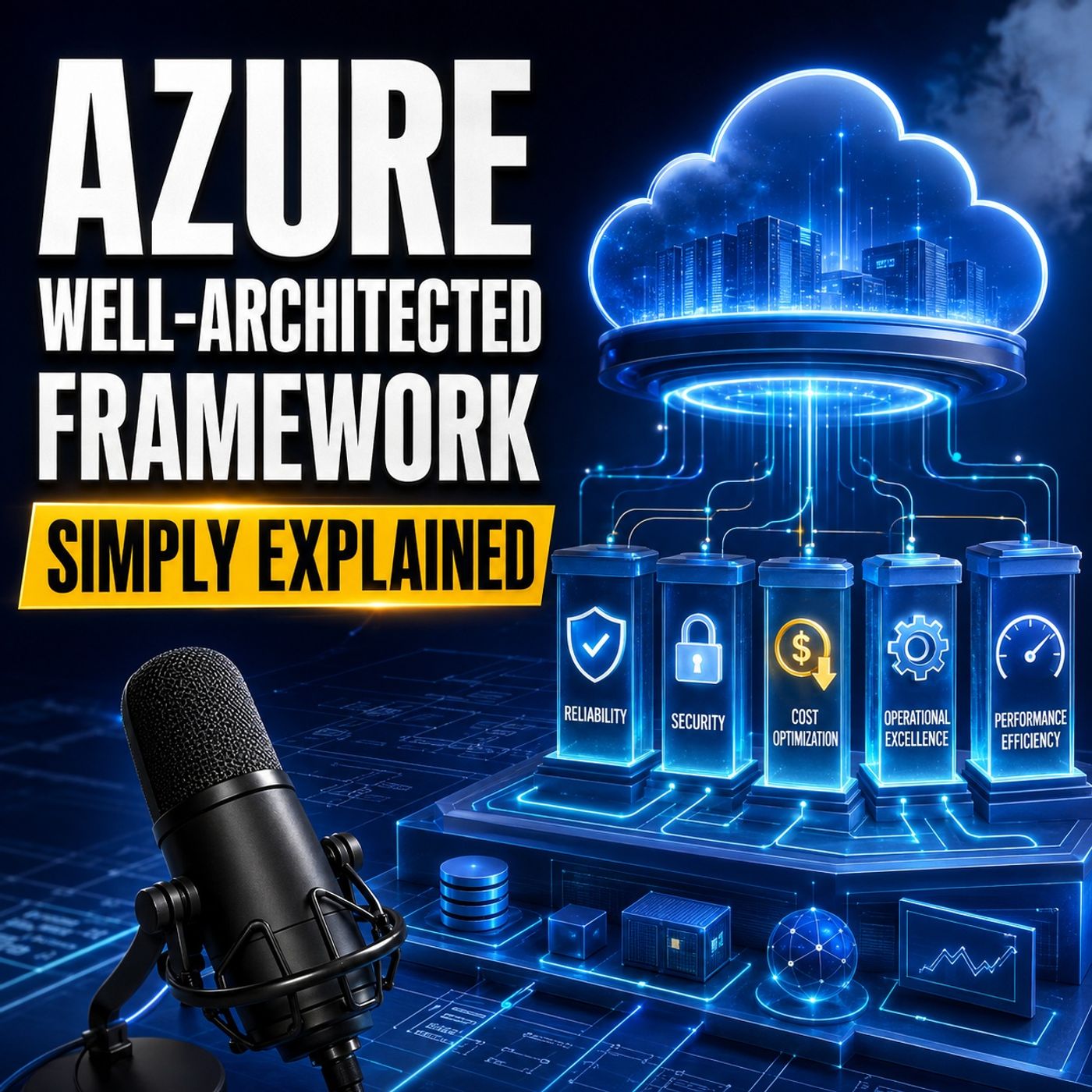 Azure Well-Architected Framework - Simply Explained63 / 100
 The Copilot Assumption That's Holding You Back - Agentic RAG
 From Demo to Production- Building Enterprise AI Agents That Actually Work with Microsoft Copilot Studio with Elliot Margot [MVP]
 Microsoft Cloud Adoption Framework - Simply Explained
 Azure Image Builder - Simply Explained