
M365.FM · 2026-08-12 · 19 min
Key moments - from our scoring
Substance score
43 / 100
Five dimensions, 20 points each
The Azure Well-Architected Framework is a design methodology that helps teams make deliberate architectural choices around individual workloads rather than treating Azure as a binary pass-fail system. Hosted on M365.FM, this episode distinguishes WAF from the Cloud Adoption Framework (CAF), explaining that CAF handles company-wide Azure foundations like landing zones and governance, while WAF focuses on single business workloads - anything from a customer portal to an order system. The five pillars guide decision-making: Reliability ensures workloads meet uptime promises through availability zones, backups, health monitoring, and graceful fallback patterns; Security implements zero-trust principles via Microsoft Entra ID, least-privilege access, managed identities, data classification, and threat modeling; Cost Optimization removes waste through resource tagging, ownership visibility, right-sizing, storage lifecycle rules, and purpose-driven spending rather than discount-chasing; Operational Excellence makes daily work repeatable via infrastructure-as-code, deployment pipelines, observability (logs, metrics, traces), runbooks, and incident learning loops; and Performance Efficiency meets real demand through load testing, autoscaling, caching, and identifying actual bottlenecks. The framework emphasizes trade-offs - faster capacity may cost more, stronger security may add latency, rapid releases require safer controls - and recommends starting with one workload, running the Azure Well-Architected Review (a roughly 60-question assessment), and turning findings into a prioritized backlog with documented owners and reasoning.
The Cloud Adoption Framework (CAF) prepares a company-wide Azure foundation with shared governance, security, networking, subscriptions, and landing zones, while the Well-Architected Framework (WAF) focuses on designing individual workloads to reliably deliver business results - think of CAF as preparing the airport and WAF as helping one plane fly safely.
First define the workload's acceptable downtime (how long unavailability impacts the business), recovery point objective (how much recent data loss is tolerable), and the critical user journeys that matter most, then design reliability features like availability zones, backups, health monitoring, and circuit breakers to protect those specific needs rather than adding redundancy everywhere.
Zero-trust means checking identity and permissions for every request, not just trusting requests that come from inside your network; implement it through Microsoft Entra ID with multi-factor authentication, least-privilege role assignments, managed identities for applications, data classification, encryption, network segmentation, and threat modeling before building.
Teams remove data copies, shorten backups, or disable security controls to cut the bill without first checking whether those changes violate the workload's agreed recovery and security targets, which simply moves risk elsewhere; the goal should be 'remove waste while keeping agreed service and security levels' rather than 'make it cheaper.'
The review is a roughly 60-question assessment across five pillars that exposes architectural decisions and trade-offs; treat it as a discussion to make decisions visible and build a prioritized backlog, not as a compliance exam, and start with one workload with clear business impact rather than auditing entire subscriptions at once.
Our reviewer’s read on each dimension, with quotes from the episode.
The episode delivers a structured walkthrough of the five WAF pillars with practical examples (circuit breakers, graceful fallback, threat modeling, runbooks, load testing), but relies heavily on architectural frameworks and metaphors rather than novel insights. Most concepts are well-established best practices (multi-factor auth, least privilege, infrastructure-as-code, observability) that operators familiar with cloud architecture would recognize. The framework itself is explanatory rather than revelatory, and there's minimal challenge to conventional thinking or surprising data points that would shift how someone designs systems.
Circuit breakers stop an app from repeatedly calling a dependency that is already failing, which can prevent one problem from spreading through the rest of the workload.
Don't trust a request just because it came from inside your network. Check the identity. Check what that identity is trying to do.
This is a faithful, well-articulated explanation of Microsoft's published Azure Well-Architected Framework - not original thinking, but a competent translation of existing doctrine into metaphorical language (the office building, the airport). The host uses known frameworks (Zero Trust, least privilege, threat modeling) and standard cloud architecture patterns without reframing them or offering contrarian insight. The value is in clarity of explanation, not in pushing thinking forward or challenging orthodoxy. No counterintuitive claims or first-principles reasoning appear.
The Azure Well-Architected Framework helps you ask those questions before they become expensive problems.
The five pillars are not separate rooms with locked doors. They share the same building budget and the same floor plan.
This is a solo host explaining Microsoft documentation. There is no guest, no practitioner with real-world experience shipping at scale, and no external operator perspective. The host reads/delivers content without the presence of someone who has actually built and operated complex workloads and encountered the tensions described. This format fundamentally limits credibility and accountability for the advice being given.
(No guest present in transcript)
The episode uses concrete examples (online retailer with shipping service failure, customer portal background process issue, load testing that discovers queue bottleneck after 20 minutes) and names specific Azure capabilities (availability zones, circuit breakers, managed identities, storage lifecycle rules, Advisor). However, there are very few hard numbers, named real companies, or specific metrics (e.g., no actual RTO/RPO targets, no specific cost scenarios, no real data on how much redundancy typically costs). The examples are illustrative but generic, lacking the specificity of a case study with actual dollar figures, timelines, or quantified business outcomes.
Picture a busy sales day for an online retailer. The order system needs a shipping service to show delivery choices. That shipping service starts failing under heavy demand.
Imagine a team testing an order system with a steady stream of requests. At first everything looks fine. Then after 20 minutes, a queue begins to grow a little faster than it empties.
The host delivers a clear, well-structured monologue with good pacing and pedagogical flow - metaphors are used consistently and questions are posed to guide thinking (e.g., "How long can this workload be unavailable?"). However, this is a solo presentation without dialogue, pushback, or genuine discovery. There are no follow-up questions that probe disagreement, no moments where assumptions are tested, and no exploration of tensions between competing principles. The host articulates the framework competently but doesn't engage it critically or challenge its applicability in specific contexts.
Have you ever opened an Azure Bill and found a cost you didn't expect?
The trouble comes from the decisions around it. How many copies do you need? Who can access the data?
Computed from the transcript - who did the talking, and the words that came up most.
Building a successful Azure workload involves much more than selecting the right cloud services. Reliability problems, security gaps, unexpected costs, weak operational processes, and poor performance often come from the architectural decisions surrounding those services.In this episode of M365 FM, we explain the Azure Well-Architected Framework in clear, practical language. You will learn how its five pillars help teams design, operate, and continuously improve Azure workloads while balancing business requirements, technical risk, performance, and cost. ㅤ WHAT THE AZURE WELL-ARCHITECTED FRAMEWORK SOLVES The Azure Well-Architected Framework, commonly called WAF, is not a product that you activate or a certification badge that you earn. It is a structured decision-making framework for designing and operating Azure workloads that can remain secure, reliable, efficient, manageable, and financially sustainable over time.A workload includes everything required to produce a particular business outcome.
Transcribed and scored by The B2B Podcast Index.
Have you ever opened an Azure Bill and found a cost you didn't expect? Or found out a public app had more access than it should? Maybe an app stopped working late at night and nobody knew where to start. Those problems don't always mean you picked the wrong Azure service.
Often the service works exactly as designed. The trouble comes from the decisions around it. How many copies do you need? Who can access the data?
What happens when a part fails? Who checks the bill? Can the app cope when lots of users arrive at once? The Azure Well-Architected Framework helps you ask those questions before they become expensive problems?
It isn't an Azure product you turn on. It isn't a compliance badge you earn. It's a decision framework for designing and running a workload that can hold up over time. Think of a workload as one business area inside a modern office building.
Maybe the customer order desk or the payroll department. It needs rooms, people, locks, power records and a plan for when something breaks. Over the next few minutes, we'll look at the five pillars, the choices they force you to make and one simple way to review a workload. First, we need to separate the buildings shared foundation from the workload working inside it.
Waff versus Caff, the runway and the plane. When people first meet the Azure Well-Architected Framework, they often mix it up with the Cloud Adoption Framework, also called Caff. They work together, but they answer different questions. Start with the word workload.
A workload isn't just an app or a virtual machine. It's everything needed to produce a business result. For a customer portal that might include the website code, customer data, user identities, Azure services, monitoring, the team that supports it, and the daily work that keeps it running. The portal might look like one thing to a customer.
Behind the scenes, it has many moving parts. The Cloud Adoption Framework looks at the company-wide foundation. It helps a company prepare a Azure for many workloads with shared rules for governance, security, networking, subscriptions and landing zones. A landing zone is simply a prepared place in Azure where workloads can live.
Think of it as the shared building foundation, the front gate, the electrical system, the building rules and the shared security desk. The Well-Architected Framework focuses on one workload at a time. It asks whether this customer portal, this order system or this reporting app can do its job well. It doesn't inspect your whole Azure subscription as one giant pass or fail test.
A simple way to remember the difference is an airport. SAF prepares the airport. It puts the runway, tower, security rules and shared services in place. WAF helps one plane fly safely.
The plane still depends on the airport, but the flight team needs to think about its own route, fuel, passengers, safety checks, and what happens if the weather changes. Before you use WAF, write down what the workload must do. Who uses it, does it hold sensitive data? What does downtime cost the business?
How much data could you afford to lose? What budget can support it? And what demand do you expect next month or next year? Those answers shape the design.
Once the workload has a clear purpose, the five pillars become five practical questions. Reliability. Can your workload keep its promise? Reliability starts with a simple promise.
Can people use the workload when they need it? Users won't remember that your Azure design looked tidy on a diagram. They remember the moment an order wouldn't go through, a file wouldn't open, or a payment set spinning on the screen. A reliable workload stays available when it can, recovers when something fails and protects data while that recovery happens.
Think about the office building again. Reliable buildings have backup power when the main supply fails. They have fire exits when the usual route is blocked. They may have more than one elevator, so one broken elevator doesn't stop everyone from reaching their floor.
They also have a plan that people have practiced. Your workload needs the same kind of thinking. Every failure can be prevented because networks fail, services become slow, software has bugs and people make mistakes. Reliability means preparing for those moments instead of hoping they won't happen.
Start with the business promise, not the Azure service. How long can this workload be unavailable before the business feels real pain? That is your acceptable downtime. How much recent data can you lose if something breaks?
Maybe losing five minutes of orders is manageable? Maybe losing even one payment record isn't? Then look at the user journeys that matter most. For an online shop, browsing products is useful, but placing an order and taking payment may matter more.
Your reliability work should protect those moments first. From there you choose the building blocks. Availability zones can place parts of a workload in separate physical locations within an Azure region. If one location has a problem, the others can keep running.
Backups protect copies of data, but a backup only helps if you can restore it when you need it. Health monitoring watches the workload and tells you when a service becomes unhealthy. Retrieves let an app try a short-lived failed request again. Circuit breakers stop an app from repeatedly calling a dependency that is already failing, which can prevent one problem from spreading through the rest of the workload.
Picture a busy sales day for an online retailer. The order system needs a shipping service to show delivery choices. That shipping service starts failing under heavy demand. Without a plan, every checkout request waits for it, times out, and the whole order process slows down.
With a circuit breaker and a fallback choice, the site can temporarily show a standard delivery option instead. Customers can still pay. Order still enter the system. The team can fix the shipping link without turning one failure into a full outage.
That is graceful fallback. The workload gives up a less important feature so it can protect the main business action, but people often make two mistakes here. First they create a backup and assume the job is done. Then, during an incident, they discover nobody has tested the restore process, the backup is incomplete, or it takes longer than the business can accept.
Second, they add extra copies of everything because redundancy sounds safe. Without agreeing on a recovery target first. More copies, more availability zones, and more regions can improve recovery. They also raise the Azure Bill and give the team more systems to monitor, test, and maintain.
So the question isn't how much reliability can we buy. It is what level of reliability does this workload need and what are we willing to support? Keeping a service available is only part of the promise. You also need to decide who should be allowed through each door and into each room.
Security, who gets through the reception desk? A workload can stay online all day and still fail the business. That happens when the wrong person can read customer records, change a payment setting, download private files, or take control of an admin account. Security means protecting identities, data, and systems from misuse and attack.
Think of enter ID as the reception desk for your digital building. Before someone enters, it checks who they are. Then even after they enter, that person should only reach the rooms needed for their job. A customer might view their own order.
A support worker might update delivery details and administrator might manage the service. Those are different jobs so they need different permissions. Giving everyone a master key is easier at first, but it creates a large problem later. This is the thinking behind zero trust.
Don't trust a request just because it came from inside your network. Check the identity. Check what that identity is trying to do. Give the smallest amount of access needed and expect that one account or one device could eventually be compromised.
For a beginner, start with identity. Use strong sign-in protection through Microsoft Enter ID, including multi-factor authentication where it fits. Give people only the roles they need. That is called least privilege.
Your applications need identities too. Instead of placing a password or long-lived access key inside code, use managed identities where you can. Azure can then give an app a controlled identity so the app can reach the resource it needs without a secret sitting in a file. Data needs protection as well.
First know what data the workload holds. Public product details need different treatment from payroll records, health data or customer payment information. That is data classification, naming the sensitivity of data so you can apply the right controls. Encrypt sensitive data when it moves and when it is stored.
Separate network areas so a public website cannot freely reach a private database. If an attacker gets through one door, that separation can limit how far they move. That security doesn't begin after the app is built. Before building, ask what could go wrong.
Could a user reach another user's record? Could a stolen account change a critical setting? Could an outside service send harmful data into the workload? This is threat modeling and it turns vague worries into things the team can design against.
While building, protect the code, the deployment process and the settings that go into Azure. After release, watch for unusual activity, keep alerts useful and know who responds when something looks wrong. A locked building still needs someone watching the alarm panel. Many teams treat security like a firewall they add near the end.
A firewall can help, but it can't fix a workload where every developer has broad admin rights or where static keys are copied into scripts, chat messages and source code. Security works best when it is part of every choice from sign-in to data storage to daily operations. There can be a trade-off. Extra checks may add another sign-in step.
Encryption and inspection can add a small delay. Those are reasonable costs when the alternative is exposing data the business cannot afford to lose. Not balance comes from the risk around the workload, not from making every action as fast as possible, and a secure workload can still waste money quietly. A service may run overnight with no users.
Old storage may keep growing. Large resources may sit mostly idle, while nobody knows which team owns the bill. The next pillar asks a direct question. Does every Azure pound or dollar have a clear job?
Cost optimization? Spend on purpose. Cloud costs rarely jump for one dramatic reason. They grow because the test system stays on after everyone goes home, a service gets sized for a rush that never comes.
Old files remain in expensive storage, and nobody checks whether the workload still needs what it is paying for. Cost optimization means getting the business results you need without paying for waste. It doesn't mean choosing the cheapest setting every time. Think about renting space in an office building.
You need enough desks for the people working there, enough power for the equipment, storage for records, and perhaps extra space during a busy season. But you wouldn't keep paying for three empty floors all year because you might need them for one afternoon. As your works in a similar way, you pay for compute, storage, network traffic, backups, logs, and other services. Each item should have a clear reason for being there.
Start by making ownership visible. Taxes are labels you attach to Azure resources. Attack can tell you which workload uses a resource, which environment it belongs to, and who owns it. When a cost appears, the team should not need to guess who can explain it.
Give each workload an owner, set a budget, then set alerts before the budget is reached. An alert doesn't stop spending by itself, but it gives the team time to investigate. A regular cost review turns that alert into a habit instead of a surprise at the end of the month. Then look at how the workload actually behaves.
A service may need a smaller size. It may need to scale down when demand drops. A resource that nobody uses can be removed. Old files can move to a lower cost storage tier through storage lifecycle rules, or be deleted when the business no longer needs them.
Backups need the same thought. Keep backups for as long as the business and any rules require, but don't keep every backup forever just because a default setting allowed it. The retention period should match the recovery promise the workload has made. Once you understand normal usage, you can look at rates.
Some workloads run at a steady level every day. For those reservations, savings plans or fixed price choices may lower the cost, but don't buy a long commitment before you understand what the workload really uses. A discount on the wrong service is still wasted money. And this is where teams can cause damage while trying to save money.
They remove a copy of important data. They shorten backups without checking recovery needs. They turn off security controls. The bill may look better this month, but the risk has simply moved somewhere else.
A cheap design that cannot recover when needed is expensive when it fails, so phrase the goal carefully. Don't say, make this workload cheaper. Say remove waste while keeping the agreed service recovery and security levels. That puts cost in its proper place.
You are not trying to spend as little as possible. You are trying to spend on purpose. Once spending has an owner, another question appears. Can the team run this workload every ordinary Tuesday, without depending on one person who happens to remember where every switch is?
An excellent team can run it on Tuesday. Launched it gets attention. People prepare the demo, watch the first users arrive, and breathe a sigh of relief when the app works. But the harder part comes after that, when patches need to be applied, changes need to be released, alerts fire at night and people move to new jobs.
Operational excellence means making daily work repeatable, making changes safe, seeing problems clearly and learning from them when they happen. Think of a well run office building. It has an operating manual, an alarm panel, a maintenance schedule and staff who know their roles. It doesn't depend on one person keeping every detail in their head.
A workload needs that same discipline. Infrastructure as code is one building block. Instead of creating resources by clicking through the Azure portal and hoping someone remembers the settings, you describe the setup and files. The team can review those files, store them with the application code and create the same environment again, when needed.
Deployment pipelines are another part. A pipeline can test code and settings before they reach production. It can apply the same release steps each time. If a release goes wrong, the team has a clearer path to stop or reverse it.
You also need to see what users experience it. This is called observability. It sounds technical but the idea is simple. Collect enough signals to answer is the workload healthy and if it isn't, where is the problem?
Logs record events. Matrix show numbers over time such as errors or response times. Traces follow one request as it moves through different parts of the workload. Health signals tell you whether an important service can still do its job.
Together, those signals feed alerts and dashboards so the team can see trouble before a customer reports it. Picture a small team with a customer portal. One experienced engineer knows a manual fix for a problem with a background process. They open the Azure portal, change a setting, restart a service and it works.
Nobody writes the steps down because it feels simple. Months later, the issue returns late at night. That engineer is unavailable. The person on call sees a vague alert, searches through old messages and worries about changing the wrong setting.
The problem lasts longer because the knowledge only lived in one person's memory. A runbook would have changed that. A runbook is a plain set of instructions for a known situation. It explains what to check, what actions are safe, who needs to know and when to escalate.
Add automation where it makes sense and the team no longer has to repeat the same manual fix under pressure. The common mistake is treating the Azure portal as the normal way to run everything. The portal is useful for looking, learning and investigating. But when routine changes depend on clicks, memory and a particular person, environments drift apart and mistakes become harder to spot.
Good operations create a loop. After an incident, don't start by looking for someone to blame. Check what happened, what the signals showed, what slowed the response and what the team can change. Write down the decision and its trade-offs.
Add the improvement to the backlog. Then test it so the same failure does not return as an unwelcome surprise. When daily work becomes predictable, the workload becomes easier to change and safer to support. That leads to the final question.
When demand rises, does the workload stay responsive at the moment users need it most? Performance efficiency? Fast enough when it counts. An app can stay online and still frustrate every person using it.
A page takes too long to load. A payment request waits in a queue. A customer clicks twice because nothing seems to happen and then both requests fail. Performance efficiency means using the right Azure resources and design choices to meet real demand when it arrives.
Picture a busy office at 9 in the morning. You need enough elevators to move people upstairs, enough open desks for people to work and enough staff at reception to keep the line moving. But you wouldn't keep every floor fully staffed through the night just because Monday morning gets busy. But with what users expect, how quickly must the main page respond?
How many orders, messages or requests need processing each minute? When do busy periods happen? Which transaction matters most when demand rises? And if the workload grows next year, what part is likely to slow down first?
Those questions give you something useful to test. Load testing creates realistic demand before customers do. Autoscale can add capacity when demand rises and reduce it later. Caching keeps frequently requested information close at hand, so the workload doesn't keep asking the same database question.
Choose can hold work safely when one part of the system needs time to catch up. The right service tier gives you enough capacity for the job. Monitoring helps you find the actual bottleneck rather than guessing. Performance and cost often meet in the same decision.
Autoscale may give users a faster experience during a rush, while also avoiding the cost of running at full capacity all day. But that only works when you know what demand looks like and what signal should trigger scaling. Guessing is where many teams go wrong. They buy the largest option for every part of the workload, hoping that more power will solve every problem.
Or they test during a quiet afternoon, see that everything works and assume the design is ready. Imagine a team testing an order system with a steady stream of requests. At first everything looks fine. Then after 20 minutes, a queue begins to grow a little faster than it empties.
The website still responds, but a background process cannot keep up. Given a few more hours, orders would begin waiting far too long. The test found the real bottleneck before customers did. That is the point.
Performance isn't about buying the biggest machine. It is about measuring the work, finding the slow part and meeting the promise when it counts. Every change here touches more than one pillar. Faster capacity may cost more.
A cache may change how data stays current. More scaling may add work for the team. So the real skill is making those choices visible. The five pillars are not separate rooms with locked doors.
They share the same building budget and the same floor plan. Tradeoffs and the practical WAF review. No workload gets a perfect score in every pillar. A good design does something more useful.
It records the choices the team made, why they made them and what they accepted in return. Take cost as an example. Reduce costs sound simple, but it can lead to bad decisions. A better goal is, reduce cost while keeping our agreed recovery and security targets.
That sentence keeps the business promise in view. Multi-region copies can improve recovery after a large outage, but they cost more to run and maintain. Stronger sign-in checks can add a small delay, but they lower the chance of the wrong person entering. Rapid releases can help a business move quickly, but they need safer testing and release controls, so speed does not create avoidable failures.
These aren't mistakes, they are design choices. The well-architected framework gives you two useful tools for discussing them. Design principles guide your thinking. They help you ask the right sort of question before choosing a service or pattern.
Checklists turn that thinking into actions. They help the team look for gaps such as an untested recovery process, unclear cost ownership or missing signals for a busy application. Keep the first review small. Don't begin with every Azure subscription, every team, and every resource your company has ever created.
Pick one workload with a clear business purpose, perhaps a customer portal, an ordering system, or an internal app, people depend on each day. Then use the Azure Well-Architected review. It asks roughly 60 questions across the five pillars and produces recommendations based on your answers. Treat it as a discussion to a not an exam.
You are not trying to earn a pass mark. You are trying to expose risks, make decisions, and find work. The team can actually do. Turn the recommendations into a prioritized backlog.
Some actions may need attention soon because they protect important data or recovery needs. Others can wait until the next plan change. Assign an owner, record the reason, and keep the work visible. Azure Advisor can give you another source of improvement ideas from your Azure environment.
Its signals can help point out places to investigate, but the workload team still decides what fits its needs. Run the review again after a major release, a large design change, or on a regular cycle. Compare milestones over time so you can see whether the workload is improving instead of relying on memory. Finish with one workload, one review, and a written list of decisions the team can act on.
One workload, one better set of decisions. The Azure Well-Architected framework turns scattered azure choices into balanced decisions for one workload. Reliability keeps its promises when parts fail. Security controls who can enter and what they can reach.
Cost optimization removes waste without cutting agreed protection. Operational excellence makes daily work repeatable. Performance efficiency helps the workload meet demand when users need it. Start with the workload that has the clearest impact on your business.
Write down what it needs. Its uptime target recovery needs the data it holds, the budget it can support, and the demand it must handle. Keep the answers simple, but write them down. The team can improve a written promise.
It can't improve assumptions that live in separate people's heads. Then run the Azure Well-Architected review, choose the first ten actions that fit the workload, give every action an owner. Record the trade-offs, especially when a decision saves money, adds protection, or changes recovery expectations. It gives your team a list they can work through, not another document that gets forgotten.
Subscribe to m365.fm for the next knowledge nugget, where we'll keep connecting the Azure foundations and cloud services that make up your Microsoft platform.
Other episodes covering the same guests and topics, from across The B2B Podcast Index.
 The Invisible Network Powering AWS with Matt RehderScreaming in the Cloud · on cloud94 / 100
 CMMC Level 2: Documentation, Costs, and Audit Readiness | Interview with Bruno LecoqSecure & Simple · on Microsoft Entra ID89 / 100
 REBOOT: The Trust Advantage: How OpenText is Securing Canada’s Information LayerDisruptors · on Data classification82 / 100
 DOP 362: Feature Flags vs Canary DeploymentsDevOps Paradox · on Circuit breakers80 / 100
 Using Airflow for diverse client projects at Accion LabsThe Data Flowcast · on Automation79 / 100
 Navigating AI Risks with Trevor Horwitz from TrustNetB2B Automation Spotlight · on Automation79 / 100
 The Copilot Assumption That's Holding You Back - Agentic RAG
 From Demo to Production- Building Enterprise AI Agents That Actually Work with Microsoft Copilot Studio with Elliot Margot [MVP]
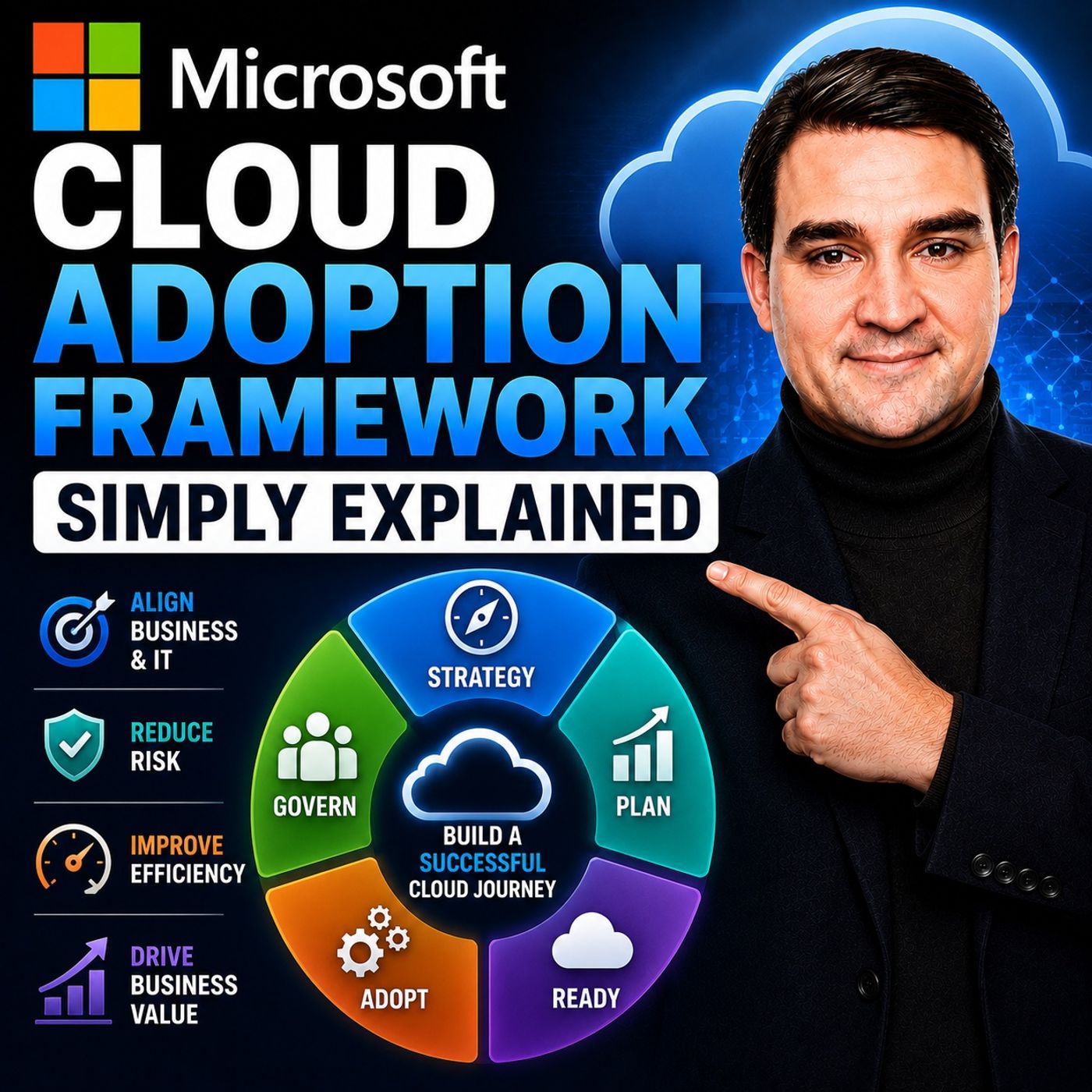 Microsoft Cloud Adoption Framework - Simply Explained
 Azure Image Builder - Simply Explained
 Your Copilot Has No Memory - Why RAG Fails and LLM Wiki Fixes It