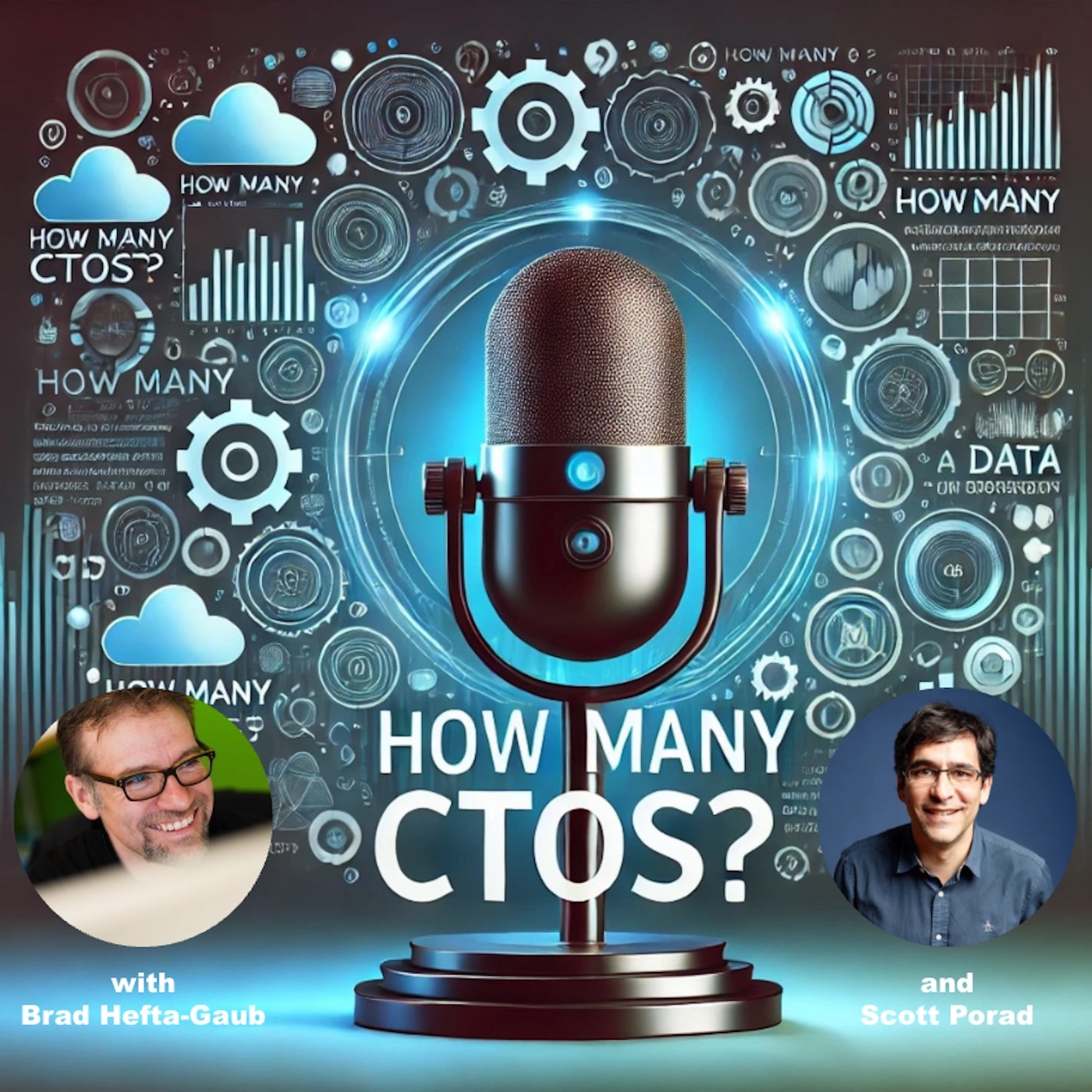
Hosted by Brad Hefta-Gaub & Scott Porad
Listed under Technology, Business › Entrepreneurship
Welcome to the "How Many CTOs?" Podcast, hosted by Brad and Scott, where we dive deep into the intricate world of Chief Technology Officers. Each episode features candid conversations with guest CTOs who share their real-world experiences and insights on a wide range of topics.
83 episodes · publishes weekly · latest 2026-08-18 · ~43 min/episode
Rank
#507
Substance
72.5
/ 100
Breakdown
Scored 2026-08
Updated monthly
Across the index
#507 of 1878
Substance
Top 27%
outscores 73% of the index
How Many CTOs ranks #507 on The B2B Podcast Index with a substance score of 72.5 out of 100, scored across 2 recent episodes. It scores highest on insight density and guest caliber. The episode contains some substantive ideas - particularly around systems thinking applied to engineering bottlenecks, the 1/3 success rate heuristic, and the tension between innovation and technical debt payoff - but these are interspersed with significant personal anecdotes (Hawaii, mountains, soccer rules, Costco membership) that dilute insight density. The core ideas about what non-engineering teams must do to enable faster delivery (shovel-ready plans, clear requirements, feedback loops, long-term thinking) are valuable but not deeply developed or novel.
Averaged across 2 recently scored episodes, with cited evidence.
The episode contains some substantive ideas - particularly around systems thinking applied to engineering bottlenecks, the 1/3 success rate heuristic, and the tension between innovation and technical debt payoff - but these are interspersed with significant personal anecdotes (Hawaii, mountains, soccer rules, Costco membership) that dilute insight density. The core ideas about what non-engineering teams must do to enable faster delivery (shovel-ready plans, clear requirements, feedback loops, long-term thinking) are valuable but not deeply developed or novel.
“If you want the system, actually first start by thinking about, how am I operating within this system and what can I change to start to get the dynamics of this system to work differently”
“if we didn't have that $10 on engineering, if the company said, well, we have a hundred dollars this year and next year we think we can get 10 more dollars by continuing business as usual and we're going to do some R D”
The systems thinking framework applied to organizational constraints is sensible but not particularly original - it's a familiar lens in management literature. The observation about product requirements being a bottleneck for engineering speed is widely known. However, the specific reframing (asking what other teams should change rather than what engineering should change) and the discussion of R&D budgets versus innovation-on-demand show some fresh perspective, though the execution is exploratory rather than conclusive.
“if other people in the system wanted the engineering part of the system to produce stuff faster, but they couldn't ask engineering to change, they could only change themselves. Yeah, what would it be? What would change?”
“Engineering is largely An R D exercise. Research and development exercise”
Scott Porad is a CTO at TaskRabbit with clear operational experience managing engineering teams, infrastructure, and real product decisions (fraud prevention, category management systems, platform modernization). His perspective is grounded in actual hands-on work managing engineering and product tradeoffs. However, this is a co-hosted show between two hosts rather than a traditional guest interview, and the episode lacks external expert voice or deeper outside perspective on the systems thinking framework being discussed.
“We made a change to how we pre authorize credit cards up front to um, uh, minimize fraud”
“TaskRabbit's been around 15 or so years and we're doing a big investment right now to, um, modernize the platform, refactor, a lot of parts of it”
The episode relies heavily on general principles and personal experience without concrete data, metrics, or detailed examples. The TaskRabbit fraud case is mentioned but without specifics about impact magnitude, timeline, or numbers. The 1/3 success rate is cited as a rough heuristic without evidence. The 3M Post-it story and Novo Nordisk GLP-1 example are real but used illustratively rather than analytically. The Spanish mail requirement and Costco's hot dog price are concrete but tangential.
“roughly speaking, a third of things succeed, a third of things actually make stuff worse. And the third in the middle just kind of don't have any impact at all”
“we made a change to how we pre authorize credit cards up front to um, uh, minimize fraud. And instead of just doing like an ordinary credit card pre auth we were actually billing for an hour of time”
The conversation is meandering and co-hosted rather than interview-based, which limits traditional host questioning. Brad asks some reasonable follow-ups ("what were your snarky answers," "tell me") but the discussion frequently veers into tangential territory (soccer fouls, mountain climbing, Costco membership) without strong redirection. There are moments of good intellectual engagement when probing the systems thinking framework, but the hosts don't push back hard on half-formed ideas or demand precision. The flow is friendly and exploratory rather than forensically critical.
“Do you have answers to this or do you. You just, like."”
“Tell me." (responding to mention of implicit tension)”
2 periods tracked.
2 scored on substance · 67 tracked in total.
Add this badge to your site - it links back here and updates automatically as you rank.

<a href="https://index.fame.so/show/how-many-ctos" target="_blank" rel="noopener">
  <img src="https://index.fame.so/badge/how-many-ctos/badge.svg" alt="Ranked #36 on The B2B Podcast Index" width="360" height="136" />
</a>Track How Many CTOs's rank
Get an email whenever this show moves up or down the Index. Monthly at most, no spam.
Companies, products and tools that come up most across this show's episodes.
The themes that come up most across this show's episodes.

Ship It Weekly
Teller's Tech - DevOps, SRE and Cloud Podcast

Unsupervised Learning with Jacob Effron
by Redpoint Ventures

Podcast Archives
Podcast Archives - Software Engineering Daily

DevOps Daily with Fexingo
Fexingo

The Pragmatic Engineer
Gergely Orosz
The Engineering Leadership Podcast
The Engineering Leadership Community (ELC)
Podcasts that dig into the same topics.