How I Grew This: Real Stories of Digital Growth · 2026-05-14 · 35 min
Key moments - from our scoring
Substance score
53 / 100
Five dimensions, 20 points each
David Leviev, Chief Revenue Officer and co-founder of Nimbus, discusses how his mobile ad monetization platform delivers 3x revenue growth by prioritizing user experience alongside monetization. The core insight: most app publishers face friction with generic mediation solutions and legacy ad networks (Google, Facebook, Max), forcing them into rigid waterfalling strategies that both degrade UX and leave revenue on the table. Nimbus began as an internal necessity for TimeHop - a nostalgia app with 90-second average sessions where standard 30-second interstitials destroyed retention. By building a full-stack mediation solution with custom creative rendering, auction mechanics across multiple ad formats, and direct DSP relationships, TimeHop unlocked premium CPMs and improved app store ratings simultaneously. Leviev reveals specific optimizations: 1.3-second ad visibility windows that maximized retention without sacrificing performance metrics, and hybrid server-side/client-side architecture enabling full-screen video native to the app's Stories-like UX. For operators running ad-dependent apps, publishers using legacy SSPs, and growth leaders balancing monetization with retention - Nimbus provides a playbook with dedicated support teams and ML-driven auction intelligence to predict buyer behavior amid signal loss (IDFA deprecation, cookieless futures).
TimeHop saw astronomical revenue growth and night-and-day improvement after deploying Nimbus, particularly in the open marketplace where they achieved premium CPMs across both brand and performance campaigns - results they couldn't touch with previous solutions.
Through retention testing, Nimbus found that 1.3 seconds hit the best benchmarks for click-through rates and retention without causing uninstalls, though the optimal duration varies by app and use case.
Nimbus supports multiple implementation types including server-side RTB to tier-one SSPs, in-app ad networks, DSPs, and offers rare direct-to-DSP relationships, giving publishers control over demand sources rather than being locked into a single mediation stack.
Each publisher receives a dedicated team of five (account manager, customer success rep, solutions engineer, technical account manager, demand facilitator) plus a dedicated Slack channel, contrasting with typical ad networks' generic helpdesk approach.
Nimbus uses ML and agentic AI to analyze massive auction data, predict buyer behavior, understand how inventory is valued over time, and optimize package-based auctions as IDFA and third-party signals disappear.
Our reviewer’s read on each dimension, with quotes from the episode.
There are genuine practitioner insights on auction mechanics, publisher-side AI as a counter to DSP bid-shading, and the retention-vs-monetization tradeoff. However, roughly a third of the episode is origin-story throat-clearing and the '3x revenue growth' promised in the title is never actually explained or evidenced in the transcript.
We realized that 1.3 seconds hit some of the best benchmarks
we are doing the opposite. We are essentially introducing the same concept and flipping it on its head and delivering only the auctions in which have a high return probability of best price
The framing of a publisher building its own ad stack and then spinning it out is a mildly fresh narrative, and the 'flip DSP AI on its head for supply-side' angle is interesting, but most of the episode covers well-trodden ad tech territory - waterfall vs. auction, signal loss, UID 2.0 - without a genuinely contrarian or first-principles argument.
We purposely omitted our potential to buy. It absolutely hindered our ability to scale and prioritize revenue. But that's okay because I think long term it is one of the main catalysts of why Nimbus was able to really stand on its own two feet
the product kind of spoke for itself. We were able to transform monetization part of it, which was never really done at the time
David Leviev is a genuine practitioner who built real ad tech out of necessity at a live consumer app and then commercialised it - not a career thought-leader. His domain expertise is evident throughout, though his company remains relatively niche and he occasionally retreats to vague forward-looking language rather than hard operational detail.
Timehop, this independent app was able to build a fully established ad tech product
We piecemealed together what we anticipated, the success of what a monetization stack for Timehop can be
A handful of concrete numbers appear - 1.3-second visibility benchmark, 90-second average session duration, 30-second fixed interstitial rates, named third-party IDs - but the episode lacks hard revenue figures, publisher scale data, or the '3x revenue growth' substantiation its title promises, leaving many claims at the level of assertion.
I remember Timehop having about an average session duration of about 90 seconds. And so whenever we introduced interstitial ads. We held the user for a minimum of what at that time, 30 second fixed rates
We realized that 1.3 seconds hit some of the best benchmarks
The hosts occasionally land sharp, specific follow-ups - particularly the Reddit/scale question and the DSP integration query - but they also telegraph answers, call questions 'leading witness' questions out loud, and never press on the unsubstantiated headline claim of 3x revenue growth, leaving several important threads unchallenged.
this is kind of a leading witness question
if I'm Joe's app and I don't have the volume or the understanding of the brand, if I say audio enthusiasts to the advertiser, how big do I have to be or how do I actually let them know that, like there's some actual performance data behind this?
Computed from the transcript - who did the talking, and the words that came up most.
What if you could transform your app's revenue without sacrificing user experience? In this episode of How I Grew This, hosts Amanda and Adam sit down with David Leviev, Chief Revenue Officer and Co-Founder of Nimbus, to explore how publishers can build custom monetization solutions, why user experience directly impacts long-term revenue, and the key strategies to leverage AI and first-party data in a post-IDFA world. Whether you're a mobile app publisher looking to optimize ad performance or an ad tech enthusiast curious about the future of auction mechanics, this conversation is packed with actionable insights on balancing monetization with retention. Tune in to discover how the right decisioning layer can unlock premium CPMs and sustainable growth.
Transcribed and scored by The B2B Podcast Index.
We understand that we're sitting on a massive amount of auction data. We should be able to better differentiate between how buyers behave, how they value inventory, how performance changes over time, and especially with more and more signal loss like IDF8 gone away, you're seeing auctions coming into packages and understanding how those packages can be optimized for predictive decisioning is where AI I feel, in the auction layer becomes really powerful. Welcome to How I Grew this, where we dive into the world of digital marketing and connect with leaders in the space about how they're scaling, evolving and growing.
Hello everybody, and welcome to How I Grew this. Really excited to have David Leviev on today. Hey David, how you doing? Doing well.
Thank you for having me. Thanks for being here. And Adam, sounds like you two know each other. Tell us a little bit about how you got connected and a little more about David.
Well, David and I have recently just met for the first time, but I've known of him and his company Nimbus for. I mean, when did you guys start? 2016? 15.
16. Technically, we got started in 2017. We didn't officially become GA available until 2019. But yeah, 2017 was when the magic started.
But I remember there are a lot of rumors. I mean, this is for 2019. There are a lot of rumors of invite only betas and it was quite in the know if, you know, you get started with Nimbus until before ga. Is that right?
That was right. Yeah. We had a handful of publishers, actually. I mean, to start, they were eager, they needed a solution similar to what we were building.
And it was out of desperation for them, quite large names too, which was really exciting to see that we built something so successful, ultimately suggesting that the moment it becomes available, they wanted first dibs. So we made it happen for him. Yeah, that's one of the things about ad serving and we're getting ahead of ourselves. You and I will go deep on ad serving because that's part of both of our backgrounds.
But Amanda, I think you wanted to talk about David's prior app. I know. So, yeah, now you're Chief Revenue Officer and co founder of Nimbus, the mobile ad platform. But I noticed in your past experience that you worked on the Time Hop app and I'm super curious to hear about that.
Such a fun and unique app. I actually received one from a friend this morning with the logo and everything. So I wanted to know if you had any, any stories from that experience to kick us off. Yeah, I mean, it was such an amazing journey.
Time Hop is really what established where we are with Nimbus today. First of all, I love the fact that your friends are still sharing Time Hop memories and nostalgia. That's like especially the banner on top that has the Time Hop nostalgia logo on it too. The very iconic ones.
But yeah, I mean, with Time Hop, it came to me with our cto currently now working at Nimbus. He brought me on to the Time Hop team because we actually worked warped back in a company called Pub Gears, even before the Time Hop days. So it's very interesting how things bring us together because had there be no Pub Gears, there would be no Time Hop. With how we'd monetized it, how there'd be no Time Hop, there would be no notice.
And so for those of the audience who don't know what Time Hop is, which is probably just me, to be honest. I've heard of it, but I've never used it. I never use apps, but I do a lot of ad tech, so I'll probably know more about the ad tech than the app. Time Op was a very popular, is very.
Is it still around? Still around. And honestly, Adam, I don't blame you. I think from what I remember, the demographic was millennial moms.
And so, hey, that was our predominant audience. But yeah, it was a nostalgia app. It was essentially like a throwback Thursday every day and you open the app and it walks you through memory lane, through various channels, whether through social networking, your text and such. So it's that day every past year.
And it's a great way to kind of remember what you were doing that past year, share photos with friends if they were a part of it and kind of reminisce together. And that's how it services my life day to day usually. And also to your question, Adam, it's still kicking, still doing really well right now. The sincere team operate and monetize that app.
Yeah, I think it's continuing to grow and it still has a very loyal fan base, Evident aluminum and is getting them still today. So that was an app, that was a published app and now Nimbus we'll get to is ad tech. I had a question. Why would anyone go from pub to ad tech?
But you came from ad tech in the past. I did. And this is kind of where everything ties in with my cto. So when we started we were working at this small startup ssp.
Like I mentioned, Pub Gears, we were running on web focused products similar to an ssp. And when we ultimately had that company acquired, we moved to our separate ways. Mark landed at Timehop to monetize the app. And then when I was brought in, the kind of merger between ad tech and app didn't really manifest until maybe the first year or so.
And I would say the company Nimbus never really was a company that was built first. It was a product that was required, it was a necessity in order for Timehop to continue to thrive, to monetize in the way that the user experience was really necessating for it to. And with that said, the product kind of spoke for itself. We were able to transform monetization part of it, which was never really done at the time, especially in that 2017 era where header bidding wasn't really a concept outside of wed, hence the header.
And now we just call it auction monetization, right? But that was a very far stretch. We were still doing waterfalling. Mobile was still the catalyst of mediation back way back when.
And so when we weren't really able to fit in this one box, one size fits all solution, backs against the wall. We really needed to find an alternative. And because that alternative didn't exist, we had to really kind of get a little scrappy. And like I mentioned, it really worked out for us.
We piecemealed together what we anticipated, the success of what a monetization stack for Timehop can be. The previous experience with me and Mark, my cto, really allowed us to kind of hit the ground running. So it was a perfect match. So do you consider Nimbus an ad server or a monetization stack or an ssp?
I would consider it first and foremost a full stack mediation solution. Though it did take us quite a bit to get there. I mean as a small team, especially being an app focused solution first we really needed to understand the landscape, understand how to make a product viable for not just the Timehop app, but also the swans different verticals that are made available. And with that we had a very long linear and successful progression to becoming that full stack solution.
And when I say full stack, I mean introducing from top down, direct solds, programmatic guarantees, PMPs, bread and butter, which is the open marketplace for auction mechanics. And then down to the house ads, the fallbacks, the cross promotions and such. So this is kind of a leading witness question, but I want to have you walk our viewers through it. You're at an app, you're having struggles finding the right monetization solution, so you build your own.
Why don't all apps do that? Why doesn't that exist already? So funny you say that, because when word got out that Time Hop, this independent app was able to build a fully established ad tech product. We were asked myself personally to kind of speak around it.
So we joined some conferences. We introduced the product on fireside chats and solo presentations with really the goal of showcasing that publishers just like us can build their own solution, but that is very bespoke to their app and their own unique experiences. The interesting point is that after almost every solo presentation, we had lines of people waiting asking for us for more insight. And I'm like, this is great.
The messaging was really resonating, but time and time again the feedback was our roadmap is done for the entire year. At this point, we are not an ad tech company. There is no way I can convince my team to allocate resources to build something. So bespoke the moment that you decide to make this available to others, you let let me know.
And after being on the 10th or the 15th publisher that kind of said that, I ended up walking over to my CEO and saying, I think that there's a real market need. It's not just a Time Hop solution or issue that has held us back in monetization. It was really the infrastructure that was needed for where the industry was transitioning into. And it goes into creative delivery and rendering.
It goes through auction mechanics, it goes through transparency, it goes through direct relationships. There was just so many mechanical pieces that was removed or even reduced from the closed sector. And so we brought that to the market and saying it doesn't need to be that way. And that's where it really resonated, I think, the most.
So I just want you to talk us through that a little bit more in terms of what the challenges were that these other publishers were facing with monetization models that weren't unique to their own app, for example, and then other challenges that publishers are still facing today that are pretty common. Yeah, for sure. I mean, like I mentioned, there's a handful. I'll speak to the most prevalent one, which was essentially the creative rendering.
So with the UX of Timehop, if you're familiar with it, and if you're not, it's a similar UX to like a Snapchat Stories or an Instagram Stories, where you're going through your friend's day and then you either tap or swipe, and then in between stories, you have this very beautiful full rich media creative that you're able to either engage with or continue around your day. So I remember Timehop having about an average session duration of about 90 seconds. And so whenever we introduced interstitial ads.
We held the user for a minimum of what at that time, 30 second fixed rates. And so to allocate such a massive portion of a user's experience to an ad was just a nonsense. And so we needed to find a way to introduce a similar concept. We weren't really into like the banners, mainly because it removed the user experience from their nostalgic environment and we wanted to interflow very natively.
And so we ultimately I went to all the demand partners that I had relationships with and I was kind of like first hesitant walking through and saying, have you heard of Timehop? Are you interested in the supply and all of them universally? Yes, absolutely. And so because of the scarcity of the time hop supply for so long, it was just built up in such a way that every demand partner essentially gave me the green light to say, hey, we'll work with you in a very custom way if it means we can monetize the time hop inventory.
And so after, you know, a handful of those types of conversations with some very premium DSPs, SSPs, ad networks, it became a real opportunity for us to do something different. So I remember looking at this from the outside, coming from the ad tech side, looking at the publisher who wanted to build their own ad server monetization, it looked crazy. Like, why would you take on that burden and commitment and technology hurdle? Because now that you're years in, you can say it's really tough.
There's like auction mechanics and I mean a lot of compute required. Is this a viable option for an app that doesn't then spin that out as a standalone product? Like if you were Timehop and you kept your monetization stack in house, is it realistic that that investment would be worth its opportunity? Or do you have to spin it out because of the technology involved?
I think it's very prescriptive. I think it's a very unique use case in which a publisher will find that type of success or need that type of customization in order for them to reach that type of success. I mean, for Timehop, the revenue was astronomical. It was night and day.
And like I mentioned, it was early on you were struggling, right? We were not generating the revenue or the performance that was sustainable. And you're admonization only, right? No, iap, that's right.
It is purely monetization. For Admon, on programmatic fronts, we had some direct sold, but after we've deployed Nimbus, we've seen the growth on the open marketplace transform revenue, that it was purely open marketplace and Like I mentioned before, IDFA took a step back. We saw some significant premium CPMs. And this goes across brand and performance, something that we've never been able to even touch before, having a solution like that.
And what is that? Is that because the ad networks out there are taking that margin and you're winning that margin back through the open market. So it's a combination of things. In terms of the Timehop app, because of the real estate that we've owned, which is the full screen, unique experience because of the direct relationships with all of our SSPs.
And at first we went straight server side, so no additional weight on the app itself. And then with the ability to render our creatives in the way that we felt most native and most just streamlined to our user base, it delivered higher retention in terms of user experience, higher ratings on the app store. And so it made just sense to have this hybrid solution which allowed us to do full screen video at the duration in which we as the publisher felt comfortable delivering and introduced a combination of auction mechanics that had multi ad sizes competing against themselves, including video, including abstract ad formats, including the banners.
Right. The 300 by 250s and so forth. So that coupled with the fact that again, Timehop users, I want to stress, were very coveted. The CPMs were always a little bit more premium just because also the brand of the timehop app was very nostalgic.
It was very close to what brands were looking to be next to and to be rendered across from. So a combination of those really drove the success. But like I mentioned, there's so many apps even today that have such similar friction points in their monetization strategy that even leveraging the mediations that are out there not named Nimbus becomes a very hard sell, mainly because it becomes more of a black box and it becomes more rigid in monetization efforts and strategy. You're really stuck with the old legacy implementation types.
You've talked a little bit about the importance of user experience or how this has enhanced the user experience, which I think is so critical when balancing monetization. But I'm curious, what is going to perform well? What level of testing is involved? How do you get it right so that you understand which placements don't disrupt the user experience?
Yeah. So we took the reverse approach to that. Right. We ultimately, and because we became the tech layer, we are the full design mediator for all forms of rendering.
And so no matter what the creative did respond back to, we were able to deliver that creative in a way in which was conducive into that native flow. And so whether it was video or whether it was a static creative type, the X button, the dismiss button, the timers was all uniformed. It all really allowed for a very seamless flow that allowed the user to still see the ad. I mean, to your point, Mana, it wasn't just, hey, we just figured this out and we've never tested anything before.
We've done a ton of tests that spoke to, for example, how long the ad should be visible before the user can dismiss. Because of course users are going to be like, there's an ad, I want to get out. Or they're just conditioned to see an ad and immediately zone out or whatever. Close, close, close, close.
So there is for sure benchmarks that we wanted to hit, specific click through rates, specific viewability scores that we wanted to make sure we were always having our advertisers feel confident that their ads are being seen and delivered and performing. And so with those metrics, we were always fine tuning and tweaking. And even today, we allow for that to happen on Animbus mediation as well for all publishers to use. So it's not just like, here's a 15 second ad, you chose it, you asked for it, now you have to render it as I say.
And instead it's, we want to make sure that we're protecting your user base retention, your lifetime value. Your arpdao is our biggest metric to continue to optimize for. And so once you see that ad, how does that work? How does that feel into your environment for Timehop?
It's so funny. We did this retention test too. We realized that 1.3 seconds hit some of the best benchmarks.
I was hoping we would get to share some of the, like, magic numbers for how long it had to be. Yeah, yeah. And we were like, all right, let's see how far we can go. And then we kept inching it further and pushing the boundaries more and more.
And then we did start seeing the retention start declining. And there were no other metrics. So if we weren't actively prescriptively looking out for this, we would just chalk it up to like, oh, we're just losing users this week. But because there was no negative commentary in the App Store, we were not seeing users complain that ads are becoming a little bit more aggressive, but we just saw some organic drop off.
And then the moment that we started making those tweaks again, all of a sudden that retention and that uninstall started to stall a little bit further. And so we wanted to make sure that the publisher, at the very least had all the controls that we saw the success in on the Tap Hop app. That really resonates with me because back in the SSP days, an ad network could control how long the ad shows up. Like they would decide where the X button goes and sometimes they would literally take the X button and the pixels where it showed the X button were different than where the actual X was.
So it tricked you to click through. But what you guys do is you give the publisher the control to actually overlay an X on that. So here's a question. Large majority of the ads today, I'm guessing, come from the standard ad networks.
Google, Facebook, Max. Right? Those are the three big ones for in app ad monetization. How do you integrate with the three big ones?
Or can you integrate with the three big ones? Yeah, yeah, it's a great question. And on the Nimbus mediation, we have a few different implementation types. The implementations go from traditional rtb and so we're able to go server side to the standard SSPs, the ones that you're probably very familiar with, the tier one partners.
And then you have the in app ad networks and you also have subsequently the dsps. So Nimbus is also one of the few solutions that offer a direct to DSP relationship. And again, it's all in the name of our client. Our customer is the publisher.
And for us, for me personally, I always wanted to be able to go as direct to the source as possible. So we've opened up that layer as well. I would like to know how you recommend how your clients keep track of these things. How do they measure their retention against revenue and everything?
Do you have sort of a playbook for them to make sure that they can track these goals or how does that work as they partner with you? So each publisher that we onboard has a very unique onboarding conversation and many conversations. We have a very specific playbook in which we operate each individual app. Each app has its own curated opportunities.
And to your point, it's not just like, here's the Nimbus SDK, let's monetize. It's more so understanding the app itself, the user behaviors, the goals of that specific publisher. What is most important as a balancing act. Sometimes it is just revenue.
And with that, you know, we're able to be a little bit more flexible. And other instances we really explore where the real estate within that specific app allows you to be a little savvy. So our team and every publisher that we onboard has a dedicated team of five and that includes an account manager, customer success representative, a solutions engineer, a technical account manager, a demand facilitation representative, and we act essentially as the passenger side. We are here introducing recommendations, market trends, opportunities.
In terms of introductions, we evaluate the app itself and we also kind of review to making sure that all ads within their ecosystem is as performant as possible. So whenever they do see an ad opportunity, our ultimate goal is to make sure that those ads render and behave as expected and as designed. That's crazy. I mean the other mediators are like there's a helprl.
com and that's your contact the company. You have five points of contact to walk them through best practices. That's right. And also a dedicated slack channel which ultimately streamlines all conversations into a single source funnel.
So I mean to your point, it's one of the biggest pain points I've personally experienced. I've always heard publishers, no matter the size, some of the bigger ad networks, giving them, to your point, the generic email to reach out and then you have five or six different people from all time zones and all places over the world trying to kind of remedy whatever issue you have. And of course it never gets anywhere. And so you'll hear from our publishers.
I mean outside of the massive sophistication of the tech, I think my hat goes off to my team in terms of the support that they've been able to produce because yeah, it's hard to be able to balance all of the publishers needs but then also be able to be forward and client facing in the way that we have. I want to ask about the market. So right now Nimbus is serving a wide variety of mobile apps. We, Amanda and I spend a lot of time talking to the advertisers and learning about what's changing on the advertising side with increasing AI helping with creative control and ML automating the ad process from the supply side, from the actual monetization side.
How is the market changing? How do you see it changing and what are your takes on where it'll be going and changing the next 12 to 24 months? I mean that's a great question. I personally put a pulse out.
It's making sure that Nimbus is obviously a pioneer in a lot of what is manifesting in the markets today. Both macroeconomics as well as just ad tech and industry trends. Obviously economics and world adjustments keep you on your toes with especially advertising in general. But AI is obviously a focal point, right.
And I think that initially we took a step back to make sure that we understood what the industry, the ecosystem, is getting ourselves into, because when we first saw AI unfolding, we just saw a lot of large language models just communicating, just having very nascent conversations. I was gonna say meaningless. Meaningless conversations. I did wanna say that as well, and I appreciate you saying that for me, but yeah, creating funny images with celebrities was as far as it went.
But in the last six to 12 months, I've really understood where the dust has settled. And on our end, we are applying a lot of ML, a lot of agentic AI, and as well as traditional AI into both the auction mechanics as well as institutionalizing it into our infrastructure in general. And the way that I'm speaking towards that in terms of the auction mechanics is essentially we want to not just understand how monetization and tech work in this ecosystem, but instead we understand that we're sitting on a massive amount of auction data.
We should be able to better differentiate between how buyers behave, how they value inventory, how performance changes over time, and especially with more and more signal loss like IDF8 gone away, you're seeing auctions coming into packages and understanding how those packages can be optimized for predictive decisioning is where AI I feel. And the auction layer becomes really powerful. And we've seen it internally happening this way as well. One of the biggest problems about ad serving and auction mechanics is just the cost of processing all the QPs.
So are you saying that then you'll predictively offer a specific auction to an ad network to reduce their costs? Like you're basically selecting and saying, hey, white glove, here's the stuff we think you'll like. What do you mean by package? Yeah, I mean, that's a great question too.
So in the game of auctions in general, there's a concept called auction theory. And to your point, Adam, the auction theory can be twofolds. It's offense and it's defense. On the defensive side, you want to preserve auction costs.
AWS cloud bills can be one of the leading costs in any kind of business, period. And so preserving that costs for any leakage or inefficiencies is a paramount first approach. We want to make sure that the demand partners are not necessarily trying to game the auction. And when you have practices like bid shading, that's exactly what they're designed to do.
And look, the DSP is literally built on one fundamental aspect of return on ad investments. So they are built from the ground up to reduce the amount of spend necessary for their clients, which is the advertisers. So on our end, we want to reverse that. We want to make sure that we're only calling on the demand partners when it's most advantageous to the publisher supply.
And when we do that, we preserve the DSP budget to only transact on one of the higher echelon opportunities of the auction itself. And then with that set, you're seeing all of the demand partners bid at the highest level, request opportunity level, rather than listening for auction mechanics by bid shading and suggesting that maybe they're going to bid on an inventory purposely to understand and learn the models so that they can game it for auctions on end. Reading this back to you because I think I just hit on what you're saying, which is really profound.
So it's not about optimizing the auction, it's about optimizing the cost or optimizing the actual bid price. So we read the news about how Facebook and Google are using ML to their advantage to do better and better buying. You're now saying this ML is going to help the publishers get better revenue from the buyer. Exactly in the same exact way the DSPs are leveraging AI and also their agentic just MLS generally to reduce spend and still see performance increase.
We are doing the opposite. Opposite. We are essentially introducing the same concept and flipping it on its head and delivering only the auctions in which have a high return probability of best price. Between the historical metrics, the market trends and also the demand behavior overall.
A true ssp. Well, I wouldn't necessarily call me an SSP calling if it's an ssp, but definitely mechanics to help the auction because that is what we are. We're a decisioning layer where technology, we don't necessarily bring demand to the table. And this is also by design.
I think one of the differentiating factors of Animbus is that we purposely omitted our potential to buy. It absolutely hindered our ability to scale and prioritize revenue. But that's okay because I think long term it is one of the main catalysts of why Nimbus was able to really stand on its own two feet against some of the behemoths in this marketplace. The agnostic layer, the transparency, the decisioning factor, and then also all of our products are built on the behalf of the publisher's success.
And so I think that goes a long way. Some things come up a couple of times and as you talk about decisioning layers and decisions, you've talked about signal loss a lot. And I know that's important to a lot of our customers and listeners. From your vantage Point, what are some of the best practices to overcome some of that signal loss today?
Yeah, understanding your user base, I think is the utmost important as a publisher. So being able to really learn and have maybe even some form of authentication to those users, having an ability to tag those users internally in a very compliant, obvious way so that they would be able to ultimately understand lifetime value of a specific individual user. And from there, understanding trends. With those trends, they can understand how to price that specific user, understanding the creative types that are being returned for that specific user from various auctions in the past.
So a good example is if you have John Smith over at Ohio, that's in your app that comes on every morning and then you start understanding some of the behaviors of John Smith in the app in itself, understanding when the auctions run, what are some of the domains that consistently bid on John Smith. And you see, for example, you know, they get a lot of BMW ads, they get a lot of Mercedes ads, and all of a sudden you're putting a couple of clues together that suggests, well, maybe John Smith is an auto enthusiast, or maybe he's in the market to buy a new car.
I love the word enthusiast in this world. I love how often it's used. Everybody's an enthusiast. Yes.
Yeah. And so with that, you're able to now have a little bit more information than you previously had. And I think with signal loss, your original question, it's really important to start learning and understanding and having some more control of your own packages like we discussed. Right.
And so now it's not just John Smith who's an auto enthusiast of your millions and millions of users. You may have 10, 15% of your user base in the same type of category. And now you're able to introduce new first party signal downstream to the auction to suggest whenever this ID is present, maybe call it 1234, but 1234 equals auto enthusiast. Your downstream partners who you've worked with, who are anticipating some of these signals to come in house, are now listening for some of those signals themselves, understanding how ultimately to curate some of their own demand to specifically understand some of these package deals.
And so there's a lot to unpack. But at the very least, in terms of publisher control, I think knowledge is power. Having more and more insight to your user base, to your audience is the first step. And then of course there's third party solutions as well.
I mean, you can leverage things like the Trades UID solution or LiveRamp's Ramp ID or Yahoo's Connect ID. There's plenty to choose from, but ultimately it does a similar solution, but you offload it to a third party to help you at scale. And so I would recommend publishers to absolutely look into that, especially if authenticated users are a big component of their overall audience, because that ultimately introduces a new ID for the ones that they've lost. I love this very practical advice question here.
So if you use a third party identifier like the trade desks, then the advertisers will know that user across other sites, so they won't need to have a package set up, correct? That's right. I mean there's obviously some nuance. So the user, for example, needed to consent.
They also had to allow for the app itself to track. And then the third component is that they have to be authenticated. And so if the app itself allows for a sign in component, whether it's through your Gmail or whether it's through a phone number, you at least have some form of authentication to allow for the activation downstream for someone like the trades. And once there is a connection and once the trades has been activated and once the encrypted IDs coming through from UID are passed downstream to the advertisers, then they are decrypted and then they are ready to be monetized specifically through that kind of flow.
Now if you're not using a third party identifier and you are doing your own packages and you're identifying the audio enthusiasts and you want to package those up, one of the questions there is scale. The best example there is the subreddits, Right. So Reddit has subreddits and people can advertise on certain subreddits. But if I'm Joe's app and I don't have the volume or the understanding of the brand, if I say audio enthusiasts to the advertiser, how big do I have to be or how do I actually let them know that, like there's some actual performance data behind this?
Yeah, if that is the case, I would say work with DSSPs if they answer your emails. Yes, if they answer your emails, because yeah, I mean, you're not wrong. The smaller publishers won't have as much leverage to be able to essentially have such an intimate relationship with those DSPs downstream to be able to activate specifically to their bespoke IDs. And so the SSPs in the last two years have done a really great job of introducing curation.
So this is exactly what they do. They essentially package your inventory to specific KPIs. The KPIs doesn't necessarily need to be, for example automotive enthusiasts, but instead it could be whenever you see this id, you're going to get a click through rate of X percent. If you see this id, you know you're going to get a viewable score of X percent.
And so those curated packages, those smaller MOM and pop apps essentially get bundled in with the rest of the SSP packages and so they get the luxury of participating within those curations. Fascinating. That's really cool. But I will say for the smaller MOM and POP ones that still want to have some form of control and they don't want to have to alleviate essentially to a third party like the Trade s or alleviate to a third party like the ssp, still having information around your user base, your audience, your performance is paramount just so that you can at least make optimizations on flooring.
Understanding how historically a specific user has been monetized in the past would introduce more competitive CPM floors to allow for incrementality. And so having at least that specific lever at your disposal goes a really long way. Right. In other words, don't let a really valuable user see a really inexpensive ad.
That's correct. Exactly right. Awesome. That's good advice.
Any final advice for our listeners out there or recommendations on how they can stay in touch? Yeah, you can check Nimbus out at Nimbus Co, you can check out our LinkedIn, you can reach out to me depending on how relevant that may be. But we're very accessible and I think Nimbus has gone a long way and we can absolutely help betterment of our publishers because of course they are our number one client. And so I'm excited for what the years to come is.
Our roadmap is actually incredibly impressive, especially coming in from the last 18 months or so to where we are today. A very refreshing sight to see. I think there's a lot of exciting products coming on board. Ah, so good to feel proud and excited about where you are, especially when you're in co founder seats.
That's great. Well, I enjoyed hearing a lot about this world, so thank you all for the deep conversation And David, thank you so much for joining us. It was a pleasure to have you on. Thank you so much for having me.
Yeah, and I'm glad we got to connect and thank you for the time. Yeah, of course. Until next time everyone, we'll see you on how I grew this. Thanks all.
Thank you so much for listening. If you like the show, please leave a review wherever you listen to this and share with someone trying to grow their career or their business. Until next time, keep growing.
Other episodes covering the same guests and topics, from across The B2B Podcast Index.
 UK CIO of the Year, Ian Penny: Why Great Tech Strategies Start with Customer ProblemsBuilt Not Born: The Startup Go-To-Market Podcast · on Sustainable growth74 / 100
 'Busy Isn't Bold': The Banking Branding ProblemMoney Isn't Everything · on Nimbus65 / 100
 What Business Leadership for Women Really Looks Like in PracticeThe People Side of Business · on Sustainable growth61 / 100
 Revolutionizing Talent Acquisition with Seamless Workflows and User ExperienceBeyond the Screen · on user experience53 / 100
 Coffee Chat Take 12: Why Doesn't This Feel Easier Yet?The Mind Your Time Podcast · on Sustainable growth41 / 100
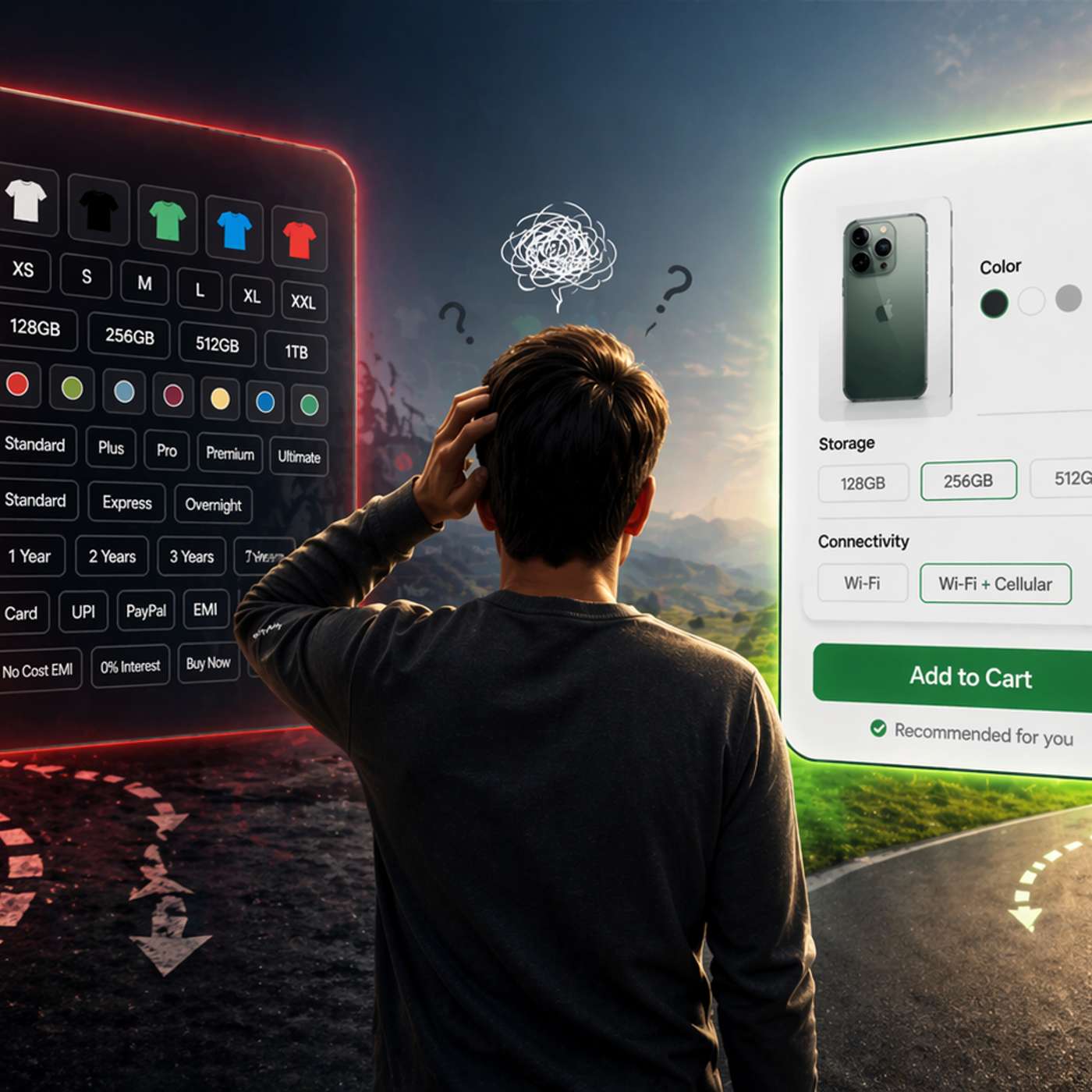 Too Many Choices, No Decisions: The Hidden UX ProblemProduct Management Tech Brief By HackerNoon · on user experience
 The API of the Physical World: Sy Bohy on the Future of Connected Hardware81 / 100
 Shifting the Search Paradigm: How Branch Discovery Powers On-Device Intent for Half a Billion Users with Harish Thimmappa85 / 100
 The Viral Growth Blueprint: How Nic Weber Turned Creators Into a Scalable Acquisition Engine71 / 100
 Why Your MarTech Stack Is Broken - And How to Fix It Without Starting Over with Rebecca Nackson52 / 100
 Reclaim Your Brand Voice and Rise Above the AI Slop with Chris Silvestri82 / 100