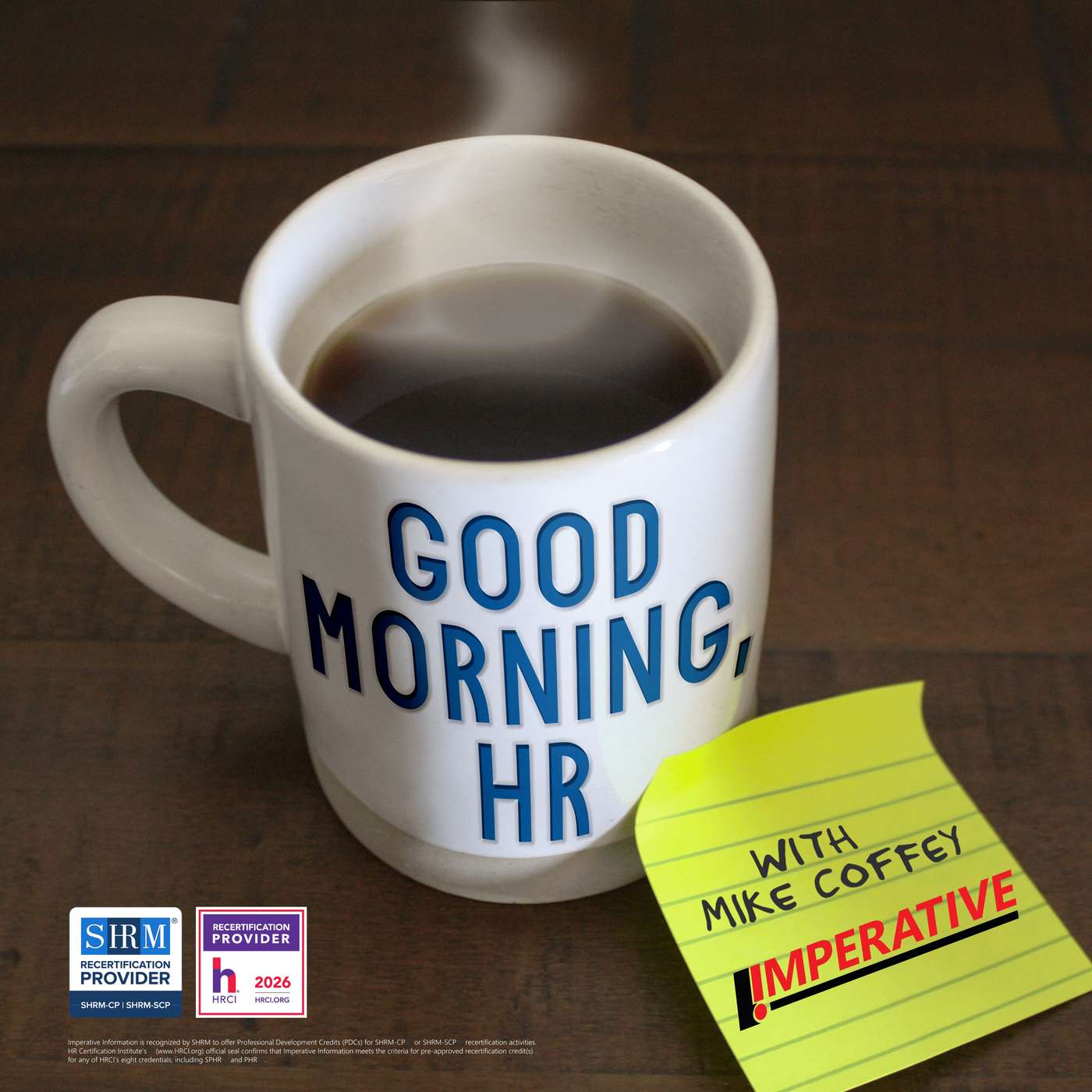
Hosted by Mike Coffey, SPHR, SHRM-SCP
★5.0on Apple Podcasts · 15 recent reviews
HR entrepreneur Mike Coffey, SPHR, SHRM-SCP engages business thought leaders about the strategic, psychological, legal, and practical implications of bringing people together to create value for shareholders, customers, and the community.
261 episodes · publishes weekly · latest 2026-07-02 · ~43 min/episode
Rank
#2546
Substance
64.0
/ 100
Breakdown
Scored 2026-07
Updated monthly
Across the index
#2546 of 6181
Substance
Top 41%
outscores 59% of the index
Good Morning, HR ranks #2546 on The B2B Podcast Index with a substance score of 64.0 out of 100, scored across 1 recent episode. It scores highest on guest caliber and insight density. Meg Delp holds genuine credentials as an organizational psychologist, a retired clinician, and the director of a major national mental health initiative with proprietary annual survey data, making her a credible practitioner - though her role is advocacy and research rather than scaling implementation inside a large employer, which limits the operational depth she can offer.
Averaged across 1 recently scored episode, with cited evidence.
The episode surfaces a genuinely interesting tension from the NAMI poll - employees see HR as responsible for mental health conversations yet actively avoid talking to HR - but the bulk of the advice (train managers, use EAP, model behavior from leadership, create psychological safety) is standard HR boilerplate padded with anecdote and throat-clearing.
“people do not feel comfortable going to HR or going to Leadership Executive C suite. And that is a problem because we also found people along with people managers see HR as the ones responsible for driving the mental health conversation at the workplace”
“burnout rates among trained managers were way lower. They felt way more connected to the company mission”
The HR-trust paradox is counterintuitive and worth noting, and the finding that direct managers rank close to trusted colleagues in employee comfort is surprising, but nearly every other takeaway - psychological safety, compassionate conversations, leadership modeling - recycles frameworks that have circulated widely for years with no new angle or first-principles argument.
“Close behind them, though, are their people managers, which honestly I was shocked by”
“there is this gap between I'm going to talk to you about mental health and I'm expecting you to teach me about mental health”
Meg Delp holds genuine credentials as an organizational psychologist, a retired clinician, and the director of a major national mental health initiative with proprietary annual survey data, making her a credible practitioner - though her role is advocacy and research rather than scaling implementation inside a large employer, which limits the operational depth she can offer.
“Meg is an organizational psychologist and retired marriage and family therapist. She is also the director of Workplace Mental health at the national alliance on Mental Illness nami, where she leads the Stigma Free Workplace initiative”
“NAMI released their third annual NAMI Ipsos workplace Mental Health poll earlier this year”
The episode does anchor several claims in the NAMI-Ipsos poll (75% find it appropriate to discuss mental health at work, higher burnout among caregivers and sandwich generation), but most statistics are reported qualitatively ('way lower,' 'way more stressed') rather than with actual percentages, and there are no company case studies, cost figures, or benchmarked metrics to make the evidence actionable.
“we found that three in four employees, they feel it's appropriate to talk about mental health in the workplace”
“the Sandwich generation, those folks who are taking care of both, uh, aging parents or an elderly relative and their own kids, they had way higher levels of burnout overall stress”
The host asks one genuinely useful practitioner question - how to support employees without becoming their therapist or acquiring legally risky information - and correctly flags the HR-trust gap as a structural problem, but the conversation is undermined by a lengthy Gen X self-deprecation digression, an extended promotional ad break, and no meaningful pushback on any vague claim (e.g., 'way lower' burnout among trained managers goes unchallenged for specifics).
“how would you coach an employer, like a frontline supervisor, let's say, to make that conversation easier to have without risking becoming that person's therapist or, you know, or stepping into a role that you're not qualified to step into”
“And so bringing, uh, that conversation, modeling good mental health from hr, from leadership, it can go a long way in creating more safety”
First period on the Index - history builds from here.
1 scored on substance · 60 tracked in total.
I recently discovered these podcasts. As a Senior HR professional, I find Mike Coffey podcasts to be interesting in content, has great guests, very well organized, professionally presented by both Mike and guests and overall a breath of fresh air as compared to others. I also earn certification credits, easy to access. Mike rocks!
- Mitchll
I love this podcast. Great HR information presented in a fair and balanced way.
- Lemons68
Add this badge to your site - it links back here and updates automatically as you rank.

<a href="https://index.fame.so/show/good-morning-hr" target="_blank" rel="noopener">
  <img src="https://index.fame.so/badge/good-morning-hr/badge.svg" alt="Ranked #131 on The B2B Podcast Index" width="360" height="136" />
</a>Track Good Morning, HR's rank
Get an email whenever this show moves up or down the Index. Monthly at most, no spam.
The themes that come up most across this show's episodes.
Podcasts that dig into the same topics.