
Full-Funnel B2B Marketing Show · 2026-04-27 · 1h 12m
Key moments - from our scoring
Substance score
42 / 100
Five dimensions, 20 points each
Andrei and Vladimir from Full Funnel break down ABM Strategy 3.0, a framework that shifts from vertical-based targeting to cluster-based targeting focused on shared customer challenges rather than industry alone. They introduce eight critical pillars: cluster-based targeting, cross-functional teams (ABM lead, content, SDR), six foundational elements (qualification, segmentation, prioritization, research, awareness, activation), playbook alignment with sales cycles, center of excellence for scaling, proven processes before AI implementation, holistic measurement with leading indicators, and operational ABM pipeline review meetings. The episode focuses on practical implementation through the POS framework (Pilot-Operationalize-Scale), recommending teams start with a small pilot of 10 accounts per SDR over three months without additional budget, using existing marketing calendar activities repurposed as account-based initiatives. Success metrics shift from vanity metrics to account-to-pipeline ratios and discovery call rates. Backbase serves as a case study, showing how they tailored webinars to specific buyer personas (wealth advisors, technical leads) within the same cluster. Essential for marketing leaders, demand gen teams, and sales organizations struggling to scale ABM beyond one-to-one personalization while managing resource constraints.
Cluster-based targeting focuses on accounts with shared challenges rather than just industry vertical, since accounts in the same industry may have different use cases and buying reasons. This allows better messaging alignment and more efficient resource allocation than traditional industry-based segmentation.
An ABM lead to run and maintain the program, a dedicated content person to prepare account-specific materials, and a sales development rep (SDR) focused on sales development activities. Without the ABM lead role in particular, the program is typically not sustainable.
Start small with one account cluster, one geography, one SDR managing up to 10 accounts with 3 buyers per account over 3 months, using existing marketing calendar activities repurposed as account-based. Set realistic leading indicators like discovery call rates and account-to-pipeline ratios rather than expecting pipeline or revenue in early months.
First run and test processes manually with proven results and detailed documentation, then create quality benchmarks showing what good output looks like. Provide AI with context about target clusters, ICPs, and case studies - otherwise you risk scaling broken tactics.
It measures what percentage of target accounts convert to sales qualified opportunities or discovery calls, indicating GTM efficiency. This metric is more valuable than vanity metrics for long sales cycles where teams aim to engage 30-50% of target accounts and convert 10% to real opportunities.
Our reviewer’s read on each dimension, with quotes from the episode.
The episode contains a reasonable density of operational ABM specifics - cluster targeting, the POC framework, AI enablement prerequisites, account-to-pipeline ratio - but is diluted by significant filler: book promotion, asking the live audience to type in chat, and recapping an already-published article. The useful ideas per minute are real but not exceptional.
the problem is not that we cannot get the data. The problem is the distinguishing signal from noise
you can't expect technology to do it for you have never done it before
The shift from vertical/industry targeting to cluster-based targeting is a genuinely useful reframe, and the 'uniquely irrelevant message' critique of AI outreach is sharp. However, most of the content repackages established ABM thinking (pilot before scaling, sales-marketing alignment, leading indicators) under proprietary framework names without introducing truly contrarian or first-principles arguments.
as John Miller put it, with uniquely irrelevant message. Because suddenly we have the signals, and AI can kind of intern for those signals and can personalize the message. But still what we get is, hey, I noticed whatever signal
instead of developing targeting or developing programs for a specific industry or an industry vertical, you want to focus on the set of accounts that have a shared challenge
There are no external guests; this is a co-hosted presentation by the two hosts who run a B2B marketing consultancy. While they reference client implementations (including Backbase), they are consultants presenting their own framework rather than operators who have run ABM at scale inside a notable company. The credibility is practitioner-level but not senior-operator level.
Next week will have an episode with Slomagenhen who was at Awa sum and I really enjoy his presentations about B to B ads
these are the things that have emerged after implementing dozens of account based marketing programs
The episode earns points for citing named research (Hockey Stack's 417+ touchpoints for $100K+ deals, Pavilion's B2B sales benchmarks with specific percentages, Emergency Capital's SDR headcount data), a named client example (Backbase webinar series), concrete pilot parameters (10 accounts, 3 buyers, 3 months), and an illustrative pipeline math example. Sources are named but not always precisely cited, and client case detail is thin.
when rates down by eighteen percent, gm VEALU is down twenty one percent, sales cycles up sixteen percent, nine of reps missed quota
such six percent of five hundred sixty tech B to B sas companies actually decrease the BDR or SDR head count
This is a webinar-style presentation, not a real interview; the two hosts present sequentially and rarely challenge each other, relying on rhetorical questions rather than genuine pushback. The audience Q&A at the end is brief and surface-level, with questions answered at a high level and no probing follow-ups or productive disagreement anywhere in the episode.
The question is what is an average ACV or LTV of clients that makes sense of ABM
No like quick quick two cents? How do you coin sales? Right?
Computed from the transcript - who did the talking, and the words that came up most.
In this episode of Full-Funnel Live, Andrei and Vlad explain what has been changed in ABM. Tune in to learn: How to pivot from the current ABM strategy to the new one? How does the new strategy impact full-funnel ABM playbooks? How to evaluate the efficiency of the new strategy? How to use AI, and what tools to add to the tech stack? RESOURCES On-Demand B2B Marketing Courses: Full-Funnel Insider - A Marketing Newsletter For B2B Marketers:
Transcribed and scored by The B2B Podcast Index.
Speaker 1: This is the Full Funnel B t B Marketing podcast, brought to you by full Funnel dot io.
Speaker 2: Let's start well, Elelan and welcome to the new ACA's a lot of final life today we are finally a hosting it together as flat and first of all, I would love to thank everybody for sharing the questions with us. After the publishing the article about ABM strategist read that zero last Friday on substack. The main question obviously was how to implement it, So today we want to focus on the implementation part. We'll just briefly remind you guys about the kind of the core pillars, what has been changed and while we are paying oh let's say, what are the core pillars where we're paying a lot of attention too, And then we'll share some practical implementation examples. As always, you're very welcome to ask any questions and let us know where you all join us from today. Where again broadcasting from sign and Spain type and the chat your city country. Looking forward to see where you guys are joining us from, and we can kick it up with the presentation of ABM Strategist three that zero. Maybe just let's cover this quickly.
Speaker 1: So this is small and we will be small for people as well. So let's jump into this. I think if you're looking at what has changed, then what as we have done a lot of projects with our clients realizing what's working today and what's not working today and what.
Speaker 3: Are the keys to success?
Speaker 1: Identify these eight key areas and the first area is the cluster based targeting, which is to say that instead of developing targeting or developing programs for a specific industry or an industry vertical, you want to focus on the set of accounts that have a shared challenge. And the main idea is that even if the accounts are from the same industry on the same vertical, they might still have different sets of challenges, that different set of challenges different reasons why they buy from you. So even let's say you're targeting banks, they may have very different reasons for why they might buy a solution like yours, different use cases. So instead of doing that, we want to focus on a set of accounts that have a shared challenge, which is what we call cluster based targeting. Allows you to align your messaging and content with those target accounts. The second critical success factor has to be in every program is having a cross functional team needs to include people from sales and marketing. From marketing, the key roles include the ABM lead who is there to actually run and maintain this program to make sure that these processes are being run. This is one of the key missing roles that we see that teams don't have somebody who's going to be in charge of that program. Without that person, the program is not sustainable. The second most important team from the role from marketing is dedicated content person. They don't have to be one hundred percent time dedicated, but having them and a third critical role as a minimum is to have sales development rep or somebody who is in charge of sales development. Other roles include also subject matter expert, a revops person, and potentially also kind of a technical assistant, somebody to help with the implementation and a design These are kind of supporting roles, but the three critical roles are a BM lead, content and sales development next. A lot of times we speak to teams where they basically believe, okay, you know what we're actually running account based marketing, What is so special about what you want us to do? And actually, when we look at what are the key elements that each account based marketing playbook or program needs to contain. We have identified these six elements, which we explain using our six A framework where we talk about account qualification, account segmentation, prioritization, so being able to qualify that accounts actually belong to the target account cost cluster and that there are a good fit account signed im poritization, prioritizing accounts by the chance of creating an opportunity not just based on the tier. Then account research, really doing proper research understanding what are the what is the information that you need to research about that account and how you're going to use that information to personalize your marketing and messaging towards that account. But also where are you going to store that information that we have kind of a three hundred and sixty degree overview of that account and not have pieces of information in different siloed systems. Another key element that is often missing is how do you create awareness specifically for those accounts and the buying committee members of those accounts that are you're targeting. How do you do account development and by that we don't mean, you know, sending an automated series of emails, mind the messages but actually are you going to introduce multiple meaningful touch points to nurture those accounts, to do to get some information about them from the people who are working there, from the target buyers, but also account activation, how are you actually going to move from an engaged account and create a sales qualified opportunity. Other elements that have to belong that we have identified as key elements for the three dot or a BM strategy are aligning the playbooks with the long sales cycle. So instead of just like I mentioned, maybe marketing doing some air cover and sales reaching out with whatever how long the sequences, and then giving up if the account doesn't respond, actually having a series of always on playbooks where you are able to engage those accounts from week to week and sometimes in you know, daily and weekly activities such as you know, create create a social engagement sharing account based content. We also make a difference between the always on, time based or program based playbooks that are aligned with marketing initiatives such as events, webinars, market research, content collaborations, and the third type is the signal based playbooks. So all of these activities create signals. We are doing the research to uncover third party signals, and we have specific playbooks that are triggered by the signals that are being discovered. The other element of the marketing account by marketing is the center of excellence. So one of the things that is the key to scaling any effort. Right, so you have done the account based marketing pilot. You have implemented it maybe with one with one team in one market it on one cluster. Now before you can scale it will operationionalize. But before you are able to scale this, you need an internal team that is going and the best candidates for that team are people who have run your successful pilot to become the internal coaches and to basically make sure and help all the other teams that now like regions or other business units that need to implement the company's marketing, to help them with that implementation. And there we are always thinking of doing. The operationalization of what works is kind of eighty percent making sure that the processes are being run being run correctly, and twenty percent experimenting with new ways to reach out to those accounts in new ways to create awareness, new channels and new technologies, introducing technologies, et.
Speaker 3: Cetera, et cetera.
Speaker 1: Very important as well, is that if you want to now scale your efforts, A lot of people will be a lot of teams are looking at AI and how to do this with AI and maybe other technology platforms. What we found is the key to success there is first making sure that you have run these processes manually, that you're actually using AI to scale or accelerate the process that has been proven. You can't expect technology to do it for you have never done it before, right, So what you need to have is a proven process, very well documented process, because how else would you be able to prompt your AI without having clarity on what are the steps? Where is the data? Where does the AI need to find the data. Let's say you're doing account research, Well, okay, what are the points of.
Speaker 3: The data that we need to research?
Speaker 1: Where? What are the places where we can find this information? How are we going to use that information? All of that needs to be documented based on a proven process that you have run and tested manually. And then also very important is to have what we call a quality benchmark, which is just an example of what good looks like, an example of successful of a good result. Because without that, again, this is something you can provide to the AI to basically show what is how does a good result look like? Right, So having that as an enablement along with information about your target cluster, case studies, your ICP, and all of the information that the AI needs for the context about your target market. Without that, any AI implementation will just be scaling tactics that are broken.
Speaker 3: To begin with two more to.
Speaker 1: Wrap up the eight pillars. Holistic measurement, especially when you're rolling out ABM, you're rolling it out for high value accounts with long sale cycles you can't expect and the goal obviously is to drive new pipeline and revenue.
Speaker 3: But when you have.
Speaker 1: A sale cycle of let's say eighteen months, you can't expect to generate revenue in the first month, second or even the third month.
Speaker 3: So it's very.
Speaker 1: Important to measure to introduce also leading indicators, and to have holistic reports that includes leading indicators, legging indicators, and also the impact that the integrated activities from marketing and sales have on pipeline. Not measuring, for example, the awareness that we're creating with marketing activities or traffic or any of these kind of siloed metrics, but looking at the actual impact that we have even if it's early on impact that we are having on those target accounts, things like account engagement and conversations that we are starting, discovery calls, and then obviously also pipeline and revenue and other revenue metrics such as win rates, sales cycle length, average average deal size, et cetera. And very very important thing that we discovered the hard way. If you're implementing a BM, to make it work, you need to have this operational rhythm that comes from weekly ABM pipeline review meetings where together marketing and sales team come together review the accounts in the ABM pipeline review the signals decide exactly what each of the team members need to do to take those accounts to the next step in the ab M pipeline, what marketing needs to do, what sales needs to do, and also to uncover early any blocking points that the team might be facing and proactively address them. So these are the things that have emerged after implementing dozens of account based marketing programs where some of the things, as I said, we learned the hard way, but without these elements, it's very difficult to actually even claim that you have an account based marketing program, if you don't cover these key eight pillars, Andre, did I miss something important?
Speaker 3: I know that I was supposed to do it. Shortly, try to do my best.
Speaker 2: Now it was good the funnel. Move to the implementation part. I would love to quickly answer three questions about the let's say the new framework, right, And the first thing I will do I will just share a link to the detailed breakdown of these pillars that we have published on subtects. So guys, if you have missed it, you can check. And let me quickly address the first three questions. So the first one was if I can pick up just a few pillars, what would be the most important? The truth is that you can't really do cherry pigeon here. They are all really important. And this is the answer to the question that Alex asked, what must be true for an organization to trustfully say is running a BM strategies ree that zero right? So this is these eight components. You can use them as a checklist if you want, or as a litmus test right to revaliate if the companies runing the true A, B, M or all right. So these are the most important things. And lastly, just to a quick summary, what has been changed from ABM strategy to that zero right? Maybe the major shift is the targeting for everybody. The let's say, the golden standard was doing the vertical or industry based targeting. Right. You pick up one specific industry, then you select the accounts, then you categorize all accounts in that three tiers.
Speaker 3: Right.
Speaker 2: Tier one you're supposed to do fully personalized on one to one ABM programs. Then tier two you can do one to few, and tier three one too many. Right, And for many companies that was the golden standard. You run the programs for three months or six months, et cetera. But as Flood already has described, the biggest problem was that in every vertical you might have accounts with completely different use cases, right, and that was the biggest challenge for everybody. Then the truth to be set no company. We've been talking to multiple even to enterprise organizations. They're all complaining about the lack of resources, and the I doesn't solve this problem. The teams are scattered, the teams are overwhelmed, and nobody honestly has a lot of time to do a proper one to one ABM, especially for the cold accounts. Right when you need to create awareness. First way, you need to identify the buying committee members. You need to engage them for the long time. So these are the major changes. Right, we shifted to the cluster targeting. Were shifted to account prioritization based on the likelihood of creating opportunity. This quatter where we're paying attention to the level of engagement and relationship with this account. Product need evidence and buying signals right and the revenue potential. And when we identify the accounts that match this criteria, this is where we start investing our time together with sales because the likelihood of at least booking the discovery call one of the most important metrics that the leadership cares about. Right the discovery calls with the strategic accounts. This would be the main changes. And with that being said, we can move forward to the implementation. We have prepared practical examples, so we'll just share the principle and show the example. And the first one is where should you start right? The first principle is making you always on programs account based. I guess and I can bet firmly that everybody has a market and plan for the upcoming quota right. And the problem is that quite often that planning happens in silence. There is simply no joint plan between product, between demandsien, between marketing and between sales. Right. And we can obviously break it down into smaller functions drs, account executives, content teams, et cetera. It's a field marketing, et cetera. Right, So everybody is creating the program in silence. But the truth is that there is already something that has been scheduled and the budget has been allocated. Now the question is why not making this activity account based. Whatever you're going to do webinars, sought leadership, market research, partnership for events, maybe business breakfasts, whatever you're you already allocated it. Why not just tailoring it to a specific subset of accounts, right. And hence the first principle is the classter target, and we need to pick up accounts with a similar use case, a similar challenge, and then tailor this activity to make it can create. If you look at the example from our client from back base, right, you can see how they have tailored a specific set of webinars to one cluster of accounts. Right, you can see that it's all about the wells, right. But then they have the webinars for economical bars where they talk about improvement and refining and advisors efficiency, leverage and AI to deliver differentiating client experiences. Right, set off accounts economical bars is the primary buyer persona. Next they have an event for the technical buyers. Now it's AI in the Wells Management and Implementation road map, right, the same cluster Wells management, the same cluster of improving advisory efficiency, but targeting completely different bar persona. And the entire change was instead of talking about I don't know, like how to use AI and banking or think about any broad topic, right, they picked up something that is highly relevant or specific subset of accounts. It's all about, let's say, improve going to advise their efficiency. This is the use case, right, and well and just tailor and they're always on programs to this specific cluster of accounts. So that's the first one and the second principle here, right, which is let's call it a subset principle that for every activity that you are going to convert into account based activity, right, every always, always on activity that you have scheduled, you need to define success criteria because later if you don't do this right, that could be biased opinions it didn't work, or it did work, or I consider that it was successful. But just to create a shared definition of success, before doing this activity, you need to think about what would be our success criteria. Let's say we're doing this webinar right, how many target accounts that have signed up for this webinar we all can see their success. How many buyers from these accounts we all can see their success. And then lastly, what we can do as marketing and sales together to achieve these targets. And when you have the same place, then you can focus your attention on engaging specific accounts and hitting up these targets. Right now, you move from the random acts of marketing from the let's say silot work, to a joint definition of success, joint planning and joint executions. Feel free to ask any questions as we are happy to cover all of them. But for now, let's move to the second plan.
Speaker 1: And the other or the next step. Actually, when you're implementing, think about what we call the pos framework or the pilot operationalized skill framework.
Speaker 3: What's this all about?
Speaker 1: So instead of trying to immediately implement ABM across your organization, involve a lot of people, And we have seen this happen in some cases where we had like a very ambitious marketer who announced like in a big kind of boardlike meeting, involving a lot of people from the organization in trying to involve as many salespeople as possible, trying to involve also their marketing team. And all he did at that time was just draw a lot of attention to and a lot of expectations that were maybe not as realistic as we wish at that stage. So what's really really important is to recognize that you need to start small with a small scope pilot, with a small team with excuse me, a small team within what we call like a pilot ABM program. Right within that pilot ABM program, you're going to focus on one account class, the one geography. So let's say Andrew was mentioning this, So let's say wealth departments are wealth and private banking departments of banks in North America with a selected person from that US sales team who is focused on those target accounts, right with one ABM manager who is going to be in charge of that whole program with one person from the content team who is going to help prepare content for that specific account cluster during the program. Forgot to mention very important when we say small scope, we mean in terms of the team, we mean in terms of the target accounts. The target account cluster. You usually advise to only look at up to let's say ten accounts per SDR, ten accounts with three buyers per account and three months.
Speaker 3: Right, so we.
Speaker 1: Try to develop a program using the six SA framework that we mentioned before, so including all these activities from awareness through nurturing, two opportunity creation, but within three months. When you define a pilot like that, it doesn't require additional budget, doesn't require additional technology resources.
Speaker 3: You do this with what you have.
Speaker 1: You do, as under mentioned, you look at everything that has been planned that is already on your marketing calendar on maybe their sales, has some event that they're going to, maybe you have a webinar that you're running, maybe there's some content that is going to be published during that period, and you look at how you can make it account based, how you can leverage what you already have by just making it account based. And very importantly it also is to define realistic criteria for that pilot.
Speaker 3: Again, I mentioned this before.
Speaker 1: If you have eighteen months sales cycle, it cannot expect to generate real sales sales I mean revenue and even maybe in some cases not even immediately sales qualified opportunity with these enterprise accounts within only three months.
Speaker 3: So you need to.
Speaker 1: Agree with sales and leadership on leading indicators that are going to be acceptable.
Speaker 3: So what we usually advise on.
Speaker 1: What we usually do is we first agree that hey, you know what, we are not going to be looking at big numbers. We are not going to be looking at addressing a lot of target accounts. What we are looking at is the quality. What we want to be able is to create, to engage and create discovery calls with our target accounts. So instead of just looking at how many let's say meetings are you able to book and how much pipeline you're able to generate, we say, you know what, if we go and target one hundred accounts and in our case we are targeting actually ten within a pilot, what is the percent of those accounts that you will end up with a meeting and later later on sales qualified opportunity. We call this account to pipeline ratio. It's essentially a measurement of your conversion, a measurement of how efficient your GTM is, and this is what we're trying to improve. I think when you start talking about, hey, we are going after the biggest these best accounts, best of accounts is big banks, for example, in the case that Andrew was mentioning, and we are trying to engage many, many more of them than today. We know that today we need to reach out to that many people before we are able to even get a single reply. Now we are trying to go and let's say, engage thirty forty fifty percent of them and end up with something like ten percent of them.
Speaker 3: As a real sales callifil opportunity.
Speaker 1: So I think this is the first aspect of it, and the second one is I already mentioned this, but just to clarify it, we're looking at leading indicators how many of those target accounts are we engaging, how many of them are responding to us, how many conversations we're able to start, And one leading indicator that very frequently is accepted by sales and leadership are the discovery calls you're proactively targeting these accounts and you're able to book with a high percent of those discovery calls. This is usually something that they accept and they know that this is anyhow a step that they need to go through before they are able to create real pipeline. Finally, very briefly, to describe the last two steps. I spend a lot of time describing that pilot, but it's the most important step for a lot of teams. Setting up a proper partilet after the pilot is done, before scaling. Especially if the pilot was successful, you will have a lot of enthusiasm and the leadership will want to do more of that, and oh, you had this very successful webinar and you did you know, you reach out to these accounts, and let's do more of that.
Speaker 3: Let's do more of that every week? Yes, every week, yes, every week every week. You first need to take a moment.
Speaker 1: To do the proper retrospect of what work, what didn't work, Understand what are the things that you want to improve, Document what was working with the real examples and screenshots that of the things that you did that you know you you've proven that they worked right. And then define actually what you advise is within your pedersonalization. That next step is to not only document, but also to run the second iteration, where you're improving the things that you identify during the retrospect that need to.
Speaker 3: Be improved, where you are already.
Speaker 1: Starting to implement AI on the proven processes to make sure that they are accelerating and you're starting to form your center of excellence, which is what we mentioned already is the basis for scaling. And then once you're ready to scale, after you have a pressionalized after you have moved from a one off success to something that's repeatable, and that you have enough support enablement AI enablement materials documentation that anybody in the organization can run this same process with seventy percent success, then you're ready to start scaling. But even then we advise to scale this gradually, not immediately share this playbook that you have developed a documentation with all the different regions and expect them to just do the same, but work as a center of excellence as an internal coach, gradually, one by one, working with those whatever the structure, internal structure you might have, like regions, we often see that regional marketing and sales team, field and sales teams or you know, specific business units that you want to roll out a BM to work with them and gradually adapting the program to their market reality in their team and their skill set and their capacity, and rolling out the same way, piloting and and and then operetializing locally and helping helping that team to to roll it out successfully. That is the only way in which you can actually change.
Speaker 3: The process and change.
Speaker 1: The go to market processes that these teams are using today, because that's what it is. It is fundamentally changing the way that these teams work, especially because these teams are very frequently not used to work between sales and marketing. They're not used to working this way. They're not used to be all accountable for the same KPIs right during pipeline revenue with those target accounts.
Speaker 3: So there is a lot of change management.
Speaker 1: And that's why you know, doing this in a gredule way that we described is the key.
Speaker 2: Good so we can Before we'll move to another principle, I just would love to briefly she with you guys that we explained in details all three stages and how to plement them in our upcommon book that will be Life on fifths of me. So if you enjoy our content, I guess you'll love the book, and I'm dropping the link in the chat where you can preorder it. And by the way, also on six of May, we're going to run a webinar where I will explain the core principles from the book and make a giveaway or for everybody who has pre ordered our book, So if you haven't, you can do it. But also I'm curious, so let us know in the chat if anybody has preorderate it. And I'm really curious to see type class or just say I have pre ordered.
Speaker 1: Alex, how many blood, sweat and tears went into it, three.
Speaker 2: Years of constant re writing and changing because of all the things that we have, all the shift that we have noticed. Anyhow, let's come back to the sart principle. Blood has sheared the pos framework right, and the part of the pilot is the small scope approach. Right For us, small scope means picking up maximum ten accounts, and that all can if you don't have robust function right, robust motions. So when you're just started you pick up ten accounts, there's a high likelihood of being converted into sales. Opportunity, so at least being converted into discovery calls. Right, So what you're going to do next together with sales is running in depths account research and preparing an in depth account engagement plan. Right, this is the best ABM play in NATCHELL that helps you to quickly align together with sales and show quick wins. Right when it comes to account research. But now a lot of companies don't really have an established process. Everybody says, yes, we're doing the account research, but the truth to the set every rep has owned process. Every app either says this data to CRM or maybe to own Google documents or notes or whatever. Right, and honestly, there is I have never seen a good usage of account research aside from just picking up some data points and trying called out bound. Right. I have seen you guys are doing this and that let's have a discovery. But what is the real goal of the account research? First of all, identifying the strategic project This company is already invested in money. Because the truth to the said, if you if you can't fit your solution into where they already put in money, probably you won't be able to generate the opportunity. It's just the reality of the enterprise buyers.
Speaker 3: Right.
Speaker 2: Next, what's happening and these account that is relevant to our product? And why? Right? Are they doing any m and as are they hiring for specific roles? Do they raise money? Whatever is relevant for you? Right that you can use and understand better how to fit your product. Next, based on all the data that you cannot cover, what are the challenges that these accounts are facing, especially when it comes to these strategic projects? Right, So what is your best guess? Maybe because quite often we're here, but we don't really know the challenges because we didn't speak to them. That's true, But you need to do your homework. Whenever you are engaged on with any account, you need to show that A you understand the business and their strategic priorities. B you have a solution in place, not just let's speak and then figure and we'll figure out later what is the best solution for you? Now you have an idea of what might be a good solution. And then what metrics do we want to influence on the account level, because with your product, depending on whom you are engaging with rite whom you engage in, that could be completely different metrics and Let's say some a piece of marketing are still reporting on MTLs. Some piece of marketing are reporting on marketing source of marketing influenced revenue, some piece of marketing are reporting on pipeline and revenue created created together with sales. Right. So, depending on and at the same time, you can do this breakdown different market and functions, especially in big organizations. Right, depending on whom you are engaging, you need to think about what would be the most important metric you are going to influence, right, that is relevant to the strategic initiatives. And then the next step is fixing the account blindness, guess and all interactions, all engagements with the accounts that you had. And based on this you can identify some non buyers. Right, maybe there are some people who are following your company on LinkedIn or connected to somebody from your company, some people who have attended your webinars, people who are engaging with your content, whatever, Right, this helps you to identify the non buyers, plus the signals the buying intends, the engagement on your website, et cetera. That might give you a better understanding of what's going on. What you are going to do with all of this with all these data points, you create your point of view or account narrative, if you will, which means basically, you prepare. This is kind of your strategic project. These are the things that are happening in your company, I guess, and that these are the challenges that you might be facing, and you try to fix with this kind of trends that we have identified and the signals right that we have seen, and this is a potential solution for you. Right, this is kind of the entire narrative. The next step, when you have the same place, you create a detailed engagement plan with every buying committee member. And this is why I feel most companies fail at a BM. The best case scenario, what we see is the sales outreach cadens with marketing air cover, right, But there is no literally planned and treatom let's say, list of activities that you as marketing and sales go into do every single week with every single buyer from a specific account.
Speaker 1: Right.
Speaker 2: That's basically that's the essence of ABM, and that's why we mentioned in the beginning and that you need to also leverage always on, always on programs. Maybe you're hosting the webinar you can invite these people to the webinar this specific week you're producing a specific report or an article, you can use it and distribute it. And also, uh use, let's say such leadership ads to promote it. Whatever. The entire point is that you have a constant flow of touch points the state top of the mind of your strategic buyers. One anecdote that I would love to share. I remember months ago I had a conversation with an enterprise sales developed development app and we were discussing. I was sharing with him a concept of playbooks optimized for the long sales cycles, right, and he said, oh, but maybe we don't have time to do this. I said, okay, fair enough. Let me ask you a question. How many touch points per buyer do you make? And he said, well, maybe seven to ten? And what are these touch points? Well, I send linked and I send connection requests. If they accept, I send linked in message, then I send a couple of a mail for llaps and I'm asking and what happens next If they don't reply, Well, if they don't reply after they're seven to ten touch points, then I consider them not being in the market, not being interested in us, and I just move forward. But my question is if you have high average contract well, let's say fifty K, sixty K, one hundred k. I'm not even talking about millions, right, multimillion deals and let's say started from fifty K and you have long sales cycle. How many touch points do you need to have?
Speaker 3: Right?
Speaker 2: If we'll just refer to hockey Stack, which will always love to do, right, they share that four deals about one hundred k, you need at least four hundred seventeen touch points to generate sales apart unity, how can we expect that we can generate this opportunity with seven emails or messages? So there is a complete mismatch with the buying reality, right, the what the data says we need to do versus what we are doing. And that's the biggest problem honestly in many companies, I would say, but it's not blaming anybody, just the reality. In majority of companies we have been working with, there is no documented plan of engagement strategic buyers week on a weekly basis.
Speaker 3: Right.
Speaker 2: But the truth is, and the data proves it. If we want to generate and it deals with these enterprise accounts, we need to narrow down our scope, right, so we're making our bets on the accounts that are likely to be converted, and then we focus on them. That's the key. So that being said, we can move to the most popular question about a Yeah, right, and we mentioned this principal AI enablement.
Speaker 3: Yeah, absolutely, thank you. I mentioned this already.
Speaker 1: Essentially, it doesn't make sense to try to just implement AI if you don't have a proven process. And that's the problem that a lot of companies today are trying to optimize, let's say a broken playbook.
Speaker 3: They are running.
Speaker 1: Tactics that are not really working when it comes to generating enterprise pipeline revenue, and by then just slapping or bolting AI on top of that, it's not going to change anything. You're just going to be able to do more of that. You're going to be able to create more irrelevant content. You're going to be able to reach out to more target buyers with the same irrelevant message, or, as John Miller put it, with uniquely irrelevant message. Because suddenly we have the signals, and AI can kind of intern for those signals and can personalize the message. But still what we get is, hey, I noticed whatever signal. I notice that you're hiring this person, or I notice that you know that you just open this new facility or whatever the signal is, and then you go and then what you see next is a pitch. But the pitch is kind of always the same. It's okay, we can help companies like yours with one, two, and three. How about we book a meeting next week and Monday or whatever and discuss and basically trying to book a meeting directly with those target buyers. Essentially, that's what I think John means by uniquely irrelevant email. It's still irrelevant. It's just like personalized here there at the beginning. So my point here being is that before actually you have proper implementation of AI, you need to have a proper pro something that actually works right, otherwise forget about scaling. Andred gave a perfect example. He just described what proper research account research looks like. If you just go in an LLM or Clay or whatever and you just say, hey, you know, research these target accounts.
Speaker 3: You will get some data. But is this.
Speaker 1: Going to be I mean data nowadays is dime A doesn't It's free, It's easy to get. Actually, the problem is not that we cannot get the data. The problem is the distinguishing signal from noise. Right, So there's just so much data that we can easily.
Speaker 3: Get, But what do you do with that data?
Speaker 1: Which of that data is actually relevant, which of this data is not relevant? How are you and then next how are you going to what are you going to do based on this data?
Speaker 3: Right?
Speaker 1: So, for example, you might uncover a buying seat, you know, something that you might consider an intens you know, let's not call it even a buying signal or a signal of what we call the product need evidence, Like is there an indication that this account might even have a need for our product? And let's say I am selling some sort of retail software or service, and I know that whenever they open a new retail location, they typically is a good buying trigger and they usually have a higher need for my product. Right, But first of all, looking at that signal in an installation makes no sense. You need to look at a complete view, like as Andrew mentioned, remove the account blindness. Look at was there any previous engagement with that account? Do we have any relationship with that with the people who are working in there, Do we know if they're using a competitor solution or not anything else that might be important for you to not only personalize your outreage, but to know that there are This is a good moment to reach out and connecting these different dots before you do, right, so what do you do with that?
Speaker 3: And then also.
Speaker 1: Once you have done this, once you know, okay, what is the signal versus noise?
Speaker 3: So what is the data that I want to collect? Next? Where can I find this data? Right? So where do you typically find this data?
Speaker 1: Okay, so we know that there is like for example, every time a retailer opens your locations, they announce it. You just go on the website and there is always a section with you know, find a store for example. Oh, that's how you find the locations. Then next you want to know, okay, what is the relevant information that you need from that to collect from there, what you need to do with that, et cetera. Right, So having clear step by step process understanding which data you need and how to collect it, what to do with it, and then next, as I mentioned already, having a quality benchmark, having an example of a count research finished the country search from one account where you can show the AI what good looks like. Before you run it right. And then also important, as we all know, having a person in the middle or wherever it's needed, especially the beginning understanding what is you know, where there might be a rival, because what we see it very often is that, you know, let's say we were looking for these new locations. In one case, we were looking, for example, for acquisitions recent acquisitions, and we were getting alm finding all sorts of acquisitions. And although we said very strictly and define the parameters, the acquisition has to be within the last twelve months, guess what it wasn't like it would very eagerly identify acquisitions that happened maybe five years ago, where maybe that company was mentioned, but that wasn't relevant for us. I mean, these were like old news if we just let to then act upon that information, I noticed that you have acquired this company, dude, that happened like five years ago before my time, Like this is completely irrelevant, right, So having that part as well, I think this is something that we see very often that are the missing steps before basically dropping the AI on that. And then of course you can have you might be able not only to do more let's say, to research more accounts, not only maybe to find more data. But in some cases the true value is also that sometimes you're not able just to don't have enough time to even do.
Speaker 3: A specific partner the specific process.
Speaker 1: So suddenly you're able to do it and get the data and can actually improve the quality of your outreach. So definitely, uh, you want to do it. We are not against AI. We just want to make sure that it comes at the right time and that you're actually automating the right processes in the right in the right way. So having said that, I'd like to go to the next point here about what we described. We develop a process first manually, then we implemented with AI. Then we need to also train the team because again AI is just going to do everything on its own. We mentioned, for example, the research as an example. We use the research accountry research as an example. So we have what are the questions, what is the data? Here's the gold standard example, right, And then obviously, like I said, we need to know what we are going to do with that. The teams might need to use this data in a specific context, and the best way to do it is you're training not only the AI, but you're also training the team and you're also using this in the context of we mentioned this already, like in weekly pipeline review meetings. We're reviewing the accounts. Okay, this is what the AI has found about these accounts. These are new signals, These are new insights WAT should marketing basically going back to what Andrea was explaining, trying to create then creating the actual plan for that account. How are we going to engage those buyers, et cetera, et cetera. These are the things that the team needs to learn as well, because for them it's also going to be new. If you're onboarding the new team. That is how you scale it. You have a process that is working, you know all the details, what good looks like, what are the steps you train AI to enable it, to make it repeatable, to make some of these things faster or possible.
Speaker 3: Even in some cases.
Speaker 1: Then you also make sure that the teams know how to use it because what we have seen is a lot of time is we have seen having excellent marketers who are really good with AI, who get budgets to hire an AI agency, and they build these fantastic sophisticated systems with like you know, discovering all these different signals and doing all these fantastic research.
Speaker 3: And then nobody's really using that. So and sometimes sales might not be even aware that that that this tool exists. I'm not sure.
Speaker 1: Okay, they see all these data, they see all these signals, better not don't know how to use it. This is what you want to avoid, just having technology for the sake of technology. Uh and and and not actually having a process this being run in real teams with real accounts by real people. So, Andrea, you want to take the next one, how to help the teams with the library of content? Yeah?
Speaker 2: Absolutely, we'll cover this one and mod TEL and the last two anyhow presented during the presentation of eight PIL so we can cover them quickly and then answer some of the questions. But the fact I'll share this one. Let us know, guys if you would be interested in maybe a few workshops about using AI for improving or refining ABM processes, because we have been considering and discussing this was a lot for quite a lot of time, for quite a long time thinking about account based content strategy and the count based contents, using AI in the sales process, a count research, all of that stuff. If that sounds interesting, just type plus in the chat and we would love to see how many of you are really interested in these topics. So after the book launch we can do something. And because we're doing quite a lot of implementations, but we just don't post this all the time on linked because we really don't spell all the weekends in the cloud cut And honestly, the implementation is way more easier than the majority of posts that we see on linked in. Girls Alexanderta Manley, thank you guys.
Speaker 3: Good.
Speaker 2: That's that's that's good to hear and to see that there is an interest.
Speaker 3: So in May we might.
Speaker 2: Host a few of these workshops. Now, coming back to the principal number five, creating class to library of content for sales. Uh, that was a great question from him Anderson. The best way to get salespeople in front of the engaged accounts? And honestly, this is one of the easiest ways, right Why because if an account is already in the sales process, sales will tell you, okay, leave me alone, I know what to do. I will close that deal, right, I will just engage that account and my own. But if there is an engaged account that is not in the pipeline, this is where the things become interested. Right, So they can't just again all no, if they will just reach out and try to teach problem, nothing will happen. We have already discussed. So what is the best way to stay top of the mind heaven sumption that is that can add value to the existing threats, right, and this is the content in any format. So when it comes to cluster approach, we often repurpose the existing content and define what are the assets that we need to create for our sales reps that they would be willing to share on linked In, in the communities or in let's say private conversations with target accounts. What's some messages, emails, any channel you can think about. Right, So this is a joint planning process. We always involve sales into it, and part of it is created evolved with the existing pieces of content. Highlight and Okay, these are the cluster challenges of whenever you are doing the why it's helpful because if you'll think about this principle that we have shared a couple of minutes ago, right, whenever you created the trailed account plan and whenever you are doing this account research, you can immediately match the existing content to the account narrative and account plan that you have created. Right, So when sales clearly see the connection between these dots, they would be willing to publish it. Right, And then the magic happens. If you look again at the example of how a client right the same cluster different selles reps. Right, you can see three different people, but all of them they are not creating the content on their own. They're just leveraged and something that are really important and something that have been created by marketing so far, and marketing helps them to boost this post vise sort leadership ads to the set of strategic accounts they are covering. Right. The best think about this approach is that later this library can be leveraged by any self. The fact let's say that Patter has published this post and he is located in one region, right, doesn't mean that another person, Let's say, I can't just pick up that post and publish six months later, five months later, right when I would be relevant for them and maybe just telloring it a little bit. So this is the easiest process to help yourselfs people to get in front of your target accounts. They are connected with these people every single day, right, This is something that helps them to attract their attention, to state up of their mind I mean to stay up of the mind of the target prospects right. Something that they can use to start or to open the conversation, even to get the feedback right on specific pieces, something that they can use to facil the existence threat with these prospects. And this is our goal as a marketing team to prepare this library. Basically it's a part of sales and ablement, so they can use it. Our goal is just to explain how they can use it and how can we help with them and does that being said, we have two last principles which I think we can just very briefly cover because we're already.
Speaker 1: Share them absolutely. We mentioned the key important thing. One of the most important things to make the project execution, the pilot project execution and later on an ABM program work are the weekly planning in REV team meetings. These are or we call them sometimes ABM pipeline REVW meetings where you have the complete cross functional team. You have represented from sales, from marketing, you have your content person, you have the ABM lead, you have people and what you do is the first thing is you share the accounting science and the account engagement and any other signals that you or your AI might have collected. So you review those accounts. So what do you do with that information? Well, first you say, hey, you know what, let's review these accounts that we believed were kind of active focused and we should focus on them strongly. But we see that they're actually after you know, different trials.
Speaker 3: After a period of.
Speaker 1: Time, they're not engaging. Maybe we should demote them and kind of like put them on kind of a nurturing track. But on the other hand, we are seeing these accounts like being more engaged, we are getting more information, so maybe we.
Speaker 3: Need to focus more on them.
Speaker 1: So, in other words, is a prioritization is the first step, so you never look at the account list as something static. It's dynamic and you update it every week. Second is, oh, what about those accounts that are engaging? What about those signals? What should we do? This is the next step account planning, And they give you a really good framework for that.
Speaker 3: About how we should plan.
Speaker 1: But essentially, we'll look at all the information that we have, we look at the signals three hundred and sixty you all together, and then we decide Okay, what are maybe the pieces of content that we could use to engage that account.
Speaker 3: Maybe we need to write.
Speaker 1: An account love letter or another piece of content for that account. What are the other things that marketing can do? Maybe you know there is an upcoming event that we can invite those that account or the buyers and that account into. Oh we have this market research or this content collaboration that we could invite those buyers into. Right, so what should sales do? How sales should engage with them? So having clarity on what happened with that account and what we need to do with the buyers within those accounts, Next we review leading indicators so to know the progress of the program. Are we, first of all on track? Did we do what we plan to do? Are we hitting the targets that we set for ourselves in terms of the number of accounts that we engaged in terms of the things that we said we would do for example, since the last week, are we going in the right direction? This also gives you an idea about the helps you also understand whether there are some blocking points, which is kind of the last point where you're retrospective, like what's doing well, what's actually maybe blocking us and where does the team maybe need some help. This is really important to uncover these bottlenecks on time and not wait until you know, just seeing the thing not working without actually seeing what is causing the team not to be able to deliver what they or to create the results that they set out to create. And of course reviewing the effectiveness of the program with these indicators. Then one last, not the least point and if you want to comment on that reporting and looking.
Speaker 2: At basically, when it comes to measure and write, you need to show the holistic journey and the progress. If you can't report on revenue, what metrics can you report on the progress you're making with the accounts right? And then these are the most important saying. You show the leadion indicators, how much afford you are putting it to engage specific accounts, right, your activities, the legan indicators. The legan indicators could be the discovery calls, book the replies right, the sign ups for example for the webinar from specific target accounts for the field event that you are running. And then this is the prioritization framework that we have mentioned in the beginning, which helps us to track account velocity. How fast can we move all accounts from being completely unaware to accounts we are actively working on creating sales opportunity right? CLUSTERICP in other let's say framework means that this are the cold accounts that just fit your ICP criteria, but they don't know you and you have no idea about their product needs. And active focus accounts accounts with whom you have the relationship that hit your engagement threshold, hit your engagement criteria. You have done the account research, you have mapped the buying committee, you have some ongoing conversations, and you're working on fully personalized activation to create a sales opportunity. Right, this is the best indicator because then you can easily measure one and if you'll ask, if you'll receive a question, okay, but how can we make any of for a cost what we can expect out of it? Right later, whenever you'll be doing this program, you'll be able to track one specific metric account to Pipelin ratio. Right, how many accounts that you were proactively targeting became sales opportunities and then it becomes a benchmark. You have your average con tract value so you can always articulate that. Let's say an our active focus, we have let's say eight accounts. Each account. Each account's value is two hundred k. So let's say the total set is whatever, one million, six one hundred thousand dollars for example, and then our account to pipeline ratio is whatever, let's say fifteen percent, twenty percent, so we expect one to deals coming out of it. So they expected pipeline value would be around like six hundred to four hundred k. Right, So more or less, this would be the best way to connect the dots between your activities and the matrix the leadership cares above. So that's that's that's the last principle, right. But if you can show that progress, then inevitably you'll get a lot of questions, and if you can't explain the way how you think about converting rate these activities and revenue, inevitably that would be a lot of tough and unpleasant conversations. But if you'll create this and if once you'll on board the leadership and agree that this is the report you're going to track, run and report on, then you'll be able to run successful ADIM programs. And has that being said again, just wanted to mention that most of these things were cow really and structured and telled way how to implement them step by step. And now a book that will be published on the fifths of me So thanks to everybody who has already pre ordered it. And yeah, we can answer a couple of questions. Feel fit to drop your questions in the chat. One of the things, I'm just going through the file with the questions that you guys have submitted before these webinars, So what maybe you'll you can cover this one from Arthur. The question is what is an average ACV or LTV of clients that makes sense of ABM. So when ABM basically makes sense in terms of unit.
Speaker 1: Economics, absolutely, what we say is you want to have a situation where you have at least thirty k ACV. I always think about like fifty k plus. A lot of our clients have deals that are six figures or larger. What you're also looking at is the complexity of the buying committee structure. So if you have one buyer, it's different than you have multiple buyers that.
Speaker 3: You need to influence.
Speaker 1: Right, that's a good fit for ABM if it is a complex and long sale cycle. But this very often goes on in hand with the size of the deal. And when I say this, it doesn't mean that the average of all of your deals over all of everything that you sell has to be let's say fifty k. It means that maybe you want to apply ABM within your enterprise segment where do you have these higher deal sizes. Right, it's not necessarily it is about applying it in the part of your GTM where you have these larger deal sizes.
Speaker 2: And another one, yes, I see one more question that we haven't covered on this session. How do you help sales teams shipt their mindset from traditional sales to ABM question from Anna. Honestly, we're all at the TEL to article ABM as a new operational model where we describe how to get buy in from sales leaders to credulely shift from old school sales to account based motion on substack. But I will share a few core principles. First of all, you can always lead by data right and look at the existent motion. If the existent motion performs well, and then hitt on that targets, probably you won't be able to do a lot right. Who will be willing to change what is working right now? Right? But then if you know that the current approach is not working, then you need to make a detailed decomposition right of the data. You need to do detailed comparison and backed by industry data. For example, if you guys have ever seen Pavilions research, I remember I once read the research about what was called bit to B sales benchmarks. So they shared that the performance of traditional sales model dropped across every revenue metric. So when rates I just found it, when rates down by eighteen percent, gm VEALU is down twenty one percent, sales cycles up sixteen percent, nine of reps missed quota. Now a few more interesting facts. Another research focused digital shows that in complex bit to B sis, the average account to pipeline ratio is zero dot zero three percent. That means that for every three thousand accounts you touch this just standard out bound sequences, you'll be able to generate one sales opportunity. Obviously, these are general, this is generic and pro data. But anyhow, right, can we see the consequence and can we see another layer of proof for these data points? I would say yes, because that was another research from Emergency Capital and they reported that such six percent of five hundred sixty tech B to B sas companies actually decrease the BDR or SDR head count, and we have seen that there were a lot of layoffs among SDRs. Isn't it the best indicator or the best proof that sunsms should be changed? Right about the way how we're working? So honestly, the entire point is you need to bring the data. You need to bring your proprietary data about the performance of this playbook, right, and then you need to bring the industry data and then sit down together and design the small scope pilot. Right, just a simple way how we describe it today, picking up maybe ten accounts together with VP of sales or with anybody from the senior leadership. You can also do it with just one sales rep and thinking about what are the best accounts that could be really converted into sales opportunities?
Speaker 3: Right?
Speaker 2: What are the common characteristics? What tells us that they might be converted into sales opportunities? Okay, cool? Next, what can we do what do we need to know about these accounts to create a solution for them to create a personalized offer? Right? Okay, this becomes the foundation for your count research and plastly, how can we leverage existent activities to build a relationship to engage the buyers for the buying group right of these accounts to create a sales opportunities with them. So in natur how that would be the simple plan. And then you run your experiment, you define the success cretera together over sales right over sales leadership, and then you'll have a good data to compare against the current motion. So one, yeah, you want to pick up.
Speaker 3: No like quick quick two cents? How do you coin sales? Right? I think at the end, what is the thing the reality?
Speaker 1: The reality is that sales believes the results.
Speaker 3: I mean it's.
Speaker 1: Whatever we say, whatever story we tell, whatever data we bring, they will be at least skeptical. And that's why doing this pilot with one we call change agent or champion, right, the sales champion somebody who is going to have a more open mind, who is more going to be willing to try different kinds of attechts, who understands that, you know, what they're doing right now is not working and that they need to try something different, who understands that the buyer process has changed. They're just reaching out is not working well. I think this is the key because then when you can show because like once you're able to run this pilot with that salesperson who is the champion, and then show that hey, now that we're doing things differently, we are also having better results, then you will have also the attention of the rest of the sales So that's like a really important piece because just saying things and just showing the data won't be enough to convince the complete sales team. It's just the reality. But sorry, Andrew, you wanted to pick up one more question.
Speaker 2: Now I think we have covered all of them. So with that being said, thank you so much guys for fantastic questions and hope you found this episode valuable. Next week will have an episode with Slomagenhen who was at Awa sum and I really enjoy his presentations about B to B ads, so stay tuned. Will announce it on Monday. Would be really cool, cool episode, and then on week of six of May, we'll host a webinar about the full final framework. So have a great rest of the week and see you ther next episodes. Take care, guys, Cheers,
Other episodes covering the same guests and topics, from across The B2B Podcast Index.
 #95: Performance management: The Revolut wayStepsero · features Andrei62 / 100
 Beyond Efficiency: Why AI Is Forcing Marketing to Rethink Everything, Not Just Cut CostsDisambiguation · on Account prioritization87 / 100
 Field Sales Is Far From Dead - It's EvolvingThe MDM Podcast · on Account segmentation80 / 100
 Episode 272 | Mike Monovoukas, CEO & Co-founder at AcuityMD | The Future of Medtech Commercialization: AI, Data, and Smarter GrowthProject Medtech · on Account prioritization78 / 100
 Episode 218: Bare-Knuckle B2B: Are agencies still worth it? Sage’s Harry Davies on the truthB2B Marketing Podcast · on Sales Development Representatives75 / 100
 ShipTalk Season 4 Finale: Engineering Excellence at AWS re:InventShipTalk · on center of excellence67 / 100
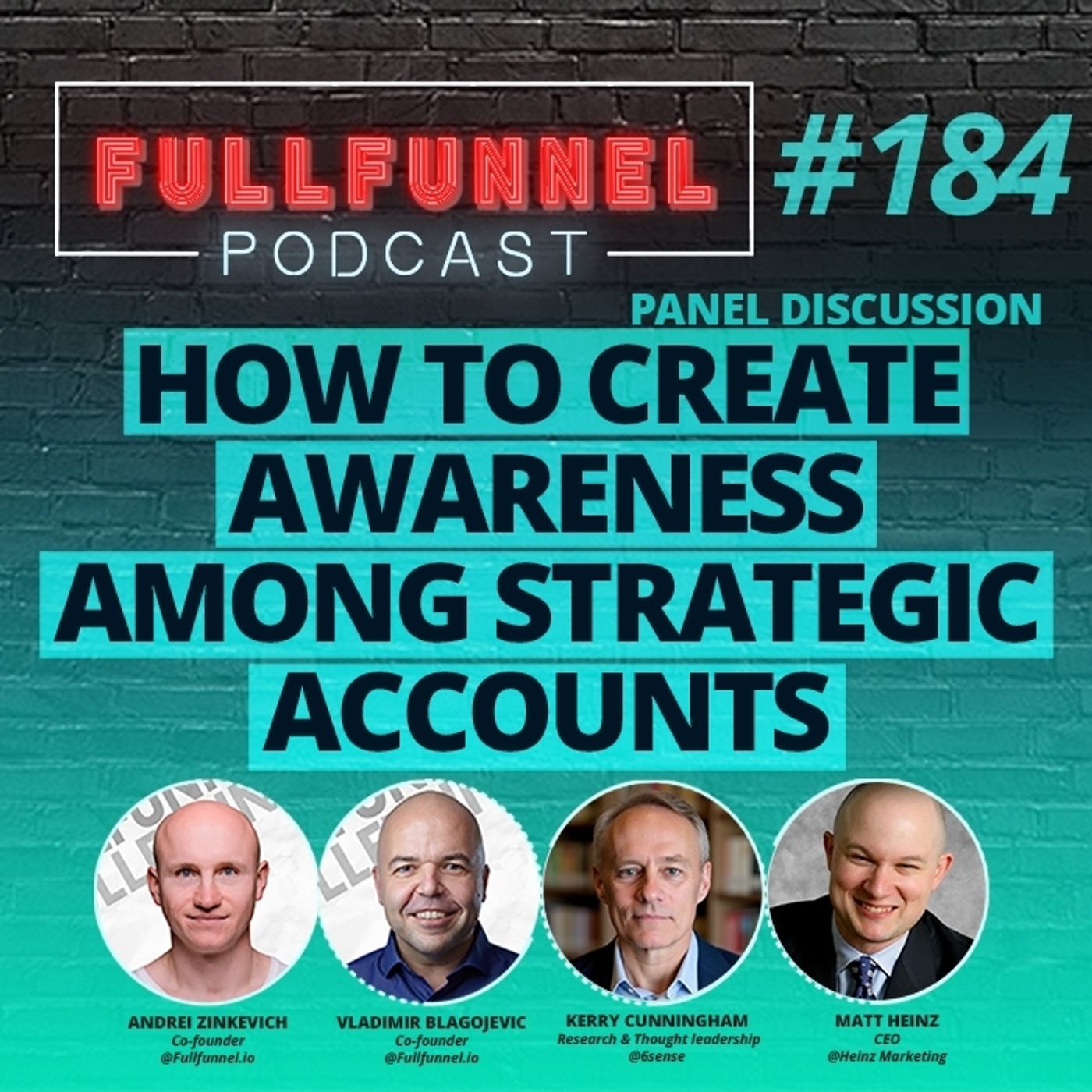 Episode 184: How to create awareness among strategic accounts with Andrei, Vladimir, Kerry & Matty82 / 100
 Episode 183: How to build a global, AI-native ABM function with Tim Rutten80 / 100
 Episode 182: B2B ADS masterclass with Shlomo Genchin67 / 100
 Episode 180: Lifecycle marketing in 2026: How to engage with buyers in AI era with Ashley Faus85 / 100
 Episode 179: Account progression framework with Steve Armenti80 / 100