
Fintech Business Podcast · 2026-08-05 · 1h 18m
Key moments - from our scoring
Substance score
66 / 100
Five dimensions, 20 points each
Jason Mikula joins to unpack three significant fintech stories that reveal deeper issues with regulatory alignment and systemic risk. The Alt5 Sigma saga - where World Liberty Financial invested $1.5B in a company with roots as a 1970s appliance recycler - exposes how mSwipe, a Canadian subsidiary, facilitated no-KYC crypto card issuance, exploiting a corporate card underwriting loophole. While not illegal per se, the practice highlights how bad actors exploit gaps in KYC enforcement. More concerning is the broader pattern: companies like Augustus (25-year-old CEO, first national bank charter in decades) and high-APR lenders Enova and OpFi acquiring banks are securing approvals under the current administration that would be unthinkable otherwise. Increase, founded by Dara Buckley (first non-Collison employee at Stripe), is launching its own bank - a significant middleware-to-bank transition. The hosts worry that regulatory agencies like the OCC, historically obsessed with institutional credibility, are trading that away for political alignment. With stablecoin bankruptcies, private credit risks, and AI capex concerns looming, the loss of regulator credibility during a potential financial crisis could be devastating. The conversation examines game theory for fintech founders: political alignment is an asset now but could become a liability under a different administration.
Alt5 Sigma (also called AI Financial Corp) is a shell company World Liberty Financial invested $1.5B into, originally an appliance recycler from the 1970s rebranded as a payments company. mSwipe is its Canadian banking-as-a-service subsidiary (also known as Strata Cart), which issued no-KYC crypto cards leveraging bank partners and program managers.
mSwipe exploited a corporate card underwriting loophole: banks do KYC on the company entity (e.g., a media buying firm) but not on individual card holders, allowing cards to be issued without individual KYC. While not necessarily illegal, it's a loophole bad actors use to bypass compliance.
The strategy - similar to MicroStrategy's bitcoin treasury model - depends on the token price appreciating, but WLFI crashed from 20 cents to 5 cents. Alt5 had to borrow money from World Liberty and pledged WLFI tokens as collateral, creating circular logic and forcing a going concern warning.
Increase, founded by Dara Buckley (first non-Collison employee at Stripe), is a banking-as-a-service middleware platform that just launched its own bank - a significant transition from middleware provider to bank operator.
Companies with explicit alignment to the current administration (Augustus with Peter Thiel backing, high-APR lenders Enova and OpFi) are securing approvals that would be rejected under prior administrations, suggesting political influence is overriding traditional regulatory standards and eroding the OCC's institutional credibility.
Our reviewer’s read on each dimension, with quotes from the episode.
The episode covers three substantial fintech/banking topics (Alt5/mSwipe no-KYC cards, Increase's bank launch, Fed master accounts) with meaningful technical and regulatory detail. However, much airtime is spent on political commentary, personal anecdotes (Sweet Pea Festival, vacation plans), and philosophical ranting rather than novel insights. The guest provides real reporting on niche issues but the conversation often retreads familiar industry patterns rather than uncovering new operational lessons.
the piece that has been overlooked, which is really what caught my attention, was a Canadian subsidiary, uh, of alt 5 called mswipe M, or as I said, also going under the name stradacart, uh, and multiple sources I spoke to, uh, indicated that mSwipe, uh, was behind some of these no KYC crypto card programs
the real solution is what you've just described. Right. Which, uh, I've, I've been sort of dubbing these like bass native banks
The reporting on mSwipe and no-KYC cards offers fresh ground-level research, and the framework of 'BaaS native banks' vs. middleware is useful. However, the broader analysis leans heavily on established critiques: the master account transparency problem, charter window opportunism under Trump, the political regulatory pendulum. The Fed structure critique (regional bank autonomy, governance issues) is well-known among industry insiders. Few truly contrarian or first-principles arguments emerge.
I actually reached out to mSwipe M to ask questions as if I were interested in using the service for card issuance. And a company representative, my favorite part of the story by far, like it was best going undercover
I've, I've been sort of dubbing these like bass native banks. If you have a better term
Jason Mikula is a credible fintech reporter with proprietary reporting (reaching out undercover to mSwipe, interviewing sources). He has authored a book on BaaS and writes regularly on banking regulation. However, he is primarily a journalist/analyst, not an operator who has built or scaled fintech/banking at enterprise level. He brings research and framework-building but lacks hands-on execution experience that would elevate caliber further.
intrepid, uh, fintech reporter Jason Mikula
I did write something on this. As I mentioned at the top, that is how I formulate and focus and pressure test my thoughts
The episode includes concrete details: Alt5 token dropped from 20¢ to 5¢, Increase has ~$100M deposits and $114M assets with 16 people, Erebor's valuations ($4.35B → $8B), specific bank names (Grasshopper, First Internet, Twin City), Fed master account tier system. However, many claims lack numbers or evidence: 'widespread fires in Spain and France,' vague assertions about charter approvals, the Erebor valuation critique relies on logic rather than sourced data. Some regulatory claims are hedged with 'reportedly' or 'sourced from anonymous sources.'
Alt 5 itself actually had to borrow money from World Liberty, which hilariously, it pledged WLFI tokens to secure the loan. Uh, which is just the kind of circular logic
The bank itself is very small. It's got, uh, a little less than $100 million in deposits. Uh, it's got $114 million in assets, 16 people, a single branch
The host asks broad, open questions ('is middleware dead?', 'what does this mean?') but rarely pushes back on assertions or demands evidence. Follow-ups tend to extend the guest's points rather than test them. The conversation meanders into political philosophy, personal stories, and tangential complaints (Delta/DraftKings rant) that dilute focus. The host does attempt to synthesize frameworks ('BaaS warp cores') and probe regulatory implications, but lacks the sharpness to keep the guest accountable or challenge half-baked claims.
is middleware dead?
But like, I mean, I'll just use ramp as an example. Shouldn't ramp be getting a bank charter? Like, is there any reason why banks shouldn't. Ramp. Shouldn't get a bank charter?
Computed from the transcript - who did the talking, and the words that came up most.
In this episode, Alex and I had the chance to discuss: * The convoluted tale of ALT5 Sigma, MSwipe, Stradacarte and “no KYC” cards * Middleware provider Increase announcing it is launching a bank * The weirdness of Fed master accounts, which are back in the headlines * And, as always, what Alex and I just can’t let go of And a reminder, if you’re enjoying this show, please follow, rate & review on your preferred podcast platform, as it really helps others to find the show. And if you want to help support Fintech Business Weekly and independent journalism, upgrade to a paid subscription or reach more than 93,000+ listeners by sponsoring an episode. Get full access to Fintech Business Weekly at fintechbusinessweekly.substack.com/subscribe
Transcribed and scored by The B2B Podcast Index.
Speaker A: Foreign. Welcome back to FinTech Recap. In this episode, Alex and I discuss the Convoluted Tale of Alt 5 Sigma, M M Swipe, Strada Cart and so called no KYC Cards. Middleware provider increase announcing it is launching a bank. The weirdness of Fed Master accounts which are back in the headlines. And as always, what else? And I just can't let go of. Today's episode is brought to you by Limited by Business Banking for founders and multinational businesses operating globally. Open a US bank account, an EU IBAN and local accounts in Mexico, Brazil, Nigeria and the UAE. Then pay out in 80 plus currencies across more M than 300 local rails. You also get corporate cards with real time spend controls, approval flows and global bill pay all in one platform. So moving money never slows you down. Again, go to LimitedApp.com to learn more. That's LimitedApp.com and a reminder, if you're enjoying this show, please follow rate and review on your preferred podcast platform as it really helps others to find the show. And if you want to help support FinTech Business Weekly and Independent journalism, consider upgrading to a paid subscription or reach more than 93,000 listeners by sponsoring an episode with that. Here's the show.
Speaker B: Okay, well, uh, crawling through the muck and the AI slop and all the nonsense out there are. Ah, friend and intrepid, uh, fintech reporter Jason Mikula is here. Jason, good to see you, buddy.
Speaker C: Good to see you too. This is, uh, actually by the time this comes out, I will ostensibly be on vacation in rural France, assuming it has not burned down because we also have, uh, widespread fires in Spain and France at the moment. But I think uh, the friends we're going to, I think their region, I believe, uh, is safe. So hopefully I'm uh, drinking a nice glass of red wine and relaxing for once.
Speaker B: Excellent, excellent. I, I wish that for you. Um, I will tell you that I similarly find myself in kind of late stage summer forest fire is range. Now, it hasn't been too bad in my neck of the woods. Um, and by the time this comes out, I will be just a couple of days away from the annual Sweet Pea Festival in Bozeman, Montana, which is like, it's kind of our Woodstock, but we do it every year. And um, there's music, there's art, there's theater, there's really delicious food that I only get one time a year. So this is like my summer, Summer Happy Time Festival, uh, right around the corner when folks listen to this.
Speaker C: Oh, that sounds, that sounds lovely. You'll have to send me some, send me some pics.
Speaker B: I will send you some pictures. I will uh, I will post a picture of what a sweet pea is in case people don't know. It is a type of flowering vine that is ah, able to be grown in Montana, which is not something that we can always say about everything, but, uh, that particular flower thrives here. And Jason, um, I feel like on this podcast, uh, sort of complicated, intricate, but important fintech news and recaps thrive here. So would uh, you like to start uh, us off with I think what is by far like the hardest story maybe ever we've had to try to unpack on the podcast?
Speaker C: Yeah, absolutely. I mean this is, uh, as a side personal note, this is why I love writing because despite our friend Kia's encouragement to keep it below 5,000 words, I can just go on as much as I want to. And when you and I speak, we have to try to keep it to like a reasonable length. So. So I did debate deleting this from the outline altogether given, uh, just how convoluted of a story it is, uh, so it'll be difficult to do justice, but I will try. Uh, also standard disclaimer that this is not a political podcast, you and I are not talking about politics. Uh, and I will do my best to stick to the banking, fintech, crypto and policy pieces of this story. Yes, I am talking about alt 5 Sigma, also known, also known, sorry, I'm laughing already, um, as AI Financial Corp, um, as well as its banking as a Service Esque subsidiary mSwipe, which is also known as Strata Cart or Strada Carti.
Speaker B: There are so many names already, Jason.
Speaker C: It really was torture to try to even write about this because everything changed names multiple times. Um, okay, so given our time constraints, I'm going to try to keep this summary high level so that we can actually discuss it. Uh, folks who are interested in all the nitty gritty details, I would suggest that they give the full story a read and I will drop the link in the show notes. Um, the TLDR is that Trump linked World Liberty Financial, which I assume folks have probably heard of, uh, as well as uh, other investors, uh, invested. And I'm putting air quotes around that 1.5 billion in this firm called Alt5, uh, which is kind of like a paymentsy looking company, uh, which itself has a very weird history going back to its origins in literally the 1970s. As I kid you not an appliance recycling company, um, World Liberty's plan basically appeared to be to use Alt5 as a publicly listed treasury company for World Liberty's WLFI token. Um, which I don't spend a ton of time in crypto space. But for folks who followed Michael Saylor or the company MicroStrategy, which of course is now just known as strategy, that's sort of like the quintessential treasury company strategy, uh, although that is primarily focused on bitcoin. Um, for alt 5, this approach, uh, has not panned out, it appears, primarily because the WLFI token, uh, plummeted from an initial price of about 20 cents a token to around 5 cents a token. So that public company treasury strategy, it can work when the price of the token is going up. It does not work very well when the price is tanking.
Speaker B: Right.
Speaker C: Uh, alt 5 itself actually had to borrow money from World Liberty, which hilariously, it pledged WLFI tokens to secure the loan. Uh, which is just the kind of circular logic I guess we've come to expect. Uh, and the company has issued a going concern warning, meaning it is warning shareholders that it may not continue to operate as a business. Um, that whole bucket of crazy has been covered fairly extensively across mainstream business press and crypto press. The piece that has been overlooked, which is really what caught my attention, was a Canadian subsidiary, uh, of alt 5 called mswipe M, or as I said, also going under the name stradacart, uh, and multiple sources I spoke to, which really got me turned on to this story, indicated that mSwipe, uh, was behind some of these no KYC crypto card programs that I and others have reported about previously. So basically, uh, leveraging M, mSwipe and mSwipe's M underlying bank partners and program managers to issue these cards that in turn, uh, are topped up with crypto and used for various purposes, whether legitimate or illicit. Uh, in the course of researching and reporting this story, uh, I actually reached out to mSwipe M to ask questions as if I were interested in using the service for card issuance. And a company representative.
Speaker B: My favorite part of the story by
Speaker C: far, like it was best going undercover, I guess. A company representative as well as the API documentation explicitly made clear that they do offer, and they use this terminology, no KYC cards, ostensibly for the purpose of media buying. And here I should make clear that this isn't necessarily unusual. I've written about what I sort of describe as this corporate card issuing loophole, um, and it's not specific to mSwipe or to, you know, the banks or program managers I mentioned in the piece. You know, corporate cards. Basically the common practice is that you're underwriting or you're doing due diligence on a company entity, let's say work week. And you're not necessarily doing KYC or collecting information for each individual card that is issued to a hypothetical person, say, Alex Johnson. Yeah. Um, so it's not necessarily like, oh, this is totally unusual and illegal and bad. I would characterize it more as a loophole that uh, some bad actors are aware of and take advantage of. Sure. Um, so that is the 30,000 foot, uh, summary. Um, a lot of different questions that this brings to mind. Um, but I mean the first one that occurred to me is, and I caveat it, that this isn't a politics podcast. Sure, bear with me. Um, under the current administration, we have seen a pretty significant centralization of, uh, control over bank regulators under the Treasury. And of course we've seen various cases in the Supreme Court, uh, most recently, uh, Trump v. Slaughter, that sort of aligns with that philosophy, throwing the asterisks that I suppose we're accepting the Fed from that for historical reasons question.
Speaker B: I wrote about those historical reasons in my newsletter. If people want to really delve into why the Fed is supposedly sacred and untouchable. But that's a totally different can of worms.
Speaker C: By the way, that was a great newsletter and I need to buy that book and add it to my never ending Kindle, uh, overflow list.
Speaker B: It's a good one. It's a good one. Yeah. It leaves you with the impression that like, we're never going to have a financial system in the US that makes any sense at all. So that was kind of my, my key takeaway. But to your point, and I actually think this is, it's relevant to that exact point, which is, um, we historically, uh, and I would argue almost kind of our political culture in the US is one of like, like fear of centralization, fear of centralized power, preference for decentralization. Even if it doesn't make a lot of sense, we have to keep the 12 individual reserve banks for the Federal Reserve around and give them some level of autonomy, which we will talk about in a little bit. But to your point, uh, a lot of kind of federal financial services regulation and policymaking seems to be not even decentralized across all the different federal agencies, but really being driven out of Treasury.
Speaker C: And I guess the question I have is what does this sort of brave new world of not only more centralized, uh, decision making and policy making, but that decision making and policy making again with a possible asterisk of the Fed for now, um, being basically directly accountable to the executive and the executive branch. What does this brave new world mean for companies that are overseen by the federal banking regulators? Particularly given that as I've said endlessly and will continue to say endlessly, it's like you don't know what's going to happen in the midterms in 2028. And so how do you think about if you're a company applying for a bank charter now, there are plenty that uh, has conditional approval and you're trying to sort of mobilize and operationalize that charter. Like I do not envy the companies that are in the position of having to navigate this situation. That is not a question. But what is your, what is your hot take from uh, from that, that prompt, other than being glad that you are not at a company that has to deal with navigating this particular political regulatory environment?
Speaker B: It's tough man, because to your point, like the politics of it are so fraught that you know, um, like right now there's really not much that like Democrats in Congress can like functionally do because they don't control uh, anything, anything. And so yeah, so like they can write. Elizabeth Warren can and will write sternly worded letters and um, that'll stir up a little bit of press in some regards, but it doesn't. There's no like functional like oversight at all really. And so, you know, it's interesting because we're headed towards the midterms and if you're a business trying to sort of think through this, like your calculus changes a bit when you have to think about, okay, like if Democrats take back one or both of chambers in the midterms, like oversight and the way that like the politics around a lot of this stuff potentially changes quite a bit. And you know, it's, it's interesting because there's a lot of um, companies that have done quite well for themselves being pretty explicitly aligned with the administration and seeming to have a good time kind of rolling through the sort of regulatory apparatus.
Speaker C: Right.
Speaker B: We've talked about Erebor on the show in the past. Um, just about to raise uh, more money which I promise I'll circle back to. Um, we have uh, Augustus. Is that the new one that just got a, ah, national uh, bank charter, not a trust charter, like a full national bank charter.
Speaker C: And I did not realize that. I think Peter Thiel is also an investor in or um, you know, his firm is an investor in Augustus, which I think little side quest. I would encourage people to Go read like the press release or read the website because it is very explicitly geared towards like promoting dollar dominance in Western values. Which, yeah, for some reason reading that just like made me vaguely uncomfortable.
Speaker B: It has this very like almost Trump esque, combative sort of way of framing what they do in terms of like, I mean, making America great again is kind of like the subtext of the marketing on the page, which tied to the fact that they have investors who are sort of well connected in the current administration. The whole thing feels like it's coded to sail through an otherwise sort of tough regulatory environment, uh, or just regulatory process. And I should note as a side note, Augustus's CEO is 25, if I'm remembering that right.
Speaker C: Uh, yes.
Speaker B: Which would make him the youngest CEO of a national bank in the US for the last like hundred years or something. And so like these are, let's say, unusual, uh, companies in various ways that are sort of getting through this process. Um, you know, another, uh, example of this that I find kind of interesting, uh, is, you know, even something like the, the current kind of ethics debate that's happening around clarity. Have you followed any of those?
Speaker C: Uh, unfortunately I have because I am a glutton for punishment and have not deleted Twitter from my phone as I'm supposed to. I mean, the word unprecedented has been used so many times in the past decade that it has lost all meaning.
Speaker B: Um, but to have,
Speaker C: and I suppose to be fair, it's not just Trump, when I see Senator Cynthia Loomis who's like a bitcoin maxi and then out promoting, obviously owns this asset and then is out promoting legislation that would be beneficial to basically her personal financial position. Um, uh, ethics. There doesn't even seem to be a pretension anywhere in government, not just the executive branch. But I mean, I know we don't need to talk about congressional stock trading. No, no. From either party. But there doesn't even seem to be a pretension of caring about, uh, attempting to look like ethics is something that is a consideration.
Speaker B: I think that's right. And I think if you sort of apply that one step further and you sort of step into the future, whether it's post midterms, if it goes more in the direction of Democrats, or 2028, if there's a, uh, when there's a new administration, like there's really no reason to think, if you're a business trying to navigate this environment, that all of this won't swing back vengefully the other way. Right. And so like, just like game theory for A second, like right now it's really beneficial to have a person prominently connected to the administration involved in your business as an investor. As uh, we've seen with the prediction markets, they both have, you know, uh, Don Jr. As a like strategic advisor or investor in their businesses, like these things are assets right now that smooth the way on a bunch of different stuff, they could become not just not assets but like severe like detriments to a business under a different political environment, which could happen relatively soon. And so I just think like it would make me cautious as a business to not maybe try too hard to game the environment that I'm in right now because the way in which I sort of game that environment might come back to bite me in a pretty significant way not too far from now. So that polarization element I think is perfectly illustrated by this weird story where it's like I'd never heard of any of these companies you're talking about before you did the reporting on them. But like the fact that I guess I wasn't shocked that they were connected to all of this at the same time like it did feels like if you want to try to do a thing and you don't care about like doing it carefully, you don't really, you're not really thinking about the long term or like sustainability. There's a very open avenue to just driving as fast through a big loophole as you possibly can. But it doesn't seem like a sound long term business strategy. And that's, that's the part I'm kind of continuing to pay attention to to.
Speaker C: Well, and I do, I wonder and I frankly don't, I don't even have a good thesis about this of like. Yeah, okay, so particularly when you're talking about granting charters. Sure. And this is a little bit of a different but related topic. Um, there are a couple of high APR lenders that are looking to acquire banks. Uh, Enova, my former employer, uh, and OpFi, ah, are both in the process of trying to acquire banks. And those are proposed acquisitions that frankly never would have happened under prior Republican or Democratic administrations. There's just sort of this, rightly or wrongly, regardless of what is spelled out in the law, this uh, sort of let's say distaste for either granting a de novo charter or approving the acquisition of a bank by a lender whose business model uh, has more than 50% charge offs like Anova's does. Um, I don't even have the framework to think about. Okay, let's say that those acquisitions go through which I strongly suspect they will. Like, uh, what, if anything can be done, would be done in a different administration in 2029. Can you unring that bell even if you wanted to? We probably need to ring up uh, Todd Phillips or Todd Baker or some bank lawyer Todd on that question, one of the Todd's, uh, because I frankly don't have a good mental model for thinking about like stuff that's been sort of signed off and codified. Now if you want to unwind or change that, how plausible is it to even do that?
Speaker B: Yeah, well, I mean, uh, another example of this that obviously was referenced in your story, but we should kind of tie a bow around is world. Uh, Liberty Financial applied for a charter, right. And um, my understanding of the current moment, as we were us recording this, is that uh, that charter has not gotten conditional approval yet. Um, in fact, it is one of the ones that is kind of hanging a bit longer than they normally do. Like, it's been a little bit of a slower process, which would make sense given that it's rife with all kinds of conflicts and problems and connections to foreign governments and all kinds of things that you wouldn't normally see in a bank, uh, charter application. And yet, um, the reporting that I'm seeing, and this is all kind of sourced from m, like anonymous sources at the uh, OCC and elsewhere, but also is sort of logical, is that there is an expectation that it is going to get approved and that that approval may happen relatively soon. And like, you know, to me that's another example of, you know, like, is there any way in hell that that charter would get approved under any other conditions except the ones we find ourselves in right now? And you know, I think you and I have talked about this, uh, in the past, but like regulatory agencies, particularly ones that were founded during the Civil War, which is the occ, they care a great deal about institutional credibility, right? Or at least they have historically. Um, and so they'll do things where it's like, not really what like the folks in charge want, but they're like, yeah, but we're the occ. We have this tradition of doing it this way. Like, they're very obsessed with tradition to the point of getting in fights over like portraits hanging in hallways in various buildings and weird like that. One of my favorite stories of all time. And um, you know, I think this is the kind of activity, this is the kind of stuff that fundamentally like, alters an institution. Like, that's permanent, like credibility. And so I, I just am very curious to like I'd love to get an inside look at like the deliberations happening because I think it's probably a foregone conclusion that that's going to happen and that these things need to go through and these things need to be approved. But the long term cost to institutional credibility and some of these things, I don't think we can say what that is yet but it doesn't seem great.
Speaker C: My last thought. And then we can move on to slightly less fraught topics. I think the question of credibility sounds very like cerebral and academic which I can totally understand why uh, people might respond that way. But if, and ah, frankly it's probably not if. It's when there is some kind of financial crisis, uh, you want the institutions that are in charge of responding to that, which to be fair is probably less the OCC and it's more the treasury and the Fed, but you want the institutions that are in charge responding to you know, a potential, some kind of like financial economic market crisis. You want them to have credibility because that is what is, that's what makes them effective in formulating a policy response.
Speaker B: The market has to trust that what they're doing is going to work and that they're going to follow through on it. Like the market has to trust them essentially.
Speaker C: Yeah, exactly. And I think you know, maybe this is like a black swan scenario or you know, something that is unlikely in the immediate or near term. But I mean you look at, we've talked about, I don't know if you and I've talked about this on the POD before but we've talked about you know, the state of private credit. Obviously there's all this stuff around uh, AI Capex which is just insane gobs of money that boggle my mind. Yeah, yeah, um, you know, stuff in the stablecoin space which I, I uh, strongly believe I would wager on polymarket actually that at some point like there is going to be a stablecoin issuer bankruptcy uh, which I learned from your repost of I think Todd Phillips uh, that depending on the type of stablecoin issuer it would be the FDIC that would be in charge of resolving it. It's like at some point bad shit and you know, I never curse. At some point bad shit is going to happen and you want the people who are responding to those unfortunate situations to both be, which, let's be honest, the financial regulators are a little bit better than some of the other, uh, some of the other departments but you want them to both be competent and credible and right Now I guess the fear I have is that some of the federal regulators are trading away that credibility, which one day they will need. And I will put a pin in my, uh, soapbox there.
Speaker B: I think all of that is totally fair. Um, Jason, with your story, we weren't visiting Bass island, but I feel like we were circling in the general direction of Bass island since the underlying company, um, that you sort of did your reporting on was Bass or Bass adjacent. Um, I have another sort of Bass story for you. Um, Increase, a company that I believe you are familiar with, um, just launched a bank.
Speaker A: Woo.
Speaker B: Yay. Um, where did this come from? What is this? How did this happen? Um, all right, a little bit of background. Uh, Dara Buckley, um, who was the first non collison employee at Stripe, uh, way back in the day, um, started Increase, which is a, uh, to put it in the terminology of the show, a Bass middleware platform, uh, in 2020. Uh, 2020, as I think many folks are aware, was kind of the uh, high watermark. Uh, in a, in this sort of general sense. Everyone's launching a fintech company. There's a need for lots more infrastructure. Uh, Increase, among many others, was seeking to provide that infrastructure. Uh, Increase has in the past worked as a Bass middleware platform with banks like Blue Ridge bank bank, uh, who has come up multiple times on this podcast and who is no longer in the banking as a service business. Uh, First Internet bank, uh, who it still works with, and then, uh, more recently Grasshopper bank, who it still works with. Its customers on the front end, the fintech. And fintech adjacent customers include very large companies like Ramp Stripe, uh, who obviously, uh, Buckley has a, uh, connection to and gusto. Um, interestingly, and this is something I've written about in my newsletter, I think you've mentioned it as well. Uh, Dara tried to buy a small community bank, Washington business bank, in 2022 and 2023. Uh, that attempt was repeatedly rebuffed by the FDIC and he settled for taking a smaller stake in the bank and a board seat, uh, ostensibly for the purpose of sort of learning more about how banks operate. Um, later he bought a, ah, controlling share in Twin Citibank Corp. And its subsidiary, Twin Citibank based in Longview, Washington. Um, this was in 2025. So last year he filed a change in bank control notice and received non objection from the FDIC. So in line with what we've been talking about, 20, uh, 25 was a better year to try these things than it had been in the past. And at the time, uh, he told, I believe it was TechCrunch quote, uh, Twin City bank shouldn't support sponsor banking. Sponsor banking requires very specific capability and capacity to supervise partners safely and soundly. Only specialized banks should do it. Well, uh, fast forward to today 2026, and apparently, uh, the bank is now ready to be a specialized bank able to do sponsor banking. So, uh, Increase bank, the rebranded bank built on top of this charter, um, will still keep its one branch in Longview, Washington. Um, it will keep its existing very, very small commercial banking business. Um, these are the things you do for like good optics so that you know, Michelle Bowman doesn't accost you at dinner and accuse you of charter stripping. Um, however, the renamed bank will obviously be focused primarily on sponsor banking. Fusing together increases proprietary developer focused tech stack which is built around like a homegrown core system and ledger. Uh, with their bank charter, um, a couple of notes. The bank itself is very small. It's got, uh, a little less than $100 million in deposits. Uh, it's got $114 million in assets, 16 people, a single branch. Uh, it is a very, very small community bank. And I think the reasonable expectation is that it will likely remain similarly small for the short term at least. Um, obviously it doesn't really have the balance sheet to absorb anything big on the lending side, as you and I've talked about many times in the past, and has bitten other banks in this exact business. Regulators don't like it when you grow deposits too fast. And so, um, I would expect that it will be fairly cautious as it relates to growth, at least from a balance sheet perspective in the short to medium term. Uh, which likely means it'll be focused more on transactional business opportunities like facilitating payments, which is a lot of its business today anyway. Um, it will also be keeping its existing bank partners, at least in the short term, First Internet and Grasshopper, so that it can continue to support its existing customers and support areas where the, uh, bank charter and balance sheet might not be a good fit at the moment. Um, Jason, as, as the student of banking as a service, is the author of the definitive book about banking as a service. Um, I would like to ask you a couple of questions about this story. The first one is, um, is. Is the age of like bass, middleware platforms, indirect platforms, you know, side cores, whatever language you want to use to describe this thing that doesn't have a bank charter is the era of those companies kind of over? Because obviously we've seen a few banks kind of go in this direction, um, we've seen some banks like, uh, the bank Corporate Cross river sort of start as a bank and then invest more in building out the tech side of their business. We've seen the opposite where we have tech entrepreneurs like, ah, Jackie at lead or William, ah, at column, go buy a bank charter and then refashion it into a banking as a service first bank. Um, so for these, these platforms we've talked about synapse obviously being the most infamous one, but there's lots of others that have done a better job and haven't collapsed into bankruptcy. Uh, is there really a market for those anymore? Is, is that era sort of over?
Speaker C: Are you asking? Is middleware dead?
Speaker B: That's what I'm asking. That's what I'm asking.
Speaker C: I usually try to avoid that formulation because it's a little bit clickbaity.
Speaker B: Uh, yeah.
Speaker C: You know, I want to sit down and write something on this. As I mentioned at the top, that is how I formulate and focus and pressure test my thoughts. But my initial reaction, uh, is probably yes. Right. So if I think about what we might call the middleware era, and if I'm remembering off the top of my head correctly, I think SYNAPSE was founded. It was either 2016 or 2014.
Speaker B: That's so funny. I was just thinking those two dates. But yeah, it's like I can't remember which.
Speaker C: It doesn't matter.
Speaker B: Split the difference, say roughly 2015. Yeah.
Speaker C: Um, but I would, I would agree with your statement that kind of like the high watermark was that call it early Covid. Right. When like money was free and everyone believed that everything was going to be only online forever. Um, which in retrospect, every company will
Speaker B: eventually be a fintech company, I believe was a rallying cry of this era. Yeah. Yes.
Speaker C: Um, and if I tried to think about the sequencing here, it's like, okay, that whole crop of what we are referring to is middleware players. And uh, obviously SYNAPSE is bankrupt and gone. But you're sort of like Unit Syncatera, uh, it's treasury prime, et cetera. They solved a real problem. And now here in 2026, looking backward, I guess the question or the way I would frame it is, you know, was was it a durable solution with a durable business model or was it a band aid? And, and the real, sort of the real answer, the real solution is what you've just described. Right. Which, uh, I've, I've been sort of dubbing these like bass native banks. If you have a better, if you Have a better term.
Speaker B: I'm, I have a, I don't have a better term. I wrote a piece a long where I called these bastard cores. Which what I meant by that was that's a good piece combining matter and antimatter, meaning like the bank charter and the developer first infrastructure which historically have been hard to fuse together. Right? Because it can create instability, it can create problems like it, the, the power of that is also the danger of that. And so regulators were always a little nervous about it. But it feels like, like we're post that and now like, I mean the, the increase thing makes me think we now know how to kind of create and safely operate warp cores that combine these two sort of diametrically opposed things together and you don't need a middleware platform sitting in between them. I mean even like referencing uh, Blue Ridge again like it's the blue ridges of the world that make you need bass middleware, right? Because you have a bank that doesn't really know what it's doing, that's not prepared to do banking as a service, who someone's nephew just convinced them to get into banking as a service because they heard about this fintech thing and they had no hope of like selling to fintech companies, uh, integrating with fintech companies, managing a ledger on behalf of like none of that would have worked if it was just the tiny little community bank that didn't know what the fuck it was doing, uh, sort of in charge of that. And so middleware like eliminated the need to touch those things directly while you still needed those things. But like those market conditions are changed now. They're not the same.
Speaker C: Well, and I would add a dimension to that that beyond, you know, the bank itself, which I think your point's about like being able to sell to fintech and onboard, uh, from like a sort of like a commercial standpoint is fair. But I mean I think the real the, the root problem as all things in community banking go back to core banking providers. Fis. Fiserv. Jack Henry. And so it's like now with the benefit of hindsight, I think it is a fair argument to make that that class of what we're calling middleware was a temporary solution to the fact that core providers generally suck and were not, they were not responsive and they were not meeting the needs that existed in the market. And so you had that generation. But here we are depending on whether you want to count, uh, I suppose almost a decade on from when SYNAPSE was founded and it's like, hey, actually this middleware Approach for all sorts of reasons is kind of janky, clearly introduced some risks and some problems and ultimately it was a workaround for both economic reasons. I think we've discussed sort of how core banking providers tend to price encore accounts as well as technological reasons, lack of API access. And so instead of relying on this sort of jerry rigged system, uh, if you could build your BAS warp core in your language or your BAS native bank, um, where hey, actually we don't need this extra layer which is introducing additional complexity and also is another mouth to feed from the economics perspective. Like if we don't need to build this band aid on top of fis, fiserv, Jack, Henry, whatever, we actually just build it to accommodate this business model a la ah, Cross river lead column and now Increase, then we don't need this additional complication and this additional company that is taking a cut of revenue. And so I do think is it going to be today, tomorrow? No. Might we see a synctera or a unit companies in that class, in that category, might we see them also pursue what Increase is doing and try to acquire an existing bank, try to apply uh, for a de novo charter? I think that's certainly a possibility. But the standalone middleware was kind of caught in between a rock and a hard place. You and I love our metaphors, um, in the sense it's like, well you have the core providers that are like hey, we're going to try to meet that need. Although I think I would argue that they still haven't actually done that. Has anyone heard anything from atelier lately? Are they alive?
Speaker B: I don't think they are inside fis. I think they're not alive. I think that didn't go so well. I mean FIS is where good technology goes to die. I think that's a joke I made like a hundred years ago when I first sort of encountered the core providers. But yeah, I mean like that, that need is not solved for. But it also hasn't stopped either tech entrepreneurs from acquiring banks to your point, or like banks that are serious about banking as a service, finding their own solution for it. And that could be getting like a newer core and using it aside along fashion. It could be building their own internal tech stack. But like I, I think one other element to all of this is, you know, in 2020 and 2021 there was such a mismatch between demand and supply, right? And so the demand was, uh, every person in the world was starting a fintech company. Every ounce of institutional capital in the world was being funneled into fintech. It Felt like. And so, like, literally everyone was like, I want to start a fintech company. I have a VC giving me a check for $10 million to start a fintech company. I need a bank in order to bring my fintech company to life. And I cannot get a bank charter because we still were living in the era of no, you may not have a bank charter unless you're Jackie Rhesus and you thread the needle. Exactly right. So what am I going to do? I have to work with a bank. Oh, there's not that many, like, banks out there that do this. There's only Bank Corp and a couple others. And then in comes this surge of community banks and then middleware platforms on top of them that meet this incredible demand for these things. And you fast forward to today, the demand is still there, but it's lesser. Right? Like, I don't think we're ever going to see 2021 again. Like, I'm going to be bouncing my grandkids on my knee, telling them about the VC funding for FinTech in 2021. And they'll be like, why do you make us come to grandpa's house? And I'll be like, because this is really important history. And then at the same time, and this, I guess, is the last part of the story. Um, I mean, I don't know, Jason, right now the window, as we've talked about for charters is wide, wide open. Um, and I think two things about that that are interesting. One is I think it might signal a future in which the charter window just stays m more open. And I don't mean to say that it's going to be as like much of a free for all as it's been lately. Right? I mean, now it's like, if you have the right connections, you're getting the bank charter. If you use the right language on your website talking about making the dollar grade again, you get a bank charter. Um, hire the right.
Speaker C: Hire the right consultants, you're getting a bank charter.
Speaker B: The right consultants, you get a bank charter. Have the right people on your board, you get a bank charter. Uh, like it really, quite frankly, it's a stunning failure on Wise's part that they didn't get a big charter. Um, like, like, come on, man. Like, like, that is embarrassing. Um, but I think that, you know, even after we get out of this era, like, wasn't the lack of new bank charters, wasn't that really kind of an artifact of, like, the 2008 financial crisis and kind of just this general tightening of all the Regulatory apparatus. Like, like for a while it was kind of a bipartisan stance reacting to the great financial crisis. I wonder if this is the moment where that particular fever kind of breaks. And even under a Gavin Newsom administration in 2028, like, they won't be as wide open, but like, I think they'll be more acquirable perhaps. And then I think as a consequence of that, the other question I wanted to ask you real quick is, is banking as a service a good business for anyone anymore? Because I think about like increase, and obviously increase is very sophisticated in terms of its tech stack. I've heard, uh, really great things from fintech companies that are looking for like, really great, kind of close to the metal developer centric infrastructure that they can build around. And obviously they have the greatest developer first companies in the world building on top of them. Ramp, uh, Stripe companies like that, that. But like, I mean, I'll just use ramp as an example. Shouldn't ramp be getting a bank charter? Like, is there any reason why banks shouldn't. Ramp. Shouldn't get a bank charter? Like they should get a bank charter. And if they get a bank charter and stripe already kind of has one through bridge and might do other things, they actually have a couple because they have that weird Georgia thing too. Um, like these companies should get bank charters while they're available. And if they do, that doesn't mean that they're going to entirely migrate off or stop using increase altogether. But it puts pressure on even the increases of the world. I've written about column before where it's like at some point they're losing mercury because they're now a bank. Um, you know, they lost Brex because Capital One bottom right. So like there's this graduation problem that now exists even for the best bass warp cores or bass native banks that I don't think, um, makes bas quite the goldmine that it was perceived to be in 2019.
Speaker C: No, I think that's right.
Speaker A: I mean
Speaker C: the graduation frame, um, I think is a good one. And then the other related lens I think about is the supply demand lens. And it's like, okay, so now we have, depending on how you want to count it, your column lead crossover increase. What. But what is the right number on the supply side? And then to your point about graduation, there's also the risk that actually the supply is going up, but the demand decreases to the extent that it is feasible from a charter window perspective and the economics make sense depending on what the line of business is. Uh, Vero, again, I'm Glad that we sit in our chairs with our microphones and I don't have to be making the very elaborate PowerPoint trying to analyze what do we think is going to happen five years from now as far as a business plan if your increase getting the charter, if you're a column thinking about, okay, what happens when a Mercury leaves or when a Brex leaves. Um, because yeah, I think it is a fair analysis to say part of the explosive demand for what we call bass was that it was functionally impossible to get a charter for like 15 years. And now, and frankly, to be clear, I think that was a bad thing. Right.
Speaker B: Yeah, me too.
Speaker C: If you look at the UK and I'm not going to profess to be like an expert on the UK market, um, but the structure. Well, one, they have alternate license categories, so there's e money institution which is like not, not a concept that exists in the United States. And two, it's uh, more feasible and there are more pathways in place to start and stand up a bank being cognizant that it may not be successful. And I think the post 2008 vibe in the United States very much reads as the regulators had no appetite to see banks fail. And one way to make sure that a bank doesn't fail is to not grant one a charter in the first place. Right. Um, so, you know, I think again, using our pendulum metaphor, we're seeing the very, uh, sharp reversal of that. That is something I'm interested to sort of follow and you and I can discuss endlessly over the next five years. Like, not all of these, not all of these newly chartered banks are going to be successful.
Speaker B: And what, you know, some may fail, that's fine. And novel ways, you know, it'll be interesting to, I mean like Jonathan Gould, I think at the OCC has gone on the record and said basically, like, it's healthy to have some banks fail. Right. And like, I think there's a lot of validity to that point and like regulators lack of comfort with having a single bank fail was kind of what kept us in the stasis. It's like, yeah, I mean it's just not, it's not a natural way that the market should work. But yeah, I wonder like in a 2028 administration if Dara and William and Jackie will very quietly be lobbying the regulators to be like, maybe don't grant quite as many bank charters because like, it's just not, it's not in the interests of uh, anyone who's trying to make a go of it in banking As a service for the charter window to be as wide open as it is. But, um, you know, I think it's one of those things that remains to be seen how it works out. Uh, Jason, time for one more story.
Speaker C: Uh, yeah, I mean, I suppose it's kind of related if we're talking about master accounts.
Speaker B: Yeah, yeah.
Speaker C: Uh, everyone, uh, I can't tell if you, me and our text chain friend and your colleague Kia just live in a bubble where we just talk to each other constantly. But, um, other people have been talking about master accounts as well. Capital account, which, uh, I can't afford to subscribe to. Um, they also had an interesting tidbit related to comments comptroller ah, Gould made regarding master accounts recently. Uh, for those who are unfamiliar is.
Speaker B: Which is the vast majority of you, which is fine. You're living your life. You're like a hit at parties, you know, that's great for you.
Speaker C: Yeah, you probably don't want to think or talk about this ever. Um, uh, but functioning a master account is an account that a depository institution. Note that I did not say an insured depository institution. I did note. I did note that holds at a Federal Reserve bank, one of the 12 Regional Federal Reserve Banks. Uh, for the purposes of what we're likely to chat about right now, the key attributes that it gives account holders are direct access to various Federal Reserve systems, including Fedwire, Fed Security Service, FedNow, Fed ACH, National Settlement Services, Check Services and Fed Cash. Um, also worth noting, where applicable, Master accounts are a, ah, prerequisite for tapping the Fed's discount window. Um, honestly, to your point about the 17 people who actually care about this topic, uh, it has been my impression until fairly recently that master account access was kind of an esoteric and relatively benign topic.
Speaker B: Yeah, it was like that Julie Hill wrote about it and that was it kind of thing.
Speaker C: Um, and that it was really, uh, kind of the explosive growth, uh, primarily of crypto, even more than fintech, that changed that in like early 2020. Because as I mentioned, um, per statute, to be eligible you do have to be a depository. Right? And so for example, there are, uh, state chartered depositories, uh, like Wyoming special purpose depository institutions that in theory, under the law, law should be eligible. Uh, but as any parent can tell you, just because you are eligible for something does not mean that you automatically get that thing.
Speaker B: You are not entitled to it.
Speaker C: Yeah, eligible but not entitled. And so, uh, Custodia, and I'm guessing folks who bother to listen this far to the podcast are probably familiar with Custodia and its, uh, long running lawsuit against the Fed related to master account access being sort of like the poster child, uh, for crypto fighting for access to this, uh, and the Fed, kind of depending on your point of view, saying no stonewalling, et cetera. So this, um, led to demands for increased transparency, which in 2022 the Fed rolled out, uh, some additional guidance that defined three specific tiers of Fed master account applications. Uh, so to try to simplify this, tier 1 was eligible institutions that are federally insured and subject to federal prudential supervision. Uh, tier two was eligible institutions that are not federally insured but were subject to additional Federal Reserve oversight or federal prudential supervision. Which is kind of weird because there's not that many entities that fall into that bucket.
Speaker B: I know small groups.
Speaker C: Uh, and then tier 3 being eligible institutions that are not insured and are not subject to federal oversight, federal prudential regulation. So that would be, uh, for example, the Wyoming Speedies. Uh, other examples, Connecticut. Uh, Connecticut has long had an uninsured charter that it recently rebranded as the Innovation Charter, which I'm sure this funny branding. Um, Nebraska has a similar crypto charter. And uh, then I would also put, I don't know to what extent it would be relevant for the purposes of a master account, but I would also put the Georgia malpi, the you mentioned stripes, weird charters. The Georgia Firing Limited Purpose bank charter.
Speaker B: Yeah, yeah, yeah. And, and to note on, um, the tier three, it's almost like if you're a state, you have to kind of craft this very specific charter to hit this eligibility thing. Because like in the case of Wyoming as an example, like the use case for getting this Wyoming special charter, it, it doesn't, it's not really a bank in the way we would recognize it.
Speaker C: Right.
Speaker B: So when we say uninsured, really what we mean is they're not lending out your money or doing anything. Right. It's like for stablecoin issuers and stuff like that. And so like, if you get that charter, you're a depository in the sense that you're taking people's money, but you're not a depository in the sense of you then like lending the money out or having NIM as a business model, which is why you don't need FDIC insurance. And so it's kind of like this strange, like kind of in between quantum state where it's like technically, technically we're a depository institution, but we don't have to, uh, be insured, meaning that we don't have any level of federal supervision. And I think in some ways that's kind of what that the Fed is sort of drawing a line around right here, right where they're like, if there's any part of your business that requires us or any of our friends at a federal level to supervise you directly, you're lower risk from our perspective. But if one of these weird states, who we don't really trust, can just give you a bank charter, but you're not subject to any of our supervision, Fed, occ, fdic, ncua, for that matter, like, if you're not. Not subject to any of our, uh, you know, supervision, we can't. We. We technically have to legally consider you for an application, but historically we have not liked this and we don't really want to give you a Fed Master account. And that's where the consternation comes from.
Speaker C: Yeah, absolutely. I mean, uh, to your earlier points about how weird and bizarre the United States banking system is, um, so the reason you put the story in the outline is because Kraken, uh, ostensibly was approved and it made headlines like a big news story both in crypto world and in tradfi world. Um, and the news release was, uh, this March. But if you look at the date of the actual approval in the weird Federal Reserve webpage that lists this stuff, the date is in, like, the end of January that Kraken was approved for a Tier three master account. Um, because I am sad and have no life, uh, I watched a YouTube, well, and because somebody sent it to me, um, I watched a Wyoming state, uh, hearing, uh, where the CEO.
Speaker B: Those are on YouTube. Jason. I didn't even know that. That's like. That's a game changer for me, um,
Speaker C: where the CEO of Kraken Financial, which is that. That, that bank subsidiary, the Wyoming Chartered bank subsidiary, uh, was, you know, giving an update on the business and saying that they had not yet actually operationalized that account. I believe Kia also wrote, um, at least in passing about, about the Kraken bit. Uh, and on Kraken's website, you know, if you want to deposit money, uh, you're still actually wiring that money to Dart Bank. So still, like, not operationalized, still relying on a third party for, uh, wire transactions. The point I was making about the very strange us, uh, structure. When I was researching the bit I wrote on Kraken and its master account, uh, I came across a Tier 3 entity, another Tier 3 entity that was approved, and it is a bank in Puerto Rico, uh, Cooperativa de Aora Y credito. Uh, and that's because it has insurance. Uh, it does have deposit insurance. It is a bank in the way that you and I would traditionally think about banks. But the deposit insurance is through, uh, the territory of Puerto rico. It's not FDIC, nor is it NCUA, so it's considered a Tier 3 entity. Um, and then Numisma, which is also just kind of like a weird business model around distributing physical banknotes, was approved for tier three access. But, uh, as far as what, what crypto advocates and also increasingly certain corners of fintech world that are pursuing these national trust charters are interested in, we really at this point have not seen an entity be approved and operationalize an account. Um, I guess the question or the topic that I find the most interesting that I know you and I in Group Chat World have discussed to some extent is the sort of disconnect between the Federal Reserve Board, which is formulating these sort of guidelines and policies, uh, including the so called Skinny Master account, uh, or M more technically I believe we're referring to that as a payment account on which comments, uh, were due, uh, earlier last week or I guess two weeks ago by the time we published this, versus the 12 individual Federal Reserve banks, uh, which, uh, per your excellent piece summarizing some of the Fed's history, those are corporations that are privately owned by their shareholders. Who are the shareholders of those 12 regional banks. They are the commercial banks that are on Main Street, Wall street, that people use as depositories. And so I guess, um, my not very well formed question to you is like, does this system make any sense? Yeah, I'm going to go, is it tenable? I mean, we also didn't even get to some of the executive orders around like access to payment systems in general. Some of the very specific stuff about whether or not ACH is included or excluded in the skinny accounts. Like there's a lot of very sort of like technical but important details that people are fighting over right now. And I'm curious, sort of broadly like, what are you hearing and what is your point of view on how this hot mess is unfolding?
Speaker B: Yeah, I mean it's really weird, right? Because uh, as you illustrated in your history, um, the Fed has been very reluctant to give out these Fed Master accounts to novel, risky, what is now considered like tier three, uh, applicants, uh, the strange sort of novel ones that they just don't really like or don't
Speaker C: trust or don't under or just don't understand. Like we don't know what to be, to be charitable. To be terrible.
Speaker B: Yeah, yeah, yeah. Like, we.
Speaker A: Oh.
Speaker B: Like we don't, we don't know what this is. This doesn't, this doesn't look like what we're used to approving as a applicant, uh, for a Fed master account. And you know, to your point, like, this is the Fed giving out bank accounts to new companies, basically. Right. And the bank account comes with access to all their payment services. It comes with, like, daylight overdraft. It comes with access to the discount window. So it's all these things that are bundled into a master account. And so, like, that generated a lot of, like, controversy, particularly with Custodia, because the decisions that were being made were weird and opaque and there was no, like, guidelines around it. And, um, if you wanted to put your finger on the specific reserve bank, it was at the heart of this. It's our friends in Kansas City who will just make weird decisions, seemingly. And, and decisions that the, uh, the board in Washington D.C. doesn't understand, doesn't have a role in. Can't stop. And so, you know, like, Kraken is a good example. Um, you know, Governor Waller, uh, comes out, I believe, late last year and starts talking about the skinny master count idea. And he's like, this will be like a streamlined way that we can get these, like, more novel, innovative, uh, institutions, access to, uh, payment services and, and Fed services and kind of floats this idea out there. Then has to clarify shortly after because people interpreted his remarks to mean we're going to give access to crypto companies, fintech companies, all these non banks. No, he says we are legally not allowed according to the Federal Reserve act of 1913, modified by the Monetary, uh, Control act of 1980. There's a little history for you. We are not legally allowed to give it out to anything except a bank, a depository institution. What I meant was the master account could help with this small category of like, weird novel charters that are having a hard time. Okay, uh, then it's reported that, uh, Kraken has indeed gotten not only a tier, uh, three approval, but it was framed in the press as like, this is the first one of these skinny master accounts. Yay. And people were like, well, that's cool, but I thought you hadn't even finalized your proposal on what a skinny master account is. Is how did Kraken get one? And then Michelle Bowman on the Federal Reserve Board, who's in charge of bank supervision at the Fed, has to come out and say, well, this is more of like a trial or a pilot program. And it's like Limited. It's time limited. We're, uh, just using this to kind of learn. Like the window for Skinny accounts is not open. We're still accepting comments on our proposal for Skinny master accounts. And once we have that and we learn from Kraken, then maybe we'll do something thing. Um, but of course the problem, as you point out, is Michelle Bowman can say that all she wants. Governor Waller can say these things all he wants. But they're not the ones in charge of deciding who gets master accounts. It's Kansas City and San Francisco and Boston and New York and all of the different reserve banks, they all independently have the authority to do this. So that all should just illustrate the sort of context around my answer to your question, which is, no, this does not make any sense at all. This is not the way that it should run. Um, just as a sort of point of contrast, this is not at all how it works in other countries. I did a little bit of research when I was writing my Fed piece just on is every central bank around the world as weird as ours? And the answer, the short answer is no. Uh, and in particular, a lot of other central banks around the world really sort of segment off their payment rails from other things that they do. Right. And so, so the idea in the US that a master account bundles both access to lender of last resort mechanisms like the discount window with payment services is a uniquely American thing that really wasn't even something we like sat down and designed intentionally. It was just the result of all these weird historical accidents and compromises over time. And if you look somewhere else like Brazil, India, there's lots of examples. Even the uk, they take a much different approach where they can, on the one hand, give limited access to their payment rails directly to companies to encourage innovation and competition and less reliance on banks, and then on a completely other hand can give access to banks for access to lender of last resort supervision, all the things that the other side of the Fed does. And so the Federal Reserve has kind of bundled all of these things together. And that when we talk about master accounts, really it's the manifestation of that bundled authority that the Fed has that's the root of all of these problems. And yet, to answer your question, makes no sense. And honestly, like, I'm not even really
Speaker C: sure what the Fed can do about
Speaker B: it, because they're going to come out with this proposal. Uh, maybe the proposal can get some level of consistency going, but at the end of the day, the board can do whatever it wants. It's not their decision and they can't even stop or really even slow down the reserve banks from doing whatever they want on this issue. And I, I, short of changing the law, I don't really see how it's possible.
Speaker C: Yeah, I'll admit it almost pains me to, to agree with, agree with the crypto maxi people. Um, but I mean a couple of things about this that, that just from like a, a public ah, policy and like a good governance perspective that, that do like really rub me the wrong way is the complete lack of transparency and accountability that, that you're just, you know, that we've described.
Speaker B: Right. The Fed does not have to explain any of these decisions.
Speaker C: Like I, I know it may sound a little like naive and Pollyanna ish, but it's like hey, like shouldn't we have a clear set of rules and guidelines that are equally and fairly applied to anybody, any company, any qualified company that is seeking to have this access? And some of the narrative I think more so from crypto world, but you get this from some parts of what I'll call more traditional fintech world as well, is that banks are uh, basically fiercely guarding their regulatory privilege in a manner that is unfair and anti competitive.
Speaker B: And you see that in the comment letters to the Fed on this proposal by the way. Like do not doubt that the Bank Policy Institute weighed in on this question of skinny master accounts and shockingly they
Speaker C: don't like the idea.
Speaker B: Not a fan, Not a fan.
Speaker C: And you know sometimes those arguments I think from, from crypto fintech world sometimes can be a bit disingenuous. But in this case like I'm really quite sympathetic where it's like, oh, okay, so the Kansas City Fed or the Chicago Fed is, is the one that ultimately has the power to decide this application. Who's on um, who's on the board of that Fed?
Speaker A: Yes.
Speaker C: Ah, oh yes.
Speaker B: Um, yeah, it's these like ex uh, Fed officials or it's these bankers from banks that you know, like again to your earlier point, the Federal Reserve banks are private corporations. They're sort of like these weird quasi government regulated private corporations but like they have bank shareholders. Like they're not answerable to the public the way that you know, the Federal Reserve Board or other parts of the Fed are slightly more answerable to the public. It's a very strange system that we have.
Speaker C: Well, ostensibly, and I only know this because I had to look it up when I was writing my piece about the Fed or about the master account stuff. Each Reserve bank has a nine member board. Three are elected by the member banks to represent, specifically to represent the commercial banking industry. Three are elected by the member banks ostensibly to represent the public. So six of the nine members are chosen by the banks that belong to the regional Fed. And then the remaining three are appointed by the Federal Reserve Board of Governors also ostensibly to represent the public. Where the public is sort of this broad hazy conception of taking into consideration agriculture and commerce and industry and labor and blah blah, blah.
Speaker B: I don't remember any of those appointments being run past me as a member of the public. And I will also say just as a little historical note that uh, the, the chairperson for each one of those Reserve Boards, uh, until Dodd Frank, until 2010, they were actually uh, elected by the banks and were not appointed by the Federal Reserve Board. That changed post 2010 because we got a little uncomfortable with just how unaccountable the Reserve Banks were. But like took a financial crisis to even modify that, which is kind of strange. Ranch.
Speaker C: But I mean I feel like we're already ranting and I know we're a bit over time. Should we, should we segue to our. What we can't let go of. Assuming it's not just Astro account official rants.
Speaker B: Yeah, this is like a warm up rant. Uh, we should. So um, I promised I would talk about Erebor, our, our sort of famous and favorite mysterious new bank. Um, it was reported recently that Erebor is planning to raise more money. Money. Um, now on one level I get this because it has brought in a ton of deposits. A ton of deposits. And um, as a de novo bank it has a higher than normal tier 1 leverage ratio which is essentially the amount of capital that it needs to keep uh, in relation to its assets. And um, notably erebor's, the tier uh one leverage ratio is 12% which is really high even for a um, de novo bank, which I think is an indication of sort of the novel nature of the bank and some of the concerns that the OCC had. But functionally what that means is for the amount of deposits that the bank has brought in and then it obviously deploys that deposits into Treasuries or it doesn't really do much lending yet, but it deploys it onto the other side of its balance sheet sheet, it really can't actually bring in much more in terms of deposits and then deploy them into different assets before it hits that cap that's been imposed on it and needs to raise more capital. So mechanically it makes sense to me as a de novo bank with this leverage ratio that it has to raise more capital. Okay, here's the part that doesn't make any sense to me. It in its last funding round, uh, was valued at like $4.35 billion, which is a lot Jason, for a de novo bank that at the time had no customers and no deposits. And now that is just Palmer, Lucky and friends. We're going to start a bank. Um, that was a big enough number apparently. According to reporting from Bloomberg and others, the amount that it's discussing for its valuation for its next round of capital, which again is necessary just to continue to bring in more deposits and start to get whatever lending it's going to be doing up and up and really running, that would be valued at $8 billion, which is roughly double what it was valued uh, at last time. And I got to say, just as a quick rant, like, do numbers not meet anything anymore? Like, what am I not? Like? Erebor has not demonstrated any ability to be a normal bank and to make money the way a normal bank would. Like, like, does its investors just not care about getting their investment back? Are these numbers all just made up? Like what the hell? Like, I don't, like, I don't understand. This is. This fundraise should be thought of more as a capital call from existing investors so that the bank continue to operate not as a, hey, we proved something amazing about this business and you should give us more money at a higher valuation. This doesn't make any sense. What am I missing in, uh, it
Speaker C: does not make any sense. I mean I do think that fundamentally, well, I guess a traditional banking business models feel like a very, very poor fit for venture capital. And yet here we are with Erebor and with Augustus. I'm a little less concerned about all the National Trust banks just because it is a bit of a different beast. Not that probably won't. There aren't risks and potential problems there. Um, but as we've discussed on a zillion other sort of topics, extremely rapid growth, which is what VC encourages, facilitates and rewards, uh, tends to blow up pretty spectacularly when you do it in uh, these kinds of businesses. Whether it's non bank lending, which I've had a front row seat to, uh, or I mean deposits ostensibly be uh, less risky. As our friend and colleague Kia would point out, it is functionally debt that you're taking on. Um, but when you're growing extremely quickly, as we've seen in Basworld, uh, and the banks underneath Basworld, there do tend to be risks that are accumulating that you need to be taking account of building appropriate controls for. And it's like the incentives are all out of whack here. And yeah, it's just weird.
Speaker B: It's like either Airborne is going to continue to run itself the way it said it will, which is like very conservative, low loan to deposit ratio. Like, we're not going to do anything crazy. We'll just hold on to your money. Cool. But that's not an $8 billion bank that keeps doubling its valuation every six months. Or we're going to take all these deposits that we've rapidly been pulling into our balance sheet. Sheet. And we're going to try to earn our way to this valuation by doing a bunch of crazy shit. And we know what that looks like in banking. And so I don't see any way for either the bank to continue to be safe and prudently run or for the investors to get their money out at this valuation. One of those two things is not true. And at this moment I can't discern which one, but it makes no sense to me.
Speaker C: It also does not make sense to me.
Speaker B: All right, give me yours.
Speaker C: Uh, Alex, remind me, are you, uh, are you a Delta? Are you a Delta guy?
Speaker B: I am. It's, uh, my go to airline.
Speaker C: Um, well, then you are in luck because I just read today that DraftKings and Delta have partnered to launch SkyPix™, a new free to play in flight sports contest that gives eligible customers age 21 and up an interactive way to engage with sports while you travel. Skype. So sorry. So on US domestic Delta flights, through Delta Sync Wi Fi, you will be able to answer a series of sports related questions such as who will score first, which team will win? And a final score tiebreaker to compete for a spot atop the leaderboard and a chance to win Delta gift cards for your next adventure. Alex, are you looking forward to the next, uh, work related trip so you can gamble, uh, during your flight?
Speaker B: No, no, no, I am not.
Speaker C: No. Why?
Speaker B: Why is this happening? I know. No, um, this is very bad. Why? You know, it makes me want to just raw dog a flight and just not like look at anything or talk to anyone or engage with the screen at all. No. Um, I'd love to know how much Delta is being paid for this. These soulless monsters who like build these planes as a mechanism, essentially Delta's businesses. We're going to build a thing where we can just keep a bunch of people hostage for hours at a time and then find ways to monetize those people who are being held hostage in the sky where they can't get away from us and then we'll just extract a ton of money because of that. Um, I hate it. I hate the fact that like, like at least the way you described it, it sounds more like kind of non gambling sort of fantasy sports esque type things the way that DraftKings actually used to before gambling was legal in the US which is not great because then like okay, my eight year old is sitting next to me on the plane and he's like oh look at this. And he's like, like or can kids play this? Is this 21 by this? Okay, 21 and up. That's at least something. If prediction markets were involved, they probably wouldn't even do that. Like, oh God, I no bad.
Speaker C: Yeah, uh, uh, I guess you and I and people in our general age cohort are just gonna sound like the old cranky parent, but it's just like I am continuously just flabbergasted at how everything is just speculation and gambling and I really can't tell if, if it hits a breaking point eventually and swings back or if this is just the new horrible dark mirror reality that we live in.
Speaker B: Well, I mean the one thought I'll add to that and then I'll let you go is um, I do think that the mechanics, the user interface of how we interact with the world being more and more oriented towards gambling is not good just for general well being of all of us in the future. I don't want to walk through the world and see like a car that's like trying to drive through an intersection that's about to change. And in my head being like, I think I want to short the odds that that car is going to make it through that intersection. Like I don't want my, my, my mental wiring for how I experience the world to be through a lens of like gambling. But it seems as though Robin Hood draftkings Kalshi at all. Delta now aided by Delta, is trying to just infuse sort of a gambling lens across literally every screen and interface that I might come across. This is why Jason, honestly like my wife and I are becoming Luddites as we get older to your point about becoming grumpy and like my house is just filled with books, physical books and that's the only like form factor I trust anymore. Everything else I feel like is like trying to reprogram my brain to make me think and terms of speculation and odds and gambling and uh, making picks like this is crazy.
Other episodes covering the same guests and topics, from across The B2B Podcast Index.
 Trust, stablecoins, and the AI margin squeeze:What McKinsey and QED's fintech report means for banksTearsheet Podcast: Exploring Financial Services Together · on Stripe89 / 100
 The API of the Physical World: Sy Bohy on the Future of Connected HardwareHow I Grew This: Real Stories of Digital Growth · on Stripe81 / 100
 Why the Best Fintech Companies Are Staying Private With Sahej Suri, Founder of Blue Dot InvestorsFintech One-On-One · on Stripe81 / 100
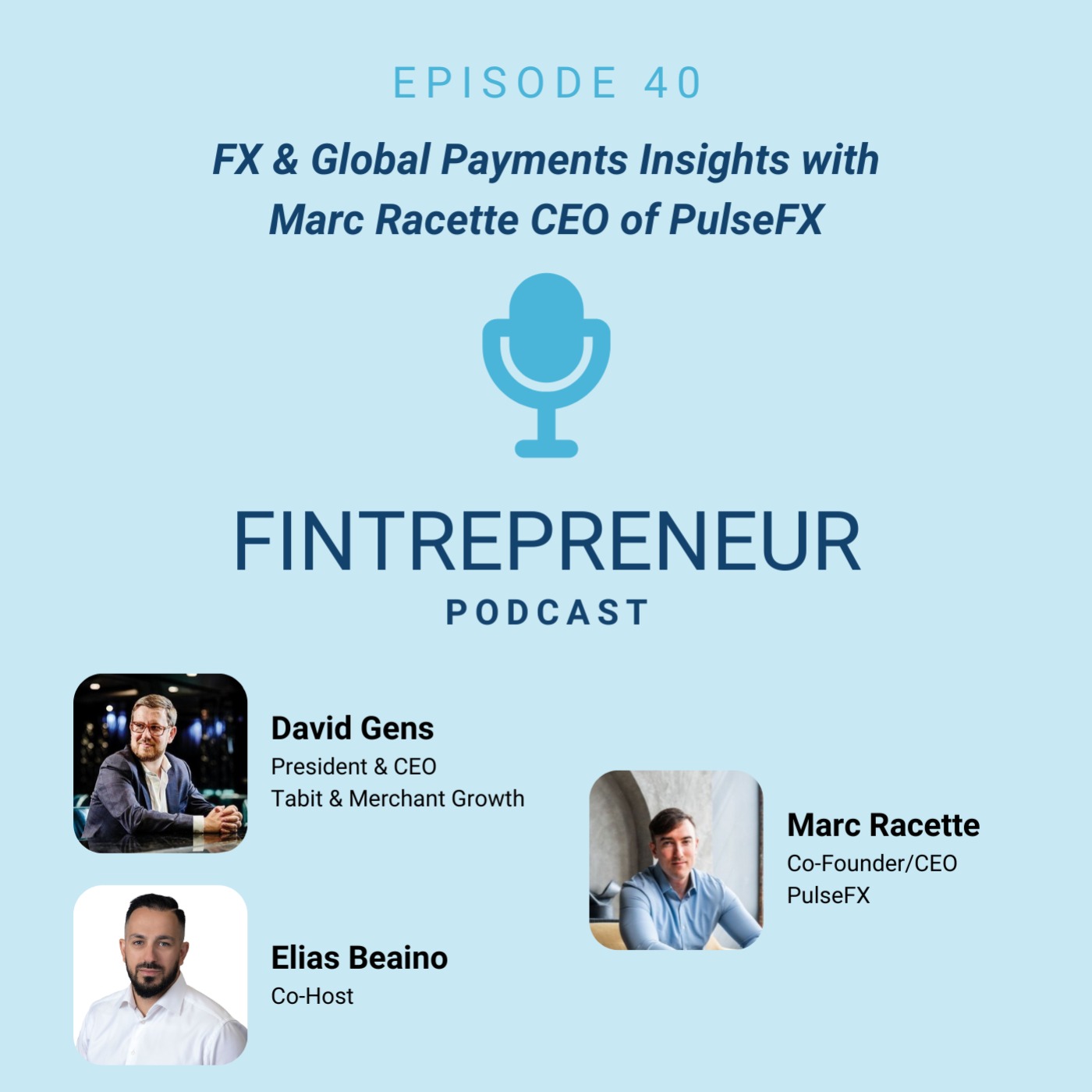 #40: FX & Global Payments Insights with Marc Racette CEO of PulseFXFintrepreneur · on Stripe78 / 100
 MicroConf Tactics: Start a SaaS From $0 in 2026MicroConf On Air · on Stripe77 / 100
 Avi Eyal on Why Great Founders Still Matter Most in the Age of AITechnovation with Peter High · on Stripe72 / 100
 Interview: Brooking’s Aaron Klein on Faster Payments, Consumer Credit & the Fed100 / 100
 Interview: Maple Cofounder Joe Flanagan85 / 100
 Exclusive: Neobank Current Raises $80M Series E65 / 100
 Fintech Recap: Everyone Wants To Be A Bank73 / 100
 Interview: zerohash's Founder & CEO Edward Woodford77 / 100