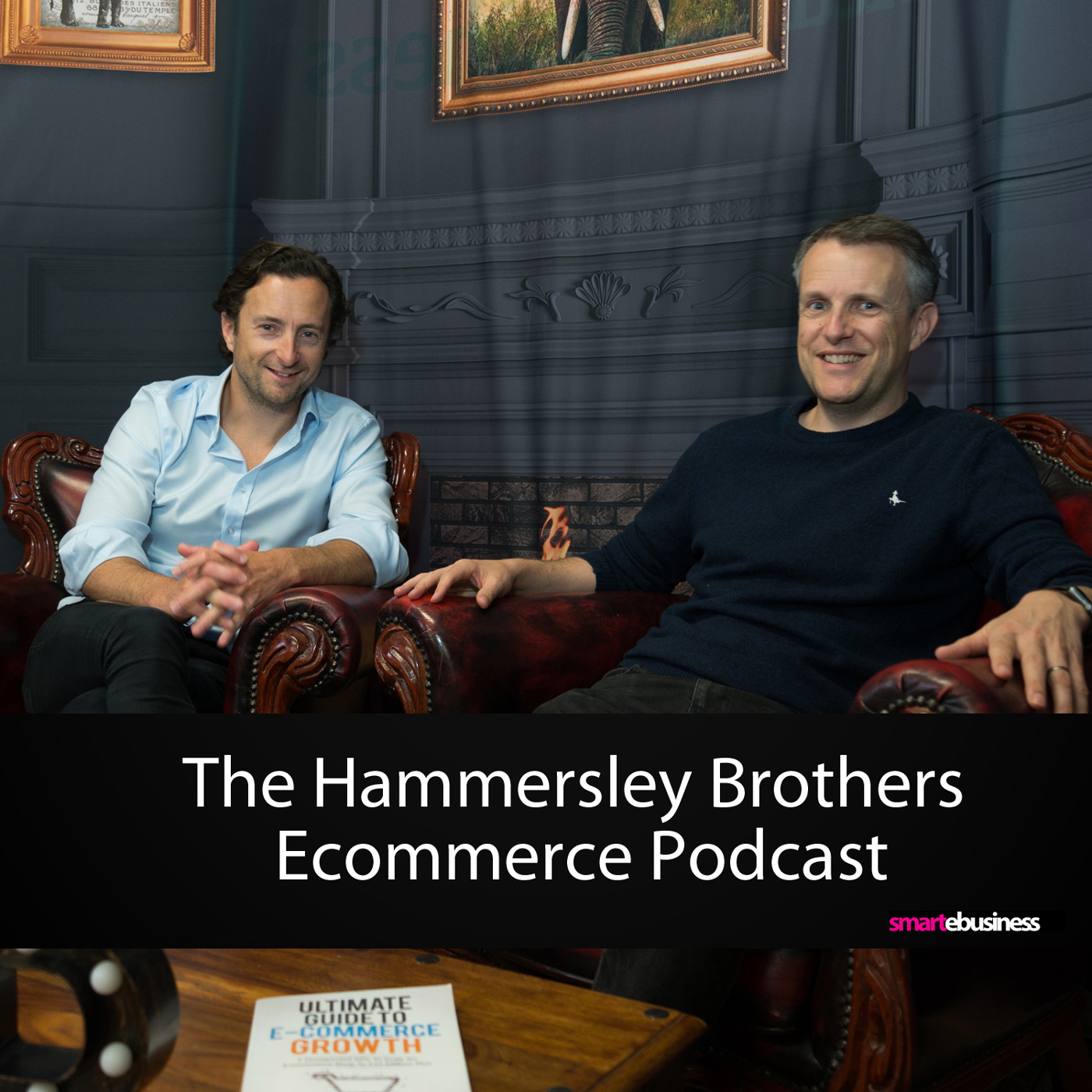
Ecommerce: The Hammersley Brothers Ecommerce Podcast · 2026-07-02 · 32 min
Key moments - from our scoring
Substance score
30 / 100
Five dimensions, 20 points each
The Hammersley Brothers break down the second stage of ecommerce growth - the often-treacherous jump from 100K to 500K annual revenue. They argue this phase requires the same effort as 0-100K, but demands a fundamentally different mindset. Rather than chasing new technologies like ChatGPT ads or the latest Meta algorithm updates, founders must resist shiny object syndrome and focus on what actually moves the needle: trust signals, offer architecture, product photography, and email capture. The hosts emphasize that most internet ecommerce advice is sensationalized clickbait ("SEO is dead," "email is dead") that assumes one-size-fits-all solutions. Instead, founders should apply the beer mat test - can you describe your business in two sentences? If not, you're not ready to scale. They warn against bringing in agencies at this stage, since agencies won't challenge your weak fundamentals and will only extract profit. The episode stresses mastering your numbers using their flying bridge methodology - knowing which metrics to check daily, weekly, monthly, and quarterly - rather than obsessing over vanity metrics. This is less about financial sophistication and more about disciplined focus.
The beer mat test means you should be able to describe your entire business and how it works on the back of a beer mat in just a couple of sentences. If you can't, you lack focus and customers and algorithms won't understand who you are either.
Agencies at this stage won't challenge your weak fundamentals like trust, offer architecture, or margins - they'll just throw ad spend at problems. Their incentive is to keep you as a client as long as possible, not to push you into the harder work of fixing your core business.
It's a framework for knowing what numbers to look at and when: certain metrics daily, others weekly, monthly, or quarterly. The key is having discipline about which specific metrics matter for your business rather than tracking everything and understanding nothing.
No; most new platforms stay around long enough to learn from others' mistakes. Focus on doing the fundamentals right - trust, offer architecture, email capture - rather than chasing shiny new channels that everyone else is talking about.
The core numbers are margins, cost of acquisition (CAC), current lifetime customer value, net profit, seasonality by channel, and how aggressively you can spend at different times of year - not every metric on a spreadsheet.
Our reviewer’s read on each dimension, with quotes from the episode.
The episode covers five recognisable principles (shiny object syndrome, agency trap, know your numbers, pick one channel, keep it simple) but spends most of its runtime restating each point in slightly different words rather than developing them. Very little that a moderately experienced operator hasn't already encountered.
you've got to know, um, what to look at daily, you know, what not to look at daily, what to look at weekly, what to look at monthly
avoid being distracted. You have to avoid. Because it's very, very Easy to add complexity for the sake of adding complexity
Every major point - shiny object syndrome, 'know your fundamentals before hiring an agency', 'don't spread budget across channels' - is a well-circulated ecommerce platitude. The 'beer mat test' is a useful shorthand but is simply a rebranding of the standard 'elevator pitch' concept.
Shiny Object syndrome. And why, why is that such a problem?
you cannot take a crappy business to an agency thinking that they're going to fix it
The hosts are working practitioners who have run their own ecommerce stores and a coaching programme, lending some credibility, but the format is two brothers chatting with no external guest, and the episode doubles as a sales pitch for their own services, which undercuts objectivity and depth.
we've scaled thousands. I mean, we've been involved with thousands of E commerce businesses
we would say, come and speak to Mark and I, because we will teach you that you don't need an agency
A handful of concrete examples appear - a bedding business on Google Ads, a woman pivoting from clothing to hair extensions to reach £5 million, a 10k/month store splitting budget 50/50 - but none are developed with real metrics, timelines, or named brands. Most claims remain at the level of anecdote.
we sell white sheets to, uh, to go on Google Ads. We've got a great margin
she got to 100k and then she was like, okay, I'm just going to do hair extensions. And then she got to 5 million
The format is two co-hosts who overwhelmingly validate each other, with almost no challenge or probing follow-up. Questions like 'why doesn't an agency work?' are immediately answered by the same speaker who asked them, and tangents (tin foil on stage, Pompeii restaurants) eat time without adding substance.
Why, why doesn't an agency work? Why does it sometimes work? Because it does work in sometimes.
Sounds like an Animal Farm quote there.
Computed from the transcript - who did the talking, and the words that came up most.
This week on the Hammersley Brothers eCommerce Podcast, we continue our series on the stages of ecommerce growth. After covering the 0 to 100K stage last week, this episode focuses on the next major step: growing from 100K to 500K per year. This is where many ecommerce businesses start to feel like they have something real. But it is also the stage where founders often make the mistakes that stop them from scaling. In this episode, we break down: • Why 100K to 500K is the danger zone for ecommerce brands • How shiny object syndrome slows down growth • Why most new tactics, platforms, and trends are distractions • The “beer mat test” for simplifying your ecommerce business • Why agencies often fail at this stage? • The numbers you actually need to understand before scaling • Why looking at too many numbers can hurt your business • How to avoid spreading your budget across too many marketing channels • Why profit, cash, and focus matter more than attribution obsession If your ecommerce business is doing around 100K per year and you want to get to 500K, this episode will help you understand what to focus on, what to ignore, and how to avoid adding complexity too early. P.S.
Transcribed and scored by The B2B Podcast Index.
Speaker A: Hello, you're listening to the Hammersley Brothers E Commerce Podcast. If some of our discussions and tips
Speaker B: are, uh, working for you, why don't
Speaker A: you grab a, uh, 15 minute call with us@ecommercecall.com we'll see whether we can help scale your e commerce business. We will quickly see if we're a fit or whether we can recommend someone else to get you where you need to go. The worst case is you'll have a fun 15 minute chat and regardless, you'll come away understanding a lot more about your business. Book a call@ecommerce.com hello and welcome to
Speaker B: the Hammers Brothers Ecommerce Podcast. This week we are talking about the second stage of e commerce businesses in terms of revenue. This is the 100k to 500k. Last week we went through the 0 to 100k annual stage. So this is when we start thinking that we might have a business. There's a certain things that slow uh, ourselves down in the past when we've gone through this stage and also what we see in other people. So let's get started. Hello Ian, how are you?
Speaker C: Hello Mark. Yes, well, I'm good. Happy E commerce day.
Speaker B: Welcome to the second in the series of the podcast we're doing on the stages of E commerce. And um, so last week we did 0 to 100k and obviously that is the stage where lots of chaos, lots of things, you try different things, doing all sorts of stuff just to kind of get a business. Because at the beginning of that you don't have a business, at the end of it you do have a business. So this is from 100 to 500k, so this is obviously different. So do you want to deduce it a little bit and then we'll just, we'll just crack into it.
Speaker C: Yeah, yeah. So the, I mean the reason why we are, the reason why we're breaking the e commerce growth down into these revenue chunks and obviously there's exceptions to the rule, but the reason why we're doing it is because, um, there are certain things that will move the needle when you're at certain sizes, you know, and there are so often you can have a list of things you should be doing in the business and probably they're all right, but depending on what size you're at, will make a massive difference to if they are effective. Um, and so that, that, you know, and that is something that, you know, I think if you, you have to apply the size of your e commerce business to understand what to do next and the Whole philosophy of Mark and I and everybody in the, in the program is to know what to do next and to remove that guesswork. So hence why this is a really important element. Um, you know, and obviously over 25 years of us working with lots of different ecommerce businesses, we've seen things that move the needle. We know what moves the needle. We know what's a waste of time. And a lot of it actually is simplifying it, simplifying the clutter out there. So this is the hundred to 500k a year, uh, stage. So you've got past the 100k, you know, and note the following. The same amount of work typically is needed and the same amount of time typically is needed for each stage. And that's why we've done it. So the 0 to 100k is about the same amount of work to go from 100 to 500k and thereafter, you know, not always, but as a general rule, you know, it is. That's why we've picked these certain stages. So, um, um, the hundred to five. I mean, that's my introduction. Do you want me to go through? Because we, we've got, we've got five points.
Speaker B: Yeah, we've got five points. Let's just go, let's just crack into them. I think this is. Yeah, yeah. It's easy to get talking, isn't it?
Speaker C: Yeah. See, I like talking, um, like talking about E commerce. So the, there's five and these, I, I suppose these are um, these are like mantras or things that mistakes we see people make or things that we think people should be focusing on looking at or you know, distractions that can be. So I think the, the 100 to 500k, the first one of the five is that you start to become really focused on, on your. I'm not saying you're not relentlessly focused at this stage, but you start to go, we've got past the, you know, we've got past 100k mark right now. We feel like we've got to add complexity and you start to become hyper attentive to, to everything that's going on around you about E commerce. Because you kind of, you know, when you're in, when you're sort of under 100k, you can. Well, I'm not really sure. I'm just proving that this thing can do something. So you're doing your first 100k and it's, this is the danger zone. Um, because you have to avoid being distracted. You have to avoid. Because it's very, very Easy to add complexity for the sake of adding complexity. So we call the first one is Avoid the Shiny Object Syndrome. And I call it the Shiny Object Syndrome because. And. And every time I go and speak on. At a. At an E. Comm event around the world. Sounds grandiose. But whenever I go and do it, occasionally I get asked to speak at events. Um, not you, Mark, only me.
Speaker B: I get asked. I just, I just, I just refuse to. Because it would just be the worst thing that ever happened to me to have to fly somewhere and speak to a group of people.
Speaker C: Yeah, yeah, I know. So, so, so I always start my, my talk with, um, some shiny metal. Like, it's actually tin foil because it's like the shiny art you sign. It's just something shiny and I. And M. That's it. They just. So I walk on stage and I literally just have shiny tinfoil behind me in a, you know, the big massive slide with no words on it. And I say, why have I got some shiny metal object behind me? Because it represents the biggest mistake people make in E commerce, which is they all get obsessed with the shiny thing. Shiny Object syndrome. And why, why is that such a problem? Because it's. Hey, you know, it's fun, isn't it? Right? And it, the problem is that with Shiny Object Syndrome is you add. You're taking your eye away from the things that matter and it's attempting to do the thing that looks exciting that everybody's talking about. Oh, it's all about this. It's all about that. It's all about this. It's all about this new TikTok series. It's all about this new Instagram, um, you know, algorithm that's come out. It's this new secret technique that you need to do with your Facebook ads, your email, and it's. And you become obsessed with the Shiny object syndrome. And 99% of the time, it never is the thing, the breakthrough. And if you look at any e commerce business that we've scaled over the years, and we've scaled thousands. I mean, we've been involved with thousands of E commerce businesses, haven't we, over the years? And, um, I don't think any of them really said that our success was this new amazing technology that came in. And, uh, we just, you know, we were the first to market. I would say there are a few exceptions to that.
Speaker B: There are some fatties, those fad things like that. But what I would say is that whenever there's been a new technology in E commerce and there's been Shiny object syndrome. People have jumped on it maybe too soon. The bus has always been there for a long time to get onto the bus. Like when Google Ads came out, you could get onto that bus for about 10 years. You know, when it first came out, when you like meta ads, uh, these buses were, they wouldn't just stay around for like 2 seconds and then disappear. You could get on them. That you can learn from other people's mistakes. You can understand it. You don't have to kind of commit to yourself, to everything. It's very similar like ChatGPT Ads. Now ChatGPT Ads is opened up, people are trying it and stuff like that. But for most people or for the majority of people, it's not going to be a complete game changer for their e commerce models. Like it's, it's just something that's, that's happening and that that boss will be around for a while.
Speaker C: Like if it's so tempting, isn't so tempting to think that that's the unlock.
Speaker B: Mhm.
Speaker C: And I mean, and I, you know, it's a good, here's a good example. You know, you think, let's do some ads in chat GPT and loads people be thinking, oh, the new. This is what we've got to do. This is what we've got to do. What they're not looking at, uh, is the fundamentals, like have I got enough trust and credibility in my store? Have I got my offer architecture dialed in? Have I got the right product photography? You know, have I got, you know, is my email capture good enough? You know, story?
Speaker B: Yeah. Something other than I wanted to sell this. Yeah.
Speaker C: So we're saying here that be very, very careful, Number one is avoid shiny object syndrome. Be very, very careful about chasing the latest trend. You got to be really, really careful. It's not necessarily about adding more complexity. It's about doing the fundamentals right. Which of course is what we teach about. So the second, the second one is connected to this first one. Um, and it's stop listening to everyone on the Internet. Um, everyone has an opinion and obviously we're on the Internet listening to us. So you should stop listening to us and you should do something else. No, I think when you listen to other people talking about e Commerce on YouTube, or in a blog or in a post, it's very sensationalistic. Uh, I, uh, don't even think that's a word. It's sensationalized in that it's been dramatically put in there so that you go and read it. You know, things like you know, SEO is dead, email's dead, meta's dead. You know, no one's, no one's doing, um, affiliate marketing anymore. You know, it's all like wildly clickbait. It's clickbait. And it assumes that one size fits all, assumes that every e commerce business is the same. You know, uh, you've got to understand what type of e commerce business you are. You got to think about if we were a bricks and mortar store, you know, what, what kind of business would this be? Where would the shop be? You know, what would the experience be? You got to, you got to, you all you are. If you're an e commerce business owner, you are just a retailer, right? You were a retailer. And what that means is that you can run the retail. You know, people have been running retail shops for thousands of years. I mean, look, I was watching a documentary about the Pompeii, you know, the shops in Pompeii and how they merchandise the store and the, and the, you know, the, they had a restaurant there that was making the bread and they would do deals in the morning and then they would do deals in the afternoon. You're doing the same stuff that every retailer's been doing for thousands, thousands of years, that you' doing it in a slightly different format, you know, and so stop thinking that you're doing something revolutionary. You're not, you're just a bloody retailer. And understand how you shift stuff. You're just moving from, you're moving a product from one side of the world to another. So be very careful about who you listen to. You said something really good because we were just thinking about this topic earlier and you said that, do you pass the beer mat test? And I think that's brilliant. Just tell everyone what that is because it's relevant at this stage.
Speaker B: So set the scene. You're doing 100k a year now, so you, you think you've got something there. You probably haven't yet, you know, but you've got something, right?
Speaker C: So you should be able to describe
Speaker B: the business on the back of a beer mat, basically in a couple of sentences. So if we'd done it like, let's talk about one of our sites that we've gone through this, uh, phase more recently. So, like betting, right? It was, we sell white sheets to, uh, to go on Google Ads. We've got a great margin. And our email, uh, our email offers, uh, build out the lifetime customer value. Like it's, it's, I mean, it's the start of something, right? It's it's how the business works. You know, it could be I sell a piece of jewelry and people come back and buy things to go with it and it sells to this demographic like it essentially is what is the business on the back of a BIM app? Because if you can't write it down like that, it's going to be very difficult to scale. If you have to go, well, I sell this little bit to these people and I sell this, this, these people and there's this, this product over here and it's this like, if you've already got mess at, uh, this level, that's a warning sign that you need to clean up because you need to focus on one thing and do really well. Remember, remember that a time ago that lady who did the, the, the hair extensions and she started off with a clothing store and she was selling dresses and, and like she got to 100k and then she was like, okay, I'm just going to do hair extensions. And then she got to 5 million. And it's, it's, you have to be able to articulate the business very quickly is what I'm saying. Because if you can articulate your business very quickly, you, you can move up now. It's almost like you've got a bit of data and you're looking around in that data, uh, and you're looking around in that data for an elevator. What is the elevator that's going to take you up to the next level? And you can't, if you've got an elevator, you can't take all your luggage with you. You can only take one bag, can't you, you can only take a few bags with you up there. Uh, you can't take all the mess that is that you've created with you. You have to say, right, we're going up the elevator and this is what's going to get there. So that's the kind of analogy that I was looking for. Because if you want to get to the next level, you have to do what you've been doing better and faster and quicker and more lean and, and stream.
Speaker C: Well, I think it go, I think it go. I think what you're basically saying is you, you've got, you know, if you can't explain your E commerce business, who it's for, what you're selling and what it solves, um, on the back of a beer mat, then, then your customers won't be able to understand who you are and Meta won't be able to understand who you are. Google won't be able to understand who you are. TikTok won't be able to understand who you are. You know, nobody knows who you are. You're just sort of floating in the, in the middle of a mush and E commerce likes to know who you are. It's not like you are the only corner shop in the town. You have to sell everything in that corner shop to survive because you're the only bloody shop. You know, if you had a physical bricks and mortar store, you know, online people can go and buy from anywhere. So you've got to have a focus. So, um, yeah, so I think keep it simple, you know, avoid adding complexity at this stage. So the third point is be very, very, very careful about not falling into the agency trap. Uh, what do I mean by that? You know, you, you, you go, or I've got, I've got my first hundred K and now I now want to get to half a million quid. And you start to look around for agencies, um, who you think will fix your parent. Either other worry or anxiety about how complex Google Ads are or how complex Meta ads are or my Klaviyo is a too. Like you believe that they're going to help you scale because if only I could just do, I've done 100k. If I knew Klaviyo better or if I knew, uh, Google Ads better, or if I knew Meta better, uh, imagine what I could do. And you start to go down the danger zone of bringing in other agencies who you believe are going to help you accelerate. And what tends to happen is they won't challenge you with the right things like what's your offer architecture, what's your margin like your website isn't any good enough anyway. You haven't got the basics of the trust and credibility, you know, and you. And they end up shocking money at ads. And they're only the agency not being disrespective to all the agencies, but the agency's objective is to keep you as long as they can. That's what their goal is. They try to keep you as a client as long as they can. They don't really push you in the right area. And, uh, they don't want to be brutal. You know, they're being polite because they don't want to upset you. Because they upset you, you leave. So you've got to be very, very careful. And that's really where we would say, come and speak to Mark and I, because we will teach you that you don't need an agency. You can do it yourself at this Stage, you don't need an agency. All they'll do is suck profit out the business.
Speaker B: Yeah, um, I mean, why is that? Let's talk about that. Why, why doesn't an agency work? Why does it sometimes work? Because it does work in sometimes.
Speaker C: And why doesn't it work sometimes? I think it's because I think that if, if you've got a good business, an agency can amplify it and they can, they can scale it because, because you've nation's right. Um, but the, the agency, they don't create the good business that comes from you understanding the core and the foundations and the fundamentals. So I think if, if you can't write your, your beer, if you don't pass the beer mat test, um, if you do, if you cannot write your e commerce strategy on the back of a beer mat, there is no way an agency is going to be able to take that business and scale it. You know, you've got to get it right. You got to know who you, who your customer is. You got to know your products exactly why people would buy them. You got to know your margin, you got to know your numbers. You know, you got to get the foundations exactly right. And you can't take a crappy business to an agency thinking that they're going to fix it. You could, because they can't. They, you know, just won't work and they won't push you enough because the agency will sit in the, you know, the meta agency will sit over there in a silo. Your Shopify, you know, will be here, your email guys will be over there, your, your pay, your Google Ads will be, Nobody's talking to each other. You just get stuck in the middle.
Speaker B: Do you think, I mean, I think it comes down to understanding your business fundamentally. You're getting that beer mat. You've got to understand that beer map process of your business. And once you understand what it is and what it isn't, you have a better chance of working with an agency to, to actually grow it. I think the difficulty is if you take that chaos and then take that to an agency and say, look, uh, I've got all this chaos and then try and grow it, they're just going to come and just throw ads at the wall and see what sticks and see if, and if it doesn't work, they won't have the ability to have the conversation with you to change those things. I think that it's much easier to scale with an agency once you have worked out what works for you and then give them that it's a bit like anything, bringing people into the team and you say, well, this is how it works, this is the system we use, this is how it works. Now you go and implement that and then also if you've got that, you can make sure they're following it over time. So, yeah, um, well, I think the
Speaker C: fourth point is linked to that. Why does an agency not work at this stage? And I think it's often because you, you as a business have. When we say understand the fund, the foundations are fundamental. You've got to understand your numbers. You've got, you've got to, you cannot be drawn in by opinions or emotions. You have to have a rational follow up process of following the numbers. You have to know exactly, you have to know your numbers, what your margins are, what your CAC needs to be cost of acquisition, what your current lifetime customer value is. You got to know your net profit, you got to know exactly which channels you should be pushing, how aggressive you could be spending at this time, at each time of year, your seasonality. You've got to really know your numbers. You've got it. That's the bit. This is the bit where if you are going to scale, not just the 500k, you know, to the next phase and the next phase, this is when you've got to really own the number.
Speaker B: And they're not hard numbers. They're not.
Speaker C: No, this is ridiculous. We shouldn't even call it the number sheet because as soon as we say the number sheet people go, okay. And they go, oh my God. I don't, I don't, I'm not good at numbers. I mean, no, this is, this is like, you know, counting conkers on the concretory. I mean, it's literally obvious. It's dead simple stuff, but it's the discipline of, it's, it's, it's like, you know, with. The biggest thing I could say is that you've got to know, um, what to look at daily, you know, what not to look at daily, what to look at weekly, what to look at monthly, what to look at quarterly. We, we, we used it, we what we do, we call it the flying bridge methodology, don't we? You got it. Flying bridge methodology. When you, when you're driving a big ship in the sea, um, you know, you've got to have the dials coming up, showing you what's happening because, you know, because you got to look where you're going and you've got to have the information coming that you need to see if you're down in the engine room looking if is the engine okay, you've driven into, into a rock, you know, so you've got to know what to look at. When. I think that's. That let's. That's the key is know what to look at when. What numbers. Look at when. Like every Monday. Look at this number. Don't look at anything else, just look at this number. If it says this, do that.
Speaker B: If it says that. I think though, at 100k you're only doing 10 grand a month. You're not, you're probably not full time. You, it won't be your full time job, will it? So you've got to simplify it down to something that allows you to scale so that you can only have to look at these numbers periodically to make sure you're on track so that you could build it.
Speaker C: And what happens is people look at the numbers. If you don't have the discipline of knowing what to look at when. Right, but you tend to look at the numbers and you go, oh, there's a number and there's another number. And you go, well, I don't know what it means, but you look at everything and it means nothing. It means. Because without the context, it's pointless. It's pointless. I mean, people say this to us, oh, gotta faith in the numbers, gotta know. I've gotta make sure everything's absolutely right. So hang on, there's some numbers on the sheet that you've probably never looked at. You're probably never gonna. Anyway, you gotta, you gotta know what's in the point.
Speaker B: That's a point. That's a very good point. Like we create a number sheet for everybody, right? We create a number sheet for everybody. And I know that probably on our number sheet for our businesses, I only really look at two of those sheets, but sometimes I put other reports onto that sheet because it might be a discussion point in a meeting or something like that. And then you go and give that to someone new and then they go, that number's wrong on that sheet and that's not working like that. And you go, well, for five years I didn't even have that sheet on my numbers sheet. I've never used it before. I've just introduced it for that meeting. And now because that number's not quite accurate on that sheet, you think everything must stop. Your whole business will stop until you get that fixed by adding more numbers. You slow yourself down because you start thinking it's important. Whatever you put in front of yourself, you start thinking it's important, but it's actually really. There's very few fundamental numbers you actually need for your business.
Speaker C: And they're so important. It is, there's something, there's something very important about that from a psychological perspective. There's something key about. There is a belief that every number is as equal, is as important as everything else.
Speaker B: Yeah.
Speaker C: And, and, and, and if you, if you absolutely, if you could only look at one thing, what would it be? Because 90 of it is in that number. And I think that's the, that's the key. And it's, and when we hear that, when people say, oh, what, I don't. What is that? That number's not right. You know, there's a, you know, and it's in a tab that we've never, like, as I say, it might be a. It just, it makes you realize that they, you know, that when, you know, they're missing the, the fundamental key.
Speaker B: Noise. All noise.
Speaker C: And, but you gotta, you gotta look at this. Forget that that's completely relevant anyway. But, so that, that's the thing people think when we say, look at the numbers, look at the numbers again. They look at all the bloody numbers. They look at bloody everything, all the, you know, for a week. They're obsessed with the numbers. And then they come away and they go, I have no idea what to do. I have no idea what to do with these. And then they don't look at the numbers again. You know, so it's like, no, so, so that is a mindset and that's big part of our philosophy. And that's probably the number one thing that we've. That's helped us grow our own ecommerce. We know what numbers to look at.
Speaker B: Not all numbers are important. Some are very important and some are completely.
Speaker C: Sounds like an Animal Farm quote there.
Speaker B: Ah, it just comes down to, like, how much you can afford to buy a customer, how much the customer's worth to you. Worth to you over time. And can you manipulate that a little bit? Can you optimize it? Like, it's, it's, it's as fundamental as that, really. You know, it's like I, I've got a machine, I put $5 in, I get $10 out. How many. How much money?
Speaker C: And at some times of year I can put more in and it keeps giving me $10 out. But another times a year, I can't put as many in.
Speaker B: Yeah, exactly.
Speaker C: So I think the fifth, the fifth one, the closing point really is, is not to add too many marketing channels. So at this point we would always say, and until you're doing a million quid, um, or a million dollars a year, you have to be really care. You don't need to add more marketing channels. Particularly, you know, I mean, you could have a little play, of course, but don't think you gotta go and spend equal amount. I mean, the worst thing you could do would be to spend equal amounts. You know, when we see 50, 50, where they go, oh, I'm gonna spend 50% on Google, 50% on Facebook, and it's like, no, I see that when you look at them, I see it all the time.
Speaker B: People doing like 10 grand a month. And I'll come and look at those and goes, I'm spending 1,500 on Google, 15 Facebook. I was like, what are you doing? One of those is gonna be better than the other. Like, there has to be. And it's just, and it's like, you're not gonna know. You're just not gonna know it was someone last night. It's like exactly that.
Speaker C: Yeah, it's like having a, uh, it's like doing like a, like, like a, doing like a radio campaign. Back in the old days, doing a radio company TV campaign. You go, well, I don't know which one's working better, you know, you don't know, but it'd be, of course, you know, you know now you know exactly which one is performing hard, you know, but it's. Anyway, well, it's like, it's, it's like
Speaker B: if you were doing a radio campaign, you wouldn't do a TV campaign. At the same time, you just do the radio campaign and see what business comes in. And then you'd go, well, I know that's the radio campaign because that's all we're doing at that level of business. That's what you would do. Uh, because the only way to know how effective that channel is is to do. Know the channels. Is it?
Speaker C: Yeah. And I mean, what we're looking for is incremental. And the way we teach people is to do incremental testing. And I think the other danger in this stage is that people get obsessed with attribution. Uh, they get obsessed with attribution. And honestly, I think, go back 10 years ago, if you'd asked us about attribution, we would have talked about attribution for about an hour, passionately about the perfect attribution model. The first touch, last touch, blended. Now, we don't talk about attribution because we know majority of it is complete and utter waste of Time. Uh, um, why? Because we're looking at profitability, we're looking at setting up the channels correctly so you're not spending the wrong amounts in the wrong areas, you're not overspending on your customers, the frequency is right, your brand campaigns are under control, everything is really set up nicely and then you can focus on profit.
Speaker B: And that's what a nice audience. If I only knew which ads were driving revenue, then I could spend more on those ads. That's the simple sentence. But when you look at it, you go, well that person came on Google Ads, they did the email and then they then went to Facebook. And it's how everything interacts. And you go, well, how do you attribute that? And you go, okay, we'll give 20% to that, 20% to that, 20 percent to that. And you go, okay, uh, oh, well that, ah, you end up answering a very simple question in a very complicated way. And it's like you dive into so much data and so many things that actually confuses you. And I've come out of the other side of that over the years and really what's now important is the signal that goes into meta and the signal that goes into Google and essentially that you've got to make that signal as accurate as possible for those tools because they will do better if they've got a better signal. It almost doesn't matter how you understand your attribution, it's how Google and meta and those tools understand what effectiveness they're having. That's, that's the play really, because you might even realize that, oh, this ad does that and you just, but if you understand it, but you've got no control over your algorithm inside Google Ads and meta ads can't do anything with it anyway because yeah, I think they're
Speaker C: choosing, I think, sorry, at this state, I think you're coming into the next phases actually, which we'll obviously be talking about tracking and things like that, next phases.
Speaker A: Right.
Speaker C: But this stage, your 100, 500K, your attribution you're tracking is the cash you got in the bank.
Speaker B: Keep it simple.
Speaker C: That's the, you know, keep it really simple, you know, um, you know, so I, I, I honestly think, you know, you, you're in danger zone. You're in the, this, this is the bit where you start to either really grow fast or start to com. Have a complex. And the same thing about bringing too many skus on them, too many products.
Speaker B: Yeah, but yeah, back of it, maybe your business should be back of a beer mat it should Be as simple as, like, if you came to us and you said, look, I'm trying to scale this, I've got to 100k, I'd go, okay, give us, give us your business on the back of a beer mat. And if they couldn't do it, then we would say, right, let me help you get it onto the back of a beer mat so we can actually scale it. That's what we would be looking at. Um, do you have something you can get to 100k without much of a thing? Like let's say I was selling clothing and I just sold clothing to my friends and family and a few people online and stuff like that. But like, if to get to 500k a year, my story needs to actually say something to the market as well. It needs to have a positioning and it needs to do something, need to break out of like being a corner shop to being a shop on the high street that actually dominates, dominates attention.
Speaker C: So while you're stealing, you're starting to steal market share a bit more and obviously you're trying to be profitable. I mean, at this point you may have not been profitable, you know, you, so you start to think about cash flow, you're starting to think about profit, you start to turn it into a business, you know, and, but, but the, you know, and obviously the fundamental part of it is you need to, you need to be careful where you spend and that's why you careful about agencies, um, because they will literally suck the cash out of your business. Cuz obviously they are, they affect your, your roas, don't they? Anyway, I think we'll leave it there. Yes, thank you very much. Closing thoughts? No good, Brilliant.
Speaker B: We're all good.
Speaker C: All right, thank you very much, Ian.
Speaker B: Sweet to see.
Speaker C: Thanks everyone. M. I'll see you next week by.
Other episodes covering the same guests and topics, from across The B2B Podcast Index.
 Your ICP Isn't Real Until It Shows Up in the CRM (with Christy Behnke from Terryberry) | Ep. 279Scrappy ABM · on ChatGPT ads86 / 100
 MicroConf Tactics: Not Sure How to Market Your SaaS? Start HereMicroConf On Air · on Google Ads83 / 100
 Ep. 280: Mid-Year Marketing Check In - Same Tactics, New SteroidsOut of the Hourglass · on Google Ads80 / 100
 From £3k to £80m: The Bootstrapped Must Have Ideas Growth Story with Amy KnighteCommerce MasterPlan · on Google Ads78 / 100
 He Was the Only Marketer at a Startup Fighting Service Titan - Here's What WonStacking Growth · on Google Ads78 / 100
 E-Commerce Localization: How to Successfully Expand Into Global Markets - Show #160The Global Marketing Show · on Google Ads75 / 100Why Most eCommerce Brands Never Get Past Their First 100kThe 5 Stages of eCommerce Growth and What To Focus On At Each OneWhat Million Dollar eCommerce Brands Talk About Behind Closed DoorsThe Ecommerce Forecasting Mistake That Kills GrowthThe Ecommerce Mindset Shift That Changes Everything