
Dronecast · 2026-07-28 · 38 min
Key moments - from our scoring
Substance score
58 / 100
Five dimensions, 20 points each
Jason Burnside, leader of Austin Fire Department's drone program, shares practical approaches to maintaining pilot skills and navigating emerging regulatory challenges. The conversation centers on the 30-minutes-per-month minimum flight requirement that Burnside emphasizes is sufficient for currency but not proficiency, supplemented by monthly fly days, continuing education courses from Pilot Institute and the FAA, and a developing web-based task book with 50 maneuvering skills. Burnside openly discusses frustration with anti-China drone legislation, arguing it prioritizes political and commercial interests over public safety capabilities, potentially forcing agencies to use equipment three to five years behind in technology at triple the cost. On community trust, he advocates transparency through school visits, public fly days at events like ACL and UT football games, media engagement, and detailed flight tracking policies. He emphasizes that demystifying drone technology through direct community engagement - showing both capabilities and limitations - has shifted public perception from fear to acceptance.
Austin Fire Department requires pilots to fly a minimum of 30 minutes per month to maintain currency, though Burnside emphasizes this is sufficient for currency but not proficiency, and pilots are encouraged to fly 1-1.5 hours if they feel less comfortable.
Legislation being pushed at state levels would force public safety agencies to use domestically-manufactured drones that cost 3-4 times more, are 3-5 years behind in technology, and may create supply shortages since only a handful of manufacturers are ready to meet demand.
They engage through public fly days at major events (concerts, football games), school visits, media demonstrations showing both capabilities and limitations, detailed flight tracking policies for FOIA transparency, and positioning flight lines in public view with information screens.
Pilots complete mandatory annual Part 107 recertification (despite only needing renewal every two years), Pilot Institute courses with quizzes, FAA FAST team courses, and participate in monthly fly days that build on concurrent continuing education topics.
They are creating a web-based task book accessible on pilots' phones with access to the Red Team's video library, continuing education materials, 50 different maneuvering skills to practice, NIST course sections, and are developing drone simulation partnerships to allow practice during bad weather or without aircraft access.
Our reviewer’s read on each dimension, with quotes from the episode.
The episode contains substantive discussion of pilot proficiency frameworks (30-minute monthly minimums, tiered training approaches), organizational scaling lessons (avoiding over-rapid team growth), and specific policy structures (Part 107 annual recertification), but these insights are spread thinly across 38 minutes with considerable conversational padding and anecdotal filler. The core tactical advice on training cadence and program structure is valuable but not densely packed.
We encourage our pilots to do 30 minutes a month. And it used to be one battery, but it's depending on the aircraft you have access to one battery could be 10 to 15 minutes or you're talking about 30. So we just went to a straight 30 minutes a month for minimum.
We got to a point where we were growing our team quickly and just trying to efficiently add pilots to our operational capabilities. And what we found was we got them out in the fields and it was really, really challenging. We had more pilots than we had aircraft.
The episode recycles familiar B2B playbook elements (invest in training before scaling, establish policy before operations, build community trust through transparency) without challenging conventional wisdom or introducing contrarian frameworks. The leasing-vs-buying discussion offers modest novelty for fire departments but is not groundbreaking business thinking. Most recommendations align with standard program management orthodoxy.
You have to nurture and constantly reassess what we're doing and making sure that we maintain that trust.
The key is transparency. We have the public's trust. And that is a delicate thing that you have to nurture and constantly reassess what we're doing and making sure that we maintain that trust.
Jason Burnside is a legitimate operational practitioner - 11 years in the Austin Fire Department with direct command of a UAS program at scale, leading the Red Team, and actively shaping national standards through the International Association of Fire Chiefs robotics working group. He has earned credibility through doing the work rather than theorizing about it, though his expertise is narrowly scoped to public safety drone operations rather than general B2B business leadership.
I've been in the department for 11 years, and I had some really great experiences as a firefighter, even outside of the Red team. But some of my most memorable experiences are being a part of this team and flying stuff we never would have imagined.
the International association of Firefighters and International association of Fire Chiefs. They have generously endorsed a robotics working group that I had mentioned slightly earlier
The episode includes concrete operational details (30-minute monthly minimums, 90-day recertification cycles, leasing agreements spanning two fiscal years, specific tools like Matterport cameras and Pilot Institute courses, roof collapse incident with Matterport documentation). However, much discussion remains abstract and anecdotal - exact numbers of pilots trained, measurable ROI figures, specific incident outcomes, and quantified impact are largely absent. References to events (2020 Austin civil unrest, ACL music festival, UT football) lack operational specifics.
We broke up those payments over two fiscal years. That stretches our budget with what we can purchase either all at once or then have that money left over for other items that year.
We just last week had a mayday event where we had a roof collapse on, uh, one of our firefighters, two of our firefighters. Thankfully, no one was hurt. Everybody got out okay. But we were able to go into that house and completely preserve that scene.
The host demonstrates curiosity and asks reasonable follow-up questions (training cadence, community trust, decision-making under uncertainty), but rarely pushes back, challenges claims, or probes for deeper evidence. Questions tend to be open-ended invitations rather than sharp probes. The host extensively steers conversations toward his own company's solutions (DroneSense) and personal anecdotes, reducing space for critical interrogation of Burnside's actual effectiveness or limitations.
I'm curious how you guys, after initially training people and I've had the luxury of seeing you guys in action doing that. I've done a lot of corporate training and I've trained peers, I've trained customers. And Yalls is very exceptional.
I'm curious particularly about refinement of skills, reinforcing skills, and what kind of cadence are you guys on?
Computed from the transcript - who did the talking, and the words that came up most.
Original Recording Date: January 2, 2024 In Part 2 of this episode of DroneCast: Rethinking Public Safety, One Drone at a Time , host John McLeod continues his conversation with Jason Burnside, Program Manager for the Austin Fire Department’s Robotics Emergency Deployment (RED) Team. Jason shares operational insights on moving beyond basic flight currency to achieve true pilot proficiency. He outlines how Austin FD maintains high-performing pilots through monthly fly days, intentional practice routines, custom web app task books, and drone simulation software. The discussion tackles critical public safety industry shifts, including the impact of anti-China drone legislation on municipal budgets, data security double standards, and practical methods for demystifying drones to earn community trust. Additionally, Jason details high-impact management decisions - such as utilizing lease-to-buy models to stretch funding for emerging tools like 3D spatial mapping - and warns against common "poison pills" that destroy embryonic drone programs.
Transcribed and scored by The B2B Podcast Index.
Speaker A: Welcome to dronecast Rethinking Public Safety One Drone at a Time, a podcast by DroneSense. We explore real world applications of drones and emergency response, offering, uh, a close examination of evolving trends in drone technology and its impact on public safety. I'm your host, John McLeod, director of customer success here at DroneSense. Hello and welcome back to DroneCast rethinking public safety One Drone at a Time. Today we're sharing part two of our conversation with Jason Burnside from the Austin Fire Department Red Team. If you missed part one, you can find it linked in the description. So feel free to head over and listen to that now or once you finish the episode. Let's jump into the conversation now. It's interesting that you referenced drone as a first responder, which our drone sense remote solution. We've spent a lot of the last 18 months really working on that, where we really see it as future facing. And we're not always trying to solve the problem right in front of our face. We're thinking, hey, what's two years from now going to be super useful so that we can kind of bend that curve a little bit to the point where, and I think the equipment manufacturers are in the same place where, you know, these docks that people are starting to adopt, that you're alluding to are developing so fast that I remember we got effectively a, uh, V one of one particular dock that will remain nameless. And they brought out a V2 so fast. We were still working on the V1 and then they said, uh, oh yeah, don't worry about the V1 anymore. Take the V2. These are like super complicated machines even compared to drones. They've got Internet, electricity and a concrete pad you have to pour. They've got an H vac system and a charging system and doors that open and close and they've got to work in the rain and the snow and everything else. And if you were working in, let's say, inspection, like you're at a power plant or something like that, it's fairly consistent. Like you have the same people working in and out day after day. But I'm interested. You've got a pretty good sized team, right? And because of what we do, not only the complexity of the hardware in the solution, but also just fundamentally understanding the application in a real world. Right. Those skills erode, uh, and get forgotten, but so, so quickly. It's not a train. You once in a classroom and then you have three days of flying and now you know everything and you're never going to forget it. And I can knock on your shoulder a year from now and you'll be in prime condition to do that. So I'm curious how you guys, after initially training people and I've had the luxury of seeing you guys in action doing that. I've done a lot of corporate training and I've trained peers, I've trained customers. And Yalls is very exceptional. But both with the resources you guys have created and written. Yeah, absolutely. But just also the way you do the instruction, like nobody's pulling out their phone and playing Candy Crush. Like they're very wrapped into this whole thing, which can be a problem. People drift off and I'm thinking about their grocery list or what they're eating for dinner. But I'm curious particularly about refinement of skills, reinforcing skills, and what kind of cadence are you guys on? Are you burning a battery every month for every one, are you trying specific use cases like how do you think about that? What's the best practice?
Speaker B: So for us, this has been a continuing evolution on our ongoing training. And you're absolutely right. It's one of those things that if you don't touch that controller for a month, coming back in and just remembering where everything is even in on the software side of things, being able to do two button presses to get to what you want in some kind of submenu versus pressing eight or nine different things because you can't remember where it's at. We encourage our pilots to do 30 minutes a month. And it used to be one battery, but it's depending on the aircraft you have access to one battery could be 10 to 15 minutes or you're talking about 30. So we just went to a straight 30 minutes a month for minimum. And we even emphasized that is, uh, good enough for currency but not proficiency. So I make sure that our pilots understand that you're current, but if you still feel you're not necessarily squared away and super comfortable, you're more than welcome to get an hour. Give yourself an hour and a half of flight time. We also have continuing education or CES that we are rolling out. We have stuff that is produced in house as far as sometimes it's a PowerPoint presentation, sometimes we will have the team will release a video. We'll have a team get together and we'll do an in person training. So we do those ces. We also lean on really heavily on existing content that's out there that's already really well produced, high production value, good quality content. We lean on a bunch of different resources. For example, like we have Pilot Institute, we have quite a few of their courses that we can then point to and say, hey crew, I want you to go to this class that we purchased for you. And I want every pilot to do videos 1 through 10 and then take this quiz. We have our pilots do things through the FAA with the, uh, fast team, the safety team. We will point to one month. We'll say, hey, I want everybody to go in. I want you to complete this course on a yearly basis starting in January. The first thing we do with all our pilots is everyone goes and completes the Part 107 recertification. It's only required every two years. But because regulations are evolving so rapidly and there's just so much that is important for us as public safety professionals to remember that I want to have us, uh, knock the, any kind of dust off of that kind of content once a year. And so the other nice thing that that does for public safety or uh, for the program managers is that I don't have to worry about anyone's 107 certification lapsing because we're all doing it at the same time every year and everybody's staying super proficient with that. In addition to the 30 minutes a month we're doing fly days and we try and do those almost every month where we have an opportunity for our pilots to get together in person. And they have a three hour block that we have where we give them a skill set. And sometimes it's based off the CE that they already completed that month. So later in the month when we have the fly day, it's building off of that same, that same education and we're now doing the practical side of things. The other area that I'm working on for our pilots is that one of the things we emphasize is that when you go to fly the drone, never do it without something, without intention. Don't do it without a goal in mind of how you want to get better. Otherwise you just, you waste 30 minutes, you're checked out, you may as well be scrolling on Facebook. You're not paying attention and there's, you're not taking something away from that experience. And so based off that feedback we have created, I'm working on an application. It's a web app, uh, that our pilots will have on their phone that will have access to all of our Red Team library of videos, CES, PowerPoint presentations we have access to. What we're creating is going to be called a, it's basically a task book for our newer pilots that have 50 different maneuver maneuvering skills that they could practice. We're going to have a section in there that hits on the NIST course. So if somebody wants to get out there, we'll have a section for proctors to fill out forms, but also for short videos and things like that for our pilots. And something recently that we're working on that we haven't that's coming is the simulation side of things. We are working with a company that focuses on drone simulation and specifically they're seeking feedback from public safety to they have sections in there that is with that's for the NIST course that practices infrastructure inspections and public safety search and rescue. So in the event that you either don't have access to a training aircraft or let's say it's um, windy or it's bad weather, our pilots could jump on a computer at the fire station and they could knock out that 30 minutes or they could fly for an hour in a setting where they're still learning something and there's attainable goals. And also as a program manager, I get notified when they have completed certain skills and tasks. So that's a variety of things that we're working on to keep our pilots engaged, just to keep them, keep them in it.
Speaker A: One of the interesting trends we're following along with is across the states and around the world you're seeing a political dynamic where people suddenly become very interested in the origin of this technology and a lot of drones and drone manufacturing on some of the tools that are very affordable and like really high performing are made in Southeast Asia very often. And so we have this trend for political reasons often and sometimes really legitimate concerns around anti China legislation, data security, data sovereignty, evidentiary concerns about having videography of these situations. And so we're kind of watching the laboratory of democracy of the state. So people wrestle with this and I have seen it like create uncertainty in the people who already have programs. What do I need to buy a blue aircraft? I need to have a MAV link that somebody 3D printed. Like I don't always know what to do, right. Because I'm busy in public safety every day doing stuff. I don't have time to surf the Internet to follow along with the legislature and figure out where it's going. So I'm curious, I'm starting to have a lot more conversations in that area, particularly in data security. Right. We've got a pretty closed ecosystem, so I feel like we're in a good place. But I'm curious, are any of those conversations living rent free in your head and if so, what do you think about with those situations? What's your opinion on that right now?
Speaker B: So I will say that to your point about program managers, where we're doing the day to day kind of stuff, or we're doing the public safety, this is absolutely a part of your job. And if it's not, it needs to be. You need to prioritize time and mental energy to paying uh, attention to these things because it does matter. And I think part of the reason that the legislation passed the way that it did in Florida is it happened very quickly. And I don't think that the legislators were seeking necessarily, uh, public safety advice until it was too late. I watched a few of those hearings and there were some people fairly aggravated about what this was going to do for public safety across Florida. But it was, the cat was out of the bag, it was happening. It's important. Like here in Texas, we have a very close knit group across the state where we are constantly communicating with each other about best practices, new training, equipment that's coming out, and legislation. We talk about those things so that we're just aware and it's on our radar and making sure that agencies can engage with their local municipalities, their local representatives and make sure that their voice is heard, that you are communicating the impact of this kind of legislation. I think on, um, speaking for myself, I'm incredibly frustrated. I think that the legislation going out is very, very short sighted. I think that it is being pushed by entities that are looking out for themselves and that self interest has, their perspective on this, has little regard for how this is going to truly impact public safety. They're looking for their bottom dollar and for new uh, clients that are going to be forced their way when this legislation passes or if it passes. But I try and keep an open mind about it and understand that, look, I don't have access to all the information that's out there. There could be information that validates some of these fears that people have. But I also tend to think that some of this, like you mentioned, is political in nature and it's easy to find boogeymen and be like, oh, you should be scared of this thing. I guess the big thing that gets me is all the cell phones that everybody's walking around with are made in China or somewhere in Southeast Asia. And we rely on American software that, that has been vetted to protect our data security. And we go around every day with this stuff in our pocket and we rely on that software for data security. But at the same time it's ironic that we also have people who, we have companies, social media companies here in this country that as people are signing on, add an app to their phone, they're just scrolling through about 14 pages of uh, stuff that's saying that hey, we're going to be able to have access to your emails and your photography and all this other stuff and we're going to be able to have all this information. And you're going to click yes because you want to look at cat videos. It's, I don't know, I feel like we're scared at one thing, but we could care less about the other. And I personally feel like if the efforts are being made in the wrong way, I think that if we do want to protect ourselves and protect our data and uh, critical infrastructure and things like that, I'm all for it. But I think that what we don't want to do is hinder our public safety's ability to, to have access to the best equipment with the latest technology at a price that is respectful of our taxpayers funding and gives us the most bang for our buck. And if we go down this road, we are going to be forced to use equipment if the program survives, we're going to be forced to use equipment that is three to four times more expensive, that feels like it's three to five years behind in technology. And even if you can get that due to the limitations on the manufacturing process and if this went nationwide, there's only a handful of companies right now that are, you know, ready to receive and there is no way they're going to be able to meet that demand. I think there will be a huge impact on public safety and our ability to do what we're currently doing the way that we're doing it. And yeah, uh, it does worry me completely. And as a program manager I can't help but have a bad taste in my mouth from um, the information and the companies that I know that are pushing this legislation forward for very selfish reasons. And it's tough to think that if we had to take all our drones right now and put them in a closet and to keep this program going, we had to go with one of those companies. I don't know, it's, I'm going to have to wrestle with some inner demons to figure out how I want to go forward with that or if I want that to be me in general. Maybe I hand that to somebody else or I've heard from some people who are just say that if we don't have the right equipment, it's going to be a situation where it's going to be such a mountain decline to get back to where we were that it may not even be worth pursuing.
Speaker A: Interesting. And that thread, not only do we see that in the political space, but also our communities. Right. We've had this interesting conversation going on, really, since the pandemic started, but the, uh, reassessing the relationship between public safety and the community writ large. A lot of this is maybe a little bit more in le than in your world. Sometimes the Internet is just full of hot nonsense. Right. There's every conspiracy theory in the world. If you're already skeptical, like, we'll find something to terrify you about if you just look around for a minute. And what I have seen is the spectrum in the community of really comfortable with this new technology thinking it really adds to safety, to paranoia. Hey, I bet you're just spying on my daughter swimming in the backyard. That makes me really uncomfortable. So I'm going to submit a FOIA to get that data. And so what I'm starting to also see more of is public safety really engaging very directly with the community and being super transparent about what do they use these tools for, what do they definitely not use these tools for? And maybe that's a fly day. Maybe that's going to a school and talking to kids. Right. Maybe it's a public hearing in the uk, the west, the West Midlands police and kind of the Birmingham area have their own TV show in the BBC called Sky Coppers, which is wild to me. Right.
Speaker B: I'm into it. That's awesome.
Speaker A: It's so neat. Right? At least for me. Maybe for you, too. I'm just curious, how do you guys feel about having that relationship with the community, explaining what you do so a layperson can understand it. Uh, how do you build that rapport and trust when, again, there's a lot of disinformation in the world?
Speaker B: A lot of the things that you mentioned are things that we do and absolutely encourage for any public safety agency that the key is transparency. We have the public's trust. And that is a delicate thing that you have to nurture and constantly reassess what we're doing and making sure that we maintain that trust. Suggestions like you had mentioned having a fly day, inviting the media out to show them the technology we have, discussing the capabilities as well as the limitations, letting them know these are drones for good. This is what we're using them for. These are ways that we are safeguarding privacy by adhering to our. Here's our policy and procedure on privacy rights. We are using software so that we are tracking every flight so that if and when someone does have a question about a particular flight, we can absolutely pass that information on, Whether it's a FOIA request or whatever it might be. We do our best to get in the schools. And the beautiful thing about the schools is that is providing public education on so many levels. The teachers walk away going, man, I had no idea you guys did that. We informed students that this is the fire service in the 21st century. Oftentimes you just think of firefighters as pulling cats out of trees and running into burning buildings. But we are iterating as technology and as, uh, technology evolves and incorporating those types of things. We're looking for thinkers in the fire service. We're looking for people with higher education that have that ability to take us into and pursue the 21st century. It's a really great way to grab kids attention too, because it's fun, it's cool. FDNY they have their own high school, which is crazy to think about, but in this high school they have a drone program, and their drone team very frequently works with the kids, with the robotics side of things. They even have what's called drone soccer, which is a way for kids to actually get their hands on the drones and have an extracurricular activity that deals with stem, aerospace engineering, and all these kinds of things. So getting out there and being transparent, when we are doing special events and we're flying for large outdoor concerts, or we're flying for a University of Texas football games, south by Southwest, things like that. We do our best when able to position our flight line in a place that is public and within the view of the community so that they can come by and ask, what are you guys doing? Who are you? We're like, hey, we're the fire department. Come check it out. And we are working on getting large screens that we can have available so they're not right up on the flight line and on the pilot. But we can point to this and we can have somebody ready to answer questions and show them what we're doing and why we're there and how we're there to help. And we were at ACL last year for two weekends, and we were right on the walking path as people were going to the venue. And we probably talked with between 50 and 100 people, all asking questions, some stopping by to ask and watching us land the aircraft. And all that stuff is invaluable and it doesn't cost us anything. It's just engaging with the public and showing them our level of transparency and answering those questions in real time so that we demystify any fears that people had. I'd say 10 years ago when we're starting, you say the word drone and people are thinking of uh, some military reaper. Now you say drone and everyone's got one under their Christmas tree kind of deal. So it's. I think we've come a long way. I think drone is a safe word now. It's an okay thing to say. And I think a lot of that is due in part to the, just the widespread adoption of this just with civilians. And they're starting to see that use that. It's not such a scary thing with public safety.
Speaker A: Yeah. You're starting to see interesting development around persistent Systems too in UAS where they can stay up for more than 30 minutes, maybe hours, maybe days. Right? Yeah, it's so interesting to see the movement towards that. And also I love what you said about the schools and fdny. My wife's an elementary school teacher. Once a year I come up for career day and I bring like a maverick or something. Show the kids they're absolutely captivated by it. It also gives me opportunity to really flex on the other parents. Like, oh, you're a doctor. Fascinating. Can I see the drone guy again? So, uh, that's a lot of fun. And I know you're. You got a full time job, maybe more than a full time job, maybe two of them effectively, because you're on the red team too. Your dad like me, that keeps you pretty occupied between those three gigs maybe. So when's the last time you got an actual plane, a manned aviation plane and flew around?
Speaker B: I was up in December. It had been previously to that, it had been about three months. But it's. I wanted to knock the rust off and so I partnered with my flight instructor and went up with him and we just did some, some practice stuff and made sure that again I'm not only current, but I'm also proficient. And so that's really important to me because not only do you have to fly three takeoffs and three landings in a 90 day period, if you want to carry passengers. I don't want to be just the bare minimum if I'm carrying my family. I want to be confident, I want to be great at what I'm doing and know that I'm going to stick to landing. It might be slightly bumpy, they're not all perfect, that more often than not I'm hitting that landing and it feels really good, really confident. I'm competent and confident in my abilities. So, yeah, last December, it was probably mid December or something like that.
Speaker A: Yeah. That's awesome. And as you know, we have a number of private pilots and just aviation enthusiasts in our company are our CEO and our CPO fly. Our CPO was, or, uh, as a master's degree in aerospace, was a pilot for the FBI for many years and just loves it. I love that enthusiasm for just that whole universe of things as well, too. The other thing I think about a lot is at this kind of embryonic stage of programs with unmanned aviation, as you're building these programs, there's like a lot of mothers to success. There's a lot of choices you guys make along the way. And you have very imperfect information. Right. Like, the future to success is very opaque, but there's a lot of ways to get there. And the way you don't do it is just I have analysis paralysis. Like, I don't know what's the perfect answer. So I'm just not going to make a choice. So you guys make choices every day, and time has to pass before you can really look back and have enough information to know, was that a good choice? Did that drive my program forward? Did that lead to success where it becomes revealed over time? You guys have had a program for a hot minute for sure. And I imagine we all have kind of shower thoughts around what we would have done if we had perfect information. And we weren't just always testing our gut in the very limited data we have. And so I'm curious if there's something that stands out when you look back and just say, hey, that decision seemed somewhat arbitrary, maybe unimportant at the time, but, man, that paid off for us.
Speaker B: Yeah. I will say, circling back just to what you were talking about before, the question was the pursuing things and not necessarily knowing how they're going to transpire. One of the things that we really have that in Central Texas that we're so fortunate are just the number of public safety agencies that. That also have UAS programs and strong programs. We're in constant communication. And so it's really nice that if I'm pursuing one idea and somebody else is pursuing another and not different, we're both headed in the same direction, but maybe they're testing out an aircraft and we, uh, went with a different aircraft. We can lean on each other for feedback on, hey, this is working, or this isn't working. And so we're all iterating together and moving towards this Kind of common goal so that we're not all having to do it independent of one another. We're working with that collaboration. And I'm super fortunate to have those relationships here with other public safety agencies, with UAS programs. To your question of something that we ended up going with and not knowing if it was going to be a success and it turned out being great, I would say one of the things that we moved towards, instead of purchasing aircraft, we wanted to try leasing aircraft. And a lot of people have strong opinions on leasing, leasing vehicles, things like that. And that was a big guess. That was something that we were taking a chance on to see if this worked. But our thought was, thankfully, uh, way when we were going leasing, it was, you can lease to buy, or you can lease and then turn it in and get new equipment. We really felt like there wasn't any harm in going this route. You talk to public safety agencies, you talk to other groups, and you mentioned leasing, and they're just like, I'm sorry, what? You want to do what? No, we just buy our stuff. And so selling that kind of change was difficult for a while. But being able to explain how there's countless public safety agencies out there like ours, that are really limited on funding, and so being able to make your funding, stretch your funding and get more aircraft, basically how we do it is our lease agreement allows us to do. It's over a period of two years. And so we break up those payments over two fiscal years. That stretches our budget with what we can purchase either all at once or then have that money left over for other items that year. And so I felt like it gave us an opportunity to, by spreading out that purchase over two years with the lease, we were able to move in and iterate in other areas that we wouldn't have had that funding otherwise. For example, one of the things we just purchased recently was a matterport, uh, camera system that allows us to go and create a digital twin of a structure. And we just last week had a mayday event where we had a roof collapse on, uh, one of our firefighters, two of our firefighters. Thankfully, no one was hurt. Everybody got out okay. But we were able to go into that house and completely preserve that scene. And not in a 2D form, but in a 3D walkthrough that people could use to learn from. And that has been a huge reception. And so going with that kind of wild card of, uh, leasing led us to this other thing that we wanted to try that was an unknown. And both right now are being very well received. And to give you guys some credit, there's a lot of drone pilot software companies that any public safety agency could go with. We in Central Texas, everybody has the agreed upon vision that we're moving forward with DroneSense and I'm really thankful that we have because there are things that DroneSense allows us to do that I don't think that you can do with other things. There's maybe some less expensive things that people could be going with, but they don't have the function, the feature rich environment, the openness to iterate by openness to feedback that you guys have, the desire to customize this to public safety. We have had huge successes being able to operate with multiple different public safety agencies using different types of aircraft, all under this one roof. And it's been a huge driver towards our success with this program.
Speaker A: Thank you for saying that. It means a lot. I never think of us as perfect people, but because we really focus on public safety and not like energy or cell phone tower inspection, it really clarifies what we need to work on. And I like to think we try really hard and we also appreciate all the suggestions and feedback. The other side of that question, which I kind of love just being a contrarian generally is again, it's opaque sometimes, the road to success. But man, it's super clear how things fail. Right. There are just certain third rails you can touch, especially if you're a new program where it's embryonic. Like you can just kill that thing right from the jump. Sometimes it's training, sometimes it's adoption, sometimes it's mastery of all these complex systems or riding a koa. I know you're aware of some of those too. And so I'd be curious if there's a couple of poison pills that kind of stand out to you. Yeah.
Speaker B: Right off the bat, I would say one of those items would be when you're developing a program, don't put the cart before the horse, don't run out to Best Buy and you get the authorization to start a program. Don't grab a bunch of drones and start flying them. And then on the back end you're developing your program, developing policy and procedure that's going to get you in trouble. That is going to. Chances are that's going to be a black eye for your department. And not to mention you're going to develop a reputation really quickly of agencies who are going about it the right way, on your left and your right are not going to want to play nice with you. They're not going to Want to even interact because you're not going about it the right way. It's not exciting. Starting off with the, the policy and procedure. It's like the classroom portion of a good training. You gotta sit in the classroom, you gotta go through the PowerPoint, you gotta learn all the how we're gonna do things before you get to go out and actually practice it. So that's a big one where you can trip over yourself with your eagerness to get out there and get those wins for your department. Not to say get the drones and do some practice, but don't throw it out in the fields where you could accidentally have a really bad day or cause something that could be catastrophic in nature. And to that point, with public safety, oftentimes we are operating in a space with crewed aviation, with helicopters from different agencies. We have to be super cognizant that we're taking care of those people, uh, just as much as the people on the ground. Yeah, that would be a big one. The other one that we learned is that going along with developing your program, make sure that you have a solid foundation on training for prerequisites for initial training, and then that continuing recertification and continuing education of your pilots. Having that there first before you continue, before you grow your team too large is critical. We got to a point where we were growing our team quickly and just trying to efficiently add pilots to our operational capabilities. And what we found was we got them out in the fields and it was really, really challenging. We had more pilots than we had aircraft. So not everybody had access to aircraft to train on. We didn't have. Everyone had access to consistent, uh, continuing education. And we had a couple of things. We had some pilots who would get on scene and not feel 100% confident with a particular airframe or we would have people. They were super excited about it on the front end. And after six months, it was hard to get a hold of them just because either they lost interest or they just didn't feel connected. We have scaled back our team and we're at a healthy number that I feel like we can actually reach. Every pilot has access to training aircraft. We have little mini twos, 600 bucks for a fly more combo that's out on at every station that has a pilot, so they have access to aircraft to train on. And like we talked about earlier, really emphasizing the access to good, uh, quality content that is not only accessible, but something that they are practicing on a regular basis to stay up on this so that they feel confident and competent on all aspects. Because there's a lot. There really is a lot.
Speaker A: So one of the things I've been really lucky to do is kind of travel across the country and at different fire conferences or meetups or fly days or whatever, meet people in fire and wildland fire and just hear about all the things they're working on. And one of my favorite things is at the end of the day, we often end up in a situation around a table. Maybe there are beverages involved and the stories come out right. And there's somewhere on this spectrum between funny and super heartwarming to absolutely dark and terrifying and everything in between. I was just curious if you had a favorite anecdote about your time.
Speaker B: I would say some of my. I've been in the department for 11 years, and I had some really great experiences as a firefighter, even outside of the Red team. But some of my most memorable experiences are being a part of this team and flying stuff we never would have imagined. I would say something that I look back on with fondly that really bonded our team and propelled us to the education that we have now today, that we learned so much from was the 2020. It was a very challenging time for Austin, for the country. There was a lot of civil unrest happening, and it was an opportunity for us to really test the capability of this team, how the hardware, how the software could integrate public safety. UAS in Central Texas, as we were all working towards a common goal, and we spent the better part of a couple of months together on random rooftops across the city, in parking garages, flying consistently, as the citizens of Austin were marching and expressing themselves across the city. One of the big things that we learned from that was that we wanted to be able to protect everybody on the ground. This was an opportunity for us to, uh, protect our public safety. There were times when we were seeing crowds engulf public safety apparatus. We were seeing explosions happening underneath the highway. People were setting cars on fire. This was a unique tool that allowed us to safely provide actionable intelligence for where we needed to send the correct resources to the right location in the shortest amount of time. And in addition to that, we were also looking for ways that to make sure that, uh, we were keeping the public safe. There were, as with most things that really energize our country. You have two sides of things, and you have some people that may want to take advantage of a situation and use that to harm others or to try and get their message across, sometimes in a violent way or something along those lines. And one of the things that we made it abundantly clear, too, was that we were there as a. We were protecting everyone that was on the ground. We're, uh, making sure that our public safety people go home at the end of the day to their families, and we're making sure that the people who are exercising their rights to voice their frustrations with those situations, that they went home at the end of the day safe to their families, that everybody had that opportunity. Yeah, I look back on that and really I'm thankful that I was where I was at that point in time to be a part of that. And that really solidified our relationships with our public safety, other public safety partners during that time. We cut our teeth after months and months of flying. We learned techniques, we learned what equipment we liked and what we didn't. We were at such a fast pace. Uh, I think that also our ability to provide feedback to you guys was something that works all where we are today based off of a lot of those experiences. So, yeah, getting a chance to sit shoulder to shoulder at a flight line with a bunch of people who were just as nerdy and eager to figure this out and find the value with public safety, uas, that time frame really sticks in my mind as being united with a bunch of people figuring this out and finding how we can benefit those people on the ground, on public safety and the civilian side.
Speaker A: Awesome. As we bring this thing to a wrap, I'd love to pass the mic to you if you want to talk about anything you're excited about or you're working on, or just a shameless plug in general, Take us away.
Speaker B: One of the things that I guess I can talk about that I want people to know about is the International association of Firefighters and International association of Fire Chiefs. They have generously endorsed a robotics working group that I had mentioned slightly earlier in our discussion. And the goal of this group is to work with agencies from around the country, and not just for the fire service, but for public safety in general, and to give a clear, concise roadmap and provide people with something that is. Demystifies the whole process. We create these standards, these national or even international standards of how we think agencies or how we recommend agencies should go forward with their process. I really hope and, uh, for people that are listening to this, understand that this is coming, we're working hard at it. We are. We're really hoping that we can provide a product that at the end of the day, anybody has access to, instead of having to go and find these agencies that already have programs you can go to One resource and download everything you need to get started with the program. And the whole idea behind this is that you're not paying any one company out there, some private company, $10,000, $20,000 to set you up with a program. You can go to this resource and it is open source you to start your program. And what that's going to do, I really think it's going to jumpstart our program around the country and give people like Christy here, one of our pilots. We're going to give everyone a common page to work off of. Uh, so that even if we haven't trained together directly, if you've gone through that training and that program, and I know that's how you have set up your standards, if we get tasked across the country to go help out with a wildfire in California or a hurricane in the Gulf, we can meet up and have never talked before and we're talking the same language, we've trained to the same standard, and we can just immediately plug in and we're off to the races. And I think that is going to do a huge service to public safety, UAS across the country. And once we have that standard and we have that, uh, agreed upon certificate or certification, I think that is going to propel other agencies to get on board much more quickly. And we will see that adoption of this technology go off like you wouldn't believe. I think it's going to be super helpful. And I know there's other agencies that are also, or other groups that are working on similar concepts. And, um, we're looking to partner with them and not, you know, hey, it's our way or the highway. We want to make sure that this is going to be something that can be adopted and accepted by whether you're law enforcement, whether you're fire, ems, when things along those lines, I think just know that it's coming. It's, we're working really hard on it and that's going to be a resource to you here very soon.
Speaker A: I mean, that's really wonderful. And then before I release you back in the wild, I just wanted to thank you for making time to visit with us today. But also really thank you for your service to this community. I think about all the things you do and I live a couple of miles for when they have Austin, uh, City Limits Music Festival, which I know you guys are always flying and my daughter's there and it makes me feel a lot better know you guys are also there and keeping everybody safe. So thank you so much. Thanks to everybody on the Internets for listening to us today here on dronecast, and we'll see you next time. Dronecast Rethinking Public Safety One Drone at a Time is brought to you by DroneSense. To find out more about Drone Sense and how our comprehensive situational awareness platform can help you fly, share and manage your drone program, please visit dronesense.com that's D R O N E and then make sure to search for dronecasts and Apple Podcasts, Spotify, Google Podcasts, or anywhere else that podcasts are found. Please don't forget to click subscribe so you don't miss any future episodes. On behalf of the team here at DroneSense, thanks for listening.
 From the Archives: Drones for Small Communities with Chris Baker, Oswego’s Drone & Robotics Coordinator80 / 100
 How to Bypass Universal Red Tape for Fast Emergency Drone Deployment with Elsa Klarich73 / 100
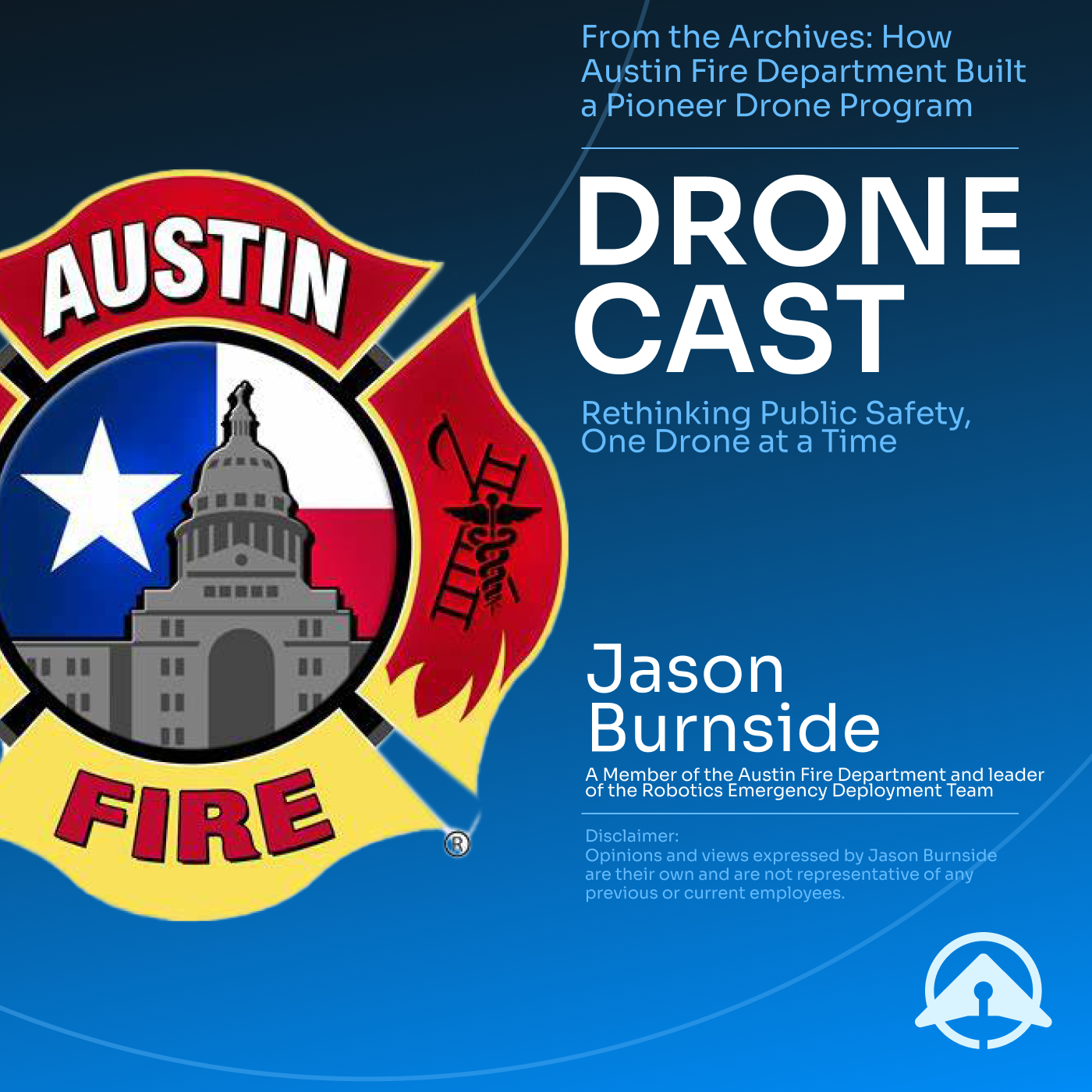 From the Archives: How Austin Fire Department Built a Pioneer Drone Program with Jason Burnside69 / 100
 Eyes in the Sky: Scaling Drone Programs Without Losing Public Trust66 / 100
 The End of Response Times? How Drones are Redefining Public Safety71 / 100