Disambiguation · 2026-06-03 · 33 min
Key moments - from our scoring
Substance score
53 / 100
Five dimensions, 20 points each
This episode unpacks how AI disrupts the professional identity of leaders accustomed to deriving value from their intelligence and expertise. Victoria draws on 25 years in Silicon Valley and her psychology background to explain why the "cognitive revolution" triggers an identity crisis: executives must shift from being approvers of AI outputs to strategic stewards who define what problems to solve and how systems should work. The conversation covers critical distinctions - moving from management (org-chart authority) to leadership (systemic thinking across any level), from automating broken processes to redesigning work entirely, and from linear productivity metrics to value-based KPIs that leverage human creativity and subject matter expertise. Victoria emphasizes that the Silicon Valley playbook is bias toward experimentation with data collection, treating failures as lessons rather than setbacks, and recognizing that no organization has fully figured out AI adoption yet. She also addresses the burnout risk when companies set unrealistic productivity expectations without teaching leaders how to use new tools, leading to nervous system dysregulation. The episode is valuable for executives struggling with identity shifts, those implementing AI without organizational redesign, and leaders tasked with balancing automation with strategic transformation.
Leaders should identify their unique value - subject matter expertise, vision, and transformative thinking - and use AI as a support tool to amplify that value rather than trying to outcompete machines on raw productivity. This requires reframing from task executor to strategic orchestrator.
Silicon Valley companies run AI pilots as deliberate experiments with data collection and learning loops, treat failures as lessons to analyze rather than setbacks, and maintain a bias toward action. Most importantly, they recognize that nobody has fully figured it out yet and everyone is still experimenting.
Chronic overwhelm and fatigue unrelieved by sleep or vacation, loss of motivation, sleep disruption (too much or too little), and changes in eating habits signal burnout. These arise when leaders are expected to match machine productivity without training or role redesign.
Automating a broken workflow creates a broken process that executes faster, amplifying inefficiencies and noise rather than eliminating the underlying workflow failures; this increases complexity and cost in the long run.
Leaders must shift from approving AI outputs to setting clear vision, providing creative and strategic input, and thinking systemically about what should be automated versus redesigned. This mirrors managing human teams: clear goals, regular input, and subject matter expertise guide AI work.
Our reviewer’s read on each dimension, with quotes from the episode.
The episode covers some substantive ideas - the identity crisis leaders face with AI, the distinction between task automation and process redesign, the systemic thinking required, and the shift from management to leadership. However, much of the discussion relies on broad principles (e.g., 'treat failure as a lesson,' 'embrace experimentation') that are well-established in management literature. The specific insights are diluted by repetition and lack of concrete examples or data to illustrate the claims.
what it is that brings value to the work that you do, unique value from you, where you can actually use AI as a support to to perform those tasks
if you automate a broken process, then I have a broken process that works by itself
While the framing of AI as a 'cognitive revolution' and identity crisis is reasonable, the core ideas - experimentation culture, learning from failure, systemic thinking, and the primacy of human judgment - are standard Silicon Valley orthodoxy. The guest repackages familiar concepts without significant counterintuitive insight or fresh theoretical grounding. The distinction between 'human in the loop' vs. 'human in the lead' is useful but not novel.
bias toward that action and running that was pilots as experiments
leadership is going to be much more important than the management
Victoria has legitimate credentials (PhD in psychology, 25 years in Silicon Valley tech roles, founder of an executive education firm) and practical experience across company scales. However, the transcript provides no evidence of her actually leading through a major AI transformation, shipping products at scale, or managing large teams through this transition. She is more of an educator/consultant synthesizing best practices than an operator who has solved these problems firsthand at significant scale.
spent about 25 years here in Silicon Valley, in the high tech industry, in different roles in large companies and small companies
I started Academy a couple of years ago
The episode is notably sparse on concrete examples, named companies, metrics, or real data. The host references a single anecdote about a friend in enterprise software struggling with burnout from productivity expectations, but no details are given. There are no case studies, no quantified outcomes from pilot programs, no budget figures, no timelines, and no named companies successfully executing these strategies. Claims remain largely abstract.
I have a really good friend who works in the, you know, enterprise software company in the marketing capacity
a CTO of a large software company that I've known for for years
The host asks competent setup questions that allow Victoria to develop themes, and he does occasionally probe (e.g., 'how do you coach leaders to cultivate ownership?' 'what does it take to get an organization to redesign work?'). However, follow-ups are often soft and allow Victoria to retreat into abstract frameworks rather than pushing for specifics. When Victoria makes vague claims, the host rarely presses for examples or challenges assumptions. The conversation is amiable but lacks the intellectual friction that would stress-test ideas.
what do you see from the best Silicon Valley companies that you know is different, perhaps on the people side that companies elsewhere are missing today?
what does it take to get an organization to redesign the work and not just automate the broken process?
Computed from the transcript - who did the talking, and the words that came up most.
In this episode of the Disambiguation podcast, host Michael Fauscette talks with Victoria Mensch, CEO of Silicon Valley Executive Academy, about why AI is not just a technology shift but a cognitive revolution that challenges the very identity of leaders and demands a completely different human operating model. Victoria holds a PhD in psychology, spent 25 years in Silicon Valley high tech across large and small companies in enterprise software, and founded the Silicon Valley Executive Academy to help companies and executives tap into the Silicon Valley innovation playbook. Her unique lens, combining neuroscience, psychology, and leadership strategy, frames AI adoption as a human transformation challenge, not a technology deployment problem.
Transcribed and scored by The B2B Podcast Index.
00:00:10:28 - 00:00:32:08 Michael Welcome to this ambiguity. I'm your host, Michael Fauscette. Each week, we interview experts in artificial intelligence, generative AI, and business automation to help business leaders understand how to use these tools for the biggest business impact. 00:00:32:10 - 00:00:45:10 Michael I show today is the cognitive revolution in leadership why AI demands a new human operating model.
I'm joined by Victoria, CEO of Silicon Valley Executive Academy. Welcome, Victoria. 00:00:45:13 - 00:00:48:21 Victoria Hello, Michael. Very happy to be here.
Thank you. 00:00:48:24 - 00:01:07:01 Michael So just to get us started, can you tell us a little bit about yourself and Silicon Valley Executive Academy? I mean, I know you've had a really interesting path from PhD in psychology, 25 years in the Valley Tech, founding an executive education firm. So just tell us a little bit about how that journey unfolded.
00:01:07:03 - 00:01:30:00 Victoria Yeah. So I started Academy a couple of years ago, but before that I spent about 25 years here in Silicon Valley, in the high tech industry, in different roles in large companies and small companies, in deprived software and senior industry. So you name it, I've done it. And then through that journey, what really attracted me through those roles is innovation.
00:01:30:00 - 00:01:55:01 Victoria And one of the questions that we answer, three Silicon Valley executive academies. How is it that Silicon Valley can innovate? I don't want to say better, but definitely bigger than the rest of the world. So we help companies, executives and teams to tap into the Silicon Valley innovation playbook so that they, too can innovate, can compete on negation and produce innovation sustainably.
00:01:55:03 - 00:02:19:13 Victoria But I myself, I came to this role unexpectedly through bye bye bye bye path of psychology. This is what I wanted to do. When I finished high school. I wanted to be a psychologist and I went and got my bachelor and master and PhD, and then I started working as psychologist, only to figure out that this is not what I wanted and switch to Silicon Valley.
00:02:19:16 - 00:02:44:01 Michael Okay. Well, so you described AI as a as a cognitive revolution, not just tech, right? And I know a lot of times we think of it as technology, but certainly it could be more than that. And you've pointed out that, you know, it creates a real identity crisis for leaders, right?
So everything they prepared for and built in their careers is based on being challenged at the cognitive level. 00:02:44:01 - 00:02:50:04 Michael So how do you executives work through that identity shift? 00:02:50:07 - 00:03:11:27 Victoria So as you pointed out, Michael, yes, artificial intelligence is a technology. But I think the key word in this is really intelligence, right?
And for better or worse, this is as leaders, most of the leaders and most of the industries, we're really prepared to provide our intelligence as a value. So we went to colleges. We got all the degrees right. 00:03:11:28 - 00:03:39:20 Victoria So really being smart and intelligence is part of the identity.
And now I think when when early tools became available, at first there was excitement like, oh wow, look at those tools. And now we can use those tools to really prepare better and to use our intelligence better, only to realize at some point that a lot of those tasks, it's not that we can do them better, but machines can do them better. 00:03:39:20 - 00:04:11:26 Victoria So it is a cognitive revolution that we're yet to assimilate, I think, throughout our work. So and one of the one, one, one of the things that we keep talking about is that what it is you help people figure out on an individual level, what it is that brings value to the work that you do, unique value from you, where you can actually use AI as a support to to perform those tasks.
00:04:11:26 - 00:04:20:08 Victoria And that's the way to get out of this cycle of fear of being replaced. 00:04:20:10 - 00:04:20:24 Michael Well. 00:04:20:25 - 00:04:21:25 Speaker 3 I know you've. 00:04:21:26 - 00:04:43:25 Michael Talked about helping executives tap into the Silicon Valley innovation playbook, right?
And when it comes to AI adoption specifically, I mean, what do you see from the best Silicon Valley companies that you know is different, perhaps on the people side that companies elsewhere are missing today? 00:04:43:27 - 00:05:10:02 Victoria First of all, I want to say, and I hear this from a lot of companies that come to us from outside of Silicon Valley with, again, the fear that they are behind. There's this fear of missing out. There is a fear that, oh, the world moved on so fast that we will never catch up.
I want to provide assurance to everyone who is listening that that's not the case so far. 00:05:10:03 - 00:05:39:20 Victoria Nobody, I think, really figured it out, and the technology is advancing in such a speed that we're all in that catching up mode, including Silicon Valley companies. Some of the experiments maybe are more advanced than in other companies, but they are what they are, their experiments. And that's a great page from Silicon Valley Innovation Playbook.
The running really bias toward that action and running that was pilots as experiments. 00:05:39:21 - 00:06:05:01 Victoria The the the the the distinction here is that it's not just, you know, all let's go and play in the sandbox, but let's really collect data. And there's really learn from that data and make decisions based on that data. So I think that's from the culture companies culture point of view, that bias toward experiment and writing those pilots and writing those.
00:06:05:03 - 00:06:34:12 Victoria Projects is experiment. That's a great lesson to learn. And another one I think, that we keep talking about is really that failure, right? Embracing failure in the sense nobody wants to fail.
Nobody wants to start something with the with the with the goal in mind to fail. But we also know that in that that pace of change that we're going through, that uncertainty that we're going through, a failure is inevitable. 00:06:34:15 - 00:06:52:15 Victoria You are not going to reach the goals. In a lot of cases.
We're not going to reach the goals that we set out to reach. Now, difference here is to really treat that as a lesson. If you treat it as failure, then that that's what it is. You just wasted time and resources on something that did not work out.
00:06:52:15 - 00:07:08:23 Victoria But if you if you treat it as a lesson and again, you collect it as a data, you analyze the data. You go through the process of thinking what work, what didn't work and why, and you apply those lessons going forward. That's what's going to make a difference. 00:07:08:25 - 00:07:25:26 Michael I mean, that's good.
I think, you know, the change. We've always thought tech change, you know, innovation happened quickly. But lately that that is compression. Time compression has been pretty bad.
And it is definitely changing very quickly. 00:07:25:28 - 00:07:27:08 Victoria You know, we talk a lot. 00:07:27:13 - 00:07:45:18 Michael On this show about something that I started to think about. You know, we talked last year.
People were talking about how they wanted human in the loop. And we need to do that to verify to trust all that. And I think, you know, for me, I started to talk more about how do we get to the point where we can put the human in the lead, not human in the loop. 00:07:45:18 - 00:07:55:12 Michael And when we were talking before, you talked about how miserable the job would be to, you know, sit there and approve all day long some mind numbing task.
Right. So what. 00:07:55:12 - 00:07:55:25 Victoria Does it look. 00:07:55:26 - 00:08:04:28 Michael Like when when a leader moves from being an approver to actually steering the bus, you know, on an AI augmented team.
00:08:05:01 - 00:08:25:02 Victoria Right. And I think that we can go back to our personal experience. I can share my personal experience again on a on a very simplistic level, using AI tools. And what I noticed, and that's what companies are noticing on the organizational level, is that what you put into the model is what you're going to to, to get out of that model.
00:08:25:03 - 00:09:07:27 Victoria So if the input is basic and rudimentary and not creative, the chances are that the output is going to be the same as well. So that's the conversation that we usually have. So and then what you put into it, that's the human value of this. So that's why it's important on individual level.
And the leaders individual leaders level really to figure out what it is, what is that value that I bring to this process and how AI can help me to to amplify that value and release you release the time and the resources so that can do a higher value activities. 00:09:08:03 - 00:09:45:15 Victoria Right. So and that really requires systemic thinking. So we're not talking about individual tasks anymore.
And managing those tasks and delegating those tasks with the rest of the organization. We're really thinking in terms of systems how the process works, what makes sense to automate, what doesn't make sense to automate. But you also want to start with the question if I am to design this process today, how is it going to look differently than if I would just apply this observation tools to the process that already exist? 00:09:45:18 - 00:10:07:15 Michael Yeah, interesting.
I mean, it does seem and I've seen this just in use of the tools that the more I can provide, what is what do I want this to look like? The more I have in my own mind conceptually, what I'm trying to accomplish and give the right, you know, guidance, facts. I mean, it's not that dissimilar from how I would manage a human team. 00:10:07:15 - 00:10:21:26 Michael I'm going to set goals that or understandable.
I'm, you know, I can provide input, which I do, you know, for my digital employees when they need it. I mean, it doesn't seem that different really than what we've done in the past. 00:10:21:28 - 00:10:50:22 Victoria Yes. And I think what you're all here is the value of a subject matter expertise.
And I think a lot of companies are really realizing this now. Yes. Tools are there. Technology.
So there. But from the cognitive revolution perspective. Right. So we have those experiences and we have the vision going forward, our own vision, our own ideas of how it should look like, and that a lot of it is really stemmed out of subject matter expertise.
00:10:50:22 - 00:11:02:10 Victoria So that's not going to go away anytime soon. So that's really something that, you know, when you start talking about the value, that's the value that we're inserting in this process. 00:11:02:13 - 00:11:23:22 Michael Yeah. That makes sense.
I mean I know, you know, from a proactive self-responsibility sort of standpoint, we were talking about this before, but you talk about how, you know, people some people use an AI, they go, AI replace my task. You know, it did this work. And then other people say I replace those tasks. So it's it's like a different framing.
00:11:23:25 - 00:11:35:13 Michael I mean, how do you coach leaders to cultivate ownership mindset across organizations rather than, you know, this, letting people default to the to the victim mentality of automation? 00:11:35:18 - 00:11:58:02 Victoria Well, I think that's actually what distinguishes leaders from followers. And when I say leaders and not necessarily say this as a as a place on the org chart, so the higher you are in the Or cherry, the more leadership you have.
You can be a leader at any, at any task, in any activity, in any level of the organization. 00:11:58:02 - 00:12:30:16 Victoria And what really distinguishes the leader from a, from a, from a non leader follower is an ability to take responsibility and self-responsibility, including then when we're starting talking about this, what is that responsibility. What does that look like. That's responsibility about how I do my job.
What helped me I remember was a great advice that somebody gave me, that when you treat your job, your career as your business, that actually starts making sense. 00:12:30:16 - 00:12:55:00 Victoria So then if that was my business, if it's not just a job that somebody gave me and somebody pays money, but this is my business, then you start making different decisions. You meet in different people, you start taking on different projects. You start really looking at this differently.
So if this is my business and I want to grow my business and I want to encourage my business, how am I going to approach this? 00:12:55:00 - 00:13:17:08 Victoria So now you look at the list of activities that you're performing with this within this job role and say, okay, well, these are the things that I can easily automate and upload. I don't really need to do that, but that will allow me to grow further. That's one part of it.
The second part that we're talking about is that what this does, this automation, does it really unbundle job roles? 00:13:17:10 - 00:13:48:10 Victoria So when we start talking about those AI agents and what they can and cannot do, which it means that within the role that you have defined, there are some pieces that do not make sense anymore to be bundled in one bucket. Right? So and that's the responsibility of each of us who wants to grow and, and really, you know, flourish in this cognitive revolution is to figure out what we can then bundle and what we can grow, what we can nurture and increase.
00:13:48:13 - 00:14:05:15 Michael I mean, it also seems like you're pointing out the difference between management and leadership, right? I mean, management's in org chart and I have that position. But leadership can come at any level. And it's and it's a very different activity than, than the simple, you know, execution of a management task.
00:14:05:18 - 00:14:30:20 Victoria Absolutely, absolutely. And as we are going into this AI enabled future, I argue that the leadership is going to be much more important than the management. So if you look at the management and the way the management structures were developed, they were really developed for a different role. But when we're talking about leaders, right.
So we're now talking about this orchestrators. 00:14:30:20 - 00:14:46:03 Victoria And again, going back to the systemic thinking, it's not just within my particular world but as a system. How do I actually organize the activity? How do I lead this activity systemically, not just delegating tasks here and there?
00:14:46:06 - 00:15:04:04 Michael Yeah, that makes sense. But I mean, you're telling me a story before about you living through burnout. And we were talking about burnout proof leadership a bit. So I mean, how does you know AI's accelerated pace of change?
We know that. We've seen that it's it's certainly crazy. And it puts a lot of pressure on leaders to adapt. 00:15:04:06 - 00:15:17:16 Michael I mean, do you think that increases burnout risk.
And then if so, what are the warning signs? I mean, as a leader, what can they look for to know that they are approaching a breaking point? How do you how do you help them? Course correct from that.
00:15:17:18 - 00:15:37:06 Victoria Yeah. So I remember when we're talking about this before podcast, the story that I was telling is that I have a I have a really good friend who works in the, you know, enterprise software company in the marketing capacity. Right? So now they have all these tools, they have all the clods and ChatGPT and Geminis of the world.
00:15:37:06 - 00:16:00:02 Victoria It's all safe. It's all secure. And there really they were really using those tools so they can produce more. Right?
So can use more and faster in the marketing space. Content is one of those that got automated very easily. But then she was saying is that. But now it looks like there is an expectations that I, as a human will perform at the same pace.
00:16:00:02 - 00:16:26:01 Victoria So my productivity output is going to be the same as the machine. And that actually is a great source of burnout, because that is close to impossible if you're only measuring the input in terms of productivity, it's like a linear productivity. Then in a lot of those tasks, we're really in no way in no position to compete with with AI tools. 00:16:26:01 - 00:16:52:06 Victoria So now there are two layers to that.
There's a systemic layer and the company layer. So that's I think, you know for smart companies what they're doing are really providing the opportunity for people to uplevel their tasks. Right. So instead of expecting them to continue producing the same output at the same pace.
And this is really an opportunity to play and transform, right. 00:16:52:07 - 00:17:20:15 Victoria And then on individual level. And I keep saying that over and over again, there is a responsibility, a self-responsibility there to really critically look at what it is that I'm doing, why I'm doing what I'm doing, and take the steps to regulate the nervous system. So when you start looking, when you start feeling overwhelmed and if not, not, not overwhelmed today and not or won't tomorrow, but chronically right day in and day out.
00:17:20:15 - 00:17:46:14 Victoria When these heard feeling fatigued and that kind of fatigue that he really cannot, you know, take a break from. So no matter how long you sleep or how many vacation days you take, you still feel drained and fatigue. Those are the signs of a burnout. There's a lack of motivation.
There could be some physiological changes of behavior. You lost sleep or you know you sleep too much. 00:17:46:15 - 00:18:00:21 Victoria You you know, you stop eating or you eat too much. Right?
So those are the signs that you're approaching that burnout point. And there is a time to, to to really take care of your own nervous system and related. 00:18:00:24 - 00:18:26:21 Michael Yeah. That I mean it is a it's, it's a, it's one of those things that you you see that and especially with generative AI saw this in businesses I worked with over the last few years, that the executives started to put really unrealistic productivity goals in place without really understanding underlying tech.
Right. They would they would go, oh, we gave you these agents, we didn't teach you how to use them, and now you're going to be five times as productive. 00:18:26:21 - 00:18:39:14 Michael So we're going to raise your quote or, you know, expectation. Right.
So that that level of of pressure, it's, you know, it's it's self-generated in a way. Right. 00:18:39:18 - 00:18:44:18 Victoria Yeah. So how it's almost like we're we're taking this thinking part for granted.
00:18:44:20 - 00:18:47:14 Michael Yeah. Yeah. Right. 00:18:47:16 - 00:19:07:10 Victoria And that's, you know, that's one of the things that I think about a lot.
And I talk about a lot as well. How do we actually, you know, stay how do we account for that value of thinking. So take, you know, the example that we were talking about before. So we're all really inundated with that low quality content.
00:19:07:10 - 00:19:30:04 Victoria And there is more and more of that has been created really without any discrimination on the quality of that. So what ends up happening within the corporate roles, for example, this is the part that is very easily automated. If you want more content from me, the only way for me to increase that output is really just put it into into any of the chats. 00:19:30:06 - 00:19:52:20 Victoria Right.
So and that will create more content, but it's not going to really increase the quality of that. So so within the organization that's the leadership challenge right. So how do you not outsource thinking. So how do you provide the tools that actually elevate the value of the thinking and then help with the routine tasks.
So we're talking about it's so easy to create content. 00:19:52:20 - 00:20:21:04 Victoria But what we're doing now, we're copying that content from a chat and we're pacing it somewhere. So tons of people just doing copy and paste, copy and paste, which is the part that we would like to automate, right. So we would like to create those pieces and then everything else would happen with automation.
So those are the elements of thinking, the transformative thing that needs to happen in the leadership level instead of just, you know, ramming for, for for sheer productivity of that. 00:20:21:09 - 00:20:35:00 Victoria So you have to rethink the KPIs. You have to rethink what it is that you're optimizing for, what you're maximizing, so that you can really take advantage of full advantage of the resources that are your disposal. 00:20:35:02 - 00:20:52:21 Michael Yeah.
I mean, it's almost like rebalancing the way you think about the AI and saying that, you know, I still want people in the creative part and I, I want to automate those things that really aren't taking advantage of the unique human capability. 00:20:52:24 - 00:21:17:19 Victoria Right, exactly. So this is just one of the there's a creative element to that, but I'm sure there are other, you know, sure. I know there are other scenarios that we're talking about.
So if there is a process that really got created because it was covering some kind of a hole within an organization, right? So, so there was some kind of a breakage in the workflow and this was workflow and was covered with with an activity. 00:21:17:20 - 00:21:41:09 Victoria Now we're not actually rethinking the workflow. What we're saying is like, well, this is the part that's a bottleneck.
And we're not thinking that it was created to cover the whole and the breakage in the workflow. Right. So we're just providing automation. What does it do?
It actually creates more noise. Your workflow is not getting repaired. It's it's just you cover your covering that breakage that shouldn't exist there anyway. 00:21:41:09 - 00:22:04:01 Victoria So those are the things that we're talking about when we're talking about automation, especially on the enterprise level.
So take the time to to to apply that mindset. It's really in mindset. Just stop. Stop taking braid.
Listen and look around. What can I do now that I couldn't have done five years from now? What am I doing now that shouldn't exist? 00:22:04:01 - 00:22:19:01 Victoria How do I actually approach this differently?
That's the formative part, that the invasion part. That's when we were talking about that. AI is not a tool, is really a transformation opportunity. That's what we're talking about.
00:22:19:03 - 00:22:41:19 Michael Yeah. I mean, you know, lately I've written a bit about, you know, an automation trap in, you know, where companies and agents apply to existing work instead of kind of redesigning. So it's kind of what you're talking about with the process thing. It's like if I, if I automate a broken process, then I have a broken process that works by itself.
00:22:41:19 - 00:22:49:13 Michael But it didn't fix anything. Right. So I mean, so it's so it's faster, but that's not good. 00:22:49:14 - 00:22:56:22 Victoria Yeah.
It's probably in a short period of time, longer. In the longer term it's not even cheaper. Right. 00:22:56:25 - 00:23:09:27 Michael Yeah.
Well yeah I guess that's true. So I mean working with the executives, you know, like you have what what what does it take to get an organization to redesign the work and not just automate the broken process? 00:23:10:00 - 00:23:35:19 Victoria Yeah, it does take leadership. And I you know, you know, I do like to talk about leadership on each and every level.
So if you are an individual you do have power, right? So you are empowered to change things around you. But an organizational level, it really makes a difference whether you have that executive leadership and that desire and that attitude of transformation. 00:23:35:19 - 00:24:09:21 Victoria So what it takes is really a, you know, intentionally putting that time into thinking and into designing those transformative processes.
And when we're talking about it's a it's assigning owners and stakeholders who owns this initiative. It's collaboration throughout the organization and different functions organization. It's really working with the rest of the organization and subject matter experts to elevate that subject matter expertise so that it can be contributed to this discussion. 00:24:09:22 - 00:24:23:00 Victoria Right.
But that leadership and the vision and and attitude and then intention to to transform that comes from the top, from sea level. 00:24:23:02 - 00:24:59:03 Michael Yeah. I mean that that really is human in the lead, right? I've kind of set the right direction goals.
And yeah, I mean, it strikes me that what you guys are doing really sits at this intersection of neuroscience, psychology and leadership strategy. So I mean, for a business leader who wants to build an organization where people and agents work together in a hybrid workforce effectively, what are, you know, what are 2 or 3 things that they should prioritize right now that really most organizations aren't looking at or they're overlooking? 00:24:59:10 - 00:25:25:04 Victoria Yeah.
So I think the first one is what we've been talking about throughout this discussion. So redesign work, not just apply tools, redesign work. We do we, you know, ask people to to to approach this way. But that kind of which decisions should be owned by humans, which, you know, tasks should be performed by agents.
What's this collision task if it's going wrong? 00:25:25:04 - 00:25:53:07 Victoria So these are the things that help you to redesign that work. The second one is really build trust. So we're talking about this identity crisis and the fear and irony.
What people don't like. People don't like uncertainty. It's not like everybody wants to hear good news all the time. But we want clarity, right?
So building that trust through clarity and not through slogans, through really the like helping people through ambiguity. 00:25:53:07 - 00:26:19:13 Victoria This is what we're doing and why we're doing this. That builds that trust. So we're not in the dark.
We're not your people are not feeling that they lost control over. They understand the steps and they understand the consequences of those steps. And the third one is really look at the leadership qualities, right. That human human qualities of like leadership.
00:26:19:13 - 00:26:38:28 Victoria What is it the the uniquely human traits that AI cannot replicate at this moment, that sense making that what we're talking about, the judgment, the context, that's what we provide. That's what's actually going to change the quality of the output. 00:26:39:01 - 00:27:07:12 Michael Yeah, that makes sense. I mean that we have to find the the balance between what human capabilities are and what digital workers capabilities are and how we balance those things.
That makes sense. You know, if we if we pull the crystal ball out for a bit and think about the future. Right. So looking ahead, as agents take more and more of the routine task and, you know, and some of the cognitive work, I mean obviously they're getting more and more capable.
00:27:07:18 - 00:27:27:02 Michael How how do you see leadership evolving for for organizations. And then if I'm in, you know, if I'm coming into the workforce, I'm going to move into a leadership position. What is the next generation really need to think about, look like train for? I mean, what what should they know?
00:27:27:04 - 00:27:56:24 Victoria Yeah. So I think one of the, one of the important changes would be from a task management to the system design. So now we talked about this task management. And that's how management systems are actually developed.
That's you know through the industrial age. This is how they they propose really best for those industrial age kind of organizations. Now we're moving into a much more free flowing world. 00:27:56:24 - 00:28:21:14 Victoria So so that system design, how will you actually understand the system and that systemic level of thinking?
That's a big change for leadership, I think. So we're leaders who are looking to step into that role and grow in their career and build and grow organizations to release tired, developing those system, system level thinking and design, not just thinking, but design of that. 00:28:21:18 - 00:28:54:07 Victoria And the second part that's very important is that as we're talking about the elevation of kind of human role within the organization, those people, there's really an elevation of of agency for each taking the agency for each and every person.
And when we talking about like free agents who are who are more proactive, right. Who are who are really rewarded for their thinking and for that systemic thinking, then there's a totally different level of leadership that's required from a human perspective. 00:28:54:08 - 00:29:14:18 Victoria There is an empathy. There is a motivation, there is a mentorship that we're talking about.
How do you motivate these people to actually contribute into your organization instead of, you know, going and contributing in their own businesses? So those are two. Those are two, I think, important changes that are going to make a difference from the next generation. 00:29:14:18 - 00:29:21:10 Victoria One is the system design, and the second one is really more empathic level of leadership.
00:29:21:18 - 00:29:45:13 Michael Yeah. That's interesting. I mean, I was not long ago talking to a CTO of a large software company that I've known for for years. And, and he needs doing a lot of, of, of coding and moving developers into a system where they're using a lot of vibe coding agenda coding tools.
And I said, like, are your developers worried about losing their jobs? 00:29:45:18 - 00:30:05:27 Michael I mean, you know, that seems like a reasonable fear. And he said, you know, the thing is, what we're trying to do and what they've put in place is they're trying to take those developers and move them to a different level because the, the, the, the coding that you see from the automated systems, that's a junior developers level work. 00:30:05:28 - 00:30:24:15 Michael Now, maybe someday it'll be more than that.
But right now it's that. But what they really need is this conceptual design, the capability to to understand what do I want the system to do, what should it look like. Because that's something that not that that can't be done by the by the tools today. 00:30:24:22 - 00:30:49:20 Victoria Exactly.
So when you say it's like what I mean where it's like, no, they're elated. Right. So I was I think I heard a quote from CEO, he and he said something along the lines like, I don't want myself to wear engineers to quote, to code at all. I want them to solve problems.
So as a business owner myself, when I'm looking at my employees, that's exactly what I want. 00:30:49:21 - 00:31:11:08 Victoria I want them to solve problems that move the business along, and the better they can do that, the better for me. So I don't want them to waste time to do routine tasks. I want them to continuously be in that problem solving mode.
And I think that's what actually the promise of AI that we should embrace. Is that right? 00:31:11:09 - 00:31:24:15 Victoria So that we have those meaningful jobs that are worthy of our human capabilities and abilities in the human brain and and all this unique human qualities? 00:31:24:18 - 00:31:47:07 Michael Yeah.
That's great. I really, really interesting conversation. I appreciate you joining today. You know, at the end of every episode, I like to do this thing where I have the guest recommend something for the audience, write a book, a podcast, a thought leader, somebody that they could check out that you think would add value and help them grow.
00:31:47:09 - 00:32:22:03 Victoria So there's there's one thought leader that I'm following and she's a thought leader, but she's also a a working CIO. Her name is Soul Rashidi, and she's in artificial intelligence as a very practical, very practical thoughts and ideas and how to implement artificial intelligence. But at the same time, a lot of thinking about the value of human qualities and the intersection of artificial intelligence and human thinking and how artificial intelligence elevates that human thinking.
00:32:22:07 - 00:32:23:12 Victoria So. 00:32:23:14 - 00:32:33:09 Michael I mean, that's definitely timely in, in something that we should be learning about. So that's great. Thank you.
And again I really appreciate you joining today. Very interesting conversation. 00:32:33:16 - 00:32:39:06 Victoria Thank you so much Michael. I'm so happy to be here.
00:32:39:08 - 00:33:05:07 Michael And that's the show for this week. Thank you all for joining us. Remember to like, share and subscribe to the show. If you enjoy the show, please leave us a review to help others find us.
For more research on AI and other software, check out arionresearch.com. If you're an expert in AI, generative AI, or business automation, either as a provider or an end, or email your information to disambiguation at arionresearch.com, don't forget to join us next week.
00:33:05:08 - 00:33:11:26 Michael Disambiguation is an Arion Research production. I'm Michael Fauscette and this is the disambiguation podcast.
Other episodes covering the same guests and topics, from across The B2B Podcast Index.
 Why AI Pilots Fail: How to Escape AI Pilot Purgatory and Scale Enterprise AI with Ronnie Kwesi ColemanUsing AI at Work · on AI agents92 / 100
 PMs Are Fintech: How Column is Rethinking Property Management BankingThe Profitable Property Management Podcast · on AI agents89 / 100
 Wins Above Replacement: The New Way to Judge FoundersVenture Unlocked · on ChatGPT88 / 100
 Paul Graham On Startups, Ambition, and Great FoundersY Combinator Startup Podcast · on ChatGPT88 / 100
 The AI-Native Law Firm, with Ryan Walker of General LegalMeeting of the Minds · on ChatGPT88 / 100
 90% of AI prototypes never reach production (w/ Temporal's Samar Abbas) | AI BasicsThis Week in Startups · on AI agents81 / 100
 The Identity Threat: Why AI Adoption Is a Human Challenge, Not a Technology Problem80 / 100
 When AI Does the Building: Innovation, Ideation, and the New Creative Advantage65 / 100
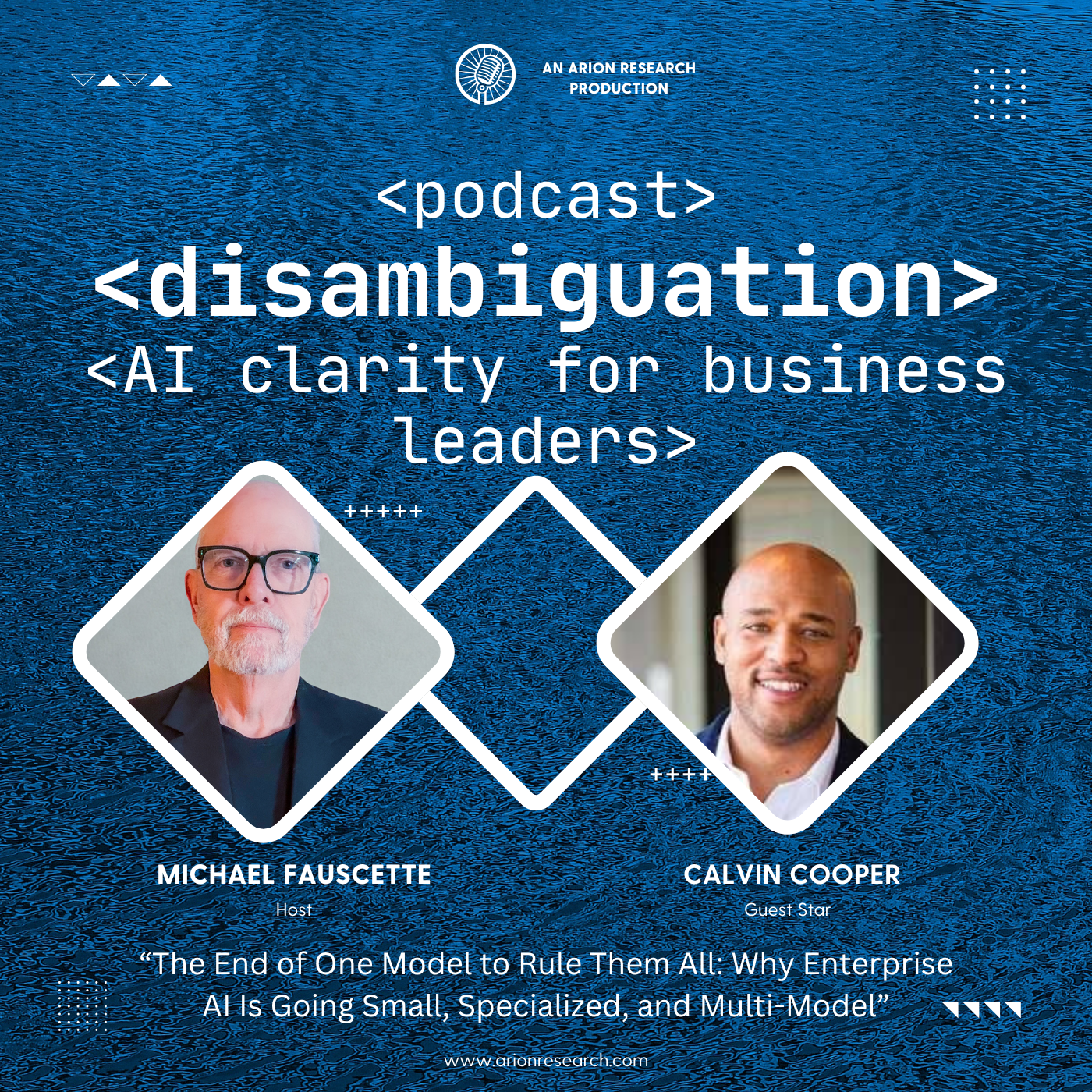 The End of One Model to Rule Them All: Why Enterprise AI Is Going Small, Specialized, and Multi-Model85 / 100AI Meets the Mid-Market: How PE-Backed Companies Are Leapfrogging with AI89 / 100Beyond Efficiency: Why AI Is Forcing Marketing to Rethink Everything, Not Just Cut Costs87 / 100