
Business Class: The Global Tourism Leadership Conversation · 2026-05-26 · 23 min
Key moments - from our scoring
Substance score
45 / 100
Five dimensions, 20 points each
Central Oregon's tourism economy is worth $1.3-1.4 billion annually with over 4 million overnight stays, making it the region's most diverse economic sector and a significant tax revenue generator for local services like law enforcement and fire departments. Scott Larson emphasizes tourism as the "front door to economic development" - many residents initially arrived as visitors before relocating permanently or starting businesses. Beyond visitor acquisition, Visit Central Oregon manages the complex ecosystem across three-and-a-half counties and eight to ten sub-regional chambers and DMOs, requiring nuanced stakeholder management and varying community preferences around seasonal visitation. Larson's leadership philosophy centers on DISC assessments, strength-based team deployment, and giving staff freedom to experiment and fail. He also addresses emerging challenges like wildfire and smoke management for West Coast destinations, and pushes back on the misconception that DMOs extract excessive lodging tax revenue - Visit Central Oregon receives only 26-27 percent of what it generates, with the remainder funding county services. The host shares her background in destination development consulting and founding Learn Tourism, a 501c3 nonprofit training 75,000 annual learners across hospitality and tourism globally.
In 2025, visitors spent $1.3-1.4 billion in Central Oregon, generated over 4 million overnight stays, and supported 11,000 jobs, making tourism the region's number one and most diverse economic sector.
Visit Central Oregon receives only 26-27 percent of the lodging tax money it helps generate; the remaining 73-74 percent goes to the county general fund and other services like fire, police, and emergency services.
A vast majority of Central Oregon residents first came as visitors before deciding to relocate, build businesses, start families, or change jobs, making tourism foundational to the region's permanent population and business growth.
The organization serves three-and-a-half counties with eight to ten sub-regional chambers and DMOs underneath, requiring nuanced communication and program customization based on vastly different community capacities, budgets, and tourism preferences.
Visit Central Oregon is working to lead in crisis communications and management around wildfires and smoke, which have become normalized operational challenges requiring dedicated partnerships and community communication strategies.
Our reviewer’s read on each dimension, with quotes from the episode.
The episode contains moderate value with some concrete economic data (1.3-1.4B visitor spend, 4M overnight stays, 11K jobs, 26-27% lodging tax allocation) and interesting conceptual framing about tourism as economic development's 'front door.' However, much of the content devolves into generic leadership advice (empowerment, vulnerability, freedom to fail) and personal anecdotes that lack actionable insight for B2B operators. The host's own tourism education background is interesting but underexplored.
1.3, $1.4 billion was spent by visitors to this area, over 4 million overnight stays, 11,000 jobs
travel and tourism is the front door to economic development
The 'tourism as economic development gateway' framing is present but not novel in destination marketing circles. The discussion of regional complexity and management-vs-marketing trade-offs touches on real challenges, but the leadership philosophy (empowerment, growth mindset, no-ego leadership) is entirely recycled conventional wisdom. The fire/smoke crisis management mention is timely but underdeveloped. Little contrarian or first-principles thinking.
travel and tourism is the front door to economic development
it starts with marketing and then it leads to management
Scott Larson is a legitimate practitioner - he runs a regional DMO managing 3.5 counties, multiple chambers, and tangible budgets. He has real operational responsibility and has restructured organizations. However, his role is specialized and regional rather than operating at scale. The host's credentials are stronger (leading a 501c3 with 75K annual learners), but the balance tilts slightly toward a mid-level regional executive rather than a major strategic voice.
executive director at Visit Central Oregon
I've got three and a half counties, I've got eight to ten chambers and DMOs underneath that umbrella
The episode includes some concrete numbers (1.3-1.4B spend, 4M stays, 11K jobs, 26-27% revenue split, 75K learners for Learn Tourism) and named entities (Visit Central Oregon, Confederated Tribes of Warm Springs, DISC assessment). However, the absence of specifics on strategy, campaigns, outcomes, or actual business challenges limits depth. Most examples are either autobiographical or generic (no named client successes, no campaign metrics, no competitive analysis).
1.3, $1.4 billion was spent by visitors to this area, over 4 million overnight stays, 11,000 jobs
of the money that we generate, we receive 26 or 27 percent of it
The host asks surface-level personal questions (childhood ambitions, greatest lesson from grandparents, staff description) that yield reflective but non-substantive answers. Follow-ups are minimal; when Larson mentions regional complexity or fire/smoke crisis management - potentially rich topics - the host doesn't dig deeper. The host does share personal anecdotes but rarely challenges claims or pursue business mechanics. This reads as a warm personality interview rather than a probing business conversation.
When you were growing up, what did you want to be?
What is the greatest lesson you learned from them?
Computed from the transcript - who did the talking, and the words that came up most.
Tourism is about far more than attracting visitors. It’s about building stronger communities, creating opportunity, protecting places, and empowering people to connect through meaningful experiences. In this episode of Business Class , Stephen Ekstrom sits down with Scott Larson, Executive Director of Visit Central Oregon, for a thoughtful conversation about leadership, destination stewardship, tourism economics, and personal growth. Scott shares his unexpected journey into tourism, why travel serves as the “front door” to economic development, and how tourism organizations are evolving from pure marketing agencies into community-focused leaders. The discussion explores everything from empowering teams and creating a culture where people are free to fail and learn, to navigating wildfire crisis communications, balancing regional stakeholder needs, and managing the realities of leadership as an introvert in a highly social industry. Along the way, Scott reflects on lessons from his grandparents, the value of time and memory-making, and why curiosity and trust are at the heart of effective tourism leadership.
Transcribed and scored by The B2B Podcast Index.
I know so many people in this industry, and I don't think I can point to any one single person who by choice chose to work in this industry, which is hilarious. We all sort of seem to stumble in here somehow, somehow. Today's guest is Scott Larson, executive director at Visit Central Oregon. Take a listen.
My story starts back probably 10 or 15 years ago now in Steamboat Springs, Colorado. I worked for the ski resort there for a little bit and enjoyed that, but I think that was where I really realized that wasn't my cup of tea. And there was an opening across the street around the same time that I was ready to make a change at the local chamber, DMO, Economic Development Agency. In small towns, those tend to all be one organization.
And I felt much more community focused, community-driven, business-oriented, and also had a really great team. And so that was sort of my introduction. I give a lot of credit to my time there and that organization because I think it really introduced me to the economic value of a DMO and the role that tourism plays, not just from our, hey, how do we bring people here? But like, why do we do that?
Why does that matter? How do we tell that story? Why does that matter to communities, large and small? And then my career has just sort of organically evolved from there.
So why does tourism matter so much in Central Oregon? So it is the number one and also the most diverse economy locally. I think 2025, Dean Running data says something like 1.3, $1.
4 billion was spent by visitors to this area, over 4 million overnight stays, 11,000 jobs. But it's I'm also a huge believer that travel and tourism is the front door to economic development. And there's a vast majority of people in this region who came first as a visitor and then decided to relocate, build a business, start a family, change jobs. And it's really woven into the fabric of Central Oregon, and it generates tens of millions of dollars in tax revenue that pays for local services.
So sheriff, emergency, police, fire, the fairgrounds, our county fairgrounds is baked into that. So it's a huge economic driver and benefit for the community in terms of tax revenue that residents don't have to pay. What sort of social impact are you hoping to make through your work? One of the things that's interesting about this organization is that we are a region, which is a complex, nuanced entity, different from a city, county, state.
But we do management and we do marketing. I sort of, in my opinion, it starts with marketing and then it leads to management. But what we've tried to do is weave in more social impact pieces throughout our work. We've got a great partnership with Real the World as one of theirs.
We try very hard to integrate the Confederated Tribes of Warm Springs, which is within our region, into our work. We give a lot of grants back to arts and culture, accessible adventure, inclusive initiatives. We try to, we're big believers in reinvesting in our spaces in addition to marketing them. It's a two-way street.
I've got plenty of board members to think where it's marketing through and through. And that's just not the state of the industry these days. When you were growing up, what did you want to be? What did I want to be when I was growing up?
Oh man, it evolved so many times. I went to school for international business, and that's actually sort of I think how I landed in Steamboat. I studied a couple foreign languages, and my dream was always to work in the ski industry abroad. And I had an internship, I think that was my third summer, so the summer before senior year, in Vale, Colorado.
And then when I graduated, I had opportunities in Vale and Steamboat. And that was always like the plan, the vision. I think at one point I drafted a business plan, had these big ideas, and it's just funny, like has different plans, different ideas in there. I still think that would be a blast, but I absolutely love the industry that I work in.
I think that we have arguably the most farm industry. We get to travel the time. The people are great. Like it's no complaints.
How is where you live now in central Oregon, like where you grew up? It's vastly different. Uh, I grew up in Nashville, Tennessee. I like to tell people that I grew up in Nashville before Nashville was Nashville.
It was a different town decades ago. Prior to this position, I was in Wyoming in a small town running a DMO for a county. So growing up in Tennessee, my grandparents had a home. They did the like Snowbird thing, and they had a vacation home out here in Salt River, Oregon.
They sold it in 2006. I think everybody in our family was like, wow, that's cool. That was a great chapter. They owned it for like 25 years and beautiful there, but like we didn't have any other really built ties in Oregon.
Never went back. Life was doing life. And then I had this opportunity almost two years ago, and I'm sitting in Sun River right now in my office, and it's just wild the way that life comes full circle sometimes. So vastly different from where I grew up, but I'm in a weird sort of way, like intimately familiar with pockets of this region.
In a weird, weird sort of way. You mentioned your grandparents. Uh-huh. What is the greatest lesson you learned from them?
The greatest lesson I learned from them is that time is all we have. Time is invaluable. It is the most precious thing. And I'm fortunate to still have both of them.
I think they're both 94, 93 now. But we spent so much time making memories and exploring and doing all the things that I now get to promote, which is pretty rad, but you know, making those memories in a place that is really special. And yeah, that's something that I hold really close. How would you like your staff to describe you?
Oh man, I love this question. I try to approach everything from a standpoint. No ego, trust that verify, curiosity. Uh we've rebuilt a bunch of things in the last couple of years since I joined a team.
So we sort of have this mentality of like never being married to any one solution or way we've done things in the past. Why not make a change? Question everything. My door is always open.
I prioritize as much as I can time with my team. I try to be as approachable and actually, I think I've said this at a couple staff retreats at this point. Now I hate the word boss. That's one of my pet peeves.
I hate the word boss. We're all in this together. Everybody on this team needs everyone else. Everybody serves a role.
Everybody's here for a reason. And yeah, there's titles and pace the elves and decision makers and whatever, but there are people on this team that have strengths that I am absolutely awful at. I'd rather be a leader than a boss. I'm right there with you.
And if I had my way, nobody in this organization would have a title. Yeah, yeah. Because we all work toward the same goal. Yeah, I mean, we're all trying to get to the same end result, right?
And we all bring different backgrounds, different strengths. That's one of the things we did in our last app retreat is we all went through a disk assessment, which was sort of like your Myers-Briggs or whatever, right? And then we mapped everything out on one chart with everyone's scores, if you will, on there. And it painted the picture for everyone on the team that, like, this person's really good at this, and this person's not.
But what that means is when we have a task or a challenge or something in the community that requires that skill, rather than looking at what is that position that should go to, like, let's send it to the person and not the position. How do we create a strength-based team? I'm also a believer that everyone on this team is a leader, whether they believe it or not. They have those skills.
They wouldn't be here if they didn't. So I try to empower people as much as possible. That's one of the key elements of I think being a leader is to give people license to do the right thing. I also like giving people not only license to do the right thing, but the freedom to try.
I had a boss two or three iterations ago who was really good at I'd go to her with an idea, and she'd say, Hey, look, I don't know if this is gonna work, but here's the deal. Like, I'm willing to give you the shot to try it. We're gonna track it, measure it, and then we're gonna assess whether or not it worked, and then we'll determine if we do it again. And so, sort of giving people the freedom to fail, if you will, and try, that's how they learn, that's how they grow, that's how they progress, and they feel empowered.
And I think sometimes too, that's how we bring innovations into the team that otherwise would be shut down. And so it's not only about empowering, but it's about giving people the freedom to you'll never know if you don't try giving people the freedom to fail is paired with giving people the comfort to learn from their mistakes. Absolutely. Absolutely.
I think it's a Nelson Mandela quote. I never lose. I either win or I learn. 100%.
I mean, everything is a learning opportunity, a growth opportunity if you choose to see it that way. And I think too, when you allow people the ability to do that, it creates a culture within the team of comfort with being vulnerable at times, accountability, ownership, vulnerability, and all of those things create a tighter, knit, more trusting team, which really shows up in a crisis or times the hard times handbook, right? So what is something you're eager to learn this year or a skill you're looking to develop?
For me, it's one of the things that I've really wrestled with over the years in this position, is contrary to how I project outwardly, I'm very much an introvert and have a little bit of social anxiety. And that's really challenging for this position. And it has not always been my strong suit to do the I call it peopleing, which is not the right word, but the liaising, uh socializing, the networking, and like I've got a good network, but it's it's being it's that aspect that's always been a challenge for me because it's not how I'm wired, and I have to learn, I've had to learn how to adapt when to dial it up, when to dial it back, how do I recharge so that I can dial it out?
I think that's an area in growth for me that I'm always excited to try and lean a little bit more in that direction, and it's taken years to figure out how to get comfortable just leaning in that direction because it goes against my natural tendencies. We're very similar in that regard. And because I also call it peopling. Exactly.
Last year, my birthday is November 1st. So Halloween weekend. Yeah. I was at a campground in northeastern Georgia, and one of the neighbors had a big party, probably 75 people, 100 people there on Thursday night.
That was enough people for me for the weekend. So I kind of laid low on Friday, and Saturday was my birthday. And so I get a call from the campo who says, you know, we haven't seen you today, and you were very lucky yesterday. We just want to check on you and make sure you're all right.
I'm like, that's very sweet of them. Thank you so much. Yeah, I'm perfectly fine. Five minutes later, there's a knock on my door.
There are 150 men outside my door singing happy birthday. Oh, wow. And uh the follow-up conversation with the owner of the camp, he's like, Yeah, you mentioned on the phone that you don't like peopling, but it was too late. So, like, okay, you know, but I like my people.
I mean, it's easier once you get comfortable with your circle to not have as much anxiety, right? I'll give you a tip that I've given several other people about networking events. Uh-huh. When you walk into a networking event, the first thing you have to notice is which direction the people are flowing.
Generally, people lean to the right and they move around the room counterclockwise. Okay. If you rotate in the opposite direction, you see more people because you're not stuck with the same group of power, and you're working your way to the exit. This is a pro tip for this, this will be my first time going to DI annual.
Oh, okay. This feels like a pro tip for that event. Yeah, you'll see me working my way to the front to the exit. Hey on it.
You know, you know what else I've learned on this topic, though, is like it's a challenge for me because well, one, you're serving a region, right? So I've got three and a half counties, I've got eight to ten chambers and DMOs underneath that umbrella. We've got teams, stakeholders, partners, politicians, the whole ball of wax. I try to always say yes, particularly to my team, but I also try to never cancel.
I try to postpone. And that was a good tidbit as well when it comes to people, of like being okay with saying, you know what, I just don't have the emotional reserves to take that meeting today. But how about tomorrow? And I try to never say no to my team because without the team, we have nothing.
But that was a good tidbit of learning Trinity on this topic, too. Of like, how do you manage that in a way that you don't come off as like, I'm an introvert, so I can't talk to you today? But how about tomorrow? How about next week?
How about this afternoon instead of this morning? I want to give you my undivided attention. Yeah, exactly. Exactly.
What is something you wish more people knew about your work I guess that depends on whether we're talking to residents or visitors? Difficult question in this industry. I think with residents by far, it's the value that we bring and the perspective that all we do is sell and sell and sell, and all we do is bring more people here, and there's already too many people here. I think there's a perception that we have gobs of lodging tax money, and the reality is that of the money that we generate, we receive 26 or 27 percent of it, and the rest of it goes back to the general fund and to the county.
So it's like it's this misconception that tourists extract and don't pay their fair share. That's and I'm sure that's attuned everywhere in this industry. I think with our stakeholders and maybe with some of our visitors, we just went through this last week. You talk about covering an entire region.
We have a lot of mouths to feed. We have a lot of people that we're responsible to, accountable to. And the low, I don't think I fully comprehended this when I made the move two years ago here. The level of nuance and variation is astounding.
Of sophistication, budget, staffing, capacity. Do you understand tourism? Do you not? Do you want more visitors?
Do you not? Do you want them in July? Do you want them in December? Like just the level, the range, the spectrum is incredibly complex and exhausting at times.
The thing that I actually think about, and this is more of a personal tie, that has really helped me in a weird sort of way. I'm one of two. I've got one brother who's got a long list of special needs. And so I have spent a lot of my lives around that community and that population.
And I think it's been built into me from very early, early on in my life. How to adjust your communication style and your body language and your approach based on what's going on, based on where that person is, based on where you assume they are. I wish more people understood how complex that puzzle is to put together. And inevitably you spend a lot of time playing whack-a-mole, but that's just part of a job.
So what did I not ask that you wish I did? What did you not ask that I wish you did? I mean, I think a hot topic for us right now, and we're trying to be leaders in this space, but we're certainly not alone, would be something around how are we as a West Coast destination navigating what may be the norm of fire and smoke and crisis comms and that whole bottle wax. And we do a lot of work in that space.
Particularly in the last year, a lot of great partners in that space. I lead the community at One West that covers that. And I started it because I didn't feel like the need was being met. But that's a flip that phrase, big big hairy, audacious goals or whatever.
That's a central challenge for us that we're trying to navigate. So what would you like to ask me? Tell me about your experience in tourism and your can what's your connection to this industry and what's your what drives that passion? Sure.
I got started after college working in a restaurant. They ended up needing a sales manager. I jumped at the opportunity. It was a theme restaurant.
The Rainforest Cafe. Oh yeah. Yeah. So I ended up developing education programs that brought school kids in during the off-peak hours.
Okay. So that was the start for me of developing a product to bring it to market. I transferred that into working in New York City for museums, attractions, activities, theater, restaurants. And then I slipped into destination development as a consultant.
Okay. Where a destination would say, look, these are our shoulder periods. What can we do? And using my knowledge of what types of travelers are likely to move during that period of time, and getting to know the destination and what their inventory is, you know, sort of matching them up and building them.
About 11 years ago, I was at a tourism trade show with Sheena Works, who's instructional designer, organizational psychologist by trade. We went to a workshop and walked out and looked at each other and said, are they all this bad? And the answer was, yeah, most of them. Most of them are.
But just wait until you're subjected to a webinar where you can go mold of one while it plays in the background. So like you, I want to find the solution. Well, why is it? I want to understand it.
And that was the beginning of my learning journey in the education space. You know, adult theory, adult learning theory, analytics on how people interact online or in person with learning content, learning styles, all of this. That was all in the background of my destination development business. So this was our kind of backburner project.
Around the same time as that workshop, I was realizing that as much as I love traveling, as much as I love trying new foods and learning about new culture and history and art and nature and science and you know, all of these things, what they had in common was the fact that I was learning. And it hit me like a bolt of lightning that my passion is actually learning. Yeah. All of these other things contribute to it.
So COVID struck, my destination work evaporated overnight. And I had a choice. I can spend my time, energy, and effort to rebuild a consulting business that I'd been running successfully for 10 years from scratch. Or I could do something that leaned into my passion for learning.
Within a couple months, Learn Tourism was founded as a 501c3 nonprofit. We now work. With 60, 70 destinations on everything from training their tourism ambassadors to staff to professional development, training for travel agents and advisors, community training and impact training. So stewardship training.
We have destination development projects in Asia and Africa that we work on. We have 75,000 people that learned through us last year, which actually makes us one of the largest hospitality and tourism education programs in the world. It's incredible. And I love it.
I learn every day. I learn from you. I'm going to learn from the next person I talk to. Yeah.
And we're we've become big in the AI space. That to us is an empowerment tool. Yeah. I have my new virtual assistant turned on yesterday.
I'm living the tree. I love it. Well, I appreciate uh the opportunity to cact this morning. And if you end up making it out this way this summer, don't be a stranger.
You know where to find us. And we'd love to give you all the tips and tricks on where to go, what to see, what to eat, and how to make the most of your time in this region. Fantastic. It's not an if, it's a when.
Love it.
Other episodes covering the same guests and topics, from across The B2B Podcast Index.
 Leading Without a Playbook w/ Stephanie BlairThe Customer UnSuccess Podcast · on DiSC assessment81 / 100
 Stop Trusting the Resume: The Behavioral Science That Predicts SuccessThe Hiring Edge · on DiSC assessment80 / 100
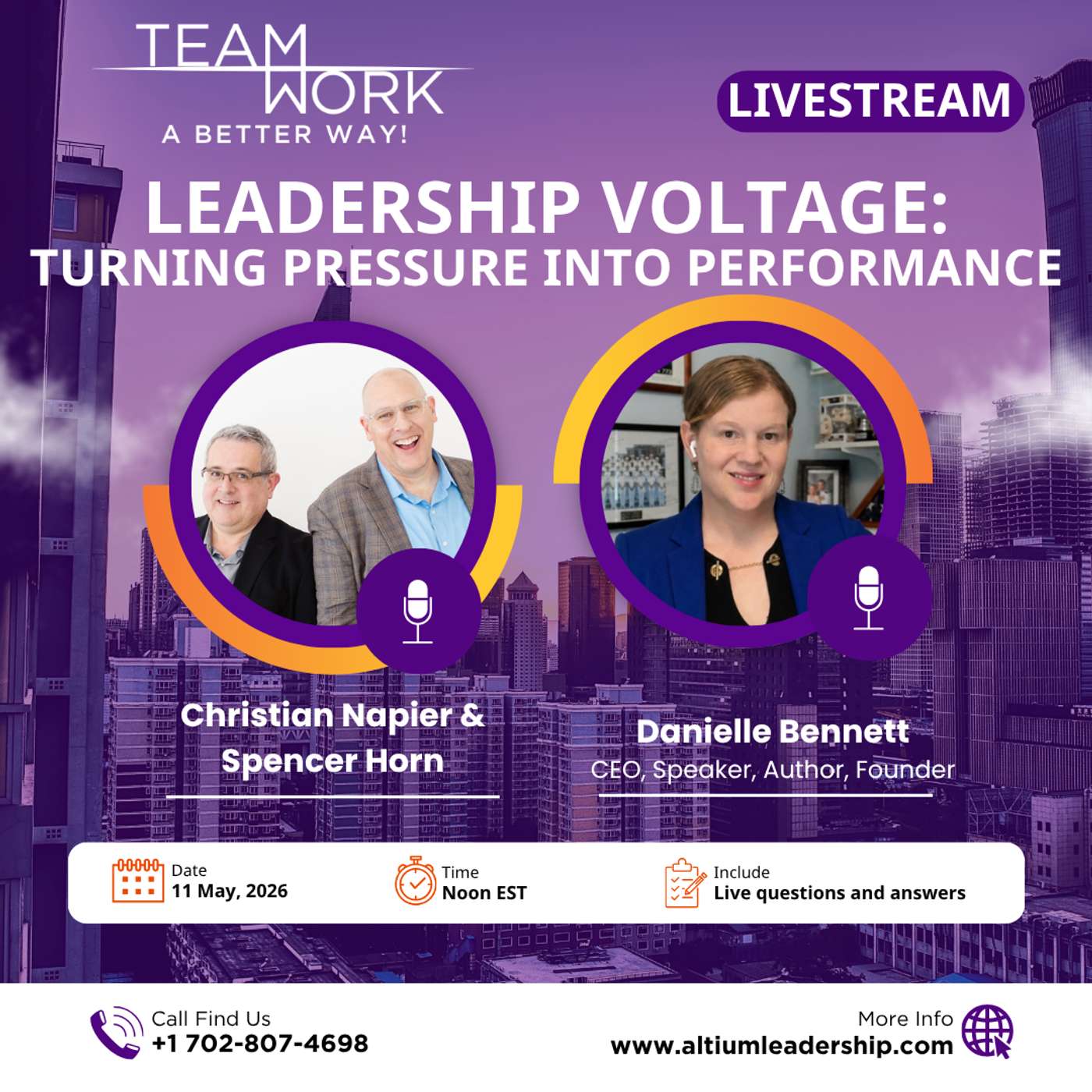 Leadership Voltage: Turning Pressure into PerformanceTeamwork - A Better Way · on DiSC assessment77 / 100
 Deep Dive with Patrick LencioniThe Daily Bolster · on DiSC assessment76 / 100
 Team Building That Actually Works, No Ropes Course RequiredStepping Into your Leadership · on DiSC assessment72 / 100
 Episode 95: Why High Performers Struggle in Leadership RolesLet's Think About It Podcast · on DiSC assessment66 / 100
 Tourism Deserves a Seat at the Table with Discover Albany's Jill Delaney58 / 100
 Edward Harris, Visit Williamsburg on Tourism, Sneakers, and America's 250th60 / 100
 Changing the Narrative: Peter Gamez on Leadership, Storytelling, and Oakland's Soul64 / 100
 The Leap: How Kristen Reynolds Went from “Not Qualified” to Leading Chicago59 / 100
 Conversation with Don Welsh, Destinations International: The Evolution of Tourism71 / 100