
Business Broker Growth Show · 2026-06-23 · 1h 1m
Key moments - from our scoring
Substance score
55 / 100
Five dimensions, 20 points each
Patrick Lange, president of Business Modification Group, built a dominant niche in HVAC broker services after a 20-year journey through financial planning, pool cleaning, and regional brokerage. Starting with virtually no awareness of business brokerage (earning just $9,000 in year one at Century 21), Lange initially sold everything - restaurants, gas stations, flower shops - until moving to rural North Florida forced a strategic pivot. When a baseball parent mentioned an HVAC business, Lange recognized the industry's appeal: non-discretionary demand, high barriers to entry, and chronic information gaps. After running an HVAC company himself for seven years, he switched to brokerage full-time and has now closed 167 HVAC deals nationwide using a content-first strategy. His approach - YouTube videos with 2.2M+ views, weekly articles, and transparent education about valuation multiples and deal structures - positions sellers to choose knowledgeably even if they don't hire him. Lange travels constantly to meet clients, believing that for most HVAC owners, selling is their life's biggest transaction and they deserve in-person guidance through unfamiliar territory. His rapid scaling from regional Florida broker to national HVAC specialist coincided with rising private equity interest in the space, creating both market tailwinds and informed buyers.
After struggling to sell non-essential businesses in rural North Florida and discovering wild valuation inconsistencies in HVAC sales (ranging from 2x to 6x revenue multiples with no clear logic), Lange realized HVAC owners had no reliable guidance. He'd operated an HVAC company for seven years, so he switched cold turkey to HVAC brokerage exclusively - unlike his last pizza restaurant deal where he couldn't add value.
Lange lives on airplanes and personally attends seller meetings nationwide, positioning himself for premium pricing. He built a small team (his son and three others) in the past two years, but maintains hands-on client involvement because most HVAC sales are life-changing transactions. He describes earning the right to charge premium fees by giving away free, high-quality information through YouTube (2.2M views), social media, and weekly articles.
Lange educates potential sellers on how to evaluate brokers and understand fair deal structures so that even if they don't hire him, they avoid predatory practices. He believes there's enough demand from informed buyers who call him directly that supporting his family doesn't require converting every educated prospect into a client.
Private equity consolidation in HVAC made acquisitions a routine industry topic, with PE firms actively calling owners daily with buyout offers. This created more informed sellers who understand multiples and sale possibilities, making them more receptive to Lange's educational content than they would have been ten years ago.
Most HVAC owners (often career technicians) don't know how to value or sell their companies, don't know what a business broker does, and lack trusted advisors. Lange emphasizes that selling is their life's biggest transaction, leaving many scared and unprepared - his value is reducing that information gap and providing reassurance through in-person presence.
Our reviewer’s read on each dimension, with quotes from the episode.
The episode has a solid core of practitioner insights - deal dynamics, seller psychology, valuation gaps, and niche content strategy - but they are diluted by extended origin storytelling, host monologues, and conversational padding. The second half is denser than the first.
If you're doing 30 or $40 million in sales, you're probably a pretty sharp business person...you could probably fumble your way through a sale. If you're doing a million and a half in sales, you're probably a very good technician and not a sophisticated business owner.
I don't sleep at night until the check clears. Right up until then. Everybody's a liar as far as I'm concerned.
There are a few sharp practitioner framings - the informed-vs-educated consumer distinction and the deal fairness framing - but the core advice (niche down, give away content, treat brokerage like a business) recycles widely circulated content-marketing doctrine. No genuinely contrarian arguments are developed.
I want the seller to think they could have gotten more, but they got a fair deal. I want the buyer to think they could have paid a little less, but they got a good deal. And I want them both to think that I got paid too much money.
Christmas comes the same time every year. But people don't ever plan for it. Right. Who do you think is planning for their air conditioner to break on accident?
Patrick Lange is a genuine practitioner with verifiable transaction volume (167 HVAC deals, 24 in one year), hands-on ownership experience running an HVAC company, and real market pattern recognition from the PE consolidation wave. He is not a thought-leader tourist - he has done the thing at scale in a specific vertical.
as of yesterday, we sold our 167th heating and air company
I did 24 deals last year and I would guess probably eight of them maybe have been private equity. Four or five of them would have been some sort of family
The episode features a useful density of concrete numbers - deal counts, revenue ranges, YouTube metrics, flight costs, NDA volumes - and named individuals. It falls short of top-tier because actual valuation multiples, commission structures, and deal-level financial detail remain vague despite the topic naturally inviting them.
I was flying round trip from Gainesville, Florida to LA for 250 round trip. And I was one of the only people on the plane.
we could get 200ndas the first day
The host has a clear structure (origin story, growth tips, Deal That Got Away) and asks a few genuinely probing questions about buyer-seller market dynamics. However, he routinely answers his own questions, delivers long validating monologues, never challenges a claim, and inserts a mid-episode advertisement. The dynamic is affirmative rather than inquisitive.
how do you deal with that informed but not educated person?
Have you seen anything in the last six, five, six, seven years where those buyers are now turning around and selling?
Computed from the transcript - who did the talking, and the words that came up most.
Are you truly adding value at every step of your client’s journey, or just showing up for the transaction? What would change if you became the go-to expert in a single niche, giving away your hard-won knowledge without fear of “losing” business? The answer, as explored in this episode, is that genuine expertise and a mindset of service transform not only your results but your reputation. When you generously educate your market and commit to being easily found, you earn the right to charge a premium, and clients see you as indispensable rather than interchangeable. In this episode, Jason Cutter sits down with Patrick Lange, President of Business Modification Group, who built a nationally recognized business brokerage practice by dominating the HVAC space. Patrick Lange shares his journey from financial planning, through running and selling multiple service businesses, to becoming the “road warrior” HVAC business broker, emphasizing how niching down, relentless education, clear communication, and treating brokerage as a real business (not just a sales job) drive outsized results.
Transcribed and scored by The B2B Podcast Index.
Patrick Lange: M. You have found the Business Broker
Jason Cutter: Growth show with your host, Jason Cutter. This is the podcast for brokers who
Patrick Lange: are ready to stop hoping for deals and start growing their pipeline.
Jason Cutter: Our goal is to bring you strategies,
Patrick Lange: stories, and insights that will be a
Jason Cutter: catalyst to move you quickly from transactional
Patrick Lange: deal makers to trusted advisors. Time for Business Broker Growth.
Jason Cutter: Hey, everybody. Jason. Here I am back with another special guest episode. Today I have with me, uh, the amazing Patrick Lang. He is the president of Business Modification Group. Uh, Patrick, welcome to the Business Broker Growth Show.
Patrick Lange: Thank you so much for having me. I'm excited to be here.
Jason Cutter: And I am, too. I know I say this in the intro all the time, and then I reference saying that all the time in the intro. I'm excited because a, we've been trying to make this happen for a while, and mostly it's been scheduling things on my side. But you are a busy guy, which we will talk about in this episode, because you are the most road warrior, road warrior business broker that I know, uh, doing amazing things. So getting you to be in this studio for any length of time, uh, has. Has been a scheduling thing for us. Uh, but I'm also really excited because of what you focus on, what you do as a niche that you have pretty much dominated. These can be, my words, dominated, perfected. You know, you can't perfect it. It's a practice. But, um, um, let's. Let's talk about this because your main focus is H Vac. Um, and as I know, because other people have said this, the. The niche finds you. You don't find the niche. You don't pick that. Uh, so let's talk about kind of your journey into business brokerage first and then evolving into the world of H Vac.
Patrick Lange: Wow. Okay, we'll go way back then. So I. It's kind of crazy. I'll go. I'll be fast at the beginning and then maybe slow down at the end. It'll tie in together. So, uh, initially, in my first shot at adulthood, I had a financial planning company. So we did investments, insurance, that type of thing. I sold that business. And most people have a midlife crisis and buy a Corvette. I had one and I bought a swimming pool service company. So I traded a suit and tie for flip flops and a tank top and, uh, started cleaning swimming pools. And, um, I wanted a break. I believe. I believe life's supposed to be fun. Um, and I really believe you can make money doing anything. Um, I think you just have to find what it is and a way to be Profitable at it. And so sold that business, um, got in the swimming pool cleaning, and we got huge quickly, partially, um, through marketing, partially through doing a good job, and then others through acquisitions. We were buying out smaller companies, um, growing them, and realized, um, that there was a business to be had by buying these smaller companies, growing them, we were selling them off. And so, um, we were in central Florida, covering probably five counties. We had trucks going in every direction, and it was a lot of work. And I realized it was crazy. People cared more about their swimming pool than they did about their finances. Right. In the financial planning business, I never got called on Christmas Day or Thanksgiving or fourth of July, but it seemed every Christmas, every Thanksgiving, every fourth of July, somebody was calling by their swimming pool. And so I did that for five years, um, sold that business off. And when I sold it, we were so big and covered such a big area, I think I couldn't find one buyer. So we ended up breaking it off and selling it off in sections, um, not knowing what I was doing. Right. I mean, we were buying, growing, selling, and. And, um, someone came to me, um, that was impressed with how fast we had grown and asked me if I would teach them about gross. We started doing a little bit of consulting work. I was at a BNI meeting and I met a business broker. And I didn't know what a business broker was. So, um, B. And I has these one on one meetings. I don't remember what the name of them is. Something like one on one. And I met with a guy and it's like, I'm a business broker. What do you do? And he told me, and I'm like, man, I've been doing that for myself for the last five or six years. Can you make any money at it? So anyways, we talked about it and he says, well, yeah, you have to get in Florida. You have to get a Florida real estate license. So I went, sat for the exam, got a Florida real estate license. Here's how naive I was in it. I went to Century 21 and big Century 21 office, uh, in Puntagora, Florida, and went, uh, in and said, hey, I got a real estate license. I want to be a business broker here. Can I do that? And they said, sure, come on in. Well, I didn't know they knew less about business brokerage than I did. So, uh, my first year as a business broker, I think I made $9,000 in total, and probably 6,000 of that was selling a couple pieces of vacant land in the town I lived in, so to say I struggled was an understatement. And um, um, as you, I believe you know, I'm active in Business Brokers of Florida, um, which I think is an incredible organization. And so I started following kind of what they do and what other brokers do there. And we co broke in the state of Florida. So I was able to find buyers, bring them to sellers deals and then I could see the sims they put together and I could see what they did. And so I found a way to become a business broker and read uh, everything I could on it. And then we were able to achieve some levels of success. We were fortunate to sell a lot of businesses. Not sure if I made any money, but we sold a bunch. And um, probably, I'm guessing five years into it, four years into it, something like that. My wife and I decided to move to North Florida, where we live now. And I looked and there wasn't the business brokerage that there is in central Florida. I thought, man, it's an untapped market. I'm going to move there and everything's going to be fantastic. And uh, we moved to North Florida to a tiny little town. And I realized there's nobody moving there, trying to buy businesses. Right. If you're in Fort Myers or Sarasota or coastal community in the state of Florida, if you got a good listing, there was enough people moving there that you could sell it. The key was to be decent at getting a listing and the uh, buyers would come. Well, I moved to North Florida and I could get tons of listings and I couldn't find any buyers. So I was driving back and forth four hours, um, to listing appointments and meeting appointments. At the time I was doing everything, bars, restaurants, gas stations, flower shops, you name it, I sold it. Much of which didn't generate a lot of revenue because they were small mom and pop businesses. And uh, I living in North Florida, my son, my youngest son played baseball. At the baseball field, a parent said to me, hey, I've got a heating and air company, will you sell it? And I went to list it. And I love the business. I love businesses with barriers to entry in Florida. I often joke I, I bought it because I don't know a husband dumb enough to tell his wife he's not fixing the air conditioner in the summertime. Right? I mean it's, it's not a want, it's a need, right? And uh, other parts of the country it's heat or whatever it happens to be. So, so I bought it, ran it for a few years and we were Fortunate to grow it. And I continued doing brokerage, but not, not full time like it was. Uh, my, my wife and others probably call me a workaholic. I enjoy working. It's something I get a lot of pleasure out of. And so I was doing brokerage running the heating and air company and I really missed the, the brokerage side of the world. And so we had grown the heating and air company quite a bit and I decided, you know, with brokerage I didn't have employees. I could work for wherever a laptop and a cell phone and I could work from anywhere. And so I kind of missed that. And so I went to go sell it. And when I was going to sell it as a broker doing valuations, Florida, we have an MLS system. So I was able to look at our MLS and see what companies have been selling for and I realized they were all over the place, right? Ah, one company would sell for two times or four times or six times. And there didn't seem to be any rhyme or reason. And I started researching online and I found if you were doing 10 or $20 million, there was tons of brokers to help you. If you're doing $2 million in sales, there was nobody who really knew anything about it. And so I thought there was an opportunity there. And so I decided that time my son, we back up, my son and daughter in law ended up buying, buying me out of my heating and air company. They run it today, um, that's been seven years ago, I guess that they bought me out. And so I thought if as a broker, if I'm struggling to find accurate information about selling a heating and air company, what's a heating and air technician who's been in the truck for 20 years gonna do, right? What kind of advice is he's going to get? So I started making the switch and I still had some other listings and I still was selling a little bit of everything, but really focusing on heating and air. And what really, really drove the point home to me is I had sold some guys of uh, pizza restaurant years earlier. They called me up and said, hey, we want to buy another pizza restaurant, you're a good luck charm. And I said, listen guys, I'm selling heating and air. Uh, now I'm not really doing restaurants. Ah, like please, we found a restaurant we want, just come help us. So I said I'd help him. Called the broker who's a PBF broker in business, uh, brokers, Florida, Georgia Antonopoulos, great guy, sells a ton of restaurants. His listing, we end up putting a deal together. And at each meeting we were at, George was asking my buyers questions that I had no clue what he was talking about. He's talking about leases on Pepsi equipment and all this other stuff. And I'm thinking, I can't even help these guys, right? I'm not doing them any service. And so at that point, I decided I was done. I was just going to do heating and air. I knew the heating and air business because now I'd run it for a few years. And, um, so I kind of cold turkey made the switch. And, um, I've been blessed since then. As of yesterday, we sold our 167th heating and air company. Um, and, um, we've been so fortunate to be able to help a lot of people, uh, and build a business and build a brand. M. And really, to me, I feel like on every deal I go on, I'm able to add value, right? And on that last deal of my last pizza restaurant, I couldn't add any value. I was getting paid for being there, and I wasn't adding anything to the equation, and I didn't want to do that anymore. And so we made the switch. And for me, it's been the right decision. So long drawn out story. And I'll kind of shut up there and, uh, see your thoughts or questions on that.
Jason Cutter: No, it's great. And I love it because I've taken lots of notes and just thinking along the way of so many things. Right. And I love the, you know, going way back in that story about the midlife crisis where you didn't buy a car, a sports car or a Corvette or something. You bought a pool cleaning business. What others would label as a workaholic side of you. It's just like, I love business. I realized that for myself years ago. People would ask me, like, what are your hobbies like? Like, I like reading business books and studying business and thinking about business. Um, and it's, you know, it's just one of those things, right? It's.
Patrick Lange: It's a.
Jason Cutter: It's a part of you, if you've got it. Um, and I. And I think what was. What's interesting too, in your pathway is the challenges that you had along the way and solve that in different ways that then became the niche. And it's fascinating because I just saw an article this morning. It was about real estate, but it was like real estate in, like, a small Italian village. And it's like, it's an amazing deal. And it's an amazing deal because there's nothing there. There's nothing to do. There's no doctors, there's no entertainment. There's nothing to do. That's why it's a good deal, because no one wants to be there versus downtown New York City. It's expensive because there's a ton to do there. And then your journey to North Florida, where there's, you know, the reason it's not a hotbed for business brokerage is because there's not a lot of import of people who want to come there and buy businesses. Which then led you into the H Vac world, which then led you into the H Vac and now you're doing it nationwide. Right. So you've gone past this kind of North Florida, uh, kind of, uh, area focus to a industry focus, which the eight with the H Vac all over the country. And so talk about that as a, as a transition away from just, let's say local ones to everywhere, anywhere in H Vac business is, is being sold. And Patrick Lang is there.
Patrick Lange: Yeah, absolutely. So, yeah. You talk about the small village. Well, I moved to a small village. Right. The town, I think had 200. The whole town had 200 people in it. Our, our county is 13,000 people. So to say it's a small town is an understatement. Right. And there's, there's not a lot of people buying or selling businesses there. Right. It's family generational kind of thing. And so my first, when I first made the switch, I sold a couple in Florida. And then somebody called me from Georgia and said, hey, you know, can you help me here? And I thought, well, you know, my office now is 10 minutes from the Florida Georgia line. So we're in Georgia, basically. And then somebody called me from the Carolinas, and then somebody called me, uh, from somewhere else. And through marketing and through different things that we did, I was starting to build a brand. And all that kind of happened as Covid was happening. And Covid was incredible for my business. Right. Um, being in Florida, Florida didn't know covet existed. Right. Compared to the rest of the country, you know, it's certainly different. I was flying round trip from Gainesville, Florida to LA for 250 round trip. And I was one of the only people on the plane. Every seat was first class, every rent a car was available, every hotel room was available. It was dirt cheap. I would leave Gainesville, Florida at 6 in the morning, get to LA at 10. I would have two meetings that day and fly back the next morning for cheaper than I could drive to Atlanta, I mean, or drive To Miami. It was incredible. So next thing I know, I went from east coast to west coast, and then everything kind of backfilled in between. Um, and so back to the journey. I'm a believer that everything happens for a reason, right? And I think it's not, you know, what happens to us, but what happens for us. I think it's always finding that opportunity of where's the lesson that can be learned? What can I fix this here? What can I do? And looking back at what was struggles is really what, what got us to where we are today. And we're fortunate that those things happened or I wouldn't have been here.
Jason Cutter: And so as you go global, let's say, or nationwide, like, how do you approach that? How do you market that? How do you get the brand out? Because that's a bigger game than a regional side.
Patrick Lange: Obviously.
Jason Cutter: It's a little easier with an industry focus. Uh, we, you know, Claudio Vilas was on the show and he focuses on roofing and so had that conversation. You've basically done that. And I know that you were, ah, assistants in his kind of journey as well. Um, but like, how do you make that transition? How do you go bigger with the brand and then how do you actually service all of that, like, effectively?
Patrick Lange: Yeah, so I live on an airplane, right? I mean, at the end of the day, you talked about my travel schedule, and I travel a ton, right? I'm Delta's premium, whatever you can be. Um, IHC hotels, whatever you can be. Um, Hertz, rent a car, as top as you can be. And so I'm on the road a ton, and part of that's my choice, right? I feel an obligation for our clients. For most of our clients, it's the biggest sale of their life. And for most of our clients, they've never done it before. And so I think in deals, brokers get numb to that, right? I mean, I think, you know, you do so many deals and it becomes a transaction instead of somebody's life. So I tell every seller, if they want to meet me, I'll be there. And if they want me at a meeting, I'll be there. Now they may have to push it off a week, right? It may have to work around my schedule somehow. Um, but I'll be there because once again, many of them are scared, right? They don't know what they're doing, right? They're looking for us for guidance. And so as a result, I travel a ton of. That's how we manage. And I've got staff now. My first three Years, it was just me. I answered the phone, I responded to every email. I did all that. And now we've been fortunate that we've grown and my son's joined the business, my youngest has joined the business. And we've got two other people that are working with us, helping us in the process. And, um, so building a team has become helpful and we've really just started the team building in the last two years. Um, uh, but the, the building of brand to me, and I don't remember, I'm going to mess up the quote, however I say it, but I heard somewhere is you earn the right by chart to charge a premium by giving away good information. Um, and so, you know, I've got a YouTube channel, I'm active on social media and we do these things and I, and I try and everything we do and, and the people who help me in my marketing, I'm. Their marching orders are. It's not a sales pitch. We're giving away the information to help somebody, right? And I want somebody who owns a heating and air company to, to know who I am and say, man, I have to be an idiot to go with somebody else, right? This guy's given all the information. And I do videos saying, if you're going to sell it by yourself, here's the things you need to do, and if you're going to go with another broker, here's the things you need to ask. And I just believe that by educating people, there's a lot of people who I'm helping that are just going to go do it themselves in their own way and good for them. There's enough people out there that call me that I can support my family, pay my bills and do the things that I need to. And so we've done that by giving away information for seven years. And it started with a video and I'd get excited with a person a month watching it, right? And now, yeah, now I think we just passed 2.2 million views on my YouTube channel. Um, which for for most of the world is not a big amount, but for a guy standing in his backyard talking about selling heating and air companies, to me it's a big deal. And so, and all of every week we, we read an article a week. And, and in that article, it's about giving value, it's about helping somebody out because most people don't know who to ask, right? And the scary part is in our industry and in lots of industries, there's a few bad apples, right? And, and sometimes they take advantage of People. And so if it's the biggest sale of their life and they've never done it, they don't know who to ask. I want to at least arm them. So if I'm not the right guy, because I'm not right for everybody, and I don't claim to be, but if I'm not the right guy, when they're interviewing that guy or girl who's gonna help them with selling their business, that they at least know what to ask them, right? And they know what should be normal, um, in a process. Um, and so we do that. And that's really been the driver behind our success, is giving away information.
Jason Cutter: And I love it because I think one of the biggest challenges that you have that all business brokers have is awareness and education. Kind of going to your story of when you sold the H Vac company, and it was just like, there's no way. There's no resource. Uh, and even the challenge you had when you sold the pool cleaning company, where it was too big, you had to break it up into parts, you had to do that. You were dealing with it all on your own. And so, you know, how much of the stats, about 80% of the businesses don't sell. And those, you know, common things that float around is just an awareness problem. There's some of it. They try to do it themselves. And then some of it's just awareness, education that there's even a thing about selling a business instead of closing the doors. Uh, I was talking to somebody the other day and they had a client where, uh, you know, the, the, the thought they had beforehand was just close it down. Just shut, shut the business down because they don't know better. And where, you know, somebody who starts a heating and air conditioning company is just doing it because they got into the trades, they got something they liked turned into a business. It grew. And. And then what, right? So you're just giving away information, you're putting all that out there because it's the best thing to do, is just literally flood the market with content that's helpful and valuable. And then I love what you said, because this has always been my stance, which is people will decide, right? Because I always have people ask me, like, well, why do you give so much stuff away? It's like, if you're the kind of person who's going to take some info and do it yourself, then you weren't my client anyway, and that's okay, right? Some people like working on their own car, right? When I watch a video on YouTube to fix something on the car. I'll watch and go, yes or no. Like, yes, I could take this on or hell no, I need to hire a professional. Like, this is beyond me. And like, I love that, that because, you know, it's. There's also a limited amount of bandwidth while you're doing, you know, close, just close your 167th deal while focusing on this. With the H Vac, there's only so much of you and the team to go around, so you really want the people who, who come to you that, that want the help. And so where have you seen much shift in the awareness and education level of H Vac owners? Where, let's say six, seven years ago, nobody knew much about this. And you're really seeing an impact from your content and just general contact ibba, the, the bbf just like more of awareness in business owners or is it still a big gap?
Patrick Lange: Definitely more awareness. And part of it is private equity and luck, timing, fate, whatever you want it to be. Private equity really made a push into heating and air. Um, and there's been a lot of consolidation the last few years. And so most industry events and industry publications talk about acquisitions, right? Where before I don't think it was talked about. So it's become more common. And private equity firms are beating the phones, right? They're calling these owners every single day, hey, you want to sell your company? You know, we'd love to buy your company. So they're getting attacked. I hate to say it that way, but that's the reality. They're getting attacked from all angles. And, um, so, so I think they're, they're a more informed consumer, maybe not more educated, right? They've heard it. They've heard what people are saying. People get up on stage and, and say, I sold my company for $20 million. And oftentimes they're lying. But. But they're at least saying it and they're talking about it. So I think, I think we have a more informed consumer out there. And so that's made it probably easier for my information to travel because 10 years ago they probably weren't looking up what does private equity even mean? Or, you know, what multiples are being paid for a business they didn't know that existed where now they're hearing that. And now they're probably looking for some information where my article or my video or my post may make sense now and help answer those questions.
Jason Cutter: If you're listening to this and thinking, I want this level of authority, I just don't have the Time to build it. That's exactly what business broker growth does for you. Most brokers know that they need consistent content, better positioning and real digital visibility. They just don't have the bandwidth to create it or the systems to keep it going. And that's what we build for you. The content engine, the visibility strategy and authority signals, everything you need that we've talked about here. So if you want this impact without adding another full time job to your play, go to businessbrokergrowth.com to learn more about what it would look like for your business. Now back to the episode. Yeah, it's an interesting shift, right? Because the biggest challenge that you have, especially from a, uh, marketing and sales perspective anybody has is the person who doesn't know what they, they don't know, right? They don't know what they don't know because then they can't even search for it. They're not even aware it's not on their radar. Like if somebody doesn't know that they don't know that you can exit a business or their business brokerage exists or acquisitions, then they can't even solve their own problem because they don't even know what exists. So the info, uh, I like what you said, like informed versus educated. And then, you know, my, my question for you is, okay, so you got people who are informed, they saw somebody on stage, $20 million, got some, you know, 300 times multiple or whatever stuff they're making up. They leave out the details about having to stay on the business and what is all involved. Like how do you deal with that informed but not educated person? Like, you know, and what are the biggest things you're seeing that they're not educated. What's the gap still?
Patrick Lange: Yeah, um, probably the biggest gap is valuation, right? I heard the guy down the street sold for X amount of dollars and my company is better, bigger, faster than his. Um, I break a lot of hearts, right? At the end of the day, I'm not a guy that's going to blow smoke, right? And so I, one of my most watched videos on my YouTube, it's called your baby's ugly. And um, and for most of these owners, it's their baby, right? You know, they, they've spent the last 20 or 30 years growing this business and a guy like me comes in and says, hey, your baby's ugly and nobody wants it. So it's a horrible conversation to have. And we're, I'm doing everything I can to have those conversations when they're 50, not when they're 70. Right. And that's part of the giving away information. Speaking on any stage they'll let me or be on any podcast that I can be on, because they don't know who to ask. They heard something, they think it's true because it was at the trade show and that's what they're operating under. And now they wait another 10 years and it's too late. Right. And so trying to give away that information to say, hey, what you're doing is not what somebody's paying for. Here's what a buyer's really gonna pay for, and here's what they really mean when they call you and they're offering you something. And so we try to do that. So if nothing else, if they don't know, it makes them think, wow, I didn't know about that. Let me look in more into that. Or how is a maintenance agreement treated? Or what about warranty work? Or what about the leases on vehicles or things that if you've never sold a business, you've never had to think about, Right. You just. You assume you just sold the business. Well, there's the downside of business brokerage to me, unlike other things, is we don't get to shut the business down on Monday and say, okay, we're going to sell it. It's going to stay closed until next Monday, and we get all these things taken care of. And then Monday we're going to open back up. We're closing on Monday. And they're still running service calls. Right. And there's gas cards that need to be given out. There's insurance that has to be in place, and there's payroll that has to be set up, and there's accounts and supply houses that have to be done. So we have to have all these things going in the background. And often sellers don't think about that. And many uninformed buyers don't either. Right. There's a lot of educated buyers in the marketplace that are doing consolidation, but there's also people who went to a seminar and they said, buy a boring business like heating and air and you're going to get rich, and all these fancy things are going to happen. But they never thought about that. They never thought about, hey, that technician, she has to get gas tomorrow. How's she going to get gas? Right? And they have to buy supplies someplace, and who's going to buy supplies? And what about their health insurance? And what about the SEO that's going on behind the scenes? And what about the marketing guy they have on there? Who's Doing the marketing. There's all these things that people don't think about because they don't do it every day, rightfully so. Right. I don't fix my own air conditioner because I don't. I don't fix air conditioners for a living. And so thank goodness my son does. And so I call him and he sends somebody over to take care of it. But. But, you know, we don't do it all day long. And it's changing and. And once again, back to the. It's the biggest sale of their life. And there's all this emotion tied into it as well. So it's not just, hey, it's a transaction, I'm going to write a check. There's everything else that goes with it.
Jason Cutter: Yeah. And to that point, Right. Because the business is operating, things are still moving forward today like it was yesterday, even as the owner changes. And yeah, I could see that. Where it's those challenges and just imagining the transactions where somebody does essentially a for sale by owner. Right. And they're trying to sell it themselves. And then what happens with that buyer that might not be a professional, let's say H ah Vac buyer. It's different if you are, because you've done it before and you've learned some lessons along the way. It's another one to think about, like when there's no, no intermediary involved, which has the experience in it. So one of the things too for you, and you said this in kind of in the opening part, but I think it's important. It's like the, the deal size and what you do, because it's not just about large deals with you. I know a lot of business brokers, they aspire to go up market, do larger deals, larger ones, like, hey, if you're H Vac and I can, I can help you, then I will help you and I will be there. Um, you know, what. What does that look like from a size standpoint? You know, how do you adjust, if at all, like what you provide, how you help them, or how do you. How have you built it in the way that scale, whether somebody's doing a million a year or 20 million.
Patrick Lange: Yeah, um, great question. And so it's a different process for somebody doing a million dollars in sales than somebody doing $20 million in sales. Right. We'll do two a year, typically over 10 or $15 million in sales. So the bulk of what we do is probably a million and a half in sales to 5 million. That seems to be our sweet spot. Not intentional um, but one, there's a bunch of them, right? Ah, a lot of people are in the heating and air space because they didn't like their boss. They got a license and started company. And now they been taking care of people for 20 or 30 years. And so it's just grown because they've taken great care of people. Not because they designed it to grow, not because they planned on growing. It just grew. Right? And so there's a lot of those people in that size. And the reality is, and this is my personal opinion, but if you're doing 30 or $40 million in sales, you're probably a pretty sharp business person, right? At some level, you don't luck your way into $30 million in sales. So you could probably fumble your way through a sale. And you probably have accountants and attorneys and stuff, uh, in your Rolodex that could help you in that process. If you're doing a million and a half in sales, you're probably a very good technician and not a sophisticated business owner. Not saying you're stupid by any stretch of the imagination. You're doing a million dollars in sales and you've stayed in business for 20 years. That's something you, uh, absolutely should be proud of. What I'm saying is you probably don't have a Rolodex full of M and A attorneys that are going to help you through that process. And so they need somebody like me in their corner, I think. Um, and I'm a pretty simple guy, and so I seem to do well with them. Right? I mean, I think it's. We talk about the same things, we enjoy the same hobbies. It's not just work for me, it's pleasure. And I get to meet a lot of great people. I love the blue collar aspect. I love the. Didn't like my boss 25 years ago, started a business. I've raised my family. I've supported every little league team along the way. I've employed people and helped buy their first house and pay for their things that I love that I get excited when I walk into a business with that. And so it resonates well with me more so than, uh, this is the 20th deal I'm buying this week, and it's just another transaction. And I feel often that I'm kind of in that seller's corner more because they need help. Right. If there's a professional buyer that bought 200 companies, the cheaper they can buy it and the better deal they can get, it's better for their company. I don't think that's not a bad thing against them, but that's their best interest. From a seller's perspective, they've never done it. They don't know what they're saying yes or no to. And so that's part of it. Um, and like if I go to market with a 10 plus million dollar sales company, I can call 10 or 15 buyers and there's going to be a bidding warrant. Right. I know the buyers who are going to buy it, I know what they're going to do. I turn them loose, they're going to come back to where our price needs to be and we're going to sell it. If it's a million and a half dollar company, we've got to market it, we've got to go find a buyer, we've got to educate the public about it sale, we've got to brag about the business, what opportunities exist. And in doing that. The hardest part of my job, I often tell sellers is I've got to let everyone know your business is for sale and no one know that it's your business. Right. So we've got to maintain confidentiality through that entire process but get as many eyes as we can on it. And so we've gotten, I feel very good in our practice about doing that. There's often, we'll go, we'll go live with the listing and a good market today and we could get 200ndas the first day because of the marketing system that we've set in place to get those eyes on there. And I believe more eyes on a listing really help create more of a fair market value. Right. It's the market's going to speak. If you got one buyer there trying to buy it, it's hard to say his price or her price is not good or bad. If you've got 50 that are making offers or five that are making offers, you should see where the market really is in that scenario, if that makes any sense at all.
Jason Cutter: Yeah, it does. And I know, you know, you and I spoke about Jim Parker, uh, offline, he was on the show. His big thing is, you know, it's all about that, that competitive tension. Right. Like how do you as a good business broker create that competitive tension where it will result in what's best for your client who is the seller, for everyone.
Patrick Lange: Right?
Jason Cutter: Yeah.
Patrick Lange: I don't want anybody to leave the deal thinking I've got a bad deal. Right. I want it to be fair for everyone. I, I joke that I want the seller to think they could have gotten More, but they got a fair deal. I want the buyer to think they could have paid a little less, but they got a good deal. And I want them both to think that I got paid too much money. And if that's the case, then we all win the process. That's the ultimate goal. We go into a transaction, I don't think somebody has to lose because six months later, that buyer is going to want to call the seller and ask them a question. If the seller feels they got ripped off, they're not going to answer the questions. Right. And, and vice versa. And so. So I want it to be a fair deal for everyone. And I think more eyes on a listing and more competition dictates what fair in the marketplace.
Jason Cutter: Yeah. And then the market will, will dictate that relative, uh, to, to what it's going to be paid. So question for you, because I think about this. So you're talking where the, let's say the, I don't want to say stereotypical, but let's just imagine the h vac owner said 20 years ago, couldn't work for someone else, didn't want to do it. Uh, I know some people who got out of the military didn't really have good skills other than shooting at other people. And it's like, um, I got to do something with my skills. Right. And so then they start this. They've been doing it for 20, 30 years. They've got this business thanks to you. They help, you know, you help sell it. Then this new generation of people buying their way into H Vac instead of founding and starting their way into H Vac. Have you seen anything in the last six, five, six, seven years where those buyers are now turning around and selling? Are you seeing a shift in the market where the buyers are coming and they didn't found it and they're doing something different? Like where do you. Where have you seen that change already in the demo, in the dynamics?
Patrick Lange: Yeah, absolutely. A huge change. Great question. So my first two years, I think every company I sold was a mom and pop buying another mom and pop right in the town next over and wanted to expand or in the same town or their kids are going to join the business and they want to grow a little bit bigger. Then my second two years, almost everything I did was private equity or consolidated. It was like this mad rush and they were gobbling up everything. Then the last, let's call it three years, it's been a combination of a little bit of private equity, a little bit of mom and pop. I have kids Whose parents sold their business to private equity and the kids didn't like working there, they didn't have a non compete so they're out buying companies. I have, I have a banker whose dad or mom was in the trades and they want to get back to the trades like their family was. We have, there's a lot of seminars going on where people are selling people. The dream of business ownership through ETA is the common language being used that you know, entrepreneurship through acquisition. And they're, they're saying go buy these boring businesses. And some of those people have come up and bought companies. Um, I bought a heating and air company and I can't fix an air conditioner, right? So, so I'm biased to can a buyer who doesn't have any trades ability do it. I think you have to have a different skill set. I sell a lot of companies to a lot of people who can't fix an air conditioner with their incredible business minds, right? They come from a technology world or a marketing world or they, they, they have different levers that they can pull. When I bought heating and air company I couldn't fix an air conditioner, but I could control what, what a technician looked like when they showed up to the house. I could control how the phone was answered, I could control our pricing, I could control how we look to a consumer. So there was things that I can control. And so I think that's evolved so much. And I think I did 24 deals last year and I would guess probably eight of them maybe have been private equity. Four or five of them would have been some sort of family, whether it's a son or a daughter getting into the trades or aunt, um, and uncle were in the trade, something like that. And then others just complete. I was an insurance agent, now I want to be a heating and air girl, you know, kind of thing. Yeah, the market's really evolved, which I think is great for the market because I think many people in the trades ran the business the way their boss ran the business, right? That was the only education, experience, training they got. They watched where they first started working. That's what they did and so they did it or that's what they did. So they do the exact opposite. Right? They hated the way they do it. So we're doing it this way now. We've got people who've been in the auto business or been in the marketing business or been in the banking business. So they may understand finances a little bit better or they may understand offering financing. Prime example. A lot of older Heating and air guys or girls don't believe in offering financing. They don't believe anybody needs it. I have a younger crowd that's, uh. And I heard this saying and I stole it. They said, listen, Christmas comes the same time every year. But people don't ever plan for it. Right. Who do you think is planning for their air conditioner to break on accident? Now it's 12 or $15,000. Nobody. And so I have companies that offer everyone 100% finance. And so, so I think it, it's really evolved the business. And some people treat private equity like it's a devil and it's ruining the business. My belief is, is it's opening eyes and it's looking at it from a different perspective. And so everything private equity does is not good or bad. But I think you could steal some of the stuff that they do and you could understand some of what they're doing from a consolidation and a growth and, uh, a marketing and a systemization. So I think there's a little bit of everything but that where I see people that are super successful is they take a little bit of it. All right. They learn a little bit from here and they learn a little bit from there. And each one of those things they're applying to the business.
Jason Cutter: Yeah. And it's like you almost need a turnover of companies in the market to bring in outside perspectives enough to introduce those things that a company isn't going to do, because that's just not what they do because they have their identity. Uh, and it's interesting how you said, you know, people grow up in the business and just copy what they learn from their boss or they do the opposites. You know, kids and their parents as well. They're exactly like their parents.
Patrick Lange: Same thing with kids taking it over. Right. I mean, I, I have a lot of business that we sell that second or third generation. Why do you do it this way? That's why we've done it for 50 years. Right. That's what we do. And, and so, so they've never, they've never seen another approach. And so I think that's where fresh set of buyers, it brings a fresh set of eyes. Right. And I think that shaped the business. Not all of it's good. I don't want to sugarcoat it and say it is, but I just think that there's an opportunity there. And, and it's a long, long, drawn out way to answer your question, but the market drastically has shifted over the last six or seven.
Jason Cutter: Yeah. And I'm wondering too not to, to get down this rabbit hole too much, but I'm curious as well as how many people are starting or buying H vac companies, roofing companies, the boring businesses, because they know they're in the crosshairs of private equity. So they're playing that game. They're not playing a I'm going to grow this and then sell it long term, or, uh, like, I'm going to run this for 20, 30 years. How do I get this to the point where I just flip it to private equity?
Patrick Lange: And some are successful. And I'm getting calls now from people who bought three years ago and they thought because private equity could do it, they could do it. And now they're struggling saying, hey, I need you to sell this. Um, so. So once again, I think it's good and bad, right? They came in and disrupted the market and now it's creating other opportunities for other people. And so, um, so, yeah, it's, um, there's a lot of. It's kind of crazy. When private equity first started getting involved, my phone ring every day and say, oh, I'm have this thesis, I want to buy a $10 million company doing a million dollars in Ebitda. Uh, and it was like everybody got the same playbook. And so the first year, everything that way. And then it was, hey, I saw private equities doing this and I want to do it on a smaller scale and then build it to sell to those private equity companies and help them in their consolidation. And so now we're seeing that as well. And once again, I think there's good and bad from it. And, um, you know, you have to pick and choose the good parts.
Jason Cutter: And it's interesting too, because you and I both know, like, if I think of the dot com era, where venture capital came in and then everything with a domain was a big deal in the late 90s and it was like the new greatest thing. And everyone should get in on it and feel similar to that. It's like a gold rush in a sense. In this case, it's the private equity kind of H vac gold rush. And then it gets to a bubble point and then it stops and it evens out. And it's better for consumers, it's better for the rest of us. But like, the market evens itself out and you have, you know, the big and the medium and the small players and, and it feels like that. And I love what you said, you know, it's like everyone wanted to be like private equity was doing it and then everyone wanted to do it. And then you just kind of the ones that can make it work. And then, you know, hopefully, theoretically for the consumers, all of us with air conditioning, uh, units then, or heating units, it's just a better marketplace for us. Right. Like, it's just.
Patrick Lange: And it's happened before, right? You, historically, consolidation took place in the trades, and then a lot of them failed and went away and went chasing the new shining object. And then it happened again and then it. History repeats itself. Right? It's, it's a little different each time. And, and we talked about it earlier now, now all of a sudden roofing super attractive to them. Um, and so now they're looking at roofing and everybody's rushing to roofing. So, I mean, it ebbs and flows, right? The housing market, the stock market, it all goes up and up and down. And that'll continue in this space as well.
Jason Cutter: Yeah. So, so interesting. And then there's the part, and we'll probably talk about this somewhat in the after show. But then there's the whole boring business that can't be replaced by AI. You know, I, I would, I would guess to say, and, and I would bet a lot of money the moment where an AI robot could fix an air conditioning unit. It doesn't matter for any of us anyway. Like, it's over for us, um, at that point. Which means this is, you know, the, the thing where a lot of people are going to see it as the long term. You go to college and get a degree that might be replaced or, you
Patrick Lange: know, and that's happening. I'm getting calls now from people saying that, specifically saying, I'm worried what AI is going to do to me. And so, uh, now I'm looking at
Jason Cutter: this and yeah, I think it's going to be a fascinating resurgence and growth in that because it's necessary and it can't be replaced and can't be outsourced, can't be moved over overseas.
Patrick Lange: Somebody physically has to do it. Now there's parts of it that AI is certainly streamlining. Now. You see everything have monitoring systems in it to notify the company that, hey, something's going wrong and here's what it may be, that kind of stuff, but still physically, somebody has to show up and do it.
Jason Cutter: Yeah, yeah. It's so fascinating. All right, let's shift gears a little bit. Let's talk about the broker growth tips. So you have a fascinating journey, like we talked about in the intro and you shared, where you're in one part of Florida, things are going great. You didn't realize the full benefit of being along the coast and, and what that would mean for business brokerage. Then you move and then you H Vac and then you know, all of that. But you've done amazing job with growing. Like you said, the YouTube channel. When you think about your growth, the things that you would put on a list, what other brokers could do, um, you know what, what do you have on there for what you think falls under the growth marketing strategies?
Patrick Lange: Yeah. And the first thing's not on the list, but hopefully it goes that saying, you got to be a good broker. Right. I mean, that's the, you've got to, you've got to know your craft. In my opinion. Um, after that, it to me, first thing is become an expert. Right. You know, I think I chose a niche that's, that's industry specific. I see great brokers that are doing it town specific. Right. They, they're the expert in selling a business in Tallahassee, Florida. Right. So if you're in Tallahassee and they understand the laws and they understand zoning and they understand all these things that I wouldn't know come into there. Um, so I, I think becoming the expert then, and we are talking about it earlier, is giving away information, right? And that's, I think that's how you're viewed as the expert, right. If, if everywhere they look, uh, for buying or selling heating and air, there's me giving away information when it's time for them to sell, I'm hoping that I at least get a shot at helping them do it and I'm viewed as the expert. I find if I'm on stage at an event, when I get off stage, I'm viewed as the expert, right. I'm the guy up there talking about this. And so if they read my article in an industry publication, when they call me, I'm viewed as an expert. If they've watched 50 of my videos, when they call me, I'm viewed as the expert. So, so I think it's giving away the information to help solidify the fact that you're the expert and know what you're talking about. Um, and then building a brand around that. Right. Um, I think brokers, we're so worried about confidentiality, we should. But. But most brokers keep themselves a secret, right? I didn't know what a business broker was until I became one. And I had sold seven companies, bought and sold seven companies in that period of time. As a brokerage community, I think we need to do a better job at Educating the general public about what a broker is. Um, if you were to sell a house, you know what a realtor is. Right. I mean there's no question about that. Yeah. Most people don't know what a broker is. Right. They never even heard of one. And so I think, you know, building that brand. And for us it's selling heating and air. We do plumbing as well, but the bulk of what we do is heating and air. Building that brand around. And I get introduced now at brokers events. Here's Patrick. He's the guy who sells heating and air companies. Right. And that's, that's my. I'm a broker. And, and I believe stole that from Ryan Serhant. He talks about your realtor. And, and, and for me, I'm a broker and I specialize in selling heating and air company. Um, if they call me to today, you know, I'm looking for a tree trimming company. I'm not your guy. Call Jim Parker. Right. That's not. And we send business back and forth. That's not what I do. Um, and I couldn't add value to that. And it's not fair to you to work with me when I can't add value to what you're doing. And so that goes down to business and brand. And then probably the final thing. Um, and this is a pet peeve of mine, and it probably shouldn't be, but uh, man, I see brokers cash big checks and then they're driving the Porsche and they're driving the big boat and they're driving this. And then I'll talk to them about doing some marketing. Like, oh, I'm not going to pay for that. It's like, wait a minute, that car isn't going to earn you anything. You know, to me, building a business. Too many people view themselves as a salesman or a saleswoman and rely on their broker, their, that firm that they're with, uh, to be the rainmaker. And to me, you've got to treat business brokerage like a business. And building a business and investing back in your business. I spend a ridiculous amount of money in marketing. Ridiculous amount of money in marketing. Between direct mail campaigns and email blasts and press releases and, and videos and, and all the things that we do. I spend a ridiculous amount of money, but it's an investment into my business. And every year we sell more businesses than the year before because of the investment we're making. So I'll get off my soapbox on that one. Everybody's driving a Porsche is going to send me hate Mail that I shouldn't say anything about their car. I drive an old pickup truck with 80,000 miles on it, you know, because if I get a big payday, I'm going to say, what other direct nail piece can I do? Or what other marketing can I try? We're running TV ads now. We're doing other things to try to expand the box of getting out in a competitive world. Um, because I treat it like a business, at the end of the day, I've got to feed the business.
Jason Cutter: Yeah, yeah. And it's so true, right? Because this is one of the things that drives me crazy from the outside perspective. Same thing as you when talking to a broker and they don't want to invest. And it's just like, then where are you working with clients who are running a business and it's owner dependency and it's not enough systems and it's not enough in marketing. And then you as a broker, like you said, essentially a salesperson instead of a business, treating it like a business and growing it. Um, and all of your list, like being an expert, giving away information, building a brand. You know, I think one of the best parts is that, you know, when you give away lots of information, I think we're firmly in an era right now where we're no longer in the information age. And the reason why I say that, and this is my, my, um, it'll probably catch on at some point, but we're no longer in the information age. We're in the instant answer age. Because people know they have all the information at their fingertips. You and I remember a time when there wasn't the Internet. If you needed something, you had to go find it or call somebody or go somewhere and you didn't have it. And so now that everyone expects answers to everything they've got what they want is the wisdom that goes with it, right? Because all of us can watch enough videos to consume info, and then we need the expert that's the authority on that to solve something we can't solve on our own. And so that's why I love your model of just giving away all the information. Because information is now commoditized. It doesn't, it's not special to me.
Patrick Lange: It's make yourself easy to be found, right? If you're looking for the information. If I've, If I've got 80 videos out there on selling companies, right? How many other people have 80 videos on selling heating and air companies? And so it's easy for them to find me, um, intentionally, right? I mean, that's the whole plan for me. You're 100% right. Everything we preach to our clients that their business is not worth much, we're doing the same. We've done the same thing as brokerage for our own. Right. And I think, ah, when I made that shift, how about building a practice that you can sell? Right? Building, you know, most of them, it's, it's a job. Right. And um, but what about building a practice that, that has value and that you could sell and if you, if you build that business, it runs better, it runs easier, it's more smooth. And then to me, it gives a better client experience. And at the end of the day, once again, back to the. Most of our sellers have never sold a business. Most of them, it's biggest sale of their life. And most of them don't know who to ask. Being able to fill that gap and hold their hand through the process is delivering value. A lot of value in my opinion.
Jason Cutter: Yeah. And I love that list. I think it's a great list. Any brokers listening? I would say that's the list. If you could do those five things, starting with being good at your craft, uh, actually doing a good job and taking it seriously and, and the education that goes into it through all the stuff you said. And now it's a good transition because you're talking about the people you know selling a business for the first time and need someone holding their hand. Now let's talk about the Deal that Got Away is the segment of the show where we talk about the lessons of the lost deal. It's funny because we chatted about this and I even told you we started this process months ago. And then scheduling and just busyness and wanting to make sure we had some dedicated time for this. What you thought maybe was then versus now. Um, so I'd love to hear, you know, some kind of cautionary tale experience that, you know, brokers, sellers, buyers can, can take something from as like a try not to do this or please don't be like this, uh, you know, kind of situation.
Patrick Lange: Great, great question. And, and you're right. Well, I gave you one a month ago, months ago, whenever we first started talking. And I've probably had 10 collapse on me since then, right at the end of the day. And I try not to dwell on those. Um, and um, and so I'll stay with that one. And because, because that one happens a lot, right? We get an offer and begin due diligence and the seller believes the business is sold and it's far from being sold. I tell everyone I don't sleep at night until the check clears. Right up until then. Everybody's a liar as far as I'm concerned. I hate to be negative about that, but that's the reality in the way I think until the check clears, everybody's lying to me. And so I had a seller recently that we were supposed to close. I don't know what the closing date was, 30th of the month. And the buyer said, hey, I'm gonna need to push it back. Bank said it's gonna be a few weeks. And the seller went into panic mode because they bought a house. They were, the listing was in Connecticut. They bought a house in Florida and they put a non refundable deposit down in the house. And they said they're calling me panicking. And I'm like, what would you like me to do? I told you, don't make any changes. The business is not sold and, and they're panicked. We're going to lose. I don't remember the figure was $50,000. We're going to lose this money. And I'm like, I told you, don't do anything until the check clears. And so they're panicking because the buyer needs a couple extra days. And the buyer's on, he's like, I'm writing a check for a couple million dollars should not be a big deal if it waits two days for this to happen. They're, they're in panic mode, calling me five times a day about what are we going to do about the house? And, and I'm, I'm good, but I'm not that good. I mean, I'm not. I can't make the bank do something the bank's not ready to do. And, and so it was, it was a few days. It ended up being like four days. And I don't know how many texts and emails and everything that that came, uh, across over this. I'm losing money. I put down on a house in Florida because the business has. And so that's. Well, go buy the house. We don't have the money. We need the money from the business to go buy the house. On what planet is it okay to go do that? And so this one didn't get away. It almost got away. We were able to salvage it. We were able to contact the realtor in Florida, let them know we're legitimately under contract. We're just waiting on the bank. The bank sent a letter saying they're going to close in a few days, but it Caused a horrible relationship between the buyer and seller. Um, because the buyer, the seller's freaking out and now calling the buyer, yelling at the buyer. And the buyer is calling me saying I have nothing to do with them buying a house. I told them I was going to buy the business. We had an estimated close date. We said it could be moved back or forth. There may be because I'm waiting on the bank. They didn't get the bank the information. They were supposed to get the bank. So it wasn't even our fault that it was delayed. It was a seller's fault that it was delayed. And it creates this chaos that doesn't need to be created. And so we were able to fix it. We were able to get across the finish line. So I guess it's not one that technically got away. Um, but sellers who think the deal's done the day we get an offer. And I tell all sellers, listen, when I'm reading an offer I'm not excited and it's intentional because I don't believe it. Right. I'll be excited when you say the wire hit your account, then I'm excited. Until then we're still shopping. We're still trying to find the right buyer to get across the table. I think it's that, um, that would probably be one is making sure sellers understand what's going on in another kind of segment. Same thing. And I think this might have actually been the one I first told you about. But taking their foot off the gas, that's really, that one happens more. And in a weather, weather dependent business like heating and air, it really can happen. Um, where you know, if it's not 90 degrees and things aren't running, it doesn't break. A 70 degree day is the worst kind of day for heating and air person things running. Nothing's breaking. Right. If the windows are open, it's a bad day. And so too many people. Stop the marketing, stop the spending, start, stop the growth. And now we've been under contract for 90 days. We're ready to close. And the buyers and this, this actually has happened more than one time. And the deal ended. Buyer says, okay, just give me updated financials. We've been three months now since we started. Give me updated financials. And now we're down 25 or 30% and the buyer says I'm not going to buy this for that price. Yeah, the money you said it was making. And now they want to retrain the deal. Rightfully so. Right. I mean that they're buying a business based on cash. Flow. And now the cash flow is not what it was supposed to be. And I've lost several deals from that. So I didn't mean to stage there. I said two, and I was only supposed to get one. But that's, uh. Those are two of my. My most painful memories.
Jason Cutter: Well, and, and it's unfortunate. It happens. And the theme I hear from both of those is the seller doesn't know how the process works. The seller, like most adults in America probably at that point in their life, have done enough real estate transactions to assume it's closed and consider it closed.
Patrick Lange: Right.
Jason Cutter: Like you get an offer on a house, everyone says, I sold my house today. I always correct people. I'm like, no, you didn't. Like, you got an offer, it's not sold. Like, absolutely anything could happen. And you never know until it's officially done. Um, but, you know, get that mindset. And the theme I see between the two is that sellers get the offer, they don't know the process, they don't understand the ramifications of some things that they might decide to do or not do, and they just consider it done right in that same mode because they don't have a frame of reference. They say, oh, we got an offer. That's great. It's going to close in 30 days, 60 days, 90 days. Okay, we're done. Great. I'm going to go make an offer on a house. I'm going to let my foot off the gas because I'm burnt out anyway. But we got an offer, so my part's done. Like, I did my part. I want to go sit on the beach. Um, and it's not like you said, it's not done until it's done. It's definitely not done. So, uh, I think it's. I think it's interesting, you know, that. And, and hopefully, you know, and it's tough because I'm sure as much as you want to tell sellers don't do this, and here's what could happen if you let up on the gas or make decisions. People are people.
Patrick Lange: They're.
Jason Cutter: They're gonna do what they're gonna do.
Patrick Lange: Yeah, absolutely. In their eyes, they don't know how many deals affect. Fallen apart for you before. Right. They. They're not in, they're not in our seat. Um, and you know, we're. If it doesn't about fall apart ah. Before the closing table, I'm nervous. Right. There's always going to be something going wrong and, and, and we're. Part of our job is to keep them alive and they don't know that. And, and, and it's emotional.
Jason Cutter: Right.
Patrick Lange: I mean, at the end of the day, it's a big deal for everybody.
Jason Cutter: All about the personal brand. Uh, again, the website, it's business modification group dot com. Your email will be in the show notes. They can find you on LinkedIn really easy. Patrick Lang business broker, uh, YouTube channel. Obviously they can find that as well. All that will be in the show notes. Uh, and I appreciate you being here and like so many guests that I have on the show, just the fact that you're a professional, you've, you've done so much for your clients, for the industry to be a part of this and, and evolve and grow and then also just be a part of putting so much content out there to help people in general. I appreciate, and I'm glad that you came on and, and shared more and, you know, help your message getting out there to more people.
Patrick Lange: Thank you so much. I had a great time and I really appreciate you having me on.
Jason Cutter: Yes. And for everyone tuning in, hopefully, uh, you got some value from this. Whether you're a broker, you're a business owner that's looking to sell, you want to buy, and you're like, how does this H vac thing work and what does the business broker do? And, and maybe, uh, my guru didn't teach me everything I needed to know about buying a boring business. So hopefully you got some value from this and from Patrick. He's an amazing guy. Please make sure to follow him, uh, and get in touch with him if you need anything in H Vac in the heating and cooling. And until next time, remember, stop hoping for deals and start growing your pipeline.
Patrick Lange: Thanks for tuning in to the Business
Jason Cutter: Broker Growth show hosted by Jason Kubernetes.
Patrick Lange: If today's episode helped you think differently
Jason Cutter: about how to build your pipeline and
Patrick Lange: grow your business, share it with another
Jason Cutter: broker who's ready to make the shift
Patrick Lange: from hoping for listings to engineering them. M Join us again for the next
Jason Cutter: episode of the Business Broker Growth show,
Patrick Lange: where brokers become trusted advisors.
 Bonus Episode, with Clint Fiore76 / 100
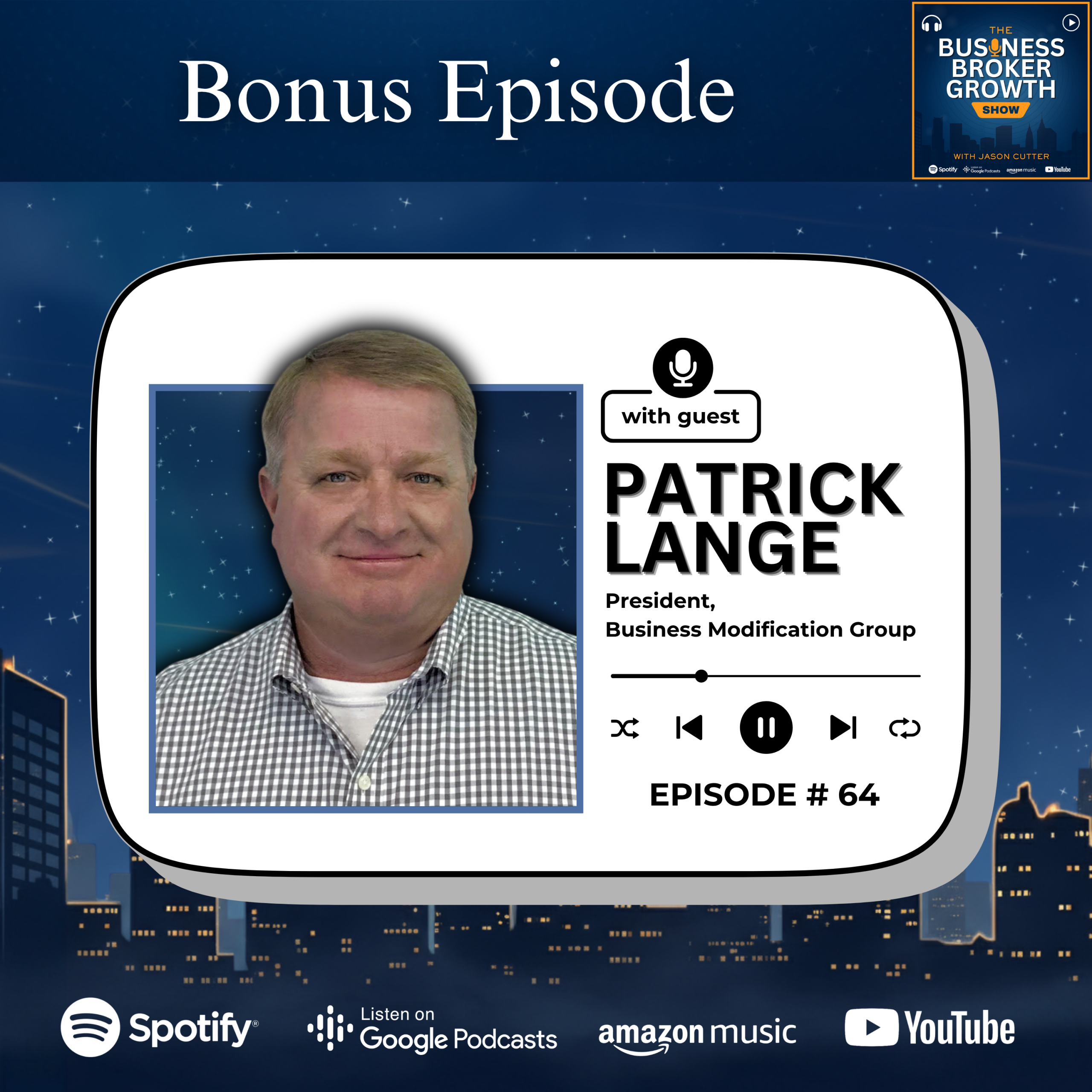 Bonus Episode, with Patrick Lange58 / 100
 Bonus Episode, with Jeannie Keen60 / 100
 Flipping the Business Brokerage Industry, with Clint Fiore
 Bonus Episode, with Joshua Carnes