
Business Broker Growth Show · 2026-07-07 · 45 min
Clint Fiore's evolution in business brokerage reflects a deliberate problem-solving approach. After a failed exit from his manufacturing startup where he lacked control, Fiore became a self-funded searcher looking to buy an established business and discovered the industry was fundamentally broken - overpriced, misrepresented, and designed to frustrate buyers. This led him to launch a Texas-based sell-side brokerage focused on buyer experience over deal volume. A decade later, his shift to social media storytelling on Twitter (2022) revealed massive unmet demand: thousands of qualified buyers across the country requesting his services despite geographic limitations. Rather than expand geographically, Fiore pivoted Deal Onomy's entire model in 2024. Backed by $3 million from industry leaders including Walker Denius (Buy, Then Build), Kevin Henderson (SMB Law), and others, Deal Onomy operates as a buy-side platform with zero commission to sellers, proprietary deal sourcing, and transparent valuation ranges with a $10,000 guarantee on 90-day offer delivery. Fiore frames this not as anti-broker disruption but as market correction - emphasizing that good brokers vastly outnumber bad ones, and the real enemy is low-quality brokers and DIY attempts that damage both sides.
Deal Onomy charges sellers zero commission and guarantees qualified offers within 90 days or pays sellers $10,000; they make revenue from membership fees and success fees paid by buyers, reversing the traditional sell-side commission model.
His daily storytelling and teaching threads about deal valuation and structuring went viral, attracting 10+ daily messages from buyers nationwide saying they wished he operated outside Texas, revealing massive unmet buyer demand that his small Texas firm couldn't serve.
The platform raised $3 million from industry leaders including Walker Denius (author of Buy, Then Build), Kevin Henderson of SMB Law, the CEO of Axial, and other recognized operators in the small business acquisition space.
He's remained part of top-tier brokerage networks despite disrupting the model, crediting an 'abundance mentality' - the belief that quality brokers should unite against bad brokers and DIY attempts rather than compete with each other, since there are more deals than good brokers can handle.
Deal Onomy sources proprietary deals, values them upfront with guaranteed price ranges, vets sellers and buyers, and acts as a transparent intermediary facilitating negotiations - rather than listing open-market deals like traditional brokers.
Computed from the transcript - who did the talking, and the words that came up most.
What if the "seller-first" mentality that has shaped business brokerage for decades is actually holding the industry back? What if the biggest opportunity for growth comes from putting buyers, not sellers, at the center of your strategy? In this episode, we challenge one of the industry's biggest assumptions and explore how building trust with buyers, creating a high-quality pipeline, and delivering a better buying experience can transform the way you grow your brokerage. Chasing more listings and simply working harder is no longer enough. Sustainable growth comes from creating a marketplace where qualified buyers seek you out and sellers value your reputation for getting deals done the right way. Jason Cutter sits down with Clint Fiore, CEO of Dealonomy, to discuss his journey from a frustrated business buyer to an award-winning sell-side broker and now to founder of a platform designed to reshape the industry. Clint shares why so many brokers become trapped by unrealistic sellers, how a buyer-first approach creates better outcomes for everyone involved, and the lead generation strategies that are working in today's market.
Transcribed and scored by The B2B Podcast Index.
Speaker A: You have found the Business Broker Growth show with your host, Jason Cutter. This is the podcast for brokers who are ready to stop hoping for deals and start growing their pipeline. Our goal is to bring you strategies, stories and insights that will be a catalyst to move you quickly from transactional deal makers to trusted advisors. Time for Business Broker Growth.
Speaker B: Hey everybody. Jason here with another guest episode. I have with me Mr. Clint Fiore. He is the CEO of Deal Onomy. Uh, he is a broker. He's been through a lot, he has evolved, he has changed. Uh, he's working on a really amazing platform and I'm super excited that he's here. Clint, welcome to the Business Broker Growth Show. Awesome.
Speaker C: Um, thanks for having me. Excited to be here.
Speaker B: Yeah. So let's start because there's where you're at now. But I think the journey to get here is interesting and fascinating and I've just fallen more and more in love with the, the kind of the hero's journey and the journey stories of business brokers, uh, than, than any other kind of industry or group that I've ever talked to before. And so let's first talk about your introduction into business brokerage and how you came to get into that in the past before we get to the current.
Speaker C: Sure, yeah. Business brokers are fascinating creatures and, and it's a very, uh, unknown industry. And so I'm glad you do this show and introduce people to it and, and the stories and, and this, this industry that, which is kind of a veiled curtain, uh, that a lot of people don't get to peek behind. Uh, I was like most business brokers. I got into it by accident. I was an entrepreneur. So I was kind of a salesman, a marketer turned entrepreneur. I started a company with angel investors and a manufacturing company in Texas, which we ended up growing. Um, it was kind of a rocket ship. Growth went from zero to 50 employees in 18 months. Um, had a 60,000 square foot manufacturing facility we were building innovative products in. And uh, I was a quarter owner of that business with a bunch of partners. And um, we ended up having a, a buyout offer kind of earlier than I wanted that we couldn't refuse or I couldn't refuse. And the next thing I knew, you know, I was thinking this was going to be the company that was going to make me some big shot multi millionaire, um, you know, when we sold years down the road, but I ended up selling for less than I thought we would, but still had for the first time in my life, some money. So it was like I started that company in my 20s, with nothing to lose, no money in the bank, you know, just, just took a big, big gamble, um, and, and had the blessing of angel investors to back our startup. Um, but then all of a sudden I'm just kind of subject to a deal. So it wasn't run through a business broker process. It was just our lead investor wanted to do this deal. He had control. And that's where I learned the golden rule that, you know, he who has the money, who, he who has the gold makes the rules, you know. And so I was just handed the check two years in and said, all right, we don't need you anymore. We'll take it from here. Eventually, uh, that company ended in the hands of a private equity group that, that ran it into the ground and, and it's no more. So I got to just kind of see that life cycle as an entrepreneur and watch, you know, what I thought was my baby be sold for less than I was hoping it was going to sell for, and then watch it get destroyed in the, in the coming years. And through that process, I was thinking, you know what, this was fun and this was a neat first step in entrepreneurship, but man, a manufacturing startup with angel investors, that fast growth, I mean, it was business on hard mode. It was probably the hardest first business I could have chosen. And so I was thinking, you know what, I'm going to do a little bit easier business for my second business. And I think I'm just gonna really try to buy like an established business instead of doing a startup. And so I had my little pile of capital from my exit. So I had some cash and I had some experience from running a manufacturing business. And I had heard about, you know, the baby boomer wave of sellers and all, you know, all those things you, you hear about. And this was 2013, I think. So this was before all the, all the social media gurus were popularizing this, uh, before Buy, Then Build was written, before, you know, all these, these things came out. But I was a self funded searcher. I didn't know any of the words, uh, of this industry. And anyways, I ended up just thinking, how hard can it be? I'll just find, you know, found biz by sell. I'm just going to find a, a business I can buy. I've got money, I've got experience. There's all these old people that need to sell their business. How hard can it be? And I discovered it. It's really hard and it's way harder than it should be. And I was kind of the, the buyer that kept striking out and realizing man, there is, it's hard to find a good deal. Like there's a bunch of misrepresentation out there. Um, um, there's just a bunch of junk on these platforms that have incomplete information, poor representation, they're overpriced, there's bait and switch tactics, there's used car salesman type of brokers out there. And I'm like man, this is way harder, way harder than it should be. And I think I ended up going back to my roots as a, as an entrepreneur which says when you have a problem there's an opportunity. And I just said as a frustrated buyer, somebody needs to make this easier for buyers and make it easier to find and close a good deal. And so instead of buying a business, I decided to do another startup and start a business brokerage that would make it easier for people to buy quality companies. So I went sell side and did a traditional kind of business model. But I wanted to be the most buyer friendly sell side broker uh, in the world which to me was just only represent good stuff that's priced right with complete information and make it, and roll out the red carpet to buyers so that people like me that are quality buyers with cash in hand can feel like wow, that's what I wanted, you know, like that's, that's a good deal. You made the process easy. And then whenever I want to sell my business, I want to use you, you know. And so I really wanted to be um, focused on the buyer experience and changing their lives, um, and finding quality opportunities from sellers, um, to feed to them and just build that reputation. And that's what I did. And so like that's how I got into it. Um, was I was a Texas based sell side firm. But I would say probably everybody's every buyer's favorite one to work with because of our high quality standards. Um, and so yeah, I did that for about 10 years, um, built a company, grew it and um, and just had a good reputation. We enjoyed a great reputation in the state of Texas. We won a lot of awards and we're in a bunch of trade groups and just kind of, we're well known, especially in central Texas. But another thing about me was I was, I have a small plane and uh, at the time and I was flying around to different cities and so I kind of developed a strategy where um, I would, I would hop in my, in my plane and fly out to sellers and go meet them and that made a cool impression on them. And, and, and that Was kind of creating fun stories and content that I later leveraged into the social media stuff. I'll talk about. Um, so, you know, I was just flying around doing deals. Um, Texas has 10 plus cities that are mid tier that have almost no business brokers in them. That, um, you know, because most of the brokers are concentrated in the big four cities of Texas. And so I did good at ranking on SEO and all the other 10 non big four cities and flying around to them because I could reach them quickly in the, in the plane and meet their best owners and go broker their deals. Um, and so we're just doing stuff like that, kind of have my own strategy. Um, but then everything started changing around Covid and that's when my, I feel like the wheels kind of fell off because my pipeline, like I had a good team. We were a small team, like maybe seven people or so on the team. So I always did like a team approach. I had real W2 staff working, working with me and for me. And we, we work every deal as, as teams do quality stuff, very high closing rate. But around the time of COVID when the world shut down, our pipeline was terribly misallocated into Covid affected things. So we had like wedding venues, catering companies, oil and gas deals, uh, restaurants, like, you name it, like everything that was, no one would touch with a 10 foot pole was in our pipeline. And all of a sudden I had a lot of capacity and was trying to figure out, you know, what do I do from here? So I'm like trying, um, to rebuild the pipeline. And I guess it was in that time that I stumbled into Twitter. Uh, and I'd never been a Twitter guy, but like, I think I was there. It was the booming days and when crypto was going crazy and I was like learning about that and I was just lurking on because there's smart people talking about smart stuff on there. Um, and the algorithm started showing me like small business acquisition people on there. And that's when I discovered this robust conversation happening on a platform I'd never been on. Um, because I've been on like other social media like Facebook and LinkedIn mainly, but Twitter was, I thought it was just like the celebrities and sports and coastal elites kind of platform. And I'm just this dude from Texas that sells businesses and flies airplanes. Um, but I found there was a niche. There was no brokers, there was no brokers really represented in that niche. Everybody there was lawyers, uh, SMB attorney was a, was a big voice on there. I met early, um, and other Kind of business gurus teaching people how to buy businesses were on there. Um, but I don't think anybody was telling the story from the seller's perspective or the broker's perspective. And and so I was, I'm a decent writer. I had a little time on my hands after my pipeline kind of crashed and I was like, you know what? I bet I could come, come into this ecosystem and really shake things up and offer a new perspective. And so for I just kind of went all in on. I think it was around 2022 I joined. I started posting every day, started telling stories about deals, started doing like long form threads where I was teaching everything I knew about. Here's how I would value a business, here's how I would structure a deal, here's how I would find a deal. If I was looking for a first business today and you know, just doing all these like how to guides and a lot of them were going viral and getting me huge numbers of views and my popularity just started climbing really quick and um, and interrupt me if you need, need to jump in if I'm, if I'm getting too long winded here. But like this is the journey that kind of brought me to De Lamy that I'm trying to set up here. Um, but long story short, I ended up probably in the, in the, in about a year's time going from someone that most people didn't know who I was unless you were in the state of Texas or um, or were in the ibba, the International Business Broker association because I would always speak there and I was well known in the brokerage community. But the, the national scope of buyers and sellers, business owners didn't really know who I was. And within a year I was probably the most popular business broker on social media. And that was leading me to podcasts and stages and just notoriety. Um, but it wasn't actually. So it was kind of fun and exciting but it wasn't actually moving the needle for me and my team because we're a Texas based sell side firm. And so I was getting messages all day long from buyers around the country that essentially said some version of man. I actually, I want to be honest, I hate business brokers. But you're okay. Like I actually like how you do business and I like your philosophy and I like how your company bison Business thinks about deals and I just wish you weren't only in Texas. I would love to buy a business from you but I'm in Massachusetts or you know, or whatever it is and I would get that message ten times a day. And, and I realized, like, what I had originally set out to do was to be, I mean, 10 years prior, as I wanted to be every buyer's favorite broker to work with, it was finally becoming realized because as I started storytelling, teaching and, and pulling back the veil on this industry, it started endearing myself to, uh, people around the country is like, all right, this guy's a straight shooter. I get a lot of value from what he teaches. And he's not just selling a course or trying to, like, be a guru out there. He's actually doing deals, and he's actually speaking from experience, and he actually knows what he's talking about. And, and so, um, eventually I said, I've got to do something with this, because it was driving my team crazy, because all of a sudden we're getting way more inquiries and phone calls. And we used to get, you know, 20, 30 NDAs signed when we launched a deal, and now we're getting 2, 300, 400 every time. And that doesn't actually make us more money, you know, because the business can only be sold to one person. And Whether you have 10 people inquire about it or a thousand people inquire about it, you get the same commission, you know, uh, and so it's driving my team crazy because we always like to give people white glove service and reach out to them, but they're now slammed with way too many buyers and not enough deals. And we said, we got to change our model here. And so, so that's, that's kind of the impetus, I guess, behind the, uh, what led me to deciding, let's do, let's change the whole game here, and let's, let's go out and do a big swing and become a national platform that goes all in on the buyer experience. And, and so that's what deutelonomy is, is around 2024, I decided, let's, let's do this. And so this was probably, you know, one or two years into the social media rise journey. Um, we raised $3 million, um, and not just from random people. These are from the best, the very best of the best industry leaders in this space. And so big names you've heard of. Walker D is an investor with us. Um, the guy that wrote the book that, you know, that changed the space for buyers Buy, then build. Um, he's on board with us. Um, you know, the SMB law guys are. One of them is an investor, Kevin Henderson. And, and he's on our board of advisors. They're the Fastest growing law firm that's innovating, you know, in this space, um, they recognize the need for a new platform. Um, and just there's, there's many others. Like, um, we're involved with the, the, the CEO of Axial is supporting us and he's got a really awesome platform in the middle market. Um, and so we, I don't, I didn't want just dumb money. I wanted smart money that could recognize this. This space needs some disruption. I've got a new model I want to do. And so our model is we switched from sell side to buy side. We're now a buyer pays model, and we have a membership program for buyers. And we're viewing this as we're kind of just flipping the script on the industry. We're saying, you know what, every other broker, they're all, it's, they're all just making it a beauty contest for the seller. Pick me to sell your business. I'm the best broker. I charge the same as everyone else. But, uh, trust me, I'm really the best. You need to use me. And we just said, you know what, we're going to corner the market on buyers. We're going to become the biggest, most trusted buyer network, and then we're going to bring them deals that are all good silver served up on a silver platter, make their life as easy as possible. And because that's going to save them so much time, energy, and brain damage versus the alternatives out there, which are none, they'll, they'll happily pay us to do that in membership fees and success fees at closing. And so we're just going to make the buyer's life a dream come true. And then that's going to help us attract sellers with the most irresistible seller pitch. And so our pitch to sellers is totally differentiated now from every other broker because we can go to sellers and say, hey, we'll sell your business for free. We're the only brokerage out there that will, um, value your company up front. We'll tell you what we think it's going to trade at. We set a range. We don't do asking prices. We'll set a price range and we're going to guarantee you offers inside that range in 90 days or less. And if we don't deliver on that, I'll write you a check for $10,000. And so we have a $10,000 guarantee, we have zero percent commission, and we make the seller's life a dream come true as well, because we can run this great process to a huge vetted buyer network and um, get it done quick, reliably, for no cost. And so that really differentiates our pitch to sellers. And so we just kind of flipped the script and we said we're going to be a buyer centered, um, network, uh, platform company here. And we're just doing proprietary deals. We find the sellers, we vet the deals, we value them, we package them, we match, make, we negotiate. And, and we're serving as intermediaries so we're not a fiduciary to either side. We facilitate the transaction, we negotiate a win win deal that works for both sides in a transparent way and we make the deals go faster, smoother and easier for everyone. And that's our whole model. But it took, you know, 10 years of evolution to kind of realize, I think this is what the market needs at this moment. There is a huge mismatch. There's the silver tsunami on the seller side hasn't shown up to the extent that it has on the buy side. Like there's, I think there's still way, way more buyers than there are quality opportunities. And so somebody needed to go, you know, cater to that massive network of buyers and not just sell them the dream, not just sell them a course, but sell them a fricking business, you know, like, sell them a good business. And so like that's, that's how we got to where we are. And uh, we successfully launched that, that model in one year ago Wednesday. So we just celebrated our one year anniversary of, of this new model and, and we're off to the races and trying to scale as fast as we can grow and innovate and disrupt in this industry.
Speaker B: So I think the big things that stand out for me in that is everyone, you know, good entrepreneurs, good business founders, solve a problem that they face themselves. And your foray into business brokerage initially and then also into the domy, you know, evolution for you was to solve the problem that as a buyer you couldn't find good deals. Right? You didn't have access to it and the whole, the whole network is broken because it's so disjointed. It's not, it's not a, it's not a cohesive thing for business owners when they're listing a business, uh, through a broker or in any way, it's just a, it's just a, a mess. And so I love the fact that you solve that as a broker obviously on the sell side, but you know, ensuring that buyers had good quality businesses that they could buy and that it was a good experience for Them and they weren't the enemy. It wasn't adversarial. Where it's like, well, I'm a broker, this is the seller, you're the enemy as a buyer and I'm going to treat you and the other 300 inquiries as, as the enemy. And it's this thing, right? Whether whether it's stated that way or it's just, it feels like it. Like you said, you know, most brokers are fiduciary, they're intermediaries, but they're, you
Speaker C: know, working for the seller and everybody knows it. Yeah, yeah.
Speaker B: And so then it creates that dynamic where it's still like you get your own representation. But I'm, I'm here for the seller side and so I love that evolution. And then it's interesting to think that now it's really an intermediary, just facilitating like a mediator, both sides, you know, in the value. What, what does the broker community think about this? Uh, as you go out there in the world, if you're listening to this and thinking, I want this level of authority, I just don't have the time to build it, that's exactly what business broker growth does for you. Most brokers know that they need consistent content, better positioning and real digital visibility. They just don't have the bandwidth to create it or the systems to keep it going. And that's what we build for you. The content engine, the visibility strategy and authority signals, everything you need that we've talked about here. So if you want this impact without adding another full time job to your play, go to businessbrokergrowth.com to learn more about what it would look like for your business. Now back to the episode.
Speaker C: You know, I think we're still, um, you know, there's, I think there's becoming some awareness into what we're doing. Uh, I'm seeing some copycats in terms of like taking elements of what we're doing. But I think I've been the only one so far that's been brave enough to just go all in on this, on the buyer pays model and differentiate my, my pitch to sellers the way that I have. Um, you know, I thought it would get me excommunicated from, from the, yeah, from the brokers Guild, you know, but so far, I mean I've, I've remained in, um, in some really top tier best practices groups of other brokerage, high performing brokerage owners. I told them when I was going to do this, this is what I'm going to do and they helped me kind of like Perfect, uh, you know, poke holes in my plan and sharpen it. And they've been supportive and I'm speaking again at IBBA in a few weeks. And so they haven't kicked me out of the brokerage world but for, for trying to disrupt the space a bit. Um, but I've always been an advocate of like there's, you know, the rising tide lifts all ships, you know, kind of thinking and an abundance mentality. And I've always thought the enemy isn't business brokers. I think the enemy is bad business brokers that give us all a bad name. And so the whole time I was teaching and preaching, I wasn't trying to like poo poo all business brokers. I've maintained that it's an 80, 20 thing where you've got 20% that are high volume, high quality, high standard, really good brokers out there. But then there's 80% that kind of don't know what they're doing or are or bad actors in some way or another that give us all a bad name. And that's the real enemy in this space. And my theory is there's more deals to be done than the good brokers have time to do. Like there's just more. And our enemy is bad brokers and people diying deals and screwing up their own deals by not having professional help get it done. And so I just keep that mindset and I think the brokers that agree with me on that, that, you know, we don't need to be the good brokers don't need to be at each other's throats because there's more than any of us can handle. But we do need to be united to say, let's all raise the bar together and um, and be, you know, good ambassadors for this industry. Because, yeah, like, there's actually probably more deals that get done with no broker at all than there are deals that get done with brokers, good or bad. Um, and so I want the market to know, hey, not all brokers suck. There's some good ones out there. On me has a different model. If you want to try us out, we make it, we try to make it a no brainer to use us. But I'd be perfectly happy if you use one of these other brokers. That's, that's a high quality, high standards one. If you want a fiduciary that's just working for you, the seller, like, that's, that's fine, but just don't try to, just don't use a bad Broker or don't try to DIY it and go all alone against a savvy buyer who's gonna out outmatch you at every turn. Like get yourself some help because it's worth it to get, get people that know what they're doing on your side.
Speaker B: Yeah, that makes sense. And I, and I, and you know, because I think that's important, I think that's a, that's a significant uh, thing to keep in mind is that there is more deals in the market than the good 20% of brokers the professionals can handle.
Speaker C: Yeah.
Speaker B: Um, right. Without scaling up and having a big team. And even then there's still only so much because the stats are there. Like again, the do it yourself the bad business brokers, the, the buyer only uh, representatives out there. You know, that's one of the things that comes in mind because I've been learning more about this recently and hearing more of, of people out there who represent themselves as a broker, but they're only working for buyers. And so they're essentially like, you know, those, those signs you see up all over every town. Like we buy houses where it's like, oh, this seems like a good deal but it's not because you uh, know they're, they're in it to make money. And so how do you deal with that or how do you combat that or how do you, how do you market it or have the conversations with a seller where they realize like, and I think this goes into the valuation process you have where like you're an intermediary, you're not their fiduciary but you actually do care about a, ah, good high quality market value and product.
Speaker C: Yeah, I think it comes through because our team all came with me uh, on this journey from buy some business to dual enemy and we were all sell side people that are used to loving on and supporting and winning for sellers. And so that DNA is still in us. And then we, I just think you, you have to align interests in the fundamental way your business is structured. Um, and, and so I just don't want to see any um, moral hazard in our business model. And for us to be an intermediary I realized like we have to come away from setting the price and we have to let the market set the price and we just basically have to uh, set the stage, you know, and we need to build a really nice package that puts this company's, puts the company's best foot forward just like we always did as a sell side broker and where we present all the facts and figures. We video interview the sellers. We have you know, SWOT analysis and all kinds of uh, analysis uh, in our deal rooms that make the, the, make it as clear as possible to the buyers like this is what you're getting. But that also helps the sellers because it gives them a very thorough, well presented representation of what their company is all about and what they're all about. And so it puts their best foot forward and it puts it forward to thousands of buyers that trust us and are all competing for these deals because there's still a lot more buyers than there are sellers. And so I think as long as we represent the business well in our packaging that the seller signs off on and then we put it in fertile soil of these, all these trusted buyers in front of them and we say hey, we value this and we think it's going to fall in this range. We think it's a three to four and a half million dollar range is where this is likely to trade. Then we'll just set a minimum offer amount of 3 million and 4 and a half is closer to the buy it now experience where it's like, we know that's the, that's kind of the high end of the rang and if people come in there you're likely to get an instant yes from the seller and get it closed quickly. But we're just going to set the stage. We're going to share the same information that we shared with the seller with you, the buyer. And then we're just going to let a bidding process happen and let the market tell us where this should land and then for credibility with the seller because yes, the buyer is paying us, but they're paying us a percentage of the deal. And so we still want what the seller wants which is uh, you know, the higher, the highest price that's going to close and get done because we, we still are a success fee oriented uh, organization. And so essentially you know, we recognizing the buyer is our customer and the sellers are inventory essentially, you know, and, but at the same time we align the game to align with the seller's interest where we can say yeah, the buyer's paying us, but we want the same thing you want. We want the deal to close and we want to receive fair market value which we only discover through a uh, competitive process. And so we just facilitate that process and try to make it as easy as possible for both sides.
Speaker B: Do you have a uh, is there a different experience now with sellers relative to their expectations on value? Because one of the things I've learned From having conversations with just a ton of brokers. And the work that we do with brokers is that stellars sometimes andor often come to the conversation with a business broker of country club valuation, their friend or just some idea or some number they have in their head or they need. I need six million. And now you're telling me it's three to four and a half. Is it a different conversation and different setup with the way that you're dealing with those sellers or is it still that rough conversation and just not everyone's going to make it, you know, forward?
Speaker C: Yeah, it's a huge part. That's a huge part of our job. That's 100% correct. I would say it's 90% or more of sellers overvalue in their head what their company is worth versus what the market reality is. And a big part of our job as a platform and as this intermediary is to bring them to reality. And um, for instance, we're here in May of 2026. Uh, our company is growing rapidly and scaling rapidly. But just as of this moment, we're onboarding financials and valuing qualified businesses that are. So these are good sized small businesses like all of ours are doing typically half a million EBITDA and up as most of our leads. And, um, we're talking to the owner. The owner tells us they want to sell and send us their financials. And we run a valuation through our valuation system. Uh, we're doing more than one of those a day right now. And so we're valuing hundreds of companies per year that fit those parameters. But we don't sign up that many. We're signing up about one a week. And so four out of five typically fall into that other bucket where they were like they said they wanted to sell, but when they found out it's not worth as much as they thought it was necessarily, then they realized, I don't have to sell right now. Let me keep working on the business for a bit. We'll come back. But we're so thorough in, in teaching them. Here's why we landed here. Yes, we'd love to get you 6 million because that would be a big, that would be a bigger win for us. But, uh, you know, I hate to be the bearer of bad news, but, you know, I looked through here for every ad back I could. We talked about it and we found everything. Right. Like this is, this is the most money you make on a, on a, your current level. Right. And, and so we verify, yes, this is the adjusted Earnings that this company makes. Okay. And then I've, I pulled every comp that looked anything like yours that I could and we found a range that went from here to here and, and I'll show them those comps and I'll show them the debt service math. And so we'll look at it, we'll look at the assets, we'll look at the income approach, we'll look at the market approach, we'll look at the bankability of the deal through the lens of lenders at today's interest rates at uh, typical buyer structures. So we will do all that for free for the seller. And by the time we're done, they believe us because we lay out all the data and we say we want the same thing you want, but we don't think, uh, as special as you are and as great as your company is, you're probably not going to set the all time record for the highest multiple paid ever for a company in your industry. Um, and so it kind of dawns on them, okay, yeah, it probably is going to sell somewhere in the range of where all the others sell after the adjustments. And so we'll teach them all that. And it's very valuable conversation for them. Usually they're not mad, they're just, they're just deflated, uh, a little bit. They're just like, okay, uh, that makes sense. Now I know, now I know the truth. And if I don't need to sell right now, I'll go back and work on it and we'll help them with some pointers. You know, here's the things you can do and then we just have a long term nurture relationship. Um, I call that our farm system. So the four out of five that go back into the, back into the field to work on their, on their business, we're going to keep a relationship going with them. We're going to periodically revalue their company and when they're ready to move forward, then we'll bring them to market at a, uh, realistic valuation. And a lot of them do go back and grow their value and then we're able to harvest that value when it's ready. Uh, so we just put the ones in our farm system that need to spend more time out in the field ripening and then the ones that are ripe and ready and realistic, those are the ones that we package up and take to market and get it done.
Speaker B: And so when you look at those deals that you're taking the market, um, uh, one of the things I'm thinking about and you know, I know you've thought about this because I know in our initial conversations we've had, plus this one, like you've got everything covered and obviously it's, it's something that you've built to account for these things is if I, if you offer this guarantee to a seller and say if we don't sell this, you know, get you an offer in the first 90 days, I will cut you a check for 10k, which means I'm upside down 10k. It's not like you paid me anything because your part is nothing. Then I. So basically you're putting out there for the buyers. What is the, what is the. The. And like, okay, I um, want to say like what's the stop gap from you just selling at any price? They have to agree on that range. Let's say three to four and a half million, right? Yes, four and a half million would be great. But what's the, what's the, what's the things that you say to that seller to appease them, that your goal is not just to sell it for 3 million in 90 days. And yes, you could say performance and we would make more. But you also don't want to lose money if that.
Speaker C: Yeah, ultimately they're in control. So like they don't have to take an offer at uh, 3 million, but we want them to be committed to sell somewhere in that range. And so we'll, we'll set the expectations. And most of ours aren't selling for the minimum. They're selling somewhere in the middle of the range, which is what we expect. Uh, because if you look at like a bell curve distribution of where we're expecting the offers to come in, we're expecting them to come in, in the fat part, in the middle of that bell curve, um, which is somewhere between the minimum and max, um, offer range. And so that's typically what happens. And we try to tell sellers, I mean we try to tell buyers that as well. Like hey, this is a cool, I know the, the lowest number looks really sexy and attractive, but if you want to win the deal and win the seller's heart, like make your, make a better offer, you know, like try to come in, in the middle of the range or at the high end of that range and that's going to increase your odds of getting acceptance and getting this deal done. Um, and so we do have, so that $10,000 bet is a two sided bet. And uh, the, the only skin in the game we have from the seller is if you, if we deliver on our part, and we get you multiple offers in this range, you can say no and say no, but if you eventually cancel and pull, pull off the market or, uh, a year goes by and you just haven't, you just won't accept any offer, then you pay me 10 grand because we did our part and uh, and you didn't accept an offer. And so we'll do, we'll take you off the market, uh, for a 10k breakup fee. And so like, it's kind of. That's the other side of that bet. And that just makes me know that they're serious about actually following through and accepting an offer is because there is that. That's the only teeth we have is I don't want you to waste my team's time. Us, uh, we did a great packaging job. We talked to hundreds of buyers about you. We, you know, like, do all this work, bring you all these offers and then you, and you were just fishing, you know, you were just testing the market, but you had no intention of selling. And so that's the only teeth I have is that breakup fee. If you just decide, nah, never mind, I'm not going to sell after all. Even though you did everything you said you were going to do. Um, yeah. And so that's the other side of that bet.
Speaker B: So with, with, with the platform and the way you have it set up so you have the buyers, they're paying a membership fee, they have the performance, you know, fee on their side that they're. They're going to pay for the deal. Does, uh, where is that more stress or different stress of making sure you have enough deals for the buyers? Because if they're paying membership fees and they're not getting enough access.
Speaker C: Right.
Speaker B: Like, how long, how long do you sustain that without the churn of people saying, wait a second, there's just no good deals here?
Speaker C: We thought of everything that keep you
Speaker B: up at, at night now, is that like a different shifting from, from one side to the other?
Speaker C: Yeah, yeah, it's, it's definitely where the pressure is. But, you know, our solution, we knew that would be an issue. Uh, especially going national out of the gate is like a lot of buyers are geographically constrained and they'll say like, I love the, I love the thought of buying a business from you, but you only have one deal in the state of Washington and I'm only looking in the state of Washington. And so I don't want to pay $99 a month if we don't have enough deals to look at, you know, and so like, that's a huge problem. But our solution to that is a rather elegant and simple one. And we didn't do just a membership only model. We do a freemium model. So our model is it's free to join the platform and you don't have to be a paying member to look at our deals and to make offers on our companies and to be part of the dealonomy ecosystem. You can register for free and fully participate. But the members that are paying just get certain advantages on the platform. And so it's freemium, it's free to join or optional to be a paying member. And those paying members, the biggest two advantages they get is first mover advantage. So when we launch new deals, the paying members get the get exclusive first look at it for 10 days and on day 11, we open that aperture up to where all the members can now sign an NDA and look at it. But if you're a free member in that first 10 days and you see one pop up that you'll uh, see the teaser on it and then when you go to click sign NDA, it says, sorry, it's for the next seven days still. This is premium only. So you want to upgrade a premium or do you want to wait seven days? Up to you. But, um, it's no pressure, um, no cost to sit and hang out, watch the deal flow. Um, and you can always upgrade at any time. And the other thing they get is our premium members pay a lower success fee than the, than the free members. And so if you're committed to using dilonomy and you want that first mover advantage and you want to have a lower fee and, and we have other advantages, um, there as well, then it kind of makes sense to join premium. But if you think, you know, the, the deals aren't there yet, you know how the deal flow I want yet you can wait, you know, just wait and hang out, be a free member. We still love you. All good?
Speaker B: Yeah. Yeah, I, I think that's great. And, and that solves that because it's one of the things. After we spoke the first time, I was thinking about that too. It's like, you know, charging people for that and if you don't have the, the inventory that they want to buy. Right. Like, I think ebay is very successful because it's just free. You just sign up and you can see, want to bid on it. You know, you just do that. And so like there's, there's no feeling of being upset, like you're buying something that has no inventory. Uh, and so I, I love that you have that in there, which is why I wanted to bring that up because I'm thinking like, how do you make sure? And then of course there is the advantage of, of paying for it. But you know what you're getting and you know that it's worth it. And you, you're, you're in that bucket where it's, it's valuable. So I think, I think that's great. Um, what's the biggest challenge now heading into year two with the.
Speaker C: Yeah, I think the, the market has uh, responded positively. I think we verified our, our thesis is valid. You know, so I think we've done deals, uh, uh, successfully. We've had buyers really tell us rave reviews about the experience and, and confirm that they are willing to pay, um, for having good deals and making their life easy. Um, and so like that was our big question is will buyers accept this notion and will they be willing to pay us? Um, and so we feel like we validated that. I think our next great challenge is the scale. And so right now it's just we needed to prove the model. And I feel like we've done that. We passed with flying colors. Now we've got to scale the model. And so for us that's um, lead generation, you know, to just keep that deal flow going and then it's hiring and uh, the people side of this business. So we have a great tech platform and technology, but you kind of need really good tech. You need really good deals and enough of them to keep growing and scaling and then you need the people to work the deals. Um, and we don't have the uh, the model of the typical business brokerage. Like we are W2 employees working together on these deals. Um, and so it's not just um, you know, the real estate type of model brokerage where you just, yeah, put a whole bunch of brokers out there, throw spaghetti at the wall, hope, hope some will stick around, hope they won't move to another broker. Like we're, we have true career paths here, um, where you can be a specialist on the assembly line, you know, with, with the alonomy, cranking these deals through. And um, and we have divided that, that labor into specialties. And so it's just kind of like getting those job descriptions right, honing in on that team approach and then making sure we've got the right people to do it. Because this is still pretty labor. We automate as much as we can, but this is still a very much labor, intense human to human interaction business. It's a high trust, white glove service type of deal. And so we've got to scale in all those areas. Um, and that's the challenge is just can we scale it?
Speaker B: Yeah, I think that makes sense. Well, it's a good segue for us to move into the next portion of the show, which is the business broker growth portion, where we talk about marketing growth strategies. All right, as you can tell, Clint and I are having such a great conversation. We are going to end part one. Leave it a little bit of a cliffhanger. Make sure to come back for part two. We're going to continue the conversation focused on business broker growth tips and of course, the deal that got away.
Speaker A: Thanks for tuning in to the Business Broker Growth show, hosted by Jason Kutter. If today's episode helped you think differently about how to build your pipeline and grow your business, share it with another broker who's ready to make the shift from hoping for listings to every engineering them. Join us again for the next episode of the Business Broker Growth show, where brokers become trusted advisors.
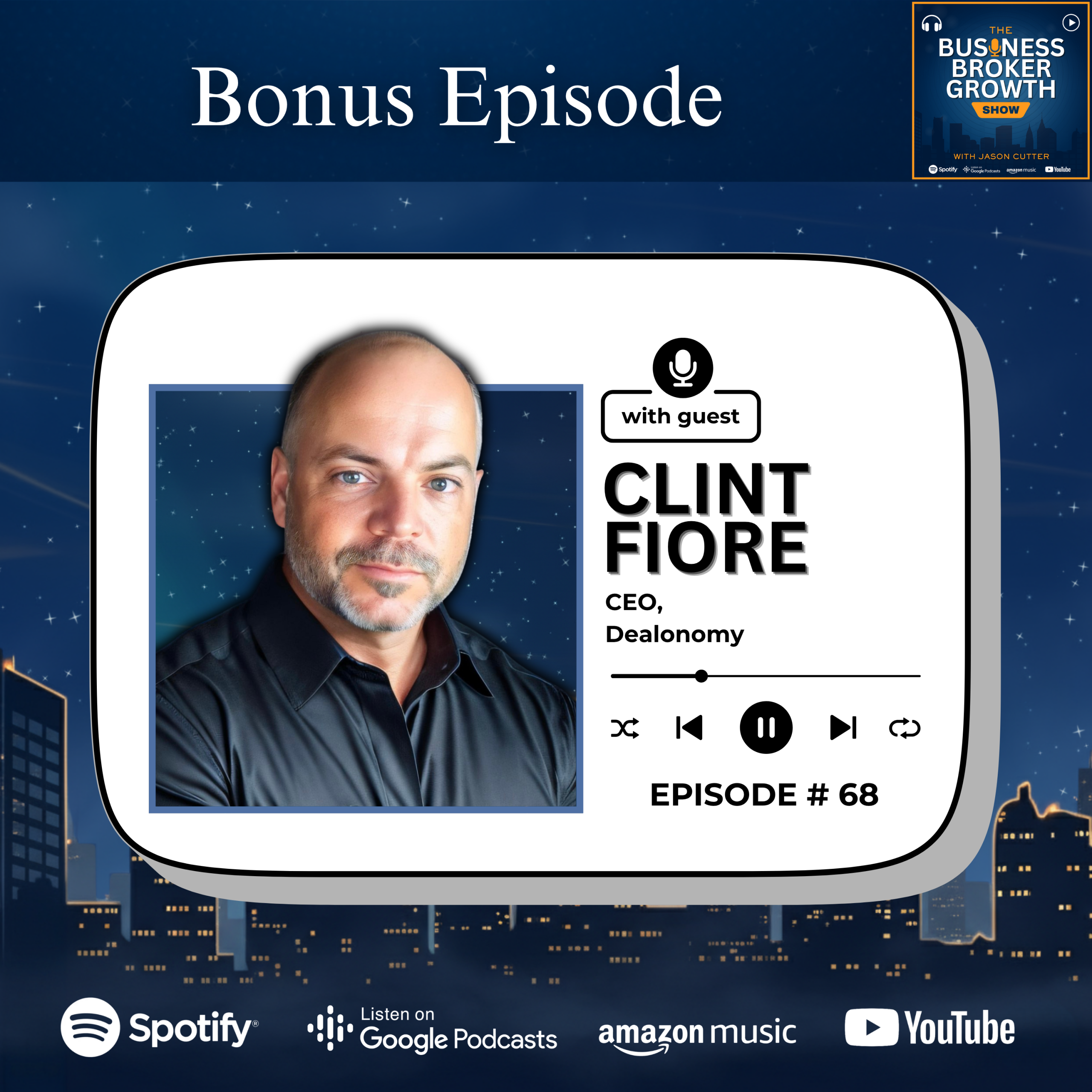 Bonus Episode, with Clint Fiore76 / 100
 Bonus Episode, with Patrick Lange58 / 100
 Strategies for HVAC Brokers, with Patrick Lange75 / 100
 Bonus Episode, with Jeannie Keen60 / 100
 Bonus Episode, with Joshua Carnes