
BriteVibe Podcast · 2024-04-04 · 46 min
Key moments - from our scoring
Substance score
14 / 100
Five dimensions, 20 points each
Carley Weisert, a confidence and identity coach, shares her personal journey of dismantling a life that looked successful from the outside but didn't align with her authentic self. Beginning in fall 2019 and accelerating during the pandemic, she peeled back layers of conditioning - perfectionism, people-pleasing patterns, and adherence to cultural expectations - that had shaped her "American dream" life of marriage, two children, and a home. Through meditation, journaling, and inner work focused on her relationship with a higher power, she realized everything she'd built was to meet others' expectations, not her own. The pivotal moment came when the discomfort of staying outweighed the fear of change, leading to her separation. She frames this as a necessary death-and-rebirth process, comparing it to a caterpillar's metamorphosis - one that requires complete dissolution before reconstruction. The episode explores how sustainable success and fulfillment require releasing old identities and the beliefs that sustained them, drawing parallels to Bruce Boiler's concept of "lifequakes" as four-to-five-year transformational periods that most people experience multiple times. Weisert emphasizes viewing life transitions as happening "for you, not to you," enabling agency and empowerment rather than victimhood.
According to author Bruce Boiler's research on lifequakes, most people experience four-to-five-year transformational periods during major life interruptions, not quick overnight changes. This aligns with Carley's own journey and provides reassurance that extended difficulty is normal, not a sign of failure.
People-pleasing, perfectionism, and a lifelong habit of meeting others' expectations rather than listening to her own inner voice led her to build a life that looked successful externally - marriage, children, a home - but didn't reflect her authentic self.
Carley describes it as a quiet inner whisper that grows louder over time when you slow down and pay attention through practices like meditation and journaling; eventually the discomfort of staying becomes greater than the fear of change.
The dark night of the soul is a rite of passage lasting months or years where you question everything about your identity, abilities, and future; it's a necessary dissolution process before you can rebuild as your authentic self.
The freedom on the other side is fundamentally different from anything experienced before - it includes openness to new ideas and ways of being that weren't possible while attached to your old identity.
Our reviewer’s read on each dimension, with quotes from the episode.
The episode is wall-to-wall personal development platitudes with virtually no actionable content for a B2B operator. The sole semi-substantive reference - a loose citation of the 'Lifequakes' book about 4-5 year life transitions - is vague and irrelevant to business practice; the rest is filler and affirmation.
It's staying true to yourself, I think, is the most. It's a gift to the world, to yourself, and to those around you.
your whole and complete exactly as you are. Like, that is something that I wish every human knew.
Every concept in the episode is recycled from mainstream personal development: the butterfly/chrysalis analogy, 'happening for me not to me,' the hero's journey, the dark night of the soul, gratitude habits, and authentic self. No contrarian or first-principles thinking is present.
I love that butterfly analogy because it literally turns to mush, right. The chrysalis, like, in that transition.
everything was, even the hard sticky parts, it was all happening for me. Not to me.
The guest is a newly practicing personal development coach whose primary credential is having ended her own marriage and undertaken self-discovery during COVID; there is no evidence of coaching at scale, notable business impact, or any relevance to B2B operators.
being coached changed my life to have that space to lean on and, or fall back into when I was going through everything
you coach, you, uh, primarily work with women, but you also, you know, coach people on just the things we've been talking about today
Almost no concrete data, named companies, metrics, or timelines appear; the only semi-specific claim is a loosely attributed stat from the 'Lifequakes' book (misattributed to 'Bruce Fuller' rather than Bruce Feiler) about 'several hundred' interviews yielding a 4-5 year process, which is unverified and cited from memory.
he interviewed it, several hundred people. He was like, that's a four to five year process.
I have like habits of like, I like thank the, the traffic lights when I like hit greens in a round.
The host routinely delivers extended personal monologues that run longer than the guest's answers, answers his own questions before the guest can respond, and never once challenges or probes a claim; the format is parallel storytelling rather than disciplined interviewing.
I never give anybody the question in advance. So if you haven't listened to my podcast all the way through, you'll never know that I'm gonna drop this on
ultimately we're racing to death. That's where we're headed, folks, It's. This isn't as. I mean, it's still a shock to say it, but everybody knows it's true.
Computed from the transcript - who did the talking, and the words that came up most.
Carley Weissert is a beacon of light in the realm of empowerment coaching, dedicated to guiding women back to their authentic selves and crafting lives filled with uncontainable joy and fulfillment. Carley employs a rich tapestry of methodologies in her coaching, from inner child work to somatic emotional release, all while infusing her sessions with her unique blend of playful energy and deep insight. Her approach is not just about transformation; it's about reawakening, about turning the page to discover the vibrant, authentic life that awaits when women stop performing and start living. Carley isn't just a coach; she's a testament to the transformative power of listening to one's inner voice and a guide for those ready to embark on their journey back to themselves. Listen now and take the first step towards reconnecting with your true self and living unapologetically. Your journey to empowerment starts here.
Transcribed and scored by The B2B Podcast Index.
Speaker A: Ahora mascolos Hill va cada projecto al sigente niver ahora quince porciento nuna selection de puertas personalizadas. Escrita.
Speaker B: Sigues.
Speaker A: Foreign. Welcome to the Bright Vibe Podcast. At, uh, Bright Vibe, we believe everyone deserves to be happy. But in today's world, everywhere you turn, there is division and negativity. At, uh, Bright Vibe, we have created a global movement to bring 8 million people together who are inspired to live bright, live bold, and share Bright Vibes. Alone, it can be hard to change. But together, we can change the world. Welcome to the Bright Vibe podcast. Carly Weisert, welcome to the Bright Vibe podcast. So happy to have you on today.
Speaker B: Thanks so much for having me. I'm excited to be here.
Speaker A: Yeah, it's going to be fun. I love talking a little bit in the pre show about things we're going to talk about. I get excited. So you are, we're, I'm, I'm calling you a confidence coach. I think it's more expansive than that. It's really kind of like a, uh, I'll call you a revolution coach, but a confidence coach. Helping people find their voice, uh, helping me m. Maybe even people step into their power. Um, and that was because you went through quite a transition or tried to trend, I'd say even a transformation over the last four years. Ish. Um, no, no coincidence that Covid was part of that time frame. Right. I think we, and I've talked to many people on the show where obviously that was a catalyst for life change, myself included. You know, we had a big life shift during that period of time for the better. Didn't always seem like it in the middle of it. So if you're listening to the show today, we're going to talk about this kind of transformative process. And really, I think no matter where you're at, if you're dissatisfied with, um, the results you're getting in life, if you're just, if you had that internal angst is, I guess, the way I would look at it, it's kind of because I, I, I had that and still have little moments or relapses of that internal angst that just says, is this really the life I'm supposed to be living? Right. Because, you know, uh, you know, and, and, and it, it's just I, and I think so many of us ask that question, but it, it sometimes gets so loud. It's like, is this really it, Is this the life that, you know, if I look in the magazines, if I'm watching tv. If I'm looking at social media, this is the thing that everybody says is supposed to be the great thing. I've got the house and the cars and the family stuff or the job that I, and, and, but yet I still feel like that this isn't it. This isn't. It doesn't feel right or it doesn't quite fit. And I think most of us can relate to that, that feeling of internal questioning, but this is even more than that. I think this is more of that internal identity almost issue. Right? Is this who I truly am? Not only is it what I'm supposed to be doing, but is this truly who I am at my core? And so with that, Carly, welcome to the Bright Pipe podcast. Feel free to chime in, kind of. What, what's your story?
Speaker B: Yeah, well, I can very much relate to everything you just spoke to. And, um, yeah, that's that inner, that internal angst that you were just mentioning. Like, I, I, I called it, like my little whisper. I had this whisper. And, um, so really kind of backpedaling to start of the pandemic. I had started, uh, to, I've always really been into personal development, transformational work. I kind of started to dive back into it in the fall of 2019. Then the pandemic hit, shut the world down, and I dove in even more because there wasn't all that much to do.
Speaker A: Right.
Speaker B: It was a great time to just do some more inner work. And I know I'm not alone in that, but, um, I had been just really starting to peel back the layers of myself and, and dig into patterns and things that had kind of run my whole life up until that point. Uh, lots of people pleasing, perfectionism tendencies, things like that. And, um, as I was kind of digging into myself and doing this healing work, I had had this whisper, and it just felt like something like, very much that. Like, is this it? Is this my life? Is this what I actually want? Because I had thought for a really long time that that's what I wanted. I had created my life up until this point to be a certain way. And, and as I started to learn more about me, I was realizing more and more that everything I had created was to meet other people's expectations and to check other people's boxes. And I just kind of was slowly waking up until this whisper that for a long time I could ignore because it was so quiet and life was so loud and busy, right. That it was easy to just be like, I'm just gonna, you know, go through the motions Keep doing the thing I'm doing. Follow the police resistance. And um, with the pandemic and then all of this attention I started to put on me. The whisper got louder and louder until I say, like she got a megaphone and was just like, couldn't ignore it anymore.
Speaker A: Right.
Speaker B: And eventually the uh, uh, the discomfort of making a change in my life, and in my case this was ending my marriage, was the scales tipped. And that became less uncomfortable than staying in this life that I had created, that I had outgrown. This, the version of me that I had grown into and just kind of discovered just didn't fit into this life that I had made. And it's, uh, it was a really challenging time. It was very messy and I had lots of moments of like, oh my God, what am I doing? What did I just do? Why did I do that? Like, just lots of questioning. And it's been about, about two years since I, you know, said the words out loud. I don't want to be married anymore. And I, uh, I don't, I don't have any regrets at all. I feel more like myself than I ever have. And it's been wild, but worth it.
Speaker A: Mhm. Yeah. And I think, you know, the, the wild part, right, is always a, um, you know, that can be very uncomfortable and, and feel very negative, I think, or at least it did for me, going through some of those things. Um, but to your point, on the other side of any type of transition, if we lean in, there's usually positive outcomes. On the other side of that transition, if we choose to see them that way and we embrace life, if we choose to not see them as positive, then it turns into a victim story. And this is what happened to me. And this is horrible. And the rest of my life's defined by that. Right. Um, you know, I was actually walking. My daily kind of therapy, um, is hiking in the woods. So every day, pretty much every day I'm in the woods in the morning, first thing and hiking. And this morning I was kind of just pondering the question, which I have off and on, but it was really, you know, kind of back to what you were talking about. Life is so noisy, you know, life is so noisy and so full of distractions, is so full of shiny objects and this thing and that thing. And it's like, uh, there's this sense of urgency, uh, and it's like, but where are we racing to? Where's. Where are we racing to? Right? Because ultimately we're racing to death. That's where we're headed, folks, It's. This isn't as. I mean, it's still a shock to say it, but everybody knows it's true. We all ignore it and pretend like it's not, but the race is. Ultimately, we die. That's where the race leads. There is no other outcome that we have found so far from a technology standpoint that leads to anything but death. And so, but yet we run. Like, where I have run, I say. I'm going to say we to some degree, but we have run this race, um, just for the sake of running it, because everybody else is running it. And that's what we. We're taught and that's what we grew up with. And that's how you get ahead and that's how you have the nice things, and that's how you send your kids to college. And that's a blah, blah, blah. The list goes on and on. But ultimately it all ends in death. So it's like, so what? What are we running so fast for? Right? Slow is good, right? At least I'm giving you my opinion. But, but I. So what was your experience through this kind of get. So you went from. You're married, you've got a couple kids, you've got a house, you've got a golden doodle. I think I've got a golden doodle. I can relate. Um, so you've got this, You've got this life. And then Covid hits and you start. This little whisper, gets louder. Um, and then you realize that you've got to change some things. But I guess then what was that process like for you?
Speaker B: Oh, it. Very bumpy, very rough.
Speaker A: Okay.
Speaker B: Um, but it did. To your point, it required a lot of slowing down and getting quiet and being with myself and. And tuning out all of these opinions, this conditioning, everything that comes at you from the world about how your life should look. And there's a lot of, uh, in our culture, especially for women of like, okay, well, you should. You should be this kind of wife and this kind of mom and do these things and. And listening to that is what got me to this life. That from the outside looking in what, like, checked all the boxes, it was very like American dream kind of two kids, a dog, the whole thing. And, uh, so the process of kind of like dissembling that light was. It was long and slow and a little, like, painful at times, if I'm being totally honest. It wasn't this walk in the park where I just realized, like, oh, this isn't a line. I'm gonna. This now and like every uh, into place. If it was that easy, everyone right would do that.
Speaker A: Right.
Speaker B: But it required a lot of again, like just being with myself, of trusting myself and knowing that like it really, my relationship to my like higher power came into play through all of this. I didn't, it wasn't something that I really had much of right there. And um, I had to lean on it and just trust that by listening to myself and my own inner voice, I was ultimately listening to my higher power and were guiding me and that everything was, even the hard sticky parts, it was all happening for me. Not to me. Like viewing life through that lens was so important transition. And I mean it's still how I choose to operate. Um, I think it's a really empowered place to come from. But uh, yeah, it was lots of challenging conversations, lots of time focusing inward and really rooting in my, in myself and trusting at the end of the day that I do know what's best for me and I need to follow that even if I can't see like exactly where I'm going, exactly what's on the other side. Just keep putting one foot in front of the other. And that's what got me here today.
Speaker A: Mhm. And um, and through that transition, I'm curious if this is, if you had some of this experience, but I have found that I had to kind of unlearn or let go of a lot of, of past beliefs and past ways of operating for me to find it's like I can't, uh. Well, I went through an executive leadership course. It was like an MBA course. And the first thing they showed us was basically Tiger woods and, and you know, he got to a point of success and then he realized that he couldn't be, um, he couldn't go on with uh, with his career and do even greater things if he didn't totally revamp his swing. And so the talk was the swing that got you here will not drive you forward. The thing that made you successful to this point in time. If you want these other things that are outside of your comfort zone or beyond what you know today, then you got to do something different. Otherwise you're just going to have the same swing. You're going to have the same exact life. And I think in a lot of instances I've probably failed to move forward with my life because I didn't want to let go of the identity I'd built because I'd built so much stock into it. Right. Whether it was, you know, work or reputation or whatever the Case, uh, put any label on it, success, label, whatever. And it was like that was. The risk was that that would all have to go away or that somehow that all that part of me would die. And, I mean, there was real. For me, there was just real sheer terrifying fear in that transition from the old to the new. It wasn't a very smooth transition. It was more like pulling teeth and hitting me with a bat and blood and guts and snot and tears and I mean, it was like a really gory mess. Um, but it had to happen for that. You know, Another example I can think of is kind of like when the butterfly, and this is, you know, cliche example, but when the butterfly or, uh, the. The caterpillar turns in the butterfly at one point, all the cells in the caterpillar have to completely realign themselves and completely realign, rearrange for it to be a butterfly. And to some degree, that's kind of what it felt like. Like, my world had to pretty much. I had to. I kind of had to lose me to find me, if that makes sense.
Speaker B: Oh, absolutely. Yeah, it's. I love that butterfly analogy because it literally turns to mush, right. The chrysalis, like, in that transition. And it has to. But we get like, to your point with identities and stuff. Like, it's so human for us to get so attached to these identities that we've created our ego, like, we just latch on. And I think about the butterfly example and like, some of us get so attached to being a caterpillar that we. We won't let go. And if you don't let go, you can't turn into that butterfly. It's. I had. I'm. I feel like a completely different human being, a completely different woman than I was definitely four years ago, two years ago. I mean, honestly, even six months ago, I'm. I. It's this constant evolution and.
Speaker A: Right.
Speaker B: Um, but my. To your point, like, things that had worked really well for me for a long time stopped working. And it were those, like, people pleasing, like, and just saying yes and stuff. And it worked well. I got, like, people liked me, I got things that I wanted. I avoided conflict. It was all great. But eventually, after like, years and years and years of that, and I finally kind of was in this waking up stage. I was like, I don't even know who I am anymore. It was this whole rediscovery process for me because I had created this person who did all the right things and looked really good and was well liked and created all of this stuff. But I Was like, I don't even know who I am anymore. Like. And it just stopped. It stopped working. And.
Speaker A: Yeah, yeah. And, and, and so yes, it so. And uh, and I just belaboring that obviously to some degree so that people understand that this isn't. Yeah, it's to your point, it's not this, oh, I'm just gonna change and I'm just gonna do this other thing. And it's like, no, there's lots of momentum that's behind your identity and behind a. And an identity when it comes to a certain point where. And then if it chooses to change, it takes a lot of energy and a lot of. To your point, you said earlier, working on yourself, focus, meditation, journaling. I mean, there, there's. And, and I've seen this, you know, whether it's in this situation, I've seen this with, you know, businesses themselves as an organization. I've seen this with high functioning business leaders, um, people that lead, you know, not for profit organizations. It's almost like you can't be successful until there's like this. You can't truly be successful or feel fulfilled. Maybe is a better way to put that. You're never going to be fulfilled until you go through this process. It's like a rite of passage. And I don't. And nobody escapes it. Nobody gets out of it. You, you can get stuck and, and get like, there's, you know, for people that have studied the hero's journey, um, his name will come to me. But, uh, the hero's journey model is basically that you gotta go through this like, dark night of the soul type experience. Um, and I always used to kind of be like, oh, yeah, I've done that. I've. You know, it was a Tuesday three years ago. I. Right. And then when I actually got to the dark night of the soul, I was like, holy shit, is this ever going to end? Like, this is not the dark night of the soul. This is an eternity of yuck. Right? And this was, for me, it was months and probably a good solid year. If I went back and actually said, okay, from here to here, this was really bad. But the dark night of the soul was like literally this whole questioning who I was, questioning all my abilities, questioning my past, questioning my future, thinking everything that I touched was now that it turned to good, was now turning to bad. I mean, it was just a whole mess of stuff. Um, but that had to happen. And when I get other people, you know, that come on the show, or I read books, or I look at other. Everybody that that does anything of significance has to go through this process. There's no skipping or no getting around it.
Speaker B: Yeah, no, I totally agree. It's uh. It is like a, A rite of passage, like an initiation from one version of yourself to another. And I think like, at least in my experience, it was like I uh, I lived, you know, the first third ish of life. Like as this, uh, as someone else. Like it wasn't actually me. I had to go through this darkness. And mine was very much like if it had been one night, it would have been amazing. But it was.
Speaker A: Right? Yeah, yeah. Like that was the best. Wow. That was crazy. But I'm. That was cool.
Speaker B: Yeah, exactly.
Speaker A: Yeah.
Speaker B: I'll think like, okay, I'll do that again.
Speaker A: Yeah, exactly.
Speaker B: But yeah, it was, it was a long process and I. When I was in the thick of it, it was awful and like. So um. Like I didn't know up, uh, from down. I just really was like you said, questioning everything and. But it was so I would. I. Not happily, but I would.
Speaker A: Yeah, no, I get it. Yeah.
Speaker B: To, to get. To become the person that I am now. To have the life that I have created, the relationships I have, like just all of it was so worth. Not only that dark night of the soul period, but everything that I had done up until that point. Cuz I did in my own journey with this. I don't know if you can relate, but it was lots of. I. I wish I had been different or done this or. What those 110% regrets.
Speaker A: Yeah, totally.
Speaker B: Yeah. I wouldn't be this version of me without all those other previous versions. So it's again going back to that everything's happening for me and trusting in my higher power that this path that I'm on is exactly the one that I'm meant to be on. And it's hard to. To lean into that sometimes.
Speaker A: Yes.
Speaker B: Middle of it.
Speaker A: But yeah, totally.
Speaker B: Hindsight's 2020 and I think.
Speaker A: Yeah, it's so easy to look outside and compare. Right. That person's life looks great or that person's life looks great or wow, I just wish I, you know, had that or that. And. And that's just such a slippery slope of. Of not. Not good stuff versus realizing that. No, what you just said. We're exactly where we're supposed to be when we're supposed to be there. It's just that we have the awareness that we're where we're supposed to be, you know, when we have to be there. And, and, and even in the midst of the. You know, I didn't have that perspective when I was in my lowest points. I didn't, uh, it would. I didn't. I couldn't think like, about a future much at all. It was just trying to survive, you know, minute by minute, day by day, to just hopefully something better was going to come along or not. Right. I mean, I was kind of. But as it. As I've kind of come through that, you know, looking, looking back again, I wouldn't trade it for the world and it was definitely worth it. I would never want to do it again. Right. But there is a freedom on the other side and, uh, that. That's just not the same freedom that I'd ever experienced before. A freedom of being able to be open to new ideas and new thoughts and new ways of being that had I not gone through that period of time, I could have never let go of because I was like, you know, I would have liked to have thought I was an enlightened human being before this process started. But that was bs, right? That was an enlightened ego. That was just an enlightened way of hanging out in the world with some concepts and some philosophy and no real connection with God or no real connection with my inner self. I mean, that was. I was just moving too fast, right? It was. And. And so. So, yeah, so I. I guess I'm kind of wandering around here a little bit. But ultimately I just want to reassure anybody who's listening that maybe they've already gone through this and if they have great help others. Right. In fact, Bruce, uh, Fuller came on my show here about a month or two, probably two months ago. He wrote a book called Lifequakes. It was all about this. It was fascinating. He'd. He's written so many bestsellers. Um, but the Lifequake book was super interesting to me because he talked about this very thing. We're talking about every human being two or three times throughout the lifespan, if they live an average lifespan, two or three times without their lifespan. They go through these lifequakes. And these life quakes are major interruptions in whatever's happening in their life. And it can be because of an illness, you know, a heart attack, stroke, things like that. We hear that that's, you know, somebody turns their life around because they've been hospitalized or cancer is a big one, that's a catalyst for this type of change. But what I didn't realize is he said, typically it's a four or five year process like most people. It's not like you Quit your job and then you get another job. That's not a lifequake. Right. It's where you quit your job and then you have a series of crappy jobs and then you start to question everything and then your life's kind of in disarray. And then my favorite part of it was. And then he said, and then you think you have it figured out and then you don't. And then. And then you transition into the new way of being. Right. He said, but typically that's when he interviewed it, several hundred people. He was like, that's a four to five year process. And it actually was a sense of relief for me. I was like, oh, I'm actually normal. Right, Right. It was like, oh, I'm not, uh, this four or five years, because it's been about. I've tracking about the same. Same timeframe you are. Mine started a little bit before COVID and. And lasted. I'm still recovering. But, um. But yeah, it's like, this is normal. And I want to just reiterate this and show this is normal for people to go through this. It's just. He kind of looked at the people that went through this and they didn't recover. And then the people that, when I say recover, they didn't fully make the transition because they pulled back to a. A position that wasn't the end of the transition. Yeah, they went back to the same thing. They went back to the same job. They went back to the same way of thinking or being. And then they just. It was a life of apathy versus people that actually were able to see that there was light at the end of tunnel, make it through, go on to do really cool things with their lives. And that could be just raising great children or. Right. Or. Or having a great family or it doesn't have to be, you know, saving orphans in India or climbing mount, you know, some great big high mountain. Right. It's.
Speaker B: Yeah.
Speaker A: Uh, I mean, so anyway, yeah, no,
Speaker B: I love that it's. I haven't. I. I sounds like I need to read this book, but I haven't read it either.
Speaker A: It sounded really interesting when you described it though.
Speaker B: The timeline of it, though, is very like you said, I. Because that's what I've been feeling in myself really over the. The past like maybe six months, maybe even less. Like, really feeling like, okay, I'm starting to like, really get my feet under me here. And, um, it did feel like very much this like, inner monologue of like, this is like, what. Not what's wrong with Me, like, what. Why is this taking so long? What's happening?
Speaker A: Yes, totally. For me. Yep.
Speaker B: Uh, yeah. And. And it is, though, like, at the end of the day, whatever I end up doing in my life, the impact I'm having, like, as long as I. I think the most impactful thing that you can do as a human is just live an aligned life. When you're in alignment, whatever that is for you, then you are positively impacting those around you. You're giving permission to other people to make shifts that they need to make for themselves and pursue their own passions or joy or whatever. And it may. Maybe it is saving orphans in India or maybe.
Speaker A: Maybe it is, yeah.
Speaker B: Raising like a really incredible human being who will then grow up to save orphans in India. Like, you just know, right? Accent. It's just staying true to yourself, I think, is the most. It's a gift to the world, to yourself, and to those around you.
Speaker A: You know, when I started looking at the. And I haven't read the whole book, but I started looking at the 12 steps, I wasn't. I was really good at drinking when I was younger, but I was never truly, um. You know, it didn't. I would. Didn't drink at home or alone or things like this. I was just a very good social drinker, um, in a not great way, but. But I looked at some of these 12 steps of the 12 step program. I was like, you know, some of this stuff really makes sense, like believing in, um, you know, a God, or my understanding or my understanding of what God is. Right? Believing in a higher power, um, you know, forgiveness for myself. Right. Forgiving myself of and admitting the things that I've done and then also forgiving myself for the things that I've done. Right. And then really asking others. I think I'm at the stage where I'm getting ready to ask more and more people for forgiveness. But I made the list. Started thinking of the list, my head. The other day, I was like, nope, this is going out on a social post because my list is way too long, right. Once you get past five or ten people, I'm like, I don't have. That's a lot of. You know, there's like, I'm sure I have pissed off people I don't even know, right? So at what point do I just need to apologize to basically the face of the earth? It's just like, please share this post. Know that I've offended anybody, but, uh, but these things have so much, uh. You know, we've kind of looked at the Or I've kind of pointed us in this kind of the, the hard part of it, but the other side. I don't know what your experience is of lately, but you know, you talk about you. It seems like even six months ago, it's just going so quickly, this transformation. And I'm like, it's hard not to just be happy all the time. I mean, I have to like really find a way to get pissed off, to get angry. I mean, it's like, it's just hard not to. It's just. There's a lot more. I was relaying this the other day. It feels like that even though there's challenges and there's issues, I still get irritated and angry and mad. But it seems like more often than not the, the, the default's now joy or peace or happiness or laughter. And it kind of crowds out the stuff that, the stuff that's negative. At least for me. It's, it's. At least I'm in that process of the crowding out where it's like, oh wait, you know. And it's, and it's not even a mental thing. It's more of just. It's happening.
Speaker B: Mhm.
Speaker A: You know, you just find more joy when you're more probably free to be who you are in alignment. Like you're talking about like when you're in line, there's just more joy.
Speaker B: Yeah, no, I totally agree. I've um, expanded my capacity for, for joy in my life for sure. And a lot of that comes from um, just being really rooted in gratitude. Like just so grateful for what I have now because I know what I had to go through to get it right and like grateful for the big things, grateful for the little things. Like, I mean I even, I have like habits of like, I like thank the, the traffic lights when I like hit greens in a round.
Speaker A: Like. Yeah, exactly like that.
Speaker B: Such a big difference. Um, um, but I do. So I have expanded capacity for joy. But I also feel something for me through my whole process was just being able to feel all of my emotions more deeply because I really didn't let myself kind of fully feel some of the like the yuckier emotions, right, of like sadness or, or anger or like grief. And there was a lot of grief that came and went throughout my whole process too. Um, but because I can feel more joy and feel that more like bigger and deeper, I can feel my other emotions bigger and deeper as well. But I also, I, I actually let myself feel them. I don't suck them down and then have Them come out sideways later. Like I. So even if I'm experiencing them and they feel like so big, I let myself move through it and then I can get to the other side and come back to that kind of neutral place. But I would say too, I definitely. And so much of it is rooted in gratitude, but I baseline is, is pretty joyful I would say.
Speaker A: And so what are your dailies? Kind of. Do you have some daily habits that keep you grounded in that uh, joy, more joyful space or that gratitude? Or is there some things that are kind of like this is how you run your day that kind of like, you know, atomic habit type things where you're like these. This keeps me on the straight and narrow or on the happy as far as happiness goes.
Speaker B: Yeah. Um, well, I meditate every morning. Um, not like just like 10 minutes and that's usually guided but that really helps me kind of start my day off. I also, I don't have like easy access to woods, but I get outside and walk as much as I can and just like outside, fresh air, the sun on my skin always makes a big difference. Um, and then movement generally too. Like I've been over the past couple months been going to yoga a lot more and that has become a very spiritual experience for me to be with myself and be with my body that in that way. Um, but yeah, and then just I have lots of um, really deep sisterhood connections with other in. In my life and those are really nourishing and help me like just I get to experience life and share it with them and share the celebrations and the hard times and all of that and it's. That makes a huge difference and just having people to share all of the parts with the good, the bad and the ugly and that really helps keep me grounded.
Speaker A: Mhm. Totally. And I think that that point you just mentioned so important because I know for me when I went through the. The harder stuff, I really was isolating a ton. Right. Uh, Covid helped but then it was like literally if I got Covid, I was like great, now I've got 10 days to not. I have a perfect excuse not to engage with the outside world. Right. It was like good. I can just like stay in my own area. So um, and that's typically with depression or with anxiety and stuff that there's typically this tendency for people to pull back and pull away and, and withdraw because they don't want to be even judged more for the having these sad feelings, bad feel. Right. And so. And I've learned that that's Just the opposite of, of what you actually. The antidote to all that is actually being in community with people that you can be, uh, real with. Right. And, and I think it's important outside your, outside your spouse and your kids. I mean, I think it needs to be people that are. That can support you from a, uh, you know, um, not a neutral place, but, you know, a place that, that, that they're just on your side. They didn't have to put up with all your crap from the day before. Right. Or they don't. Right. It's just some, some, some and, and, and, and there's some relief and, and some safety. And especially when you, like, you talk about you have maybe four or five close friends and you can meet in kind of some type of way that, that you can say, oh, this is what I'm worried about it. This is what I'm concerned about. And, and it just lets the air out of the balloon a little bit, I think. And, and it feels. And, and anytime I'm in those situations when I lead, I always feel better. Doesn't matter if I'm sharing or they're sharing. Right?
Speaker B: Yeah. Yeah. It's just that the, like, true human connection is like a nutrient that is like no other. And we need it as we're, we're social beings as humans. We need that and, um, to be able to like, take the mask off, let the guard down and actually show up as your true, raw, vulnerable self and just be met with like. It's not even about necessarily having someone fix the problem for you.
Speaker A: No.
Speaker B: Almost never even heard, like, we don't get anyone to do anything.
Speaker A: Right.
Speaker B: It's, uh, to express and to be witnessed is so therapeutic in and of itself.
Speaker A: Well, you know, around the thing. I was in a, uh. And still am in a. In a business organization called Young Presence Organization. It's a worldwide thing for business leaders and owners and stuff like this. But we would do these small groups, which were typically six to eight business people. Um, and it used to be like, they used to call it a personal board of directors. Like, so you could tell these people anything because it's 100% highly confidential. In fact, you break confidence, you're out of the deal. There's no, there's zero tolerance for anything. So it's really this unique that I haven't necessarily been able to replicate this unique, um, group of people that would come together that literally had no, um. They were just basically on your. Not on your side, but they were just there to open. Be open and Listen, and one, and the number one thing was we weren't there to fix anybody's problem. It was just, and this is, I mean especially for men, this is like really foreign. Right? I mean this is like, wait, we're not gonna, you just told me that business thing and I can't tell you how to fix it right now. No, no, that's not how this works. It was just we had to relate to emotion. So basically it was the person would start off present, presenting by saying, you know, I had to fire this person or I'm thinking about firing the person or my kids having an issue with drugs or uh. Because it could go both, it could go business or personal. And then the rest of the group had to key in on um, the motion. Say man, I remember the last time I felt anxious about X, Y, Z. And this is what I did or this is what happened to me. And so it was all this sharing versus fixing. And, and I, and, and I watched the difference in the group. When we were first formed, there was lots of trying to fix because we just didn't know what we didn't know. And people could leave super deflated because in that environment if you're like, well you should. Have you done this? Have you done this? Should you? You know, maybe you should do this, maybe you should. And it's like, and you could just see them, the light kind of going down and their light going out in their eyes because it's like, um, I'm just an idiot, I should have known better, I should have done this, I should write. It's almost all this shooting on people was really harmful. But then when we kind of got better at our communication, then it was just all shared experience. And then people came away from amazing, with amazing experiences because not only was the presenter able to share their stuff, but then everybody else kind of started to unpack their stuff. You could just watch people because it's a feeling and emotion that we could all relate to.
Speaker B: Mhm.
Speaker A: But there was sadness, grief. And so I think, you know, as we come together with humans, I think I 110% agree with you and I try to be better about this with my own wife is just not trying to fix things, but just actually actively listen, ask questions and then just hold space, walk with, be with, whatever term you want to use another human being. And that in and of itself is the cure.
Speaker B: 100%. Yeah. And there is, I mean there are times when someone wants like the advice, but they, they can ask for it, they can give the consent.
Speaker A: Right.
Speaker B: Opt into the advice, like, unsolicited advice. And problem solving is not something that anyone. I don't know.
Speaker A: They really don't.
Speaker B: But that. And that's something I love about, um, like, inside of, like, coaching spaces. Like that, uh, it's about sharing, bringing things to the table and then just talking through stuff, maybe being asked some questions so that you can come to the realization that you need on your own. Because we all have, like, the answers are there within us. Sometimes we're just, you know, very disconnected from them, or it takes time to find them. But when you discover something for yourself, like, work through it, discover it on your own, it lands so much better and feels so much more empowering. Then, like you said, like, if someone's just telling you, oh, you should do this, then you can have that internal talk of, like, I should have known better. Why didn't I see that? Like this, that and the other. And so, yeah, I. I just love a good, like, connection, sharing, intimate moment. Like, oh, it fuels me. I love it.
Speaker A: And that's why you're in the coaching space, right? You get to have. You get to have those moments all the time. That's why you do what you do.
Speaker B: Exactly.
Speaker A: I love it. I love it. Well, what piece of. Um. And I'll just open it wide open. So, you know, uh, versus kind of the subject we've been talking about. So it could hit that or any other. But if there was one piece of wisdom that you have gleaned from your years on the earth here that you. You just wish everybody knew or just everybody really got, like, it's like, man, I wish everybody. Like, maybe it's when you're with your coaching clients or in your, you know, in the groups that you do, it's like, is there something that you just wish everybody knew? And if they knew this, it would just. They. They'd just be happier. They'd be more fulfilled. They would. Is there. Is there one piece of wisdom you could just mic drop for us here at, uh, the end? Uh, no pressure.
Speaker B: I was gonna say.
Speaker A: No pressure. No, no pressure. And I never. And. And I never give anybody the question in advance. So if you haven't listened to my podcast all the way through, you'll never know that I'm gonna drop this on because I want. I want the raw feed, right? I don't want the mana. So what. What's the raw feed? So is there. Is there something you'd be like, man, if everybody knew this, things would just be better.
Speaker B: Well, so I first thought. Best thought yeah, of course. Connected to what you just said, like, that's what people want you. You're the raw, vulnerable, true, authentic version of you. Not what you think you need to create, to be liked, loved, worthy, valuable. Like, they don't actually want that. And God, if I had known that sooner, uh, it would have probably changed the trajectory of my life. Who knows? I don't know. But like, to just trust that you exactly as you are is a gift. Like you, there isn't anything to change or fix your whole and complete exactly as you are. Like, that is something that I wish every human knew. Like, and not just because it's something too, to be fair. Like, you hear that. That's not like, Right. Like you've never heard it before, but to really. Yeah. Like, embody it. Have it be like, in your heart, in your soul and your body, and not just this, like, oh, I'm perfect. Total and complete.
Speaker A: Like, okay, right.
Speaker B: Actually believe.
Speaker A: Right.
Speaker B: That I. I wish every human had that. Because when you believe that you are worthy and lovable exactly as you are, like, your whole life opens up. There's so much freedom in that. And I want everybody to have it.
Speaker A: And, And I'm curious. You're. Because you had related to a higher power before. For me, I'm. I'm, um. You know, I have. That experience is shifting from the love of my wife, the love of my kids, the love of, you know, friends, to the love of. I'm going to say God in my instance. So the love of God. And that's a different love. And, and in that, then there's freedom in these other relationships for me to be able to have the. For them to have a tougher conversation with me, or me to have a tougher conversation with them. Because it's coming from, uh, a place of love, not a place of lack. I'm not trying to get something from those other relationships. I'm actually in a way trying to give something in those other relationships because it's the love of God, not my love, but love coming through me. And it's kind of mixed with mine. It's kind of like this, you know, that's at least what it feels like, uh, towards this. Towards this human being, this other person. And I. I had not experienced that that way before. And until the last like, month or two where I'm like, okay, because I had a chance to have, you know, somebody was having hard conversation with me and in it, when I normally would have been like, Felt like, oh, God, you know, this is painful and this Hurts. And why are you saying this this way? And what's this mean? And what. None of that crap was going on. It was. I could feel nothing but love. I just said, this was with my wife. My wife was telling me some things that I probably normally would not want to want to do here. But it was like when she was telling me it was. She was very upset about it. But I was in the space of just like, I kept just saying, uh, I hear you and I love you. And there's nothing else for me to say. I just love you. Right? And she was like, why I'm telling you all these horrible things? And I said, I'm like, I just love you. Right? And it was very confusing for both of us, honestly. Like, like I was relating to a good friend of mine that we have deep conversations. Next day I was like, I don't know why it worked that way because this never happened that way before. But I said, I just think I'm actually starting to experience this thing that I've thought was just crap or cliche or whatever. The love of God and the love of a higher power. It's like, I think I'm actually experiencing it because I didn't. None of it hurt my feelings. I said, not even a little bit. That should have really irritated me. These were big buttons she was trying to push. And I said, and she hit those buttons and it was like they just all went straight down. And it was like, no, there's. And then tomorrow she'll probably touch one of them and I'll fly off and lose it. But. But in that moment I got to experience that. And for me, it's like letting go of the past, forgiving myself, accepting forgiveness of others. And then there's this flow that just comes in where I'm just like, yeah, I have more energy to want to give. Right? You have more. You just want to love people more. When you're full of love, there's not. I don't know how else to say it, if that makes sense.
Speaker B: Yeah, no, I love. Yeah, it has to. It has to pour out somewhere. Uh, like you fill up and like, you know, your cup runneth over sort of.
Speaker A: Yes, yes.
Speaker B: And, and yeah, that's something that I, as I've been on my own, like, self love journey and really over these past few months have really gotten like deeply connected to love for myself. And to your point, like, it's not, it's not just my love that I'm experiencing. I can feel that it's God, higher power, universe, Whatever is resonant for you, it's that flowing through me. And I had to like, it took work to get to this place. But I have such, such trust that like, I have a note over here on my watch. It says my higher power adores me. Like.
Speaker A: Right? Yeah, exactly.
Speaker B: And that's that I like, I feel it. Like I, I know that I have all of this love for me exactly as I am.
Speaker A: Like, right.
Speaker B: Full approval for every single single part of myself. The things I like about myself, the stuff that I don't. All of it. I know that I'm loved for it.
Speaker A: Yes, right.
Speaker B: And it took a while to get to that, but now, because I feel it for myself, that I can offer it up to other people and love them in all of their humanity because we've all got our hearts. It's all there. And again, some days it's a lot easier to do that, but I have access to it now and that is something I didn't have in the not so distant past.
Speaker A: Right, I agree. So, yeah. So hopefully that puts. Not a bow necessarily, but hope. So if we started off the show a little darker and a little deeper on the. This is, this is how life has been. This is kind of how life can be. In the middle of the muck, hopefully, if you're in the middle of the muck. My hope is that this is that light in the darkness that says, hey, you know, it's uh, there's. There's better times a coming as long as you don't try to escape. Take an escape route through drugs or alcohol or some hobby that, you know, you gotta stay focused on the who am I and who is the higher power and what does it want for me and what do I want? I mean, just the hard questions, the deeper questions. Right. Just continue to focus on those. Um, then there's great big rewards I think, on the other side, but nobody could necessarily sees them. Right. It's like an internal job. It's like drive the same car, live in the same house, but just happier. Happier about both of those things. Right?
Speaker B: Yes. Yeah, totally. Yeah, it's very much an inside job.
Speaker A: Yep. Well, sweet. Well, thank you so much, Carly. It's been lovely having you on the show today. Thank you for coming on and sharing some of your wisdom and some of your light. Um, I know people. Your website's Carly Wesert dot com.
Speaker B: Mhm.
Speaker A: Did I say it fast enough that I said it right? I tried to say it super fast. Your last name is Weiser. Dang it, Ste. You had Booted up. I had it before. Doggone it. So, uh, carlyweisert.com okay, and then we'll put it in the show notes and all that good stuff. But you coach, you, uh, primarily work with women, but you also, you know, coach people on just the things we've been talking about today. To coach them through those dark times, to coach them into the light and I'm assuming continue to coach them. I mean, coaching is a booming industry right now, but there's a reason it's a booming industry. It's because it works.
Speaker B: Yeah.
Speaker A: If it didn't work, people wouldn't buy it. Right. People wouldn't do it. And I think we're just living in a space now where it's just like you said, just having people that you can come to talk to confidentially. Be able to share your authentic self, be able to experiment with who you are. I mean, for a lot of me, it was just experimenting in those, in those type settings of who, who am I really? Right. What am I really? Because I don't really know. So how do I find out? And kind of seeing those reflections. So very important stuff you're doing in the world.
Speaker B: Thank you. Yeah, I love it. It's, it's honestly it being coached changed my life to have that space to lean on and, or fall back into when I was going through everything. And I still, I, I will very likely have a coach for my whole life because I love being the support and being in connection with another human in that way. So to be able to give back to the world in that way is an honor. I love doing it.
Speaker A: Well, I'm sure because you love doing it that you're very good at it and you've helped lots of people. So thank you for continuing to do it.
Speaker B: Thank you.
Speaker A: Thank you for being a part of the Bright Vibe podcast. For more information, go to britevibe.com that's B R I T E vibe V-I B E.com thank you for listening. Hey, it's Ryan Reynolds here from Mint Mobile. Now, I was looking for fun ways to tell you that Mint's offer of unlimited Premium Wireless for $15 a month is back. So I thought it would be fun if we made $15 bills, but it turns out that's very illegal. Uh, so there goes my big idea for the commercial. Give it a try@mintmobile.com Switch upfront payment
Speaker B: of $45 for 3 months, $90 for 6 months or $180 for 12 month plan required. 50, 15 per month equivalent to taxes and fees Extra initial plan term only greater than 50 gigabytes me slow when network is busy See terms I started
Speaker A: Ornod in 2013 and we make bike apparel. The best part of Shopify for me is our ability to run the business as essentially non technical people. We're able to admin everything on the back end, front end and uh sell things online easily. If Shopify were a bike accessory I think it would add actually be the bicycle. It's the thing that you do the thing on. Um we run the business on Shopify. Start your free trial on shopify.com when
Speaker B: it's time to scale your business it's time for Shopify. Get everything you need to grow the way you want like all the way. Stack more sales with the best converting checkout on the planet. Track your cha chings from every channel right in one spot and turn real time reporting into big time opportunities. Take your business to a whole new level. Switch to Shopify. Start your free trial today.
Other episodes covering the same guests and topics, from across The B2B Podcast Index.
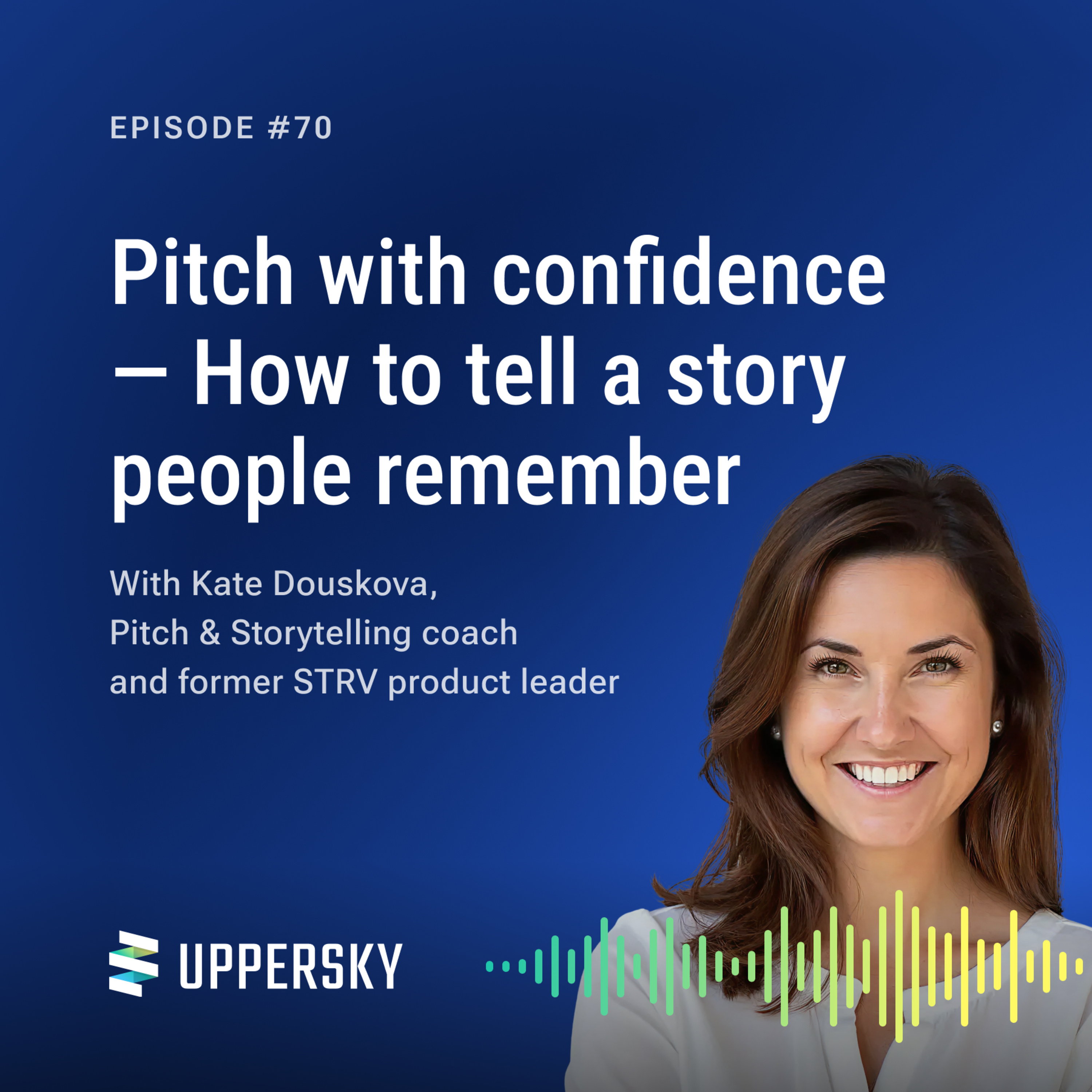 #70: Pitch with confidence - How to tell a story people remember | Talk with Kate Douskova - Pitch & Storytelling coach and former STRV product leaderUppersky Podcast · on Hero's journey framework80 / 100
 Spotlight: The 5,000-Year-Old Method of Making People Remember YouMarketing Trends · on Hero's journey framework75 / 100
 Be Yoda, Not Luke: How to Use Story, Data & Advocacy to Win Hearts (Not Just Clicks)Growth Leap · on Hero's journey framework67 / 100
 Expertly Crafting Your Story and MessagingThe Conscious Marketer · on Hero's journey framework57 / 100Hypnotherapy for Business Success | Addison BowenEmbracing Abundance in Business | Alison ReevesGuided Journaling for Mental Health | Shawnti RefugeNavigating Mid-Career Burnout with Strength-Based Coaching | Sheri MiterRevolutionizing Business Sustainability | Tabitha Scott