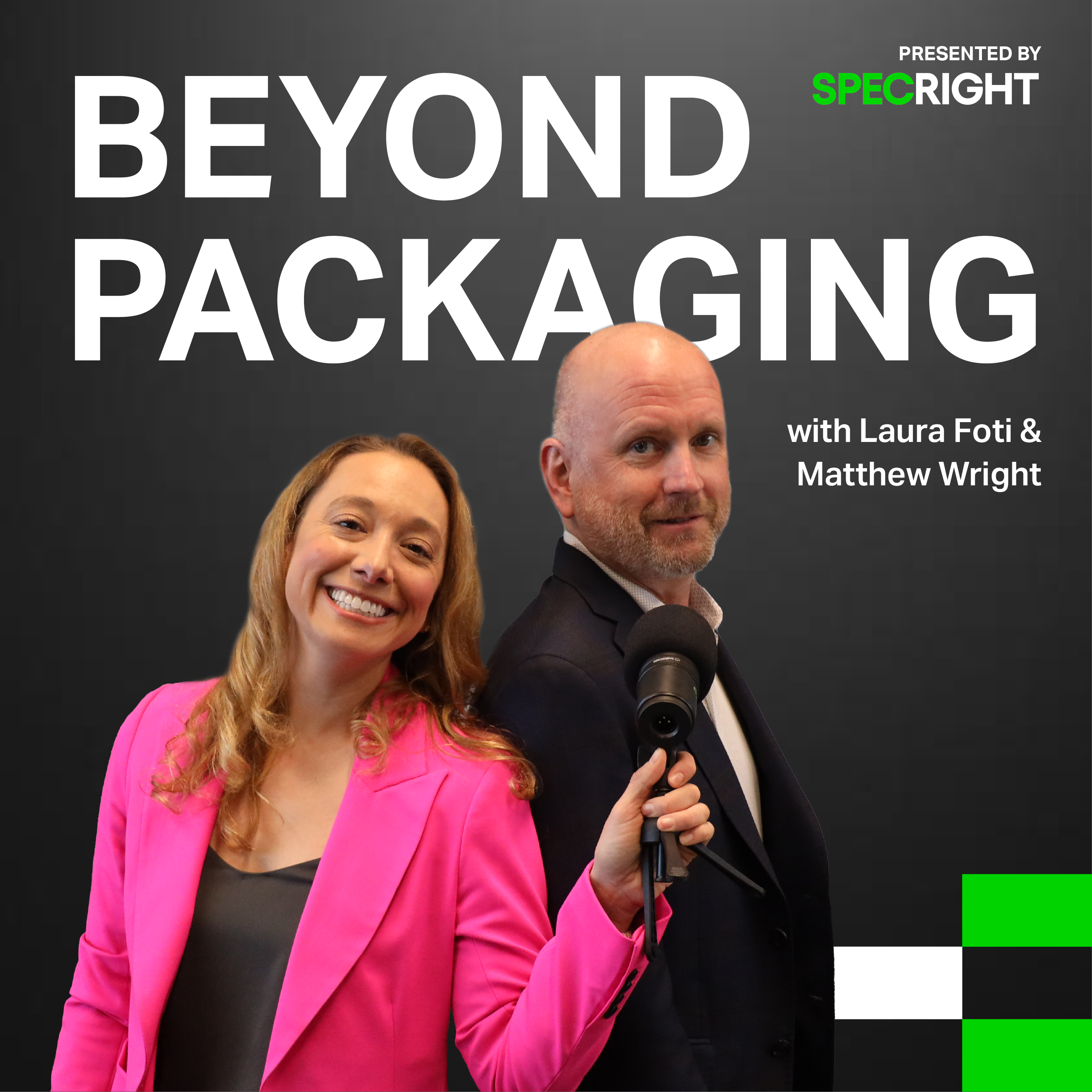
Beyond Packaging with Laura Foti & Matthew Wright · 2026-07-27 · 29 min
Key moments - from our scoring
Substance score
53 / 100
Five dimensions, 20 points each
This episode centers on the announcement of New Earth Ventures' investment in Spec Rite, a specification data management platform addressing a critical pain point in packaging: fragmented data living across spreadsheets and supplier systems. Matthew Wright explains that Spec Rite digitizes all data necessary to procure, produce, share, and report on products and packaging. Laura Foti, as Chief Customer Officer, contextualizes why this matters now: regulatory requirements like Extended Producer Responsibility (EPR), which is rolling out across U.S. states starting with Oregon and Colorado before California, require companies to report precise packaging data they often don't have centralized. Matt Saunders, representing New Earth Ventures (the corporate venture arm of Atlantic Packaging), articulates the investment thesis: massive CPGs operate out of Excel and Google Docs, making EPR compliance impossible without data infrastructure. The partnership unlocks multiple use cases beyond EPR compliance - item finder for consolidation, new product development, RFQ automation, and supplier collaboration. New Earth Ventures is also actively seeking companies in material science (barrier coatings, alternative foams to displace plastic) and packaging optimization technology.
Spec Rite collects packaging data from suppliers via a supplier portal or dedicated spec assist team, digitizes it into a single source of truth, and standardizes it so companies can report accurate packaging composition and basis weights to EPR providers like Lorax, similar to filing taxes with centralized W2 information.
EPR has existed in Europe and Canada for years, and is now unraveling in the U.S., starting with Oregon and Colorado, with California expected as the major rollout - creating regulatory pressure on U.S. brands to report and pay fees based on their packaging footprint.
Most major brands manage packaging data across spreadsheets, Google Docs, and supplier systems with no centralized source of truth, making it impossible to search specs quickly, collaborate with suppliers, report regulatory data accurately, or leverage AI for optimization.
New Earth Ventures is the corporate venture arm of Atlantic Packaging led by Matt Saunders and Wes Carter, investing in and partnering with material science companies (barrier coatings, alternative foams, plastic displacement) and packaging technology firms with a minimum viable product ready to scale through Atlantic's solution center in Charlotte.
Spec Rite enables item consolidation via Item Finder, new product development workflows, RFQ automation for procurement, and supplier collaboration by giving all parties access to accurate, standardized specification data.
Our reviewer’s read on each dimension, with quotes from the episode.
The episode contains some substantive points - particularly around EPR compliance workflows, data centralization challenges, and the business case for specification management - but suffers from significant filler: lengthy personal introductions, vague aspirational language about "connecting" and "innovation," and repeated analogies that don't advance understanding. The practical insights (e.g., data scattered in Excel/spreadsheets, EPR's state-by-state complexity, Item Finder consolidation) are solid but thin for a 29-minute episode.
all the data necessary and required to make procure, produce, share now report on product and packaging
so much data lives in spreadsheets. I mean, truly the biggest CPGs in the world are operating out of Excel and out of Google Docs
The framing of EPR as a tax-filing analogy is clear but not novel. The Waymo/Google Maps comparison for data infrastructure is borrowed thinking. The core thesis - that data silos block AI and compliance - is well-established in B2B SaaS. The discussion of materials innovation (paper-like plastic, cold-chain foams) is generic venture-speak without specific technical novelty or contrarian takes. No genuine first-principles or counterintuitive arguments emerge.
it's not really the sensors that are so innovative, it's that we have Google Maps that's mapped every road
if you have all of this data in Excel, how will you ever report EPR fees?
Matthew Wright (founder of Spec Rite) and Laura Foti (CCO) are genuinely relevant practitioners with operational experience, though their roles are somewhat promotional. Matt Saunders (Managing Partner of New Earth Ventures) brings corporate venture credibility and direct customer access, but is still primarily a capital allocator rather than a builder. All three are stakeholders in an announced partnership, which creates some bias. None are independent domain experts or operators with neutral distance from the product being discussed.
I spent a lot of years in my early career working with what I deem just amazing products
It's been really interesting to see sustainability and corporate social responsibility evolve over the years
The episode mentions Oregon and Colorado as early EPR adopters and California as a major upcoming jurisdiction, which is specific. However, concrete metrics are almost entirely absent: no customer counts, no timeline data, no ROI figures, no specific company examples beyond vague references to "major retailers" and "biggest CPGs." The AI formulation workbench example is mentioned but not detailed with results or impact metrics. Most claims remain abstract or procedural.
it's coming to the United States for the first time and is just now unraveling in your state. Corey of Oregon, also in Colorado... the big shooter drop will be California
I pulled up my computer as he was talking about it, and I made a formula for that product... And I showed it to him and he's like, my gosh, this is, this is what we would do
The host Cory Connors asks straightforward, softball questions that rarely push back or dig deeper. Follow-ups are mostly narrative extensions rather than genuine probes: "What's next? What are you excited about?" The guests are largely allowed to deliver prepared talking points without challenge. There is one gentle interrupt where Matthew redirects a feature credit to vendors, but no real friction or disagreement emerges. The entire dynamic feels orchestrated around announcing a partnership.
Matthew, let's jump right in with you. Sir. Tell us what Spec Rite is and why you founded it
Laura, as a chief Customer officer, this question should go to you, I think. How are your customers using SpecWrite to fulfill their EPR
Computed from the transcript - who did the talking, and the words that came up most.
In this joint episode with the Sustainable Packaging Podcast, Matthew Wright and Laura Foti join Cory Connors and Matt Saunders to discuss the exciting new partnership between Specright and New Earth Ventures. Together, they explore how digitizing packaging data, leveraging practical AI, and strategically deploying venture capital can transform global supply chains. From staying ahead of Extended Producer Responsibility (EPR) regulations to driving faster product innovation, this episode breaks down why accurate spec data is the foundation of modern, waste-free business. Beyond Packaging is presented by Specright , the leader in Specification Management. Feel free to
Transcribed and scored by The B2B Podcast Index.
Speaker A: Welcome to Sustainable Packaging with Cory Connors, presented by Atlantic Packaging. I'm your host, Cory Connors. In today's episode, I connected with three incredible guests. Matthew Wright, the founder of Spec Rite, Laura Foti, Chief Customer Officer, Spec Rite, and Matt Saunders, the Managing Partner of New Earth Ventures. We talk about an exciting new partnership and more. I'd also like to thank our sponsors, 3M Specrite and Lorac CP. We couldn't do this show without them.
Speaker B: Welcome, um, to Sustainable Packaging Podcast with Cory Connors. I am so excited to have these amazing people on the show. It is, uh, it's taken several months and many assistance and lots of effort and elbow grease, but we've got it done. And these incredible people are all on the stage at the same time. So welcome to you all. I'll uh, like I said before, I'll do intros before this. So, uh, Matthew, let's jump right in with you. Sir. Tell us what Spec Rite is and why you founded it. Really?
Speaker C: Yeah. No, I hope, Corey, you're not blaming me for the schedule. Even though I was the high majority of the problem.
Speaker B: I always blame myself.
Speaker C: Yeah, I can't keep control of where I'm at. No. Great to be here, Corey. I love it. Spec Rite, the story. You know, I spent a lot of years in my early career working with what I deem just amazing products. A company making those amazing products, amazing people making those amazing products. And what I really saw was just a lot of challenges. You know, I saw a lot of wasted time. Uh, I just saw these just really smart people chasing data, uh, trying to figure out what version they're on. Great companies making big mistakes, uh, sending product to landfill, not getting it for the consumer to buy it quickly. So it's kind of frustrating. But you know, like everybody when I was in industry, as my head was down, I was focused on the business at hand. When I had a chance to come up for some air and pause, I said, can I really fix this problem that's irritated me for, you know, 20 plus years of my career and, and really enable people to do amazing things. And that's the foundational belief or story of a Spec Rite. A world without waste. And then what is specrite? Specwrite is the first specification data management platform. What does that mean? All the data necessary and required to make procure, produce, share now report on product and packaging. And so, uh, again, great to be here.
Speaker B: Corey, you and I have been friends many years. You've been a mentor of mine, uh, as well as Laura and Matt have and I'm just, uh, so thankful to have you on the show. And uh, the story of Spec Rite is incredible. And I think we're going to add a nice twist to it today with Mr. Matt Saunders. But let's go to Laura first. Laura Foti, the chief customer or cupcake officer as she prefers. Why is specrite such an important element in the sustainable future?
Speaker D: Yeah, it's a great question, Corey. It's been really interesting to see sustainability and corporate social responsibility evolve over the years. And now when we talk about sustainability, it shifted from that social element to a compliance and regulatory element. And we've seen this especially with packaging, ppwr, epr, there's now a penalty to the packaging that we're putting into the world. And it makes a lot of sense. You and I have walked through MRFs. Uh, we've seen it, we've created a lot of product that has to go somewhere. And so why is SpecWrite so important? We need a way for companies to be able to communicate what packaging, uh, is, is being put into the waste stream. And you really can't communicate that if you don't know your data. So it's no longer enough to say it's, it's corrugate. Um, you know, what are the different levels of your packaging? Are there films, are there? All that information typically lives in spreadsheets and it typically lives with your supplier. And so in a time where everyone needs to understand how sustainable they are, well, that really means you need to know your data and not just the data that you have in your own four walls, but the data across your entire packaging value chain. So it's really evolved. And to me, when I think about the sustainable future, it's really collaborative. And that's why we're so excited, uh, not just collaborating with the value chain, but collaborating with folks like you. So really thrilled to be here today.
Speaker B: Well, thank you so much. And you and I have, like we talked about before, have been through it together and gone through the grind and convinced people that this is necessary. And now people are saying, oh my gosh, I have to have SpecWright. And it's so exciting to see the other side of the coin is turning. And we're really excited to be a part of it with my coworker and friend, Mr. Matt Saunders, the managing partner of New Earth Ventures. Matt, tell us about Nev. Tell us about this partnership. We're excited to announce it. You're the one who gets to announce it.
Speaker E: Yeah, that' my pleasure. And Corey, thank you for having me we're lucky we talk about this on another podcast. But New Earth Ventures is the hybrid corporate venture arm of Atlantic Packaging, led by myself and Wes Carter, who is the third generation leader of Atlantic Packaging. We're using the incredible assets of the organization that we both work for to support innovators founders across packaging materials and the best ideas in technology along the supply chain. Um, it comes at a time, as Laura says, where the tailwinds of regulation are really strong, where the pull of consumer demand is very strong, and an age where AI will revolutionize the unsexy businesses that, um, exist all over, that aren't really the focus of everyone, uh, investing around AI today. And so we're excited about New Earth Ventures opportunities across materials and tech to just proliferate good technology throughout our supply chain and with Atlantic Packaging's customers and partners. So why spec? Right? Well, first of all, amazing people, and it's been a pleasure, Matthew and Laura and Mike and everyone on your team to get to know you guys. But we started with a, uh, thesis around EPR and the data problem that existed, and a separate thesis around how AI will totally revolutionized how we work with packaging, but that there was a mismatch. And that mismatch comes back to exactly what Laura said, which is that so much data lives in spreadsheets. I mean, truly the biggest CPGs in the world are operating out of Excel and out of Google Docs and they're clamoring for a solution. Um, so what, what did we think about. Well, one, if you have all of this data in Excel, how will you ever report EPR fees? Now, EPR Extended Producer Responsibility is something that's existed in Europe and Canada, but it's coming to the United States for the first time and is just now unraveling in your state. Corey of Oregon, also in Colorado. And uh, you know, the big shooter drop will be California. How can people report the basis weights of all of their packaging to a very specific level that can be audited with regulators if all of this sits in Excel? Well, they can't. We actually tried to build a reporting tool and what we realized is reporting isn't the hard part. The hard part is organizing your data, um, and checking that it's high fidelity data with accuracy that you can report on. And once we, uh, unlocked that, it was obvious that there was no other company doing it like specrite, that was already integrated with all of the ERP systems out there, et cetera. And then go to the AI thesis. The only way to take advantage of the tech that will come out there is by digitizing your specs and if you cannot get your specifications on the cloud, forget AI. And so spec right really unlocks that. So there aren't a lot of companies I invest in that are on the forefront that want to be partners with us in expanding and proliferating their tech, which is a big part of our value add and hit so many thesis areas. So we're huge spec rights supporters and excited to announce m our investment and partnership in them.
Speaker A: Hey friends, we are going to take a quick break to thank our sponsors. Please be sure to support them. Are you shipping with recycled corrugated? Think outside the box with 3M tape. 3M packaging tape can help you overcome your recycled corrugated challenges with confidence. Making sure your boxes are sealed securely the first time, reducing downtime, um, and providing consistent performance. With 3M as your partner, you can maintain productivity, achieve cost savings and turn packaging problems into ceiling success when you use recycled corrugated shipping boxes. Think 3M packaging tape. Sustainability starts long before a product hits a shelf. It starts with the spec. That's why brands choose Spec Rite, the leader in intelligent specification, data management and modern product lifecycle management. Becright turns siloed packaging and product data into connected reliable intelligence. So AI uh can identify waste, optimize materials, streamline supplier collaboration and accelerate sustainable product design. If you're trying to reduce packaging complexity or meet evolving regulations, it's time for a spec first approach. Spec Rite, the intelligent foundation for every product. Discover more@specright.com in packaging, it's still. I know a guy, but what happens when you don't or when you need something beyond your network? Forest is built for that. A platform that connects packaging knowledge with AI uh intelligence, giving you access to verified suppliers, real capabilities and actionable data in one place. Take action at speed, execute with intelligence. That's Forest.
Speaker B: Great. Well said as always. You're a talented speaker, my friend. Matthew and Laura, I'd love to know your thoughts about what this partnership means to spec right with New Earth Ventures. Matthew, can you start us off?
Speaker C: I was going to toss it to Laura because that would be two great speakers together.
Speaker D: You know, it's. I remember meeting Matt and Wes at the design center and walking through the facility and just feeling like there was a perfect fit. At Spec Rite, we're really big on partners and ecosystems and bringing really smart people to the table. And it was really clear that Atlantic and New Earth are adventures. They're thinking about it differently. I love what Matt said about AI. Ah, you know, I was, I was taking A Waymo. I live in Los Angeles. We have Waymos, those are the automated self driving cars. And I was thinking about it and it's not really the sensors that are so innovative, it's that we have Google Maps that's mapped every road. So when you have that, the data infrastructure, when you've mapped every road, you can have a self driving car. And that's what we're thinking about at spec, right? I mean we have the digitized data packaging. Oh my gosh, this could mean so much for people who make packaging. You know, like Atlantic. Right. There's just, I remember walking through the facility and seeing all their equipment and seeing all the innovation they have on the floor. You start to see the data come to life. And then also in talking with them, their customers are our customers. Right. And so there were just, there was just this amazing fit of ultimately vision, alignment of values, sustainability being one of the forefront and then just this innovative spirit in both companies that uh, I think is going to come together in a really special way. Matthew, I'd love for you to add as well.
Speaker C: Yeah, I know there's so much in there. First of all, Matt mentioned it starts with people, you know, the chance I've had to meet, uh, Matt, Wes and the greater team at Atlantic and obviously New Earth Ventures just are good people. So it starts with culture, something that's really important to me and the company, uh, around me and our partners that we bring into this space. And Laura has heard, I don't know how many times I've ranted and raved about the lack of packaging companies, innovation in this space and really phenomenal innovations in machinery, phenomenal innovations in design, uh, technology and software delivery methods. But uh, really that what I call the front end of the office, you know, where the data resides really has been needed a major overhaul for many years and it's been really hard to get the packaging industry to understand that it's changed dramatically, I'd say just in the last month. But I really like innovators and that's what Matt and Wes brought forward and really love the whole thesis, love the connectivity. I gave this speech the other day. I think it's just a connected world. It's a massive world. We got to all do this together. There's no little fiefdoms. It doesn't matter if you think you're competing or not, you're not. It's just so big and we've got to do this for the, for the globe. So when you look at it that way, you look for innovators, good people. And I think that's where the marriage and connection happen and we could be more excited.
Speaker B: Well said, Matt. When we met in Europe recently at the Sustainable Packaging Summit in Amsterdam or Utrecht, just outside of Amsterdam, we talked about how New Earth Ventures is so much more than just money for a company. I would hope that you could tell us what, what this investment in this partnership means to both sides.
Speaker E: Well, one thing I'll say is we're a, uh, solutions provider at Atlantic Packaging, more than simply a packaging company. And what New Earth Ventures allows us to do is go and find the solutions that our customers are asking for and invest behind it. So it's great for our limited partners, but it's even better for our customers. And what I'm really thrilled about is Laura talked about earlier, you know, our customers are their customers. Well, there are some that aren't and those who are asking us in kind of the frenzy, which is not their fault, it's the uh, regulators who have put EPR into place, the frenzy to comply with epr. They're looking for a solution that tomorrow they can be on and start to uh, upload their data to so that three weeks from now they can meet a, ah, deadline to post. And it's amazing to be able to connect those dots and I think not just around EPR alone, but around, you know, managing specs wide thinking about what's next in sustainable packaging. If you can't measure it, you can't manage it. And the dashboarding of uh, spec right and understanding exactly where everything sits, where everything comes from and how to adapt to a new world, it's just amazing. Forget sustainability, it's great for efficiency in business. It speeds up timelines to developing products. So connecting those dots between the customers we have access to and spec right is to me a huge part of the value we can add. And hopefully I'm a crazy outside of the box thinker about where AI can even take spec right itself. But you have the greatest leaders at that company. I'm not sure I add much value there, but it's uh, once you get
Speaker B: part of this, you have a ton of value.
Speaker D: We're always looking for ideas, Matt, and this is a huge, uh, huge area of excitement for us. I mean every day we're thinking about different ways to not only incorporate AI into our product, but our delivery model. I mean it really is changing the way that we're working. So it's exciting.
Speaker B: Laura, as a chief Customer officer, this question should go to you, I think. How are your customers using SpecWrite to fulfill their EPR. Uh, we're talking about it, that it works and this. But how does it work and how are they using it?
Speaker D: Yeah, absolutely. That's a great question, Corey, and certainly top of mind for many of our customers, especially with. With deadlines coming up next year, you know, scary deadlines. Yeah, I always think about it. I'm really big on analogies because EPR is something that is really abstract to people because everyone's getting used to what it is and what it means, but it really is like filing your taxes. Right? So, you know, every year I get a, uh, W2 that from my employer that tells me how much I made. I give that to the, you know, to my accountant. They tell me how much I owe and I pay the irs. It's really a similar workflow. Right. So at spec, right, we're gathering your data. So in some cases, that means we're helping you collect it in the first place from suppliers. We have both a supplier portal where people can come in and upload data. We have a spec assist team that can go get that data for you. We're then taking that data that is scattered across your supply chain, and we're digitizing it in a single source of truth. We're giving you your W2 and saying, this is exactly the type of packaging you have. And then you take that data and you can go to a, uh, provider who is looking at all the regulations, like a Lorax, for example, and they can say, okay, based on the data you have and the packaging laws, here's the fees that you owe, and then you can go file your taxes. Right. File your EPR report. And what's really exciting to me is really simplifying the complex. When Matthew founded the company, we talked about that all the time. So simplify the complex. And with EPR, when we're meeting with CIOs Chief Sustainability Officers, it really is, do you have your data? Let's collect it, let's digitize your data, let's standardize your data, and then let's put that data to work. And that's really how to think about extended producer responsibility. It can get overwhelming really fast because people are like, oh, my gosh, in Europe, all the countries are different. Every state's different. In the U.S. wow. More complexity. If you have your data, you can then manage that complexity. If you're managing it in spreadsheets, it then becomes really hard to manage things in spreadsheets in different states, in different countries. And so our philosophy is Simply digitize your data and then it really flows from there.
Speaker A: Well said.
Speaker B: Matthew. What are some of the other things that specrite does, other than epr? Because I think it's such a, it's such a larger platform than. I know that's kind of the number one and on top of mind for a lot of people. But what are some other things that people use it for?
Speaker C: Yeah, and I was wondering. Click back on what Laura said real quick. And I know Laura's so tired and you guys will become my horrible analogies that continue. But I love the whole concept of the Sherpa. I mean, just the concept of somebody's done it a thousand times and is going to guide a newbie through that, through that path of, Of Treacher. Right. And so, you know, very much like on the epr, before I jump to your question, you know, I think adding to Laura, like, we've seen it all. We've seen data from everywhere. We've seen data really complex and we've done it. We've helped people navigate this path. And so I think that's what we have to look for is, you know, people that we can follow to find and figure this out, uh, together. Uh, and then, yeah, to your point, Corey, obviously when the company was founded, it really wasn't founded on epr. I always say it wasn't. That wasn't the core purpose. It's become, you know, top of mind because there's so much pressure on corporations today. But I really look at it, you look at some of our best tools and I continue. I was laughing with Mike, our CEO yesterday. We, uh, were at a major retailer this week and they were so excited about search. I mean, just the fact that they could search and find a key attribute of a product and whether it was in a PDF or whatever, because as you know, you know, as a packaging brand owner or something else, all day long you're getting questions, you're getting challenged about something and your ability to react to. Yeah, I know where that is. And then pull it up and then do something with it. Maybe it's sharing it with, uh, your customer, maybe it's sharing it with the supplier, maybe it's having an internal meeting about it and making changes that are relevant. So I think, as funny as it sounds, that's the core value. It's just finding it, having the data at your fingertips, which is what we've all become used to in the rest of our life, I always say. And the same second bad analogy, you know, is our 9 to 5 life looks a lot different than our nighttime life. Right. And, uh, so I'm trying to blend it, make it look the same. But consolidation of items like Item Finder, uh, is one of our best used tools. Just find, consolidate, or items and consolidate. That's a huge secondary trend. If you know you've been picking up on the news, brands are trying to now go the other direction. When we had Skuzilla, now it's trying to control that so you can use like Item Finder to do those types of things. New product development is probably the most cool, uh, thing coming out of spec right today. As we've gone from packaging to ingredients to formulations to full product. It's amazing. And some of the AI influencers are coming in that space. It's really neat what we're doing. Uh, and procurement, you know, just ability to buy stuff better, smarter and give good data so that both are incentivized to do better things with it. So, yeah, there's a lot of use cases. It, uh, was interesting as a dinner the other night. Six or seven customers, and everybody is excited about just a different part. But it's the same core value offering at the beginning, right?
Speaker B: Yeah. Well said. That RFQ feature is amazing that Spec Rite has. It's just incredible. It just saves so much time.
Speaker C: Can I interrupt real quick, Lauren? You know who loves that the most is the vendor. And I've got so many big vendors call me, say you need to go help and give that tool to this, uh, customer mine, because they're tired of supplying the data, uh, to the brand. So it's good for all. Sorry, uh, to interrupt there.
Speaker B: Well, for anybody who doesn't know, Matthew has written a few books and I highly recommend them. And in the first book, he talks about running a corrugated facility and how it was so difficult to get the specs from the customer. And this is something I've dealt with for 28 years in my career is. Well, we don't know what we're buying. Here's a sample. Good luck. You know, we want more of these. And, uh, that's pretty normal, unfortunately, in the industry. And I think Specright solves that issue too. Mr. Saunders, back to you, sir. I would love to know, for the people listening to this episode that are interested in a potential, uh, investment and partnership with New Earth Ventures, what kinds of companies are you looking for who should reach out to you today?
Speaker E: Thanks, Corey. I think that we're looking for those companies that are ready to scale something unique in packaging. On the material side, it's People who have created a minimum viable product that we can test. We talked earlier about our home and Defacto headquarters being our solution center in Charlotte. It's truly a one of a kind facility where we're able to do almost anything in packaging. And so folks who need to take advantage of that to scale, who need advice on how to get into customers, those companies should come to us. So we think about it a lot in materials. The theses areas that we're focused on a lot now regard how to make paper act like plastic. Um, that'll mean new barrier coatings. Um, we're thinking about cold chain alternative foams, anything that's going to displace plastic. But also anything that is going to reduce people paying EPR fees or make more efficient packaging that uh, we're selling. I step into an organization like Atlantic that's already tech forward. Our program around must is amazing optimization and truly the first rule of sustainability and packaging is just use less. And that's where we think about the tech side. How can AI, machine learning, automation make it so that we're shipping less air and we're using less materials or brand new materials that we haven't even thought about yet? So I'm thinking a lot about how I will invent new materials. And we have crazy ideas about using 3D printing to make goods in your backyard. Rather than make things in China and ship them to an Amazon DC for them to sit there for nine months. We want to be on the forefront of what's next. Not only in packaging and adjacent tech, but how things move through our economy. Because these goods matter to our lives. Packaging is everywhere. It's how the economy moves. And so we have to be on the forefront and we have to be constantly, uh, rethinking it. So all of that is to say who are the best people to come to us, folks who need help and who work in our industry. As you flagged earlier, we're more than our investment asset. We're the full team of at Atlantic. Um, we're access to our customers and we're all tools that these technologies need to scale materials or software.
Speaker B: AI Such a great partnership. Laura, I, uh, know you, you have to cut out here real soon. So I'm going to give you final thoughts. Can you tell us what you're excited about? Uh, what, what the future holds, that kind of stuff?
Speaker D: Yeah, absolutely. I think we're all living in a unique moment of time. I mean when we look at human history, the industrial revolution changed how we make products. The digitization you know, the digital revolution really changed how information and networks were connected. We are living in the AI revolution. We are being, we are part of it. And I just can't stress that it's here. I was with, uh, a customer recently, and at Spec Rite, we now have an AI formulation workbench. So part of packaging is the label and you need to know the ingredients. And so we do a lot more than just packaging. We do ingredients and formulations and product data as well in Spec. Right. And the head of product development was up there talking about a hypothetical product that hadn't been made yet. And I, I pulled up my computer as he was talking about it, and I made a formula for that product and I. With AI, right. And I showed it to him and he's like, my gosh, this is, this is what we would do. And it's here. And we're going to bring that same approach to packaging. And so I just can't stress enough because every customer I talk to is being asked by their leaders to be leveraging AI. It starts with your data, start to get your data in there. We are partners that can help you do that and not just help you get your data in, but then put that data to work. And it's just so exciting when you see it happen. It just becomes tangible. And I think there's a lot of questions out there, uh, about what's the ROI of AI. But when you see these business outcomes, it's pretty clear when you think about how transformative this is going to be in organizations. So, just so excited to continue to pioneer that, to continue to work with our customers, our partners like New Earth Ventures, to make sure that we're using technology and driving business outcomes. Um, I would just encourage everyone to really lean in. I think the history books are going to have a lot to say about this time period. Um, and it's really exciting. It can be scary, but I think it's more exciting than scary.
Speaker B: Great points. Thank you so much, Laura. Appreciate you always.
Speaker D: Thanks, everyone.
Speaker B: Mr. Wright, your turn. What's next? What are you excited about?
Speaker C: It's always hard to go after Laura, but, uh, no, I think just a couple points. And then what am I excited about in the future? Uh, yeah, I think to, uh, incredibly humbled. I mean, I've had an amazing road trip last month of just wonderful companies joining Spec Rites and partners such as yourselves. And so it's really exciting from that perspective to see the maturity and, uh, where this company is going far beyond, uh, any initial dreams. So that's that's kind of personal. And then secondarily, yeah, I've, I've had an amazing life and career in the packaging space and it's, and it's cliche but it's just getting more exciting. I think that it's, it's the, I don't know what the tipping point, but I think what for me, EPR is really critical and important and it's at hand and we got to address it. But I also think it's going to uncover and challenge a lot of functional thinking and packaging far beyond just epr. And I think it's going to be kind of the linchpin to change the way the business runs and operates uh, because of this event or events coming. So I actually think it's a good catapult to change and uh, will impact all of us differently. And so with that my excitement in the future uh, is where it's all just very much uh, more attainable. Things move faster, they're better, uh, we have much more clarity as a human being. What we're consuming, what we're using, where it's going. And I think that's, that's really closer than we think it is. Especially if we have selfless driving cars in la, we can get there quickly. Uh, and I think the catapult will be EPR and the pressures that it's putting on all of us right now to think differently, think bigger and challenge our historical thinking. So I'm more than excited for the next five, ten years of this business.
Speaker B: Yeah, me too. Exactly right. We need to embrace this change and we need to adapt to it and that's exciting. Matt Saunders, you're the final word on the show. Sir. What do you think, uh, what's next? What are you excited about?
Speaker E: Well I'm certainly excited for any company that makes something physical to use Spec Rite, which is something that Matthew promised me would happen as part of our investment. So in all seriousness, I think Spec Rite will win just based on the product, the team's hustle, um, and how they've already gotten into the market. I'm excited for your guys European expansion. All of emea, which is next. Look more broadly, I really think the software revolution, um, and a lot of innovations of VC have missed the packaging world entirely. And so I'm excited for the next decade to feel like three decades at once in acceleration and innovation and I'm thrilled that we're going to be part of that. But I'm excited for that impact on not only our economy but on our communities. And on pollution and on conservation. And this is not a, you know, not a, uh, partisan issue. It's a nonpartisan issue. And so when we receive goods at our house, for those to be 100% compostable with as limited materials as possible, Great. For it to come to us in the most efficient way, great. To, uh, potentially be made nearby, rather than thousands and thousands of miles away. Great. And that's the world that I envision and that we're excited to invest along.
Speaker B: Well said. Well, thank you all for this amazing show. I can't wait to talk about this partnership again. We'll do another several podcasts about this, I'm sure. So thank you again.
Speaker E: Thanks, everyone.
Speaker C: Let's get to work.
Speaker D: Take care.
Other episodes covering the same guests and topics, from across The B2B Podcast Index.
 Empowering Teams in Fast-Growing Startups w/ Shan MohtaLeadership Launchpad · on RFQ automation83 / 100
 From Playing With AI to Putting It to Work: A Practical Guide for Supply Chain and IT LeadersAuto Supply Chain Champions · on RFQ automation73 / 100
 How free meal planning is changing food researchBusiness Is Boring · on New product development70 / 100
 How Burton Snowboards Is Rethinking Packaging From the Inside Out with Mitch RovitoSustainable Design Lab · on Extended Producer Responsibility (EPR)66 / 100
 174: Lost in the WoodsBusiness Unusual with Barbara Corcoran · on New product development35 / 100
 Making the Case for Change with Lisa Husken47 / 100
 The Hidden Complexity of Packaging Transitions with Maureen Dollard
 The Next Generation of Packaging - and the Impacts They're Driving
 How AI-Ready Data Is Powering the Future of Sustainable Packaging with Cory Connors
 Simplifying the Complex: Modern Packaging Innovation with Jonathon Rabedeau