
Aerospace Manager Podcast · 2026-02-23 · 24 min
Key moments - from our scoring
Substance score
44 / 100
Five dimensions, 20 points each
Alexander Beer, Vice President of Operations, Strategy and Standards at Diehl Aviation, explains how Aero Excellence addresses the aerospace supply chain's critical pain point: redundant audits. Rather than adding another assessment tool, Aero Excellence is a mutualized, third-party evaluation framework with an open-source grid used across the industry. The initiative began in the UK, France, and Germany, with Spain joining in 2024 and North America following this year. By end of December, 464 production sites from 361 companies had registered, with 182 completed assessments and 140 qualified assessors. Major OEMs including Airbus, Safran, Thales, and Linamar contribute to governance, while GE, RTX, and Boeing signal adoption. The assessment costs thousands of euros per program - standardized across companies regardless of size - with supplemental funding from founding organizations. Suppliers benefit upstream (internal supply chain benchmarking), downstream (replacing multiple customer audits with one standardized assessment), and internally (aligning processes to a single grid). The framework covers all industrial maturity dimensions and is recognized by defense bodies including France's Ministry of Defense.
By end of December, 464 production sites from 361 companies had registered, with 182 assessments completed, 77 ongoing, and 64 resulting in bronze or silver level ratings.
Airbus, Safran, Thales, Linamar, and Diehl are core governance participants; GE and RTX have announced participation, and Boeing, Embraer, and Bombardier are in active discussions.
Typically four to eight weeks for preparation including self-assessment, plus two to four months until on-site assessment, depending on assessor availability and geographic location.
Assessment fees are standardized at thousands of euros per complete program, regardless of company size or assessment length, with costs varying slightly by country due to VAT and currency differences.
Aero Excellence covers both commercial and defense sectors; France's Ministry of Defense partners with Aero Excellence to reduce their assessment burden, and Airbus has begun replacing its AP cars internal assessments with Aero Excellence.
Our reviewer’s read on each dimension, with quotes from the episode.
The episode is almost entirely a structured introduction to the Aero Excellence program rather than an exploration of deeper operational lessons. There are a handful of concrete procedural details useful to a supplier evaluating the program, but the conversation rarely moves beyond descriptive to analytical, and much of the runtime is filler or signposting.
So in ITech numbers from end of December, um, end of December, via our sites we have 464 different production sites from 361 companies.
from those 182 assessments, um, we had 64 assessments with a result
The core idea - mutualized, open-source audit grids to reduce supplier audit fatigue - is a sensible industry response but not a novel concept; similar approaches exist in automotive (MMOG) and other sectors. No contrarian or first-principles thinking is offered; the guest stays firmly in promotional mode throughout.
the main idea is not to add another assessment or audit
where you had numerous assessments and audits in the past, you will have one today
Alexander Beer is a legitimate VP-level practitioner at a real Tier-1 aerospace supplier (Diehl) with direct operational responsibility and chairs the initiative's international committee, which grounds his perspective. However, his dual role as subject and spokesman for the program he governs limits the independence and candour of his commentary.
within Diehl. Um, I'm the vice president of operations, strategy and standards
within the committee, I'm the chairman
The episode provides a useful cluster of real numbers (464 sites, 361 companies, 182 assessments, 64 with results, 140 qualified assessors, 752 onboarded, two silver-level sites), named OEMs, and rough cost/timeline ranges - better than most promotional interviews. Evidence is quantity-of-registrations rather than outcome metrics, and cost is only vaguely characterised as 'a couple of thousand euros.'
we had done 182 assessments and 77 already ongoing
we have GE with us. They announced this, um, end of last year. Uh, we have rtx, um, who already communicated to their supply chain
The host covers the obvious questions in a logical sequence (what is it, who's in it, how to join, cost, timeline) but never challenges a claim, requests a failure case, or probes why adoption is slow outside the founding countries. The interview closes with 'Did I forget to ask you any question?' - a textbook soft landing that signals an absence of editorial pressure.
Did I forget to ask you any question? Alex, before we quit
Can you share concrete numbers? How many companies participate and in which countries?
Computed from the transcript - who did the talking, and the words that came up most.
Aero Excellence represents a unified industry standard in aerospace, aiming to reduce audit effort, increase transparency, and strengthen collaboration between OEMs and suppliers. In this episode, Alexander Beer shares insights into his professional journey - from Airbus, where he served as Executive Assistant to Guillaume Faury, through various management roles, to his current position at Diehl Aviation. At the core of our discussion: How can the aerospace supply chain become more efficient, transparent, and strategically aligned? Topics include: * The core problem Aero Excellence addresses in the supply chain * Eliminating duplicate and even triple audits * How the Aero Excellence assessment differs from traditional audit programs * Measurable impact on cost, efficiency, and performance * Participating companies and international reach * Entry requirements and first steps for companies interested in joining
Transcribed and scored by The B2B Podcast Index.
Tom Heinkel: Brainseeker consulting sudhein cfo director of finance mvd m in denier von bodensee in tresenten bitte direct by tom heinkel uber LinkedIn melbourne. Welcome to the Aerospace Manager podcast. My guest today is Alexander Beer. Welcome Alexander. Welcome Alex.
Alexander Beer: Hi Tom. Thanks for having me.
Tom Heinkel: Before we start and talk about aero Excellence, I would like to introduce uh, you very briefly. You've been uh, an executive assistant of Jean Fury at Airbus and after that you had several management positions before you moved to the very famous German cabin supplier Diehl. And what is your role there at Diehl nowadays? This is your main job, right?
Alexander Beer: Correct, yeah, this is the company who pays um, um, my salary within Diehl. Um, I'm the vice president of operations, strategy and standards. What I do basically is in three different um, areas. One is global footprint. So developing the international footprint of deal. We are currently expanding into Mexico and Romania out of Germany. Um, the other is um, standards lean. And this is where the link to air excellence comes from. And the third pillar is everything related to sustainability.
Tom Heinkel: So um, what core problem does aero excellence solve for the aerospace supply chain? We know many, many quality management, uh, um, projects within the aerospace and defense companies. So what's new with Aero excellence?
Alexander Beer: So the main idea is not to add another assessment or audit. This is an assessment. Um, first of all this was created to support the ramp up um, of the whole industry as you know, compared to other industries. Um, for aviation it's still upwards a couple of uh, you know, more aircraft every year, which then translates into a heavy workload for the complete supply chain. And this is what AO Excellence uh, wants to support with. And um, yeah you mentioned several audits and assessments. So this is a mutualized assessment, um, across the supply chain. It can be used for the supply chain, it is used by the OEMs, but it is one standardized and it should help to reduce the number of multiple um, assessments that we all basically suffer from every year with one standardized that is generally accepted and understood.
Tom Heinkel: And how do you help companies to avoid duplicate or even triple audits? Because sometimes you know, uh, that suppliers complain maybe um, about the third and fourth audit and always answering the same questions. How do you help to avoid these argument?
Alexander Beer: Actually you're addressing a very important topic that usually when we talk about AR excellence we get asked the first question. Right? Um, so AI Excellence is organized as an independent third party assessment. Um, and the grid we use. So the questionnaire is an open source grid that is available and accessible to everyone. Um, the grid is mutualized between different customers who helped build the grids as well as is the assessor pool. So the assessors come from numerous industrials of course you have Airbus for example in it, but also Safran, you have Thales, you have Libya, you have Deal, Um, and this mixed team then is basically arriving. Um, so with this mutualized um approach the result in the end is that you have not a redundancy in several assessments from several companies but one with a standardized grid, um, and on a governance level on top. So the ERA Excellence governance interacts with different bodies, for example IAQG and others to ensure inconsistent deployment and a universal approach. Uh, for example we give very precise recommendations to the assessors how to best value and incorporate other standards like an ISO norm or an enhanced or something like this.
Tom Heinkel: And in which countries are you present right now? You've mentioned several companies, um, OEM or big companies who um, runs or invented let's say um Aero Excellence. In which countries are you present right now?
Alexander Beer: So basically it is a worldwide approach. Um there are four countries driving the whole initiative. Um and the fourth country joined this year which is Spain. Uh, it started with uk, France, uh and Germany. Those are the so called operating countries. They drive the whole initiative, they created the grid, they manage uh the different bodies. Um we are now um, welcoming Spain and the next move is across the ocean towards North America. This year we will open um bodies um to incorporate the uh supplier landscape in the United States for example. And of course a big target is also to onboard um the OEMs in North America, uh, which is not only Boeing, it's the biggest one but could be also um Bombardier or if you think about South America and Brea and
Tom Heinkel: your role is let's say a non paid um job or what is it like? Do you do it in your free time on the weekend next to your main job also?
Alexander Beer: Also yeah. So um, my main job is with Deal and um, Deal sent me into a body that is uh, you know, the governance of um AO Excellence, which is the operating committee, the international Operating Committee within the committee, I'm the chairman. Um the operating committee basically deploys um, the um whole setup makes uh, sure that the grid is up to date. We currently receive feedback to the grids um as well as the outer world evolves. So whenever we see for example a typo in a question, a misleading explanation or something that we can incorporate um, we upgrade the grid. This is what we do. We also look at the results. We overlook the nomination and deformation of the assessors and so on. Uh, and this is what I do, um, on behalf of deal, on behalf of the our excellence community. And like me, we have many other industrialists, um, from other companies, uh, from the three countries and soon then also Spain. And with this kind of very diverse and versatile setup we want to ensure that it's not only one opinion basically on the table and one understanding of the issue of maturity and ramping up, but that ah, we have an understanding and a wording of the complete my aerospace, um, sector.
Tom Heinkel: Can you share concrete numbers? How many companies participate and in which countries? Well we already talked about the countries but um, in the future, what is your proposal? How long does it take to be global?
Alexander Beer: Yeah, so I wanted to come back to the countries because I mentioned these so called operating countries. Of course we are present in different countries, but this is now specifically they're not operating countries, they are managed by the operating countries. All they are. Outside of those four we have also sites, um, in Morocco, in Mexico, in Spain, in Poland, across the world. Um, but not everyone basically is incorporated in those operating bodies I mentioned. Right. So in ITech numbers from end of December, um, end of December, via our sites we have 464 different production sites from 361 companies.
Tom Heinkel: Wow.
Alexander Beer: Um, already registered. Um, by end of December we had done 182 assessments and 77 already ongoing. Either they are started planned. Um, from those 182 assessments, um, we had 64 assessments with a result. Maybe we should mention this as well in the bronze, silver or gold level. And uh, most of the assessments result in bronze for the time being. But we can also be very proud of announcing already two silver sites, one in the UK and one um, in France. And on the assessor site, um, 140 assessors are already qualified and in total 752 are onboarded and should proceed to become um, assessors. So this basically shows that you know, it is a huge movement. It's not only one or two companies, um, it is very global and it is growing month, um, by month.
Tom Heinkel: Wow. And what measurable impact do you see now in the first year or the first time after these impressing numbers?
Alexander Beer: Yeah. So basically if you are a company in the aerospace sector, I think I always try to explain by you know, upstream, downstream and within your company. So upstream you can use it in your own supply chain. Uh, so there's a grid that you can use, you can deploy, um, it will be the same for everyone and um, you can then also compare results. So downstream of course, um, if you take the example of Deal, our customers are, ah, um, Airbus and Thales. So, uh, in the old days Airbus would have visited Deal and maybe the different Airbus divisions would have visited Diehl. So the helicopter guys, the Defence in Space and the commercial guys. Today Airbus is not even coming. It's Aero Excellence. We have a standardized assessment. We can show the result to Airbus, we can show the result to Thales, uh, instead of several assessments. So this is the downstream, um, aspect. And within our company, since the assessment is targeting industrial sites, um, we can also compare our different sites on how they perform so we can learn about prospectuses within our company, we can improve, we can learn from each other and, um, on top, like many other companies, uh, we want to align our internal processes also with the AO Excellence grid. So even internally we can reduce efforts, um, in the sense of not doing an internal assessment and one month later the external assessment with AO Excellence. So there are many ways of, um, trying to, you know, identifying the overlaps, limiting them and using one grid and one standard in order to improve the overall effectiveness of the company in the supply chain.
Tom Heinkel: And if a company wants to join Aero Excellence, who should they contact and what are the first concrete steps?
Alexander Beer: Yeah, so, um, the easiest way would be to go on the homepage of Aero Excellence www.aeroxlenstogether.com and there you have all the important info, um, a rough introduction, some material. You can register your company, um, and then behind the scenes, uh, you will be rerouted to the operating country that is responsible for you. Right. So there's some work to be done, um, in the back. And this is done by our Excellence. You, uh, can also contact us via our LinkedIn page. Um, or if you are in Germany, UK, France and soon Spain, you can directly contact the operating bodies, um, or the trade association in the country. But I recommend go to Aero Excellence. You'll find everything that is necessary there. You can register and then someone will take contact with you.
Tom Heinkel: I will put this information, of course, into, uh, the show notes of the episode. Then it's very easy to do the next step. Um, but maybe we should name two or three main entry requirements or typical timelines, from registration to the first assessment. Because this is usually a frequently asked question. I can imagine.
Alexander Beer: So requirements? There are none that you have to do as a company, you are in the aerospace sector, you want to do this, you have understood how this is important and can benefit you, then please do it. There's nothing else that you need to prove, for example. Right. Um, so in terms of timeline, I Think it will take a couple of days between registration and then hearing back and rerouting you to the correct operating body trade organization. Um, and from that the first step will be a self assessment. The self assessment helps you to understand so what is the grid? It's very transparent. You can see um, what is asked. You can see whether there's a KPI or some evidence that could be a process description or something else that you need to show during the assessment. No information will be taken, no information will be recorded from your sometimes confidential company information. And with this you can also get an um, idea of how much time you might need to prepare between self assessment and the then on site assessment. Right at the same time the AI extension organization will then look for open um time slots for the assessors to come and assess your company. Um, and I take a guess what we've seen in the past is usually a couple of days between registration and 15 feedback, then two to four weeks for a company to read the grid, understand the grid, do the self assessment and maybe two months between self assessment. Two to four months between self assessment and assessments because you know sometimes we need to travel far not um everything is in Europe, uh where most of the assessors are based today. Um, so there needs to be some kind of preparation. But rest assured um, it's not something that will come from the outside and you can only say yes or yes. Um there are several steps of course of communication in terms of dates. Maybe there's something important going on in a company for the proposed date the same you will get a very transparent um overview on who would be the assessor team name the company they are employed with and you could also object or comment on the assessor team. For example one of them is a possible uh competitor and you don't want uh that person to be on site. This is possible. So we, we know that on AOX lens we want to collaborate whereas on product um, sometimes we compete. And um, all of this is built into a very uh, thorough um contractual situation that respects all of these um aspects. So you can be sure that the date is not coming um from heaven and you have to accept. But the rough timeline to come back to your question would be um four to eight weeks for the complete preparation until the self assessment and another um two to four months until the assessment. It is not a thing you do within a week um and usually it's the start of a longer improvement way um because you get recommendations um, from the assessment. You have also if you remember the numbers 182 assessments to only 64 resulting in bronze or silver. You see that there's room for improvement and usually the assessment is the kickoff or a support of an improvement, uh, project anyway, running in that company, becoming more mature and more effective and efficient, um, for the upcoming ramp up.
Tom Heinkel: Can you tell me anything about the costs? I mean if I'm the CEO of a aerospace company now, I ask myself, um, I'm interested in aero excellence. Can you tell me anything about a cost, what an audit cost per day or per week? Or do I have to pay an annual fee to be a member of any association? Or how does that work? I mean, it's not for free, right?
Alexander Beer: It is not for free. Um, the easiest way would be you only do the assessment. You pay an assessment fee that is aligned between the different countries. Of course we have different VATs in the UK and different currencies, for example, so there might not be any same number. Um, and this is a couple um, of thousand euros for the complete assessment program. And it's not depending on the size of the company, it's not depending on the length of the assessment, which is also standardized.
Tom Heinkel: Um, but you have auditors and they have travel costs for Axure and someone has to bear these costs, right?
Alexander Beer: Yeah, this is the obvious cost. The cost behind is, um, you also need to have an IT infrastructure for hosting the grid, uh, managing the data and so on. And setting all of this up, um, for example, is not paid with the fees what we're trying to do, uh, the running cost of the program, um, the trade organization of the three founding countries, Germany, UK and France, plus some of the bigger OEMs and customers, um, they invested a lot of money at the beginning in order to keep, you know, to support this and start this. Of course, um, the best way of um, um doing this is also becoming part of it, so becoming a member and um, supporting our excellence. Not only do the assessments, uh, also supporting via the um, training of assessors, um, helping to improve the grid is also a way, um, of being, you know, being part of the assessment, being part of AO excellence.
Tom Heinkel: Alex, final question. If you had to summarize this direction, strategic way of error excellence in one sentence, what would it be? That's a tough one, right?
Alexander Beer: It's a tough one.
Tom Heinkel: Especially you can, you can name, say two sentences as well, whatever you like.
Alexander Beer: So the important thing is that you have unified and a standardized assessment with a very transparent open source grid that covers all aspects of a company, uh, today and in the future. And you can use it Upstream, downstream and within your company. And the really important thing is it is recognized by several companies. So where you had numerous assessments and audits in the past, you will have one today.
Tom Heinkel: Very good, very good. I like that. Did I forget to ask you any question? Alex, before we quit, before we end our, our talk here, do you have to. Would you like to mention something else to the aerospace and defense world? Now is the chance.
Alexander Beer: Uh, you mentioned defense. Um, so defense is part of it as well. For example, in France, the mod, the Ministry of Defense is even cooperating M with Aerox lens in order to lower their assessment needs. Needs they have. So it's not only, um, it's not only commercial aircrafts, um, if I take the example of, of Airbus, they are part of our, of our different bodies. Pierre Perdu is a driving force behind all of this.
Tom Heinkel: Yeah. Maybe you can drop some more names if you like. Um, yeah.
Alexander Beer: And what I wanted to say about them, they have been very clear that they want to replace. Not on want to, but they started replacing the AP cars which are there Airbus specific assessments in the past with Aero Excellence. Um, so they have done already that move. Um, and this proves for me that this is not only a plan in the future, in the future assessments will be, uh, reduced and will be recognized. One big player in the European market already started. And the same is true for Thales, um, and for Safran in the us. I mentioned already that we have GE with us. They announced this, um, end of last year. Uh, we have rtx, um, who already communicated to their supply chain. Uh, we will be part of this. We will do it. We recommend you do it. Um, and if you see the sheer size of GE and rtx, you see that this is a big movement in the complete supply chain. Um, we have been in talks with Boeing for months now. The same with Embraer and Bombardier. So the idea of being global is no longer an idea. It's become a reality and also growing bigger in Europe. Spain is now on board. Italy is interested. Canada, uh, is interested. Um, so there's more to come.
Tom Heinkel: Wow. Wow. Impressive. And um, yeah. Why two Germans speak in English to each other? We're gonna answer that questions in the next episode. That's. This is my, um. To make the people curious for the next, uh, episode. No, Well, I mean we, we just learned in your last answer, it's a global, uh, branch. It's Aerospace and Defense. Uh, everyone speaks English also in Hamburg on site, right?
Alexander Beer: Correct. With a nice German accent, but English correct.
Tom Heinkel: I apologize for my German accent. Your English is perfect, Alex. So, um. Well. But that's the answer if people think, why do they do this to us? All right. Thank you for your time, M. Um. Um. I wish you success for this great initiative.
Alexander Beer: Thanks, Tom, for having me. And it's really a pleasure. And it is fun, I can tell you, to do this. We all know that our industry is very global, and, um, this is a global answer to a very common problem. And, um, I'm happy to be a part of it.
Tom Heinkel: Thank you, Alex. Bye. Bye. Brainseeker Consulting is looking for a head of finance in Southern Germany. If you're interested in recording an episode in English or in German. And if you're an Exhibitor for the ELA in Berlin 2026, please contact me and we can send you an offer. Thank you for your interest.
Other episodes covering the same guests and topics, from across The B2B Podcast Index.
 The Weakest Link in a Global Life Sciences Company? People. With Dr. Kevin JonesCyber Leaders · on Airbus88 / 100
 Exostar: The Explore Platform's First InvestmentThoma Bravo's Behind the Deal · on Boeing86 / 100
 The Science Behind Nature-Inspired Innovation | Ep. 89 [Sidney Rostan]Industry Ignited Podcast · on Safran80 / 100
 Why Aviation Maintenance Is the Next Generation's Best-Kept Career Secret | Jennifer Radtke, BoeingThe Lost Art Of the Skilled Trades · on Boeing80 / 100
 2025 - The Year We Fired OKRs - Radhika Dutt Brings the MatchesThe Elephant in the Org · on Boeing78 / 100
 Scaling Financial Operations and AI Innovation with Rohini JainSecrets of Rockstar CFOs · on GE73 / 100
 35 Richard Aboulafia - global expert59 / 100
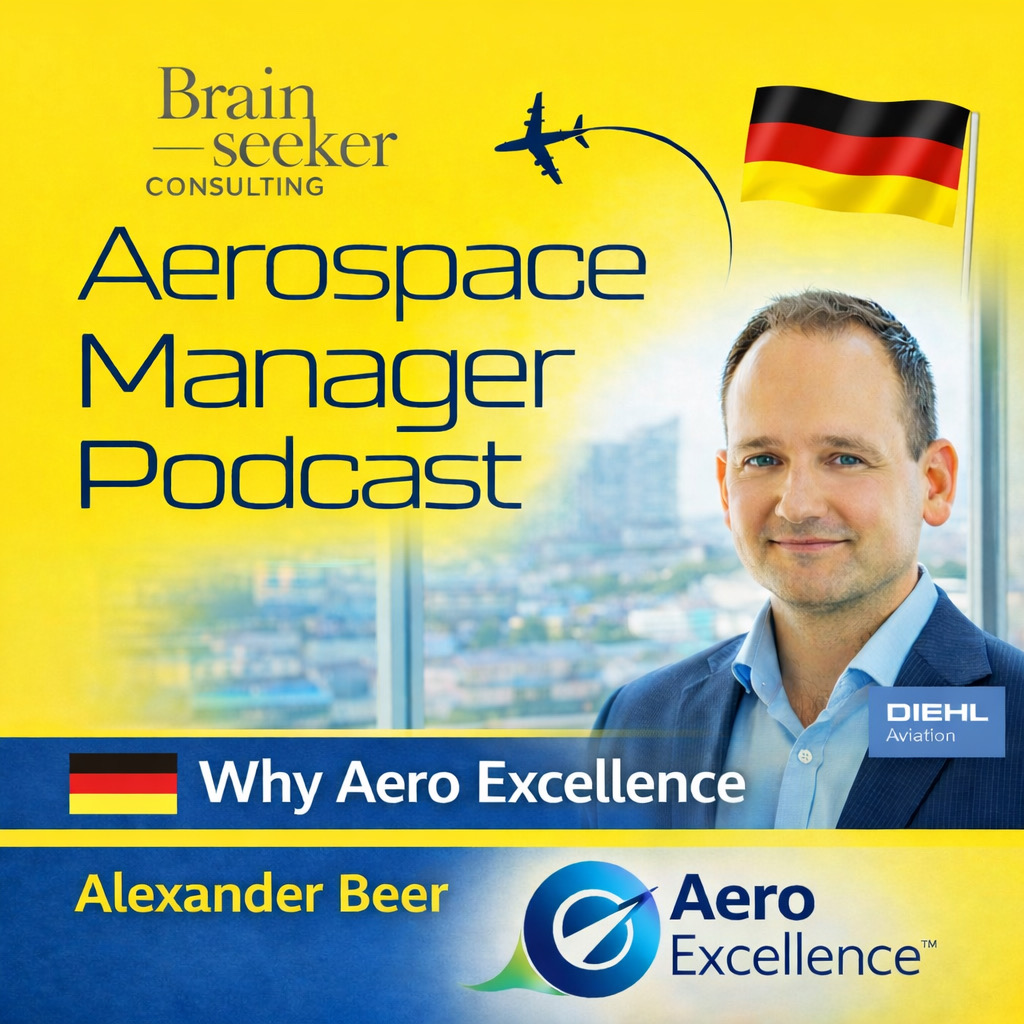 34 Alexander Beer (DIEHL) - Why Aero Excellence65 / 100
 33 Ralf Gust (Hamburg Aviation)69 / 100
 31 Henrik Baark (Rechtsanwalt & Unternehmer)68 / 100
 32 Aviation Forum Hamburg