Where AI Works · 2026-05-21 · 12 min
Key moments - from our scoring
Substance score
37 / 100
Five dimensions, 20 points each
This season finale synthesizes lessons from four major interviews exploring how large organizations are integrating AI into operations. Matthew Bidwell, the host, distills insights from James Crowley and Eric Bradlow (Wharton-Accenture Skills Index), Donna Morris (Walmart Chief People Officer), Paul Stathakopoulos (eBay VP of Product), and Richard Ranjan (Expedia VP of Product). The central theme across all episodes is the shift from thinking about jobs to thinking about skills - and recognizing that the skills needed today won't be the skills needed tomorrow. Key lessons include the critical importance of keeping humans in the loop to maintain organizational trust in AI systems, the rising value of soft skills like communication and learning agility, and the need for business leaders to help employees develop judgment and craft expertise to evaluate AI outputs. The speakers emphasize that AI is a learning tool enabling rapid upskilling, but only when combined with human oversight, builder mentality, and an owner's mindset. For B2B operators, the episode provides a roadmap for managing the twin challenges of working with today's unreliable but capable AI while preparing workforces for tomorrow's more advanced systems.
Focus on soft skills like learning agility, communication, adaptability, and interpersonal abilities rather than narrow technical expertise. Emphasize the ability to learn quickly and continuously, as today's relevant skills will change. Liberal arts and behavioral skills are increasingly important for evaluating AI outputs and maintaining human judgment.
Without human oversight, AI agents can create compliance violations, damage customer experience, and erode organizational trust in AI systems. Humans are needed to verify that agents are applying correct governance, ensuring outputs are accurate before going live, and preventing AI efforts from failing entirely.
Deep expertise and craft judgment (to evaluate quality among abundant AI-generated outputs), builder mindset and hands-on experimentation with AI tools, and owner mentality with accountability for larger problem scopes and responsibilities.
Reframe AI as a learning tool and opportunity for upskilling rather than a replacement threat. Provide access to AI tools and training, encourage experimentation and boundary-pushing, and explicitly show how AI frees people from manual tasks to focus on higher-value human interaction and decision-making.
Treating AI as reliable and deploying it without human oversight leads to trust erosion and failed rollouts. Organizations must ensure human review of high-value, compliance-sensitive work and help employees develop appropriate skepticism alongside understanding of AI's real value and limitations.
Our reviewer’s read on each dimension, with quotes from the episode.
As a 12-minute recap of four separate episodes, the format structurally caps insight density - every observation is compressed to a few sentences. There are a handful of worthwhile points (AI slop degrading productivity, the skills-not-jobs reframe) but they're surrounded by generic future-of-work commentary and the natural repetition of a highlight reel.
you end up in a situation where there is a lot of AI slop being thrown at you. Your productivity actually decreases significantly
23% would cite if they could increase the availability of talent, skilled talent, new skilled talent, and training, that that would be the most beneficial in accelerating their AI journey
The dominant takes - soft skills matter, humans must stay in the loop, trust-plus-skepticism, liberal arts is underrated - have circulated widely in AI/future-of-work discourse for years. The 'AI slop' framing is modestly fresh but nothing here is contrarian or first-principles.
So I think for many years, we may have said liberal arts, that's not as important. I'd actually say, well, actually, liberal arts probably super important
The question for today is still, how can we use AI to help us, not how can we use it to replace ourselves?
The underlying season guests are legitimate senior practitioners - Walmart's CPO, an eBay VP of Product, and an Expedia SVP of Product - who have deployed AI at genuine scale. However, this recap episode reduces them to two-to-three-sentence quote fragments, so their real depth never surfaces here.
I feel like now managers can actually manage people
Every single person on my team has access to basically any model that they want to use and almost any tool that they want to use in some way, shape, or form
There is one concrete data point - the Wharton-Accenture pulse survey of 7,000 C-suite leaders across 20 countries and 20 industries - and company names (Walmart, eBay, Expedia) provide some grounding. Beyond that, the recap offers no dollar figures, timelines, or specific outcome metrics; nearly all claims remain at the level of assertion.
we have what we call a pulse of change survey where we talk to 7,000 C-suite leaders, 20 countries, 20 industries... 23% would cite if they could increase the availability of talent
Every single person on my team has access to basically any model that they want to use
This is a solo host monologue stitching together clip summaries - there is no live conversation, no questions asked, no follow-ups, and no possibility of productive disagreement. The format entirely eliminates conversational craft as an evaluable dimension.
I'm Matthew Bidwell, back in the hosting chair one last time for a recap and review of our fifth season
Our guests shared a lot of valuable advice and insights over the course of this season. What's my main takeaway for business leaders?
Computed from the transcript - who did the talking, and the words that came up most.
What happens when AI stops being a tool and starts reshaping how decisions get made? Who has the judgment and responsibility to double-check the work that AI is doing? And what actually separates companies that are scaling AI from those that are just experimenting? On this special season five recap episode, host Matthew Bidwell looks back at his interviews with James Crowley, global products industry practices chair at Accenture, and Eric Bradlow, the vice dean of AI and analytics at Wharton; Donna Morris, the Chief People Officer at Walmart; Paul Stathacopoulos, Vice President of Product for Focus Categories and International Cross Border Trade at eBay; and Ritcha Ranjan, Senior Vice President of Product at Expedia Group. Across these conversations, a clear pattern emerges: AI is moving from isolated pilots into the core of how organizations operate, forcing a shift in how decisions get made, in how work is structured, and in the very skills needed by employees and employers alike. Episode Highlights: 1:39 - James encourages business leaders to think about the skills they need for their organizations rather than focusing on roles and resumes.
Transcribed and scored by The B2B Podcast Index.
What skills you have today may not be the skills you need for the future. How are you embarking on that journey? I do not care what you know now. I care how quickly you can learn.
People who actually thrive in environments where they're continuing to learn becomes very, very important. You may have agents that are off doing work, but you need to have humans in the loop. Otherwise, your organization will not build trust with AI and your AI efforts will die on the vine. Hello and welcome to Where AI Works, conversations at the intersection of AI and industry brought to you by Wharton in collaboration with Accenture.
I'm Matthew Bidwell, back in the hosting chair one last time for a recap and review of our fifth season. Our guests shared a lot of fascinating insights, so I want to share some highlights and just go over some of my key takeaways for you. As we keep saying all along, things are changing fast. Apparently, they still are.
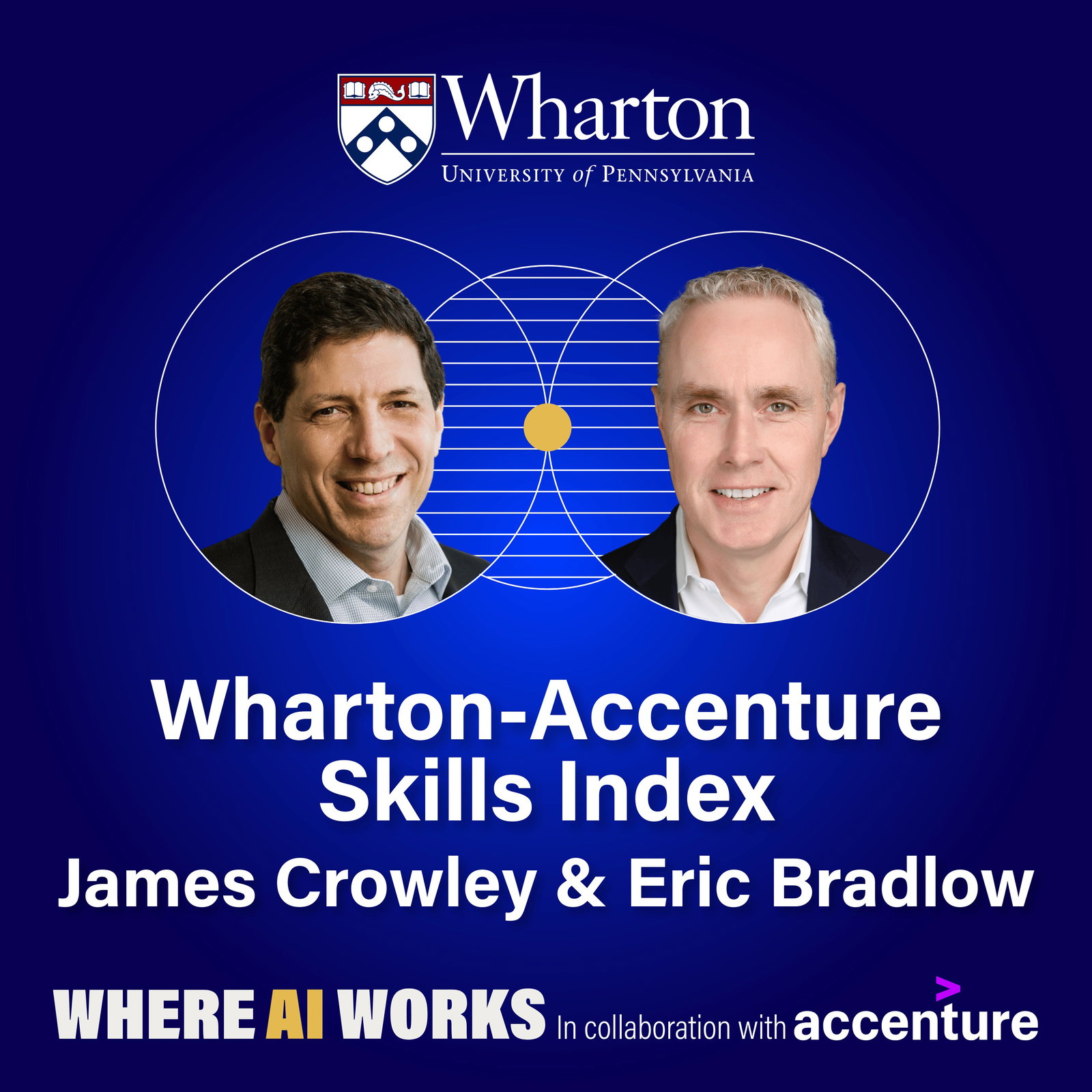
So let's get started. We kicked off the season with a special episode featuring James Crowley, the Global Products Industry Practices Chair at Accenture, and Eric Bradlow, the Vice Dean of AI and Analytics here at Wharton. They unpacked the findings of the Wharton Accenture Skills Index. My main takeaway from James was the crucial importance of thinking about skills rather than jobs and figuring out what skills we need to be building.
This question of identifying the right skills for the future of work is emerging as a key question, both for individuals who want to stay relevant and, well, employed, and for organizations that need to build the capabilities to keep up with technological shifts. I think first it starts with acknowledging the shift and frankly, just thinking about skills. Like we are ingrained to think about roles and titles. We represent our roles in resumes.
So this notion of just even at a basic level, you know, thinking about skills and specifically the skill evolution for your business. What skills you have today may not be the skills you need for the future. And how are you embarking on that journey? And I think that then leads me to then, how are you going to enable that journey if I'm an employer?
We have what we call a pulse of change survey where we talk to 7,000 C-suite leaders, 20 countries, 20 industries. So it's quite pervasive and quite global. And basically, 23% would cite if they could increase the availability of talent, skilled talent, new skilled talent, and training, that that would be the most beneficial in accelerating their AI journey. I also thought it was interesting when Eric talked about AI's impact on the very nature of how we learn.
I'm currently teaching the MBA core and I talk to students about this. I'm not only impressed in what large language models and AI can do today, but I even tell them, think about how quickly you can learn something that you didn't know before. I do not care what you know now I care how quickly you can learn And to me AI is a tool that enables you to learn quickly As a matter of fact it should just be seen as an opportunity You mean I can learn something different and move into a different skill position at my company?
I think that's a great opportunity for most employees. On episode two, I spoke with Donna Morris, the chief people officer at Walmart, about what it means to introduce AI across one of the very largest workforces on the planet. I was particularly struck by what she had to say about the ramifications of AI in management or supervisory roles, helping set the tasks for the workforce. I feel like now managers can actually manage people.
So as opposed to being a manager that is giving out the tasks of the day, it's pretty uplifting to be the manager that can actually spend time with an associate getting to know what they're doing really well and or getting to know areas that they need support or help and or getting to know the customers really well and getting to see what's working in their store or working in their club. So what we're hearing from our associates is that they're actually able to have more real human interactions because AI is taking out some of the work that was either manual and or very task-driven.
And so we would anticipate that discussions around somebody's feedback or performance is a very people-driven discussion, whereby my next task or action, that being given to me in an automated fashion, isn't actually a bad thing. Donna also had her own perspectives on this critical question of what skills are going to be most important for an AI-enabled workplace? I think it's some of the softer skills that we really need to lean into. Communication skills, super important.
Learning agility, people who actually thrive in environments where they're continuing to learn becomes very, very important. People who are highly adaptable, so they're open to doing different ways of working as agentic changes their ways of working, super important. And then I think ultimately some of the people skills, such as interpersonal skills and capabilities, moving away from hiding behind screens, but actually having to have people interaction, that's going to be super important.
So I think for many years, we may have said liberal arts, that's not as important. I'd actually say, well, actually, liberal arts probably super important because it builds a lot of those behavioral skills and capabilities that are deeply human. And those are areas where we all need to lean into. For our third episode, I was joined by Paul Stathakopoulos, Vice President of Product for Focus Categories and International Cross-Border Trade at eBay, finding out how AI is being used inside one of the world's largest online marketplaces.
One thing that really stood out to me was his belief that we still very much need to keep humans in the loop. I don think we at the set it and forget it point And I don know that we ever fully get there especially for things that are high value like this where you have high levels of security high levels of compliance. And so the marriage of kind of humans and machines to do this in a collaborative way, I think is what actually gets us there. And this is where I think it's interesting that the roles change, right?
And you may have agents that are off doing work, But you need to have humans in the loop that are ensuring that the agents are doing the right thing, actually applying the right compliance and governance on top of what's going live to site, and then is actually confirming that we're actually doing the right things in our case in the business so that we're not creating damage to the business or doing something that creates damage to the customer experience. I believe that getting these human AI interactions right is going to be a focus of our efforts in the next few years.
Helping people develop the right balance of trust and skepticism that allows us to make use of AI inputs, but also subject them to the necessary scrutiny to continue ensuring they're actually right. Paul had his own take on upskilling. Upskilling is really important. We spend a lot of time inside of eBay trading folks on the tools, helping them to learn how to use AI in their jobs.
giving them tools that we build internally. Every single person on my team has access to basically any model that they want to use and almost any tool that they want to use in some way, shape, or form. There is governance on it, but we effectively have free reign to try and learn from anything. There's also, as we think about hiring for the future, we do have a very strong focus on hiring interns and recent college grads and people early in their careers that have grown up in an AI environment so that we're bringing in this like AI first DNA from the very beginning with some of the newer members of the team that are joining.
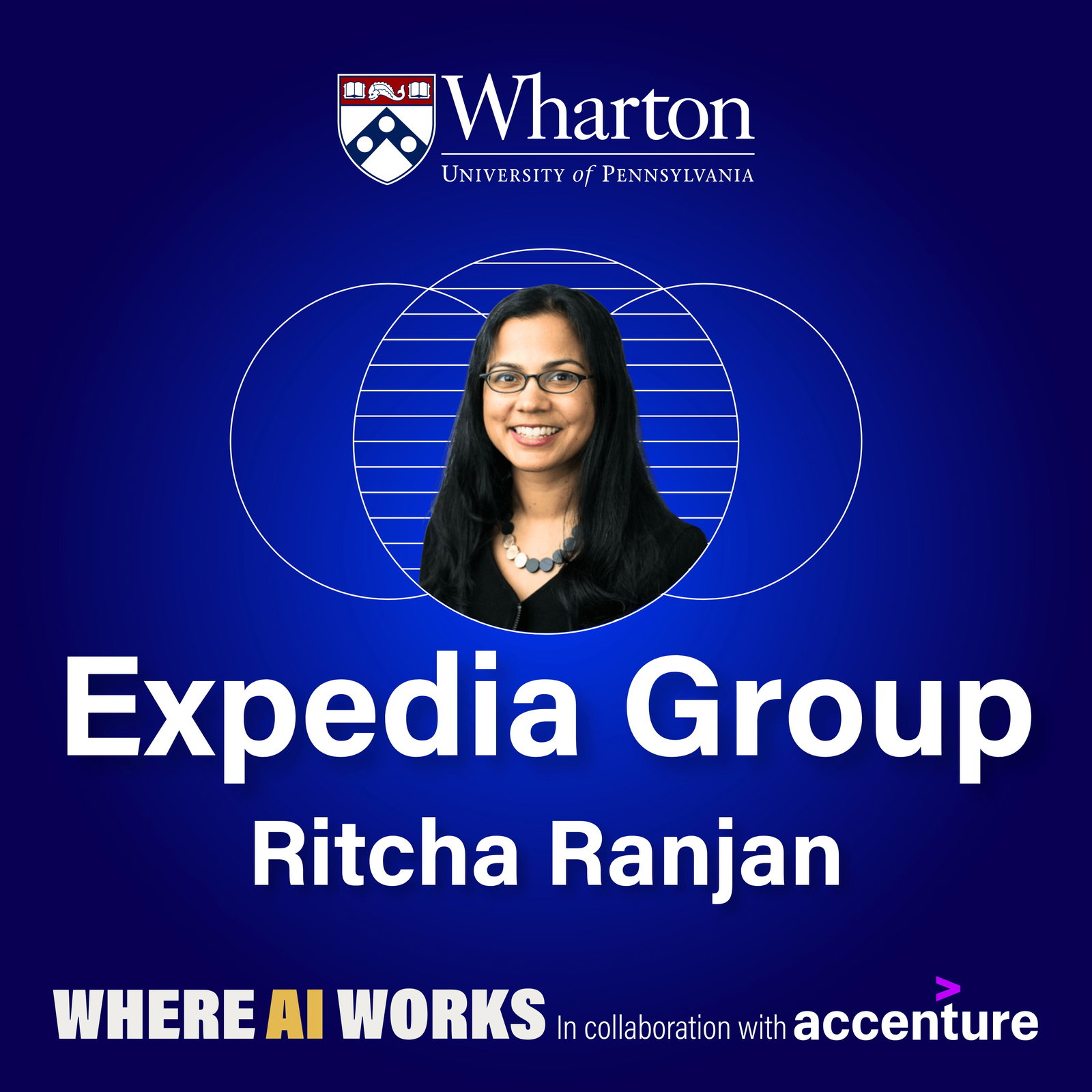
And then hopefully the combination of both of those starts to really shift and change the DNA of the organization overall. My fourth and final guest of the season was Richard Ranjan, the Senior Vice President of Product at Expedia Group. She shared her own experiences about how to build trust and understanding when it comes to AI tools and what executives need to watch out for? I think right now everyone's really trying to learn as fast as possible.
And in that learning loop, I don't think everyone has a full understanding of what is and isn't possible. When you first start to play with this, you think, my God, this is magical. And then you start to realize, wait, it's not always correct. And so that correctness is critical, especially in business systems.
And so that's one of the things that when I talk to people, especially some executives, and I'm always trying to explain to them, like when you design with AI, you need to ensure that you have human in the loop moments so that you can ensure that the output is correct. Otherwise, your organization will not build trust with AI and your AI rollout and your AI efforts will die on the vine I also appreciated Richard insights on what skills are becoming more valuable in the age of AI One is deep expertise in your craft The thing with AI is it's marvelous at creating things, but because it can create so much stuff, you end up in a situation where there is a lot of AI slop being thrown at you.
Your productivity actually decreases significantly. And so that judgment on the craft side is going to become more and more important. The other thing that I think I've seen people who really thrive is that they're builders. They play, they build, they're actually pushing boundaries, and they're getting their hands dirty.
One of the other set of skills that I think will become more important because AI democratizes skill sets is that owner mindset. And what's going to end up happening is I think people actually have larger scopes of roles or larger responsibilities because you'll be able to do more and you will be able to do things that you couldn't do before. And so we're looking for people who have that mindset and that desire to take a problem, own it and solve it. Our guests shared a lot of valuable advice and insights over the course of this season.
What's my main takeaway for business leaders? So we're facing a lot of challenges being in the middle of a transition. AI is capable. It's now being used to deliver real value, to do real work in organizations.
but it's still unreliable. The question for today is still, how can we use AI to help us, not how can we use it to replace ourselves? AI has also been improving very rapidly though. So our baseline expectation has to be that it will continue to get better.
We therefore face the twin challenges of asking, how do we build the skills to work with the AI that we have today? But also, how do we help our people prepare for the AI that we expect to have? We need to address questions like, How do we get people comfortable with AI? How do we help our people become builders?
How do we build that balance of trust and skepticism? Trust so that people understand there's value to be created, but skepticism that encourages people to be careful about what AI recommends and how we use it. We have our guesses. We think relational skills may become more important.
We think judgment is likely to continue to be an important part of the skill set as we focus more on understanding what to do rather than how to do it. The challenge for business leaders then is to help their employees think through what might these changes mean, not just for our organizations, but for us. How do we build these skills to make sure that we're prepared for the future? This has been season five of Where AI Works, conversations at the intersection of AI and industry, brought to you by Wharton in collaboration with Accenture.
If you enjoyed the podcast, we'd really appreciate a review. Hey, recommend it to your friends as well. And of course, if you haven't listened to all of our previous episodes, I really encourage you to do so. I'm Matthew Bidwell.
On behalf of all of us here at The Walkin' School, thank you for listening and goodbye.
Other episodes covering the same guests and topics, from across The B2B Podcast Index.
 Less about Models; More about ArchitecturePractical AI · on Large Language Models (LLMs)85 / 100
 Microsoft Fabric: The Platform That Turns Data into Competitive AdvantageLeading IT - APAC Insights · on Large Language Models (LLMs)85 / 100
 How Organizations Can Thrive in the Human + AI Era with David ChestnutThe Edge of Work · on Large Language Models (LLMs)85 / 100
 Episode 7: AI & the Power of a "Thin Core"Architecting the AI Enterprise · on Large Language Models (LLMs)82 / 100
 #194 Brian Donohue: Intercom threw their playbook out the window when AI got good - A case study on questioning your mental models.The Way of Product with Caden Damiano · on Large Language Models (LLMs)82 / 100
 Almost Everything We Believed About AI a Year Ago Was Wrong - Seven Experts Who Still Can't Agree on Whether It's a Bubble, Who It Pays Off For, or What Comes NextInvested by Aleph · on Large Language Models (LLMs)78 / 100
 Judgment is the New Bottleneck
 From PRDs to Prototypes: How AI Is Reinventing Product Development
 People-Led, Tech-Powered: Walmart’s AI Job Shift
 How AI is Reshaping Skills, Hiring, and Education
 Host's Cut: Reflections on Season Four