
What The Heck, Fintech · 2026-06-16 · 26 min
Key moments - from our scoring
Substance score
42 / 100
Five dimensions, 20 points each
Evan Schnidman, head of Fidelity Labs, discusses how large financial institutions and fintech startups have shifted from competition to collaboration over the past seven years. Rather than startups disrupting incumbents, the reality shows established players like Fidelity building internal innovation units, acquiring promising startups, and partnering with entrepreneurs to access speed and specialized expertise. Schnidman walks through Fidelity Labs' structure - a 20+ year old innovation group (originally FCAT, founded 1999 in response to the internet's rise) that now operates seven active businesses and an entrepreneurs-in-residence program designed to maintain a constant flow of new ideas. He details specific products including Fidelity Private Shares (acquired from Shoebox for cap table management), Fidelity Stock Transfer (the first modern transfer agent in 30 years), Catchlight (customer profiling for wealth managers), Safer (AI-driven compliance), and Calico (crypto holdings aggregation, launched spring 2024). Schnidman emphasizes that Labs operates differently than core business units - accepting failure as part of innovation while leveraging Fidelity's scale, service teams, research capabilities, and distribution. The Boston fintech ecosystem, through organizations like Fintech Sandbox and MassChallenge, has enabled this collaborative approach rather than pure disruption.
Fidelity Private Shares (originally Shoebox, acquired three years ago) provides cap table management, 409A valuation, data room, and document storage services for startups. It combines best-in-market technology with Fidelity-scale service support, differentiating itself from purely self-serve competitors by offering dedicated service teams that guide startups through their lifecycle.
Fidelity Stock Transfer is the first fully modern transfer agent launched in over 30 years. It replaces the industry standard of paper stock certificates with electronic information and streamlined processes, eliminating medallion signature guarantees. Transfer agents are a regulatory requirement when companies go public, and Fidelity's modern approach is growing faster than planned.
Fidelity Labs is the successor to FCAT (Fidelity Center for Applied Technology), founded in 1999 by Ned Johnson in response to the rise of the internet and perceived risk to Fidelity's business. Labs was formally created six years later to build full-scale businesses within Fidelity, reflecting the company's 20+ year commitment to future-proofing its operations.
Calico, described as 'Plaid for crypto,' aggregates cryptocurrency holdings across multiple wallets and platforms into one place. It addresses the primary problem that financial advisors, compliance officers, and employers cannot currently see clients' or employees' crypto holdings across different exchanges and wallets, with potential to expand into transactions in the future.
Labs uses multiple discovery paths: asking business units about profound client problems they're unable to address due to bandwidth or timeline constraints; listening to entrepreneurs-in-residence who spot unmet needs; and monitoring the startup landscape to identify why Fidelity isn't addressing certain opportunities. The goal is balancing client needs, business unit feedback, and emerging market trends.
Our reviewer’s read on each dimension, with quotes from the episode.
The guest delivers some genuinely useful structural details about Fidelity Labs (headcount, business count, EIR pipeline, specific product descriptions) but the episode is heavily padded with host self-reference, mutual admiration, and standard startup-enterprise bromides. Novel claims per minute is low.
we've got seven existing businesses as well as four entrepreneurs in residents about to start new businesses
our expectation here is, um, that we have a faster flow of ideas. We will have more failures, but we'll also have more successes
The episode recycles the canonical Kodak cautionary tale (which the guest himself labels 'the canonical example'), uses the clichéd hockey-puck metaphor, and frames startup-enterprise collaboration in the most standard terms available. No contrarian or first-principles arguments appear.
In Kodak's the canonical example of this vis a vis the Digital camera
not just how do you skate to where the puck has been, but like how do you skate to where the puck is going?
Schnidman has genuine multi-stage credentials - PhD, academic, serial founder across Prattle, Market Reader, and Outrigger, now running a real internal venture unit at a major financial institution. He is a practitioner who has actually done it, not a thought-leader circuit rider.
I've been in the fintech ecosystem a long time. I'm very fortunate that I had some wonderful people who encouraged me to, to leave academia and go start prattle. It's my first startup and then kind of let me keep at it building, building subsequent businesses, market reader, outrigger
prior to joining Fidelity, um, I referred a lot of companies to Fidelity Private Shares because I'd gotten fed up with other cap table management solutions
The guest names specific products (Shoebox acquisition, Catchlight, Saifr, Calico, Fidelity Stock Transfer), gives headcount (300+ in Labs, 85,000+ at Fidelity), dates (FCAT 1999, Labs ~6 years later, Calico launched 'this spring'), and frames Saifr's market at ~5 years. However, there are zero revenue figures, growth metrics, or client counts to anchor the claims.
Fidelity Private Shares was, uh, originally a company called Shoebox that Fidelity acquired three years ago
Labs is a non trivial team. We have over 300 people
The host repeatedly redirects to his own 23-year Fidelity career, asks softball openers ('What do you got cooking going on?'), and closes with extended flattery. There is no pushback, no probing follow-up on ambiguous claims, and multiple questions are actually statements about the host's own experience.
Let's go to Fidelity Labs a little bit now. What do you got cooking going on?
Evan, I want to say thank you so much. Your stories, your perspectives, your journey, you're learning how you're helping the whole ecosystem
Computed from the transcript - who did the talking, and the words that came up most.
AI, startups, financial innovation, and the future of fintech - all in one conversation. In this two-part episode, we sit down with Evan Schnidman, Head of Fidelity Labs, to explore a career that spans academia, artificial intelligence research, startup founding, and building new fintech businesses inside one of the world’s largest financial institutions. Evan’s journey perfectly illustrates a core idea of this podcast: Fintech is FinLife. From building early AI and natural language processing systems to analyze central bank language, to founding and selling an AI startup before the recent LLM boom, to now launching new ventures inside Fidelity Labs, Evan has spent his career translating complex financial signals into meaningful innovation.
Transcribed and scored by The B2B Podcast Index.
Rob Sarnie: Foreign,
Co-host: um, sarny. And you're listening to what the heck? Fintech, where you'll experience and learn that fintech is fin life.
Rob Sarnie: Let's get started.
Co-host: Welcome back to Part two with Evan Shinman. If you didn't hear Part one, please go back and listen to, to hear how Evan started out as a PhD researcher, a professor, then founder, and now the head of Fidelity Labs.
Rob Sarnie: You're in such a sweet spot too, because, you know, Fidelity, uh, obviously, um, a, you know, large company doing extremely well, right? And then also, um, working with so many startups. So I mean, I like, let's go back seven years ago, right? Everything was like, oh, it's fintech, it's a small startup going, you know, you know, kill the big giant. No, right. It's now, you see, it's more collaboration and what you do is exactly what. And I grew up with that, right? Being at Fidelity for 23 years. So now. But everyone kept saying, oh, they're gonna, you know, upend the whole thing. I was, no, no. But the collaborations in now all the, all the, you know, larger financial institutions do are doing, you know, their own, uh, incubators, their own labs. They're collaborating because they want to, because those startups can do things. And I want to hear your take on this. You might, you might totally disagree. What I'm saying, those startups can do things that you don't want to have, um, over on this side. You want them to be over here and see how it works, then, okay, can we scale it? Can we just, can we distribute it, right? To go hand in glove. That's how things are going to happen. And that's, it's always, it's a marriage because the startups want to be the big industry folks and the industry folks want to be quick and nimble like the startups. What are you seeing? Because you're right in that center, right in that middle spot, that sweet spot to make that young, making that happen.
Evan Schnidman: I think there's kind of three different components to this. So one is the independent startups that are just kind of out there doing their own thing, figuring out what works, what doesn't. Usually, not always, but usually. Those are founded by people who have some great product idea, they have some engineering prowess, they have some, some innate advantage from a technology standpoint. Once in a blue moon, it'll be somebody who uncovers, oh, hey, there's a, there's a profound market need being unmet by, by larger players. But that's, that's unusual. And frankly, usually it's Industry, industry veterans that leave industry to go do that when they uncover one of those opportunities that's fewer and further between. More often than not it's hey, somebody's got a great product idea, they run with it and then they go back, they kind of backward inductive figure out how the heck are we going to sell this thing. Um and so I think you know as, as I look at them, you know that that industry continues to grow. That industry has struggled in recent years though because of lack of funding for early stage startups. Um kind of growth stage, late stage have been well funded through this kind of post 2021, post 2022 bubble. Right like that, that bubble that, that we saw really inflate in 21 and kind of deflate in 22. Um, we're still, we're still living in the shadow of that for a lot of AI companies even but, but especially for fintech companies. And so I think then that brings kind of the next category which is okay, well what about the uh, the, the kind of fintech businesses within larger enterprise. Right. So I um, get to you know the great luxury of, of operating within a giant financial institution. Right. Um, you know Fidelity is massive. Um and I'm um, you know within Fidelity Labs we've got seven existing businesses as well as four entrepreneurs in residents about to start new businesses and we're growing all the time. Um, but the really incredible thing about Fidelity Labs is that Fidelity Labs is more than 20 years old and in fact um, is the successor organization to Fidelity center for Applied Technology FCAT which was started in 1999 in response to kind of the rise of the Internet and what Ned Johnson saw as profound risk to Fidelity's business almost 30 years ago. Um, and so really the massive um, kind of buy in within Fidelity that we have to future proof the business, we have to understand trends in industry and invest in the future that started in the late 90s and frankly there are lots of, there's lots of ways in which it predated that. It was just that uh, that um, in the late 90s they formalized it with the creation of FCAT and then six years later the creation of labs to really build out full scale businesses within Fidelity was buy in that hey, sometimes it takes thinking a little bit differently to start something brand new inside a giant financial institution. And so to your point Rob, I get to sit on both sides of that. Which is to say I came out of the startup world. Um, I'm not fully in the big corporate world because I get to spend my days um, building new businesses within a giant corporation. And so that's kind of the second stage there. And then the third piece is large companies aren't standing still, Fidelity included. Right. It's not just us in labs that are innovating. There are 85,000 plus people at Fidelity that are, that are all looking around the corner and saying hey, what's next for not just for me but for my business. And uh, yes, some of those things land on my desk that hey, this is far enough afield from our day to day. We should be, it should be built in labs. But a lot of those things are incremental innovation or frankly even sometimes revolutionary. But it just belongs within the business unit. And so uh, um, I get to play this kind of interesting role of, of paying attention to what's going on in broader financial services with Fidelity being obviously what I'm closest to. Um, but understand, hey, what, what belongs in a startup versus what belongs in a core business unit and what belongs in kind of this hybrid thing in between which we get to live in, in labs.
Co-host: Yeah.
Rob Sarnie: And that timeline you just, I started in 1996 and I left in 2019. So, so think about the stuff. I saw that and I used those stories in my class. Cause the first Harvard Business Publishing case study they do, it's for discussion. It's on exactly that story and how it started and uh, moved to Agile and all that kind of stuff. So I lived that. And that's like what a story that's in my DNA.
Evan Schnidman: Well when you think about it, we all look at the success stories of companies that have, have done this. Right, right. Like that have, have future proofed their business, have evolved. There's also dozens of stories of companies that went the other direction. Right. Um, you know, not to, not to pick on anybody but uh, I'll uh, use my own family as an example. Right. Um, my grandfather was an optical engineer for Kodak. And um, among the worst financial decisions I've ever heard of. Um, when a colleague of his pitched him on this idea to be able to take pictures of a document and print as many copies as you want, he told him to get out of his office, that I didn't, that he wasn't going to invest. Um, and so that became Xerox. Right. And I mean these are like great businesses were born out of these. Some of these older technology companies like a Kodak, great businesses also died because they didn't innovate. In Kodak's the canonical example of this vis a vis the Digital camera. Right. And so you, uh, know we look at that and say, you know, that's, that's kind of a cautionary tale for how do you, it's not just how do you skate to where the puck has been, but like how do you skate to where the puck is going? And frankly, more importantly, how do you know where the puck is going? Because that's being able, being able to pick up your head and understand that that's actually the hardest thing when you're heads down running a business day in and day out.
Rob Sarnie: Yep.
Evan Schnidman: Yeah.
Rob Sarnie: And you must have so much fun just because I know you're on the same floor, you know, FCAT and Fidelity Lab. So you're always talking and collaborating together, learning from each other, helping each other, and then you get the cause. Here's the thing that I loved about Fidelity. You know, I was in the corporate IT space for my, almost my whole career there. My 23 years. Uh, 21 of them were, yeah, 21 of them were in corporate, uh, space, corporate IT. I was always one or two calls away from a genius in any technology at Fidelity because it was just unbelievable. If I was in trouble or something going on, I needed some guidance. I could go to one call and get there or go direct because it was just what an amazing place. And you're one of those people to
Evan Schnidman: call,
Rob Sarnie: you know what's going on from a deep emerging tech standpoint.
Evan Schnidman: Well, and I think you also highlighted something else here which is like Fidelity is an extremely people driven organization. It's very network based. It's not a process heavy place, it's very relationship based. And a lot of that is wonderful because frankly it's because it derived from being originally a relatively small family business that grew to being a massive family business. Um, and I think that what's really fascinating about that is, to your point, Rob, this is one of those things like when I have a question, it's never, oh, there's some formal process or some document I got to look up. It's like I'm just going to go ask that person. Right? And it's, it's a conversation, it's an email, it's a teams message. Whatever it is, it's, it's saying, hey, explain this to me please. Like it's, you know, can we get a cup of coffee? Right. Um, and to your point, the resources are incredible to be able to answer those questions. And I had one of my entrepreneurs in residence pull me aside a few weeks ago saying, um, you know, hey, as we start recruiting the next cohort of EIRs. One of the things we should tout is specifically the FCAT research team. Um, the center for Applied Technology has a phenomenal research team, um, that does really incredible, groundbreaking, groundbreaking studies of societal trends. Deep dives into specific things. He's like, this is such valuable insight into what we should build. Where there's white space, where there's opportunity, where there's things to avoid. You know, he. He, uh, he keyed in on it as, hey, this is a selling point as you're trying to try to bring in entrepreneurs to build new things. Like having this quality research team just sitting at your disposal is. Is a completely different thing than exists almost anywhere else in the world, except for maybe academia. And they don't have the distribution rails that we do. Right, Right.
Rob Sarnie: Let's go to Fidelity Labs a little bit now. What do you got cooking going on? I'd love to. If you can't tell me, you can't tell me. I fully get it because you guys are always figuring stuff out. Anything, uh, you can share with this audience, uh, what's going on right now or close to now.
Evan Schnidman: Yeah, for sure. So, um, I guess I'll talk about the businesses that I'm allowed to talk about. So, as I said before, we've got seven businesses operating in labs right now, uh, plus four entrepreneurs and residents working on new businesses. We'll welcome another cohort of EIRs in the next couple of months. And really, um, the objective here is to have a constant flywheel going of new ideas, new things that we're thinking about. Uh, one of the big things I've changed since joining Fidelity almost a year ago, um, uh, is really to focus in on this. EIR programs. We do have a constant flow of new talent, new ideas, and really just we accelerate the pace of innovation. Um, and importantly, we don't have an expectation of batting a thousand. Right. Um, it's. It's almost impossible to have 100% success rate in anything, let alone entrepreneurship. And so really, um, our expectation here is, um, that we have a faster flow of ideas. We will have more failures, but we'll also have more successes. And. And so that's been the big change, uh, since I joined, is really growing that EIR program. Um, in addition to that, we've got, as I said, the seven operating businesses and labs. I can talk about a few of them, not all of them publicly, um, but, um, Fidelity Private Shares was, uh, originally a company called Shoebox that Fidelity acquired three years ago. Um, Shoebox Cap Table Management 409A valuation, data room, document storage. A lot of startups uh, in, in the Boston ecosystem but also much more broadly um, are using uh, you know, using Fidelity Private Shares for their cap table management. And um, you know we think, we think we've got the best product in the market there. Um, we're very excited about the fact that you know to be completely honest, uh, our service model is just world, world leading. Um, we are so much better than anybody else in the space um because we're just playing a different game. It's a Fidelity scale product. It's not um, it's not just a tech product that spun out of Silicon Valley that it's purely self serve. We've got a phenomenal service team that supports startups and can help them kind of through that whole journey. And so I think back on what I would have liked uh, when I was starting my first company, um, absolutely would have loved that support. I um, also should note that prior to joining Fidelity, um, I referred a lot of companies to Fidelity Private Shares because I'd gotten fed up with other cap table management solutions. And we had a great experience with our clients there. So it's always fun to then be on the other side of it and say like hey, I was a big advocate for you even when I, even before I had an incentive to be. Um, and so that business is great and I think that represents one of the big pushes we have in labs which is around um, helping to do more in private markets around Fidelity. And so another leg of that school is uh, Fidelity Stock Transfer, um, which is the first fully modern transfer agent in over 30 years. Um and uh, so for those who aren't aware when uh, you take a company public, uh you have to have a transfer agent. It's a regulatory requirement. Um, the industry standard for many many years is still paper stock certificates. Um, uh, turns out that from a tech standpoint we've kind of moved beyond that as a society. And so having a fully modern transfer agent um, with electronic information, uh, no medallion signature guarantees a streamlined process and phenomenal Fidelity grade service makes um, a big difference. And uh, um, if anything that the challenge with that business is we're growing it significantly faster than we planned. Um, which is a good problem to have but it's still a challenge nonetheless. And so um, that's going great. And I think it also allude you know, those two businesses uh, kind of hint at where we might be heading with some things in the future around private markets and private market liquidity. And so I can't say a whole lot more about that right now but uh, direction of travel certainly in that way. Um, and then beyond that we've got uh, uh, a couple other businesses that have been in market for a little while. Um, so Catchlight, uh, which is um, uh a solution to do customer profiling primarily for RIAs, wealth managers, regional um, community banks, um, really to help understand their customer, their clientele, um, and identify is that person the right profile for the RIA that aims for mass affluent or is that the right profile for somebody who aims for ultra high net worth? And um, so really uh, that tool has been uh, has been in market for a couple of years and has grown extremely quickly in the last year and I think it's beloved by its clients. Really proud of the Catch Light team and what they've built there. Um, and then Safer, uh, it's called saifr, is an AI driven compliance tool, um, streamlines the compliance process not just for financial services firms, although that is obviously the beachhead market. Um, we've seen massive uptick by consumer facing companies and particularly marketplace businesses where they have to do, they have to understand um, a lot of the KYC implications and things like that. Um, ah, about both counterparties. And so um, we've seen really an AI driven compliance tool. Um 5 years ago no one had understood that that was even possible. Now um, we've seen significant uptake on that because it's just a no brainer that this is where the world is headed. Um and so Safer has really done a great job there. Um, and then the last one I'll talk about publicly is a business uh, called Calico, um, which you can kind of think of as plaid for crypto. Right. So being able to understand your crypto holdings ah, across multiple wallets, across multiple platforms, all collated into one place. So whether you're a financial advisor that needs to see into your clients holdings or whether you're a compliance officer who is trying to understand hey, you know, what are my employees doing? Um, you know there's a lot of applications here that ultimately can, can eventually extend into transactions and a variety of other things. But right now it's just a question of hey, we don't even know what you're holding, um, how do we get that all that information in one place. And so Calico solved that problem and uh, so we just launched that product publicly this spring. So um, excited to get that in the hands of a lot of folks. Um, as I said we've got a few other things brewing both uh, more nascent businesses. And then our EIR is launching new things all the time. Uh, so can't quite disclose those just yet.
Rob Sarnie: Now, any of those. And you, uh, don't have to say which ones were any of those organic from Internal, from Fidelity, and you don't have to say which ones, if you can.
Evan Schnidman: Yeah, yeah. Um, so I guess different flavors of that. So, yes, um, obviously, um, Private Shares was originally the Shoebox acquisition. So that's a little bit of an outlier. Um, but Catchlight and Safer were the first two businesses created by my predecessor who ran labs before me, Mona Vernon. Uh, when she came in and said, hey, we're going to focus in on SaaS businesses, these were the first two organic ideas that really took root. Um, I think we've seen that evolution and that generation of labs bear fruit here, um, with some really impressive businesses. Um, as we look at, uh, the other businesses and labs, we try to, um, follow a couple of different paths here. One is to go talk to the business units and say, okay, what are the profound problems clients are posing to you or identifying? And then we go through that list and say, all right, which of these are you addressing? Which of these do you think are important to address? You either don't have the bandwidth or it's too long a duration project, um, or maybe it's a cross business unit, um, uh, application. Those are the things that we take on in labs, and we certainly don't take on all of them. We don't have the resources for that. But Labs is a non trivial team. We have over 300 people. Um, we've really been able to throw resources at building things that can solve profound problems for our clientele. And that's mostly uncovered from the business units. Now the flip side of that is we also have entrepreneurs coming in all the time who might have a distinct expertise and look around and say, why are we not doing this thing? And we go, that's a great question. We don't know why we're not doing that. No one had stepped back and thought about it. Sometimes that's us in lab saying, hey, has anybody considered pulling together these three, four or five different pieces into a fully modern application stack that makes our clients lives easier? Um, it's an interesting balance of what are the business units saying they need, what are the clients saying they need? And what are we looking around the broader startup landscape and saying, why are
Rob Sarnie: we not doing this thing?
Evan Schnidman: Um, and we have to get that balance right because we can't just pick one or the other avenue. We have to kind of hit all of the above. Wow.
Rob Sarnie: Evan, I want to say thank you so much. Your stories, your perspectives, your journey, you're learning how you're helping the whole ecosystem you've done from day one to today and still will. Obviously the things you're doing are amazing. And every time I meet more and more of your team, they amaze me of what they know and what they do and how they do it. Right. Uh, because as I go to different events, there's always someone from your team. Seems like they're always in the mix, learning and making things happen, which is unbelievable.
Evan Schnidman: Wow. Yeah. Well, it's fun to get to do what we do. I've been in the fintech ecosystem a long time. I'm very fortunate that I had some wonderful people who encouraged me to, to leave academia and go start prattle. It's my first startup and then kind of let me keep at it building, building subsequent businesses, market reader, outrigger, etc. Um, I, you know, I've been, been fortunate in that way. I've also, you know, I think we're all, we're fortunate in the Boston area to have great, uh, support system for, for the fintech world. Right. So, um, the Fintech Sandbox is a wonderful organization that I've been a part of, a part of for a long time. Um, gotten the advantage of leveraging their data access. Um, and then Mass Challenge is so supportive of the startup ecosystem broadly and has a whole fintech program now that, um, supports a lot of companies. I think we're fortunate as Fidelity to be part of that ecosystem. I personally have been lucky to get to interact with probably thousands of wonderful entrepreneurs over the years. Um, and so, um, you know, it'll, I, I hope it continues to be just as much fun as it's been.
Rob Sarnie: Yeah, I mean, a couple of those organizations, Fintech Sandbox, our bill has been on, on this, um, on this podcast and also, you know, you know, you know Chris Houlihan really well from Mass Challenge. Right. The chief growth officer of MassChallenge. Yeah. So it's all in the family. It's. That's what's unbelievable about this FinTech Boston, you know, New England community. It's just like, it's amazing. Everyone wants to help and bring, get everyone to that next level, which I think is so much fun.
Evan Schnidman: Well, and I think to your point, I think, you know, what's wonderful about those organizations and all, uh, you know, especially, especially thank Sarah Biller, because Sarah's one of the people who really convinced me That I had a viable business idea and leaving academia was not an insane idea. This is well over a decade ago, um, when I was wrestling with whether or not, um, I should leave academia and start, and start prattle. Um, and I did. Um, and in large part Sarah's one of the people to credit with convincing me that I was not crazy, that I had to add something real here. Um, and I think Fintech Sandbox is a great example of this. I think MassChallenge is a great example of this. These are organizations that help startups figure out how they can collaborate. They're not going in and saying, oh, this is cutthroat competitive. Either this one's getting funded or that one is, it's now. How do we make sure the rising tide lifts all boats here? Right. How do we help build businesses? And in many cases you see these startups partnering with each other and partnering with the sponsors, uh, to those organizations, Fidelity included. Right. Um, to make sure that the next wave of great financial technology businesses is not just operating as one offs, but there actually is an ecosystem, there is a community and hopefully that a lot, you know, a core sort of part of that community at least sits in Boston.
Rob Sarnie: So Evan, I know this audience wants to probably. I heard you, great story. They want to connect with you, they want to learn from you, they want to meet you. Like, what's the best way that you'd like to have people reach out to you?
Evan Schnidman: Yeah, folks should, should absolutely reach out through the Fidelity Labs website. Um, feel free to also ping me on LinkedIn. Happy to connect with any of your listeners. Um, always happy to both direct them to folks in my network, uh, both within Fidelity and elsewhere. Um, but uh, certainly, uh, as I said before, this is about helping grow the financial technology ecosystem. Um, the more smart, talented people we can be interacting with, the better access we have to great ideas and um, certainly want to interact with any and all of your listeners.
Rob Sarnie: Uh, awesome Evan, thank you so much. Everybody get connected, reach out. Uh, follow Fidelity Labs. You're going to learn a lot. And uh, definitely when you get a chance and you see Evan at a fintech event, come up and say hi. So hey again, Evan, I want to say thank you so much. I just want to say bye everybody. Thank you so much.
Evan Schnidman: Thanks Rob.
Co-host: Thank you for listening to what the heck fintech. Make sure you tune into our, uh, next episode as we continue to interview fintech leaders and share real world stories from across the fintech ecosystem so you can fully understand that fintech is fin life.
 Sarah Biller: How Data Access & “What If We” Are Transforming The Future Of Fintech72 / 100
 Tracie Kosakowski: From Chemist, to Lawyer, to Fintech Leader (Part 1)53 / 100
 Building Trust in Digital Finance: Compliance and Stablecoins with Cristina Palladino (Part 1)51 / 100
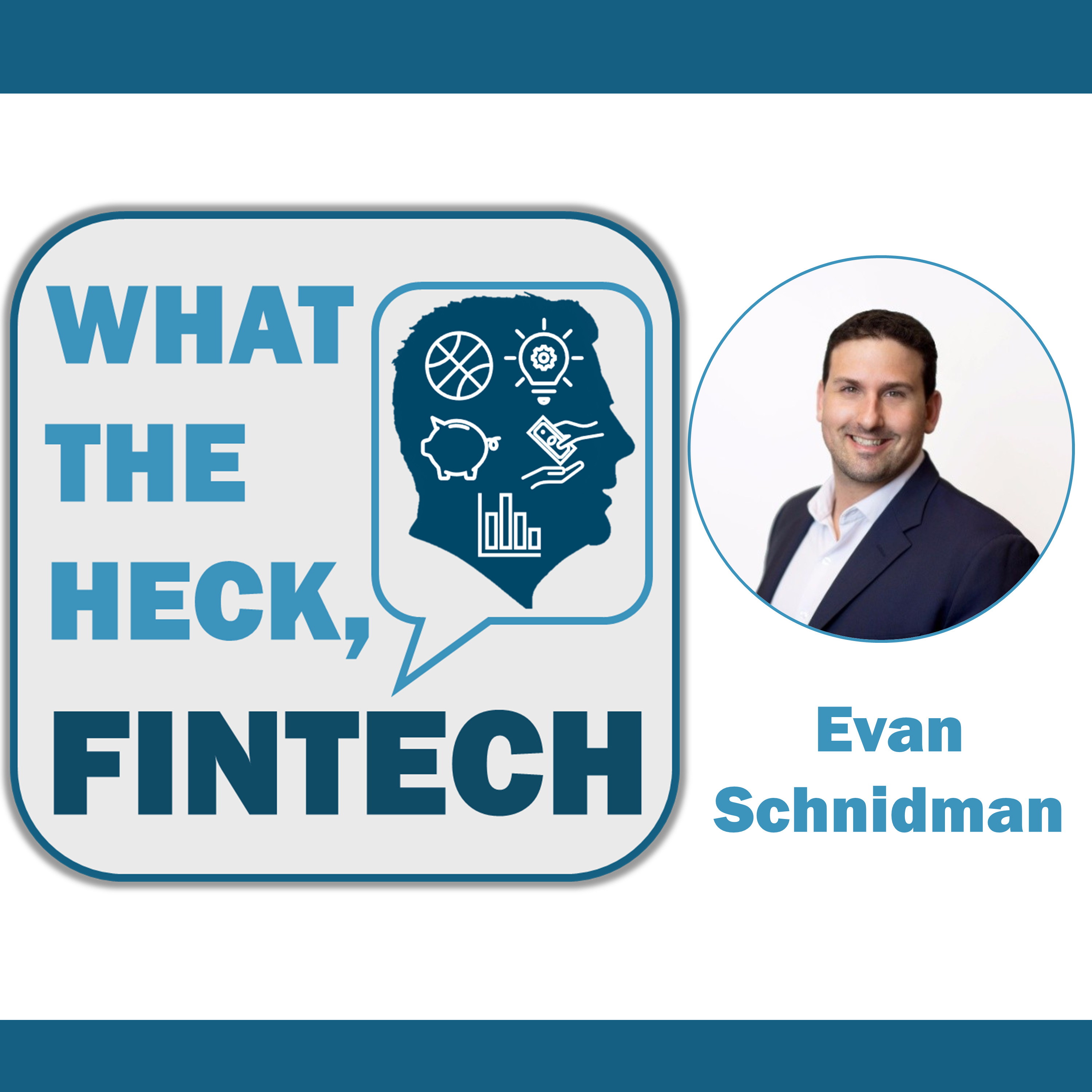 How Evan Schnidman Went From Professor to AI Founder to Leading Fidelity Labs (Part 1)69 / 100
 Ralph Dangelmaier: AI, Stablecoins & Agentic Commerce Reshaping Global Payments (Part 2)