
Weeks Weekly with Ed Weeks Jr. MBA · 2026-05-19 · 16 min
Key moments - from our scoring
Substance score
58 / 100
Five dimensions, 20 points each
Ed Weeks Jr. returns for season six with a sharp repositioning of Weeks Weekly as a show for Gen X founders and operators running $2-20M revenue businesses who are contemplating their next chapter - whether that's an exit, scaling, acquisition, or stepping back from operations. Drawing from 30+ years across capital markets, regulated industries, and real business operations, Weeks occupies a rare intersection: he understands how Wall Street buyers think about acquisitions, how complex compliance frameworks work, and what it actually feels like to run a Main Street business. The episode uses this credibility to tackle a specific, emerging problem: AI dependency. As workflows get built into personal ChatGPT and Claude accounts rather than company systems, intellectual property and institutional knowledge become untransferable - a direct threat to valuation that mirrors classic owner dependency but hasn't been widely documented yet. A $4M revenue, $800K EBITDA business could lose $200-400K in purchase price if AI dependency issues aren't fixed pre-sale. The show targets operators who understand real deal mechanics, not productivity hacks or social media growth tactics.
AI dependency occurs when employees or consultants build workflows inside personal ChatGPT or Claude accounts instead of company systems, meaning the workflow, institutional knowledge, and intellectual property remain outside the business and walk out the door if that person leaves. This reduces buyer confidence and can cost $200-400K off the purchase price of a $4M revenue business.
Only 30-40% of the estimated 2-3 million boomer-owned businesses transitioning over the next decade will actually sell; the rest will close, get fire-sold, fail in family handoffs, or be acquired by competitors at steep discounts due to lack of preparation.
The show is built for Gen X founders and operators running businesses between $2M and $20M in revenue who are thinking about their next chapter - which could mean exiting in 1-5 years, scaling for optionality, acquiring a second business, or stepping back from day-to-day operations while keeping upside.
Weeks has spent 30+ years across Wall Street (learning valuation and deal mechanics), big pharma (understanding complex compliance and regulated operations), and Main Street businesses (working directly with founders in the $2-20M range on growth, financing, and exits) - a rare combination that lets him speak both the buyer's and seller's language.
Episodes are 20-25 minutes maximum, designed for someone listening on a walk, in the car, between meetings, or on a train, with every episode delivering something actionable the listener didn't know at the start.
Our reviewer’s read on each dimension, with quotes from the episode.
The episode delivers genuine, non-obvious insights - particularly the AI dependency framework as a valuation risk that mirrors owner dependency. The $200-400k valuation impact and post-close holdback mechanics are concrete and novel. However, roughly 40% of the runtime is positioning (target audience, personal background, show philosophy) rather than substantive content, which dilutes density somewhat.
Fail the AI dependency diagnostic and a real buyer is going to take a quarter to a half turn off the multiple, that's 200 to 400,000 off the purchase price. Plus they're going to want 5 to 10% of the deal value held back contingent on documentation cleanup
When an employee or a consultant builds a real workflow inside their personal chat or Claude account account, three things are simultaneously true. The workflow that actually lives outside the business, the institutional knowledge lives in their history, and the business has no claim on either
The AI dependency concept is genuinely fresh and contrarian - reframing an old problem (non-transferable workflows) through a new technological lens that most M&A advisory is not yet discussing. This is first-principles thinking grounded in actual deal experience, not recycled frameworks.
A major second dependency problem is building inside small businesses right now, and most owners have no idea it exists. Hides in different places than owner dependency, but it's going to start hitting valuations the same way over the next 12 to 24 months. I'm calling it AI dependency.
It's not a technology problem. That's a transferability problem. And transferability is the single biggest determinant of what a business will sell for.
This is a solo monologue by the host with no guest. The host (Ed Weeks Jr.) does claim relevant credentials (30+ years in capital markets, pharma, and Main Street M&A operations), but no external guest appears to validate, challenge, or add perspective.
Ahmed, um, Weeks Jr. This is Weeks Weekly.
I've spent 30 plus years across a lot of different worlds.
Strong on deal mechanics: $4M revenue, $800k EBITDA businesses normally transact at 3.3-4x multiple; AI dependency causes 0.25-0.5x multiple discount ($200-400k loss); 5-10% holdback post-close. The boomer transition thesis includes hard numbers (2-3M businesses, $10T assets, 30-40% will actually sell). However, the AI dependency examples are conceptual; no named companies or specific failed deals are cited.
4 million revenue business 800k of EBITDA, right? 4 million top line. Sending 20% to the bottom line at 800k in EBITDA should transact 3.3.6, maybe 4 on the high end in a normal market.
Somewhere between 2 and 3 million boomer owned businesses are going to transition over the next decade. That's roughly $10 trillion in business assets changing hands.
No conversation occurs - this is a scripted solo monologue with no guest pushback, follow-ups, or disagreement. The host does ask himself rhetorical questions ("Let me know if you've ever heard this before?") and makes assertions confidently, but there is no actual dialogue or host pressing for depth. The format deliberately avoids challenging the claims presented.
This is a solo episode with no guest interaction.
Let me know if you've ever heard this before. Every vendor relationship and every customer call it ran through that damn owner. So they weren't buying a business, they were buying a job.
Computed from the transcript - who did the talking, and the words that came up most.
Thinking about what's next for your business? See what it's worth to a buyer with the free Exit Readiness Scorecard: edweeksjr.com/scorecard Welcome to episode one of Weeks Weekly . In this relaunch episode, Ed Weeks Jr. lays out exactly who this show is for: Gen X founders and operators running real businesses in the $2M - $20M range who are thinking seriously about growth, optionality, acquisitions, or eventual exit. This is not another startup podcast. No hustle culture. No TikTok growth hacks. No recycled business clichés. Instead, Ed breaks down the intersection of: Building a business buyers actually want Understanding how deals and capital really work Navigating business ownership as a Gen X operator in a rapidly changing market Drawing from 30+ years across Wall Street, Big Pharma, and Main Street operating businesses, Ed explains why he believes the next decade will create the largest transfer of small business ownership in American history, and why most owners are dangerously unprepared for it.
Transcribed and scored by The B2B Podcast Index.
Speaker A: A buyer in our group passed on a deal last week. Solid revenue, decent margins, pretty damn good market. The kind of business that should have closed 45 to 60 days. The reason for the pass. Let me know if you've ever heard this before. Every vendor relationship and every customer call it ran through that damn owner. So they weren't buying a business, they were buying a job. That's the conversation, my friends, I have almost every week with buyers, with sellers, with operators who are trying to figure out whether the thing they've spent the last 20, 30, 40 years building is actually worth what they need it to be worth. This podcast is for the people in those conversations. Ahmed, um, Weeks Jr. This is Weeks Weekly. This is season six, six, episode one. Let's get into it, my friends. I want to do something a little bit different in this first episode than I see most people doing when they actually relaunch a show. I'm not going to spend the next 20 minutes telling you my life story. I promise you that story is somewhere in our past episodes. What I'm going to do is spend the next 20 minutes telling you why I'm in this specific lean, who I think this show is for, and what you can expect from me every week if you decide to subscribe, which I would greatly appreciate. So let me start with the lane. If you, my friend, are a Gen X founder or operator running a business somewhere between 2 million and 20 million in revenue and you're starting to think about what the next chapter looks like, this show is for you, that might mean selling in the next one, two, three to five years. It might mean scaling to a number that gives you optionality. It might mean acquiring a second business to get you where you want to go. It might mean stepping back from day to day operations without losing the upside. What it doesn't mean is that this is the typical small business, um, podcast conversation. I'm not going to teach you how to do Facebook ads. I'm not going to interview a 27 year old who just hit seven figures on TikTok. I'm not going to spend an hour talking about productivity hacks. What I'm going to do is sit at the intersection of three very real conversations that most operators in this revenue range never get to have with the same person. Number one, how to grow a business that's actually viable when you're ready to exit. Number two, how to finance and structure deals when you're the actual buyer. And number three, how to think about all of this as a Gen X operator who's Been in the market long enough to know that the rules change every decade and now it seems like every week. And that the people who win are the ones who see the change before everyone else does. That, my friends, is the lane exit. Aware operators, real businesses, real money, and real conversation. If that's you, you're in the right place. If you came here looking for hustle, culture or motivation, you're going to be sorely disappointed. And I'm um. And I'd rather you find that out in the first three minutes than the next three months. So let me tell you how I ended up in this specific spot. Because the path matters. I've spent 30 plus years across a lot of different worlds. But we'll just get into three. The first was the the dream. As a kid, it was Wall Street. Big shop, regulated environment, real money moving through real institutions. That's where I learned how capital actually works. How deals get structured behind the language, how the people on the other side of the table think about risk. Most of what I know about valuation, deal mechanics and the difference between a headline number and an actual close, I learned in those years. The second, at least the second that I'll mention that was big pharma, heavily regulated industry, billion dollar product lifestyle cycles, compliance frameworks that would make most small business owners head spin. AKs, HIPAA, uh, CPOM, FDA, biological. That's where I learned how to operate inside complicated rule sets without getting it wrong and without getting getting cute. The third, and this is the majority of my life, it's been on Main street with real businesses, real operators, real revenue. For the last decade, I've been working with founders and CEOs in this two to $20 million range, mostly through weeks, consulting, sometimes with my agency, HV Marketing. But it was growth marketing, financing and exit planning. What I figured out about five years ago is that people who travel between those three worlds, they're pretty damn rare. Most Wall street guys don't understand small businesses at the operating level. They understand math. They don't understand what it feels like to make payroll on a Friday when the wire from your biggest customer happens to be late. Most pharma and big company executives don't understand entrepreneurship. And that's why I left. They understand systems. They don't understand what it's like when you are the system. And most Main street operators don't understand capital markets. They understand their business. They don't understand how the buyer on the other side of the table is going to think about their business. The lane I ended up in is the place where those three perspectives intersect, where you can talk to a 5 million revenue H vac owner about his exit and actually understand what he's going through while also being able to tell him exactly how the buyer is going to model his business and what's going to cost him a million dollars at the loi stage if he doesn't fix it. Now. I didn't plan to land here. I ended up here because every other lane I tried to occupy was already crowded with people who knew one of those worlds and really well. But hell man, not all three. The intersection is where I can actually be extremely valuable and useful. So that my friends, that's where I'm going to build. The reason that I'm doing this now, this, this specific way with this specific show comes down to timing. We are at the beginning of the largest ownership transfer in the history of American small business. The numbers are so real and they're not subtle. Somewhere between 2 and 3 million boomer owned businesses are going to transition over the next decade. That's roughly $10 trillion in business assets changing hands. Almost half of business owners in the five to hundred million dollar range are saying they want out inside the next three years. And here's what most people miss in that story. The trade press is covering this as a seller problem. Boomers need to plan their exits. Boomers need succession plans. Boomers need to figure out what their business is worth. That's true, but it's only half the story. The other half is that only 30 to 40% of those businesses are actually going to sell. And those numbers may be high. The rest simply are going to close, get fire sold, fail in family handoffs, get acquired by a competitor at a deep discount because the owner didn't prepare. What that means is the next 10 years are simultaneously the biggest exit opportunity for sellers in modern history. The biggest buying arbitrage in modern history. And almost no one is qualified to talk about both sides of that table. That's the gap I want this show to fill. Every damn week. We're going to talk about what's actually happened in the deal flow conversations right now. Not the textbook version, not the M M and a consulting firm version with the 60 page deck. The actual conversation, what sellers are saying, what buyers are pricing, what's working, what's killing deals and what's changing. And we're going to do it in a format that respects your time. Most podcast episodes in this category are 60 to 90 minutes of two people interviewing each other and saying absolutely fucking nothing. Mine are going to be 20 to 25 minutes tops. Dense. And they're going to be built for someone who's listening on a walk, or in the car, or in between meetings, or maybe on the train. The promise is simple. Every episode you'll know something useful by the end of it that you didn't know at the start. Something you can actually use. This week, if I'm not delivering on that, you should unsubscribe. And please, please tell me why. I want to give you a quick example of what I mean by the actual conversation, because the piece I published this morning is a good one. The the newsletter and this episode were both about something I'm calling AI dependency. Here's the short version, and if you want the long version, it's in the week's weekly newsletter this morning. There'll be a link to subscribe in these show notes for the last 20 years, the single biggest diligence risk in lower middle market M and A has been owner dependency. The classic problem where the owner is the business. Vendor relationships run through them. Customer relationships run through them. Operations live in their damn heads. The business is unbiable as a business because the buyer would actually be buying a job. Every M and A advisor on the planet knows this. Every buyer screens for it. Every seller underestimates it. Here's what I'm seeing now that I haven't seen anyone else write about yet. A major second dependency problem is building inside small businesses right now, and most owners have no idea it exists. It hides in different places than owner dependency, but it's going to start hitting valuations the same way over the next 12 to 24 months. I'm calling it AI dependency. When an employee or a consultant. I don't know why I said that. So very strange. When an employee or a consultant builds a real workflow inside their personal chat or Claude account account, three things are simultaneously true. The workflow that actually lives outside the business, the institutional knowledge lives in their history, and the business has no claim on either if that employee walks or that consultant walks. I've seen this happen from my decade that I spent working in Mark Digital Marketing. I've seen it happen over and over again inside of website ownership, inside of ad account ownership. So this AI is a real issue. It's not a technology problem. That's a transferability problem. And transferability is the single biggest determinant of what a business will sell for. I gave a real example in my article this morning. 4 million revenue business 800k of EBITDA, right? 4 million top line. Sending 20% to the bottom line at 800k in EBITDA should transact 3.3.6, maybe 4 on the high end in a normal market. That's, that's the, that's where they play. Fail the AI dependency diagnostic and a real buyer is going to take a quarter to a half turn off the multiple, that's 200 to 400,000 off the purchase price. Plus they're going to want 5 to 10% of the deal value held back contingent on documentation cleanup that the seller is now responsible for executing post close. What a pain in the ass. Real money. Money that doesn't come back. Money that didn't have to be lost. That's the kind of conversation I'm going to be having on this show every week. Things that are actually happening right now in the real deal rooms that nobody else is writing about or talking about yet. If you want the diagnostic and the full pricing model and the three moves to fix it before you go to market the newsletter it's up to and it's in the show notes, Boom. Link it One last thing before I wrap today. I want to tell you a little bit about who I am when I'm not in the deal flow conversation because I think it matters for how I show up here. I live in the Hudson Valley, specifically in Poughkeepsie with my beautiful wife. Sorry with my beautiful wife Vanessa. We walk as much as we can. I walk nearly every day. Usually it's first thing in the morning before the day starts, trying to negotiate. It's just always fun. I'm currently on day 18 of something I am calling my hard 90. It's a personal discipline challenge I do once or twice a year. Six daily non negotiables, a monthly walking target, a specific commitment to showing up the same way every day for 90 straight days, regardless of how I feel about it. Because most mornings I'm like, damn, I don't want to do that today. The hard 90 is connected to a book I'm writing which is almost done. It's called fighto uh, the week's way 55 years of resilience. The book is about how Gen X operators like me, specifically, given everything we've already been through, should think about the second half of Life, the remaining chapters of Life. The premise is that people who will win the next 20 years are going to be the ones who press on while everyone else is looking for permission to slow down. I bring this up because the FIFO mindset I'm going to tell you what FIFO means if you're offended, move on. Fuck it, press on. Um, learned it in Senior Year of College, 1992. The FIFO mindset is going to show up in this show even on the weeks when we're talking about deal structures and diligence checklists. They're not separate things. The reason I can sit across from a 67 year old H Vac owner and actually understand what he's going through is isn't just because I know how the math works. It's because I'm in the same chapter of life he is. I'm no 32 year old McKinsey associate trying to optimize his EBITDA. I'm a gen X operator who's been in the market for 30 plus years and is thinking about the same damn questions he is, just from a completely different angle. That's the lens I'm going to bring to this show. Operator to operator, same chapter of life. No pretending I have it all figured out. Here's what I'm going to ask of you. Um, if you made it this far, I want you to subscribe to the newsletter. The newsletter is the source. Every episode of this podcast is built around something I'm publishing in the newsletter that same week. The newsletter goes deeper than the show. It includes the diagnostics, the frameworks, the actual numbers and the breakdowns. I can't always do an audio. Well, be real hard to do them in audio. You can read it on substack and that link will be here. There is a free bypass to the paywall on the weekly essay. I send it every Tuesday morning. You can read the whole thing in about 10 minutes. If you read one piece on operator level M and A this year, make it that one. Subscribe read for a few weeks. If it's not for you, unsub. Um, no hard feelings, no upsell, no email sequence trying to drag you back, but I think for the right operator, this is going to be the most full thing, most useful thing, my friends, that hits your inbox on a Tuesday. So this is it. This is it. The end of episode one. Next week we're going to go further on the AI dependency conversation. I'm going to walk through what the buyer's diligence attorney is actually going to ask you in 2027. Specific questions, specific language, specific dollar figures. If you're an operator inside of five years of wanting out, that episode is going to matter to you. Ahmed uh, Weeks JR this has been Weeks Weekly Season six Episode one It's a wrap. Thanks for being here. Press on, my friends. Peace.
Other episodes covering the same guests and topics, from across The B2B Podcast Index.
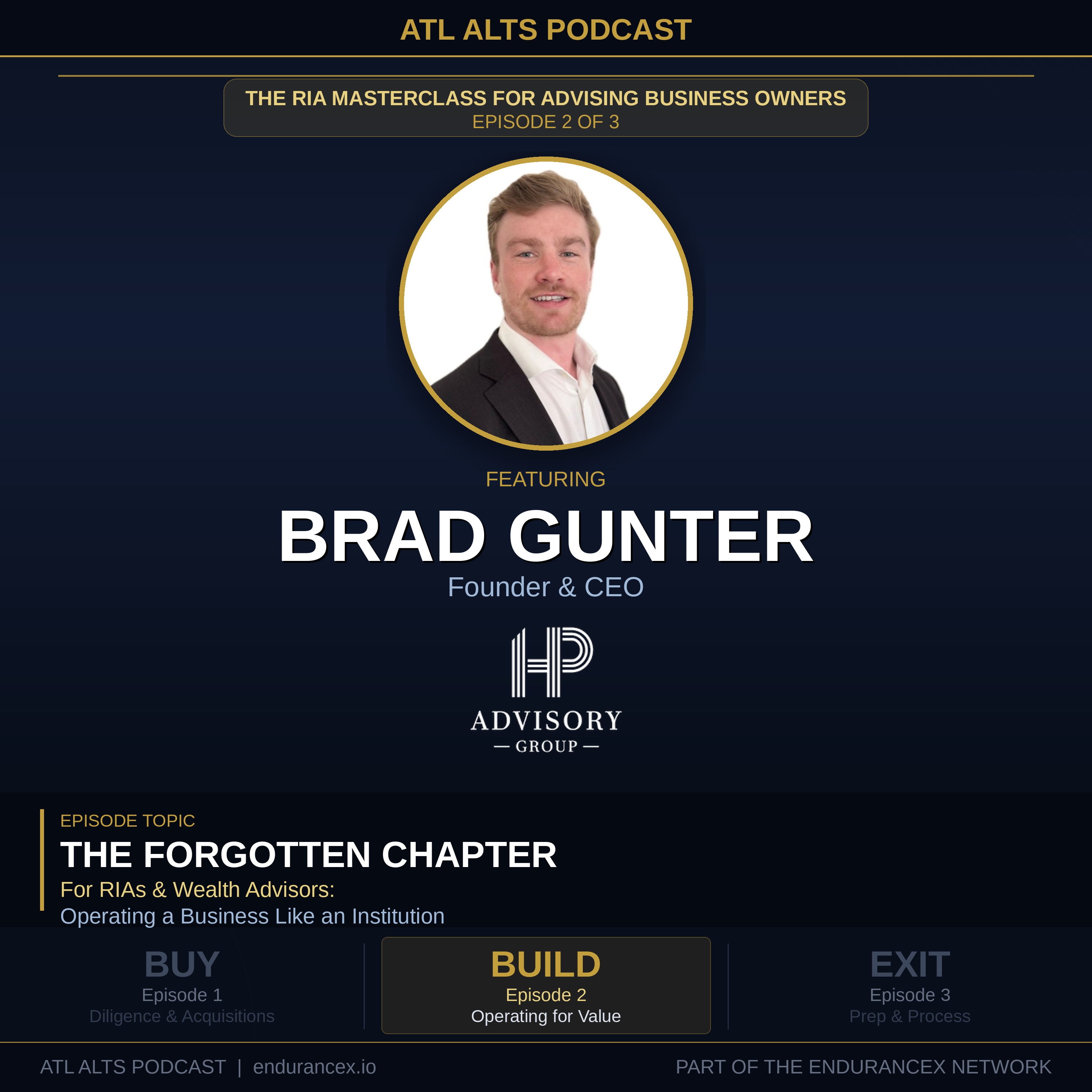 The Forgotten Chapter - Operating a Business Like an InstitutionATLalts · on Owner dependency88 / 100
 SMME #489 Stop Being the Most Expensive Employee in Your BusinessSpa Marketing Made Easy · on Owner dependency49 / 100
 How to Know When Your Online Business Needs Your Expertise, Not Your AvailabilityThe Mind Your Time Podcast · on Owner dependency47 / 100
 The Real Deal: Why Buyers and Sellers Never Agree on ValueValuationPodcast.com · on Lower middle market M&A
 Why Your Business Gets Harder to Run as It Grows (And What to Do About It) | Ep 236Strategy Meets Finance · on Owner dependency
 Stop Pretending "Sell and Stay" Is the Safe Play66 / 100
 We Hated PE. So We Became the Buyer.60 / 100
 Booming and Broke: The Owner Who Swore He Wasn't For Sale58 / 100
 Direct Primary Care That Actually Works: Affordable, Human Healthcare with NP Amy Bryson75 / 100
 Testing 1-2-3: Parenthood, Marriage, and Purpose at 55 - The Next Chapter of The Weeks Weekly