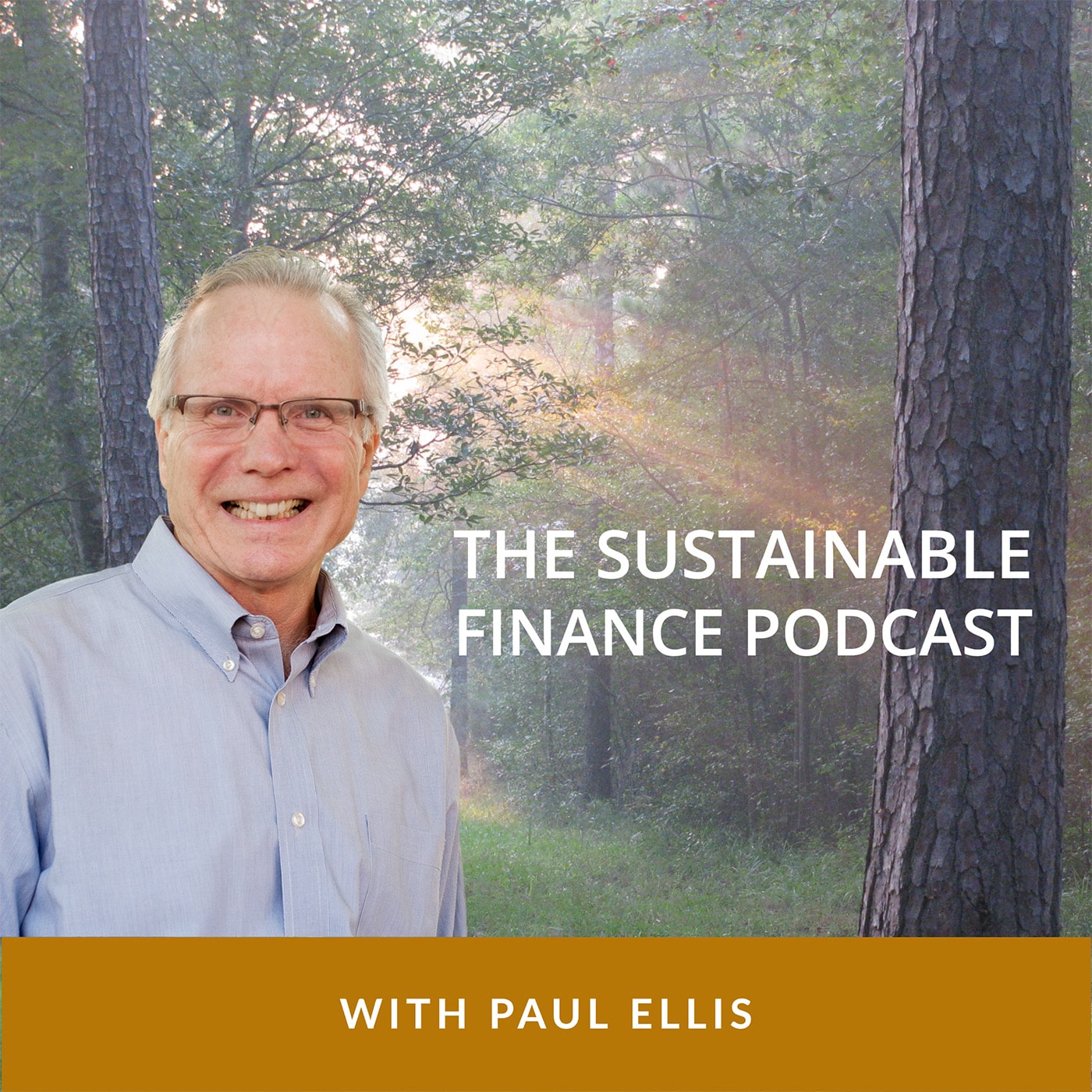
Hosted by Paul Ellis
Listed under Business › Investing
Investors and advisors can learn everything they need to know about sustainable finance as Paul Ellis interviews leaders in the field.
220 episodes · publishes weekly · latest 2025-11-11 · ~27 min/episode
Rank
#507
Substance
72.5
/ 100
Breakdown
Scored 2026-08
Updated monthly
Across the index
#507 of 1878
Substance
Top 27%
outscores 73% of the index
The Sustainable Finance Podcast ranks #507 on The B2B Podcast Index with a substance score of 72.5 out of 100, scored across 2 recent episodes. It scores highest on guest caliber and specificity & evidence. Cindy Jha is Head of Sustainable Solutions Group at ING Capital, a legitimate institutional role managing capital deployment and portfolio strategy. However, she is a corporate executive at a large bank, not an entrepreneur or operator who has personally navigated the Valley of Death or built a sustainable technology company. Her credibility is institutional rather than ground-truth; she speaks *about* startups bridging the gap but hasn't lived it at scale as a founder or CTO. This limits the authenticity of her insights compared to a guest who actually scaled a cleantech or greentech company from lab to commercialization.
Averaged across 2 recently scored episodes, with cited evidence.
The episode covers the Valley of Death concept clearly and provides useful context about ING's three-platform approach (lending, sustainable investments, advisory). However, there is substantial filler around ING's institutional positioning and generic sustainability talking points. The specific project examples (H2 Green Steel, iSet, Dow bond) add some concrete detail, but most insight is secondary (describing what ING offers rather than revealing novel operational or commercial truths). The discussion lacks deep mechanics - how startups actually navigate capital transitions, what specific metrics ING uses to evaluate risk, or counterintuitive lessons from failed transitions.
“It is really a period where a startup has had sufficient capital from founders, from government funding to build some sort of demonstration of the product, but at the same time it's not yet profitable.”
“We also have what is called a sustainable investments platform that, that present earlier stage capital. So that includes potentially equity investments as well as junior mezzanine debt for emerging technology developers.”
The 'Valley of Death' framing is established terminology, not novel. The three-platform solution (lending, equity/mezzanine, advisory) is a straightforward institutional response with no counterintuitive insights. The guest recycles standard sustainability rhetoric: sustainable companies are 'better credits,' they 'manage risk better,' and firms should focus on 'doing more with less.' There is minimal contrarian thinking or first-principles reasoning about why the Valley of Death is structurally hard to solve or alternative approaches to bridge it.
“sustainable companies are better credits. They're um, better able to manage their risk.”
“Sustainability means the ability to continue the pace of growth and pace of success.”
Cindy Jha is Head of Sustainable Solutions Group at ING Capital, a legitimate institutional role managing capital deployment and portfolio strategy. However, she is a corporate executive at a large bank, not an entrepreneur or operator who has personally navigated the Valley of Death or built a sustainable technology company. Her credibility is institutional rather than ground-truth; she speaks *about* startups bridging the gap but hasn't lived it at scale as a founder or CTO. This limits the authenticity of her insights compared to a guest who actually scaled a cleantech or greentech company from lab to commercialization.
“I think having worked at a startup myself, I experienced the Valley of death firsthand.”
“I think ING is very unique in that we have a very broad product offering that can be valuable to sustainable technology, uh, startups”
The episode includes named projects with concrete details: H2 Green Steel (Stegra, Sweden, 5 million tons per annum by ~2030, green hydrogen + direct reduction), iSet (Linden, New Jersey, 1500 tons food waste/day → ~30,000 gasoline-equivalent gallons/day), and Dow (1.25 billion green bond for net zero cracker in Alberta, circular hydrogen from off-gas). These examples anchor the discussion. However, most operational and financial specifics are absent: no numbers on capital amounts ING deployed, no failure rates or default statistics, no timelines for profitability, no metrics on how ING evaluates risk-reward at the Valley of Death stage, and limited detail on the mechanics of how the three platforms actually work together.
“H2 Green Steel project. Now the company's been renamed to Stegra. It's one of the largest green steel projects in Sweden. Sweden, multi billion dollar project that is aiming to produce about 5 million tons per annum of green steel per year by the time it becomes operational near 2030.”
“It's expected to convert food waste, um, such as restaurant grease into pipeline quality natural gas, um, based from uh, renewable sources. So the expected capacity of this facility is about um, 1500 tons of food waste per day to be converted into uh, approximately 30,000 uh, equivalent amount gallons of um, gasoline per day.”
The host asks clear opening questions and provides soft transitions, but rarely probes for depth, contradictions, or specifics. When Cindy describes the Valley of Death, the host accepts her answer and moves forward rather than asking how ING actually prices risk at that stage or what their success/failure rate looks like. The host pivots to project examples without asking about capital deployment amounts, holdout rates, or what determines ING's willingness to finance. Near the end, the host volunteers positive framing ('you're way ahead of the curve') instead of testing claims. Questions are procedural and hospitable rather than challenging or investigative.
“So it sounds like you have three very fleshed out and operating platforms that you can support these startup companies from. Can you give us a couple of examples of where ING has already made a difference?”
“Great. Well, Cindy, if you could send us the link, or actually, we can look it up for ing. Think.”
2 periods tracked.
2 scored on substance · 60 tracked in total.
Add this badge to your site - it links back here and updates automatically as you rank.

<a href="https://index.fame.so/show/the-sustainable-finance-podcast" target="_blank" rel="noopener">
  <img src="https://index.fame.so/badge/the-sustainable-finance-podcast/badge.svg" alt="Ranked #88 on The B2B Podcast Index" width="360" height="136" />
</a>Track The Sustainable Finance Podcast's rank
Get an email whenever this show moves up or down the Index. Monthly at most, no spam.
Companies, products and tools that come up most across this show's episodes.
The themes that come up most across this show's episodes.
Podcasts that dig into the same topics.