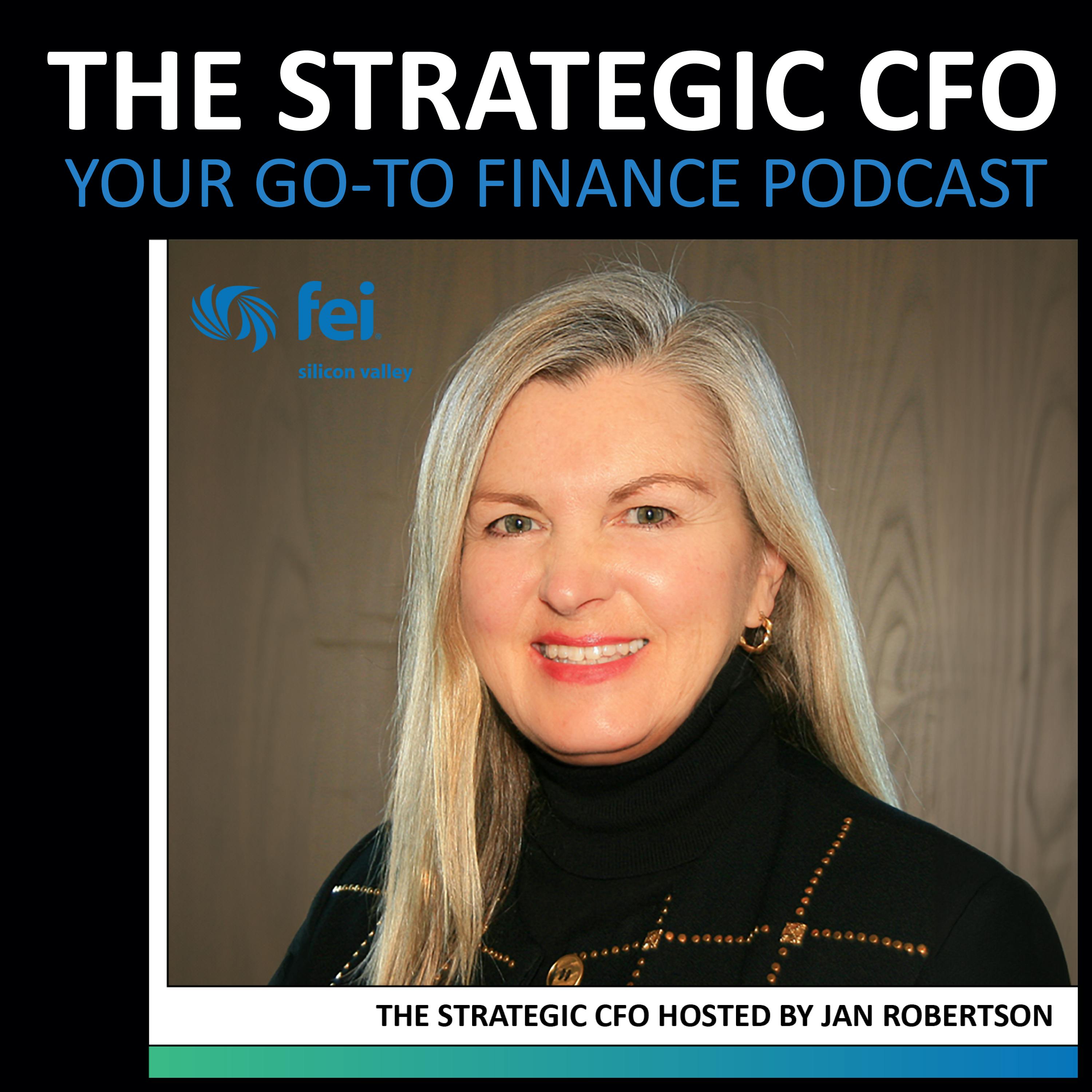
Hosted by FEI Silicon Valley
Listed under Business › Investing, Business › Careers, Business › Entrepreneurship
Hosted by Jan Robertson, The Strategic CFO is the Financial Executives International’s premier podcast. In this show, Robertson will speak with esteemed guests of high-ranking thought leadership to provide meaningful insights and best practices on the financial world.
34 episodes · publishes fortnightly · latest 2025-11-11 · ~41 min/episode
Rank
#365
Substance
74.5
/ 100
Breakdown
Scored 2026-08
Updated monthly
Across the index
#365 of 1878
Substance
Top 19%
outscores 81% of the index
The Strategic CFO by FEI ranks #365 on The B2B Podcast Index with a substance score of 74.5 out of 100, scored across 2 recent episodes. It scores highest on insight density and guest caliber. The episode covers practical AI tools for finance with some technical depth about LLMs vs. deterministic formulas, but heavily padded with background stories, tool descriptions that lack concrete use cases, and repetitive explanations of confidentiality. The distinction between LLMs and specialized finance tools is valuable, but much of the content is surface-level tool introductions without deep operational insights a CFO would need.
Averaged across 2 recently scored episodes, with cited evidence.
The episode covers practical AI tools for finance with some technical depth about LLMs vs. deterministic formulas, but heavily padded with background stories, tool descriptions that lack concrete use cases, and repetitive explanations of confidentiality. The distinction between LLMs and specialized finance tools is valuable, but much of the content is surface-level tool introductions without deep operational insights a CFO would need.
“ChatGPT runs on a large language model, uh, called GPT, which stands for General Purpose Transformer... LLM M, it's built on large language model. So this form of AI is trained on language. It is not good with numbers, which is especially the calculation, the financial part is more deterministic.”
“So that's why specialized tools have been built on top of these LLMs. Using the strength of the LLMs, which is around content and pattern recognition and reasoning, and then using deterministic formulas, which are, uh, the holy grail of finance and math calculations.”
The guest presents a legitimate technical insight - pairing LLMs with deterministic formulas for finance - which is sound but not particularly novel given the state of AI discourse by 2025. Most other content is descriptive catalog of existing tools (ChatGPT, Gamma, HeyGen) without contrarian thinking, first-principles analysis, or counterintuitive frameworks. The Molick rules at the end are borrowed from an external expert.
“Bringing those two together, there are tools which are just focused on finance professionals and I talked about a few of them. For example, there's Bookkeeping AI, Shortcut AI, there is Quadratic hq, there's Julius AI.”
“Gamma is my favorite tool. Uh, I've been an early adopter of Gamma since I think the first week they opened their product.”
The guest is a technologist with legitimate startup experience (Comcast engineer, founded Socio Squares, CPO at Propel) but has not demonstrated operating-level depth in finance, CFO responsibilities, or even B2B SaaS scale. He is primarily a marketer and software developer speaking about finance tools secondhand, not a seasoned CFO, controller, or finance operator who has deployed these at scale. His credibility rests on tooling familiarity, not domain expertise.
“I'm a technologist and marketer, and by education I have an engineering degree.”
“So I'm sure some of this consolidation would happen in actual. In the last six months, Meta has acquired several companies in that effort of bringing in more AI talent as well as capabilities.”
The episode names many tools (Bookkeeping AI, Shortcut, Quadratic, Julius, Context, Gamma, HeyGen, Tavas) but provides minimal concrete evidence: no specific company results, no actual ROI figures, no before/after metrics, no named customer outcomes. The Nvidia 10K example is mentioned but not detailed. Most claims about tool capabilities are assertions rather than documented facts or case studies. Guest lacks numbers on adoption rates, cost savings, or implementation timelines beyond rough generalities.
“Accuracy levels were really low... it would give suggestions that add these words, make those changes. But the incremental increase in engagement wasn't that much.”
“Julius... claim that they have over 2 million users using the platform already.”
The host asks reasonable follow-up questions on confidentiality, tool comparisons, and applicability to M&A and forecasting, showing genuine curiosity. However, follow-ups are often cut short or abandoned (e.g., the library question for Julius isn't fully explored; the custom GPT forecasting capability is mentioned but not probed). The host rarely pushes back on claims or asks for proof, allowing hand-waving about tool capabilities to pass unchallenged. Conversational flow is pleasant but lacks the rigor expected for a substantive B2B show.
“Can I just ask a follow up question? Does it. So you would feed in, say your financial statements... where does that data go and how can you be certain of the confidentiality?”
“So once you've written your customized code, you export it and then you use it on your other files. Does Julius then retain.”
2 periods tracked.
2 scored on substance · 34 tracked in total.
Add this badge to your site - it links back here and updates automatically as you rank.

<a href="https://index.fame.so/show/the-strategic-cfo-by-fei" target="_blank" rel="noopener">
  <img src="https://index.fame.so/badge/the-strategic-cfo-by-fei/badge.svg" alt="Ranked #65 on The B2B Podcast Index" width="360" height="136" />
</a>Track The Strategic CFO by FEI's rank
Get an email whenever this show moves up or down the Index. Monthly at most, no spam.
Companies, products and tools that come up most across this show's episodes.
The themes that come up most across this show's episodes.
Podcasts that dig into the same topics.