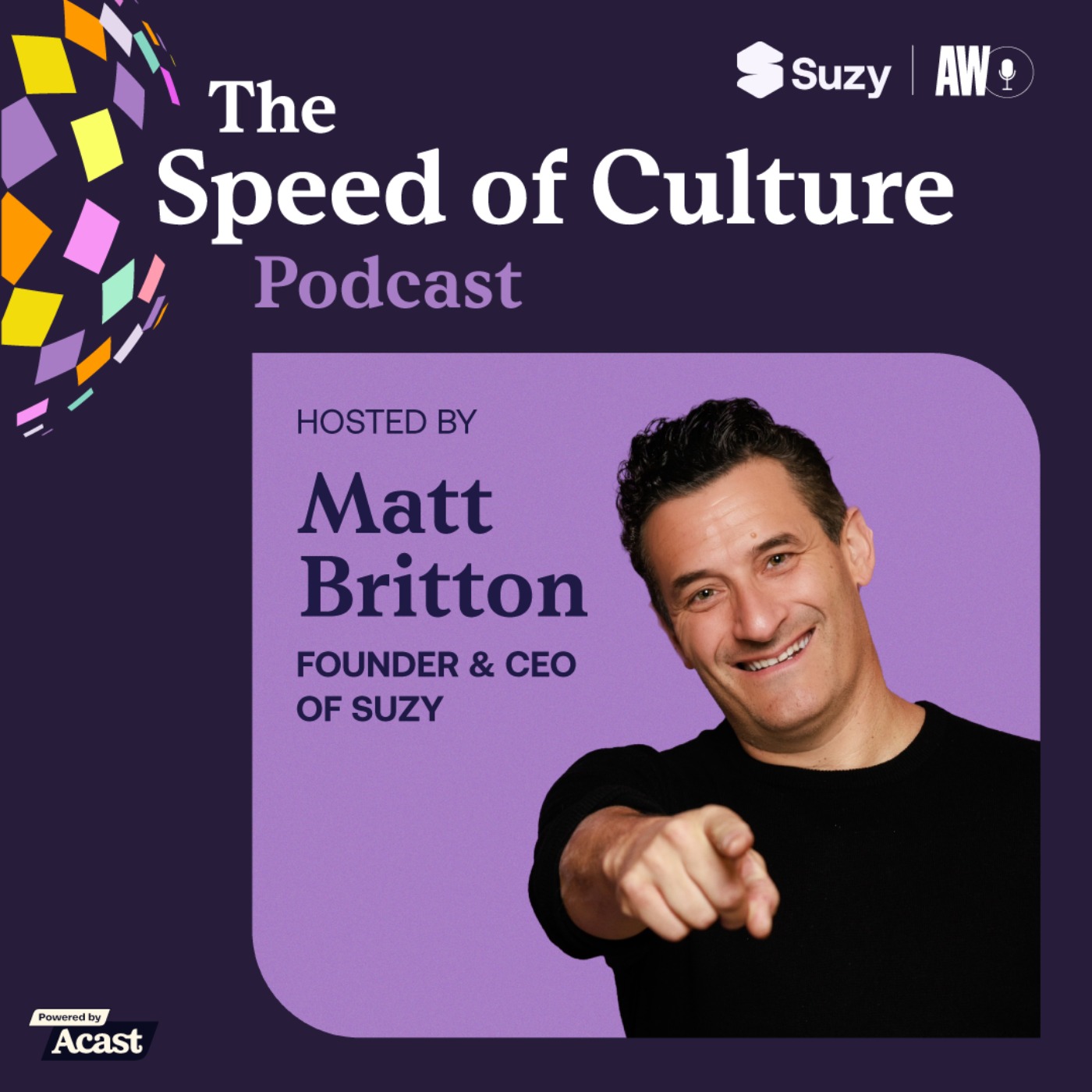
Hosted by ADWEEK & Suzy
Listed under Business, Business › Marketing, Technology
To thrive in a rapidly evolving landscape, brands must move at The Speed of Culture. Join Matt Britton, Founder and CEO of Suzy, and key industry leaders, as they dive deep into shifting consumer trends within their industry, why it matters now, and how you can keep up.
267 episodes · publishes weekly · latest 2026-09-22 · ~30 min/episode
Rank
#2354
Substance
66.5
/ 100
Breakdown
Scored 2026-08
Updated monthly
Across the index
#2354 of 6203
Substance
Top 38%
outscores 62% of the index
The Speed of Culture Podcast ranks #2354 on The B2B Podcast Index with a substance score of 66.5 out of 100, scored across 2 recent episodes. It scores highest on guest caliber and insight density. Ryan Dieter is a genuinely qualified guest with substantial credibility: founder and CEO of Influential, an early architect of the creator economy at scale, spent 16 years in the space (including as an influencer himself), achieved nine-figure annual client spend, and navigated a strategic acquisition by Publicis. His lived experience building from scratch and operating at enterprise scale gives him legitimate authority. This is a practitioner who has moved real business levers, not a consultant or talking head.
Averaged across 2 recently scored episodes, with cited evidence.
The episode delivers moderate insight on creator marketing evolution and platform dynamics, but much of it consists of familiar industry wisdom (micro-creators outperform mega-influencers, measurement matters, AI has reputational risks). While Ryan's personal journey from influencer to platform builder adds credibility, the conversation lacks novel frameworks or surprising data points that would challenge an experienced B2B operator. Substantial ad load and meandering tangents dilute density further.
“16 years ago, I was an influencer. First I had 30 million followers on Twitter, then eventually on Instagram. I don't sing or dance. I don't have no talents. Instead, I built what are called niche accounts.”
“we were fighting for $25,000 campaigns for like a three month period today I'm sure like many others that are listening that are doing influencer campaigns, they are six, seven, even eight figures depending on the brands”
The conversation largely reiterates well-established industry narratives: the shift from follower count to audience targeting, the rise of micro-creators, measurement as the unlock, AI sentiment concerns, and platform-by-platform efficacy rankings. Ryan's lived experience as an early builder is valuable but his broader perspectives on TikTok Shop, live commerce, and AI adoption echo Gary Vee and mainstream discourse. Few counterintuitive claims or first-principles arguments emerge.
“about 80% of our business is a mixture of both on, um, most campaigns, 20% of our business where someone just goes, hey, either we don't believe in paid media or we run it ourselves”
“The content has to have a resonance for it to have value. And I think in our industry, finding a way to be consistent and differentiated enough in what you say, besides just the usual, I'm so happy for this, or I'm so honored for this”
Ryan Dieter is a genuinely qualified guest with substantial credibility: founder and CEO of Influential, an early architect of the creator economy at scale, spent 16 years in the space (including as an influencer himself), achieved nine-figure annual client spend, and navigated a strategic acquisition by Publicis. His lived experience building from scratch and operating at enterprise scale gives him legitimate authority. This is a practitioner who has moved real business levers, not a consultant or talking head.
“I was an influencer. First I had 30 million followers on Twitter, then eventually on Instagram.”
“we have clients that spend nine figures annually”
The episode lacks concrete numbers, named brands, and case studies that would enable a listener to replicate insights. Ryan mentions follower counts (30M, 7M, 50K - 250K tiers), budget progression ($25K → multi-figures), and business splits (80/20 mix), but provides almost no named client wins, performance deltas, or timelines beyond vague references to 2016 - 2017 inflection points and 'the last 18 months.' Platform analysis is observational rather than data-backed, and claims about AI sentiment remain anecdotal.
“we were fighting for $25,000 campaigns for like a three month period today I'm sure like many others that are listening that are doing influencer campaigns, they are six, seven, even eight figures”
“I think it's about a. I heard several billion dollars are spent each year on virtual badges or tokens or gifting that happens on these platforms.”
Matt's questions are broadly competent but tend toward soft setup queries that allow Ryan to deliver prepared talking points rather than challenging claims or forcing precision. Few sharp follow-ups; when Matt does probe (e.g., 'Is that perception reality?' on AI sentiment), Ryan's answer remains vague and is not pressed. The conversation meanders into tangents (Electronic Daisy Carnival analogy, Digital Fight Club anecdote) that diffuse focus. Matt lets generalities like 'it depends on your KPIs' stand without pushing for specifics on when, how, or why.
“So take us back to that moment on, um, why you decided to dive into this opportunity, what you saw then and what proved to be true over time.”
“Is that perception reality?”
2 periods tracked.
2 scored on substance · 66 tracked in total.
Add this badge to your site - it links back here and updates automatically as you rank.

<a href="https://index.fame.so/show/the-speed-of-culture-podcast" target="_blank" rel="noopener">
  <img src="https://index.fame.so/badge/the-speed-of-culture-podcast/badge.svg" alt="Ranked #335 on The B2B Podcast Index" width="360" height="136" />
</a>Track The Speed of Culture Podcast's rank
Get an email whenever this show moves up or down the Index. Monthly at most, no spam.
Companies, products and tools that come up most across this show's episodes.
The themes that come up most across this show's episodes.



