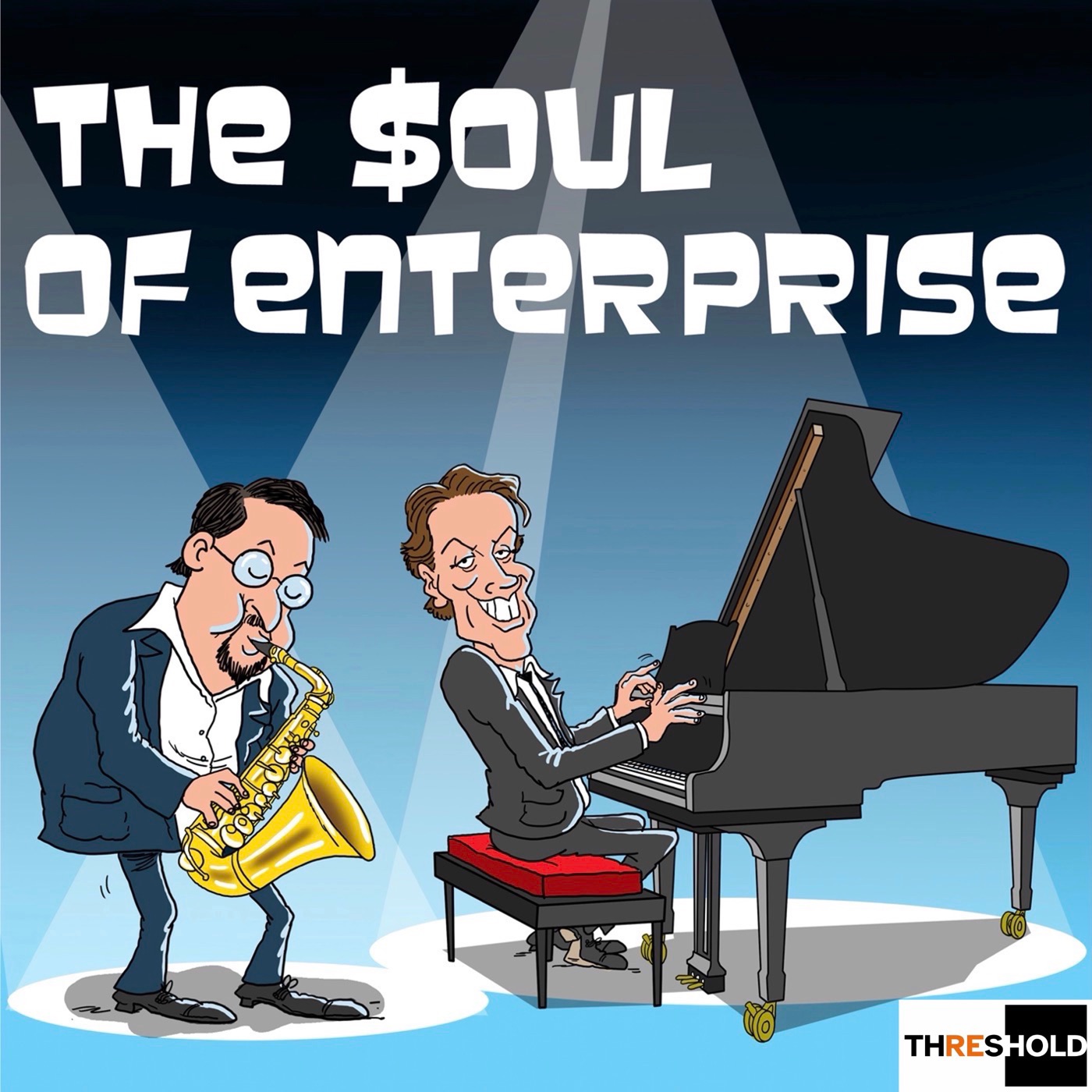
The Soul of Enterprise · 2026-10-30 · 57 min
Key moments - from our scoring
Substance score
36 / 100
Five dimensions, 20 points each
Player Piano, Vonnegut's debut novel written after his time at General Electric, depicts a dystopian society where mechanization has eliminated the need for human labor, creating spiritual emptiness despite material abundance. Ed and Ron connect this 1952 narrative to current AI debates and recent papal encyclicals, arguing the novel's central insight isn't about technology itself but about technocracy - the rule of experts - and the human need for meaning beyond survival. They examine how Vonnegut anticipated the credentialing treadmill (needing PhDs to survive) and the distinction between meaningful work, leisure, and idleness. The hosts use concrete examples: the character Rudy Hertz, whose craftsmanship gets replicated by machines that displace him; and Ed's experience using ChatGPT to organize 957+ Verisage blog posts in eight hours - work that would have taken 800 hours and never happened otherwise, creating new creative labor. They wrestle with the tension between liberation from work versus liberation of work from people, questioning what organizations owe workers whose expertise becomes embedded in automated systems.
Hosted by Ron Baker and Ed Kless. The show scores 62.0/100 on substance across its analysed episodes. See the full show profile.
Published in 1952, Player Piano depicts a dystopian near-future society almost totally mechanized where technological automation has eliminated the need for human labor, creating deep conflict between wealthy engineers and managers who control society and the displaced lower classes whose skills and purpose have been replaced by machines.
Vonnegut was inspired by his firsthand experience working at General Electric, where he witnessed industrial automation up close, which gave him insight into how mechanization could reshape society and displace human workers.
The player piano represents automation that preserves the output (music notes) while eliminating the person who created it (the musician), symbolizing how machines can replicate human expertise without the human being necessary anymore.
The novel is anti-technocracy - it's a warning against rule by experts and technical elites rather than a rejection of technology itself; the problem is expertise being wielded as authoritarian control rather than as guidance.
Vonnegut anticipated that automation would eventually displace educated professionals and knowledge workers who thought credentials protected them, not just factory workers, leading to forced idleness and spiritual emptiness despite material security.
Our reviewer’s read on each dimension, with quotes from the episode.
The episode has a handful of genuinely interesting framings - Jevons paradox applied to AI adoption, the leisure-vs-idleness distinction, and the 'player piano' metaphor applied to professional firms - but the idea-to-talk-time ratio is poor. Long stretches of mutual agreement, repeated affirmations ('right, right, right'), and sponsor reads dilute the substantive content considerably.
Are we liberating people from work or are we liberating work from people?
It's not that I saved 800 hours because it never would have been done
The synthesis of Vonnegut, the Pope's encyclical, and current AI debate is a moderately creative framing, and the application of 'player piano' as a metaphor for professional firms automating themselves out of relevance is a nice original move. However, most of the intellectual content is borrowed wholesale from named thinkers - Gilder, Semmler, Pine, McCloskey, Drucker - without meaningfully extending their ideas.
Are we watching professional firms building their own player piano?
perhaps a greater danger is a world in which machines can do everything. But human beings forget what's worth doing
There is no guest at all - this is a two-host book club conversation. Both hosts appear to be practitioners in the professional services and accounting space, but neither presents credentials or scale-level experience during the episode itself, and there is no outside expert to raise the analytical ceiling.
Since we don't have a guest, but we are talking book, what I'll do is I'll do a read in for the book
The most concrete passage is the ChatGPT blog taxonomy story with actual numbers (957 posts, 8 hours vs. 800, 16 clarifying questions, $50 in tokens), which is genuinely specific. Beyond that, most claims are abstract philosophical assertions with only name-drops as evidence - no data, no case studies, no dollar figures tied to outcomes.
It had asked me 16 different clarifying questions, eight of which I said, nope, you got it. You understand it completely correctly
I embarrassingly spent like $50 in tokens, I don't know, four or five weeks ago to build a workflow
There is no guest to challenge, and the two hosts agree with each other almost without exception throughout the episode. Questions are soft and leading ('What surprised you most?', 'What's one thing you'd never surrender to AI?') rather than probing. There is no productive disagreement, no pushed-back claim, and no moment where a flawed premise is tested.
That's a great question
Wow. All right, well, Ron, we're up against our last break
Computed from the transcript - who did the talking, and the words that came up most.
More than 70 years before the emergence of generative AI, Kurt Vonnegut imagined a world in which machines did nearly all the work, leaving humanity to wrestle with a fundamental question: What happens when technology makes human beings seemingly unnecessary? In this episode of The Soul of Enterprise , Ron and Ed revisit Vonnegut's remarkably prescient 1952 debut novel, Player Piano , exploring its themes of automation, economic efficiency, technological progress, and the search for human purpose. How accurately did Vonnegut anticipate today's AI revolution? Does technological advancement necessarily lead to human flourishing? And what happens to creativity, dignity, and the value of human knowledge when machines can increasingly perform tasks once reserved for people? Join Ron and Ed as they examine the novel's warnings, its biting satire, and its surprising relevance to the future of work, business, and the knowledge economy. Is Player Piano a cautionary tale about the dangers of technology, or a reminder that human ingenuity will always find a way to reinvent the future?
Transcribed and scored by The B2B Podcast Index.
Speaker A: Like a chrysalis, we're emerging from the economy of the industrial revolution, an economy confined to and limited by the earth's physical resources, into the economy in mind, in which there are no bounds on human imagination and the freedom to create is the most precious natural resource.
Speaker B: Welcome to Thresholds, the soul of enterprise business in the transformation economy. Charting the new economy where human flourishing is the bottom line. I'm Ed Kless with my friend, co host and co founder of Threshold, Ron Baker. And folks on today's show we are going to be talking about Player Piano, Kurt Vonnegut's warning about AI. Hey Ron.
Speaker C: Hey Ed. How's it going?
Speaker B: Going great, going great. Um, looking forward to this conversation. This is was a real interesting book. I figured Brad, since we don't have a guest, but we are talking book, what I'll do is I'll do a read in for the book. And so this is right from the Wikipedia page, the summary of the book, no spoilers. So for those of you who might want to read, uh, Kurt Vonnegut's Player Piano, this is just an overview. So Player Piano is the debut novel by American writer Kurt vonnegut. Published in 1952. The novel depicts a dystopia of automation partly inspired by Vonnegut's time working at General Electric. It describes the negative impact technology can have on the quality of life. The story takes place in a near future society that is almost totally mechanized, eliminating the need for human laborers. The widespread mechanism m mechanization creates conflict between the wealthy upper class, the engineers and managers who keep society running, and the lower classes whose skills and purpose in society have been replaced by the machines. Welcome to the soul of Enterprise. Kurt Vonnegut's Player Piano.
Speaker C: No kidding. Ah, Ed, when I was reading this, this was so weird. It was written in 52. I didn't realize it was his debut novel. I did not know that. Um, it. But it feels it in a science fiction of course. But it felt like reading that day's newspaper about AI. We're grappling with some of the. And as I was reading Player Piano, I was reading the Pope's encyclical.
Speaker B: Mhm.
Speaker C: And the connections between the two are just uncanny.
Speaker B: Oh yeah, no, absolutely. I mean I think that that's one of the things that jumped out at me. I was not reading them at the same time. I read Player Piano much later. But yeah, the connections are clear from the very beginning of the novel. Um, now having read other works by Kurt Vonnegut, I can tell you that I Don't think this is his best work, but it is his debut novel. Um, there was, I thought, some weaknesses in the plot, but be that as it may. But just as a reminder, we talk about a previous Kurt Vonnegut work, uh, Harrison Bergeron back. And this I couldn't believe when I looked this up. Episode 368. Can you believe that? It was like it was 2021. So it was before generative AI ChatGPT had. Had. Had come onto the scene. And on that one we actually looked at two things. We looked at that story, the Verger, and then of course, Harrison Bergeron, which is also a dystopian short story, but yeah, and the connections there are obvious in that. And one of the things that I wanted to jump in and talk to you about, Ron, is that in the novel it's the engineers and managers who occupy that privileged class of society. Right. And AI, um, uh, and it's really mechanization and robotics that have replaced their work now in our world. It's gone up a level, right. It's AI. It's challenging the professionals and you know, to consider whether intellectual work guarantees protection as opposed to, you know, the physical labor. And now we're starting to see that automation is a, you know, philosophical, ah, uh, emergency. That. That's Reaches people who write essays about automation. Right. So it's like, okay, here we go. Um, how do you think professionals are going to. Or are they going to respond differently to the displacement than the factory workers did who had. Who, you know, did not seem, at least in the novel, to be able to adapt?
Speaker C: Yeah, I mean, that's the central tension of this novel, isn't it? Machines can eliminate the necessity of human labor, but that doesn't eliminate the need for significance and meaning for humans. And whether you're a knowledge worker or factory worker or any type of worker, that. That human nature doesn't change. And that's one of the things that caught me. It's almost like, are we liberating people from work or are we liberating work from people? And Ed, is that even possible?
Speaker B: Right.
Speaker C: Because we're, you know, like you always say, we're born to create. Right. We carry on creation
Speaker B: works of the, you know, the purpose of business and entrepreneurship is to continue the work of creation.
Speaker C: M.
Speaker B: Right. And create new things. And I think that, you know, that. That that's. I think that the, the thing that's missing, uh, in all of this. And I don't know if I've told the story on here, but I'm going to repeat it just because I can't remember and it's appropriate here. But you and I were working through this process of. We have the Verisage website that has been defunct, but back in the day in 2005 when you started that, the blog was very active and it was cool to blog. And not only that, but there's, there's 900 or so blog posts, many of them with 20 plus comments and the comments were sometimes 500, 1,000 words or even longer. And then you would respond to them. And so there was uh, uh, a back and forth, a give and take even in that conference. And we thought, well, we've got this, what are we going to do with it? So I actually asked ChatGPT what we can do and ChatGPT suggested, well, we can incorporate the, that into the Canon of Threshold and what Threshold is about. Uh, but I'd have to have access to the blog. So it told me, okay, this is what you do to download it out of Squarespace, et cetera. And um, we'll ask Greg about this too. But I downloaded the blog, uh, from Squarespace and when it looked at it, it said, yeah, no, this is everything. This is the entire Threshold blog. It wasn't just the Verisage blog. It had exported everything. I said, well, I only exported this. It said don't worry about, I'll find it. So it goes through the entire thing. That is the Threshold blog that has the Verisage blog or I'm sorry, Threshold website which has the Vericade blog embedded in it. It says, don't worry, I got it. I found all 957 blog posts or whatever. And I said, all right, well help me incorporate this into the Canon. It comes back and over about eight hours and this was a Friday. It was actually after the show that I did this with a couple glasses of wine. By 8 o' clock the next morning it had produced this incredible taxon me. It had asked me 16 different clarifying questions, eight of which I said, nope, you got it. You understand it completely correctly. The eight others I did make some specific clarifications about just to give it very specific language. Not that it was wrong, it just was not as precise as you and I would like. It says, okay, I'll reinterpret this. It sticks the whole thing in here and this is a big wind up for a very quick pitch. And that is if I had done this on my own, it would have taken 800 hours at least. At least. And it wouldn't. And the output would not have been as good as the eight hours. But here's the biggest and most important point. It's not that I saved 800 hours because it never would have been done.
Speaker C: Done. Um,
Speaker B: there is no way that that ever would have risen to the priority of me going through the 800 hours to go through that, create that taxonomy, figure all of that crap out. It would have never gotten done. So therefore, the eight hours that I did spend was new creative work. And if that just happened to me in one specific scenario, you know, this is something that needs to be done throughout the world. Right. How, how do we, how do we take the. The knowledge that the tacit or, uh, uh, you know, that's buried in companies and explicitly get it out into some of these systems. And I think that that's. So that's a new job or a new task. Certainly that's been created. That didn't exist 20 minutes ago. You know,
Speaker C: it's a phenomenal illustration of the Jevons paradox that you talked about with the, you know, the, uh, digits guys.
Speaker B: Oh, that's when I talked. Yeah, yeah. Uh,
Speaker C: yeah. And, you know, once, uh, a new resources can, um, get cheap, it gets cheaper and more abundant. You find more uses for it. You don't use it less, you use it more. And you did the same thing with the 600 plus TSOE episodes.
Speaker B: Right,
Speaker C: right,
Speaker B: right.
Speaker C: And that probably never would have got done if it wasn't for AI.
Speaker B: Right. Certainly not the way it got done.
Speaker C: Yeah. You know, this is kind of another tension in the whole novel. I mean, we can. We've solved the material, you know, issue, uh, in the novel. They did, they solved the materiality thing, but you can tell that the people are still spiritually troubled.
Speaker B: Correct.
Speaker C: In that world.
Speaker B: Right, right. And here's one of the questions that I want to ask you about that. I don't know if you remember, there's a character called Rudy Hertz. Uh, he's the guy who was the expert machinist that they copied his way of. Of. I forget it was, you know, creating this, this, this cut in some metal or something like. Right. And they, they mimicked his hand motions or whatever to create the robot that, that did it. And he actually comes back later on. But this, it was reminding me he had this, this high level of craftsmanship and ultimately made his job. Uh, he displaced himself. Right. Because he, he taught it to the machine and the machine was able to do it and repeat it over and over again. Well, this is happening right now. Right now in the example that I just gave with the Verisage website. It was at least our own work, at least primarily it was yours and mine and uh, uh, others at Verisage. But this is really important. What do organizations owe the people whose expertise are now being used to create these systems? Do they owe them anything?
Speaker C: Wow, that's a great question.
Speaker B: Right,
Speaker C: right. Yeah, yeah. And most organizations take all the intellectual capital that any employee creates unless there's an agreement to the contrary.
Speaker B: Mhm. And is this going to change? Are, are we going to see things that that level of agreement begin to change, where people are going to say no, if I bring something to the table here, I need to be compensated for that. Not just in the moment for my job, but in the long haul as well.
Speaker C: Well, you just kind of saw this with that law firm employing, uh, you know, imploding.
Speaker B: Oh right, right.
Speaker C: While, or whatever, they, they were a huge firm by the way. And, and it did implode because the top rainmakers left. And the Economist did have a big write up on it, by the way. Um, and they said these people, these top rainmakers are the ultimate gig economy workers. They don't care what institution they go or indeed they go out on their own. Mhm. Mhm. But they know their worth. And that's a point Drucker made in the knowledge economy too. Remember the joke about when um, Disney bought Pixar and they said if three people from Pixar leave because Disney screws around with their culture, they just bought the most expensive computers in the world.
Speaker B: Yes, yep.
Speaker C: And you know that's a knowledge worker issue, but yeah, it can be a blue collar worker issue as well.
Speaker B: Mhm. Yeah, crazy stuff. All right, well we're up against our first break. Want to remind our listeners they can get a hold of Ron or me by sending an email to ask tsoe thresholdnow.com of course the website is the soul of enterprise where you can see show notes as well as previews to upcoming shows. We would love for you to actually take our reflection and response story that is available on the website@thresholdnow.com reflection and jump in. Take that, it's 10 level of agreement statements and a couple of open ended questions and we will send you our response story. But right now a word from our sponsors, including the California Society of CPAs.
Speaker C: Tax season and an accountant working from home. Can't get into their software. Your IT guy isn't picking up. Sound familiar?
Speaker B: Summit was built for exactly this. A secure, fully managed cloud workspace that hosts QuickBooks tax software and any desktop application your firm depends on,
Speaker C: accessible from anywhere, with the security and compliance your clients expect. And when something needs attention, our team picks up fast. 15 minute response 24. 7 with experts who actually know your software.
Speaker B: One predictable monthly price. No surprises. Find out what your firm has been missing@SummithQ.com
Speaker D: in a world moving faster than ever, who helps make sense of what comes next? At CalCPA, we bring together the brightest minds in accounting and finance, professionals shaping how businesses grow, adapt, and lead with integrity. From advocating for sound policy to advancing financial literacy, CALCPA is more than an association. We're a voice for trust, clarity, and the future of the profession. Discover how we're making sense of what comes next@Calcpa.org
Speaker B: if someone tells you that you need to productize your services, you're turning your wisdom into widgets. But that's not progress, it's a U turn. At, uh, Threshold, we help professionals escape the factory floor of formulas and checklists and enter the domain of the transformation economy. You weren't born to sell products and services. You were called to guide transformations. If you're being told to productize, call us instead. Because your highest value isn't an SKU, it's a shift. Visit thresholdnow.com to learn more.
Speaker E: You are tuned into the Soul of Enterprise with Ron Baker and Ed Klass. To find out more about our show, visit us on the web@thesoloventerprise.com you can also chat with us on Twitter using hashtag ask tsoe. Now back to the Soul of Enterprise.
Speaker C: Welcome back, everybody. We're talking about Kurt Vonnegut's player piano novel, uh, his warning about AI and Ed, you know, him working at GE and seeing, you know, industrial automation first close up is kind of an interesting link as well. Even though can you imagine what that automation must have looked like back in the 50s or whenever he worked there? Certainly does. It doesn't look like the modern, you know, BMW factory with the robotics that they have. But, uh, the other thing that struck me is just the metaphor of the player piano, because I think I learned about this book from Acton somebody. They had a show on AI, of course, and somebody mentioned, just as a throwaway line, yeah, like in Kurt Vonnegut's Player Piano. And that's what intrigued me about it. And that's why I read it. And I, you know, when you think about that metaphor, the player piano music without a musician, I mean, it's just creepy, right? The notes survived, but what happened to the person that once played them? And the other thing I found very interesting was a lot of the people that, you know, got displaced from automation. Where do they tend to hang out? Yeah, in saloons. Right. Yeah. Which is kind of like historically despair or, you know, and all that. So. But, but what surprised you most about how accurately Vonnegut anticipated the AI debate that we're having today?
Speaker B: You know, I don't think I was surprised by it. Um, and maybe because this, I think this is just a vision of the debate that's happened since time immemorial with regard to technology. You know, this goes back to the Luddites and the saboteurs. Right. Is, you know, what happens when we get, we lose our jobs and we get replaced when the loom, the physical looms replace the human looms and the worry over that. So I think he was more extrapolating from the past than he was seeing into the future,
Speaker C: if
Speaker B: that makes sense. Uh, I don't think that that's necessarily a, uh, surprise to me. What did I think surprised me a little bit was how well he anticipated
Speaker F: the societal aspect of it. Meaning, I don't know if you recall this, but even, uh, the people who were in Homestead, a lot of them have college degrees, but you had to have the advanced college degree. And if you weren't a PhD, you were nothing.
Speaker C: Right.
Speaker F: So, uh, I thought that that was interesting that he kind of anticipated this level of, you need to get more and more education. Like we're seeing, you know, when. I don't know about your dad, but my bad M. My dad was the first to go to college in his family. And uh, if you had a college degree you were in, you know, you're going to be fine, you know.
Speaker C: And that swerves into another tension in this novel, I think, because I don't think this novel, it's not anti technology.
Speaker F: No.
Speaker C: It's anti technocracy. It's, it's, it's. It's really a warning against the rule of experts.
Speaker F: Mhm. Yes.
Speaker C: And I love that because. Wow. As we saw with the whole Covid fiasco, I don't want to be ruled by experts. Yeah. I want to
Speaker F: be guided by experts.
Speaker C: Absolutely. Absolutely. But they're ruling here. Yeah. And I think that is what adds to the tension in the society.
Speaker F: Mhm. Yeah. The, the whole, the whole thing that was also a little bit wacky to me. Um, and what's it. It probably was not WAC when it was first written is, you know, they go on this whole corporate retreat to that island.
Speaker C: Right. And they have like, ah,
Speaker F: you know, like the games they're going to play. And I was just brought suddenly back to like, you know, ropes courses. You know, it's just like, oh, my God. Really? And, but, but the thing that got me. And, but this was a thing because I remember my uncle who went, uh, to work for Metropolitan Life at one point. You know, it was not all that crazy in the 60s and even into the early sevens 70s for people who are hired when they were orientation process to be taught songs to sing,
Speaker C: like
Speaker F: corporate songs.
Speaker C: Yeah, yeah. I think even some American companies did that.
Speaker F: Yeah. Oh, yeah,
Speaker C: yeah,
Speaker F: yeah,
Speaker C: for sure. Um. Wow. The novel also makes you think about the distinction between a job and a vocation and a calling.
Speaker F: Yes.
Speaker C: You know, and, and how, I mean, all work is dignified. And I think sometimes we confuse that dignity with what the, what the salaried per. The. The wage earner earns as a measure of its worth. But all work is dignified. This was actually something that Stephen, uh, Covey used to talk about. He, he said anybody can be a knowledge worker. It depends on how leaders treat them. And he cited a janitorial company that did hospitals and you know, hospital rooms have to be pristine. Otherwise, infections, people die, all of that. And that work has tremendous dignity if the person doing it knows that the company believes that they're doing that. You know, the guy who's building the cathedral, you know, laying stones or bricks or whatever, and saying, I'm building a cathedral to the heavens or whatever. Right,
Speaker B: right. We talked about. But what is. And this is where it gets to Gilder's work too. It's all knowledge. I mean, yes, there is skill. I mean, uh, I talked about the Rudy Hurts character. Yes, he had the skill, but you have to have the knowledge of how to move m
Speaker F: the metal through the machinery in order to make the cut that he wanted. Right. So that's knowledge in a sense. Think about even, um, you know, professional football, reading defenses. That's knowledge work, right? Yes. You have to be able to throw the ball downfield 60 yards so that there's. There's a physical element to it, but you have to be able to know when that is appropriate to do. Otherwise, even if you can throw the ball 60 yards downfield, it's not, not going to be helpful.
Speaker C: Right.
Speaker F: Because if you're always just, you know, heaving and chucking. So it does come down to is. Is it. Is it all really knowledge is. Is wealth, knowledge is. Is Gilder correct in that wealth equals knowledge?
Speaker C: Right.
Speaker F: I think he's definitely onto Something.
Speaker C: I think so. Yeah. Especially when you use the caveman metaphor.
Speaker F: Yeah.
Speaker C: M. But. And this book does. It made me think of the word, the Hebrew word avida a lot. Because obviously work and service and worship, all the same thing. It's not just merely an economic transaction. But the other thing, Ed. Ah. Is the novel also challenges the assumption that leisure automatically creates flourishing. Now, here's another rabbit hole. Ricardo Semmler makes a great point. You know the guy from Brazil. Right. That everybody thinks lives on a different planet. Um, he says the opposite of work is not leisure. He said leisure is actually incredibly busy activity. You go to a baseball game, you meet up with people. You have to go over here for that. And this, you know, he says we're busy when we're on vacation or doing whatever. The opposite of work is idleness.
Speaker F: Yes.
Speaker C: These people that weren't in the upper echelon, they were not in leisure, they were in idleness. We need leisure to kind of recharge from the work that we do.
Speaker F: Right.
Speaker C: And these people were in a perpetual state of idleness.
Speaker F: Idleness. Right.
Speaker C: So the
Speaker F: idle brain is the devil's playground.
Speaker C: Yes, I know. I know. Um. Yeah. This is really human nature. I mean, you. You nailed it, because what's Jonah. He always quotes somebody. I always forget who said this, but you can chase human nature out with a pitchfork, but it comes rushing back in, you know, it's so true.
Speaker F: Well, and this. This leads to something I wanted to ask you about. Let's see if we got time. Yeah, we did probably have time for this. And I'm going back to humanity. Magnifica humanitas. Right. And this is paragraph 154, where the encyclical states, work remains a fundamental dimension for the human experience, for it is only not only a means of sustenance, but also a context for expression, relationships, and contributing to the community. Totally agree with that. This is one of those sections where I think I went from agreeing to disagreeing almost instantaneously. Because it later says a society that guarantees employment only to a small fraction of the population, despite having a level of technical development, risks exposing many to forced inactivity. So this is that idleness point. I don't think that that's true. Right. Uh, because what he's saying, I think a society that guarantees employment only to a small fraction of the population. Well, even if you guarantee, uh, guarantee employment to a large fraction doesn't mean that they won't feel idle. If they're digging up holes and filling them in, that's going to be perceived just as idle as sitting around a bar.
Speaker C: Yep, yep. Absolutely. Because it's not meaningful work. It's not
Speaker F: meaningful work. Right.
Speaker C: Yeah. Yeah. Ah. And uh, you know, that's the other thing is, is there a difference between being useful and being needed? You know, I don't know. I think they're both really important. But boy, if we could guarantee everybody a comfortable living, would that be liberation? No, it become another form of poverty. And this, this is why I don't like the ubi, the Universal Basic income.
Speaker F: Mhm. Yeah. Even if we got there, what are you going to do with it? I mean, are you going to be, are you going to be in a perpetual state of leisure? No, you can't be as human beings, you can't be. You've
Speaker C: got
Speaker F: to feel that what you're doing is having a meaningful impact now. Yes. I suppose if you could channel your time uh, to raising your kids and maybe we'll go back to the point where you educate your kids at home and there's no schools and all of this stuff so that the meaning can be around the family, I suppose because at least you would be channeling that towards something. You know, maybe we can, we can, we can change some of the structures of, of society the way they are now. We don't need a school system to, to educate kids because the parents always have to work. So maybe that families can become closer and more tight knit because maybe that's, that's the channeling of the work. The work becomes raising children. Right. I mean I'm just speculating here but you see my point is that changing some of these things is going to require the changing
Speaker B: of thought processes that have been pervaded for a long time.
Speaker C: Yeah. And you brought up guild or wealth is knowledge. And a little bit later on I want to introduce Pines Transformation Economy because that might be part of how we, how we get out of this automation debate. We're going to lose jobs, whatever. What if we start helping people transform and change their identity? Mhm. That, that's a, that's a whole, that opens up whole new vistas for human creativity that can't necessarily be automated.
Speaker F: Right, Right. Yep. Wow. All right, well, I hope against our next break want to remind our listeners they can contact me or ron by sending one email to ask tsoe thresholdnow.com the website is the soul of enterprise. And there you can see show notes going back all 609 shows. I think Ron, we're up to show 610 or
Speaker B: 611. Uh, but right Now a word from our sponsors, including our friends at Summit hq.
Speaker C: Tax season. And an accountant working from home can't get into their software. Your IT guy is not picking up. Sound familiar?
Speaker B: Summit was built for exactly this. A secure, fully managed cloud workspace that hosts QuickBooks, tax software and any desktop application your firm depends on.
Speaker C: Accessible from anywhere with the security and compliance your clients expect. And when something needs attention, our team picks up fast. Ah. 15 minute response. 24. 7 with experts who actually know your software.
Speaker B: One prediction. Predictable monthly price. No surprises. Find out what your firm has been missing@SummithQ.com
Speaker D: In a world moving faster than ever, who helps make sense of what comes next? At uh Cal cpa, we bring together the brightest minds in accounting and finance professionals shaping how businesses grow, adapt, and lead with integrity. From advocating for sound policy to advancing financial literacy, CalCPA is more than an association. We're a voice for trust, clarity, and the future of the profession. Discover how we're m making sense of what comes next@Calcpa.org
Speaker B: if someone tells you that you need to productize your services, you're turning your wisdom into widgets. But that's not progress, it's a U turn. At, uh Threshold, we help professionals escape the factory floor of formulas and checklists and enter the domain of the transformation economy. You weren't born to sell products and services. You were called to guide transformations. If you're being told to productize, call us instead. Because your highest value isn't an SKU. It's a shift. Visit thresholdnow.com to learn more.
Speaker E: You are tuned into the Soul of Enterprise with Ron Baker and Ed Klass. To find out more about our show, visit us on the Web at the Soul of Entertainment, enterprise.com. you can also chat with us on Twitter using AskTSOE. Now back to the Soul of Enterprise.
Speaker C: Welcome back, everybody. We're talking about Kurt Vonnegut's novel Player Piano, and it's a warning about A.I. um, the connection, Ed, to the Pope's encyclical Magnifica Humanitas. Humanitas. Thank you. Uh, is eerie. Uh, especially when you're reading them at the same time. Um, but they both lead to a connection to human dignity. That there's value intrinsically in work not just because of your productivity or your intelligence or your station in life, but just by fact that through work you're serving others. And that human dignity, I just think gets lost. You know, Russ Roberts line. Human dignity doesn't show up in the spreadsheet.
Speaker F: Dignity isn't in the Data. Yeah,
Speaker C: yeah, exactly. But look what happens when you remove it. And I think that's another warning in this novel.
Speaker F: Yes. Because the question then becomes, is what is actually meaningful work? I mean, you brought up Avada earlier. Right. Uh, correct me if I'm wrong, M. My understanding is the Hebrew word avodah can mean work or worship, but. But in context, it almost always means service. Right.
Speaker C: Uh,
Speaker F: so to worship God is to be in service of God, and to work at a profession is to be in service to your fellow man.
Speaker C: Right.
Speaker F: So the tie in is service. And there is a word for toil. He wrote for toil, which is different from work. And then this is just the. The backbreaking, what one had to do in ancient times just to survive. Um, I guess it was meaningful and that it kept you alive. But you see, what I'm saying is that when one is in active work in service of others is different from when one is just oppressed and a slave, and one's labor is just being used for the benefit of someone else.
Speaker C: Right. Especially if it's meaningless toil. Meaningless toil. Dig this ditch and refill it over and over. I mean, no human could tolerate that.
Speaker F: Right.
Speaker C: And it does bring up an interesting, I think, this. This book also, it. It kind of challenges, I think, our. Our optimism about, you know.
Speaker F: Yes.
Speaker C: Free markets and all that. I mean, nobody wants to go back to the old days, the grim old days, as we'll learn from Chelsea Follett in a couple weeks. Yes.
Speaker F: I'm about a third of the way through that book right now,
Speaker C: so. Yeah, and it's that. That is just mind bending. Um, but. And I'm not trying to romanticize that at all, Certainly Deirdre, uh, McClowski, her great enrichment, you know, the hockey stick out of poverty and how that's been liberating. But, you know, it is true that maybe sometimes capitalism overvalues the value that we play or the wage that we place on the work because we can't measure the dignity.
Speaker F: Right. You cannot. Right? Nope. And that is a weakness in our. We like to say that the money that you get is the applause. It's not the performance.
Speaker C: Right,
Speaker F: Right,
Speaker C: Right. Yep. I also think there's a connection to Adam Smith's theory of Moral Sentiments and the impartial spectator, the person that supposedly, he said, sits in your breast and watches you do things. Right. Somebody. Ethics, is doing the right thing even when nobody's watching. Right. Mhm. And Smith's theory was, well, there is an, uh, impartial spectator always Watching you. Um, and, you know, the question isn't merely whether AI can execute a decision, but whether the decision deserves to be made. I mean, I think it's a really interesting question. Can AI make a morally sound decision or an ethical decision, or does that require human judgment?
Speaker F: Well, this is that. Right? This is the. Can. Can we decide what to decide?
Speaker C: Right.
Speaker F: Can it decide what to decide? Can it. And it certainly can it want about its wants. Right? We can want to be better. We can say, my want is to do this. And I know that that's bad for me. Like, I want to have four martinis tonight. I want to.
Speaker C: Right, right.
Speaker F: I want to have four martinis tonight. Okay, that can be a want. But I can also want about my wants. I can also say, you know what, Having four martinis tonight would not be a good idea. So I want to not want to have four martinis tonight. And that's a level of, uh, abstraction that, uh, if, I don't know, maybe AI can. Can duplicate that in some way. Can it? Can one AI check another? I suppose, like one. One abstract layer more as the detail layer. But I don't know. It's a tough case. That still doesn't make it sentient, by the way. It just. It just. It just. It just. It just makes. It. It just makes. It just makes it capable of another layer of abstraction. That's all.
Speaker C: Because when AI executes a decision that humans instructed it to do, like you did with the shows and the blog, we still remain responsible, right? We have full accountability for it. AI is never going to be in court, it's never going to lose its license, never going to get sued, blah, blah, blah. Um, but that's kind of another rabbit hole too. What about free will? We're told now that free will doesn't exist. Um, that's kind of a scary thought.
Speaker F: Yeah. And Russ Roberts has had a couple of shows on that. I
Speaker C: know.
Speaker F: Um, I always disagree with them a lot.
Speaker C: Me too. Because even if they're right, even if you concede the whole argument, which I don't. But what would that mean for, like, law? Well, your honor, you know, I didn't mean to kill him, but
Speaker F: I don't have free will. I couldn't make that decision. You know, you still have the consequences of your actions. Right.
Speaker C: And the other thing I think interesting about player piano is, you know, it's. It's a warning. It's not an economic forecast. Correct. I think he's really getting at what can go wrong if institutions fail to adapt.
Speaker F: And yes, institutions fail to adapt. And what the ramifications are that on the people who want to adapt.
Speaker C: Right, right,
Speaker F: right. Because I always got a sense that the rebels in this book, the people in Homestead or whatever, um, that second tier, they were, they wanted to adapt. They just weren't even allowed to adapt.
Speaker C: Mhm. Mhm. And they had a lot of animosity towards the, the upper echelon because they lived differently, they were regarded. It's kind of like meritocracy in the old days, the thing that we fled from.
Speaker F: Right.
Speaker C: Um, yeah, it was a very interesting read in conjunction with the Pope's encyclical because it really does put. It puts human dignity right at the center. Even with all this wonderful automation and all the benefits that we constantly tout about how AI is going to lead to medical breakthroughs and extend our life and all of that, you still need that human dignity. You still need that builder, that creative act,
Speaker F: right? Yep, absolutely. All right, well, Ron, we're up against our last break here. I want to remind you that you can get a hold of either one of us by sending an email to asktsoetherresholdnow.com go out to ratethispodcast.com TSOE where you can guess what. Ron, rate this podcast and we'd love for you to do that. We do read all of the reviews that we have. But right now, a word from our sponsors, including the California Society of CPAs and Summit HQ.
Speaker D: In a world moving faster than ever, who helps make sense of what comes next? At Cal cpa, we bring together the brightest minds in accounting and finance professionals shaping how businesses grow, adapt, and lead with integrity. From advocating for sound policy to advancing financial literacy, Cal CPA is more than an association. We're a voice for trust, clarity, and the future of the profession. Discover how we're making sense of what calculates comes next@Calcpa.org
Speaker C: tax season and an accountant working from home can't get into their software your IT guy isn't picking up. Sound familiar?
Speaker F: Summit was built for exactly this. A, uh, secure, fully managed cloud workspace that hosts QuickBooks, tax software and any desktop application your firm depends on.
Speaker C: Accessible from M anywhere with the security and compliance your clients expect. And when something needs attention, our team picks up fast. 15 minute response 24. 7 with experts who actually know your software.
Speaker F: One predictable monthly price, no surprises. Find out what your firm has been missing@summithq.com
Speaker B: if someone tells you that you need to productize your services, you're turning your wisdom into widgets. But that's not progress. It's a U turn. At Threshold, we help professionals escape the factory floor of foreign and checklists and enter the domain of the transformation economy. You weren't born to sell products and services. You were called to guide transformations. If you're being told to productize, call us instead. Because your highest value isn't an SKU. It's a shift. Visit thresholdnow.com to learn more.
Speaker E: You are tuned into the Soul of Enterprise with Ron Baker and Ed Klass. To find out more about our show, visit us on the web@thesoulofenterprise.com youm can also chat with us on Twitter using AskTSOE. Now back to the Soul of Enterprise.
Speaker B: And today on the Soul of Enterprise, we are talking about Kurt Vonnegut's novel Player piano, published in 1952, his first novel. And Ron, one of the. I didn't. I was not a big fan of the ending because it just kind of ends. It's like, it just, it just, it just ends. It's just a thing. Uh, and. But one of the things about the ending that I thought was
Speaker F: interesting is in the end, the, the rebels start to repair the machinery that they had destroyed.
Speaker C: Yes, that's exactly the question I had for you. What did you think about that?
Speaker F: Right, so which, which I thought, you know, because, look, their desire to build kicked in.
Speaker C: Right.
Speaker F: Solve problems, you know, exercise craftsmanship. It's, it's. It survived the rebellion. They're like, nah, Ah, all right, we, we destroyed it. Now I guess we should.
Speaker C: Let's rebuild it.
Speaker F: So it's like they're again, rebuilding the seeds of their own destruction, so to speak. So the question, I think that comes out of that, and of course, I think this is the main question at the end of the novel, is how do we preserve this human joy of invention and dignity and ability to solve problems without recreating the institutions that made the human superfluous in the first place?
Speaker C: Right,
Speaker F: right. So, because. And I think that's the. You made this point earlier, but let's make it a little bit more explicit. It wasn't the people that was the problem. Well, it was, but it was the institutions that were created. And yes, those institutions were created by the people.
Speaker C: People, sure.
Speaker F: But, but that was the issue. It wasn't the fact that these, these folks, again, did not want to be idle. They wanted to work, as is evidence of the fact that after they destroy the equipment, they start, they start fixing it.
Speaker C: Right, right. And like Jonah says, you know, institutions are just rules. Mhm. Right. And they are created by humans. And yeah, that, that's a, that's a big issue. Um, but what, what it taught me when they created, when they destroyed all the machines and then started rebuilding them, is that, yeah, we're creators, you know. No, no one remembers the consumer. We only remember the builders, the creators, the Steve Jobs of the world, the people that bring new things. This is why I believe the supply side economic theories align so well with human nature. Mhm. Because it's about the supply side. It's about what you put out into the world, what you give your fellow man. With no, um, guarantee of an expected return.
Speaker F: Right. There's no guarantee. There may be an expectation of a return, but it's not a guarantee.
Speaker C: It's not guaranteed. If you want guarantee, put your money in a cd, you ain't going to get it in business. There's no guarantees anywhere.
Speaker F: Mhm. Yeah. Yeah. Well, so the last thing that I want, and again, this is a tie back then to magnifica, um, humanitas. And you know, one of my favorite topics in Catholic social teaching, Ron, and I think yours too, is the principle of subsidiarity. Right. And this notion that the decisions should be made at the most local level that's appropriate for the decision. It doesn't mean that all decisions should be forced down. It means they should be made at the lowest level, appropriate. And I think that's where you can get into debates. All right, where's the level that's appropriate? But I think it's pretty clear that, uh, deciding on how one should fund one's retirement should not be done at the federal level. And this is ultimately the problem with Social Security is not that it's a bad idea that one should have savings and have, uh, money put aside, but that the decision for that should be made by the federal government. That's the problem. It would be better if each individual state had its own system. It would be better if each individual county had its own system. It would be better all the way. And certainly even individual families at that point. But where I wanted to go here is that the, if we apply this, this principle of powerful technology to our, uh, to technology and government, is AI going to give the power to the people to act and decide at the lowest level possible? Will AI help with that? Or if governments get their way, is AI going to hurt that and make it more likely that somebody says, you know what, we can now plan the economy because we've got AI,
Speaker C: Right, yeah. Social network.
Speaker F: This gets to your institutional Question. Is the institution that AI, that the promise of AI is the promise of AI that it enables more decisions to be done locally, or is the promises of AI that it enables the people at the top to know everything and be able to make those decisions from the top down? That is best for society.
Speaker C: Right.
Speaker F: That, that to me is the crux question that we face right now.
Speaker C: And, and, and maybe this was a question I should have asked Father Sirico or Father, um, Vincent, was it? Yep,
Speaker F: yep.
Speaker C: But I'll ask you the next best person to ask. Um,
Speaker F: I don't want nowhere in either of their leagues. But.
Speaker C: Okay, but, but I, I don't want to conflate subsidiarity with the market competitive competition process. But aren't they in some sense the same thing? By letting businesses, you know, have a go,
Speaker F: have a go
Speaker C: at any level, isn't that a form of subsidiarity?
Speaker F: Of course, yes, it absolutely is a form of. I can firmly say that both Father Sirico and Father Vincent DeRosa would say,
Speaker C: would say that,
Speaker F: yes.
Speaker C: Well then that's a vital institution to uh, keep and make sure that we nurture it and it survives. Because if, like, if all this talk about regulating and putting guardrails around, you know, Anthropic and all the big players, if that blocks competition, well, then we're going down the Vonnegut path. Or it's easier to go down the Vonnegut path than if you have, because, you know there's going to be a, uh, threat to Anthropic. There probably already is.
Speaker F: Oh, gosh. Yeah.
Speaker C: You know, and OpenAI and all of that. So I just, I put my trust in, and the market and I should revise that. I put my trust in human creativity and entrepreneurship. Mhm. To protect us. Just like Mark Zuckerberg's point about AI, let it compete. Spy versus Spy. Let it compete. Give people, make sure people are free to choose.
Speaker F: What was the Deirdre McCloskey phrase? Uh, market, innovation and design or.
Speaker C: Yeah, it was very awkward in a mouthful, but yeah, innovation. It, um, yeah, she's got a new book out, by the way. It's coming out in a couple weeks, but. Oh, uh,
Speaker F: good.
Speaker C: Yeah. Um, maybe we can get her back on, talk about all this, but, uh, yeah, I, I just love this. Plus, I think, Ed, this also opens up Joe Pine's Transformation Economy, you know, products and services. Sure, we, we can, we can automate that and maybe some point computers will make all that, but, but we still are going to need experiences to engage people and transformations to change people. Mhm. And you know, as I thought about Joe Pine's framework of time, you know, not wasted, don't waste the customer's time, but then save the customer time. Make sure the time you spend to them, with them is well spent. And then make sure with transformations, it's time well invested. Um, just because you save time doesn't mean it's automatically well invested or well spent. Right.
Speaker F: Yeah. Now,
Speaker C: and, and the experiences and the transformations open up, I think, whole new vistas for us to move to because like we always say, we're always going to find ways to serve one another.
Speaker F: Yep. So let me see if this, this relates in it. It clicked. What you said clicked off something in my mind. So there's. There's a connection. I just don't know what it is I saw today. And I think it was. I forget which of the who's the accounting podcast guys. David Leary and
Speaker C: Blake Oliver.
Speaker F: Blake Oliver. What kind of thing? Blake's name. It's like early Alzheimer's. Sorry. Blake, um, was one of those two who posted that they've seen a lot of accountants complaining recently about having to answer questions that their customers are now asking them after they deliver their. Their outputs, that clearly what customers are doing are taking the outputs, running it through AI and said, you know what you should do? You should ask them about this. And the accountants are getting pissed off about this.
Speaker C: Yep.
Speaker F: And what do, what do you do? And my response is, be better.
Speaker C: Be better. Yeah, be better.
Speaker F: If you can't be better, you're done.
Speaker C: Lawyers are complaining about the same thing. And I heard one say, if they send me, uh, an email that's got 40 questions that I know are AI generated, I'm billing them by. I'm billing them for my time. They've got to learn to respect my. Okay, great, Excellent. Yeah. You try and compete with AI, especially by the hour. You know, nobody wakes up to buy tokens. Nobody wakes up to buy billable hours.
Speaker F: Right. Well, and this is something that I think we talked about a year ago with AI. AI is already smarter than me at M. Most things, like 99.9% of things.
Speaker C: Yep.
Speaker F: There's no question.
Speaker C: Agreed.
Speaker F: Now, that 0.1% is really important because that's the human discernment piece.
Speaker C: Right. It's like when you hear the statistic that, you know, we share the DNA with dolphins, 97
Speaker F: chimpanzees or whatever.
Speaker C: Yeah. It's like, does that mean you should marry a dolphin or a champ? I mean, that, that point one, it makes A huge difference. There's
Speaker F: a little. That's a difference.
Speaker C: Yeah, yeah,
Speaker F: yeah. No, can't marry your dog even though you share 98 of the DNA. So
Speaker C: another question, this rate this book raised for me was, are we watching professional firms building their own player piano? That's a great
Speaker F: question.
Speaker C: They're so hell bent on automating everything. Are we losing sight of what it is a professional is for?
Speaker F: Yes. Yes.
Speaker C: That's scary. That's just scary to me.
Speaker F: Mhm. Yeah. I mean look, I, I can. In tax season 2027, the majority of tax returns will definitely be prepared by AI in some capacity. One. One capacity or another.
Speaker C: To some level. Whatever that is. 50% whatever.
Speaker F: Yeah,
Speaker C: who cares?
Speaker F: And, and all of the stuff that stops them from being prepared by AI is. Is the human intervention anyway. Is the purposeful roadblocks that are being thrown in place to make things drag out. Transactions are transactions, once they happen, they happen. It's instantaneous as to know what they are. Uh, I just can't see that the firm that does a million tax returns is going to survive much longer. I mean, I guess their clientele will just. Well, I just always go to Fred.
Speaker C: Well, it's always going to. Or it's going to just be a race to the bottom on price. Um, what's one thing? Well, I think you've already answered that with your blog task and your TSOE task. One thing that you wish AI could eliminate from what you do on a day to day basis.
Speaker F: You know, here's the thing, Ron. I'm coming up with new and new stuff like every day and I haven't even talked to you about this, so I mentioned that reflection uh, that we're doing just today. I eliminated the middleware piece of it because we were using that outside company that did the workflow,
Speaker C: right? Mhm.
Speaker F: And I redid it. Now it's all going to be done in ChatGPT. There's no reason to even engage the outside processor at all. At all. And I've run some historic tests and it's better. And not only that, um, I embarrassingly spent like $50 in tokens, I don't know, four or five weeks ago to build a workflow that would extrapolate all of the to do items that take place in our OTTER transcripts and in our uh, Zoom transcripts. Right. We get the summaries and it says here's the to dos for ed. And I spent $50 in tokens to come up with some kind of integration using this outside processor as well. As write code on my laptop, uh, local. That would put stuff into Apple reminders. Well, and I'm sure Greg and I will talk about this more on the extended, uh, episode, the, uh, bonus time, um, or overtime. But Muse can write directly to Apple reminders, like, out of the box. Like, they didn't have to do anything special. And now I connected up those two things together and boom. Uh, it's now taking anything that I talk about as a to do item on any of the phone calls that we have, and they appear in my Apple reminders in a holding pen where I get to sort them and decide when I'm going to do them and schedule them. But I don't even have to, like, write them down anymore. They're just there. So every. The answer to your question is every day there seems to be something new that I'm thinking, I just do this. I can just dot it.
Speaker C: What's one thing that you would never surrender to AI Even if it could do it a million times better?
Speaker F: Um, you know, anything. The finalization. I'm always going to have the last look at an email. I'm never. I don't think I will ever have AI respond to an email that's not just a, uh, like, uh, I mean, you know, maybe there'll be a time when I have a whole bunch of emails that are coming in on the same topic and just respond, respond, respond, respond. But I don't think I'll ever respond to someone, someone that we're working with, where I would just say, all right, let AI respond to it and not look at it before it goes out. I don't know if I'll ever trust that level. Maybe I will, but I just don't think I will. I
Speaker C: don't,
Speaker F: uh. I will always be the one who approves this. The show descriptions. AI writes our show descriptions now, but I change. I change almost every single one of them a little bit.
Speaker C: Right. My answer would be reading.
Speaker F: Reading. Okay, yeah.
Speaker C: And writing. But like you said, that might change. I don't think.
Speaker F: You know, at the beginning of the year, I know we're almost out here, but at the beginning of the year, A.I. i think, was getting in. In the way of my reading time. But in the last three or four months, I think I have significantly increased my reading time because of what AI has allowed me to do.
Speaker C: Right.
Speaker F: So
Speaker C: there you go. You know, I think. I think, uh, just final thought on Vonnegut's Player Piano is perhaps a greater danger is a world in which machines, um, can do everything. But human beings forget what's worth doing.
Speaker F: Yep.
Speaker C: And that's what scares me about professional firms building the ultimate player piano. Mhm. And we lose, we lose that human contact in that relationship. And I think that's why transformations are so important to reconnect us human, human wise with our customers.
Speaker F: Yep. It's all connected, Ron. All connected.
Speaker C: All right, Ed. Well, what do we have next week?
Speaker F: Next week, Ron, we're going to do one more thing for 2026. We had done a show from our One Thing Journal earlier in the year which was back on episode 574 in February. But we had to get one more thing in.
Speaker C: Excellent. And for insiders, uh, we did pre record this show because I will be out in Arizona at the Woodard Summit, Ed, doing a pricing track educational program.
Speaker F: All right, well say to hello to all of our friends at Wooded for me.
Speaker C: Will do. I'll see you in 167 hours.
Speaker F: This has been Thresholds the soul of Enterprise Business in the transformation Economy. Charting the new economy where human flourishing is the bottom line. Join us next week on Friday at 3pm Eastern. Eastern. That's noon Pacific. In the meantime, feel free to Visit us at www.thesoulofenterprise.com. Sam.
Other episodes covering the same guests and topics, from across The B2B Podcast Index.
 Episode 029 AI and the Rise of the Superpowered SoloAI Tools for Practicing Lawyers · on ChatGPT88 / 100
 Wins Above Replacement: The New Way to Judge FoundersVenture Unlocked · on ChatGPT88 / 100
 Paul Graham On Startups, Ambition, and Great FoundersY Combinator Startup Podcast · on ChatGPT88 / 100
 The AI-Native Law Firm, with Ryan Walker of General LegalMeeting of the Minds · on ChatGPT88 / 100
 Six Sigma Pioneer Mike Carnell on Leadership, Data, and AIQuality Time With MoreSteam · on General Electric79 / 100
 It's Not Autopilot: What AI Does Well (And Doesn't) - AXIOM Insights Learning & Development Podcast #46AXIOM Insights Learning and Development Podcast · on ChatGPT79 / 100

