
The Rialto Marketing Podcast · 2026-06-19 · 32 min
Key moments - from our scoring
Substance score
36 / 100
Five dimensions, 20 points each
Mark Scramenti, founder of Vivid Path, works with founder-CEOs in professional services, law firms, creative agencies, and healthcare to break through growth plateaus. The core problem he identifies is structural: founders unintentionally become the de facto operating system of their business. In early stages, this works - the founder is the strategy, culture, decision-maker, and talent engine. But as the company grows, instead of building systems to replace themselves, founders simply work harder, hire people to fill gaps rather than creating intentional functional structures, and fail to publish strategy so teams can execute independently. Most mistakes trace back to a single root cause: the founder remains the constraint. Scramenti works with leadership teams using frameworks like Agile Scrum sprints, OKRs, metrics, organizational design, and deliberate culture-building. He shares a case study of an attorney client (Paul) who initially tried to promote a lawyer into an operator role - a mismatch - but instead elevated a paralegal who thrived, while restructuring the lawyer's compensation around his actual strength (casework). The conversation also covers the use of fractional executives (fractional CFO, COO, CMO) as a cost-effective alternative to full-time hires for small teams, enabling founders to step back without the six-month ramp-up of a traditional executive hire.
The founder becomes the de facto operating system - the strategy, decision-maker, and talent engine - and instead of building systems to replace themselves, they just work harder and hire people to fill gaps rather than creating intentional functional structures aligned with the business model.
Working in the business is managing deliverables, meetings, and filling immediate gaps (firefighting); working on the business is asking why gaps keep appearing and designing systematic solutions to prevent them (fire marshal thinking), and it requires standardizing processes, templates, and repeatable Lego-block modules.
Use fractional executives - part-time CFOs, COOs, CMOs - who bring playbooks and jump in within weeks rather than requiring six months of ramp-up, costing far less than unqualified full-time hires and enabling the founder to exit day-to-day operations.
Mark uses Agile Scrum sprints (two-week, one-month, or quarterly cycles) with a prioritized backlog, regular reviews, and OKRs with milestones to bring discipline and completion to project work that builds the business.
Working at 100% capacity means you have no bandwidth to pull yourself out of day-to-day operations; founders need to work at 80% to create the protected time needed for strategic project work and organizational design.
Our reviewer’s read on each dimension, with quotes from the episode.
The episode surfaces some solid structural framing (founder as 'de facto business operating system,' standardisation vs. reinvention) but is padded significantly by rapid-fire personal questions, mutual affirmation, and the host narrating his own anecdotes at length. Ideas-per-minute is low, and most actionable content is crammed into the back half.
the founder has unintentionally become the de facto business operating system
hiring, growth, margin improvement is just adding weight to a structure that wasn't meant to bear that load
Nearly every framework here is well-worn: work on vs. in the business (E-Myth vintage), founder-as-bottleneck, Agile Scrum for org projects, fractional C-suite. The 'kill your darlings' application to strategy is a mild spark but not developed. No contrarian or first-principles arguments appear.
working on the business is stopping to ask, why does this gap keep appearing in the first place
visionary founders often fall in love with ideas that just don't fit their strategy
Mark Scramenti is a legitimate practitioner working hands-on with founder-led professional services firms, and the Paul attorney case shows real client experience. However, he is a boutique consultant, not a demonstrated large-scale operator, and the episode provides little evidence of the breadth or depth of his track record.
I work with founder, CEOs of uh, professional services firms, law firms, creative services, healthcare
I have a client, um, Paul, who's um, an attorney. And one of the first things that we had to do was actually build a formal leadership team because he didn't, he didn't really have one
The Paul attorney vignette is the episode's one concrete case study and contains genuine specificity (role misfit discovered in two to three months, paralegal promoted). Beyond that, there are no named companies, dollar figures, conversion rates, or hard data anywhere in the transcript.
within two or three months it became clear that you know, the operator's role just wasn't a good fit for him
she was a paralegal and not a lawyer. But, um, and she, given the opportunity, she's been thriving in the role
The host makes a genuine effort to synthesise and reframe (the 'root cause vs. symptom' riff is effective), but he frequently answers his own questions, goes on long personal tangents (the Apple consultants conference story), and the guest rarely faces a challenging follow-up or any productive disagreement.
let me make sure I've got this right because I want to make sure people get this
I was just at a, um, an Apple consultants conference that I, that I spoke at and I talked to one of the VMSPs
Computed from the transcript - who did the talking, and the words that came up most.
In this episode, we unpack the biggest mistakes founder-led businesses make when trying to scale, what it really takes to step out of day to day, and the critical piece most businesses overlook when chasing sustainable growth. If you are ready to build a business that grows with intention, this conversation will give you the clarity and direction to start making that shift. >>> Here are 4 ways we can help you reach your revenue goals faster... #1 Unlock the full potential of your marketing engine. We'll provide you and your team with the direction, insights, and tools necessary to excel in the complex landscape of modern marketing. - Marketing Advisor On Call #2 Discover the marketing strategies & tactics that will guide your next quarter and unlock explosive growth in 90 minutes. - Quick-Start Marketing Strategy Game Plan #3 Discover a tailor-made strategy for unprecedented growth to transform your marketing in 30 days. - Unlock Your Growth Opportunities #4 If you need guidance on the most effective direction for your marketing, then schedule a call with us today! - Get Your Free Discovery Call Now
Transcribed and scored by The B2B Podcast Index.
Speaker A: Welcome to the Rialto Marketing podcast. I'm your host, Tim, uh, Fitzpatrick. If you are a business owner or entrepreneur looking to have a thriving business, you've come to the right place. We cover the best marketing, growth and business tips sprinkled with a little bit of mindset to keep you motivated. You have built a successful business and you've grown through referrals, relationships, and doing great work. And now you're looking to scale beyond where you are today. But growth has stalled, marketing feels inconsistent, and making the shift from doing the work to leading the business is easier said than done, leaving a lot of owners stuck in the same cycle. In this episode, we unpack the biggest mistakes founder led businesses make when trying to scale, what it really takes to step out of day to day, and the critical piece most businesses overlook when chasing sustainable growth. If you are ready to build a business that grows with intention, this conversation will give you the clarity and direction to start making that shift. Thank you so much for taking the time. I am Tim Fitzpatrick with Rialto Marketing, where we believe marketing shouldn't be difficult and it definitely shouldn't be guesswork. Appreciate you tuning in. I am super excited to have Mark Scramenti with Vivid Path with me today. Mark, welcome and thanks for being here.
Speaker B: Thanks Tim. It's great to be here. I'm excited to talk to you.
Speaker A: Yes, I am excited to talk to you as well, man, as. As we, we were talking before we hit record and Mark and I could sit there and talk for hours, I think. So, uh, yes, here we are. Um, I am excited to dig into this with you today. Before we do that, I want to ask you a few rapid fire questions if you are ready to jump in with both feet.
Speaker B: I'm ready. Let's do it.
Speaker A: Okay. So when you are not working, how do you like to spend your time?
Speaker B: I garden, um, I play bocce with some friends, I bike, I hike whenever possible. Um, I play a little guitar. And uh, as much as possible, I try to make time for my family. So my wife Julia, we got two daughters and a dog, Rufo.
Speaker A: Okay, Rufo. What kind of dog?
Speaker B: It's a standard poodle. Um, he's red. So you know, rufo means like red in Italian.
Speaker A: Okay.
Speaker B: Um, yeah, very cool. Great dog.
Speaker A: What's, uh, what's your hidden talent?
Speaker B: Yeah, you know, I don't know if it's a talent or just a passion, but I love urban planning and um, you know, I regularly follow things like zoning battles and, and uh, adaptive reuse projects and you know, neighborhood development stuff that, you know, the way that people, uh, often follow sports, and especially in Milwaukee, which is where I grew up. Uh, I haven't lived there in 40 years, but, you know, I know that town, and so I just follow the development scene there. Um, I also have a professional writing degree. Um, and I write fiction and creative nonfiction. Uh, now, most people who know me already know that, so it's maybe not such a secret, but, uh, that's another thing that, uh, I do.
Speaker A: Yeah. Interesting. What's the best piece of advice you've ever been given?
Speaker B: I. Like murder your darlings or kill your darlings. It's a quote from a British critic. It's often misunderstanding attributed to Dorothy Parker, but writers use it to mean you've got to cut your favorite sentences if they don't serve the story. And, um, I apply it. You know, this is hard, you know, especially if you really love these things. But I apply it in business all the time. Um, because, you know, visionary founders often fall in love with ideas that just don't fit their strategy. Um, so knowing what to cut and being ruthless about it is just as important as knowing what to build. Yeah.
Speaker A: Simplicity is one of my values, and me too. That's just. That is right up my alley, man. Because it can be really hard to cut some of these things, but it. And if it's not serving a purpose, it doesn't need to be there.
Speaker B: Right. Right.
Speaker A: So I love that. Um. What's one thing about you that surprises people?
Speaker B: I think most people expect one version of me, either the strategic operations person or the creative writer Bohem in. And sometimes they're surprised to find both. Yeah. Um, you know, so I. I was pretty shy as a kid, so I can be quiet and, um, measured at first, but, you know, I listen and observe a lot. But I. I can also be really direct and even opinionated, especially once I've grown comfortable with the situation or a team. Um, so in general, you know, I'm a big fan of both and thinking versus either or thinking. And I'm comfortable holding ambiguity. So if people are not used to that, it may be surprising to them.
Speaker A: What does success mean to you?
Speaker B: Um, success means choosing. Choosing to pursue something meaningful on purpose and, um, you know, sticking. Sticking with it when things get hard and, you know, developing real mastery over time, ideally. Um, and, Howard, to me, I would say that, uh, everything happens within the context of community and human relationships. So if you achieve your goals at the expense of others, it doesn't. It doesn't count for Me, Real success means making the world a better place for people who are not you.
Speaker A: Yeah, you're speaking my language, Mark. Where's your happy place?
Speaker B: Um, you know, I have a few, uh, the garden. I mentioned gardening. I really enjoy shaping living, uh, space and all that involves designing and pruning and nurturing, which also happens to be a lot like running a business.
Speaker A: Yes.
Speaker B: Um, Lake Michigan in summer, uh, when it's warm out, I love to just swim in the water especially. I like to just skim the bottom of this, you know, the sandy bottom, uh, like a manta ray. Just, you know, just really enjoying the, you know, the feel of the water on my body, um, and then bocce on the bocce court. So, you know, we play in a league. Um, it's mostly just an excuse to, you know, for good company outdoors. But um, the game is fun too, and it's deceptively simple, um, and like infinitely variable. Like there's a lot of different ways a game can play out, so it's a lot of fun.
Speaker A: What qualities do you value in the people you spend time with?
Speaker B: I value honesty, curiosity, sense, ah, of humor, probably in that order. Um, you know, people who are comfortable with ambiguity, people who can laugh at themselves and you know, people who can really have a conversation about anything.
Speaker A: I love it. So Mark, tell us more about what you're doing at vividpath before we kind of jump into our topic for the day.
Speaker B: Yeah, so I work with founder, CEOs of uh, professional services firms, law firms, creative services, healthcare. And I help them to get out from the day to day operation. It's usually where they stall out in terms of their scaling. So if these companies want to grow, if they want to scale, they want to be a sellable asset, the founder needs to get out of the um, stop from being the bottleneck. And in order to do that, I work with them and their leadership team to create a strategic roadmap so they know where they're going to help transfer some of that knowledge that's still in the founder's head to the rest of the team to create an org structure that fits their business model and you know, plays to people's strengths and the functions, uh, that they're going to need to be successful. And then we work on culture too. So we do all kinds of things like metrics and uh, objectives and key results. But culture is a big part of it too. So you know, how do you, um, core values and um, behavioral practices that are going to help create the culture that you know, is going to sustain your business and make it a great place for people to work long term so you can keep them.
Speaker A: So you, you, you started to touch on this a little bit. What, what are some of the biggest mistakes founder led, um, professional service firms make when trying to scale and what do you do to help them break through that?
Speaker B: Yeah, so, and typically I don't think it's just one thing and that, that's sort of the point. Um, it's, it's a cluster of things that point to the same root cause, which is, you know, the founder has unintentionally become the de facto business operating system.
Speaker A: Yeah.
Speaker B: And you know, in the early days, that works. The founder is the strategy, it's the culture, the process that, you know, the decision maker, it's their talent, their relationships, their judgment, their hustle that, you know, gets the business off the ground. Um, but then, then it grows and instead of building systems to replace themselves, they just, you know, work harder and you know, so they, you know, they'll hire people. Um, but the jobs are often shaped around, um, you know, what's falling through the cracks versus a clear, you know, functional structure that's aligned with the business model with the right people in the right seats. Um, there's no published strategy. Um, you know, assuming there is a strategy at all that, you know, that's still in the founder's head, it hasn't been published so that the rest of the team can't make decisions against a plan. Um, there may be no meaningful metrics or if there are meaningful metrics, you're not necessarily looking at them on a regular basis. Um, and then also like the culture is evolving organically rather than being deliberately designed and the founder is still in the middle of everything, which means, you know, the business has a, uh, has a ceiling on scale and it's, it's the founder.
Speaker A: Yeah, yeah. So let me make sure I've got this right because I want to make sure people get this. If I'm hearing you correctly, the, there's a lot of symptoms. Right. Uh, I see this a lot. On the marketing side, I have a lead gen problem like most people I talk to think they have a lead gen problem. That is a symptom. It is not the root cause of the issue and we need to get to the root if we're going to solve it. In your case, that root cause is really that the founder is the constraint, is that right?
Speaker B: Yeah, yeah, I think, I think that's right. And it's, it's again, it's not really. It's not a character flaw, you know,
Speaker A: it's not, not at all.
Speaker B: It's just that, uh, it's, it's a structural issue. That's the, that's the main thing.
Speaker A: A, um, lot of times I find too, it like it's, it is a natural thing because like when you started the business, it was just you.
Speaker B: Right.
Speaker A: And then you added one person, then you added another and another. And so the systems initially, the systems, if they exist, were initially built for smaller teams and. Right. And they never get to the point where they upgrade them. Right. Because the system for five people can break when it's 15.
Speaker B: Right, exactly.
Speaker A: Right. And so it's, you know, founders don't uh, intentionally do this. It just. When operations is not your thing, it's just kind of a natural evolution unless you take the time to address it.
Speaker B: Right, totally. Yeah. It has to be designed, uh, to run without them. And until it is like everything, hiring, growth, margin improvement is just adding weight to a structure that wasn't meant to bear that load.
Speaker A: Yeah, yeah.
Speaker B: You know, yeah.
Speaker A: So that is a perfect lead into the next thing I want to ask you about, which is, you know, we've all heard about, you know, we should work on our business, not just in it, but very few actually make that shift.
Speaker B: Right.
Speaker A: What does that transition look like in practice? How do they, what are the first steps and how do they start going down that path?
Speaker B: Uh, right, yeah. I mean, you know, everybody's familiar with those terms like, you know, working on the business versus working in the business. But almost nobody knows what it, what it actually means. On any given Tuesday morning, you know, when you're sorting through your inbox and you've got a client waiting on Zoom and you're working on your hundredth to do. Um, so to clarify the concept, you know, working in the business is doing the day to day work. Um, you know, it's managing deliverables, it's ah, meeting with clients, answering questions, filling gaps. And working on the business is stopping to ask, why does this gap keep appearing in the first place and what can we do to design it out of existence and then building out those longer term solutions to these problems in a systematic way. Um, you might say it's the difference between a firefighter and a fire marshal. One puts out fires in, one figures out why the fires are starting in the first place. Um, because in order to scale you need to standardize and I mean you need repeatable processes and structures. It's standardization, modularization, templatization. Um, in some cases productization, which is often a goal. Um, so you're building all these frequently recurring pieces like Lego blocks or kits, uh, and making them as interchangeable as possible so you can customize without constantly reinventing the wheel, which is a very common problem with professional services.
Speaker A: Yeah, yeah. You know, it's the way that there's a few ways I, I think about this that have always made it easy for me to make the distinction. It's the working on, on the business is focusing on the important things. Um, working in the business is taking care of the urgent.
Speaker B: Right.
Speaker A: Stuff that just pops up every day. You know, I was in a group for a while where they talked about being stuck on the treadmill. Right. Stuck on the treadmill is in the business. You got to step off of it to really be working on it.
Speaker B: Right.
Speaker A: But you know, one of my mentors said, uh, something that's always stuck with me where, you know, he said, as, uh, founders, if you are working at 100% capacity, you are never going to be able to pull yourself out of the business. He's like, you have to be working at 80% so that you have the capacity to actually focus on these important things to pull yourself out of the business. What are your thoughts on that?
Speaker B: Yeah, no, I think that's, that's absolutely right. Um, I think making that change requires two things and which most founders haven't done yet. One is, um, carving out dedicated time for project work um, that's protected from the day to day and that's a separate to do list, separate priorities and everything. Um, and then practicing a proven method for doing project work. Um, because building something new requires a very different skill set than running something that already exists. Now most founders have done both, but a lot of time. First of all, they haven't been trained as organizational architects or designers. That's one thing. And secondly, their teams, often their leadership teams don't know how to do project work. Um, so that's something that we do together. It's like they're fine executing their function, but if you ask them to build out something new, well, we need to standardize this. We need a, I don't even know where to begin. So that's something that uh, we work on together. I like to use Agile Scrum, um, sprint process, whether it's a two week sprint or a one month sprint, or even um, quarterly sprint. Um, but it requires a prioritized backlog of ideas, a process for reviewing them regularly, and clear objectives and key results with milestones. So you can make sure that you're staying on track throughout and that you know, projects get done according to plan. So you know, that's a big. And that's something that people are missing too, that, that um, how do I, the M. Project methodology, like how do I get this stuff done? Um, and it requires a lot of discipline to stay on task and keep um, that time protected.
Speaker A: Yeah, yeah. But if you don't, you're just gonna keep spinning your wheels, right?
Speaker B: Oh, absolutely. Right, right. And I think the other thing is, um, like with the organizational redesign part of it in practice, it's often kind of messy, it's nonlinear, it's very human. Um, I can think of an example. I have a client, um, Paul, who's um, an attorney. And one of the first things that we had to do was actually build a formal leadership team because he didn't, he didn't really have one. He had sort of a few people who took on lead roles, but they weren't a formal, formal leadership team. So we had to test it out. Um, and one aspect of this was he had a lawyer on his team we thought of as his potential number two. Um, so he wanted to put him in that operator's seat. Um, so you know, which means running the day to day business so Paul wouldn't have to do that. Um, and so this move made sense on paper, but, um, because the other lawyer was really the only other full time lawyer on staff and he was very qualified as a lawyer. Um, but within two or three months it became clear that you know, the operator's role just wasn't a good fit for him. It's a very different set of skills and aptitudes. And so, and the lawyer knew this as well. Um, but until then, you know, he assumed that that was his only path, you know, to uh, advancement in the company. And so of course he wasn't going to pass up that opportunity. Um, but you know, there's always other options. So we figured out, you know, that the other lawyer was really good at casework, you know, and if we gave him the right process and uh, you know, structured process that was efficient, he would really bang out casework effectively. And uh, the firm needed that, you know, that was, they really needed that. So it was a good role for him. And then, and then Paul, uh, just talked to him and you know, about different compensation options and structures that would make that, you know, motivating and viable for him long term. And then once that was resolved, he was able to promote, ah, a paralegal into the Somebody that he had suspected would be a really good operator. But like, it didn't necessarily fit because she was a paralegal and not a lawyer. But, um, and she, given the opportunity, she's been thriving in the role. Um, you know, his instincts were right on that. And um, and the lawyer is happy, Happier too. So, um, you know, even though it was uncomfortable at times, we learned fast and adapted. And I think that's what, you know, working on the business looks like. In reality, it's, it typically involves some trial and error, some learning, some making difficult human decisions, just being intentional and careful about that and building an organization that's structured to scale, uh, versus one that just grows haphazardly and stalls out.
Speaker A: You know, um, thank you for bringing this up because I think this is where a lot of people get stuck. And I would, you know, because a lot of people think, well, you know, I'm small, I, I don't, I don't need a leadership team or I can't afford a leadership team. And I was, I, I was just at a, um, an Apple consultants conference that I, that I spoke at and I talked to one of the VMSPs that was there. Uh, not based in the US based overseas, but 10 people in his company. He has an entire leadership team made up of fractionals or part time, um, executives. Right. This is kind of self serving for us. But I thought it was interesting that he brought it up because here he is, he has 10 people and I, if I can't remember exactly how many he had, I think he had four or five fractional executives in his company and it was costing him a fair amount for that. But m. Here's the owner, he travels all the time. He is not stuck in his business because he has 4 or 5 fractionals that are helping lead his business.
Speaker B: Yeah.
Speaker A: And he's paying a fraction of what it would cost to hire any of those people full time. You know, so I know he, I mean he had, he had a, uh, chief operations officer. He had a, uh, chief financial officer, A uh, chief marketing officer. And then I think he had a chief growth officer, um, something like that. But like this can be done. Yeah, but so many business owners overlook it or feel like, oh, I've got to hire somebody full time.
Speaker B: Right.
Speaker A: And what ends up happening in that case is if you are too small for a full time executive, you post for a full time, you know, whatever, a chief operations officer. And you're not paying what a chief operations officer gets paid. So guess what happens? You hire somebody in that Role that is not qualified for that role.
Speaker B: Right.
Speaker A: And you know, and so it's, it doesn't work well.
Speaker B: Uh, yeah, that's a great example.
Speaker A: Yeah, there are baby, there are baby steps to this.
Speaker B: Right, right, right.
Speaker A: It can be hiring fractionals. It can be, in your example. Right. Building somebody up internally within the organization who's going to continuity step up and up and up, you know, the organization.
Speaker B: Right.
Speaker A: Um, it's not, it's not just one thing, it's multiple things. But I think as an owner, you got to look at where you're at and where your needs are and then start to fill some of those gaps. But as owners, man, we're not great at everything.
Speaker B: Right.
Speaker A: We need, we need to hire fractional leaders until we're ready to hire full time that fill those, those gaps that we have.
Speaker B: Yeah, I mean, I think you make a great case for hiring fractionals. And I know other businesses that are structured that way as well, where they really have a fractional C suite, you know.
Speaker A: Yeah.
Speaker B: Um, and I mean, I'm really interested too. Uh, I'd love to learn more about this business. Just like how they're structured, you know, how much time for each person, because, you know, I can imagine. But it's going to be a little bit different for each business. And um, you know, like a CFO probably doesn't need to be there as much as, uh, the operations person. Typically, um, a marketing person would be there pretty regularly or, you know, be pretty involved, I think, depending on where you're at. But there's all these considerations and I, uh, do think that's the way to go. Again, it's an unconventional, um, model still. Even though it's been, you know, adopted for a few years, people are getting used to the idea. Um, it's still something different. So, you know, it might feel a little bit risky, but it's a lot less risky than, you know, you know, paying full salary for somebody who's not qualified or somebody who's going to realize, you know, this operation is, you know, is not going anywhere, you know.
Speaker A: Right.
Speaker B: Move on.
Speaker A: I mean, it takes, you know, it depends on the position and the company. But I've heard, you know, numbers like, uh, to hire a full time executive and start to really get them up to speed can be like a six month.
Speaker B: Right.
Speaker A: Process.
Speaker B: Right.
Speaker A: Whereas a fractional, you can hire, I mean, as far as, as fast as you can qualify, find a qualified one and they can jump in and start rocking and rolling very quickly. So.
Speaker B: Right.
Speaker A: You know, you take something that could be a six plus month process and be rocking and rolling in less than a month.
Speaker B: Yeah, I think you need to bring a playbook though, you know, I mean, and playbook may be too generic, but you need to be able to come in like you said, and jump in right away and make things happen. And it can't be just like, well, I'm going to figure stuff out for three months. I mean there is a learning curve, but it's a balance. You know, you have to bring some kind of framework, I think with you,
Speaker A: they have to have some type of process.
Speaker B: Right.
Speaker A: What is the process you are going to help my business work through so that we can get to this outcome that we want?
Speaker B: Mhm.
Speaker A: Right. And because any higher level executive that comes in is going to have to get a baseline, whether they're part time or full time, they've got to get a baseline of where things are at to really create a solid plan.
Speaker B: Right.
Speaker A: But they shouldn't be winging it like the, the process they follow should be a standardized process that they know works.
Speaker B: Right. With, with some built in milestones and, and metrics too.
Speaker A: Yes, yes, absolutely. Yeah. Milestones, waypoints, uh, something that says, hey, at this point, here's where we are going to be.
Speaker B: Yeah.
Speaker A: Right. So that, and that as an owner. That's a really good point, Mark, because as an owner that's how you can help keep that person accountable.
Speaker B: Absolutely. Yeah. Now the thing is that the owner may not know necessarily what the metric should be or you know, what the pace should be. And so I think it's incumbent on the fractional to provide that. Um, at the same time it's a dialogue I think too because you know, and it needs to be if it's going to work well anyway, you know, mutual expectations need to be clear.
Speaker A: Yeah. What's, what's one thing that small businesses consistently overlook?
Speaker B: Yeah.
Speaker A: That's essential for, for that sustainable growth. Right. Most of us are looking for sustainable growth. Um, Right. But a lot of people are finding it very hard to find.
Speaker B: Yeah. Um, I think one thing I, I see missing is what I would call organizational intelligence and adaptability. And you know, by that I mean, you know, deliberate, systematic capturing what's actually happening in your business, consistently analyzing it, you know, with some rigor and intellectual honesty and letting the data and the results drive decision making. You know, because most small businesses run on, on instinct and habit. You know, um, the founder has a gut feeling about what's working and what the clients want and um, you know, which services are profitable if they don't really know, and in the early days that, that may work. Um, but as the business grows, gut feeling doesn't scale. And so you need, you need real data, you need closed feedback loops, ah, ways to, you know, digest this information and then put it to strategic use. A lot of people capture the data, but they don't do anything with it. Um, so again it comes to having a process, um, you know, having cycles where you're, where you're putting this information to use in a structured way. Um, and then the willingness and flexibility to change, change direction or change course if the evidence points that way, even if it's uncomfortable. And it's often uncomfortable. I mean that's, but that's what a growth mindset looks like in a business context.
Speaker A: Yeah, yeah, absolutely. I. Any, uh, this has been a great conversation. Mark, do you have any last minute thought, words of wisdom that you want to, want to leave us with today?
Speaker B: Well, I think, um, just that you know, the issues that founders face when they're, when they're stuck or when things are stagnant is um, it's structural again, you know, and it's um, so if you're, you know, if you're exhausted, if you're overwhelmed, um, and you can't seem to get ahead, uh, no matter how hard you work, um, it's not, it's not because of you, that's not unique to you, but it's really a design problem and the business was built around you and it was never deliberately designed to run without you. And so um, that is fixable. Um, but you have to start, um, stop at, you know, adding to a structure that wasn't meant to, you know, bear that load. And um, I have a, uh, I have a founder, ah, readiness, ah, um, assessment that I'd like to share like as a tool. It'll help you figure out if you're, if you're ready to scale and it looks at a few different dimensions it's needed. Um, you know, how founder dependent is your business right now and are the conditions ready to scale? Um, are you and your leadership team truly, uh, ready to change how the business runs? You know, uh, are you open and flexible, uh, to changing and then you know, do you have the people, margin and infrastructure to support it? So those are essentially the three dimensions. But it's a five minute, 20 question assessment that you can take and it'll give you your results. Um, you know, it's free but it should give you some insight and you know, if you want to talk about it, I'd be happy to talk to you about it or anybody who takes the assessment as well.
Speaker A: Cool. And so we'll make sure that gets in the show notes. That's founder-assessment, Vercel V E R C E L E app. Uh, so we'll put that in the show notes. Where else can people connect with you?
Speaker B: Um, uh, yeah, LinkedIn is good. Um, just under my name, Mark. Uh, scramente. And um, my website is vividpathconsulting.com and there's a contact us form there. There's, you know, there's a lot of information about my services and about me. Um, but you'll be able to contact me from there as well.
Speaker A: Cool, I love it. Um, thank you so much for taking the time Mark. I really appreciate it. If, uh, anybody watching, listening, if you're stuck in your business and you need help getting out, reach uh, out to Mark. We'll make sure that these, ah, all his contact info and everything is in the show notes for you. Um, and uh, yeah, again thank you for being here Mark. Uh, those of you watching, listening, thank you. Appreciate you tuning in. I am Tim Fitzpatrick with Rialto Marketing. If you are stuck in the marketing maze, you're not sure what's working or what to focus on next, take our free marketing engine scorecard@, uh, marketingengine scorecard.com in less than two minutes, we'll help you evaluate the nine areas of a super supercharged marketing engine so that you get clear direction on exactly what to find fix first. You can also always connect with us over@rialtomarketing.com. thank you again, until next time. Take care. Thank you for listening to the Rialto Marketing podcast. If you'd like to learn more about us, uh, and how we help businesses grow, or simply check out the show notes, visit us on the web at www.rialtomarketing.com. that's www.rialtomarketing.com.
Other episodes covering the same guests and topics, from across The B2B Podcast Index.
 Ivo Gormley, GoodGym's Founder on designing for contributionCreative Capes · on Organizational design84 / 100
 Xero’s CFO: Why Finance Is Taking On More of the BusinessRun the Numbers · on Organizational design82 / 100
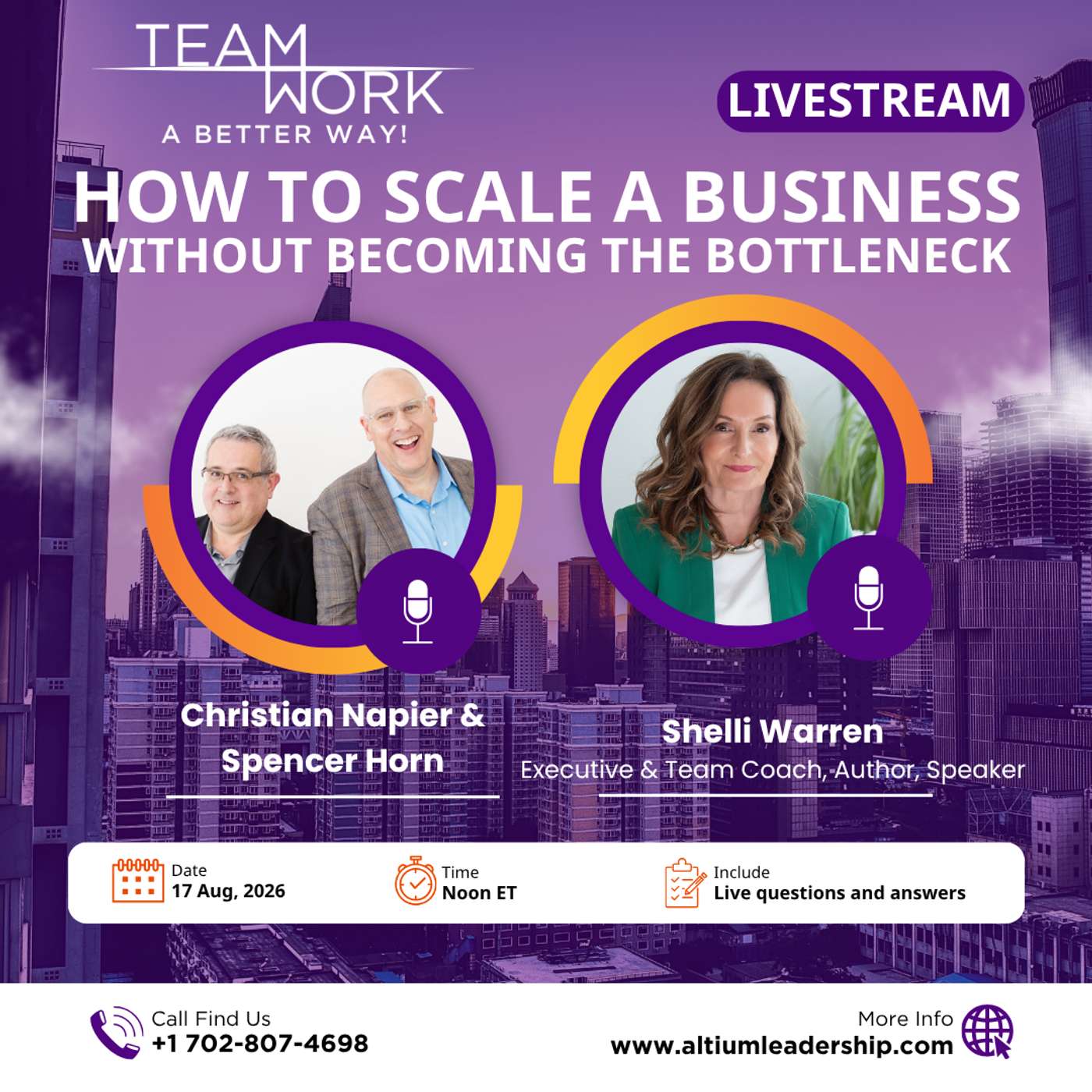 How to Scale Your Business Without Becoming the Bottleneck | Shelli WarrenTeamwork - A Better Way · on Leadership team structure80 / 100
 Building a business that works with your brainDifferently Aligned · on Systems thinking78 / 100
 The Pace of Innovation: Systems Thinking for Faster EngineeringHow Many CTOs · on Systems thinking78 / 100
 How can agency owners hold themselves accountable?Agency Leadership Podcast · on OKRs (Objectives and Key Results)78 / 100422. The 10 Rules I Wish Every Business Owner Knew Before Spending a Dollar on Marketing421. The MSP Retention Problem: Why QBRs Fail and What Smart MSPs Do Instead420. The Cost of Not Having Strategic Marketing Leadership419. What Most MSPs Are Missing When It Comes To Finding Great People418. The Hidden Reasons Companies Leave Millions on the Table When They Sell