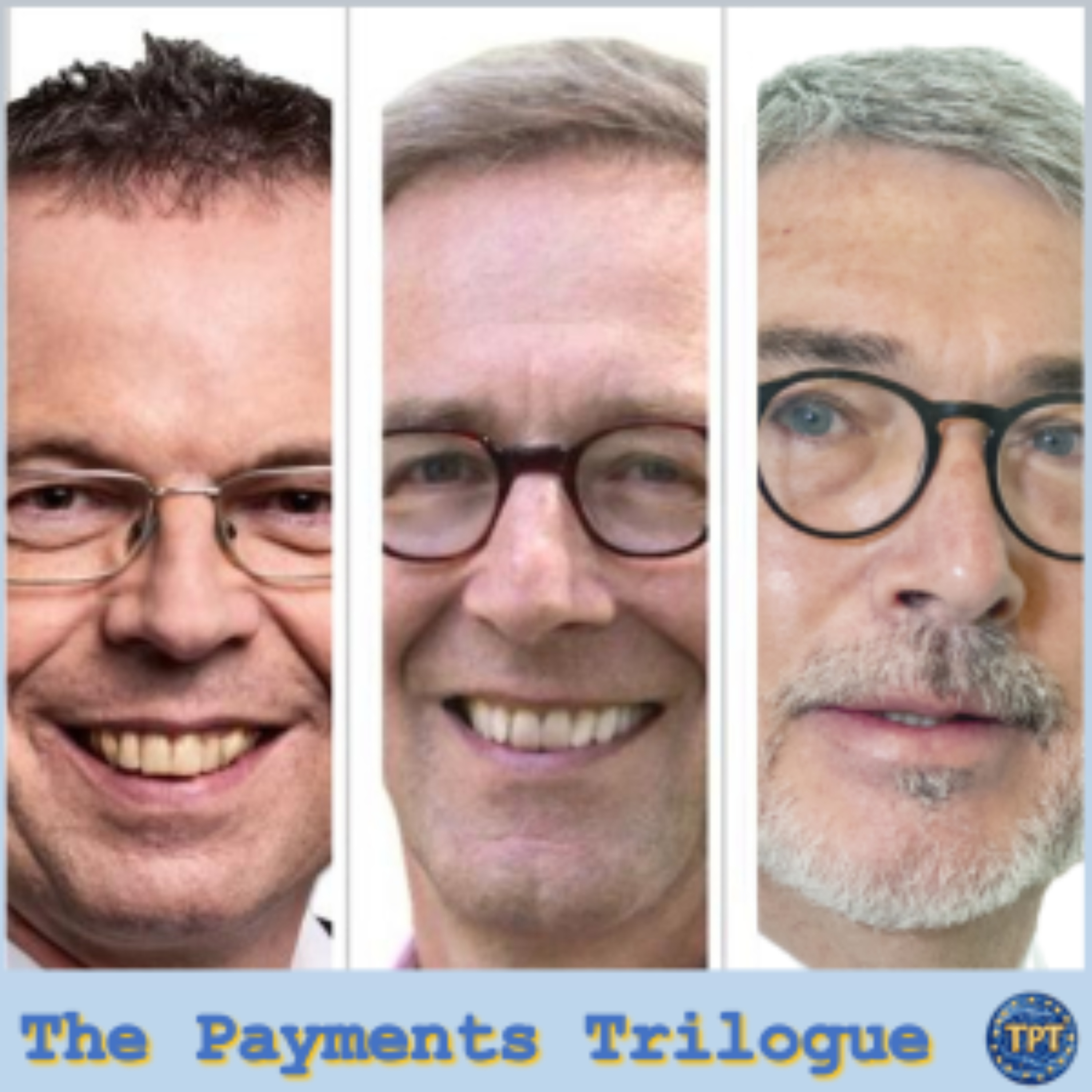
Hosted by The Payments Trilogue
Listed under Business
The Payments Trilogue is a podcast of 3 seasoned payments professionals aiming to foster the European payments industry's stakeholder collaboration and self-regulation. Michael Salmony, Javier Santamaria and Ralf Ohlhausen discuss current topics from their different perspectives.
51 episodes · publishes fortnightly · latest 2026-08-04 · ~36 min/episode
Rank
#37
Substance
84.0
/ 100
Breakdown
Scored 2026-08
Updated monthly
Across the index
#37 of 1878
Substance
Top 2%
outscores 98% of the index
The Payments Trilogue ranks #37 on The B2B Podcast Index with a substance score of 84.0 out of 100, scored across 2 recent episodes. It scores highest on guest caliber and specificity & evidence. Charles Damon is CPO of Token.io and industry director of the UK Payments Initiative, making him directly involved in operationalizing the initiative rather than commenting from the sidelines. He has executed experience in payments at scale and is embedded in the institutional design. However, he is primarily representing and promoting his own organization's work, which limits the independent perspective or contrarian viewpoint a more external operator might bring.
Averaged across 2 recently scored episodes, with cited evidence.
The episode provides substantive context on UK payments infrastructure, regulatory drivers, and the structural setup of the UK Payments Initiative, but relies heavily on Charles explaining his own organization's work rather than surfacing surprising, non-obvious claims. The technical details (VRPs, sweeping mechanics, fee structures) are explained competently but represent established knowledge within payments circles. Several minutes of the conversation involve straightforward recap and confirmation rather than novel insight.
“sweeping VRPs now represent uh 18% of all the open banking transactions in the UK”
“the UK payments initiative went live on the 1st of June. Uh so five uh out of six major banks um are transacting and five of the major TPPs are transacting”
The conversation recycles well-known open banking narratives (CMA enforcement, PSD2 limitations, Brexit comparisons, European regulatory fragmentation) without presenting genuinely fresh frameworks or counterintuitive arguments. Charles articulates a collaborative model that is interesting but execution-focused rather than conceptually original. The core insight - that aligned incentives through equity stakes encourage collaboration - is sensible but not surprising to operators familiar with multi-stakeholder platforms.
“mandating and forcing that, that sort of. We've seen plenty of examples where that doesn't, doesn't work too well. Right. It's so much better if everybody sees uh their own advantage”
“through a single API you reach all the EU member states, all the account holders. That is payment sovereignty”
Charles Damon is CPO of Token.io and industry director of the UK Payments Initiative, making him directly involved in operationalizing the initiative rather than commenting from the sidelines. He has executed experience in payments at scale and is embedded in the institutional design. However, he is primarily representing and promoting his own organization's work, which limits the independent perspective or contrarian viewpoint a more external operator might bring.
“my name is Charles Damon. Um, I'm Chief Product officer@token IO”
“I represent um, the UK payments initiative as an industry director”
The episode includes concrete numbers and named examples: 40 million payments per month, 23 companies funding the initiative, 5 of 6 major banks live, 30% of chargebacks from unrecognized transactions, six-year funding runway, five regulated use-case categories. However, many claims lack supporting evidence (e.g., assertions about European market fragmentation, CMA CEO phone calls reported secondhand, future projections). Data on adoption impact and merchant ROI are absent.
“there are about 37 million, no, but 40 million payments a month now”
“23 companies that now that have funded the UK payments initiative”
The hosts ask competent structural questions (why the UK diverged, governance mechanisms, competition law treatment) and engage Charles thoughtfully. Ralph (Speaker A) brings valuable European context for comparison. However, follow-ups are often confirmatory rather than challenging; when Charles makes claims (e.g., about CMA enforcement or European NCA behavior), they are accepted without pressure for evidence. The conversation lacks productive friction or willingness to question Charles's framing of his own initiative's prospects.
“why is it that UK has come to a different conclusion? Why did the banks not go this way in the uk?”
“If a TPP complains that the access is not working properly, the CEO, not some technical guy, don't send a fax. Three weeks later they phone the CEO of the bank”
2026-08-04
2026-06-23
2 periods tracked.
2 scored on substance · 51 tracked in total.
Add this badge to your site - it links back here and updates automatically as you rank.

<a href="https://index.fame.so/show/the-payments-trilogue" target="_blank" rel="noopener">
  <img src="https://index.fame.so/badge/the-payments-trilogue/badge.svg" alt="Ranked #5 on The B2B Podcast Index" width="360" height="136" />
</a>Track The Payments Trilogue's rank
Get an email whenever this show moves up or down the Index. Monthly at most, no spam.
Companies, products and tools that come up most across this show's episodes.
The themes that come up most across this show's episodes.
Podcasts that dig into the same topics.