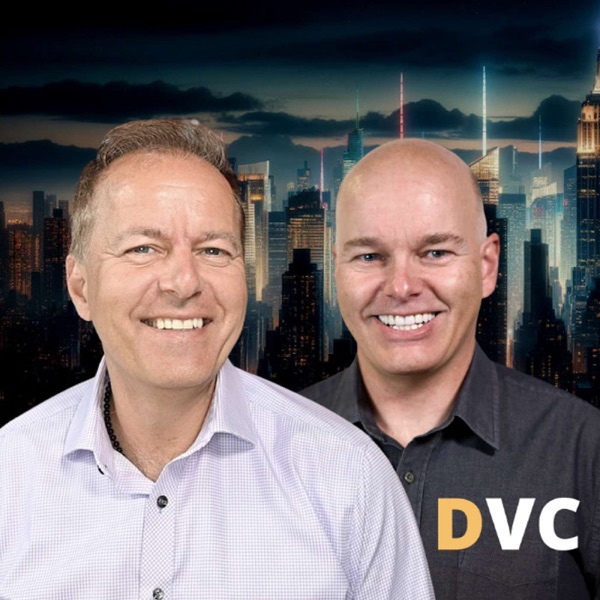
Hosted by Lean Startup Co
Listed under News › Tech News, Technology, News
Welcome to The Lean AI Podcast, where we want to flip the AI conversation on its head by offering invaluable insights into the practical application of AI, the challenges companies face, and the strategies used to achieve success.
18 episodes · publishes fortnightly · latest 2025-06-12 · ~35 min/episode
Rank
#1932
Substance
68.8
/ 100
Breakdown
Scored 2026-09
Updated monthly
Across the index
#1932 of 6203
Substance
Top 31%
outscores 69% of the index
The Lean AI Podcast presented by Eric Ries ranks #1932 on The B2B Podcast Index with a substance score of 68.8 out of 100, scored across 5 recent episodes. It scores highest on guest caliber and insight density. Supreet has legitimate credibility: started as a data scientist in healthcare consulting, built an AI engine at Morgan Stanley that generated 6x new assets and earned patents, and is now at Microsoft (7 months in as of recording). She has done the technical work and navigated executive alignment in regulated, capital-intensive environments. However, she is relatively junior at Microsoft and the 'education sessions' role suggests she may not be driving major product strategy at scale, and there is some humble-bragging evident.
Averaged across 5 recently scored episodes, with cited evidence.
The episode delivers several concrete, non-obvious insights about leadership buy-in (tie tech to business problems, create phased roadmaps, do pre-work before pitching use cases), though it cycles through some familiar themes (elevator pitches, stakeholder management, data strategy) without aggressive depth. There is meaningful density in the middle sections on expectations-setting and the risk/reward matrix, but the ending devolves into generic encouragement about embracing AI and holding hackathons.
“Tie the, I would say the technology with the problem. See how AI can enable you to solve the problem rather than the other way around, like trying to find a problem just so that I can use agents.”
“If you can give me a matrix of low risk, high reward use cases, let's start with that.”
The guest repackages standard product management and lean startup principles (phased delivery, stakeholder involvement, data strategy first) without substantial novelty. The framing around 'art of the possible' and 'art of the not possible' is mildly fresh, and the specific advice on pre-work before pitching (researching prior failed attempts) is sensible, but the core frameworks (2x2 matrices, elevator pitches, ROI calculations) circulate widely in corporate innovation spaces.
“Start with your data strategy, see where those gaps are.”
“You basically choose that emotion whether you want to get scared of it or you want to embrace it.”
Supreet has legitimate credibility: started as a data scientist in healthcare consulting, built an AI engine at Morgan Stanley that generated 6x new assets and earned patents, and is now at Microsoft (7 months in as of recording). She has done the technical work and navigated executive alignment in regulated, capital-intensive environments. However, she is relatively junior at Microsoft and the 'education sessions' role suggests she may not be driving major product strategy at scale, and there is some humble-bragging evident.
“I started my career as a data scientist in the healthcare space. I was in consulting, so working with different pharma companies mostly, uh, around demand planning, launch strategies, leveraging AI and machine learning. Then I pivoted to finance, uh, at Morgan Stanley, had a very successful run, uh, built AI personal engine, got patents for it, and also the results were phenomenal. It was 6x new assets.”
“And now I'm on the other side where I hold education sessions for the C suite and educate them on the art of possible.”
The episode includes some concrete numbers (6x new assets at Morgan Stanley, 33 trillion market size for small business, 15-20 minutes of developer time saved) and named organizations (Microsoft, Morgan Stanley), but lacks depth in most examples. The guest frequently speaks in generalities ('productivity benefits might take 3, 6, or 12 months,' 'there is so much noise right now') and avoids specifics about actual use cases she has deployed or their outcomes beyond the Morgan Stanley example. The small business prospecting example is mentioned but not developed.
“It was 6x new assets. Ah, that was what the solution bought.”
“This is a 33 trillion market.”
The host asks solid questions that probe the guest's logic (e.g., 'Are you suggesting developers are not the best at change management?' and pressing on how to handle C-suite mandates), and does push back on some claims. However, many of the host's follow-ups are more confirmatory than challenging ('I love that,' 'That's a great point'). The host occasionally pivots away from depth to move the conversation along, and there are few moments where the host genuinely presses Supreet on contradictions or limits in her advice. The conversation flows but lacks the friction that would elevate it.
“Are you suggesting that developers are not the best at change management?”
“One of the things in our work that we've seen is if you're failing for $10,000, you're really learning. It's not really a failure. But if you spend a hundred million dollars over seven years and that doesn't go well, that's a failure.”
4 periods tracked.
6 scored on substance · 18 tracked in total.
From Data to Dollars: Building Practical AI in Large Organizations
2025-06-12 · 37 min
How to Lead in the Wild West of AI with Philip Chew
2025-05-29 · 41 min
Best practices for Corporate AI transformation with Adam Newton
2025-05-15 · 47 min
Avoid "Burning Star Syndrome" using Smart AI Investment Strategies with Kunal Sawarkar
2025-04-24 · 39 min
How to Get Senior Leadership Buy-In and Alignment with Supreet Kaur
2025-04-10 · 39 min
Cultivating AI Use Cases to Move Beyond 'Magical Thinking' with Chris Reitz
2025-03-27 · 34 min
Add this badge to your site - it links back here and updates automatically as you rank.

<a href="https://index.fame.so/show/the-lean-ai-podcast-presented-by-eric-ries" target="_blank" rel="noopener">
  <img src="https://index.fame.so/badge/the-lean-ai-podcast-presented-by-eric-ries/badge.svg" alt="Ranked #192 on The B2B Podcast Index" width="360" height="136" />
</a>Track The Lean AI Podcast presented by Eric Ries's rank
Get an email whenever this show moves up or down the Index. Monthly at most, no spam.
Companies, products and tools that come up most across this show's episodes.
The themes that come up most across this show's episodes.
Podcasts that dig into the same topics.