The Digital Decode · 2025-01-14 · 26 min
Key moments - from our scoring
Substance score
38 / 100
Five dimensions, 20 points each
Enterprise networking faces a structural challenge: IT teams are managing exponentially more infrastructure - more switches, routers, Wi-Fi access points, cloud deployments, and remote workers - without proportional increases in headcount. Presidio's Modern Network Practice Director Andy Richter, along with senior architects Britney Bolton and Jacqueline Tomy, walk through how Cisco's unified management platform (Meraki), combined with AI/ML and automation tools, directly addresses this gap. Meraki's dashboard simplifies day-to-day operations like code upgrades, troubleshooting, and patch scheduling; layered on top are predictive analytics and machine learning that reduce service-impacting changes - Bolton highlights a 60% reduction in wireless channel changes through predictive RRM optimization. Cisco's Thousand Eyes provides synthetic testing and visibility across network services, while AI-driven chatbots and automated device tracking eliminate manual lookups across multiple systems. The core barrier to adoption isn't capability but awareness: customers don't realize these features exist, are compatible with their existing infrastructure (Catalyst switches, not just Meraki hardware), or can be implemented affordably against the business opportunity cost of freeing engineers from manual operations to support strategic initiatives.
Platforms like Cisco Meraki centralize management into a single dashboard, eliminating the need for Python scripts or manual device access. Engineers can schedule patches and iOS updates remotely, troubleshoot issues in real time, and perform deployments from their desk - tasks that previously required physical access to each device.
Predictive radio resource management using AI has reduced wireless channel changes by 60% at production customers. Since channel changes can cause service disruptions to laptops, iPhones, and clinical devices in hospitals, this 60% reduction directly translates to fewer service-impacting outages without additional manual intervention.
Andy Richter identifies three barriers: IT administrators don't know the features exist (buried in documentation), they don't realize tools like Meraki work with their existing Catalyst infrastructure (not just proprietary hardware), and they underestimate the business case - when time savings are quantified against hiring challenges, the ROI often justifies implementation costs to CFOs.
Unified dashboards with AI prioritization help parse critical alerts from noise, reducing false positives and preventing alert fatigue that causes administrators to ignore genuine threats. This applies both to network security operations and physical security, such as AI-powered object identification in camera feeds.
Thousand Eyes provides synthetic testing and aggregates all network service information into one place, allowing IT teams to identify issues before they escalate, form faster technical decisions, and resolve problems while they're happening rather than after users report outages.
Our reviewer’s read on each dimension, with quotes from the episode.
The episode recycles well-known pain points (talent shortage, IT complexity, managing multiple systems) and spends considerable time on generic solutions (unified dashboards, AI automation) without concrete mechanisms or novel angles. Most specific examples (Meraki ease, wireless channel changes reduced 60%) are vendor-advertised features rather than independently discovered insights. Substantial padding exists around the Presidio pitch and team affirmations.
there's not enough network and security talent out there in any geography that Presidio addresses
we were beholden to things like Python scripts and you know apick em when that first came out
The framing of AI/automation solving IT operations complexity and talent shortage is standard industry orthodoxy. No contrarian positions, first-principles analysis, or challenges to prevailing wisdom are offered. The discussion mirrors Cisco/Presidio's marketing materials almost verbatim without independent interrogation or novel reframing.
AI OPS, machine learning, chatbots, a whole range of technologies that Cisco's bringing the market
unified management, network assurance, and data solutions, and then AID automation put together
Three Presidio practitioners (Practice Director, Senior Architect, Senior Solutions Architect) with relevant operational experience deploying Cisco solutions. However, all three work for the sponsor company, creating obvious bias. No independent voices, skeptics, or operators from different vendor ecosystems present. Credibility exists but conflicts of interest are unaddressed.
Andy Richter, our Modern Network Practice Director, Britney Bolton, our senior inside architect, and Jacqueline Tomy, our senior solutions architect
I started off into delivery almost ten years ago now, and you know, as somebody who used to go out and deploy you know, campus networking
Limited concrete data: only one specific metric (60% reduction in wireless channel changes), vague geographic references (Michigan, Manhattan, Grand Rapids), and no customer names, deal sizes, timelines, or dollar figures. Examples like Meraki dashboards and configuration automation are mentioned but lack quantified impact. Most claims remain at principle level without hard evidence.
turning those features on reduced the amount of radio resource management changes. But I have to sixty percent
an organization with a thousand employees and Grand Rapids
Host asks open-ended questions but rarely pushes back, challenge claims, or probe disagreement. Multiple softball questions beginning with "can you give me examples" and deferring fully to guest answers. Self-deprecating humor ("I'm always putting one of those in as a placeholder") fills time without advancing rigor. No genuine tension or productive friction emerges between parties.
I apologize for kind of putting you on the spot here
Jackie, I. Apologize to put you on the spot. I know I didn't give you you know, is everyone this question specifically was that Alec
Computed from the transcript - who did the talking, and the words that came up most.
Legacy systems are holding you back. They're slowing you down, hindering innovation, and increasing your operational costs. You have so much you want to accomplish, so much that your IT teams could do, if only you had the time or support, or a simplified, modernized network... This week, host Allec Brust sits down with three experts from Presidio - Andy Richter , Enterprise Networking Practice Director; Jacquelyn Thome , Consulting Solution Architect; and Britny Bolton , Inside Solutions Architect - to explore the transformative power of automation in enterprise networking, internal company problem-solving, and beyond. Together, they dive into the tools and strategies reshaping the field, including the impactful technologies Cisco is bringing to market with AI-driven solutions. Get ready to learn how AI automation and cutting-edge technologies are shaping the future of business infrastructure and enterprise networking - and how they can seamlessly integrate into your organization's workflows. Discussed in this episode: The role of unified management platforms like Cisco Meraki in simplifying infrastructure management.
Transcribed and scored by The B2B Podcast Index.
Digital transformation has become one of the buzziest of buzzwords. This podcast is where we decode and deconstruct digital technologies, strategies, and best practices that are impacting the way companies deliver value to their customers. No buzzwords, nobs, Let's get to it. Hello everyone, and welcome back to another episode of the Digital Dcode, brought to you via Prosidio and our partners over at Cisco.
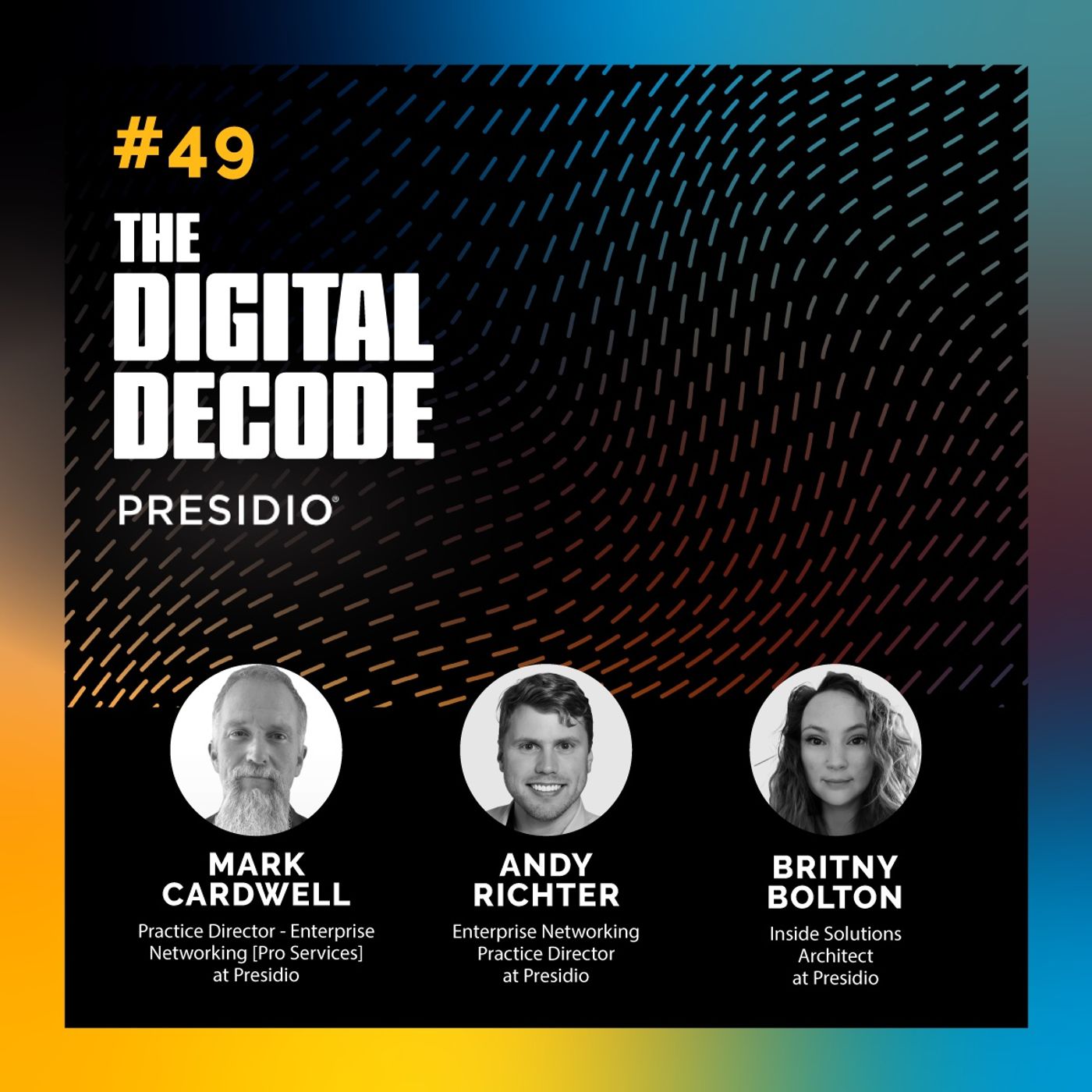
Today, I have a couple of Presidio people joining me to discuss the new era of enterprise networking, how we are transforming it operations in the age of AI. So with me I have. Andy Richter, our Modern Network Practice Director, Britney Bolton, our senior inside architect, and Jacqueline Tomy, our senior solutions architect. How are you doing, guys today?
Doing great? Thank you so much for having us. Alex thrilled to be here. It's good to have you on.
Andy. I will just pass it right over to you. Can you just give us kind of an overview of what we're talking about today? Absolutely so.
Networking has changed, as with everything else in technology that we've experienced the past. You know, length of all of our careers, you know, there's there's no constants, but change inside technology that we work with and networking really is no difference. And the most wonderful part about being at Presiding and working with Cisco is that we have a lot of wonderful solutions to help address those new challenges. And new changes that we've seen them in the networking business and in the markets.
And when we when we look at what those changes mean for all of us, we always like to start out with, you know, defining the problem. What really are we looking to help our clients and network engineered network architects around the world deal with. And the most fun part about this part of you know, all of our careers is that there are tools and techniques and sets of technologies that are well built to make people's jobs easier, to make them better, to make us all more effective practitioners at computer networking and cybersecurity, the things that we got into these careers to do.
So the reason this is. So important is when we look at the biggest problem that most organizations are facing today, it's a challenge of tech talent. There's not enough of us in this career right, which. Is amazing to me is these are careers This is a career that I've loved for so long, but there's just not enough network and security talent out there in any geography that Presidio addresses.
And the reason is obvious when you're working in the business. It's that you know, we're always as organizations adding technology, adding network instructure. We're bringing up new branches, new campuses. We have employees that are getting hired and bringing more devices so we have more devices that connect to Wi Fi.
And what does this all mean. It means we're adding more switches and more routers and more Wi Fi. But at the same time, we're not adding the same number of people to these IT departments, right where the problems increase. And that's not the only place the problems and the challenges that come from.
You know, CIOs, CEOs, CFOs, other senior leaders, and our clients continue to ask more of their IT departments, including the network departments that they're working with, and the reasons are they are also obvious. They need help driving business strategy fully interview with technology. They're looking to make sure that their own customers are properly served and helped by the technology stack that the companies are developing and building so and business leaders. Can't do it in a vacuum, so it departments.
Network engineers, network architects are pulled in these two directions all the time, you know, the day to day maintenance and also the business development that their leaders are asking them to participate in. And the result is that there's so much work to do and the challenges feel like they're insurmountable, but they're not insurmountable. Alec. You know, Brittany and Jackie and I are spend our days working with our client helping them identify how to best address these things, and we wanted to spend some time here and talk to you, Alec, and you know, the listeners and the Digital Decode about the technologies that Cisco provides that have really helped make this challenge, the talent challenge of being enough, addressing enough operational challenges and being available to help those business leaders address the business challenges at the same time, really walking and showing bubble gum at the same time.
Right, what are those technologies right? It's management updated more unified management solutions, data driven technologies that allow us to really ensure that we're achieving business goals with the networks. And when you wrap all that together and you add. In AI, AI OPS, machine learning, chatbots, a whole range of technologies that Cisco's bringing the market, We're able to really help accelerate the addressing of these challenges.
And it's the. Combination of the of those three of technologies, unified management, network assurance, and data solutions, and then AID automation put together, we find those are just incredible. Tools to help address that core problem. Alic So Pritty, I got a question for you, and I apologize for kind of putting you on the spot here, but you know, when I'm looking at AID automation, you know, I'm aware that you know, we can't do those.
Things in a vacuum. There's lots of specific things we can do in AI and talk about those, but can foundationally can you talk about you know how unified our cloud management solutions you've seen helped these our clients manage complexity, make the technology challenges, the business challenges more addressable, and you know the emotional reactions and the easier lifestyle that network administrators are looking for, you know, more time back in their day. What have you seen, what's helped and what's your experience been.
Brittany absolutely. So this is something I feel pretty passionate about. I started off into delivery almost ten years ago now, and you know, as somebody who used to go out and deploy you know, campus networking, prior to the days of things like unified management, you know, we were beholden to things like Python scripts and you know apick em when that first came out, and that felt like a really big deal because it took something that you know, you would have to go and physically touch each top of rex which and put it in a space where you can access it all easily from your desk.
Right, So, talk about what a like time saving feature that is. Then fast forward to something like Marocci and it's wonderful dashboard. I mean, think about how much easier deployment has become and day to day management. I mean, we all know that code upgrades are a thing that that's not going away, right, Understanding if there's an issue in your network at your fingertips, and then being able to troubleshoot that much easier.
These are all the types of things that bring time back to that person's day. And I kind of joke that Muraki is so easy even my kid could do it, but that's not totally far from the truth. I have always been a Maroaki fangirl, and this is why, because you talk about ease of use in combination with the fact that you know you have everything you need at your fingertips. So yeah, it goes back to unified management, like you said, And I've seen it from prior to and now that we have it, and I don't think I want to go back.
Yeah. I mean, it's so amazing that just something so foundationally that we're putting a unified platform to see and make changes can be so dramatic. And the wonderful thing about that, you know, is, is that it's just the beginning, right and as we start layering on automation and AI solutions, Jackie, I. Apologize to put you on the spot.
I know I didn't give you you know, is everyone this question specifically was that Alec I said. You're putting everyone on the spot today. I know. I'm assuming we're going to edit at least one of those jokes out, which be great, Like I'm.
Always putting one of those in as a placeholder because I because I always I'm. Putting both these ladies in the spot by dragging them around for the Digital Decode Allecy. We'll keep that in Gocky Jackie. Beyond the foundation of unified management building on top AI and automation, can you give me any examples in your experience and how you're talking to your clients about both the opportunities to make a difference with the future of AI and automation, but also you know, there's a lot of them that we're going to see in the world in the future, but there's some real world use cases today.
So you know, if you don't mind, you know, tell me about what's resonated we've seen work and what you see as the future that's going to help us really make networking better for our clients and easier and more accessible. Yeah, just going to the crux of the question that you're asking, you know, what's what is new and how is it intersecting with traditional legacy networks? Right, I would say over the last fifteen years, lands, wands, w lands, really any ads you can think of, the complexity is increased.
So we have larger skilled networks with more devices like you mentioned, we have more cloud usage, we have more virtualization, we have more remote workers. We need to think about employee retention. Aside from some of those factors, I think that just the systems that we have today are a lot more complex. Some of those complex systems are like OTV or VX land or ACI in these types of modern networks need more TLC than the management traditionally managed legacy systems.
So I think artificial intelligence and machine learning allows it engineers and admins to analyze more data in real time, potentially forecast issues, investigate the good and the bad patterns, and also to allow some of that technology to do some unmanned decision making for us. So I've seen at work in real time at many of my customers, and also when I was a deployment engineer like Brittany, one of my favorite things about the Maracci dashboard was being able to set a time where I could do patching or iOS updates, you know in the wee hours of the morning, having those be kicked off before I actually get online, Being able to check that everything's up and functional, and being able to move either onto my next task or perhaps go back to bed AI has created helped create config files and network documentation and monitoring and optimization, device tracking, troubleshooting.
I feel like I could just go on and on and on about all the things that it has helped people do currently. And I'm also geeked about having some of those AI chatbots and some of these management platforms that can help you trap down and answer without going to let's say, four different pages and trying to seek out your answer, you know, like when did AP number go down? Or where is this user. Idea in the building.
So I find that people and customers and everybody in between are on board with having more AI and machine learning than the networking infrastructure. You know, you set a bunch there that has just it resonates with me so much. You know, when I'm working with our clients, the thing that I've always found is the hardest question for them to answer for themselves is what happened? And things like AI and automation can help, to your point, tell that story in a way that before took real person hours, right, it took an individual and administrator, you know, a network admin, you know, time to look in those four different systems that you're calling out.
You're right, right, and that's something that is that is not worth our time anymore because what business leaders again are looking for us to do is participate in strategy and if all of our time is taken up by staging switch upgrades, Jackie, it doesn't have to be that way anymore. You're right, right. We can help our customers spend their time on more meaningful things. And it is the adoption of those solutions.
I want to call it another use case that I know we've seen together, and that is you know, you know, using machine learning in wireless environments. You know, wireless environments are always a challenge because you know, by the time you get there, after you get a report of a problem, usually everybody is left because they couldn't get good Wi Fi at that time. So you're like, oh, the problem is here two hours ago. What of the world happens?
Well, you know, it's you don't always know. Things like machine learning and AI solutions can predictively analyze what the environment would look like in a particular situation and preemptively accommodate end users. And that's it is is a feature that exists today in Cisco wireless and just the statistics that we've seen show that turning those features on reduced the amount of radio resource management changes. But I have to sixty percent and Alex.
You know it's hard to always articulate to you know, to non non. Networking practitioners why this is important. But a channel change in the wireless environments could be service impacting to your laptop, to your iPhone, to the if it's a hospital, to the clinical device that the doctor is using. To give you your love of patient care.
With machine learning and AI, we can reduce those channel changes by sixty percent, and those are sixty percent fewer potential service impacting changes in environments. It's reality today. And what I find is a lot of my clients don't even know they can turn it on and how much bene that they can see from it. And these are the things that are so wonderful.
And you know, Andy, all I'm hearing is good things from you, And you said something earlier that really resonated with me. So I'm just going to throw in a question here for you. It doesn't have to be this way. I want to ask you, you know, with all of these great things that you're saying, with all of this, you know, saving time, saving your IT teams from being overwhelmed with all of these challenges, are we seeing a challenge with people adopting some of these things, and why are they not doing it?
If it's going to be the easier route, why are we seeing customers or clients not adopting. It's a really good question. You know. The challenge with the adoption come down in my mind to about about three things, and it's not and some of these things overlap and they're not perfect.
You know. One is is that it administrators don't always know what their opportunities are. You know, these features and functions sometimes are buried in documentation, right and you know, we're evangelizing these things for our clients, and sometimes they think it's sales. I was a Presidio customer before I joined Persidio a long time ago, and I understand and I don't take offense to that we are a for profit company, but it's not you know, evangelizing.
This is not a sales pitch, so you know, they don't know about it. The second thing is is that some people might not realize that it really is adoptable for them. You know, we know Brittany talked about the wonderfulness of Cisco Moroki as a wonderful solution. She's one hundred percent right.
As usual, I'm always calling her for advice. She's always right. You know something that a customer might have thought, You know, I could only use Muraki with Mauraki gear. They may not realize that they can use it with Cisco catalysts, switches, Cisco catalys infrastructure.
These organizations might realize that technologies exist, but they might not realize that it's so easy for them to adopt. Right, right, And we need to do a better job explaining to them that adoption really is achievable for them in a much more meaningful way. Than they might realize. And the last thing is is that they might think that it's more trouble than it's worth.
I go to a lot of organizations, they. Say, well, Andy, there's so much I might have to do to achieve this, And they might be right, it might take a fair amount of work. But when you contextualize it and say, well, let's let's go talk to the CFO or the CIO and say, you know, there's costs to some licenses. It's true, and there's costs to the implementation.
Of some of this technology. Time is money. We're aware of that. But when you can textualize these costs against any lost opportunities in the business development that these CIOs CFOs CEOs are looking for the IT department to do.
If you go to the CFO and say it's one hundred granded licensing and I can have a lot of my time back, mister CFO, he might go, well, that means I don't have to hire negarly so many people and struggle in an area that might be hard to hire in, and the business benefit might far out strip thee hundred random license might costs and us in it. And I say it's all of us because it's me included. Might not always know the opportunity cost that our business leaders might identify. So you know, the reasons ALEC are not always straightforward, and they're not always consistent, and it might be a blend of those.
But the wonderful part about working. With people like Jackie and Brittany here is is that they spend their days showing people how easy it can be. Right. It doesn't have to be this hard.
Right, and the juice is worth the squeeze. Based on what you've been telling me. It's worth the squeeze everywhere. When we look at the business problems in every industry, in every geography, in the Midwest, in the rust Belt, in Manhattan, everywhere, the problems are consistent.
Businesses need help from their own people, that their own people are always getting more infrastructure to deploy, and we got to put all together. It's amazing that it's so easy that we can help everybody. We just we just need to educate them about those worlds of possibilities. That's it, Alex.
And this is why, again, why I'm so excited about the future of networking here, Britnie. I want to jump in and kind of go back a little bit, you know, and I said, you know, the things like what happened is the hardest thing that we talked to our clients about. It's the hardest question that they ask. You know, you answer some of these questions with our clients about how we can help.
What are the answers to give, you know, what are some technologies and examples of technologies that you find really help illustrate to our clients what happens and then help them make better decisions about solving those problems more in real time. You really did throw me under the bus with that way thousand eyes plunk. That kind of Yeah, that's fine. So I do think that when you look at things like security operations, right, we see a lot of issues with things like alert fatigue.
How do you weed out the things that are truly important with the things that are just kind of a nice to know, you know? And we feel it every day too, Right? You get dinged on your phone how many times? And eventually you just kind of start to ignore it and you might miss some good things in there.
So when you look at things like security operations and again that unified dashboard, unified management and some sort of like organization of how to prioritize those things, I think that is extremely helpful. That's just just having your data in one place and having a consistent format builds us up so much. Jackie. The other part of this that I think is interesting is the role of synthetic tests and actually going on validating services.
How are you seeing customers if you adopt things like Cisco thousand Eyes, how can they make organizations make decisions faster and form their business faster, form the technic leaders faster, and give the end users a better experience. Have you seen that make these kinds of material differences and making people's lives easier. What's the experience from you and your clients been with that kind of stuff. Yeah, not only the IT security part of it, but also physical security part of it.
I think that the meantime resolution is just a whole lot faster. So like when you're talking about thousand eyes being able to congregate all the information, and IT being able to parse some of the more important ones versus the less important ones, and being able to fix issues either before they even happened or while they're happening, so you don't have this catastrophe or this snowball effect. Right, even when you're talking about like physical security, I think a good example of AI being put to good use for the general public safety is object identification.
So camera streams the video footage to a dashboard, and the dashboard assimilates that there's a threat of an object that could cause bodily harm. Right, depending on the physical security that that place might have, it could put a place in complete lockdown. It could proactively alert the authorities and hopefully turn this hypothetical bad situation into note situation at all. We want to do that both in your network, so people that are trying to hack or people that are trying to steal your information.
We also want to do that for the safety of our public let's say school, so literally anywhere that people need to be safe, and that's everywhere. Inedy, So, being located in Michigan and unaware of really how the East functions or how fast they are to adopt security functions like this, how do you feel like Persidio is helping our customers move this footprint forward? You know, Jackie, you know the way I've seen Presidio really help our clients is remarkably the same exact way that I've seen you do it.
The way you do things in central Michigan has been the same type of success that I've seen across our clients. No matter where they are and what they are. So you might be an organization with a thousand employees and Grand Rapids that works with you every day. I work with organizations frequently in Manhattan with many thousands of employees.
The fun part is is that they don't realize it, but they have the same problems. So the efforts that I've. Seen you guys make, and you've had so much success with in your areas, both you checking and candidly and you Brittany also, I've taken these lessons and brought them to our clients large small around the nation and found that they really are portable in governments, higher education, secondary education, and down in school systems where we're looking about talking about public safety.
It really is compatible in a way. But again a lot of our clients don't fully realize. They all think that their unique snowflakes. Some of them are.
They all have personalities, and I love all of them. But the problems that we're seeing in the market in technology and it truly are consistent. So no matter who you are, I know that we can help them, our clients, we can help them large or small. We can help them adopt technology easier, solve their problems faster.
And in candidly, we have the best engineers and architects in the business. And you know, I'm the practice director for modern Networks here at Persidio. I can't do it without your advice, your assistance. Jackie and Bernie and our engineers are the best.
And that's what candidly, Alec, that's what makes us so successful and so special. We have these. Wonderful partners like Cisco, with wonderful technologies, and we get to work with the best engineers in the business everywhere. In the country.
We really do, Alec, I want to wrap up some of my thoughts here and ask you to tell us about, you know, things like Presidio Explorers and other ways that we're bringing these these wonderful solutions to markets, and how customers can expect the spsis to keep coming out from Persidio, and how they can engage us to make their lives better, faster, easier, and they can get more for less from their networks. Yeah. Absolutely, thank you so much. Andy.
Yeah, I would love to plug. We are running this campaign right now called Presidio Explorers, which we will have linked in the show notes for you guys to go and check out for Citio Explores is our virtual adventure that will take you through a number of journeys that will have you scaling new heights in cloud collaboration. It's super fun. You can check that out in the show notes and walk yourself through that journey.
Really recommend doing that. And then just to wrap up, thank you guys so much for joining me on this episode of the Digital Dcode, and thank you to Cisco for being a great sponsor of the Digital Dcode. You can find all of us on LinkedIn, so please go ahead and go and connect with us on there. You can also follow Prosidio on LinkedIn and Instagram.
And I know that this will be coming out after the holidays, so I hope that everyone had a lovely holiday break and is ready to kick things off in twenty twenty five. But we'll see you next time on the Digital Dcode. Thank you everyone. So navigating the digital transformation of your business is no joke.
Prosidio can help. Prosidio is a leading IT solutions provider that helps clients simplify IT complexity and drive return on IT investment. By investing in the future of IT solutions, we stay at the forefront of technology trends, which ensures that our clients have access to a wide rangenge of technology solutions. Let Presidio help you tap into the extraordinary potential of a digital future.
Learn more at presidio dot com. You've been listening to The Digital Dcode for more glimpses into the digital future. Subscribe to the show on your favorite podcast player and if you like the show, give us a rating.
Other episodes covering the same guests and topics, from across The B2B Podcast Index.
 The 2026 Cybersecurity Trends Outlook53 / 100
 Modern Networking for AI vs AI for ModernNetworking58 / 100
 Reimagining Fan Engagement with Presidio Captivate58 / 100
 AI, Observability, and the Future of Digital Resilience58 / 100
 Sports Betting and Gaming: Surging Users and Rapid Revenue Growth75 / 100