
The Culture Soup Podcast®️ · 2026-06-11 · 29 min
Key moments - from our scoring
Substance score
43 / 100
Five dimensions, 20 points each
Elle Michelle Smith's 'Call and Response' positions the Black church as an unexpected leadership school, backed by neuroscience and positive psychology. Speaking with Pastor Stephen Brown at Greater Life Church in Dallas, Smith traces how her corporate keynote success revealed a profound realization: the leadership training she received as a 14-year-old teaching Sunday school and serving as a junior deacon at Good Street Baptist Church directly enabled her ability to connect with audiences and drive engagement. The book features interviews with 155 high-performing Black leaders, including former Dallas Mavericks CEO Cynthia Marshall and Fortune 500 executive Trudy Bourgeois, extracting lessons in community building (social cohesion and oxytocin), resilience (the ability to bend without breaking), Hope Theory, and emotional intelligence. Smith emphasizes that the Black church teaches soft skills - particularly emotional and intuitive capabilities - that are organizational superpowers often overlooked in traditional leadership development. She addresses a critical concern: younger millennials and Gen Z have largely abandoned physical church attendance, thereby losing access to communication and interpersonal skill development that happens through real roles like junior deacon, usher boards, and teaching adult Sunday school. The conversation bridges theological wisdom with scientific validation, showing how practices like call-and-response, community gathering through shared adversity, and naming-taming-reframing emotions create measurable neuroscience outcomes that drive team performance and social cohesion.
The book identifies 10 lessons including community (through social cohesion), resilience (bending without breaking), emotional intelligence, and others tied to practices like call-and-response, mentorship roles in churches, and shared experiences of adversity that teach hope, naming emotions, and reframing.
When teams bond through shared experience and adversity (not just social events), oxytocin - the trust hormone - is released, causing them to operate in sync, reduce friction, and get things done faster because they function as one cohesive unit.
Hope Theory consists of goals thinking (planning), pathways thinking (brainstorming multiple solutions), and agency thinking (drawing on past success); Black church practices like singing spirituals about laying down burdens rewired believers' brains for hope by activating the prefrontal cortex rather than fear responses.
Physical church roles like junior deacon, teaching Sunday school, and serving on usher boards require real communication and interpersonal skill development that cannot be replicated online; generational shift away from the church building means losing access to this hands-on leadership training.
When Trudy and her husband were left behind by their CEO's group at the Kentucky Derby (an act of exclusion), her exposure to Black church traditions taught her to feel the hurt, cry, name it, tame it, and reframe the situation - allowing her to restore her dignity and still show up at the CEO's dinner, demonstrating resilience as the ability to bend without breaking.
Our reviewer’s read on each dimension, with quotes from the episode.
The episode opens with roughly a quarter of its runtime as pure promotional filler (bookstore shoutouts, tour dates), and the substantive middle contains some genuinely interesting ideas - social cohesion via oxytocin, Hope Theory's three-part structure, neuroplasticity through choir repetition - but these are named and quickly moved past rather than unpacked with operational depth. A B2B operator walks away with a few interesting concepts but little they can immediately apply.
In order to form that kind of community, remember what I said about, um, oxytocin and social cohesion, you have to go through something together.
There's goals thinking, there's pathways thinking, and then there's agency thinking.
The central framing - the Black church as an overlooked, institutionalized leadership school with concrete developmental mechanisms - is genuinely fresh in leadership podcast discourse and not a recycled McKinsey framework. However, the underlying constructs (soft skills as superpower, community bonding, resilience) are standard coaching language, and the cultural lens is the only truly novel element.
It's like we get the Happy Meal version. Adult ministry.
Being a junior deacon, can you do that online?
Elle Michelle Smith is a real practitioner - former AT&T corporate communications leader, executive coach to named senior executives, and author backed by survey research of 155 leaders - which gives her genuine credibility. However, this is recorded as a church promotional fireside chat for her book tour, so the format limits the depth of her practitioner knowledge that surfaces, and Pastor Brown functions as a friendly emcee rather than a substantive co-discussant.
I surveyed 155 high performing black leaders.
She was the chief diversity officer when I was working in corporate communications. And she was my primary client. But she became one of my sponsors.
The episode includes meaningful specifics: named executives (Cynthia Marshall as former Dallas Mavericks CEO, Trudy Bourgeois as Fortune 500 executive), a vivid and detailed anecdote (the Kentucky Derby abandonment story), a stated survey sample size of 155 leaders, and named neuroscience constructs. What it lacks is any hard business metrics, ROI data, or before/after outcomes that would make the evidence actionable for an operator.
do you know in 45 minutes, you garnered 25 million impressions in that time alone? Now, I thought he wasn't telling the truth because there were only 150 people in the room
she and her husband were headed to the Kentucky Derby with her new senior leadership team. She had just joined that company, and she and her husband were the only black folks in that group.
This is a church promotional fireside chat, and every question is a friendly setup designed to let the author present her book - there is zero pushback, no challenging of claims, and the interviewer frequently interrupts with affirmations ('Come on, come on,' 'She preaching up here, y'all') that fragment the guest's answers. The questions are structured but entirely softball, with no follow-up probing on any specific claim.
She preaching up here, y'. All.
that you did not just write this as a cultural tribute. You back the lessons with neuroscience and positive psychology. How does the science affirm what the black church has always known?
Computed from the transcript - who did the talking, and the words that came up most.
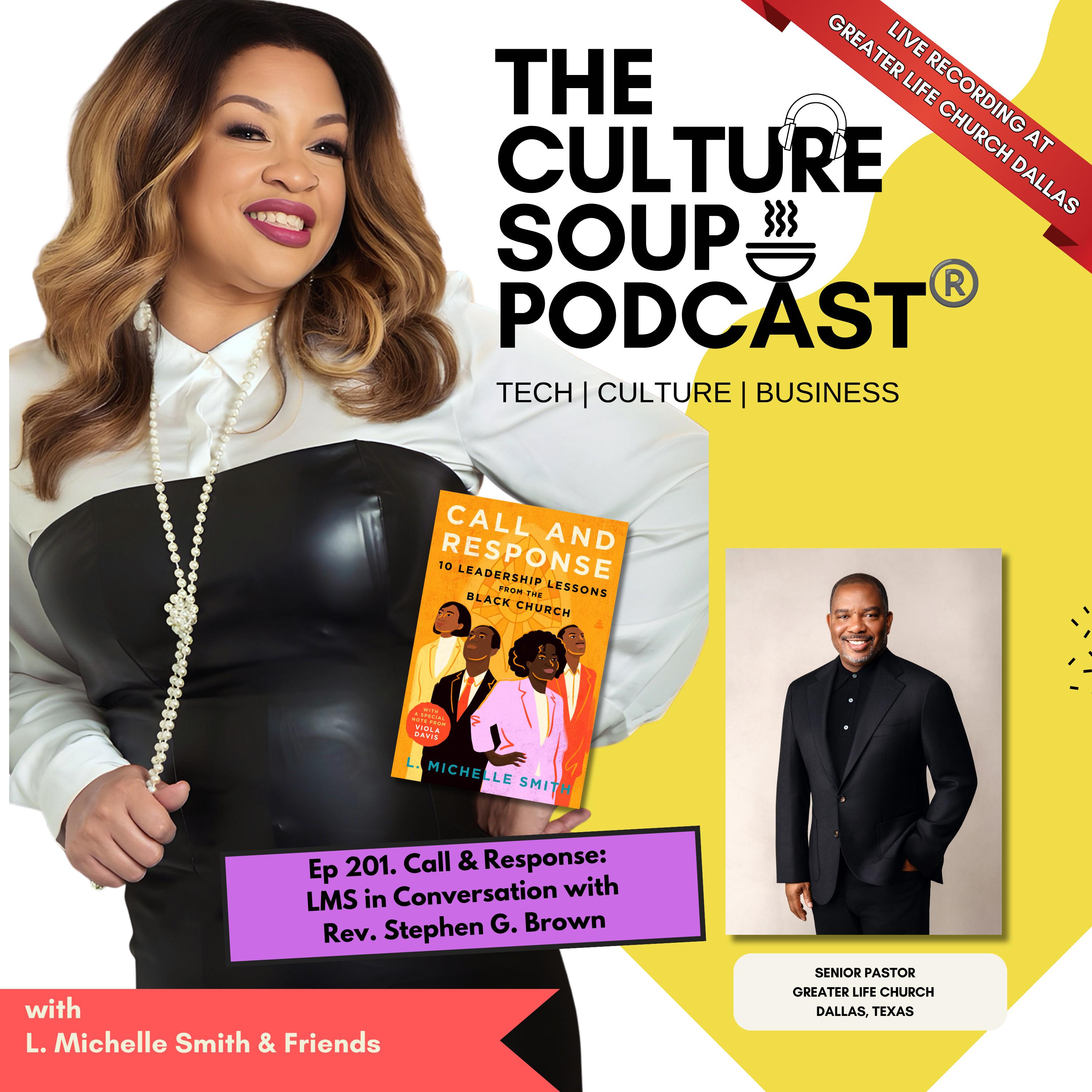
What if the most sophisticated leadership training you ever received happened before you turned 15, and it happened in church? In this fireside chat recorded live at Greater Life Church in Dallas, L. Michelle Smith joins Pastor Stephen G. Brown for a conversation that moves between sermon and scholarship, between science and story. Drawing from her bestselling book Call & Response: 10 Leadership Lessons from the Black Church, L. Michelle traces the origins of her keynote career back to a Sunday school floor at Good Street Baptist Church, where she learned to stand in front of a room and deliver. This is not nostalgia. It is a leadership masterclass grounded in neuroscience, positive psychology, and the lived wisdom of Black excellence. In this episode, you will hear: - Why real team bonding requires going through something real together, and what the science of social cohesion and oxytocin reveals about how trust is actually built in high-performing teams. - The story of Trudy Bourgeois, former Fortune 500 executive, who was deliberately left behind by her new leadership team at the Kentucky Derby, and what she did next.
Transcribed and scored by The B2B Podcast Index.
Speaker A: Today is Thursday, June 11, 2026. And yes, I've been on a bit of a hiatus with the show because the call and response book tour continues and so does life continues to life. So sometimes I have to put it down. But today I'm back and we are following up in the spirit of sharing more from the road from the call and response book tour. Have you gotten the book yet? It's available wherever fine books are sold. Make sure that you go get your copy wherever you are in the world. They're there. Also, there are bookstores around the country where the call and response book tour has been that have signed copies available. Many of them have sold out. So what I try to do is go back through when I'm in the city and sign more. I know that the good booksellers over at Pan African Connection here in Dallas sold out completely at Greater Life Church, where I spoke and did a fireside chat with Pastor Stephen Brown and I was told that they were totally sold out in store as well. So she said give them a couple of weeks and they will have more. In the meantime in other cities, I'd like to just call out, shout out the bookstores and booksellers that have been a, uh, part of this tour. I can't do this without them. They actually bring the inventory with them and many of them bring the Sharpies and I sit there and sign while they sell. So let's start with Kingston, New York, when I was at the Old Dutch church for the Pinkster celebration, that's oblong books from the Hudson Valley. Drove in probably about 30 minutes to be at the Old Dutch, uh, church with me. I mentioned Pan Africa Connection. They've actually shown up for me three times in three different churches. I mentioned Greater Life, but they were also at Concord Church, my home church in Dallas. And they also showed up to my childhood church, Good Street Baptist Church, earlier right around launch in February. There are more stores in the Dallas Fort Worth area that are supporting me in that way. In fact, the Doc Bookshop in Fort Worth, they're, uh, driving in on I30 east to downtown Dallas to support me at AT&T headquarters, where I am being presented by the network erg, Faith at Work ERG and Ability erg, so that whoever is an ATT employee can listen in to the simulcast. I'll be live at headquarters on June 16. So I'm shouting them out as well. I want to shout out 44th and third in Atlanta, Georgia, which hosted one of the book signings in store, but also has signed copies at least the last I checked. You might want to double check. Also the book joint in Chicago where we hosted our signing. They supported me there in store. And then of course, Mahogany bookstores in Washington, D.C. who supported me at the MLK Library where I sat in conversation with the incomparable A' Lilia Bundles. And then if you're in New York City, get on over to the Barnes and Noble Upper east side where they hosted me for a book signing where I was in conversation with the Carla Harris of Morgan Stanley. And they have signed copies on hand, at least the last I checked. I try to get back to these stores when I'm back in town to sign more books for. So be looking for that. There's one more bookstore that I want to shout out and that is the connection at Concord Church. They will be fully stocked and ready to go with for the E.K. bailey preaching conference that's coming to town the last week in July. In the meantime, today I bring you yet another conversation. It's myself and my longtime friend, Pastor Stephen G. Brown. He's the pastor of Greater Life Church in Dallas, where he's doing an amazing work. I was their featured speaker on Sunday and he sat on the platform with me and had a nice long feast Fireside chat before they continued worship. So enjoy. Learn more about call and response in this conversation and you get to hear the way I nuance the conversation for ministries. If you have a church and you'd like for me to come out and do something similar, reach out. Ellemichellsmith.com callinresponse let's get it. Hey, y'. All.
Speaker B: This is Culture Soup, where tech, culture and business collide.
Speaker A: It's a podcast that spoons up everything hot from social media. I'm your host, Elle Michelle Smith, and each episode we bring you some of the most notable and not yet notable thought leaders in tech, business and culture.
Speaker C: Come on, come on. Test that, uh, mic for me. Test that mic. Keep talking, keep talking. Y' all hear her?
Speaker B: Good.
Speaker C: Alrighty. Well, we're so honored to have you here.
Speaker B: Thank you so much for having me, y'. All.
Speaker C: I've known L for a while. I met her. She was singing on the praise team of Concord.
Speaker B: That's right.
Speaker C: And. And she has just blossomed. She was already something then, but she's really blossom now. And I had the privilege of hearing about her new book and I went to the Barnes and Noble and I bough my book and I have my signed copy. Yes, you do, but I didn't read it. Oh, I read the digital copy. I read the digital copy.
Speaker B: Okay, good.
Speaker C: See that? Y. Ah, y'.
Speaker B: All.
Speaker C: Y' all missed that. See that? You. Yeah, I. I bought the digital copy cuz I'm a digital guy.
Speaker B: Yes, you are.
Speaker C: But this book is absolutely phenomenal. It will transport you into the experience of the black church with all which. All of you know. And so let me get into my script to, uh, you, uh, y' all pray for your pastor. I don't have my reading glasses on. We going to get this together. L. Michelle.
Speaker A: Yes.
Speaker C: Many of us know you as an executive coach and leadership expert who has advised some of the most powerful organizations in America. But this book, Call and Response, takes us, uh, straight to the back to the black church. What moved you to write this book and why now?
Speaker B: Well, you know, it was a bit of an aha moment for me. It wasn't at the front of my.
Speaker C: My mind.
Speaker B: I was at the time working at AT&T right downtown. Yeah. And my senior vice president wasn't available to speak, so someone called me and said, come speak now. Ah, they had heard me lecture at Howard University maybe a couple weeks before, and it was two days out. And I said, well, when is it? They said, two days from now. I said, that's a little crazy. They said, just do what you did at Howard. Well, it was a keynote, and I'd never done a keynote message before. That's a little different from lecturing in college. So I cobbled together something. I had some walk up music come on now. Together. Yeah. Well, after it was over, the founder of the organization that had the event stopped everybody from asking questions. And he raised his hand and he said, I need you in New York next week doing that same thing at this ad agency. Wow. Well, you know what? I, um, have a day job, so let me go talk to my boss. So I went back to the SVP and asked him if that was okay. He said, well, if he's paying for your flight, hotel, go. And he did. Wow. So I, uh, went same message. After it was over, the social media person who was back there counting hashtags and things like that said, do you know in 45 minutes, you garnered 25 million impressions in that time alone? Now, I thought he wasn't telling the truth because there were only 150 people in the room and they were tweeting, but that's a lot. And he turned his laptop around, he said, see? And he wasn't. He wasn't lying. Wow. So someone asked me, where did you learn to speak that way? Now before you jump to the black church. I didn't jump there first. I started thinking about all the work, things I had done in my career. Where did I learn that? What training did I have? Well, the only thing I could come up with was I was a corporate media trainer. I had trained CEOs to do it, but that wasn't anybody teaching me. Wow.
Speaker C: Uh.
Speaker B: It took a few weeks, and then I realized I was 14 years old at Good Street Baptist Church.
Speaker C: Come on up. Come on.
Speaker B: Me and my peers were. It was a mandate to teach adult Sunday school class. And if you didn't get it right, they would pull you to the side and they'd coach you and throw you back in. And then after it's over, we had the reconvening. You remember that word? Oh, God. We would reconvene, and I would do the high points. So I would stand in front of the entire Sunday school in a room looked kind of like this, with about this many people in it, and deliver the high points. So I realized then I might have been on to something. And I talked to my other friends that didn't go to Good Street. I wanted to know if it was just a church thing. My white friends didn't know what a junior usher board was. They didn't know. And it's because little people in the black church can be big jobs. It's like we get the Happy Meal version. Adult ministry.
Speaker A: Yeah.
Speaker B: And so we learned so many things. And then I wanted to know, what all did we learn besides speaking?
Speaker A: Yeah, yeah, yeah.
Speaker C: That's outstanding. And y', all, you're looking at a junior deacon. See, I was junior deacon.
Speaker A: Junior deacon.
Speaker C: When I used to pray, I would start crying. And my mom said, whenever you get upset when you're praying, go to the Lord's Prayer. Yeah, I. I couldn't cry and do that. I knew that. But, yeah, Junior, uh, deacon right here. Y' all never became a deacon, though. Praise God. All right, Michelle, you identified. You identified 10 leadership lessons that come directly from the life and practice of the black church. Without giving away the whole book, which I've read, feel free to. To share just a few of those lessons that you believe are most urgent for leaders right now. And can you give us a glimpse of the person whose story brought it alive for you?
Speaker A: Yes.
Speaker B: Okay, so my favorite is with. Okay. Community. Community is my favorite. And that's something that we learn not just in the black church, but it takes us all the way back, even before.
Speaker C: Absolutely.
Speaker B: The middle passage. The thing is, when it comes to People who have been through advers generation over generation. We have a bond. Yeah, it's almost magical. It's miraculous that the Lord gave this to us. Uh, all that means is a word called social cohesion. And all that means is like in call and response, if I say God is good and all the time you already know what to do and say before anybody tells you to do or say it.
Speaker C: That's right. That's right.
Speaker B: And that's the natural affinity that we have to form community. And some of the masters of community are in this book. Now, the people who are in the book are high ranking corporate executives. They're people in entertainment and in business. But one of them you may be very familiar with, in fact, you saw her sit with me at Barnes and Noble. Her name is Cynth Marshall and she is the former CEO of the Dallas Mavericks. History making.
Speaker C: Okay.
Speaker B: She turned that place around. I knew her from working at, AT&T. She was the chief diversity officer when I was working in corporate communications. And she was my primary client. But she became one of my sponsors. That being said, she's in the book and she is a master at forming community. So you may be going, how, how does this relate to the workplace? Because this is a leadership book for the workplace. Okay, how does it work? Well, if you have a team, you may work together, but you haven't bonded. What do you need to do to bond? Well, in order to bond, there's this little hormone in our brain called oxytocin. It's called the love hormone or the trust hormone. It causes you to bond. What if your team at work was able to bond in a way that I just, I just, um, made an example of when I did that call and response with you. You'd have better performance, they'd be in sync and they get things done faster because you wouldn't have as much friction because they operated as one. Now here's the thing. In order to form that kind of community, remember what I said about, um, oxytocin and social cohesion, you have to go through something together.
Speaker C: My, my, my, my.
Speaker B: So I'm not just talking about pizza carts and, you know, um, feel Good Fridays, whatever they do at work. I'm not just talking about that manufactured stuff. You have to fail and get better. Learn from the failure and get better. You have to do that multiple times. And we have done that as a people, generation over generation. So we can almost read each other. And this is the thing about what's in this book here. We're going beyond the tactical, uh, strategies and. And skills that people are taught that are hard skills. You've heard people say hard skills. You know, reading, writing, whatever that might be. Singing is a hard skill. Right. We're talking about what they used to call soft skills. But it is our absolute superpower, and that is emotion.
Speaker C: Oh, my.
Speaker B: It takes intuition to know and even just do what we did. When I said God is good, and you said all the time. When he gets to hollering and hooping, y' all respond, don't you? It's. It's almost. It's in us. And so we have that to share with other people.
Speaker C: That's good. Social cohesion. That's a good word, y'.
Speaker B: All.
Speaker C: That's a good word. I want to keep going, but I just want to, um. There's a part in the book where, uh, one of the executives, uh, she was headed to the Kentucky Derby, and she experienced some direct, um, hatred. That's only what I can use. And I saw how she took that difficult situation, and she still showed up knowing what had been done to her. That, to me, just speaks of the resilience of. Of black folk.
Speaker B: Yeah.
Speaker C: And how we can be mistreated, but we still show up.
Speaker B: Right, right, right. Um, he's speaking of Trudy Bourgeois, who happens to be a mentor of mine, and she's former Fortune 500 executive as well. And the story goes that she and her husband were headed to the Kentucky Derby with her new senior leadership team. She had just joined that company, and she and her husband were the only black folks in that group.
Speaker C: Group.
Speaker B: And so, uh, they had on their Kentucky Derby vest, and they were dressed from head to toe, and everybody got on this very beautiful bus and went to the Kentucky Derby. Well, Trudy wanted to make sure she knew when the bus was coming back, so they knew what time to meet the bus. She knew from growing up in the black church, you don't mess with people's time. So she was going to make sure she was there 15 minutes early. She and her husband made sure they were in the spot 15 minutes early. And there was no bus. So then they thought, well, maybe we're early. So they waited, and they waited. Then they said, well, maybe they said, the south side of the arena. Maybe we should go that way. So they walked all the way around and tried to meet the bus. No bus. By this time, it was time for the bus to be there, and they came back to where they're supposed to be being. No bus. Turns out that her CEO and everybody on the Bus left without them. Um, so you have to wonder, how did they miss this couple? Because, first of all, visually, you probably couldn't have missed them. But if somebody had counted correct, they would have missed the couple. So her husband was furious. She was crying. And I can't even imagine Trudy crying, because she's tough. Uh, she was crying. They went back to the hotel room, and she said, but we've got to show up. Yes, we've got to show up. Anyway, they were having invented the CEO's house. The husband didn't want to go, but she said, come on, we got to get it together. We'll go. She got herself together, got those tears out the way, fixed her makeup in her face, looked as Kentucky Derby ready as she could.
Speaker C: Come on, Ms. Trudy.
Speaker B: And rang the doorbell of, uh, her CEO's house. The wife answered the door, and she could kind of tell she was shaking. She was like, oh, my God, what happened? And she said, well, it looks like we were left. And the CEO came to the door, said, come on in. We're so sorry. They apologized to her, but she told me that if she, who was actually Catholic, hadn't traveled with her grandparents down the road when she was little to the black church some Sundays, she wouldn't have known how to get herself together like that. Pull herself together and walk in with her dignity. My, um.
Speaker C: My, my.
Speaker B: And he's right. We have learned resilience. And let me tell you what resilience is, because there's a mis. Misunderstanding of what it is. Most people think it means we're just so strong. No, it doesn't mean that. It means we're pliable. It's like one of those big skyscrapers downtown. The engineers in here, you probably know, you don't build it rigid and strong. You build it so that it will bend and not break.
Speaker C: Come on. Come on.
Speaker B: Pushes up against that skyscraper. It bends, and then it pops back into place. Resilience is the ability to bend and not break. But that wind is teaching it something. That's the adversity hitting the side of that building. And guess what it does? It bends. It learns, and then it straightens up.
Speaker C: Come on. Come on.
Speaker B: So it takes you to feel the adversity.
Speaker C: Yes.
Speaker B: You gotta name it. And naming causes you to tame it. Okay, so if. If it's not right, say it's not right. Feel the emotion. Cry if you need to. But then when you process all that, you refrain it. So you name it, tame it, then reframe it. And reframing says what's the opportunity? What did I learn from it? And that's the passport to resilience, y'.
Speaker C: All. She preaching up here, y'. All. Yeah. Come on, now. I know I gotta say some amen for my sermon, but get some amen right now. All, uh, right. We're pressing forward. Uh, what I found remarkable is you, that you did not just write this as a cultural tribute. You back the lessons with neuroscience and positive psychology. How does the science affirm what the black church has always known? And why did that matter to you?
Speaker B: Okay, so, first of all, let me tell you what science is. Some people think that science and faith are separate, but science is just the language that God gave us to understand the. His amazing works.
Speaker C: Right, right, right, right.
Speaker B: So there needed to be science here. But science also opens this book up, uh, for those people who didn't have the experience to give it. Language that maybe even my grandmother, your grandma, grandfather didn't have. But let me tell you about Sephora Turner. That's my mother's mother.
Speaker C: Come m on.
Speaker B: I used to go there summertimes with my sister. She was in Louisville, Arkansas, about. I got, I guess, about 45 minutes outside of Texarkana, right across the line. And her little wood frame house was right beside the railroad track. So we would hear the train just coming down, roaring down. But in the midst of that, Grandmama always had on her records she would play Mahalia Jackson.
Speaker C: Yes.
Speaker B: And she was saying, gonna lay down my burdens down by the riverside to say, study war no more. Now, what I didn't know that, ah, my grandmother was doing then, that I know today, thanks to science, she was rewiring her brain for hope.
Speaker C: Come on. Come on.
Speaker B: And for resilience.
Speaker C: Come on.
Speaker B: She said, I'm going to lay down my burdens down by the riverside down by the riverside by the way, that's where the black church was formed. It was against the law for us to worship in public. It was against the law for us to gather. So we had to go into the hush of nights, uh, down by the riverside Because a lot of plantations were by the river because of commerce. We'd go down by the riverside and study Warner more. We're going to get into this in one of the next books. That's where a lot of the rebellions happen. Right by the riverside.
Speaker C: Wow. Wow. Come on.
Speaker B: So she said, I'm not going to have to fight anymore for justice for me or even my granddaughter. You know what she was doing? It's called Hope Theory, and that's positive Psychology, there is goals thinking. That's a part of hope theory. That means that without planning, you have no hope. So what hope does, uh, is. It's a positive emotion. It's one of the only emotions that will re. Hijack your brain from thinking. M fear, your prefrontal cortex, the very front of your brain, that's where your decision making power is. That's where you plan. Hope can snatch it back from fear.
Speaker C: Come on now.
Speaker B: So if somebody says, don't raise my hopes. No, you got that all wrong. Raise my hopes all day long because that helps me to get clarity of mind. The next thing is going to be pathways thinking. And that's just like brainstorming. It gives you multiple avenues to figure out what you can do in your engaging anticipation. Now, whether my grandmother was thinking about herself or me or even my child, that she didn't even get to know that somewhere down the line that hope, something would change. That's what kept her moving forward. There's goals thinking, there's pathways thinking, and then there's agency thinking. That's where you actually get to look back. Now, hope you wouldn't think was looking back. But it says, I've done this before. My people have made it through this before.
Speaker C: Yes, yes, yes.
Speaker B: That's hope, y'.
Speaker C: All. That's hope. That's hope.
Speaker B: That's hope. And God gives us hope.
Speaker C: Come on, give God some praise. Come on, come on. We got, we got, we got more.
Speaker B: Hold on.
Speaker C: I'm gonna cut across the field if that's okay. Uh, for the men and women sitting in greater life and truly this morning, leading their families, their teams, their communities, what is the one thing you want them to leave with today? What is the call and what is the response?
Speaker B: Yes, you, you hit on something. Because the whole book is a call and response.
Speaker C: Yeah.
Speaker B: Once you get towards the end of it, you realize I've raised an issue. And the issue that I raised is that it's generational.
Speaker C: Okay.
Speaker B: Um, when you look at who's in this book, I surveyed 155 high performing black leaders. Most of them were older millennials, Some of them were Gen X like me and you. There were some boomers. I say that because barner research shows us that the younger millennials in Gen Z largely have left the black church building. In fact, they've left the church building. Now, there's several different reasons why you can say there are people who don't believe. Put them over there. Okay. But you can also say that there are those who have left the Building because it's become so convenient. I mean, I don't know about you, because it's not you, because you come to church just about every day. Okay, every Sunday. But I'll tell you, sometimes it's easy for me to stay home and swipe and watch Pastor Cosby in Houston and swipe and then listen to Reverend John Wesley in Virginia and then tune on over to Pastor Carter and I. I get to see an array, and before you know it, you're a member of Bedside Baptist, the Church of the Holy Comforter. Uh, come to the building anymore.
Speaker C: Um, convenient.
Speaker B: But here's the issue. Being a junior deacon, can you do that online?
Speaker C: No. No.
Speaker B: Can you teach an adult Sunday school class? At least back then I couldn't.
Speaker C: No.
Speaker B: Online with.
Speaker C: Can't do it. Can't do it.
Speaker B: So there are communication skills and interpersonal skills that we're losing because we aren't coming to the building.
Speaker C: Come on, y'.
Speaker A: All. That's good.
Speaker C: That's so good.
Speaker A: Good.
Speaker B: The next thing is the modernization of the church. Now, I, uh, like praise teams. I was on one. That's right. But do we get a. Do we do away with the entire choir? I don't.
Speaker C: No, no. Absolutely not.
Speaker B: There's a whole chapter on collaboration in the book, and I center the music ministry and all. Ah, the intuitive, emotional intelligence. You learn from standing beside someone and singing. And you are also rewiring your brain. That's called neuroblast plasticity. That's where you've done things over and
Speaker C: over and over and over and over
Speaker B: again, and you actually know what to do again without somebody telling you to. So there is value in every bit of what we do in the black church. But the problem is, if those generations have left the building, and I know shout out to my gen zers here and my young millennials here, because you're here and you stay.
Speaker C: Yeah.
Speaker B: How do we get more to stay?
Speaker C: That's right. That's right.
Speaker B: That's the call and response. So I'm going to colleges and universities. I'm going to churches just like these.
Speaker C: That's right.
Speaker B: I'm in corporations. I'm talking to everybody, and I'm getting real feedback from these young people to take back to pastors just like you so that you can begin to think about how we keep the ones that are here. Uh, because I'm sorry to say, you might have lost the ones that are already gone. Let's pray that they're logging on.
Speaker C: Amen. Amen. That's good. L. Michelle Smith. Everybody. Come on. Give God some praise. Thank you. Come on, come on, come on. Give God some praise. Stand up. L Her books are in the foyer. She will do a book signing immediately after service.
Speaker A: What an awesome conversation with the Senior pastor of Greater Life Church in Dallas, the Reverend Stephen G. Brown. And I have to say, hats off to the audio visual team at Greater Life who really put together a wonderful three and four camera shoot and this is the way their production looks every Sunday. If you ever stream church service, find us online@theculturesoup.com on Instagram heulturesoup and on Facebook at the CultureSoup podcast. If you'd like for me to visit with your organization or ministry, reach out at ellemichellesmith.com speaking learn more about call and response 10 leadership lessons from the black church@ellemichellesmith.com call and response submit a speaker request there as well.
Speaker B: The Poetry Soup Podcast is a production of Noah Size Communication M
Speaker A: the Culture Soup Podcast is a registered trademark of no Silos Communications, llc.
Other episodes covering the same guests and topics, from across The B2B Podcast Index.
 Bonus Episode: Master Your Spiritual Intelligence, Featuring Yosi AmramHumanity Working · on Positive psychology77 / 100
 Train Your Mind or Lose Your EdgeTeamwork - A Better Way · on Positive psychology76 / 100
 In conversation with...Binna KandolaFuture of Work Hub Podcast Series · on Resilience73 / 100
 How Revenue Marketing Makes the CMO a Business Growth DriverThe B2B Revenue Executive Experience · on Positive psychology71 / 100
 Ep 216, Failure Is A Component Of SuccessConflict Managed · on neuroscience69 / 100
 What’s Neuroscience Got to Do with It? (ft. Rich Kuepper | Founder & President L.E.A.D. U.S.A. | Leader & Team Development Expert)No More Bad Events · on Oxytocin62 / 100
 Ep 201: Call & Response Book Tour: Fireside Chat w/Rev. Stephen G. Brown - feat. L. Michelle SmithCall and Response: About the ResearchTCU Call and Response Conversation with Rev. Dr. Shonda JonesEP. 200: Call and Response Conversation at TCU w/Rev. Dr. Shonda JonesThe Call and Response Conversation w/ Cynt Marshall