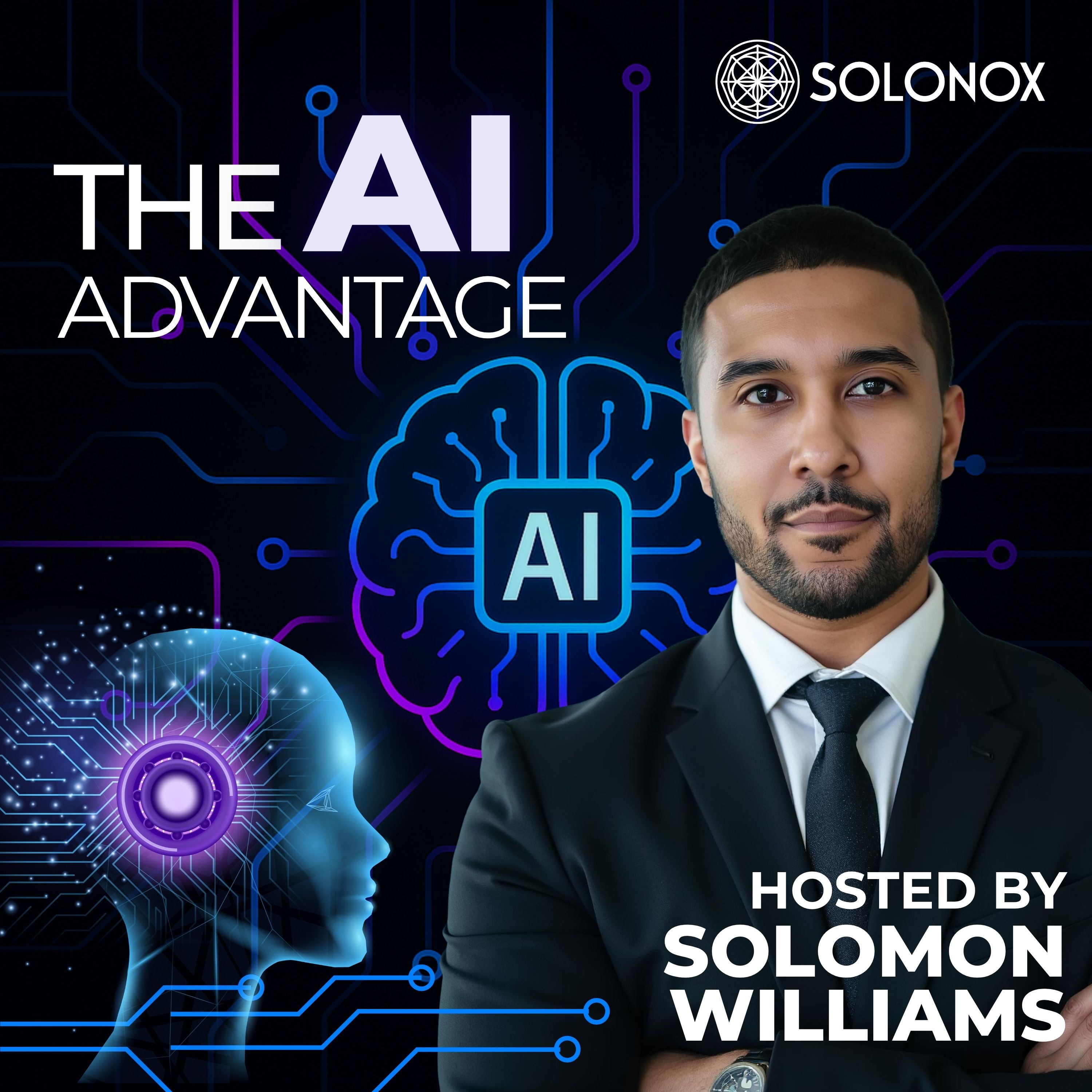
Hosted by Solomon Williams
Listed under Technology, Business › Entrepreneurship
The AI Advantage: Smart Tech for Modern Leaders where artificial intelligence meets real business outcomes. No fluff. Just strategy. Hosted by Solomon Williams, Founder of Solonox, this show delivers bold conversations on AI strategy, business automation, cloud technology, and digital transformation.
49 episodes · publishes weekly · latest 2026-08-05 · ~39 min/episode
Rank
#329
Substance
75.0
/ 100
Breakdown
Scored 2026-08
Updated monthly
Across the index
#329 of 1878
Substance
Top 17%
outscores 83% of the index
The AI Advantage: Smart Tech for Modern Leaders ranks #329 on The B2B Podcast Index with a substance score of 75.0 out of 100, scored across 2 recent episodes. It scores highest on guest caliber and insight density. The guest is a legitimate practitioner with 17 years in data science and ML, has built ML platforms at multiple startups, and now runs an executive education business. However, he is primarily a thought leader and consultant rather than an operator currently running a business at scale, which limits the caliber slightly. His experience is real but somewhat dated in terms of current operational responsibilities.
Averaged across 2 recently scored episodes, with cited evidence.
The episode contains several substantive insights about AI adoption, agent architecture, and organizational change management, particularly around the gap between technology champions and rank-and-file adoption, and the importance of leadership modeling. However, there is significant filler including repeated pleasantries, long meandering answers that circle back on themselves, and conversational throat-clearing that dilutes the density of novel claims.
“companies are very much over indexed on the governance side of things and as a result I think they're missing opportunities”
“two thirds of it double is leadership and culture”
While the guest brings legitimate practitioner experience and some useful frameworks (the fitness analogy for tool adoption, the three-part model of toolset/mindset/skillset, the concept of 'taste' in AI), much of the advice remains conventional wisdom about change management, adoption curves, and executive education. The contrarian angle about over-governance is somewhat fresh but not deeply developed or evidenced.
“it's like buying the state of the art peloton or treadmill or building a home gym. If you don't have the accountability, the mindset, the skill set to use it”
“think of the AI as a colleague and not a tool”
The guest is a legitimate practitioner with 17 years in data science and ML, has built ML platforms at multiple startups, and now runs an executive education business. However, he is primarily a thought leader and consultant rather than an operator currently running a business at scale, which limits the caliber slightly. His experience is real but somewhat dated in terms of current operational responsibilities.
“spent those 15 years working for startups, building out ML and AI platforms, reinventing hiring, E commerce, lending, fraud detection and finance”
“I once upon a time had aspirations of going into academia. I got a PhD in econometrics”
The episode lacks concrete data, metrics, and named examples to support its claims. While the guest mentions a few anecdotes (an oil and gas workshop, an L&D leader's smart home project, a consulting firm), these are sparse and largely used as illustrations rather than evidence. No numbers on adoption rates, financial impact, or measurable outcomes from the 12-month program are provided. Vague references to 'research bears this out' without citation undermine specificity.
“Twenty executives, one of the biggest oil and gas companies in the world. These are smart guys. First off, ask them, show of hands, who here has built an agent? 20 executives, three show, three raise their hands”
“He's an L and D leader. He's not technical at all, but he was obsessed. He wanted the smart home of the future, like Jarvis from Iron Man”
The host asks reasonable follow-up questions and attempts to probe deeper into the guest's consulting model and leadership transition. However, many questions are soft and predictable, the host frequently validates rather than challenges, and there are few instances of productive pushback or skepticism. The host occasionally hijacks to share personal anecdotes rather than pressing the guest further. Good conversational flow but limited substantive tension.
“So I'm curious of this because, you know, usually sometimes what you hear of, you want someone to champion it”
“what do you see? The SMEs or the technical teams understand that sometimes the board is having a hard time. That's still missing. Would you say”
2 periods tracked.
2 scored on substance · 49 tracked in total.
Add this badge to your site - it links back here and updates automatically as you rank.

<a href="https://index.fame.so/show/the-ai-advantage-smart-tech-for-modern-leaders" target="_blank" rel="noopener">
  <img src="https://index.fame.so/badge/the-ai-advantage-smart-tech-for-modern-leaders/badge.svg" alt="Ranked #38 on The B2B Podcast Index" width="360" height="136" />
</a>Track The AI Advantage: Smart Tech for Modern Leaders's rank
Get an email whenever this show moves up or down the Index. Monthly at most, no spam.
Companies, products and tools that come up most across this show's episodes.
The themes that come up most across this show's episodes.
Podcasts that dig into the same topics.

Rethink Imaging
Imalogix

Hidden Layers
KUNGFU.AI

The So What from BCG
Boston Consulting Group BCG

Future Ready Lawyer
Armin Alimardani, Mark Bennett, Alexandra Vost

Deciphered: The Fintech Podcast
Bain & Company

The Curiosity Current: A Market Research Podcast
Stephanie Vance, Molly Strawn-Carreño



